
Introduction
AI Marketing Attribution Modeling Tools help marketing teams understand which campaigns, channels, ads, touchpoints, and customer journeys contribute to leads, pipeline, revenue, purchases, and retention. These tools use AI, machine learning, first-party tracking, multi-touch attribution, marketing mix modeling, incrementality testing, customer journey analytics, and revenue reporting to help teams make better budget decisions.
Why It Matters
Marketing teams often invest across paid search, paid social, organic search, email, influencer campaigns, affiliates, events, webinars, content, retargeting, direct traffic, and offline channels. The challenge is that customers rarely convert after one interaction. They may first discover a brand through a social ad, return through organic search, read a blog, click an email, visit a pricing page, and finally convert after a remarketing campaign.
Without proper attribution, teams may over-credit the last click and under-value earlier touchpoints that created awareness or trust. AI attribution tools help marketers understand the full journey, reduce wasted spend, identify true revenue drivers, and make smarter decisions about where to scale, pause, or optimize campaigns.
Real World Use Cases
- Measuring which marketing channels drive revenue
- Understanding the full customer journey before conversion
- Comparing first-touch, last-touch, linear, and multi-touch attribution
- Connecting ad spend to pipeline and sales outcomes
- Measuring marketing influence on long sales cycles
- Analyzing ecommerce customer acquisition paths
- Combining paid media, organic, email, and offline attribution
- Identifying underperforming campaigns and channels
- Improving budget allocation across channels
- Supporting executive reporting for marketing ROI
Evaluation Criteria for Buyers
When choosing an AI marketing attribution modeling tool, buyers should evaluate:
- Multi-touch attribution model support
- First-party tracking and server-side tracking strength
- Integration with ad platforms, CRM, ecommerce, and analytics tools
- Revenue attribution accuracy
- Support for marketing mix modeling and incrementality
- Customer journey visualization
- Data privacy and cookie-loss readiness
- Reporting dashboards and executive summaries
- AI insights and optimization recommendations
- Pricing flexibility for startups, SMBs, agencies, and enterprises
Best For
AI marketing attribution modeling tools are best for performance marketers, growth teams, ecommerce brands, SaaS companies, B2B revenue teams, agencies, demand generation teams, media buyers, and enterprises that need clearer visibility into marketing ROI.
Not Ideal For
They are not ideal for teams with very little traffic, limited conversion volume, poor campaign tracking, or disconnected data. Attribution tools work best when tracking, CRM data, UTM hygiene, conversion events, and revenue reporting are already reasonably structured.
What’s Changed in AI Marketing Attribution Modeling
Marketing attribution has shifted from simple last-click reporting to unified measurement. Modern teams now need to combine multi-touch attribution, marketing mix modeling, incrementality testing, first-party data, server-side tracking, and AI-powered insights. This shift is happening because customer journeys are more fragmented, privacy rules are stricter, cookies are less reliable, and platform-reported numbers often do not match business revenue.
Another major change is the movement from reporting to decision intelligence. Attribution tools are no longer just dashboards that show where conversions came from. They now help marketers understand budget impact, channel contribution, creative influence, funnel quality, customer lifetime value, and campaign efficiency. AI is making attribution more actionable by surfacing patterns, explaining performance shifts, and recommending where to invest next.
Quick Buyer Checklist
- Does the tool support multi-touch attribution?
- Can it connect ad spend to revenue?
- Does it integrate with your CRM or ecommerce platform?
- Does it support server-side or first-party tracking?
- Can it handle long B2B sales cycles?
- Does it support ecommerce purchase attribution?
- Does it include marketing mix modeling or incrementality?
- Can it compare attribution models?
- Does it provide AI insights or recommendations?
- Can non-technical marketers understand the reports?
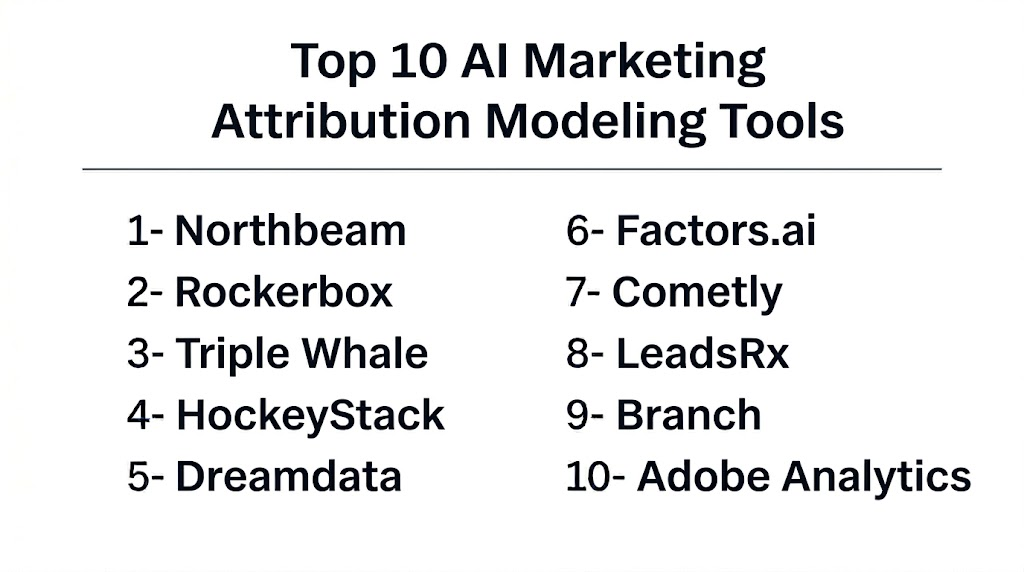
Top 10 AI Marketing Attribution Modeling Tools
1- Whatagraph
2- Rockerbox
3- Triple Whale
4- HockeyStack
5- Dreamdata
6- Factors.ai
7- Cometly
8- LeadsRx
9- Branch
10- Adobe Analytics
1- Whatagraph
One Line Verdict
A powerful marketing intelligence platform that unifies cross-channel data into automated, AI-ready reports for performance-driven teams.
Short Description
Whatagraph centralizes marketing data from 45+ sources into a “Unified Data Hub,” creating a single source of truth for cross-channel performance. It enables marketers to monitor customer journeys and build interactive dashboards without code, simplifying attribution through clean metrics and a governed semantic layer.
Standout Capabilities
- Unified Data Hub for automated multi-source data centralization.
- 45+ native connectors with no-code data blending and transformations.
- Real-time dashboards with automated white-label delivery and KPI monitoring.
AI-Specific Depth
Whatagraph organizes fragmented data into a structured semantic layer, making it “AI-ready” for predictive modeling and integration with automated analysis agents like Whatagraph IQ.
Pros
- Exceptionally intuitive interface with fast, no-code setup and time-to-value.
- Visually consistent automated reporting and high-quality client dashboards.
Cons
- Entry-level pricing can be a barrier for very small agencies or individual users.
- Less flexible for users requiring complex SQL-level data manipulation.
Security and Compliance
SOC 2 Type II and GDPR compliant.
Deployment and Platforms
Cloud-based SaaS.
Integrations and Ecosystem
Native support for Google Ads, Meta, LinkedIn, Shopify, and BigQuery.
Pricing and Tiers
Plans start from $249/month with a 14-day free trial available at whatagraph.com.
2- Rockerbox
One Line Verdict
Rockerbox is a strong unified measurement platform for brands that need multi-touch attribution, marketing mix modeling, and incrementality measurement together.
Short Description
Rockerbox helps marketing teams measure performance across digital, offline, and complex customer journeys. It combines attribution, marketing mix modeling, and incrementality testing to help teams understand what is actually driving results. It is especially useful for brands that advertise across many channels and want a more complete view than single-touch attribution.
Standout Capabilities
- Multi-touch attribution
- Marketing mix modeling support
- Incrementality measurement
- Offline and digital channel coverage
- Customer journey reporting
- Media spend analysis
- Unified measurement workflow
AI-Specific Depth
Rockerbox uses modeling to help marketers separate correlation from real contribution. Its AI and analytics depth is valuable when teams need to understand how channels work together, how offline and digital media influence outcomes, and where incremental value is being created.
Pros
- Strong unified measurement approach
- Useful for complex channel mixes
- Supports attribution plus incrementality
- Good fit for mature marketing teams
Cons
- May require data maturity
- Setup can be more involved than simple analytics tools
- Smaller teams may not need all features
- Best results depend on clean campaign data
Security and Compliance
Not publicly stated for every package. Buyers should verify data privacy, access permissions, retention policies, and compliance needs.
Deployment and Platforms
Cloud-based marketing measurement platform.
Integrations and Ecosystem
Rockerbox works well for teams connecting paid media, ecommerce, CRM, offline media, and analytics sources. It is useful when marketers need a single measurement layer across many channels.
Pricing Model
Varies / N/A
Best Fit Scenarios
- Unified marketing measurement
- Multi-channel budget planning
- Incrementality testing
- Offline plus digital attribution
- Mature performance marketing teams
3- Triple Whale
One Line Verdict
Triple Whale is a practical choice for ecommerce brands that want attribution, customer analytics, ecommerce reporting, and AI-assisted insights in one platform.
Short Description
Triple Whale is widely used by ecommerce and direct-to-consumer brands to connect ad spend, store revenue, customer behavior, and performance reporting. It helps teams understand which campaigns and channels are driving sales while also giving a broader view of ecommerce metrics. It is especially useful for Shopify-focused teams and brands that want daily visibility into marketing performance.
Standout Capabilities
- Ecommerce attribution
- Marketing performance dashboards
- Customer and revenue analytics
- Ad platform reporting
- AI-assisted insights
- Store performance visibility
- Useful for DTC brands
AI-Specific Depth
Triple Whale uses analytics and AI-assisted reporting to help ecommerce teams understand performance trends and marketing contribution. Its value is strongest when teams need a combined view of store revenue, ad spend, channel performance, and customer behavior.
Pros
- Strong ecommerce focus
- Useful for daily performance reporting
- Good for DTC and Shopify-style workflows
- Combines attribution with business metrics
Cons
- Less suited for complex B2B sales cycles
- Best fit depends on ecommerce stack
- Attribution still requires clean tracking
- Some advanced needs may require additional tools
Security and Compliance
Not publicly stated for every plan. Buyers should verify data handling, store permissions, access controls, and privacy requirements.
Deployment and Platforms
Cloud-based ecommerce analytics and attribution platform.
Integrations and Ecosystem
Triple Whale fits into ecommerce, ad platform, store analytics, and performance marketing workflows. It is especially useful for teams that want marketing and revenue reporting in one place.
Pricing Model
Varies / N/A
Best Fit Scenarios
- Ecommerce attribution
- DTC growth teams
- Shopify performance reporting
- Paid media budget decisions
- Store revenue analytics
4- HockeyStack
One Line Verdict
HockeyStack is a strong choice for B2B SaaS teams that need marketing attribution, account analytics, buyer journey visibility, and revenue intelligence.
Short Description
HockeyStack helps B2B companies connect marketing activity to pipeline, revenue, accounts, and buyer journeys. It is useful for teams that need to understand how website visits, content, ads, campaigns, sales touchpoints, and account activity influence revenue outcomes. It is especially relevant for SaaS companies with longer sales cycles and multiple stakeholders.
Standout Capabilities
- B2B marketing attribution
- Account journey analytics
- Pipeline and revenue reporting
- Website visitor and campaign tracking
- Buyer journey visibility
- Revenue team dashboards
- AI-assisted insights for go-to-market teams
AI-Specific Depth
HockeyStack uses AI and analytics to help B2B teams interpret account-level behavior and campaign influence. Its value is strongest when marketing teams need to explain how demand generation, content, paid media, and account engagement contribute to sales pipeline.
Pros
- Strong B2B SaaS fit
- Useful for account-based marketing
- Connects marketing to pipeline and revenue
- Helps analyze long buyer journeys
Cons
- Less focused on ecommerce attribution
- Requires CRM and campaign data discipline
- May need setup support for best results
- Small teams with short sales cycles may not need full depth
Security and Compliance
Not publicly stated for every plan. Buyers should verify CRM access, data security, user permissions, and privacy requirements.
Deployment and Platforms
Cloud-based B2B analytics and attribution platform.
Integrations and Ecosystem
HockeyStack fits into SaaS marketing, sales, CRM, website analytics, paid media, and account-based marketing workflows. It is useful for revenue teams that need marketing-to-pipeline visibility.
Pricing Model
Varies / N/A
Best Fit Scenarios
- B2B SaaS attribution
- Account-based marketing analytics
- Pipeline influence reporting
- Long sales cycle analysis
- Revenue team dashboards
5- Dreamdata
One Line Verdict
Dreamdata is best for B2B revenue teams that need multi-touch attribution across accounts, pipeline, and long customer journeys.
Short Description
Dreamdata helps B2B companies connect marketing, sales, website, and CRM data to understand how buyers move through the funnel. It is designed for long B2B sales cycles where multiple contacts, multiple sessions, and multiple campaigns influence a deal. The platform helps teams measure marketing impact on pipeline, revenue, and account progression.
Standout Capabilities
- B2B multi-touch attribution
- Account-based journey tracking
- Pipeline and revenue analytics
- CRM and marketing data unification
- Buyer journey visualization
- Campaign influence reporting
- Go-to-market performance insights
AI-Specific Depth
Dreamdata’s AI and analytics value comes from connecting fragmented B2B touchpoints into a clearer buyer journey. It helps teams understand how different channels influence accounts and opportunities across long sales cycles, where last-click attribution is usually misleading.
Pros
- Strong B2B attribution focus
- Useful for complex buyer journeys
- Good for revenue and demand generation teams
- Helps connect marketing to pipeline
Cons
- Less suitable for simple ecommerce reporting
- Requires good CRM hygiene
- Attribution setup may take time
- Best value comes with enough pipeline data
Security and Compliance
Not publicly stated for every plan. Buyers should confirm CRM data handling, access control, privacy, and enterprise security requirements.
Deployment and Platforms
Cloud-based B2B attribution and revenue analytics platform.
Integrations and Ecosystem
Dreamdata fits into B2B marketing, CRM, sales, demand generation, account-based marketing, and revenue operations workflows.
Pricing Model
Varies / N/A
Best Fit Scenarios
- B2B SaaS revenue attribution
- Long sales cycle analysis
- Account-level journey tracking
- Marketing-sourced pipeline reporting
- Demand generation measurement
6- Factors.ai
One Line Verdict
Factors.ai is a strong option for B2B teams that need marketing attribution, account intelligence, visitor identification, and funnel analytics.
Short Description
Factors.ai helps B2B marketing and revenue teams understand website visitors, account journeys, campaign influence, and funnel performance. It is useful for teams that want to connect anonymous traffic, account engagement, campaign activity, and pipeline signals. It supports attribution use cases where teams need better visibility into which channels and campaigns influence accounts before conversion.
Standout Capabilities
- B2B marketing attribution
- Account intelligence
- Website visitor analytics
- Funnel analysis
- Campaign influence tracking
- Account-based marketing insights
- Revenue team reporting
AI-Specific Depth
Factors.ai uses analytics and intelligence to help teams identify account behavior and marketing influence. Its AI value is strongest for B2B teams that need to connect website activity, campaign data, and account-level signals into actionable insights.
Pros
- Strong for B2B funnel visibility
- Useful for account-based marketing
- Helps identify high-intent accounts
- Good fit for demand generation teams
Cons
- Less relevant for consumer ecommerce
- Requires clean campaign and CRM setup
- Some advanced workflows may need configuration
- Attribution accuracy depends on data quality
Security and Compliance
Not publicly stated for every package. Buyers should verify data handling, access controls, and privacy requirements.
Deployment and Platforms
Cloud-based B2B marketing analytics and attribution platform.
Integrations and Ecosystem
Factors.ai fits into B2B marketing, website analytics, CRM, advertising, and account intelligence workflows. It is useful for teams focused on pipeline generation and account engagement.
Pricing Model
Varies / N/A
Best Fit Scenarios
- B2B website attribution
- Account-based marketing
- Visitor identification workflows
- Funnel analytics
- Demand generation reporting
7- Cometly
One Line Verdict
Cometly is a practical attribution platform for marketers who need multi-touch tracking, server-side attribution, and campaign performance clarity.
Short Description
Cometly helps marketers track conversions, analyze campaigns, and understand which channels and ads drive results. It is useful for teams running multi-channel campaigns across paid social, paid search, email, and other acquisition channels. Cometly focuses on improving attribution accuracy and helping marketers optimize campaigns based on better conversion data.
Standout Capabilities
- Multi-touch attribution
- Server-side tracking support
- Campaign performance tracking
- Conversion journey visibility
- Ad platform reporting
- Revenue attribution support
- Useful for paid media teams
AI-Specific Depth
Cometly uses attribution modeling and campaign analytics to help teams understand where conversions originate and which touchpoints matter. Its AI and automation value is strongest for marketers who need clearer conversion tracking than ad platform dashboards alone provide.
Pros
- Practical for paid campaign tracking
- Useful server-side tracking orientation
- Helps improve attribution visibility
- Good for performance marketers
Cons
- Best results require clean tracking setup
- May not be as broad as enterprise measurement suites
- Less focused on offline media
- Attribution still requires disciplined campaign naming
Security and Compliance
Not publicly stated for every plan. Buyers should verify tracking data handling, platform permissions, privacy practices, and security controls.
Deployment and Platforms
Cloud-based attribution and campaign tracking platform.
Integrations and Ecosystem
Cometly fits into paid media, lead generation, ecommerce, and campaign tracking workflows. It is useful for marketers who need better visibility into conversion sources.
Pricing Model
Varies / N/A
Best Fit Scenarios
- Paid media attribution
- Conversion tracking improvement
- Multi-channel campaign reporting
- Server-side tracking workflows
- Lead generation campaign analysis
8- LeadsRx
One Line Verdict
LeadsRx is a useful attribution platform for marketers that need multi-touch attribution across digital, broadcast, audio, and offline campaign channels.
Short Description
LeadsRx helps marketers understand customer journeys across multiple marketing channels, including digital and offline media. It is useful for teams running paid search, social, display, radio, podcast, TV, email, and other channels that influence conversions. The platform helps marketers see how different touchpoints contribute to customer acquisition.
Standout Capabilities
- Multi-touch attribution
- Digital and offline channel support
- Customer journey analytics
- Campaign performance reporting
- Broadcast and audio attribution support
- Conversion path visibility
- Useful for media-heavy advertisers
AI-Specific Depth
LeadsRx uses attribution modeling and analytics to help teams connect fragmented channel activity with conversion outcomes. Its value is strongest for marketers that need visibility beyond simple digital last-click measurement.
Pros
- Good multi-channel attribution coverage
- Useful for offline and media campaigns
- Helps visualize customer journeys
- Strong fit for advertisers using many channels
Cons
- May require setup and tracking discipline
- Not as ecommerce-specific as some newer tools
- Best value depends on channel complexity
- Public AI-specific details may vary
Security and Compliance
Not publicly stated for every plan. Buyers should validate data processing, access control, privacy, and compliance requirements.
Deployment and Platforms
Cloud-based attribution and analytics platform.
Integrations and Ecosystem
LeadsRx fits into media attribution, campaign analytics, digital advertising, broadcast measurement, and customer journey reporting workflows.
Pricing Model
Varies / N/A
Best Fit Scenarios
- Broadcast attribution
- Podcast and audio campaign measurement
- Multi-channel advertising
- Customer journey analytics
- Media-heavy marketing teams
9- Branch
One Line Verdict
Branch is best for mobile-first companies that need attribution, deep linking, app measurement, and cross-platform customer journey tracking.
Short Description
Branch helps mobile apps and digital businesses measure user acquisition, app installs, engagement, deep links, and campaign performance. It is especially useful for mobile-first brands that need to connect web, app, ads, referrals, and user journeys. For attribution modeling, Branch is valuable when mobile app journeys and cross-device experiences are central to the business.
Standout Capabilities
- Mobile attribution
- Deep linking support
- App install measurement
- Cross-platform journey tracking
- Referral and campaign attribution
- Mobile growth analytics
- Useful for app marketers
AI-Specific Depth
Branch’s intelligence value comes from connecting mobile journeys across fragmented devices and channels. It helps app marketers understand where users come from, how they convert, and which campaigns influence app engagement.
Pros
- Strong mobile attribution focus
- Useful for app install and engagement tracking
- Supports deep linking workflows
- Good for mobile growth teams
Cons
- Less relevant for non-mobile businesses
- Requires technical setup
- Attribution depends on app and web tracking quality
- May need additional tools for broader marketing mix modeling
Security and Compliance
Not publicly stated for every deployment. Buyers should verify privacy, data handling, mobile attribution rules, and security controls.
Deployment and Platforms
Cloud-based mobile measurement and deep linking platform.
Integrations and Ecosystem
Branch fits into mobile app marketing, paid user acquisition, referral campaigns, app analytics, and cross-platform customer journey workflows.
Pricing Model
Varies / N/A
Best Fit Scenarios
- Mobile app attribution
- App install measurement
- Deep linking campaigns
- Referral tracking
- Cross-device user journeys
10- Adobe Analytics
One Line Verdict
Adobe Analytics is a strong enterprise analytics platform for teams that need advanced customer journey reporting, attribution models, segmentation, and cross-channel insights.
Short Description
Adobe Analytics helps enterprises measure digital customer journeys, segment audiences, analyze behavior, and understand marketing performance across channels. It is not only an attribution tool, but it includes attribution modeling and advanced analytics capabilities that can support enterprise marketing measurement. It is useful for organizations already using Adobe Experience Cloud or managing complex digital properties.
Standout Capabilities
- Advanced analytics and segmentation
- Attribution modeling support
- Customer journey reporting
- Cross-channel analysis
- Enterprise dashboarding
- Audience and behavior insights
- Adobe ecosystem integration
AI-Specific Depth
Adobe Analytics includes intelligent analytics capabilities that help teams explore performance patterns, segments, journeys, and attribution views. Its value is strongest when enterprises need flexible analysis across large datasets and complex digital experiences.
Pros
- Strong enterprise analytics platform
- Flexible attribution and segmentation
- Good for complex digital journeys
- Fits well into Adobe Experience Cloud
Cons
- May be complex for smaller teams
- Requires analytics expertise
- Implementation can be resource-heavy
- Not a lightweight plug-and-play attribution tool
Security and Compliance
Security and compliance capabilities vary by enterprise configuration. Buyers should verify data governance, access control, privacy, and compliance needs directly.
Deployment and Platforms
Cloud-based enterprise analytics platform.
Integrations and Ecosystem
Adobe Analytics fits into enterprise analytics, customer experience, personalization, marketing reporting, and Adobe Experience Cloud workflows.
Pricing Model
Varies / N/A
Best Fit Scenarios
- Enterprise customer journey analytics
- Advanced segmentation
- Cross-channel attribution
- Adobe ecosystem users
- Large digital experience teams
Comparison Table
| Tool | Best For | Main Attribution Focus | Deployment | Standout Feature | Best Fit Team |
|---|---|---|---|---|---|
| Whatagraph | Ecommerce and DTC brands | Revenue attribution and paid media measurement | Cloud | First-party performance insights | Ecommerce growth teams |
| Rockerbox | Unified measurement | MTA, MMM, and incrementality | Cloud | Full-funnel measurement mix | Mature marketing teams |
| Triple Whale | Ecommerce analytics | Store revenue and marketing attribution | Cloud | Ecommerce performance dashboard | DTC brands |
| HockeyStack | B2B SaaS attribution | Pipeline, account, and journey analytics | Cloud | Account-level revenue insights | B2B revenue teams |
| Dreamdata | B2B buyer journeys | Multi-touch revenue attribution | Cloud | Long sales cycle attribution | SaaS demand teams |
| Factors.ai | B2B funnel analytics | Account intelligence and campaign influence | Cloud | Website and account journey insights | ABM teams |
| Cometly | Paid campaign attribution | Multi-touch and server-side tracking | Cloud | Conversion tracking clarity | Performance marketers |
| LeadsRx | Multi-channel media attribution | Digital and offline journey tracking | Cloud | Broadcast and offline attribution | Media-heavy advertisers |
| Branch | Mobile attribution | App installs, deep links, mobile journeys | Cloud | Mobile-first attribution | App growth teams |
| Adobe Analytics | Enterprise analytics | Attribution and journey analysis | Cloud | Advanced segmentation and reporting | Enterprise analytics teams |
Scoring and Evaluation Table
| Tool | Attribution Depth | AI and Modeling | Ease of Use | Integrations | Revenue Reporting | Journey Analytics | Value | Weighted Total |
|---|---|---|---|---|---|---|---|---|
| Northbeam | 9 | 9 | 7 | 8 | 9 | 8 | 7 | 8.2 |
| Rockerbox | 9 | 9 | 7 | 8 | 9 | 8 | 7 | 8.1 |
| Triple Whale | 8 | 8 | 9 | 8 | 9 | 7 | 8 | 8.1 |
| HockeyStack | 8 | 8 | 8 | 8 | 9 | 9 | 8 | 8.2 |
| Dreamdata | 9 | 8 | 7 | 8 | 9 | 9 | 7 | 8.1 |
| Factors.ai | 8 | 8 | 8 | 8 | 8 | 8 | 8 | 8.0 |
| Cometly | 8 | 7 | 8 | 8 | 8 | 7 | 8 | 7.7 |
| LeadsRx | 8 | 7 | 7 | 7 | 7 | 8 | 7 | 7.3 |
| Branch | 9 | 7 | 7 | 9 | 7 | 8 | 7 | 7.7 |
| Adobe Analytics | 8 | 8 | 6 | 9 | 8 | 9 | 6 | 7.8 |
Score Interpretation
- 8.0 and above: Strong fit for serious marketing attribution and revenue measurement
- 7.0 to 7.9: Good fit for specific attribution, analytics, or channel-focused use cases
- Below 7.0: Useful for lighter or narrower attribution needs
Top 3 Recommendations
Best for Enterprise
1- Adobe Analytics
2- Rockerbox
3- Northbeam
Enterprise teams usually need advanced analytics, strong integrations, data governance, segmentation, cross-channel reporting, and scalable measurement. These tools are better suited for larger data environments and more mature marketing operations.
Best for SMB
1- Triple Whale
2- Cometly
3- Factors.ai
SMB teams usually need practical dashboards, easy setup, campaign-level clarity, and revenue-focused reporting without excessive complexity. These tools are useful for teams that need faster attribution visibility.
Best for B2B Teams
1- HockeyStack
2- Dreamdata
3- Factors.ai
B2B teams usually need account-level journey tracking, CRM connection, pipeline influence reporting, and long sales cycle attribution. These tools are stronger for SaaS, ABM, and revenue teams.
Which Tool Is Right for You
Choose Northbeam If
You are an ecommerce or direct-to-consumer brand that needs deeper revenue attribution across paid media channels. It is best for growth teams that want to make budget decisions based on customer journey and revenue contribution.
Choose Rockerbox If
You need unified measurement across multi-touch attribution, marketing mix modeling, and incrementality testing. It is ideal for mature marketing teams running both digital and offline campaigns.
Choose Triple Whale If
You run an ecommerce brand and want attribution, store analytics, marketing performance, and revenue reporting in one place. It is especially useful for DTC teams that need daily performance visibility.
Choose HockeyStack If
You are a B2B SaaS company that needs to connect marketing activity to accounts, pipeline, and revenue. It is strong for revenue teams that want buyer journey analytics and campaign influence reporting.
Choose Dreamdata If
You need B2B multi-touch attribution across long sales cycles. It is useful for demand generation teams that want to understand how content, campaigns, and sales touchpoints influence closed revenue.
Choose Factors.ai If
You want account intelligence, website visitor insights, and campaign influence tracking for B2B marketing. It is a good choice for teams focused on ABM and funnel analytics.
Choose Cometly If
You need practical campaign attribution, server-side tracking, and clearer conversion reporting for paid media. It is useful for marketers who want better visibility than ad platform dashboards provide.
Choose LeadsRx If
You advertise across digital and offline channels such as radio, podcasts, TV, email, and paid media. It is useful for teams that need broader journey tracking across media touchpoints.
Choose Branch If
You are a mobile-first company that needs app attribution, deep linking, install measurement, and cross-platform user journey tracking.
Choose Adobe Analytics If
You are an enterprise team that needs advanced analytics, customer journey reporting, segmentation, attribution modeling, and integration with a broader customer experience stack.
Implementation Playbook 30 60 90 Days
First 30 Days
- Define your attribution goals clearly
- Audit all current campaign tracking
- Standardize UTM naming rules
- Identify key conversion events
- Connect ad platforms, CRM, ecommerce, and analytics tools
- Compare current reporting with attribution tool output
- Create baseline reports for channel performance
Next 60 Days
- Test multiple attribution models
- Compare first-touch, last-touch, linear, and multi-touch views
- Build revenue dashboards for marketing and leadership
- Identify channels that are over-credited or under-credited
- Review customer journey paths before conversion
- Train marketing teams on attribution interpretation
- Start using attribution data in budget review meetings
Next 90 Days
- Add incrementality testing where possible
- Combine attribution data with customer lifetime value
- Build budget allocation recommendations
- Create reporting for campaign, channel, creative, and funnel performance
- Review attribution gaps caused by privacy limits or missing data
- Document the official attribution model for internal reporting
- Scale attribution insights into campaign planning and quarterly strategy
Common Mistakes to Avoid
Depending Only on Last-Click Attribution
Last-click attribution often overvalues bottom-funnel channels and undervalues awareness, content, social, and nurture touchpoints. Teams should compare multiple models before making budget decisions.
Ignoring Data Quality
Attribution tools cannot fix messy tracking. Poor UTM naming, broken pixels, disconnected CRM fields, duplicate leads, and missing revenue data can create misleading reports.
Treating Attribution as Absolute Truth
Attribution is a model, not perfect truth. It helps guide decisions, but teams should combine it with incrementality, customer research, sales feedback, and business judgment.
Forgetting Offline and Dark Funnel Influence
Not every touchpoint is trackable. Word of mouth, community engagement, brand awareness, podcasts, events, and referrals may influence conversions without appearing clearly in reports.
Changing Budget Too Quickly
Attribution insights should guide decisions, but sudden budget cuts can disrupt learning. Teams should validate patterns over time before making major spend changes.
Not Aligning Sales and Marketing Data
For B2B companies, attribution is weak without CRM hygiene. Marketing, sales, and revenue operations teams need aligned definitions for leads, opportunities, pipeline, and revenue.
Overcomplicating the Model
More complex attribution does not always mean better decisions. Teams should use models that are understandable, explainable, and connected to real business goals.
Frequently Asked Questions
1- What are AI Marketing Attribution Modeling Tools?
AI Marketing Attribution Modeling Tools help marketers understand which channels, campaigns, ads, and touchpoints contribute to conversions and revenue. They use attribution models, journey analytics, first-party data, and AI insights to show how marketing activity influences business outcomes. These tools help teams make better budget and campaign decisions.
2- What is multi-touch attribution?
Multi-touch attribution assigns credit to multiple touchpoints in the customer journey instead of giving all credit to the first or last interaction. For example, a customer may click a social ad, read a blog, open an email, and later convert through paid search. Multi-touch attribution helps teams understand the contribution of each step.
3- What is the difference between attribution and marketing mix modeling?
Attribution usually looks at user-level or journey-level touchpoints, while marketing mix modeling looks at broader channel-level impact over time. Attribution is useful for digital journey analysis, while marketing mix modeling is useful for understanding media spend, seasonality, offline influence, and channel-level contribution.
4- Which attribution tool is best for ecommerce?
Northbeam and Triple Whale are strong choices for ecommerce brands. Northbeam is useful for deeper paid media attribution and revenue modeling, while Triple Whale is practical for ecommerce dashboards, store analytics, and daily performance reporting.
5- Which attribution tool is best for B2B SaaS?
HockeyStack, Dreamdata, and Factors.ai are strong choices for B2B SaaS teams. They focus on account journeys, CRM data, pipeline influence, long sales cycles, and revenue attribution rather than only ecommerce purchases.
6- Can attribution tools prove true marketing impact?
Attribution tools can show likely contribution and journey influence, but they do not always prove true incremental impact. For stronger proof, teams should combine attribution with incrementality testing, controlled experiments, marketing mix modeling, and business outcome analysis.
7- Why do attribution reports differ from ad platform reports?
Ad platforms often use their own attribution windows and may claim credit for conversions influenced by their ads. Independent attribution tools try to unify data across channels, reduce duplicate credit, and connect campaigns to business revenue. Differences are normal because each system uses different rules.
8- Do small businesses need attribution tools?
Small businesses need attribution tools when they run multiple campaigns, spend across several channels, and want to know which efforts generate real leads or sales. Very early-stage teams may start with basic analytics, but attribution becomes more important as spend and channel complexity grow.
9- What data is needed for attribution modeling?
Teams need clean campaign tracking, UTM parameters, conversion events, CRM or ecommerce data, ad spend data, revenue data, and ideally first-party customer journey data. Better data quality leads to more useful attribution insights.
10- How do I choose the right attribution tool?
Start by identifying your business model. Ecommerce brands should consider Northbeam, Triple Whale, or Cometly. B2B SaaS teams should consider HockeyStack, Dreamdata, or Factors.ai. Enterprises should consider Rockerbox or Adobe Analytics. Mobile-first businesses should consider Branch. Choose based on data sources, sales cycle, channel mix, reporting needs, and budget.
Conclusion
AI Marketing Attribution Modeling Tools help teams understand which campaigns and channels truly influence revenue, pipeline, and customer acquisition. Northbeam and Triple Whale are strong options for ecommerce and direct-to-consumer brands, while HockeyStack, Dreamdata, and Factors.ai are better suited for B2B SaaS and account-based marketing teams. Rockerbox is powerful for unified measurement with attribution, marketing mix modeling, and incrementality, while Adobe Analytics is a strong enterprise analytics option. Cometly is practical for paid media tracking, LeadsRx supports broader media attribution, and Branch is ideal for mobile-first businesses. The best results come from clean tracking, aligned revenue data, clear attribution rules, and a realistic understanding that attribution is a decision-support model, not perfect truth. Start with better tracking, test multiple models, validate findings with business outcomes, and use attribution insights to improve budget allocation and marketing performance.

Find Trusted Cardiac Hospitals
Compare heart hospitals by city and services — all in one place.
Explore Hospitals
Great comparison of AI marketing attribution tools—very useful for understanding how different platforms measure customer journeys and ROI across channels.