
Introduction
AI bioprocess control systems help biopharma and industrial biotech teams monitor, predict, and optimize upstream and downstream operations using artificial intelligence, machine learning, soft sensors, and advanced automation. Instead of depending only on static control loops, offline sampling, and manual process adjustment, these systems combine real time sensor data, historical process records, and predictive models to guide better control decisions across fermentation, cell culture, purification, and related workflows. This matters because modern bioprocesses are complex, highly variable, and tightly constrained by yield, quality, cost, and regulatory expectations. Real world use cases include AI guided feed control, bioreactor state estimation, digital twin based process simulation, predictive maintenance, real time deviation detection, and continuous process optimization. Buyers should evaluate these systems based on sensor and PAT integration, control robustness, model explainability, support for batch and continuous modes, validation readiness, human oversight, integration with MES and historians, and deployment flexibility.
These tools are best for biopharma manufacturers, CDMOs, process development teams, advanced therapy manufacturing groups, and industrial biotech operations that need tighter process control or faster scale up learning. They are especially useful in environments where data volumes are large, deviations are costly, and product quality depends on managing multivariable nonlinear processes in real time. They are less ideal for very small labs with limited digital infrastructure or minimal online sensing, where foundational automation and data capture may still need to come first.
Why it matters
Traditional bioprocess control strategies depend heavily on simplified mechanistic models, fixed control loops, and manual interventions whenever processes drift outside expected ranges. As cell lines, media formulations, and process intensification strategies get more complex, these approaches struggle to keep up with variability and to use the full richness of available sensor and historical data. AI changes this by learning patterns across multivariate time series, enabling real time state estimation, early deviation detection, and optimized control moves that can maintain productivity and quality more consistently. In 2026, this category matters more because Bioprocessing 4.0 concepts and self-driving lab ideas are moving from theory into serious pilot projects, supported by better sensors, cheaper compute, and a growing body of work on AI-guided process control, digital twins, and multivariate control models in biomanufacturing.
Real world use cases
A common use case is AI-guided feed control, where machine learning models use real time bioreactor signals and soft sensors to infer cell growth and metabolite levels, then adjust feed rates to maximize productivity and avoid toxic byproduct accumulation. Another is continuous bioprocess control, where AI monitors critical quality attributes in near real time and tunes process parameters in perfusion or continuous downstream operations to maintain steady state performance. AI bioprocess control systems are also applied to develop digital twins for process development, allowing teams to simulate parameter changes before running expensive experiments, and to predictive maintenance, where models forecast equipment degradation and suggest service before failures impact batches. In more advanced setups, AI frameworks combine soft sensors, multivariate control, and historical campaign data to support “self-driving” bioreactor concepts in which the system proposes or implements optimal control trajectories under human supervision.
Evaluation criteria for buyers
When evaluating AI bioprocess control systems, buyers should first assess how well the platform integrates with existing sensors, PAT tools, historians, DCS/MES, and data stores, because fragmented data will limit model performance. The next priority is model and control robustness: how the system handles noisy signals, missing data, process drifts, and scale-up differences between development and manufacturing. Buyers should also examine explainability and validation practices, including how models are trained, tested, versioned, and documented in ways that support regulatory expectations for GMP manufacturing. Governance and human-in-the-loop controls are critical, so teams should confirm how operators approve, override, or audit AI-driven control actions. Finally, decision makers should review deployment options, cybersecurity posture, vendor support for continuous improvement, and whether the system can support both upstream and downstream use cases over time, not just a single unit operation.
What Is Changing in This Category
- Bioprocess control is moving from reactive correction to predictive and adaptive optimization.
- Digital twins are becoming a practical layer for process control strategy development and scenario testing.
- AI is increasingly used for soft sensors and hidden state estimation when direct measurements are difficult or delayed.
- Continuous bioprocessing is pushing demand for more automated multivariate control strategies.
- Real time monitoring is becoming more valuable as PAT and IIoT data become easier to collect.
- Bioprocessing 4.0 ideas are pushing smarter automation across development and manufacturing.
- Self driving lab concepts are expanding from experimentation into process development and control workflows.
- Buyers now care more about integrating AI with existing MES, DCS, and plant systems instead of standalone analytics.
- Process control conversations increasingly include quality risk, not just yield optimization.
- Regulatory and operational trust still depend on explainability, validation, and human review.
Quick Buyer Checklist
- Check whether the platform supports your exact process type, such as fed batch, perfusion, fermentation, or downstream purification.
- Ask how it integrates with online sensors, PAT tools, historians, MES, DCS, and automation systems.
- Confirm whether the system supports soft sensors, digital twins, predictive analytics, or closed loop control.
- Review how well it handles noisy data, scale up differences, and process drift.
- Ask how control recommendations are explained and validated for GMP use.
- Check whether operators can review, approve, or override AI driven actions.
- Evaluate support for both upstream and downstream optimization if you need broad coverage.
- Review deployment options such as cloud, on premises, or hybrid industrial setups.
- Ask how the vendor handles model retraining, version control, and lifecycle governance.
- Pilot on one real control bottleneck before planning plant wide rollout.
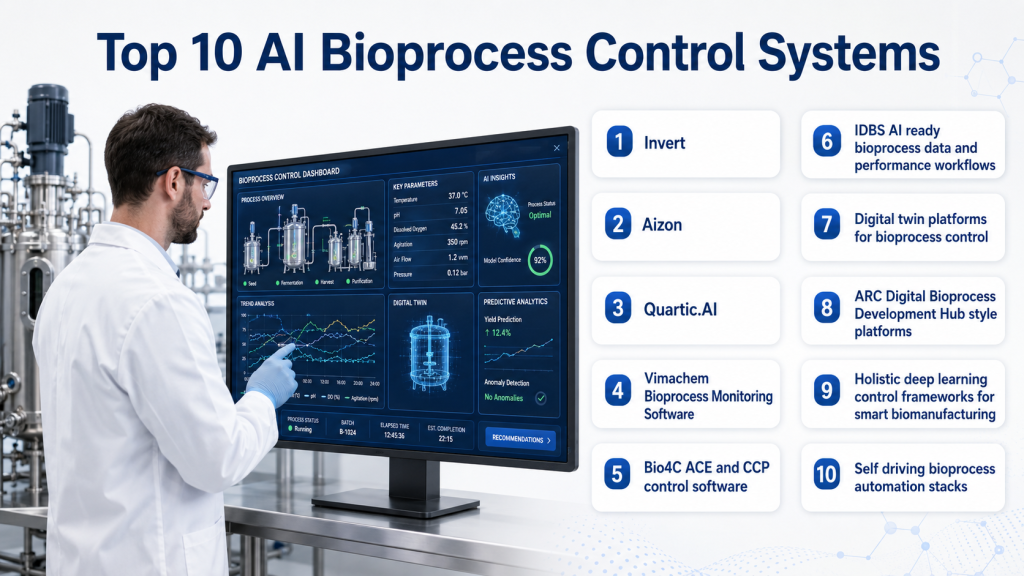
Top 10 AI Bioprocess Control Systems
1. Invert
One line verdict: Best for bioprocess teams that want purpose built AI software for optimization and manufacturing learning loops.
Short description:
Invert is positioned as a purpose built AI bioprocess optimization platform for pharmaceutical manufacturing. It is designed for teams that want to use production and development data to improve yield, process understanding, and decision making without relying only on manual analysis.
Standout Capabilities
- Purpose built AI software for bioprocess optimization.
- Focus on pharmaceutical manufacturing use cases.
- Helps connect process data with actionable optimization insights.
- Relevant for both development and operational improvement loops.
- Strong category fit as a specialized AI bioprocess platform.
AI Specific Depth
- Model support: Proprietary AI platform, exact model flexibility not publicly stated in reviewed material.
- Knowledge integration: Bioprocess manufacturing data context is public, broader connector details not publicly stated.
- Evaluation: Public positioning emphasizes better process optimization, but detailed benchmark methods are not publicly stated.
- Guardrails: Not publicly stated in reviewed material.
- Observability: Not publicly stated in reviewed material.
Pros
- Highly focused on bioprocess use cases.
- Strong fit for manufacturing oriented optimization.
- More specialized than generic analytics tools.
Cons
- Public technical detail is limited.
- Security and deployment specifics were not verified in reviewed material.
- Buyers should validate closed loop control depth versus optimization support.
Security and Compliance
Not publicly stated in the reviewed material for this comparison.
Deployment and Platforms
Not publicly stated in the reviewed material.
Integrations and Ecosystem
Invert appears strongest as a specialized AI software layer for bioprocess improvement. Buyers should confirm how it connects with plant systems, historians, and lab development datasets.
- Bioprocess optimization focus.
- Pharmaceutical manufacturing relevance.
- Data driven process improvement.
- Specialized platform positioning.
Pricing Model
Best Fit Scenarios
- Bioprocess teams wanting purpose built AI.
- Manufacturing organizations seeking faster process learning.
- CDMOs or biopharma groups optimizing yield and control.
2. Aizon
One line verdict: Best for GxP oriented biopharma teams needing AI driven bioreactor intelligence and manufacturing analytics.
Short description:
Aizon is presented in reviewed industry coverage as a GxP compliant bioreactor intelligence platform. It is most relevant for teams that need predictive analytics and manufacturing visibility in regulated biopharma environments.
Standout Capabilities
- GxP compliant bioreactor intelligence positioning.
- Strong fit for regulated biopharma operations.
- Relevant for manufacturing monitoring and analysis.
- Useful where quality and compliance matter as much as optimization.
- Good category fit for production focused bioreactor analytics.
AI Specific Depth
- Model support: Proprietary AI platform, detailed model flexibility not publicly stated in reviewed material.
- Knowledge integration: Bioreactor intelligence context is public, exact connector details are not publicly stated here.
- Evaluation: Public market positioning exists, but formal benchmark detail was not publicly stated in reviewed material.
- Guardrails: GxP oriented positioning suggests structured governance, but exact AI guardrails are not publicly stated.
- Observability: Not publicly stated in detail in reviewed material.
Pros
- Strong fit for regulated manufacturing settings.
- Good relevance for bioreactor centered operations.
- Public positioning aligns with compliance conscious buyers.
Cons
- Public feature transparency is limited in reviewed material.
- Exact deployment architecture was not publicly verified here.
- Buyers should confirm how much is bioreactor intelligence versus broader control.
Security and Compliance
GxP compliant positioning is publicly referenced in reviewed material, but detailed certifications and control features were not publicly verified here.
Deployment and Platforms
Not publicly stated in the reviewed material for this comparison.
Integrations and Ecosystem
Aizon appears compelling for regulated manufacturing teams, but buyers should verify plant system integrations, data ingestion options, and validation documentation in detail.
- Bioreactor intelligence orientation.
- GxP relevant positioning.
- Manufacturing analytics fit.
- Biopharma process visibility.
Pricing Model
Best Fit Scenarios
- Regulated bioreactor operations.
- Manufacturing analytics in GxP environments.
- Biopharma teams prioritizing compliance aware AI.
3. Quartic.AI
One line verdict: Best for manufacturers connecting legacy operational systems to AI driven operational intelligence.
Short description:
Quartic.AI is described in reviewed material as a platform that connects legacy operational technology with intelligent analytics for real time manufacturing context. It is best suited to organizations that need AI process visibility without replacing their full plant control stack.
Standout Capabilities
- Connects legacy operational technology with AI analytics.
- Provides real time manufacturing context.
- Useful for bridging data silos across plant systems.
- Strong fit for operational intelligence in established manufacturing sites.
- Relevant where modernization must coexist with existing infrastructure.
AI Specific Depth
- Model support: Proprietary analytics platform, exact model flexibility not publicly stated in reviewed material.
- Knowledge integration: Strong OT and manufacturing system connectivity is publicly described.
- Evaluation: Public industry commentary references manufacturing value, but formal benchmark methods are not publicly stated.
- Guardrails: Not publicly stated in reviewed material.
- Observability: Real time manufacturing context is public, deeper ML observability not publicly stated.
Pros
- Strong fit for legacy heavy manufacturing environments.
- Useful bridge between plant data and AI insight.
- Likely practical for sites avoiding rip and replace transformation.
Cons
- Public detail on bioprocess specific control depth is limited.
- Security and compliance specifics were not verified in reviewed material.
- Buyers should validate whether it supports advisory analytics or control loop actioning.
Security and Compliance
Not publicly stated in the reviewed material for this comparison.
Deployment and Platforms
Not publicly stated in the reviewed material.
Integrations and Ecosystem
Quartic.AI is most attractive when bioprocess manufacturers want to add AI context to existing OT systems without rebuilding core automation.
- Legacy OT connectivity.
- Intelligent analytics.
- Real time context.
- Manufacturing modernization support.
Pricing Model
Best Fit Scenarios
- Legacy plant modernization.
- Sites needing AI on top of existing OT.
- Manufacturers prioritizing operational context over full stack replacement.
4. Vimachem Bioprocess Monitoring Software
One line verdict: Best for Pharma 4.0 teams wanting AI and IIoT based monitoring inside MES oriented workflows.
Short description:
Vimachem Bioprocess Monitoring Software is positioned as a Pharma MES layer that uses AI and industrial IoT to monitor, analyze, and extract value from manufacturing process data. It is a good fit for teams prioritizing monitoring, analysis, and digital operations alignment.
Standout Capabilities
- AI and IIoT powered monitoring.
- Built for pharma manufacturing process data.
- Fits inside MES oriented digital operations.
- Strong relevance to Pharma 4.0 initiatives.
- Useful for continuous data driven process insight.
AI Specific Depth
- Model support: AI powered monitoring is publicly stated, exact model flexibility not publicly stated.
- Knowledge integration: Manufacturing process data and MES context are public.
- Evaluation: Public messaging emphasizes monitoring and analysis value, formal benchmark detail not publicly stated.
- Guardrails: Not publicly stated in reviewed material.
- Observability: Process monitoring is central to the product positioning.
Pros
- Strong fit for MES connected manufacturing environments.
- Good for monitoring centric bioprocess digitization.
- Clear Pharma 4.0 alignment.
Cons
- Public detail on closed loop control is limited.
- Security and deployment specifics were not publicly verified here.
- More monitoring focused than some buyers may want if they need direct control actioning.
Security and Compliance
Not publicly stated in the reviewed material for this comparison.
Deployment and Platforms
Not publicly stated in the reviewed material.
Integrations and Ecosystem
Vimachem looks strongest for teams that want AI aware monitoring inside broader MES and digital manufacturing initiatives.
Pricing Model
Best Fit Scenarios
- Pharma 4.0 monitoring programs.
- MES integrated bioprocess environments.
- Sites needing better process visibility and analysis.
5. Bio4C ACE and CCP control software
One line verdict: Best for teams that need secure automation and connectivity across upstream and downstream operations.
Short description:
Bio4C ACE software and Common Control Platform software from Merck’s life science business are presented as automation and control platforms for monitoring and running bioprocess unit operations in manual or automated modes. They are best suited to teams looking for process reproducibility, flexible connectivity, and integrated control infrastructure.
Standout Capabilities
- Controls and monitors bioprocess unit operations.
- Supports manual and automated process modes.
- Flexible connectivity across diverse upstream and downstream systems.
- Strong focus on reproducibility and reduced manual error.
- Reliable data acquisition and reporting.
AI Specific Depth
- Model support: Automation and control software are public, explicit AI model details are not publicly stated in reviewed material.
- Knowledge integration: Strong connectivity across unit operations and systems is publicly stated.
- Evaluation: Public messaging emphasizes reproducibility, uptime, and reduced manual risk.
- Guardrails: Manual or automated operation modes are publicly available, supporting operator control.
- Observability: Monitoring, data acquisition, and reporting are publicly stated.
Pros
- Strong operational control and connectivity story.
- Good for mixed upstream and downstream workflows.
- Useful where reproducibility and data capture matter.
Cons
- Public AI specific depth is limited.
- Buyers wanting advanced predictive AI should verify roadmap and current capability.
- Pricing and detailed deployment specifics were not publicly verified here.
Security and Compliance
The software is described as intuitive and secure, but detailed security controls and certifications were not publicly verified in the reviewed material.
Deployment and Platforms
Not fully publicly stated in the reviewed material for this comparison.
Integrations and Ecosystem
This option is strongest when automation, connectivity, and reliable process execution matter more than purely model driven optimization claims.
Pricing Model
Best Fit Scenarios
- Mixed upstream and downstream operations.
- Teams improving automation and reproducibility.
- Plants needing cross system control connectivity.
6. IDBS AI ready bioprocess data and performance workflows
One line verdict: Best for process development teams building AI ready data foundations for optimization and control.
Short description:
IDBS publicly frames AI in bioprocessing around predictive modeling, optimization, real time monitoring, and AI ready data foundations. It is best suited to organizations that need stronger data readiness and process performance improvement rather than only a narrow runtime control tool.
Standout Capabilities
- Strong focus on AI ready bioprocess data.
- Predictive modeling for culture condition optimization.
- Real time monitoring and process optimization relevance.
- Useful across upstream and downstream process performance discussions.
- Strong fit for process development and data maturity programs.
AI Specific Depth
- Model support: AI and machine learning predictive modeling are publicly described.
- Knowledge integration: Strong use of process data across development and manufacturing contexts.
- Evaluation: Public content emphasizes reduced trial and error, better yields, and improved monitoring.
- Guardrails: Not publicly stated in detail.
- Observability: Real time monitoring and optimization relevance are public.
Pros
- Strong fit for data foundation and process development improvement.
- Useful for teams that are not yet ready for full autonomous control.
- Broad relevance across upstream and downstream process performance.
Cons
- More data and optimization oriented than control room oriented.
- Public deployment specifics were not verified here.
- Buyers should confirm direct operational control features.
Security and Compliance
Not publicly stated in the reviewed material for this comparison.
Deployment and Platforms
Not publicly stated in the reviewed material.
Integrations and Ecosystem
IDBS is most attractive for organizations that want to prepare process data for AI driven optimization and improve process development quality over time.
- Predictive modeling.
- AI ready data foundations.
- Real time monitoring relevance.
- Upstream and downstream performance support.
Pricing Model
Best Fit Scenarios
- Process development teams.
- AI readiness programs in bioprocessing.
- Organizations improving data quality before advanced control rollout.
7. Digital twin platforms for bioprocess control
One line verdict: Best for organizations that want scenario testing, control strategy development, and virtual optimization.
Short description:
Digital twin platforms in bioprocessing are increasingly used to model biological, chemical, and equipment behavior so teams can simulate control strategies before deploying them in real processes. They are ideal for process development, control strategy design, training, and risk reduction.
Standout Capabilities
- Scenario simulation for control strategy development.
- Virtual testing of process changes before plant use.
- Can model yield, quality, and process behavior.
- Useful for both training and optimization.
- Strong fit for advanced smart biomanufacturing programs.
AI Specific Depth
- Model support: Often combines AI, ML, mechanistic modeling, and optimization.
- Knowledge integration: Integrates process mining, machine learning, simulation, and real operational data.
- Evaluation: Public research emphasizes development, implementation, and optimization of control strategies.
- Guardrails: Typically used in advisory and simulation settings before live deployment.
- Observability: Strong for virtual monitoring and scenario analysis.
Pros
- Excellent for reducing wet lab trial and error.
- Useful for risk reduction before control changes.
- Strong strategic fit for advanced process development teams.
Cons
- Not always a turnkey commercial product.
- Requires strong data and modeling maturity.
- Can be harder to operationalize than simpler monitoring tools.
Security and Compliance
Varies by platform and implementation.
Deployment and Platforms
Varies by platform and implementation.
Integrations and Ecosystem
Digital twin platforms work best when connected to process data infrastructure and used as part of broader control and optimization programs rather than as isolated simulations.
- Process mining.
- Machine learning integration.
- Simulation and optimization.
- Control strategy development.
Pricing Model
Varies and is not publicly stated in reviewed material.
Best Fit Scenarios
- Advanced process development.
- Control strategy design and training.
- Smart biomanufacturing transformation programs.
8. ARC Digital Bioprocess Development Hub style platforms
One line verdict: Best for research driven teams exploring end to end AI and digital twin control architectures.
Short description:
The ARC Digital Bioprocess Development Hub publicly describes a digital platform integrating digital twins, virtual models, AI, process mining, and optimization for monitoring, controlling, and improving real world bioprocesses. It is more research and ecosystem oriented than a typical commercial software package, but highly relevant to where the field is heading.
Standout Capabilities
- End to end digital platform vision.
- Integrates digital twins, AI, virtual models, and optimization.
- Supports monitoring, control, and improvement of real bioprocesses.
- Covers cell culture, chromatography, and formulation operations.
- Strong focus on reducing costly wet lab experimentation.
AI Specific Depth
- Model support: Uses ML, AI, process mining, and optimization.
- Knowledge integration: Broad integration across upstream and downstream unit operations.
- Evaluation: Research stream is explicitly designed to implement and evaluate digital twin technology.
- Guardrails: Not publicly stated in detail.
- Observability: Strong emphasis on real time monitoring and predictive methods.
Pros
- Strong vision for next generation control architectures.
- Good for innovation oriented organizations.
- Covers both monitoring and improvement across operations.
Cons
- Not a mainstream packaged commercial product.
- Better for strategic learning than fast operational procurement.
- Requires significant technical maturity.
Security and Compliance
Not publicly stated in the reviewed material.
Deployment and Platforms
Not publicly stated in the reviewed material.
Integrations and Ecosystem
This type of platform matters most for R and D heavy bioprocess organizations and collaborative innovation programs evaluating future control architectures.
- Digital twin integration.
- AI and optimization.
- Cell culture and chromatography relevance.
- Predictive monitoring.
Pricing Model
Best Fit Scenarios
- Research consortia and innovation programs.
- Advanced process architecture exploration.
- Teams evaluating future bioprocess control stacks.
9. Holistic deep learning control frameworks for smart biomanufacturing
One line verdict: Best for advanced teams building cyber physical AI control strategies for biotherapeutic production.
Short description:
Recent research introduces holistic process control frameworks that combine deep learning and cyber physical system design for smart biomanufacturing. These are best viewed as forward leaning architectures for teams with strong technical depth rather than off the shelf tools.
Standout Capabilities
- Deep learning driven process control framework.
- Cyber physical system orientation.
- Built for smart manufacturing in biotherapeutic production.
- Strong conceptual relevance to future control architectures.
- Useful for advanced engineering teams.
AI Specific Depth
- Model support: Deep learning driven approach is explicitly stated.
- Knowledge integration: Designed as a multi module cyber physical framework.
- Evaluation: Public snippet indicates a framework for enabling smart manufacturing, but detailed benchmark information is not visible here.
- Guardrails: Not publicly stated in reviewed material.
- Observability: Not publicly stated in reviewed material.
Pros
- Strong future facing control architecture.
- Useful for organizations with deep engineering capability.
- Relevant to next generation smart biomanufacturing.
Cons
- Not a packaged commercial platform.
- Operational deployment details are limited.
- Likely too advanced for most near term buyers.
Security and Compliance
Not publicly stated in the reviewed material.
Deployment and Platforms
Not publicly stated in the reviewed material.
Integrations and Ecosystem
This framework is most valuable as a design reference for advanced digital manufacturing teams rather than as a direct software purchase shortlist.
- Deep learning control.
- Cyber physical architecture.
- Smart manufacturing relevance.
- Biotherapeutic production focus.
Pricing Model
Best Fit Scenarios
- Advanced internal engineering programs.
- Smart manufacturing research.
- Organizations designing custom control architectures.
10. Self driving bioprocess automation stacks
One line verdict: Best for frontier teams pursuing autonomous experimentation and adaptive bioprocess control.
Short description:
Self driving bioprocess automation combines robotics, automated experimentation, AI, and process control into a more autonomous development or production loop. It is not one product category yet, but it is increasingly influential in how buyers think about the long term direction of bioprocess control systems.
Standout Capabilities
- Combines automation, robotics, and AI.
- Supports autonomous experimentation concepts.
- Relevant to self driving lab and development workflows.
- Strong fit for rapid process learning loops.
- Represents the frontier end of Bioprocessing 4.0.
AI Specific Depth
- Model support: AI and machine learning are central, architecture varies widely.
- Knowledge integration: Often combines experimental, sensor, automation, and process data.
- Evaluation: Strongly research driven and concept oriented in reviewed sources.
- Guardrails: Human oversight remains important, though exact guardrails vary by implementation.
- Observability: Varies by implementation.
Pros
- Highest long term innovation potential.
- Useful for advanced autonomous process development.
- Strong strategic fit for frontier R and D groups.
Cons
- Not a simple procurement category today.
- High technical and organizational complexity.
- Limited near term suitability for conservative GMP operations.
Security and Compliance
Varies by implementation and was not publicly specified in the reviewed material.
Deployment and Platforms
Integrations and Ecosystem
These stacks matter as a strategic direction for advanced labs and manufacturers planning multi year automation and AI programs.
- Robotics integration.
- Automated experimentation.
- AI driven adaptation.
- Frontier bioprocess automation.
Pricing Model
Best Fit Scenarios
- Autonomous experimentation programs.
- Frontier process development groups.
- Multi year digital bioprocess transformation efforts.
Comparison Table
Scoring and Evaluation
The scores below are comparative and based on public evidence for bioprocess relevance, operational usefulness, and technical maturity rather than private demos or customer references. Commercial platforms with clearer positioning around manufacturing monitoring, optimization, and integration scored higher for practical use, while research frameworks and frontier architectures scored higher on innovation but lower on usability and deployment readiness. In this category, a lower score often reflects lower productization rather than weaker scientific value.
| Tool | Core | Reliability and Eval | Guardrails | Integrations | Ease | Performance and Cost | Security and Admin | Support | Weighted Total |
|---|---|---|---|---|---|---|---|---|---|
| Invert | 8 | 6 | 4 | 6 | 7 | 7 | 5 | 6 | 6.45 |
| Aizon | 8 | 6 | 6 | 6 | 6 | 7 | 6 | 6 | 6.55 |
| Quartic.AI | 8 | 6 | 4 | 8 | 6 | 7 | 5 | 6 | 6.55 |
| Vimachem | 7 | 6 | 4 | 7 | 7 | 7 | 5 | 6 | 6.35 |
| Bio4C ACE and CCP | 8 | 6 | 6 | 8 | 6 | 7 | 6 | 7 | 6.95 |
| IDBS | 7 | 7 | 5 | 7 | 7 | 7 | 5 | 7 | 6.75 |
| Digital twin platforms | 9 | 8 | 6 | 7 | 4 | 6 | 5 | 5 | 6.75 |
| ARC Digital Bioprocess Hub style platforms | 8 | 7 | 5 | 7 | 4 | 6 | 4 | 4 | 5.95 |
| Holistic deep learning frameworks | 8 | 7 | 4 | 6 | 3 | 5 | 4 | 4 | 5.45 |
| Self driving bioprocess stacks | 9 | 7 | 5 | 6 | 2 | 4 | 4 | 3 | 5.40 |
- Top 3 for Enterprise: Bio4C ACE and CCP, Aizon, Quartic.AI.
- Top 3 for SMB: Invert, IDBS, Vimachem.
- Top 3 for Developers: Digital twin platforms, Self driving bioprocess stacks, Holistic deep learning frameworks.
Which Tool Is Right for You
Solo and Small Labs
Most small labs should not start with advanced AI control. A data ready process development platform or a narrower monitoring tool is usually a better first step than a complex real time control stack.
SMB
Small and mid sized bioprocess organizations often need practical gains in monitoring, optimization, and learning speed rather than fully autonomous control. Invert, IDBS, and Vimachem are the most practical fits if the team wants clearer operational value without building a research grade digital twin stack first.
Mid Market
Mid market manufacturers need a balance of plant integration, process insight, and deployment realism. Quartic.AI and Bio4C ACE are attractive where legacy equipment and cross unit operation connectivity are major concerns.
Enterprise
Large biopharma and CDMO organizations should prioritize integration, validation, operator control, and coverage across upstream and downstream operations. Aizon, Quartic.AI, and Bio4C ACE are strongest when bioprocess control needs to fit into broader digital manufacturing programs and regulated plant environments.
Regulated Industries
In regulated biomanufacturing, the right tool is usually the one with the best balance of predictive power and operator governance, not the most aggressive automation story. Human review, traceability, validation, and reproducibility are still essential before any AI driven control move can be trusted broadly.
Budget vs Premium
Budget focused teams should start with monitoring, data readiness, or advisory optimization rather than closed loop autonomy. Premium buyers can justify deeper digital twin, MES integration, and cross plant orchestration when the value of avoiding failed batches or yield loss is high enough.
Build vs Buy
Build when the organization has advanced modeling capability, strong process science teams, and a reason to tailor control logic deeply to its process. Buy when faster deployment, vendor support, and easier integration matter more than maximum flexibility.
Implementation Playbook
First 30 Days
Choose one high value control pain point such as feed optimization, oxygen control, batch deviation detection, or chromatography variability. Define baseline metrics like yield, batch failure rate, deviation frequency, cycle time, and operator intervention load before introducing any AI layer.
Next 60 Days
Map all required data sources, including sensors, PAT streams, historian data, batch records, MES events, and lab assays. Build review rules for when AI outputs are advisory only, when operators can act on them, and how every recommendation or control action will be documented and validated.
Next 90 Days
Expand only after the pilot shows repeatable value on more than one run or campaign. Add model monitoring, retraining triggers, version control, and governance reviews, then decide whether to stay with advisory analytics or move carefully toward tighter control integration.
Common Mistakes and How to Avoid Them
- Starting with closed loop control before proving data quality.
- Ignoring sensor reliability and soft sensor validation.
- Treating digital twins as plug and play software.
- Focusing on yield alone instead of yield plus quality and compliance.
- Skipping operator governance and override workflows.
- Buying AI analytics without clear MES or historian integration.
- Assuming research frameworks are ready for plant deployment.
- Underestimating scale up differences between development and manufacturing.
- Piloting too many control use cases at once.
- Not defining measurable success criteria before rollout.
FAQs
1. What are AI bioprocess control systems
They are software and control layers that use AI, machine learning, digital twins, and advanced analytics to monitor and optimize bioprocess operations in real time or near real time.
2. Why are they important now
Bioprocesses are becoming more complex, and traditional fixed control strategies often cannot use the full value of sensor and historical data. AI helps make control more predictive, adaptive, and data driven.
3. Are these systems only for upstream bioreactors
No. AI can also help in downstream operations such as chromatography, purification, and formulation, especially when combined with digital twins and optimization models.
4. What is the role of digital twins here
Digital twins let teams simulate process behavior, test control strategies, and estimate outcomes before making real world changes, which reduces risk and speeds optimization.
5. Do these platforms replace operators
No. In regulated and high risk settings, human oversight remains essential. The strongest current deployments support operators with better predictions and recommendations rather than removing them entirely.
6. What data is usually required
These systems usually need sensor data, PAT signals, historical batch records, equipment logs, assay results, and process context from MES or related systems.
7. Can smaller bioprocess teams use these tools
Yes, but they should usually start with monitoring, optimization, or data readiness tools before pursuing advanced autonomous control.
8. What is the main implementation risk
The biggest risk is poor data quality or weak integration between plant systems, because even strong models fail when process data is incomplete, noisy, or fragmented.
9. Are public ratings available for these tools
Reliable public ratings were not confidently verified for most tools in this comparison, so the table uses N A instead of guessing.
10. What should buyers validate first
Buyers should validate one control use case with measurable business value, such as fewer deviations, higher yield, less downtime, or tighter process consistency.
11. When should a company build instead of buy
A company should build when it has advanced process modeling talent, strong internal data infrastructure, and a need for highly customized control logic. Most teams should buy or pilot packaged options first.
12. What does success look like
Success means more stable processes, fewer manual interventions, faster learning, reduced deviation risk, better quality consistency, and measurable productivity or yield improvement.
Conclusion
The best AI bioprocess control system depends on where your bottleneck really is: data readiness, monitoring, optimization, control connectivity, digital twin simulation, or advanced autonomous process adaptation. Some teams will get the most value from a practical monitoring and optimization layer, others need a stronger automation platform across unit operations, and the most advanced organizations will pursue digital twins and self driving process architectures over several years. The smartest path is to start with one high value control problem, prove the data and governance model, keep operators firmly in the loop, and then scale only after the platform shows repeatable gains in consistency, yield, quality, or uptime under real process conditions

Find Trusted Cardiac Hospitals
Compare heart hospitals by city and services — all in one place.
Explore Hospitals
AI bioprocess control systems are powerful, but consistent results still depend on sensor accuracy, process stability, and strong validation in regulated environments.