
Introduction
Prompt Security & Injection Defense Tools help organizations protect large language model applications from malicious prompts, jailbreak attempts, data leakage, unsafe outputs, prompt manipulation, and unauthorized tool actions. These tools are important for teams building chatbots, copilots, AI agents, retrieval-based applications, workflow automation bots, and customer-facing generative AI systems.
As AI applications become more connected to private data, APIs, documents, databases, and business systems, prompt attacks can create serious operational and security risks. A weakly protected AI assistant may expose confidential information, ignore system instructions, trigger unsafe actions, or produce harmful responses. Prompt security platforms reduce these risks by adding detection, guardrails, policy enforcement, red teaming, monitoring, and runtime protection around AI workflows.
Modern prompt defense platforms go beyond simple content filters. They inspect user inputs, model outputs, tool calls, retrieved context, hidden instructions, jailbreak patterns, sensitive data, and abnormal behavior. Many tools also support AI red teaming, adversarial testing, policy rules, observability, compliance reporting, and LLM application monitoring.
Why It Matters
- Protects AI systems from prompt injection and jailbreak attacks
- Reduces risk of sensitive data leakage
- Helps secure AI agents connected to tools and APIs
- Improves trust in customer-facing AI applications
- Supports responsible AI and compliance programs
- Helps security teams monitor AI application behavior
- Adds runtime protection for LLM workflows
- Reduces unsafe, manipulated, or policy-violating outputs
Real-World Use Cases
- Securing enterprise chatbots and copilots
- Protecting AI agents that use tools or APIs
- Detecting jailbreak and prompt injection attempts
- Preventing confidential data exposure
- Testing AI applications with adversarial prompts
- Monitoring unsafe model behavior in production
- Enforcing AI usage policies across teams
- Protecting RAG systems from malicious document instructions
Evaluation Criteria for Buyers
When evaluating Prompt Security & Injection Defense Tools, buyers should focus on:
- Prompt injection detection accuracy
- Jailbreak and adversarial prompt protection
- Runtime guardrails and policy enforcement
- Support for LLM applications and AI agents
- Data leakage prevention capabilities
- Red teaming and adversarial testing
- Integration with AI frameworks and APIs
- Observability and incident reporting
- Ease of deployment into production workflows
- Security, compliance, and enterprise controls
Best for: AI security teams, platform engineers, MLOps teams, developers building LLM apps, enterprises deploying copilots, and organizations using AI agents with sensitive business systems.
Not ideal for: Very small AI experiments, internal prototypes without sensitive data, or teams that only need basic moderation without runtime security controls.
What’s Changing in Prompt Security
- Prompt injection is becoming a major concern for enterprise AI adoption
- AI agents are increasing the risk of unauthorized tool use
- RAG systems now require protection against malicious retrieved content
- Security teams are adding AI-specific controls to application security programs
- Runtime guardrails are becoming more important than static prompt design
- Red teaming is becoming a standard part of AI deployment readiness
- Data leakage prevention is moving closer to LLM workflows
- Enterprises want centralized monitoring for AI application threats
- Policy-based AI controls are becoming part of governance programs
- Prompt security is becoming a core layer of LLMOps architecture
Quick Buyer Checklist
Before selecting a platform, verify:
- Does it detect direct and indirect prompt injection?
- Can it defend against jailbreak attempts?
- Does it inspect both inputs and outputs?
- Can it protect tool calls and AI agent actions?
- Does it support RAG and retrieved document scanning?
- Can it detect sensitive data leakage?
- Does it provide policy-based guardrails?
- Can security teams review incidents and alerts?
- Does it integrate with your AI stack?
- Is it suitable for production-scale deployment?
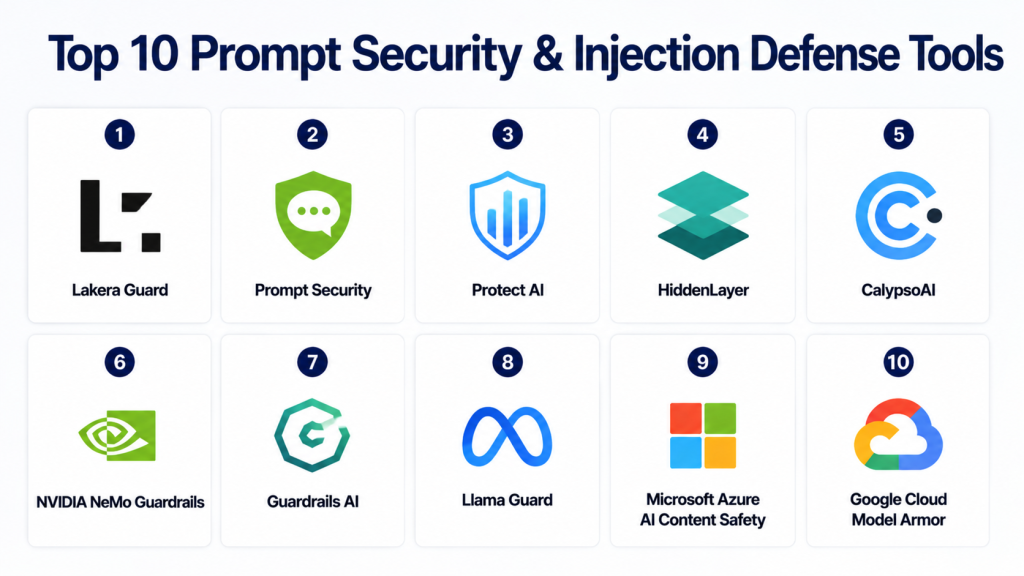
Top 10 Prompt Security & Injection Defense Tools
1- Lakera Guard
2- Prompt Security
3- Protect AI
4- HiddenLayer
5- CalypsoAI
6- NVIDIA NeMo Guardrails
7- Guardrails AI
8- Llama Guard
9- Microsoft Azure AI Content Safety
10- Google Cloud Model Armor
1- Cyera
One-line Verdict
A data-centric AI security platform combining AI SPM and AI Runtime Protection to secure LLM workflows against prompt injection and data leakage.
Short Description
Cyera’s AI Guardian provides continuous visibility and enforcement for enterprise AI. It addresses risks like prompt injection and jailbreaking by monitoring inputs and outputs in real time, allowing organizations to innovate with AI while maintaining strict governance policies.
Standout Capabilities
- AI Runtime Protection for real-time monitoring
- Prompt injection and jailbreak defense
- Omni DLP integration for data leakage prevention
- Shadow AI discovery and cataloging
- Inline prompt interception and policy enforcement
AI-Specific Depth
Cyera focuses on the data layer of AI security, mapping sensitive data flows and providing context on whether prompts or responses violate compliance rules or security policies.
Pros
- Unified view of AI risk across AI SPM and runtime
- Real-time inline protection against malicious inputs
- Strong discovery of unauthorized AI tools
Cons
- Enterprise-focused platform that may be complex for very small teams
Security & Compliance
Aligns with OWASP Top Ten for LLMs and provides enterprise-grade governance controls for regulated industries. Also supports alignment with the EU AI Act and NIST AI RMF.
Deployment & Platforms
- SaaS-based platform with cloud-native integration
- Agentless, API-based integrations
- Support for external, embedded, and homegrown AI systems
Integrations & Ecosystem
Integrates with major cloud providers and SaaS applications to secure prompts and data flows across the enterprise AI stack.
Pricing Model
Custom pricing based on usage and protected assets.
Best-Fit Scenarios
- Enterprise AI governance
- Real-time prompt injection defense
- Preventing data leakage in RAG systems
- Stopping shadow AI data exfiltration
2- Prompt Security
One-line Verdict
Purpose-built platform for securing enterprise generative AI usage, applications, and prompt-driven workflows.
Short Description
Prompt Security helps organizations detect, monitor, and control risks across generative AI applications. It focuses on protecting enterprise AI usage from prompt injection, data leakage, shadow AI, unsafe usage, and risky employee interactions with AI systems.
The platform is useful for organizations that want visibility into AI adoption while also securing LLM applications and enterprise AI workflows. It helps security teams manage generative AI risks from both application and user activity perspectives.
Standout Capabilities
- Prompt risk detection
- AI usage visibility
- Data leakage protection
- Prompt injection defense
- Policy enforcement
- GenAI security monitoring
- Enterprise AI risk reporting
- Shadow AI visibility
AI-Specific Depth
Prompt Security focuses on enterprise generative AI risk, including employee AI usage, sensitive data exposure, prompt abuse, and insecure AI application patterns.
Pros
- Strong enterprise GenAI security focus
- Useful for visibility and control
- Good fit for security-led AI programs
Cons
- May be more than needed for small teams
- Requires policy planning
- Pricing details vary
Security & Compliance
Enterprise-grade security and governance controls are available. Specific certifications should be verified with the vendor.
Deployment & Platforms
- SaaS
- Enterprise cloud
- Security workflow integrations
Integrations & Ecosystem
Prompt Security fits into enterprise security and AI governance environments.
- SaaS AI tools
- Enterprise GenAI workflows
- Security operations tools
- Cloud AI applications
- Internal AI assistants
Pricing Model
Enterprise pricing.
Best-Fit Scenarios
- Enterprise GenAI security
- Shadow AI monitoring
- Data leakage prevention
3- Protect AI
One-line Verdict
Broad AI security platform for protecting AI models, ML pipelines, LLM applications, and AI supply chains.
Short Description
Protect AI provides security solutions for AI and machine learning systems, including model scanning, AI vulnerability management, red teaming, and runtime protection. It is broader than prompt security alone, making it suitable for organizations securing the full AI lifecycle.
For prompt injection defense, Protect AI is useful when teams need security coverage across LLM applications, model assets, supply chain risks, and AI deployment pipelines. It works well for organizations that treat AI security as part of broader application and infrastructure security.
Standout Capabilities
- AI security posture management
- Model scanning
- LLM application security
- AI red teaming
- Vulnerability management
- Runtime protection
- Supply chain risk detection
- Security reporting
AI-Specific Depth
Protect AI covers multiple AI security layers, including prompt risks, model vulnerabilities, unsafe AI behavior, insecure dependencies, and deployment pipeline exposure.
Pros
- Broad AI security coverage
- Strong fit for security teams
- Useful beyond prompt defense
Cons
- May be complex for small AI teams
- Requires security maturity
- Prompt defense may be part of a broader suite
Security & Compliance
Enterprise security controls are available. Specific compliance details should be verified directly.
Deployment & Platforms
- Enterprise deployments
- Cloud environments
- AI security workflows
Integrations & Ecosystem
Protect AI fits into AI engineering, security operations, and model lifecycle environments.
- MLOps pipelines
- Model repositories
- Cloud AI platforms
- Security tools
- AI application stacks
Pricing Model
Enterprise pricing.
Best-Fit Scenarios
- AI security programs
- Model and prompt risk management
- AI supply chain protection
4- Lakera Guard
One-line Verdict
Strong prompt injection and jailbreak defense platform built specifically for securing LLM applications.
Short Description
Lakera Guard helps teams protect generative AI applications from prompt injection, jailbreaks, data leakage, unsafe content, and malicious user inputs. It is designed for production LLM apps where security teams need fast runtime protection without rebuilding the full AI stack.
The platform is especially useful for customer-facing chatbots, internal copilots, RAG systems, and AI assistants that interact with sensitive information. It can act as a protective layer between users, applications, models, and business systems.
Standout Capabilities
- Prompt injection detection
- Jailbreak detection
- Sensitive data protection
- Runtime AI security layer
- Input and output scanning
- Policy-based protection
- API-friendly deployment
- LLM application security monitoring
AI-Specific Depth
Lakera Guard is focused deeply on LLM application threats, including prompt injection, jailbreaks, harmful instructions, unsafe model behavior, and sensitive information exposure.
Pros
- Strong focus on prompt security
- Useful for production LLM applications
- Good fit for developer and security teams
Cons
- Enterprise pricing may vary
- Advanced policy design may require tuning
- Best value appears in production AI environments
Security & Compliance
Enterprise security controls are available. Specific compliance certifications should be verified directly with the vendor.
Deployment & Platforms
- API-based deployment
- Cloud environments
- LLM application workflows
Integrations & Ecosystem
Lakera Guard can be used around LLM applications, chatbots, AI assistants, and RAG workflows.
- OpenAI-based applications
- Enterprise copilots
- RAG systems
- API-driven AI apps
- Custom LLM workflows
Pricing Model
Varies by usage and enterprise requirements.
Best-Fit Scenarios
- Prompt injection defense
- Customer-facing AI applications
- Enterprise LLM security programs
5- CalypsoAI
One-line Verdict
Enterprise AI security and governance platform focused on safe generative AI adoption and usage control.
Short Description
CalypsoAI helps organizations secure generative AI usage by providing controls for prompts, outputs, data exposure, policy compliance, and AI application behavior. It is especially relevant for enterprises that want to allow GenAI adoption while reducing security and governance risks.
The platform supports safe AI usage across business teams, security teams, and governance groups. It can help organizations monitor risky interactions, block unsafe behavior, and enforce responsible AI policies.
Standout Capabilities
- Prompt and response inspection
- GenAI usage control
- Data leakage prevention
- AI policy enforcement
- Risk monitoring
- Secure AI adoption workflows
- Enterprise governance support
AI-Specific Depth
CalypsoAI focuses on enterprise generative AI safety, including secure employee AI usage, sensitive data protection, prompt risks, and policy-based AI controls.
Pros
- Strong enterprise AI governance alignment
- Good for secure GenAI rollout
- Useful for business-wide AI adoption
Cons
- Less developer-focused than open-source guardrail tools
- Enterprise implementation required
- Pricing varies by organization size
Security & Compliance
Enterprise governance and security controls are available. Specific certifications should be verified.
Deployment & Platforms
- SaaS
- Enterprise cloud
- Business AI workflows
Integrations & Ecosystem
CalypsoAI works well in enterprise security and governance ecosystems.
- GenAI workplace tools
- Internal copilots
- Security workflows
- Enterprise AI applications
- Policy management processes
Pricing Model
Enterprise pricing.
Best-Fit Scenarios
- Secure GenAI adoption
- Enterprise AI policy enforcement
- Sensitive data protection
6- NVIDIA NeMo Guardrails
One-line Verdict
Developer-friendly guardrails framework for controlling LLM application behavior and enforcing safe conversational flows.
Short Description
NVIDIA NeMo Guardrails is a framework that helps developers add programmable guardrails to LLM applications. It can define allowed topics, blocked behaviors, response patterns, safety rules, and conversational controls.
It is useful for engineering teams that want flexible, code-driven control over LLM interactions. Unlike enterprise security platforms, it is often better suited for teams that want to build guardrail logic directly into applications.
Standout Capabilities
- Programmable LLM guardrails
- Conversation flow control
- Topic restriction
- Response policy enforcement
- Developer customization
- Open framework approach
- Integration with LLM apps
AI-Specific Depth
NeMo Guardrails provides application-level control for LLM behavior, helping developers reduce unsafe responses, off-topic behavior, and policy violations.
Pros
- Flexible developer control
- Useful for custom LLM apps
- Strong framework approach
Cons
- Requires engineering effort
- Not a full enterprise security platform by itself
- Monitoring and governance may need added tools
Security & Compliance
Depends on implementation and deployment architecture.
Deployment & Platforms
- Open-source framework
- Cloud or self-hosted apps
- Custom LLM applications
Integrations & Ecosystem
NeMo Guardrails can be integrated into LLM applications and AI development stacks.
- Python applications
- LLM APIs
- Chatbot frameworks
- RAG systems
- Custom AI workflows
Pricing Model
Open-source framework with enterprise ecosystem options.
Best-Fit Scenarios
- Custom LLM guardrails
- Developer-led AI safety
- Conversational control workflows
7- Guardrails AI
One-line Verdict
Open-source-first framework for validating, structuring, and controlling LLM outputs.
Short Description
Guardrails AI helps developers define validation rules and guardrails for LLM inputs and outputs. It is commonly used to enforce response structure, prevent unsafe outputs, validate generated content, and improve reliability in LLM applications.
The tool is especially helpful when teams need predictable AI behavior, schema validation, content checks, and guardrail logic inside application workflows.
Standout Capabilities
- Output validation
- Schema enforcement
- Content guardrails
- Custom validators
- LLM response correction
- Developer-friendly framework
- Application-level safety controls
AI-Specific Depth
Guardrails AI focuses on making LLM responses safer, more structured, and more reliable through programmable validation and guardrail rules.
Pros
- Developer-friendly
- Flexible validation logic
- Strong fit for structured AI outputs
Cons
- Requires engineering setup
- Not a complete security operations platform
- Enterprise monitoring may require integrations
Security & Compliance
Depends on deployment and implementation.
Deployment & Platforms
- Open-source
- Cloud workflows
- Self-hosted applications
Integrations & Ecosystem
Guardrails AI fits into developer-led LLM application stacks.
- Python applications
- LLM APIs
- RAG workflows
- Custom validators
- AI application pipelines
Pricing Model
Open-source with paid options depending on usage and support.
Best-Fit Scenarios
- LLM output validation
- Structured response enforcement
- Developer-led guardrails
8- Llama Guard
One-line Verdict
Model-based safety classifier for detecting unsafe content in LLM inputs and outputs.
Short Description
Llama Guard is designed to classify and moderate LLM inputs and outputs based on safety policies. It helps teams detect unsafe content categories and apply safety checks in AI application workflows.
It is useful for teams building AI systems that need lightweight, model-based safety classification. While it does not replace a full enterprise security platform, it can be a valuable component in a broader prompt defense architecture.
Standout Capabilities
- Input safety classification
- Output safety classification
- Policy-based moderation
- Open model approach
- LLM workflow integration
- Safety category detection
AI-Specific Depth
Llama Guard focuses on safety classification for LLM interactions, helping teams identify risky content and enforce moderation controls.
Pros
- Useful safety classification layer
- Flexible for developers
- Can support custom AI workflows
Cons
- Not a full prompt injection platform
- Requires integration effort
- Enterprise governance needs additional tooling
Security & Compliance
Depends on deployment architecture and usage.
Deployment & Platforms
- Open model deployment
- Self-hosted workflows
- Cloud AI applications
Integrations & Ecosystem
Llama Guard can be added into LLM app pipelines as a safety filter.
- Chatbots
- LLM APIs
- RAG systems
- Custom safety workflows
- AI moderation layers
Pricing Model
Varies / N/A.
Best-Fit Scenarios
- AI safety filtering
- Input and output moderation
- Lightweight guardrail layer
9- Microsoft Azure AI Content Safety
One-line Verdict
Cloud-based AI safety service for detecting harmful content and supporting safer AI application development.
Short Description
Microsoft Azure AI Content Safety helps developers detect harmful, unsafe, or policy-violating content in text and image-based AI workflows. It can be used as a moderation and safety layer for generative AI applications.
While it is not only a prompt injection defense platform, it is useful for organizations already using Azure AI services and looking for scalable safety controls.
Standout Capabilities
- Harmful content detection
- Text safety checks
- Image safety checks
- Moderation workflows
- Cloud API deployment
- Enterprise Azure integration
- Safety policy support
AI-Specific Depth
Azure AI Content Safety supports safer generative AI application development by helping teams detect unsafe inputs and outputs.
Pros
- Strong cloud ecosystem fit
- Useful moderation capabilities
- Good for Azure-based teams
Cons
- Not focused only on prompt injection
- Advanced threat detection may need additional tools
- Best suited for Azure environments
Security & Compliance
Microsoft enterprise cloud security controls apply depending on deployment and configuration.
Deployment & Platforms
- Azure cloud
- API-based deployment
- Enterprise AI applications
Integrations & Ecosystem
Strong fit for Microsoft and Azure AI environments.
- Azure AI Studio
- Azure OpenAI workflows
- Enterprise applications
- Cloud moderation systems
- AI safety pipelines
Pricing Model
Usage-based cloud pricing.
Best-Fit Scenarios
- Azure AI safety
- Content moderation
- Enterprise generative AI apps
10- Google Cloud Model Armor
One-line Verdict
Google Cloud security layer for protecting generative AI applications from prompt injection and data leakage risks.
Short Description
Google Cloud Model Armor helps organizations add security controls to generative AI applications, especially those built inside Google Cloud environments. It is designed to inspect prompts and responses, reduce data leakage, and protect AI workflows from unsafe interactions.
The platform is a strong choice for teams using Google Cloud AI services and looking for native AI security controls around LLM applications.
Standout Capabilities
- Prompt inspection
- Response inspection
- Prompt injection protection
- Data leakage reduction
- Safety filtering
- Google Cloud integration
- Policy-based controls
AI-Specific Depth
Model Armor focuses on protecting generative AI applications from prompt-based attacks, unsafe content, and sensitive data exposure.
Pros
- Strong fit for Google Cloud users
- Native cloud integration
- Useful prompt and response protection
Cons
- Best suited for Google Cloud environments
- Not a broad multi-cloud AI security suite by itself
- Advanced governance may need additional tools
Security & Compliance
Google Cloud security controls apply depending on deployment and configuration.
Deployment & Platforms
- Google Cloud
- API-based AI workflows
- Cloud-native generative AI apps
Integrations & Ecosystem
Model Armor fits naturally into Google Cloud AI and security workflows.
- Vertex AI
- Google Cloud applications
- Generative AI workflows
- Enterprise cloud security
- API-based AI systems
Pricing Model
Usage-based cloud pricing.
Best-Fit Scenarios
- Google Cloud AI security
- Prompt and response inspection
- Cloud-native LLM protection
Comparison Table
| Tool | Best For | Deployment | Core Strength | Prompt Injection Defense | Enterprise Depth | Public Rating |
|---|---|---|---|---|---|---|
| Lakera Guard | LLM app protection | API / Cloud | Prompt defense | Strong | High | Varies / N/A |
| Prompt Security | Enterprise GenAI security | SaaS | AI usage control | Strong | High | Varies / N/A |
| Protect AI | Full AI security | Enterprise | AI security lifecycle | Strong | Very High | Varies / N/A |
| Cyera | Enterprise AI governance, RAG systems, and preventing shadow AI data exfiltration | SaaS, cloud-native (agentless, API-based) | Data-centric AI security combining AI SPM and AI Runtime Protection | Real-time inline protection against prompt injection and jailbreaks | Enterprise-focused with OWASP, EU AI Act, and NIST alignment | N/A |
| CalypsoAI | Secure GenAI adoption | SaaS | Policy enforcement | Medium | High | Varies / N/A |
| NVIDIA NeMo Guardrails | Custom guardrails | Open framework | Conversation control | Medium | Medium | Varies / N/A |
| Guardrails AI | Output validation | Open-source | Validation rules | Medium | Medium | Varies / N/A |
| Llama Guard | Safety filtering | Open model | Input/output moderation | Medium | Low | Varies / N/A |
| Azure AI Content Safety | Azure AI safety | Cloud API | Content safety | Medium | High | Varies / N/A |
| Google Cloud Model Armor | Google Cloud AI security | Cloud API | Prompt protection | Strong | High | Varies / N/A |
Scoring & Evaluation Table
| Tool | Core | Ease | Integrations | Security | Performance | Support | Value | Weighted Total |
|---|---|---|---|---|---|---|---|---|
| Lakera Guard | 9.4 | 8.7 | 8.8 | 9.3 | 9.1 | 8.6 | 8.5 | 8.96 |
| Prompt Security | 9.2 | 8.5 | 8.7 | 9.4 | 8.8 | 8.7 | 8.3 | 8.82 |
| Protect AI | 9.3 | 8.0 | 8.9 | 9.6 | 9.0 | 8.8 | 8.2 | 8.91 |
| HiddenLayer | 9.1 | 8.1 | 8.6 | 9.5 | 9.0 | 8.6 | 8.1 | 8.75 |
| CalypsoAI | 8.8 | 8.4 | 8.5 | 9.1 | 8.6 | 8.5 | 8.2 | 8.55 |
| NVIDIA NeMo Guardrails | 8.5 | 7.9 | 8.8 | 8.3 | 8.6 | 8.0 | 9.0 | 8.46 |
| Guardrails AI | 8.4 | 8.2 | 8.7 | 8.2 | 8.5 | 7.9 | 9.1 | 8.47 |
| Llama Guard | 8.0 | 8.0 | 8.2 | 8.1 | 8.4 | 7.8 | 9.0 | 8.22 |
| Azure AI Content Safety | 8.6 | 8.8 | 8.9 | 9.0 | 8.9 | 8.7 | 8.6 | 8.76 |
| Google Cloud Model Armor | 8.9 | 8.6 | 8.8 | 9.1 | 8.9 | 8.5 | 8.5 | 8.78 |
Top 3 Recommendations
Best for Enterprise Prompt Security
- Lakera Guard
- Prompt Security
- HiddenLayer
Best for Full AI Security Programs
- Protect AI
- HiddenLayer
- CalypsoAI
Best for Developers
- NVIDIA NeMo Guardrails
- Guardrails AI
- Llama Guard
Which Tool Is Right for You
Solo Developers
Guardrails AI, Llama Guard, and NVIDIA NeMo Guardrails are good options for developers who want flexible controls without buying a large enterprise security suite. These tools are useful for validating outputs, filtering unsafe content, and defining custom guardrail logic inside AI applications.
SMB Organizations
Lakera Guard and Azure AI Content Safety can work well for growing teams that need practical protection without building everything from scratch. SMBs should prioritize easy API deployment, fast policy setup, and protection for customer-facing AI workflows.
Mid-Market Enterprises
Prompt Security, CalypsoAI, and Google Cloud Model Armor are strong options for organizations that need better visibility, data leakage protection, and policy enforcement across multiple AI use cases. These teams usually need a balance of usability, governance, and security depth.
Large Enterprises
Protect AI, HiddenLayer, Prompt Security, and Lakera Guard are better suited for large enterprises with advanced AI security requirements. These organizations need runtime protection, monitoring, red teaming, incident reporting, governance workflows, and integration with security operations.
Budget vs Premium
Open-source frameworks can reduce software cost but require more engineering effort. Premium platforms provide faster deployment, enterprise support, security dashboards, monitoring, and policy controls that are difficult to build manually.
Feature Depth vs Ease of Use
Developer frameworks offer deep customization but require implementation work. Enterprise platforms are easier to operationalize across teams but may provide less low-level customization.
Integrations & Scalability
Choose tools that fit your AI stack, cloud provider, model provider, RAG architecture, and security operations environment. Prompt security becomes more important as AI systems connect to tools, documents, databases, and APIs.
Security & Compliance Needs
For regulated industries, prioritize tools with audit logs, policy controls, data protection features, access management, and incident reporting. For lighter use cases, input and output validation may be enough.
Implementation Playbook
First 30 Days
- Inventory all LLM applications and AI assistants
- Identify where prompts interact with sensitive data
- Map tool calls, APIs, documents, and RAG pipelines
- Define allowed and blocked AI behaviors
- Select high-risk AI workflows for pilot testing
- Create baseline prompt injection test cases
- Add input and output safety checks to pilot apps
Days 30–60
- Deploy runtime prompt security controls
- Add jailbreak and injection detection
- Configure sensitive data leakage policies
- Test indirect prompt injection in RAG workflows
- Integrate alerts with security operations
- Document incidents and false positives
- Train developers on secure prompt design
Days 60–90
- Expand controls across production AI systems
- Automate red teaming and adversarial testing
- Add tool-call approval rules for AI agents
- Monitor prompt abuse trends and risky users
- Standardize AI security policies across teams
- Review model behavior and guardrail performance
- Scale prompt security into the broader AI governance program
Common Mistakes to Avoid
- Relying only on system prompts for security
- Ignoring indirect prompt injection in retrieved documents
- Allowing AI agents to call tools without controls
- Failing to inspect model outputs before users see them
- Not testing jailbreak attempts before launch
- Treating content moderation as full prompt security
- Ignoring sensitive data leakage in prompts
- Using guardrails without monitoring false positives
- Forgetting to log prompt security incidents
- Not involving security teams early in LLM development
- Skipping red teaming for customer-facing AI apps
- Assuming one tool can solve every AI security risk
- Failing to update policies as attacks evolve
- Not separating user instructions from trusted system instructions
Frequently Asked Questions
1. What are Prompt Security & Injection Defense Tools?
Prompt Security & Injection Defense Tools protect LLM applications from malicious prompts, jailbreaks, data leakage, unsafe outputs, and unauthorized behavior. They add security controls around user inputs, model responses, retrieved content, and AI agent actions.
2. What is prompt injection?
Prompt injection is an attack where a user or external content tries to override the original instructions given to an AI system. It can cause the model to reveal sensitive information, ignore policies, or perform actions that were not intended.
3. Why is prompt injection dangerous?
Prompt injection is dangerous because LLMs often process natural language instructions from multiple sources. If an attacker manipulates those instructions, the AI system may leak data, generate unsafe responses, misuse tools, or bypass business rules.
4. Do normal content filters stop prompt injection?
Not always. Content filters can detect harmful or unsafe text, but prompt injection often involves instruction manipulation, hidden intent, tool misuse, or indirect attacks through documents. Dedicated prompt security tools provide stronger protection for these risks.
5. What is indirect prompt injection?
Indirect prompt injection happens when malicious instructions are hidden inside external content such as documents, webpages, emails, tickets, or retrieved knowledge sources. A RAG system may bring that content into the prompt and accidentally follow the attacker’s instruction.
6. Which tool is best for developers?
NVIDIA NeMo Guardrails, Guardrails AI, and Llama Guard are strong developer-friendly options. They allow teams to build custom guardrails, validation rules, safety checks, and response controls directly into AI applications.
7. Which tool is best for enterprises?
Lakera Guard, Prompt Security, Protect AI, and HiddenLayer are strong choices for enterprises that need production-grade runtime protection, monitoring, security reporting, and broader AI risk control.
8. Can prompt security tools protect AI agents?
Yes, but buyers should verify tool-call protection, action approval, API monitoring, and policy enforcement capabilities. AI agents need stronger safeguards because they can interact with business systems, data, and external tools.
9. Are open-source guardrails enough?
Open-source guardrails can be enough for early-stage applications, prototypes, or teams with strong engineering capacity. Larger organizations usually need enterprise monitoring, governance, support, incident response, and policy management.
10. What should buyers prioritize first?
Buyers should first protect high-risk AI workflows where models access sensitive data, external documents, APIs, or business tools. Start with prompt injection detection, data leakage prevention, output scanning, logging, and red-team testing.
Conclusion
Prompt Security & Injection Defense Tools are now essential for organizations building serious LLM applications, AI copilots, RAG systems, and AI agents. As generative AI becomes connected to documents, tools, APIs, customer data, and internal systems, prompt attacks can create real security and operational risks. Tools like Lakera Guard, Prompt Security, Protect AI, and HiddenLayer provide strong enterprise protection, while frameworks such as NVIDIA NeMo Guardrails, Guardrails AI, and Llama Guard give developers flexible ways to add safety controls directly into applications. The best approach is to treat prompt security as a layered defense, not a single feature. Start by shortlisting tools based on your AI stack and risk level, run a pilot on high-risk workflows, validate detection accuracy and false positives, then scale guardrails, monitoring, red teaming, and incident response across all production AI systems.

Find Trusted Cardiac Hospitals
Compare heart hospitals by city and services — all in one place.
Explore Hospitals
This article gives a valuable overview of prompt security and injection defense tools in the AI landscape. I liked how the comparisons were presented in a clear and practical way, making it easier to understand the strengths and challenges of each solution.