
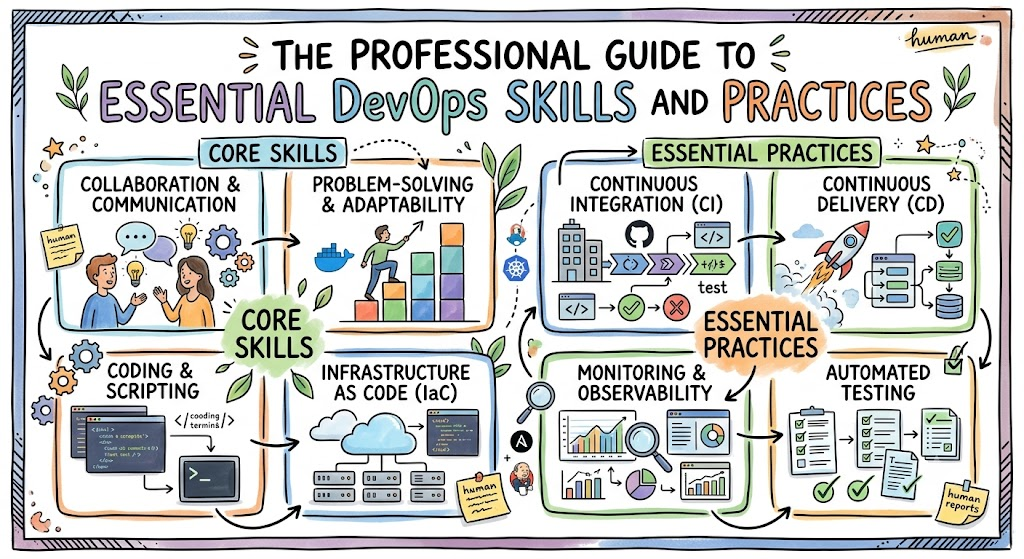
Introduction
In the current landscape of rapid digital transformation, the demand for reliable, scalable, and automated software delivery is at an all-time high. Companies are no longer just building software; they are building complex ecosystems that require constant uptime, security, and integration. This is where the DevOps philosophy becomes critical. However, many aspirants find themselves overwhelmed by the sheer volume of tools, practices, and technologies involved.
The confusion is understandable. The industry often treats DevOps as a collection of tools rather than a mindset backed by specific technical proficiencies. Whether you are a student, a system administrator looking to pivot, or a software developer aiming to expand your scope, understanding the specific skills that matter is your first step toward success. Structured learning is not just recommended; it is essential to avoid burnout and skill gaps. For those seeking a guided, hands-on path to mastering these competencies, DevOpsSchool provides the industry-aligned curriculum and environment needed to turn theoretical knowledge into professional capability. In this guide, we will break down the essential DevOps skills required to thrive, categorized for both beginners and seasoned professionals.
What Are DevOps Skills?
DevOps skills represent the intersection of development, operations, and security. They are not merely about knowing how to install a tool; they are about understanding how to bridge the gap between writing code and maintaining that code in a production environment.
At its core, a DevOps skill set combines three distinct areas:
- Technical Proficiency: Mastery of command-line interfaces, automation scripts, cloud architecture, and containerization.
- Operational Awareness: Understanding networking, security, monitoring, and infrastructure reliability.
- Cultural Mindset: Collaboration, incident management, empathy, and a drive for continuous improvement.
True DevOps skills allow an engineer to take a feature from a local development environment all the way to a global production server without manual friction.
Why DevOps Skills Are Important
The importance of these skills lies in the velocity and stability they bring to an organization. When an engineer understands the entire stack, they can identify bottlenecks before they impact users.
- Faster Software Delivery: By mastering CI/CD, teams can release updates multiple times a day instead of once a month.
- System Reliability: Infrastructure as Code (IaC) ensures that environments are consistent, reducing the “it works on my machine” problem.
- Cloud Efficiency: Cloud skills enable engineers to optimize costs and scale resources automatically, which is a massive value-add for any business.
- Career Resilience: The demand for DevOps professionals is growing in every sector, from startups to enterprise banking, making these skills highly future-proof.
Overview Table: Essential DevOps Skills
| Skill Category | Example Skills |
| Technical Skills | Linux Administration, Networking, Scripting |
| Tools | Git, Jenkins, Ansible, Docker, Kubernetes |
| Cloud Platforms | AWS, Azure, Google Cloud Platform (GCP) |
| Soft Skills | Communication, Problem Solving, Incident Ownership |
| Security Skills | DevSecOps, Vulnerability Scanning, Identity Management |
| Automation Skills | CI/CD Pipelines, Configuration Management |
Essential DevOps Skills for Beginners
For those just starting, the objective is to build a solid foundation. Do not rush into advanced orchestration tools until you understand the basic mechanics of how systems communicate.
Linux Basics
Linux is the backbone of the internet and the primary operating system for servers. You must be comfortable with the terminal, file system permissions, package management, and basic troubleshooting.
Networking Fundamentals
You cannot secure or scale what you do not understand. Learn how IP addresses, DNS, HTTP/HTTPS, SSH, firewalls, and load balancers work.
Git & Version Control
Git is the standard for collaboration. Learn to branch, merge, resolve conflicts, and manage repositories. This is how teams work together safely.
CI/CD Basics
Understand the concept of Continuous Integration and Continuous Deployment. Start by automating simple tasks—building code, running tests, and deploying it to a server.
Scripting (Bash/Python)
Automation is the heart of DevOps. Learn Bash for system tasks and Python for more complex automation and API interactions.
Cloud Fundamentals
Learn the basics of at least one major provider (AWS, Azure, or GCP). Focus on Virtual Machines (EC2), Storage (S3), and Virtual Networks (VPC).
Docker Basics
Containers are the modern standard for application packaging. Learn how to create, run, and manage containers to ensure your application runs the same way in every environment.
Essential DevOps Skills for Professionals
Once you have the basics, you must shift your focus toward architecture, reliability, and security at scale.
Advanced CI/CD Pipelines
Move beyond simple pipelines. Learn how to manage complex multi-stage pipelines, integrate security scanning (SAST/DAST), and implement automated rollback strategies.
Kubernetes & Container Orchestration
Kubernetes is the standard for scaling containers. You must understand how to manage clusters, write manifest files, handle service discovery, and manage ingress controllers.
Infrastructure as Code (Terraform)
Stop manually configuring servers. Learn to define your infrastructure (servers, databases, networks) using code. Terraform allows you to spin up and tear down environments with a single command.
Monitoring & Observability
You cannot fix what you cannot see. Learn to use tools like Prometheus and Grafana to track system health. Understanding logs, metrics, and traces is vital for SRE roles.
DevSecOps Practices
Security should be embedded in the pipeline. Learn how to manage secrets, scan dependencies for vulnerabilities, and implement compliance checks automatically.
Cloud Architecture Skills
Professionals must think about cost optimization, high availability, multi-region deployments, and disaster recovery strategies.
Technical Skills Breakdown
| Skill | Why It Matters | Example Use |
| Linux | Powers servers and containers | Writing shell scripts to manage user logs |
| Git | Essential for code collaboration | Managing source code versions and pull requests |
| Docker | Ensures consistent application runtime | Packaging a web app into an image for deployment |
| Kubernetes | Orchestrates large-scale container clusters | Auto-scaling an application based on traffic |
| Jenkins/GH Actions | Automates code integration and delivery | Triggering build tests automatically on every code push |
| AWS/Azure/GCP | Provides global computing infrastructure | Hosting scalable web applications |
| Terraform | Automates infrastructure provisioning | Creating a production environment in 5 minutes via code |
| Prometheus/Grafana | Provides visibility into system health | Visualizing CPU/Memory spikes in real-time |
Soft Skills Required in DevOps
DevOps is inherently a people-focused discipline. You are the glue between development, testing, and operations teams.
- Communication: You must be able to explain technical issues to non-technical stakeholders and developers.
- Collaboration: Working with developers to fix “it works on my machine” issues requires patience and a helpful attitude.
- Problem Solving: When production is down, you need to remain calm, isolate the root cause, and think logically under pressure.
- Incident Handling: Accepting ownership of failures and participating in blameless post-mortems is crucial for growth.
- Ownership Mindset: Don’t just close tickets. Take ownership of the platform’s stability and look for ways to make things better long-term.
Beginner DevOps Learning Roadmap
- Phase 1: Linux & Networking: Spend 3–4 weeks learning CLI, file systems, and how web traffic flows.
- Phase 2: Version Control: Master Git and GitHub/GitLab.
- Phase 3: Scripting: Learn Bash basics for system automation.
- Phase 4: Virtualization/Containers: Dive deep into Docker.
- Phase 5: Cloud Foundations: Get comfortable with one cloud provider’s basic services.
- Phase 6: CI/CD Foundations: Build your first simple pipeline.
- Phase 7: Project: Build a “from-scratch” web app deployment project.
Professional DevOps Skill Growth Path
For those moving into senior roles, the focus shifts:
- Scaling Systems: Moving from single instances to distributed systems managed by Kubernetes.
- Production Troubleshooting: Deep-diving into system kernels, networking bottlenecks, and application performance tuning.
- Advanced Automation: Implementing GitOps workflows and complex IaC modules.
- Architecture Thinking: Designing for failure, cost, and high performance from day one.
Real-World Example: Beginner Without Proper Skills
Imagine “Alex,” a junior developer who learns only tools. Alex knows how to run a Docker command but doesn’t understand the underlying Linux process or networking. When the container fails to connect to the database, Alex is helpless. They spend hours searching forums for a copy-paste solution. Because they lack foundational knowledge, they cannot troubleshoot. They are slow, frustrated, and their deployments are often broken.
Real-World Example: Skilled DevOps Engineer in Action
Compare this to “Sarah,” a senior engineer with strong fundamentals. When a service fails, Sarah immediately checks the logs, uses Linux networking commands to verify connectivity, checks the Kubernetes pod status, and traces the issue back to a misconfigured security group. She fixes it in minutes using Terraform. Sarah delivers value, maintains system stability, and enables the development team to ship features faster.
Common Mistakes in Learning DevOps Skills
- Tool Hopping: Trying to learn Jenkins, GitLab CI, CircleCI, and Travis all at once. Pick one and master the concepts.
- Ignoring Fundamentals: Skipping Linux or Networking to jump straight to Kubernetes. You will struggle later.
- Lack of Hands-on Practice: Watching tutorials without typing commands. DevOps is a practical skill; you must break things to learn how to fix them.
- Skipping Cloud Basics: Thinking you can learn DevOps without cloud knowledge.
- Not Building Projects: A resume full of certificates is worth less than a GitHub repo with three working projects.
Best Practices for Learning DevOps Skills
- Start Small: Master Linux commands before building an entire cluster.
- Practice Daily: Consistency is better than cramming. Spend 30 minutes a day in the terminal.
- Focus on Fundamentals: Understand the “why” behind the tools.
- Build End-to-End Projects: Deploy an application from source code to a live, monitored URL.
- Document Your Learning: Write down what you learned; this helps with retention and building a personal brand.
Role of DevOpsSchool in Skill Development
Success in DevOps requires more than just reading; it requires guided experience. DevOpsSchool bridges the gap between learning and professional application. By providing structured, hands-on labs and curriculum that reflects actual enterprise requirements, it helps learners move past the common pitfalls of self-study. Their approach emphasizes the “why” and “how” of engineering, ensuring that students aren’t just memorizing commands but building the intuition required for real-world production environments.
Career Opportunities After Learning DevOps Skills
- DevOps Engineer: Focuses on the integration of development and operations.
- Cloud Engineer: Specializes in designing and maintaining cloud infrastructure.
- SRE (Site Reliability Engineer): Focuses on system reliability, uptime, and performance.
- Platform Engineer: Builds internal tools and platforms for developers to use.
- DevSecOps Engineer: Focuses on integrating security into every stage of the pipeline.
Industries Hiring DevOps Professionals
- SaaS Companies: They rely on constant updates and high availability.
- Banking & Finance: Need high security and strict compliance-driven automation.
- Healthcare: Require data integrity, security, and consistent environment management.
- E-Commerce: Need massive scaling capabilities during peak traffic.
- Telecom: Need robust, low-latency, and highly reliable infrastructure.
Future of DevOps Skills
The future of DevOps is moving toward AI-driven DevOps and Platform Engineering. Engineers will increasingly use AI tools to predict system failures and automate routine tasks. However, the requirement for human judgment, architecture design, and system-level understanding will never disappear. The “automation-first” mindset will remain the gold standard, and those who master the foundational skills will be the ones defining the future.
FAQs (15 Questions)
- What are essential DevOps skills?It includes Linux administration, cloud platforms, containerization (Docker/K8s), CI/CD pipelines, and IaC (Terraform).
- Do I need coding for DevOps?Yes. While you aren’t building software products, you need to write automation scripts in Bash, Python, or Go.
- Is Linux important for DevOps?It is the single most important skill. Most cloud servers and container runtimes are Linux-based.
- What tools should beginners learn first?Start with Linux, Git, and Docker.
- How long does it take to learn DevOps?It depends on your background, but expect 6–12 months for a solid, job-ready skill set.
- Can freshers become DevOps engineers?Yes, provided they focus on building strong project portfolios and foundational skills.
- Is Kubernetes necessary?Yes, for any mid-to-senior level role in modern enterprise environments.
- Do DevOps engineers code daily?They “code” infrastructure and automation, rather than application business logic.
- Should I learn AWS or Azure?Learn the concepts of cloud computing first; the specific provider matters less once you understand the principles.
- Is DevOps a tool or a culture?It is a culture supported by tools. Tools change, but the culture of collaboration and automation remains.
- What is the best way to practice DevOps?Build a project, deploy it, monitor it, and break it—then fix it.
- Do I need to be a developer first?It helps, but it is not mandatory. Many successful DevOps engineers come from system administration backgrounds.
- What is the role of IaC?It allows you to manage infrastructure through code, making it reproducible and version-controlled.
- How do I stay updated?Follow industry blogs, experiment with new releases, and participate in community forums.
- What is the most challenging DevOps skill?Usually, it is mastering Kubernetes or distributed systems architecture, as these require deep, multi-layered knowledge.
Final Thoughts
The path to becoming a skilled DevOps engineer is not a sprint; it is a commitment to continuous learning. Your focus should always be on the fundamentals—the principles of how systems work, how networks communicate, and how software moves from source to production. Tools like Kubernetes and Terraform are powerful, but they are only effective in the hands of an engineer who understands what they are trying to solve. Stay curious, practice building real-world projects, and ensure that your technical growth is always matched by a collaborative and problem-solving mindset.

Find Trusted Cardiac Hospitals
Compare heart hospitals by city and services — all in one place.
Explore Hospitals