
Introduction
AI LIMS optimization tools combine laboratory information management systems with artificial intelligence, machine learning, predictive analytics, and workflow automation to help labs run faster, with fewer bottlenecks and fewer manual decisions. Instead of using LIMS only as a record-keeping or sample-tracking system, modern platforms increasingly use structured lab data to optimize sample routing, technician scheduling, inventory planning, anomaly detection, instrument maintenance, compliance review, and operational forecasting. This matters now because labs are under pressure to improve turnaround time, reduce costs, and maintain compliance while dealing with growing data volumes, more instruments, and more complex workflows. Real world use cases include smart scheduling, predictive maintenance, reagent forecasting, outlier detection, automated compliance checks, intelligent task assignment, and AI assistants embedded inside lab operations. Buyers should evaluate these tools based on workflow coverage, data readiness, configurability, AI depth, auditability, deployment options, integration maturity, and how well the system supports human review in regulated environments.
These tools are best for R and D labs, quality labs, clinical labs, biotech teams, CROs, and enterprise lab operations groups that already rely on LIMS or ELN systems and want more operational intelligence from the data they already collect. They are especially useful when labs have recurring throughput issues, high instrument utilization, compliance burdens, or enough historical data to support predictive models. They are less ideal for very small labs with low workflow complexity or poor data standardization, because AI optimization depends heavily on clean, structured, and connected data.
Why it matters
Traditional LIMS platforms are valuable for tracking and traceability, but they often depend on static rules and manual intervention when priorities shift, equipment fails, or bottlenecks emerge. AI changes that by turning LIMS from a passive tracking layer into a decision support system that can identify patterns, predict operational issues, and recommend better actions before delays or quality issues grow. Recent vendor and industry commentary shows that labs are increasingly interested in AI for workflow optimization, preventive quality management, predictive maintenance, and resource planning rather than only after the fact reporting. This is especially important in 2026 because digital labs are moving toward AI native architectures where intelligence is built into orchestration, quality, and data management rather than added later as a reporting layer.
Real world use cases
A common use case is smart workflow orchestration, where AI helps optimize how samples move through the lab based on priority, due date, analyst capacity, and instrument availability, reducing bottlenecks and balancing workload more effectively. Another important use case is predictive maintenance, where models trained on usage data, calibration schedules, and error logs can predict likely instrument failure and trigger preventive service before downtime disrupts testing. AI LIMS optimization is also used for reagent and inventory forecasting, where historical consumption patterns and schedules help predict demand, reduce waste, and prevent stockouts of critical materials. In quality and compliance workflows, AI can support anomaly detection, automated checks, real time monitoring, and even AI generated summaries or descriptions that reduce repetitive administrative work while keeping humans in control of final decisions.
Evaluation criteria for buyers
When buyers evaluate AI LIMS optimization tools, the first criterion should be data readiness, because AI value depends on having clean, structured, and well connected records across samples, instruments, scheduling, inventory, and quality events. The second is workflow fit, meaning whether the platform can optimize the actual bottlenecks in your lab such as routing, resource allocation, maintenance, or compliance review instead of offering only generic analytics. Buyers should also assess configurability and governance, including whether users can review, override, and document AI recommendations in a way that supports audits and regulated operations. Integration depth matters as well, especially across LIMS, ELN, LES, instruments, and analytics layers, because isolated AI features are usually less useful than connected decision workflows. Finally, teams should review deployment options, performance at scale, vendor support, and long term AI roadmap, then run a pilot on one high value use case before scaling to broader lab operations.
What Is Changing in This Category
- LIMS is shifting from static record keeping to decision support and workflow orchestration.
- Predictive analytics is becoming a core AI use case for demand, quality, and maintenance planning.
- Smart sample routing and dynamic scheduling are becoming practical, not just aspirational.
- More vendors are framing AI as embedded inside the platform rather than as a bolt on dashboard.
- AI agents are emerging as a new interface for scientist productivity and lab coordination.
- Human in the loop design remains critical for GxP and regulated workflows.
- Compliance monitoring is moving from reactive review to preventive quality intelligence.
- Data foundation quality is becoming a bigger buying factor than model marketing.
- ELN and LIMS integration is becoming more important because AI needs broader context across experiments and operations.
- Edge AI and instrument connected analytics are becoming more relevant in advanced lab environments.
Quick Buyer Checklist
- Check whether the vendor supports optimization use cases you actually need, such as scheduling, routing, inventory, maintenance, or anomaly detection.
- Ask how much historical structured data is required before AI features become useful.
- Confirm whether AI is embedded natively or depends on external BI and data science tools.
- Review whether users can override recommendations and document decisions for audits.
- Check if ELN, LES, instrument, and inventory data can be combined for richer optimization.
- Ask how the system handles compliance, audit trails, and data integrity in AI assisted workflows.
- Verify cloud, on premises, hybrid, and edge options based on your lab architecture.
- Test the tool using one real workflow bottleneck before scaling broadly.
- Review whether the platform supports anomaly detection and predictive maintenance out of the box.
- Ask how easy it is to configure optimization rules without vendor services for every change.
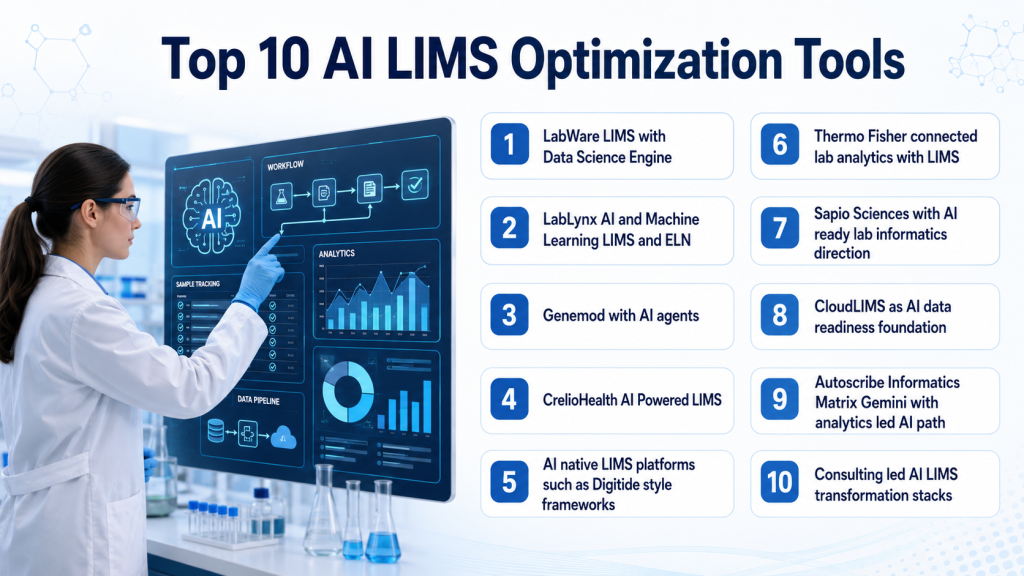
Top 10 AI LIMS Optimization Tools
1. LabWare LIMS with Data Science Engine
One line verdict: Best for enterprise labs that want practical AI optimization inside an established LIMS workflow stack.
Short description:
LabWare is one of the best known LIMS vendors and publicly highlights AI use cases such as anomaly detection, predictive maintenance, smart sample routing, scheduling, and reagent forecasting through its Data Science Engine. It is best suited to labs that want to build AI optimization on top of a mature LIMS and structured process controls.
Standout Capabilities
- Anomaly detection on historical lab data.
- Predictive instrument maintenance using usage and error logs.
- Smart sample routing and scheduling based on priority, capacity, and due dates.
- Reagent usage prediction and expiration risk reduction.
- Real time action through configurable workflows and rules based automation.
- Strong focus on structured data, auditability, and process control.
AI Specific Depth
- Model support: Data Science Engine is publicly stated, exact model flexibility and BYO model support are not fully publicly stated.
- Knowledge integration: Integrates LIMS structured data, instrument manager data, and stock manager information.
- Evaluation: Public use cases emphasize measurable outcomes such as reduced retesting, downtime reduction, and better throughput.
- Guardrails: Human in the loop usage is explicitly encouraged in public guidance.
- Observability: Real time predictive alerts and workflow actioning are public, deeper ML observability detail is not publicly stated.
Pros
- Strong, concrete public AI use cases.
- Good fit for enterprise operations and regulated labs.
- Mature workflow foundation for scaling optimization.
Cons
- Likely more complex and resource intensive than lighter platforms.
- Public pricing detail is not stated.
- Best value depends on strong data quality and configuration discipline.
Security and Compliance
LabWare publicly emphasizes auditability, structured data quality, and process control, but detailed public information on SSO, RBAC, residency, and certifications was not verified in the reviewed material here.
Deployment and Platforms
Not fully publicly stated in the reviewed material for this comparison.
Integrations and Ecosystem
LabWare appears strongest when AI optimization is tied directly into core lab workflows and structured records rather than isolated analytics dashboards.
- Data Science Engine.
- Instrument Manager.
- Stock Manager.
- Configurable workflows and process automation.
Pricing Model
Best Fit Scenarios
- Enterprise labs with mature LabWare deployments.
- High throughput operations needing predictive routing and maintenance.
- Regulated labs that need optimization plus auditability.
2. LabLynx AI and Machine Learning LIMS and ELN
One line verdict: Best for labs wanting broad embedded AI features across workflow, compliance, and resource optimization.
Short description:
LabLynx positions its platform around embedded AI and machine learning features inside LIMS and ELN workflows. Public material highlights predictive analytics, automated anomaly detection, intelligent scheduling, smart resource allocation, compliance automation, and security oriented monitoring.
Standout Capabilities
- Predictive analytics on historical lab data.
- Real time anomaly and outlier detection.
- Intelligent task prioritization and scheduling.
- Smart allocation of equipment and personnel.
- Automated compliance checks and real time quality monitoring.
- Audit trails, document control, and data integrity emphasis.
AI Specific Depth
- Model support: Embedded AI and machine learning are public, exact model flexibility not publicly stated.
- Knowledge integration: Combines LIMS and ELN data in the platform.
- Evaluation: Public material emphasizes better decisions, reduced risks, and fewer manual errors, but formal benchmarks are not publicly stated.
- Guardrails: Automated compliance checks and audit trails are publicly highlighted.
- Observability: Real time quality monitoring is public, deeper ML observability detail is not publicly stated.
Pros
- Broad public AI feature coverage.
- Strong fit for labs needing both operational and compliance support.
- Good for teams wanting AI inside both LIMS and ELN context.
Cons
- Public detail on deployment architecture is limited.
- Public benchmark and model transparency are limited.
- Buyers should validate how much is turnkey versus configured per use case.
Security and Compliance
LabLynx publicly mentions document control, audit trails, enhanced security, AI powered encryption, user behavior monitoring, and automated backup and recovery. Certifications and finer identity control details were not publicly verified in the reviewed material.
Deployment and Platforms
Not fully publicly stated in the reviewed material for this comparison.
Integrations and Ecosystem
LabLynx is appealing for labs that want AI functionality spread across workflow, analytics, compliance, and administration rather than only a narrow optimization module.
Pricing Model
Best Fit Scenarios
- Labs seeking broad AI driven operations support.
- Teams that want ELN and LIMS context together.
- Organizations prioritizing compliance plus automation.
3. Genemod with AI agents
One line verdict: Best for modern life science teams that want AI agents to reduce routine coordination and admin work.
Short description:
Genemod publicly describes AI agents in LIMS as a way to automate tasks, optimize workflows, and help scientists work faster. It is best viewed as a newer generation lab platform direction centered on scientist productivity and agent assisted operations.
Standout Capabilities
- AI agents for workflow automation.
- Focus on helping scientists work smarter and faster.
- Strong relevance to life sciences environments.
- Useful framing for task reduction and lab coordination.
- Modern AI native positioning.
AI Specific Depth
- Model support: AI agents are publicly stated, exact model flexibility not publicly stated.
- Knowledge integration: LIMS workflow context is public, broader connector detail not publicly stated.
- Evaluation: Public value proposition emphasizes faster work and workflow optimization, formal benchmarks not publicly stated.
- Guardrails: Not publicly stated in reviewed material.
- Observability: Not publicly stated in reviewed material.
Pros
- Strong fit for agent driven productivity use cases.
- Appealing for modern digital lab workflows.
- Good strategic fit for teams exploring AI native operations.
Cons
- Public technical depth is limited.
- Compliance and deployment specifics are not clearly public.
- Buyers should validate workflow maturity versus marketing positioning.
Security and Compliance
Not publicly stated in the reviewed material for this comparison.
Deployment and Platforms
Not publicly stated in the reviewed material.
Integrations and Ecosystem
Genemod is most attractive for teams that want AI agents to act as productivity layers inside lab management workflows, but integration and governance maturity should be validated carefully.
Pricing Model
Best Fit Scenarios
- Modern biotech labs exploring agentic workflows.
- Scientist productivity improvement initiatives.
- Teams wanting a more AI native lab platform direction.
4. CrelioHealth AI Powered LIMS
One line verdict: Best for diagnostic and healthcare labs focused on error reduction and operational oversight.
Short description:
CrelioHealth markets AI powered LIMS and LIS features aimed at eliminating oversight and improving accuracy. Based on the reviewed public material, it appears most relevant to healthcare and diagnostic lab settings rather than broad R and D optimization alone.
Standout Capabilities
- AI powered LIMS and LIS positioning.
- Focus on eliminating errors and oversight.
- Accuracy and better outcomes orientation.
- Diagnostic and medical lab relevance.
- Practical operational improvement messaging.
AI Specific Depth
- Model support: AI powered features are public, exact model flexibility not publicly stated.
- Knowledge integration: LIMS and LIS context are public, broader connector details not publicly stated.
- Evaluation: Public messaging emphasizes better accuracy and outcomes, formal benchmarks not publicly stated.
- Guardrails: Not publicly stated in reviewed material.
- Observability: Not publicly stated in reviewed material.
Pros
- Clear relevance for healthcare lab operations.
- Strong messaging around accuracy and missed detail reduction.
- Likely attractive where oversight errors are costly.
Cons
- Public technical details are limited.
- Broader optimization depth is not clearly described in reviewed material.
- Security and deployment specifics were not verified here.
Security and Compliance
Not publicly stated in the reviewed material for this comparison.
Deployment and Platforms
Not publicly stated in the reviewed material.
Integrations and Ecosystem
CrelioHealth looks most relevant in healthcare lab contexts where AI is being used to tighten operational reliability and reduce oversight errors.
Pricing Model
Best Fit Scenarios
- Diagnostic laboratories.
- Labs focused on accuracy improvement.
- Healthcare operations reducing oversight risk.
5. AI native LIMS platforms such as Digitide style frameworks
One line verdict: Best for organizations planning long term transformation toward predictive and autonomous digital labs.
Short description:
AI native LIMS frameworks describe platforms where intelligence is embedded into the architecture, not added later through plugins. Public descriptions emphasize intelligent workflow orchestration, predictive quality, autonomous data management, embedded scientific insight, and human in the loop automation.
Standout Capabilities
- Intelligent workflow orchestration.
- Predictive quality and compliance.
- Autonomous data management.
- Embedded AI for scientific insight.
- Human in the loop automation.
AI Specific Depth
- Model support: AI native embedded intelligence is public, detailed model flexibility not publicly stated.
- Knowledge integration: Described as integrating broad lab architecture and scientific systems.
- Evaluation: Public framework is strategic and capability focused rather than benchmark oriented.
- Guardrails: Human in the loop is explicitly emphasized.
- Observability: Not publicly stated in detail.
Pros
- Strong strategic direction for future ready labs.
- Clear focus on predictive and preventive operations.
- Good conceptual fit for regulated environments that still need human control.
Cons
- Framework level, not always a directly comparable off the shelf product.
- Public product specifics and integrations are limited.
- Buyers need to separate roadmap messaging from current deployable capability.
Security and Compliance
Predictive compliance and human in the loop automation are publicly described, but detailed security controls are not publicly stated in the reviewed material.
Deployment and Platforms
Not publicly stated in the reviewed material.
Integrations and Ecosystem
These frameworks are most useful for enterprise architecture planning and for understanding where LIMS platforms are headed over the next several years.
- Workflow orchestration.
- Predictive quality functions.
- Autonomous data handling.
- Human reviewed automation.
Pricing Model
Best Fit Scenarios
- Enterprise digital lab modernization.
- Multi year transformation programs.
- Organizations evaluating AI native architecture direction.
6. Thermo Fisher connected lab analytics with LIMS
One line verdict: Best for labs exploring edge AI and analytics connected to scientific instrumentation workflows.
Short description:
Thermo Fisher has publicly discussed the role of LIMS and data analytics in enabling edge AI in scientific domains. This is more ecosystem and architecture oriented than a single clearly documented AI optimization module in the reviewed material, but it is relevant for labs where instrument connected intelligence matters.
Standout Capabilities
- LIMS with data analytics enabling edge AI.
- Strong scientific instrumentation context.
- Useful for advanced connected lab architectures.
- Relevant to predictive and distributed intelligence workflows.
- Good fit where instrumentation data is central.
AI Specific Depth
- Model support: Edge AI enabling architecture is public, exact model and deployment flexibility are not fully publicly stated.
- Knowledge integration: Strong relevance to instrument and analytics data.
- Evaluation: Strategic capability is public, specific optimization benchmarks not publicly stated.
- Guardrails: Not publicly stated in reviewed material.
- Observability: Not publicly stated in reviewed material.
Pros
- Strong fit for connected lab and instrument data strategies.
- Relevant for advanced digital lab environments.
- Backed by a major life sciences vendor ecosystem.
Cons
- Public feature transparency for AI optimization is limited in reviewed material.
- Harder to compare feature for feature against more explicit vendors.
- Deployment and pricing details are not clearly public here.
Security and Compliance
Not publicly stated in the reviewed material for this comparison.
Deployment and Platforms
Edge AI orientation is publicly stated, but full platform details are not publicly stated in the reviewed material.
Integrations and Ecosystem
Thermo Fisher is most compelling for labs already invested in connected lab or instrument ecosystems rather than buyers wanting a narrowly defined AI scheduler or optimizer.
Pricing Model
Best Fit Scenarios
7. Sapio Sciences with AI ready lab informatics direction
One line verdict: Best for labs wanting unified informatics with growing AI optimization potential across workflows.
Short description:
Sapio Sciences is positioned around broader lab informatics, with public material noting that AI powered tools can optimize workflows, automate data entry and validation, and assist with predictive tasks. It is most relevant for labs that want integrated informatics and see AI optimization as part of a broader platform strategy.
Standout Capabilities
- Unified lab informatics orientation.
- AI powered workflow optimization messaging.
- Automation of routine data entry and validation.
- Useful for integrated LIMS and ELN style environments.
- Strong relevance to digital transformation planning.
AI Specific Depth
- Model support: AI powered tools are mentioned publicly, exact model flexibility not publicly stated.
- Knowledge integration: Broad lab informatics context is public.
- Evaluation: Public description is directional rather than benchmark based.
- Guardrails: Not publicly stated in reviewed material.
- Observability: Not publicly stated in reviewed material.
Pros
- Good fit for integrated lab informatics buyers.
- Useful where workflow unification matters as much as optimization.
- Strong strategic relevance for growing labs.
Cons
- Public AI optimization detail is limited in reviewed material.
- Hard to verify exact current feature depth from reviewed sources alone.
- Pricing and deployment details were not publicly verified here.
Security and Compliance
Not publicly stated in the reviewed material for this comparison.
Deployment and Platforms
Not publicly stated in the reviewed material.
Integrations and Ecosystem
Sapio is attractive when the goal is broader unification of lab systems and gradual addition of AI powered workflow improvements.
Pricing Model
Best Fit Scenarios
- Growing labs standardizing informatics.
- Teams wanting one platform strategy.
- Organizations planning future AI expansion.
8. CloudLIMS as AI data readiness foundation
One line verdict: Best for smaller labs preparing their data foundation before deeper AI optimization adoption.
Short description:
CloudLIMS publicly emphasizes data readiness for AI and the role LIMS plays in cleaning, structuring, and organizing lab information for future AI use. It is more a readiness and foundation option in the reviewed material than a heavily featured AI optimization suite.
Standout Capabilities
- Focus on AI data readiness.
- Emphasis on structured and organized lab data.
- Good fit for labs earlier in digital maturity.
- Useful for foundational LIMS adoption before advanced AI.
- Practical relevance for smaller or growing labs.
AI Specific Depth
- Model support: Not publicly stated in reviewed material.
- Knowledge integration: Focuses on how LIMS supports future AI adoption through better data.
- Evaluation: Not publicly stated in reviewed material.
- Guardrails: Not publicly stated in reviewed material.
- Observability: Not publicly stated in reviewed material.
Pros
- Strong message around getting the data foundation right.
- Good for labs not yet ready for advanced AI features.
- Useful as a stepping stone toward optimization.
Cons
- Less public evidence of deep current AI optimization features.
- Not the best fit for buyers seeking advanced predictive capabilities today.
- Public technical detail is limited.
Security and Compliance
Not publicly stated in the reviewed material.
Deployment and Platforms
Not publicly stated in the reviewed material.
Integrations and Ecosystem
CloudLIMS is most relevant when a lab first needs standardized, AI ready data flows before it can benefit from predictive models or agentic automation.
Pricing Model
Best Fit Scenarios
- Small to mid sized labs early in AI maturity.
- Teams fixing data quality before optimization.
- Labs building a future ready LIMS base.
9. Autoscribe Informatics Matrix Gemini with analytics led AI path
One line verdict: Best for labs that want configurable LIMS workflows and an incremental path toward AI maturity.
Short description:
Autoscribe’s public messaging frames analytics as a step on the road to AI and emphasizes the importance of asking the right questions before adopting AI in LIMS. This makes it a useful option for organizations that want high configurability and a measured, staged approach rather than immediate AI first transformation.
Standout Capabilities
- Strong configurable LIMS background.
- Practical analytics first path toward AI.
- Useful for staged modernization.
- Encourages realistic planning around AI value.
- Good fit for organizations that want control over rollout pace.
AI Specific Depth
- Model support: Not publicly stated in reviewed material.
- Knowledge integration: Public discussion emphasizes analytics tools such as BI integrations as a path toward AI.
- Evaluation: Not publicly stated in reviewed material.
- Guardrails: Public messaging is cautious and planning oriented.
- Observability: Not publicly stated in reviewed material.
Pros
- Realistic fit for incremental adopters.
- Strong value for labs not ready for aggressive AI rollout.
- Good for organizations that want configurable foundations first.
Cons
- Less public evidence of advanced embedded AI optimization.
- More analytics path than AI native story in reviewed material.
- Public deployment and technical details are limited.
Security and Compliance
Not publicly stated in the reviewed material for this comparison.
Deployment and Platforms
Not publicly stated in the reviewed material.
Integrations and Ecosystem
Autoscribe is appealing when the lab wants to move from reporting and analytics into AI over time without overcommitting too early.
- Analytics tool alignment.
- Configurable workflows.
- Incremental AI readiness.
- Planning oriented adoption.
Pricing Model
Best Fit Scenarios
- Labs taking a staged modernization path.
- Buyers prioritizing configurability first.
- Teams wanting analytics before predictive automation.
10. Consulting led AI LIMS transformation stacks
One line verdict: Best for enterprises combining LIMS, ELN, NLP, and predictive analytics into a custom optimized lab stack.
Short description:
Consulting firms and integrators increasingly position AI LIMS optimization as a layered stack that combines LIMS, ELN, LES, NLP, analytics, and custom ML workflows. Public material from Astrix and Clarkston highlights the importance of strong data foundations, NLP, anomaly detection, predictive modeling, and workflow optimization in modern lab informatics programs.
Standout Capabilities
- Custom fit across LIMS, ELN, and LES.
- NLP for turning lab notes into structured data.
- Predictive modeling and anomaly detection.
- Strong alignment with enterprise transformation programs.
- Useful where no single vendor solves the full stack.
AI Specific Depth
- Model support: Varies depending on architecture and vendors selected.
- Knowledge integration: Broad lab informatics and analytics integration is central.
- Evaluation: Pilot driven ROI and use case design are publicly emphasized.
- Guardrails: Compliance and human reviewed workflows are publicly emphasized.
- Observability: Varies by implementation.
Pros
- Maximum flexibility for large enterprises.
- Good for labs with heterogeneous informatics environments.
- Useful when advanced NLP and predictive workflows are needed.
Cons
- Not a single product.
- High complexity and services dependence.
- Longer time to value than packaged platforms.
Security and Compliance
Depends on the chosen architecture and vendor mix. Public material emphasizes compliance and traceability, but exact controls vary by implementation.
Deployment and Platforms
Cloud, on premises, and hybrid options vary by implementation.
Integrations and Ecosystem
This option is best for large organizations that need a tailored AI lab informatics program rather than one packaged LIMS purchase.
Pricing Model
Services led and implementation dependent.
Best Fit Scenarios
- Complex enterprise transformation programs.
- Multi system lab environments.
- Organizations needing custom NLP and analytics layers.
Comparison Table
Scoring and Evaluation
The scores below are comparative and designed to help shortlist AI LIMS optimization options using public evidence, not private demos or procurement documents. Tools with clearer public use cases in workflow optimization, anomaly detection, predictive maintenance, and compliance support scored higher, while broader framework or consulting options scored lower on ease but higher on flexibility. In this category, lower scores often reflect limited public product detail rather than weak capability.
| Tool | Core | Reliability and Eval | Guardrails | Integrations | Ease | Performance and Cost | Security and Admin | Support | Weighted Total |
|---|---|---|---|---|---|---|---|---|---|
| LabWare LIMS with Data Science Engine | 9 | 8 | 7 | 8 | 6 | 8 | 7 | 8 | 7.80 |
| LabLynx AI and ML | 8 | 7 | 7 | 7 | 7 | 7 | 7 | 7 | 7.20 |
| Genemod with AI agents | 7 | 5 | 4 | 5 | 8 | 7 | 4 | 5 | 5.95 |
| CrelioHealth AI Powered LIMS | 7 | 5 | 5 | 6 | 8 | 7 | 5 | 6 | 6.25 |
| AI native LIMS frameworks | 8 | 6 | 7 | 7 | 4 | 6 | 6 | 5 | 6.40 |
| Thermo Fisher connected lab analytics | 7 | 5 | 4 | 8 | 5 | 7 | 5 | 7 | 6.15 |
| Sapio Sciences | 7 | 5 | 4 | 7 | 6 | 6 | 5 | 7 | 6.00 |
| CloudLIMS | 6 | 5 | 4 | 5 | 8 | 7 | 5 | 6 | 5.90 |
| Autoscribe Matrix Gemini | 6 | 5 | 5 | 6 | 7 | 7 | 5 | 6 | 6.00 |
| Consulting led AI LIMS stacks | 9 | 8 | 8 | 9 | 3 | 4 | 7 | 7 | 7.15 |
- Top 3 for Enterprise: LabWare, Consulting led AI LIMS stacks, LabLynx.
- Top 3 for SMB: LabLynx, CloudLIMS, CrelioHealth.
- Top 3 for Developers: Consulting led AI LIMS stacks, LabWare, Thermo Fisher connected lab analytics.
Which Tool Is Right for You
Solo and Small Labs
Most very small labs should focus on data quality and workflow standardization before chasing advanced AI optimization. CloudLIMS or a lighter configurable platform is more practical than a heavy enterprise AI stack when the main need is simply building an AI ready operational base.
SMB
Small and mid sized labs usually need faster wins such as better scheduling, less manual oversight, and stronger basic forecasting. LabLynx, CrelioHealth, and CloudLIMS are the most practical fits when teams want easier adoption and less implementation complexity.
Mid Market
Mid market labs should prioritize platforms that balance workflow depth with operational practicality. LabLynx and LabWare are strong options when the lab already has enough structured data to support predictive workflows but still needs manageable implementation.
Enterprise
Large pharma, CRO, and quality organizations should care most about workflow breadth, auditability, integration, and long term optimization flexibility. LabWare and consulting led AI LIMS stacks are strongest when the goal is to operationalize AI across many sites, instruments, and workflows instead of solving one isolated bottleneck.
Regulated Industries
In regulated labs, human review, traceability, audit trails, and preventive quality monitoring matter more than novelty. Any AI optimizer that cannot explain recommendations, preserve review records, and fit compliance workflows will create more risk than value.
Budget vs Premium
Budget minded buyers should solve one clear use case first, such as sample routing or anomaly detection, rather than buying an expansive AI native roadmap. Premium buyers should optimize for integration depth, workflow coverage, and the ability to reuse AI investments across multiple sites or lab functions.
Build vs Buy
Build when the organization already has strong data engineering, informatics, and analytics capabilities and needs tailored optimization beyond what vendor modules offer. Buy when speed to value, validated workflows, and lower operational burden matter more than maximum technical flexibility.
Implementation Playbook
First 30 Days
Pick one workflow bottleneck with clear value, such as delayed sample routing, reagent waste, or instrument downtime. Define baseline metrics like turnaround time, queue length, analyst utilization, exception rate, and manual review time before the pilot starts.
Next 60 Days
Clean and map the underlying data needed for the pilot, including sample records, timestamps, instrument logs, inventory events, and role assignments. Set human approval rules, exception handling steps, and review checkpoints so AI recommendations do not bypass regulated decisions.
Next 90 Days
Scale only after the pilot proves value. Add more workflows, formalize governance, create model monitoring or rule review cycles, and connect ELN, LIMS, and instrument data so optimization decisions reflect the full lab context rather than isolated records.
Common Mistakes and How to Avoid Them
- Starting with AI before fixing data quality.
- Trying to optimize too many workflows at once.
- Treating AI suggestions as fully autonomous decisions in regulated labs.
- Ignoring instrument and inventory data when optimizing operations.
- Buying roadmap promises instead of validating current use cases.
- Failing to define success metrics before the pilot.
- Not involving lab managers and end users in workflow design.
- Using BI dashboards as a substitute for operational AI.
- Skipping ELN and LIMS integration planning.
- Scaling before the first use case proves measurable ROI.
FAQs
1. What are AI LIMS optimization tools
They are LIMS or LIMS adjacent platforms that use AI, machine learning, or predictive analytics to improve lab workflows such as scheduling, routing, forecasting, and quality monitoring.
2. Why do they matter now
Labs face higher throughput pressure, more complex data, and tighter compliance expectations than before. AI helps turn LIMS from a tracking system into a more proactive decision support system.
3. What are the most common use cases
Common use cases include anomaly detection, smart scheduling, sample routing, predictive maintenance, reagent forecasting, and automated compliance checks.
4. Do labs need a lot of data before these tools work
Usually yes. AI optimization works best when labs have enough clean, historical, and structured data to train or support useful models and rules.
5. Are AI native LIMS the same as traditional LIMS with analytics
No. AI native LIMS are described as having intelligence embedded into the architecture, while traditional LIMS often add analytics later as separate layers or modules.
6. Can these tools help with compliance
Yes, some platforms publicly emphasize compliance checks, audit trails, and preventive quality monitoring, though the depth varies significantly by vendor.
7. Are AI agents already relevant in LIMS
Yes, at least as an emerging direction. Public material from Genemod and other AI native LIMS discussions shows that agentic workflows are becoming part of the category conversation.
8. What should buyers validate in a pilot
Buyers should validate one specific operational outcome such as faster turnaround time, fewer bottlenecks, less waste, lower downtime, or better anomaly detection accuracy.
9. Are public ratings available for these tools
Reliable public ratings were not confidently verified for most tools in this comparison, so the table uses N A instead of guessing.
10. What is the biggest risk in this category
The biggest risk is assuming AI can compensate for poor data quality or fragmented workflows. Most failures happen because the data foundation and process design are not ready.
11. When should a lab build instead of buy
A lab should build when it has advanced informatics capabilities, complex workflows, and the need to tailor optimization logic beyond vendor defaults. Most labs should buy first and prove value on one use case.
12. What does success look like
Success means measurable operational improvement, such as shorter turnaround time, less reagent waste, higher equipment uptime, lower exception rates, and easier compliance review.
Conclusion
The best AI LIMS optimization tool depends less on who has the flashiest AI claims and more on who can improve a real lab workflow with clean data, usable recommendations, and compliant operations. Some organizations need a mature enterprise LIMS with embedded predictive workflows, some need lighter AI driven lab management, and some need a custom stack that combines LIMS, ELN, NLP, and analytics across a large digital lab program. The smartest path is to start with one painful operational bottleneck, prove value with a tightly scoped pilot, confirm that humans remain in control of regulated decisions, and then scale AI optimization only after the data, workflows, and governance are strong enough to support it.

Find Trusted Cardiac Hospitals
Compare heart hospitals by city and services — all in one place.
Explore Hospitals
AI LIMS optimization works best when lab data is standardized, workflows are well-defined, and integrations with instruments and compliance systems are reliable.