
Introduction
AI predictive maintenance platforms help maintenance, reliability, and operations teams detect asset failure risk early and act before equipment breaks down. These platforms combine machine learning, anomaly detection, condition monitoring, maintenance history, and industrial data integration to identify emerging issues, prioritize interventions, and improve uptime across plants, fleets, and infrastructure. This matters because traditional preventive maintenance often leads to unnecessary service, missed warning signs, or slow root cause analysis, while modern industrial environments generate far too much data for manual interpretation alone. Real world use cases include anomaly detection, remaining useful life estimation, plant-wide asset health scoring, predictive work order creation, maintenance schedule optimization, and spare parts planning. Buyers should evaluate these platforms based on brownfield integration, sensor and historian compatibility, alert quality, explainability, CMMS and ERP connectivity, multi-site scalability, operator workflow fit, and time to value.
These tools are best for manufacturers, utilities, energy operators, transport organizations, mining companies, and any asset intensive enterprise where downtime is expensive and maintenance teams need to focus attention more effectively. They are especially useful when organizations already collect sensor, SCADA, historian, or maintenance data but struggle to turn that data into reliable action. They are less ideal for very small operations with few critical assets or poor data foundations, where basic CMMS discipline and condition monitoring may need to come first.
Why it matters
Traditional preventive maintenance relies on fixed schedules, manufacturer recommendations, or technician intuition, which often leads to either over-maintenance or late intervention. AI predictive maintenance changes that by using real time and historical data to identify patterns humans would miss, estimate failure risk, and guide action based on actual asset condition rather than rough averages. This matters more in 2026 because manufacturers and asset-intensive industries are scaling digitalization across legacy and modern equipment at the same time, and manual analysis can no longer keep up with multi-site, data-rich operations. The category is also moving from standalone analytics to platforms that combine predictive intelligence with workflow execution, making it easier to go from alert to action without jumping across disconnected systems.
Real world use cases
A common use case is plant-wide anomaly detection, where AI continuously analyzes vibration, temperature, pressure, and operational signals to identify equipment behaving abnormally before failure occurs. Another is remaining useful life estimation, where the platform predicts how soon a component or machine may need intervention so planners can schedule maintenance with less production disruption. These tools are also used for predictive work order generation, root cause analysis, and reliability benchmarking across multiple lines or plants, especially when manufacturers want to standardize maintenance practices across both legacy and modern assets. In more advanced settings, predictive maintenance platforms are tied directly into CMMS, historians, and SCADA environments so teams can move from detection to diagnosis, prioritization, and execution in a single workflow.
Evaluation criteria for buyers
When evaluating AI predictive maintenance platforms, buyers should first assess data readiness and connectivity, including whether the system works with existing sensors, historians, PLCs, SCADA systems, and maintenance records without requiring proprietary hardware. The next priority is model usefulness: not just whether the tool can detect anomalies, but whether alerts are actionable, explainable, and prioritized in a way technicians can trust. Buyers should also compare brownfield deployment readiness, multi-site scalability, and how easily the platform integrates with CMMS, ERP, and reliability workflows. Governance matters too, so teams should review user roles, approval processes, alert escalation logic, and auditability of maintenance decisions. Finally, evaluate how quickly the vendor can deliver time to value, especially in environments where maintenance teams cannot wait months for custom data science projects before seeing operational results
What Is Changing in This Category
- Predictive maintenance is moving from isolated pilots to multi-site operational scale.
- More vendors now emphasize working with existing data instead of requiring major new sensor rollouts.
- Generative AI is being layered on top of machine learning to make maintenance insights easier to interpret.
- The category is shifting from alerting alone to recommendation and action support.
- Buyers increasingly expect integration with CMMS, ERP, and reliability workflows.
- Remaining useful life and maintenance schedule optimization are becoming more common than simple anomaly alerts.
- Platforms are getting better at unifying data from sensors, maintenance logs, documents, and parts systems.
- Brownfield deployment readiness is becoming a major differentiator in industrial environments.
- Reliability teams now care more about alert precision and operator trust than generic AI claims.
- ROI expectations are rising, with buyers asking for visible downtime reduction and faster payback.
Quick Buyer Checklist
- Check whether the platform works with your existing sensors, historians, PLCs, and maintenance records.
- Ask how much manual data science or model tuning is required to get useful alerts.
- Review whether the platform supports anomaly detection, failure prediction, and remaining useful life, not just dashboards.
- Confirm integration with CMMS, ERP, and parts inventory workflows.
- Ask how alerts are explained and prioritized for technicians and planners.
- Check whether the system can scale from one site to many without custom rebuilds.
- Evaluate brownfield readiness if you run mixed legacy and modern equipment.
- Ask whether the vendor supports asset classes relevant to your industry, such as pumps, motors, transformers, or circuit breakers.
- Review governance, approvals, and how predictive insights become actual maintenance actions.
- Pilot on a high value failure mode before broad rollout.
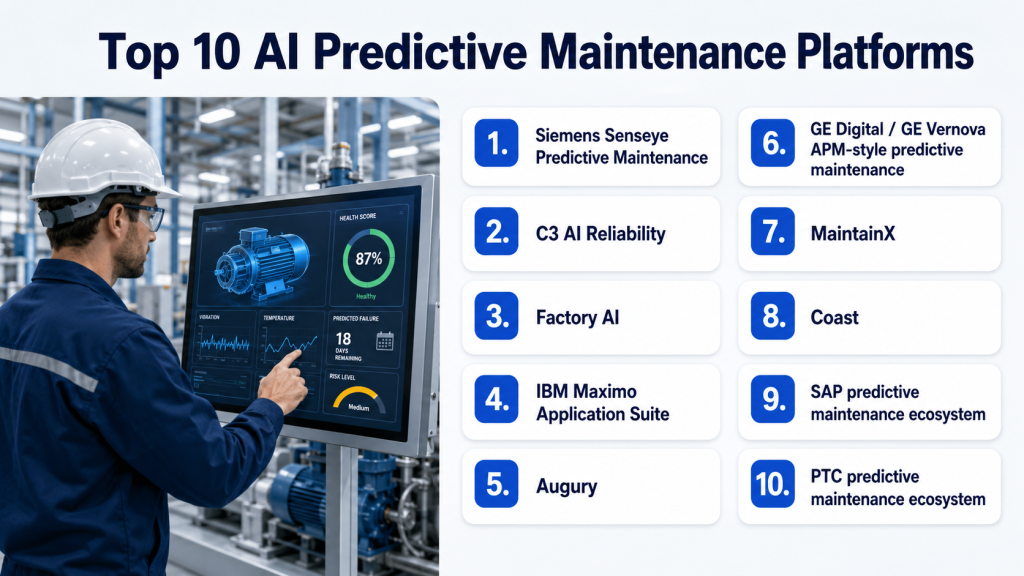
Top 10 AI Predictive Maintenance Platforms
1. Siemens Senseye Predictive Maintenance
One line verdict: Best for manufacturers wanting scalable predictive maintenance across many assets without depending on specialist data science.
Short description:
Senseye Predictive Maintenance is Siemens’ industrial AI approach to predictive maintenance, combining software, services, and domain expertise to help teams understand asset health, anticipate failure risk, and decide where to act first. It is particularly strong for organizations seeking scalable condition-based maintenance using existing machine and maintenance data.
Standout Capabilities
- Scalable predictive maintenance for manufacturing and industrial companies.
- Uses existing data rather than relying only on new sensor programs.
- Helps teams understand asset health and prioritize action.
- Designed to avoid dependence on specialist data science skills.
- Generative AI conversational interface added for easier maintenance insight access.
- Processes data from multiple machines, systems, and maintenance software.
- Outcome oriented SaaS approach inherited from Senseye’s original model.
AI Specific Depth
- Model support: Proprietary machine learning and AI; multi-model or BYO model support not publicly stated.
- Knowledge integration: Integrates IoT sensor data, machine data, operational metrics, and maintenance software inputs.
- Evaluation: Public outcome claims include up to 50 percent reduction in unplanned downtime in cited material, though results vary by deployment.
- Guardrails: Supports maintenance decision processes, but specific AI guardrail details are not publicly stated.
- Observability: Asset health understanding and failure risk visibility are central; deeper model traceability details are not publicly stated.
Pros
- Strong industrial credibility and scale story.
- Good brownfield fit using existing data.
- Easier adoption path for teams without internal data science expertise.
Cons
- Detailed public pricing is not stated.
- Public security and deployment specifics are limited in reviewed material.
- Best value depends on maintenance workflow adoption, not just model accuracy.
Security and Compliance
Not publicly stated in the reviewed material for this comparison.
Deployment and Platforms
Senseye is publicly described as a cloud-based SaaS solution in reviewed partner material, while Siemens presents it as a scalable solution approach that can include software and services; exact deployment variants were not fully detailed in the reviewed pages.
Integrations and Ecosystem
Senseye is strongest when used as part of a broader Siemens industrial digitalization approach, but it also emphasizes compatibility with existing maintenance and machine data sources.
- Existing machine and maintenance data.
- Multiple maintenance software sources.
- Industrial AI within Siemens ecosystem.
- Services and expert guidance.
Pricing Model
Best Fit Scenarios
- Multi-site manufacturing predictive maintenance rollouts.
- Brownfield industrial environments with mixed asset types.
- Teams wanting AI guidance without heavy internal data science staffing.
2. C3 AI Reliability
One line verdict: Best for large asset-intensive enterprises needing AI predictive maintenance across complex data and asset fleets.
Short description:
C3 AI Reliability is an AI-enabled predictive maintenance application that helps asset operators improve uptime, lower costs, and predict equipment failures in advance. It is well suited to enterprises that need to unify sensor data, maintenance records, inventory data, and operational context across complex environments.
Standout Capabilities
- Predicts subsystem and component failures before they occur.
- Optimizes maintenance schedules based on more than operating hours.
- Supports part lifecycle forecasting and remaining life estimation.
- Improves spare parts demand forecasting and inventory decisions.
- Unifies data from sensors, documents, maintenance records, and process diagrams.
- Designed for predictive monitoring at scale across large fleets and systems.
- Strong public utility case study showing measurable asset-failure reduction.
AI Specific Depth
- Model support: Proprietary AI platform with survival analysis and failure prediction modules; BYO model support not publicly stated in reviewed material.
- Knowledge integration: Sensor data, maintenance records, parts inventory, documents, process diagrams, and other data sources.
- Evaluation: Public case study cites 48 percent transformer failure reduction and significant economic value in a utility deployment.
- Guardrails: Not publicly stated in detail.
- Observability: Dynamic updating of recommendations as new data arrives is public, but detailed model trace tooling is not publicly stated.
Pros
- Strong fit for large-scale enterprise asset environments.
- Rich data unification capabilities.
- Clear support for maintenance, parts, and lifecycle optimization together.
Cons
- Likely more complex than smaller teams need.
- Public pricing is not stated.
- Detailed operator workflow and UI simplicity are less clear from reviewed material.
Security and Compliance
Not publicly stated in the reviewed material for this comparison.
Deployment and Platforms
Not publicly stated in the reviewed material for this comparison.
Integrations and Ecosystem
C3 AI stands out when predictive maintenance depends on unifying many enterprise systems rather than analyzing one narrow sensor stream.
- Sensor and operational data.
- Maintenance records.
- Parts inventory and supply planning.
- Flexible enterprise data model.
Pricing Model
Best Fit Scenarios
- Utilities and large infrastructure fleets.
- Enterprises with many disparate maintenance data sources.
- Organizations optimizing both failures and parts planning.
3. Factory AI
One line verdict: Best for teams wanting AI powered predictive maintenance tightly paired with CMMS style workflows.
Short description:
Factory AI positions itself as a predictive maintenance and AI-powered CMMS platform aimed at reducing maintenance costs and preventing asset failures. It is attractive to teams that want maintenance intelligence and execution workflows closer together instead of stitched across separate systems.
Standout Capabilities
- AI powered predictive maintenance plus CMMS positioning.
- Focus on maintenance cost reduction and asset failure prevention.
- Likely useful for moving from alerting into action.
- Practical fit for operations teams wanting workflow continuity.
- Free-start positioning lowers evaluation friction.
AI Specific Depth
- Model support: AI powered platform is publicly stated, exact model flexibility not publicly stated.
- Knowledge integration: CMMS plus predictive maintenance context is public; exact connector details not publicly stated in reviewed material.
- Evaluation: Public marketing emphasizes cost reduction and prevention outcomes, formal benchmark details not publicly stated.
- Guardrails: Not publicly stated.
- Observability: Not publicly stated.
Pros
- Strong workflow alignment between maintenance intelligence and execution.
- Appealing for teams that want practical day-to-day usability.
- Lower barrier to initial evaluation.
Cons
- Public technical depth is limited.
- Enterprise scalability and brownfield integration specifics are not clear publicly.
- Security and compliance details were not verified in reviewed material.
Security and Compliance
Not publicly stated in the reviewed material for this comparison.
Deployment and Platforms
Not publicly stated in the reviewed material.
Integrations and Ecosystem
Factory AI appears strongest for organizations that want predictive maintenance outcomes embedded inside maintenance management workflows rather than delivered as a separate analytics layer.
- AI powered CMMS context.
- Predictive maintenance alignment.
- Maintenance cost reduction focus.
- Operational workflow orientation.
Pricing Model
Not publicly stated beyond free-start messaging.
Best Fit Scenarios
- Maintenance teams wanting one workflow from alert to work order.
- Mid-sized operations evaluating predictive maintenance quickly.
- Organizations preferring CMMS-centered adoption.
4. IBM Maximo Application Suite
One line verdict: Best for enterprises that want predictive maintenance within broader asset management and operational workflows.
Short description:
IBM publicly highlights AI in predictive maintenance as part of a broader shift toward real-time, data-driven asset intervention. In practice, IBM’s position is most compelling for organizations that want predictive maintenance integrated into enterprise asset management rather than used as a narrow standalone model layer.
Standout Capabilities
- Strong thought leadership and enterprise asset management context for AI maintenance.
- Real-time forecasting of when machines require intervention.
- Good fit for organizations already invested in IBM asset operations stack.
- Broad enterprise maintenance and operations relevance.
- Natural positioning for asset lifecycle management use cases.
AI Specific Depth
- Model support: AI-based predictive maintenance is publicly described; exact model flexibility for this comparison is not publicly stated.
- Knowledge integration: Real-time data and asset context are central to IBM’s predictive maintenance framing.
- Evaluation: Public article is conceptual and does not provide product-level benchmark details here.
- Guardrails: Not publicly stated in reviewed material.
- Observability: Not publicly stated in reviewed material.
Pros
- Strong enterprise credibility.
- Good fit for organizations wanting PdM inside broader asset management.
- Useful for companies already using IBM operations tools.
Cons
- Public feature verification for this specific comparison is limited.
- AI technical depth and deployment specifics were not fully visible in reviewed material.
- May be heavier than teams looking for a narrower PdM product.
Security and Compliance
Not publicly stated in the reviewed material for this comparison.
Deployment and Platforms
Not publicly stated in the reviewed material.
Integrations and Ecosystem
IBM’s value is strongest when predictive maintenance is one part of a broader enterprise operations and asset-management architecture.
- Enterprise asset management context.
- Real-time predictive intervention framing.
- Broad operations stack relevance.
- Maintenance strategy modernization.
Pricing Model
Best Fit Scenarios
- Existing IBM asset management customers.
- Enterprises unifying asset lifecycle and predictive maintenance.
- Asset-intensive operations with broad EAM needs.
5. Augury
One line verdict: Best for organizations prioritizing machine health insights and condition-based maintenance at industrial scale.
Short description:
Augury is widely recognized in predictive maintenance discussions for machine health and industrial asset monitoring. In the reviewed material, it appears as one of the notable companies using AI for predictive maintenance and is most relevant for organizations emphasizing machine condition intelligence.
Standout Capabilities
- Strong market recognition in AI predictive maintenance landscapes.
- Focus on machine health and early failure detection.
- Good fit for condition-based maintenance programs.
- Useful for industrial asset reliability teams.
- Established presence in category shortlists.
AI Specific Depth
- Model support: Proprietary AI approach is implied by category coverage; exact model details not publicly stated in reviewed material here.
- Knowledge integration: Not publicly stated in reviewed material here.
- Evaluation: Not publicly stated in reviewed material here.
- Guardrails: Not publicly stated.
- Observability: Not publicly stated.
Pros
- Strong category reputation.
- Clear alignment with machine health use cases.
- Good shortlist candidate for industrial reliability teams.
Cons
- Public technical and deployment detail were not sufficiently verified here.
- Security and compliance specifics were not reviewed.
- Buyers should validate exact workflow fit and integrations.
Security and Compliance
Not publicly stated in the reviewed material for this comparison.
Deployment and Platforms
Not publicly stated in the reviewed material.
Integrations and Ecosystem
Augury is best treated here as a strong category contender that warrants direct product validation, especially for machine-health-focused programs.
- Machine health focus.
- Predictive maintenance relevance.
- Industrial reliability applicability.
- Category recognition.
Pricing Model
Best Fit Scenarios
- Machine condition monitoring programs.
- Industrial reliability teams building PdM maturity.
- Plants prioritizing early machine fault insight.
6. GE Digital / GE Vernova APM-style predictive maintenance
One line verdict: Best for energy and industrial operators wanting predictive maintenance inside broader asset performance management.
Short description:
GE Digital, now reflected in current market discussions through GE Vernova and broader APM contexts, has long been associated with predictive maintenance and industrial asset optimization. In the reviewed material, it is cited among notable predictive maintenance companies, making it a relevant option for asset performance management-led buyers.
Standout Capabilities
- Strong legacy position in industrial predictive maintenance.
- Natural fit with asset performance management workflows.
- Good relevance for energy and heavy industry.
- Suitable for large asset fleets and infrastructure contexts.
- Broad industrial operations orientation.
AI Specific Depth
- Model support: Not publicly stated in the reviewed material here.
- Knowledge integration: APM-style relevance is implied; exact connectors not publicly stated here.
- Evaluation: Not publicly stated in reviewed material.
- Guardrails: Not publicly stated.
- Observability: Not publicly stated.
Pros
- Strong industrial heritage.
- Good fit for asset-intensive infrastructure environments.
- Relevant to buyers already thinking in APM terms.
Cons
- Public product-level verification was limited in reviewed material.
- AI feature depth not clearly visible here.
- Buyers should validate current product scope directly.
Security and Compliance
Not publicly stated in the reviewed material for this comparison.
Deployment and Platforms
Not publicly stated in the reviewed material.
Integrations and Ecosystem
This is most relevant for organizations evaluating predictive maintenance as part of broader asset performance transformation rather than as a standalone analytics buy.
- APM relevance.
- Industrial predictive maintenance heritage.
- Heavy industry applicability.
- Fleet and infrastructure orientation.
Pricing Model
Best Fit Scenarios
- Utilities and energy operations.
- Heavy industry APM programs.
- Enterprises with complex asset fleets.
7. MaintainX
One line verdict: Best for teams wanting predictive maintenance close to frontline maintenance execution and usability.
Short description:
MaintainX is commonly discussed in predictive maintenance software comparisons as a maintenance operations platform with a strong usability reputation. It is best suited to teams that want maintenance workflows, inspections, and operational coordination connected to reliability improvement efforts.
Standout Capabilities
- Strong presence in predictive maintenance software comparisons.
- Likely high usability for frontline maintenance teams.
- Good workflow fit for inspections and maintenance coordination.
- Useful bridge between operations and maintenance execution.
- Appealing for organizations needing adoption by technicians, not just analysts.
AI Specific Depth
- Model support: Not publicly stated in reviewed material here.
- Knowledge integration: Maintenance workflow relevance is public; exact PdM data integration details were not reviewed here.
- Evaluation: Not publicly stated in reviewed material.
- Guardrails: Not publicly stated.
- Observability: Not publicly stated.
Pros
- Strong operational usability angle.
- Good fit for maintenance team adoption.
- Useful shortlist option when execution workflow matters most.
Cons
- Public AI predictive maintenance depth was not fully verified here.
- Enterprise-scale brownfield analytics specifics are unclear from reviewed material.
- Buyers should validate advanced predictive features directly.
Security and Compliance
Not publicly stated in the reviewed material for this comparison.
Deployment and Platforms
Not publicly stated in the reviewed material.
Integrations and Ecosystem
MaintainX is most attractive for organizations that value maintainability, user adoption, and work execution alongside predictive maintenance ambitions.
- Maintenance workflow orientation.
- Predictive maintenance shortlist relevance.
- Operational coordination fit.
- Frontline usability emphasis.
Pricing Model
Not publicly stated in the reviewed material for this comparison.
Best Fit Scenarios
- Technician-driven maintenance organizations.
- Teams improving execution discipline before full PdM maturity.
- Operations-first maintenance programs.
8. Coast
One line verdict: Best for smaller operations seeking approachable predictive maintenance software with simpler adoption.
Short description:
Coast appears in predictive maintenance software reviews as an approachable option for organizations looking to reduce downtime and manage equipment reliability. It is best suited to teams that want a simpler entry point rather than a highly complex industrial AI platform.
Standout Capabilities
- Included in recent predictive maintenance software reviews.
- Condition-monitoring-based failure prediction positioning.
- Likely simpler than enterprise-heavy platforms.
- Useful for maintenance teams wanting quicker setup.
- Good fit for smaller or mid-sized operations.
AI Specific Depth
- Model support: Not publicly stated in reviewed material here.
- Knowledge integration: Condition monitoring data usage is public at a high level.
- Evaluation: Not publicly stated in reviewed material.
- Guardrails: Not publicly stated.
- Observability: Not publicly stated.
Pros
- Lower complexity starting point.
- Good for teams early in predictive maintenance adoption.
- Practical relevance for reducing downtime.
Cons
- Public enterprise AI depth is limited.
- Brownfield and large-scale integration specifics are not clear.
- Best fit may be narrower than major industrial platforms.
Security and Compliance
Not publicly stated in the reviewed material.
Deployment and Platforms
Not publicly stated in the reviewed material.
Integrations and Ecosystem
Coast is most relevant for buyers who want a simpler predictive maintenance starting point rather than a highly customized industrial intelligence stack.
- Predictive maintenance software relevance.
- Equipment reliability focus.
- Downtime reduction orientation.
- Simpler adoption profile.
Pricing Model
Not publicly stated in the reviewed material for this comparison.
Best Fit Scenarios
- SMB maintenance teams.
- First predictive maintenance rollout.
- Simpler equipment reliability programs.
9. SAP predictive maintenance ecosystem
One line verdict: Best for enterprises that want predictive maintenance tied closely to ERP and asset operations processes.
Short description:
SAP is frequently included in predictive maintenance company landscapes because of its strength in enterprise process integration and asset management. It is most relevant when predictive maintenance needs to connect closely with ERP, service, procurement, and maintenance execution processes.
Standout Capabilities
- Strong enterprise process integration potential.
- Relevant for maintenance tied to procurement and asset planning.
- Good fit for organizations already standardized on SAP.
- Supports a process-centric approach to maintenance decisions.
- Attractive where enterprise workflow continuity matters.
AI Specific Depth
- Model support: Not publicly stated in reviewed material here.
- Knowledge integration: Enterprise data and process integration relevance are implied.
- Evaluation: Not publicly stated.
- Guardrails: Not publicly stated.
- Observability: Not publicly stated.
Pros
- Strong ecosystem potential for SAP customers.
- Good for linking PdM to enterprise workflows.
- Useful in procurement and service-heavy environments.
Cons
- Product-level predictive maintenance detail was not verified here.
- AI depth and deployment specifics are unclear from reviewed material.
- May be more attractive for ecosystem fit than best-in-class PdM depth.
Security and Compliance
Not publicly stated in the reviewed material for this comparison.
Deployment and Platforms
Not publicly stated in the reviewed material.
Integrations and Ecosystem
SAP matters most when predictive maintenance is part of a larger enterprise systems strategy rather than a standalone reliability initiative.
- ERP relevance.
- Asset operations process fit.
- Service and procurement alignment.
- Enterprise systems continuity.
Pricing Model
Best Fit Scenarios
- SAP-centric enterprises.
- Maintenance programs tied to ERP workflows.
- Large organizations prioritizing systems continuity.
10. PTC predictive maintenance ecosystem
One line verdict: Best for industrial organizations connecting IoT, asset monitoring, and predictive maintenance in one ecosystem.
Short description:
PTC appears in predictive maintenance landscapes because of its relevance to industrial IoT, connected asset monitoring, and digital operations. It is best suited to buyers who want predictive maintenance tied to broader connected-product and industrial data initiatives.
Standout Capabilities
- Industrial IoT and connected asset relevance.
- Good fit for organizations building broader digital thread strategies.
- Useful where predictive maintenance overlaps with connected operations.
- Attractive for industrial monitoring-led use cases.
- Strong ecosystem relevance in smart manufacturing contexts.
AI Specific Depth
- Model support: Not publicly stated in reviewed material here.
- Knowledge integration: IoT and connected asset ecosystem relevance are public at a high level.
- Evaluation: Not publicly stated.
- Guardrails: Not publicly stated.
- Observability: Not publicly stated.
Pros
- Strong fit for IoT-centric industrial strategies.
- Useful where connected asset data is already central.
- Good shortlist candidate for smart manufacturing teams.
Cons
- Public PdM-specific technical detail was limited in reviewed material.
- Buyers should validate maintenance workflow depth directly.
- Security and deployment specifics were not publicly verified here.
Security and Compliance
Not publicly stated in the reviewed material for this comparison.
Deployment and Platforms
Not publicly stated in the reviewed material.
Integrations and Ecosystem
PTC is most relevant when predictive maintenance is part of a connected operations or industrial IoT program rather than a standalone maintenance analytics purchase.
- Industrial IoT alignment.
- Connected asset relevance.
- Smart manufacturing fit.
- Digital operations context.
Pricing Model
Best Fit Scenarios
- IoT-led predictive maintenance initiatives.
- Smart manufacturing programs.
- Organizations linking connected asset data to reliability strategy.
Comparison Table
Scoring and Evaluation
The scores below are comparative and based on public evidence of predictive maintenance depth, scalability, workflow fit, enterprise integration, and practical usability. Platforms with clearer public evidence for failure prediction, enterprise data integration, and measurable outcomes scored higher, while broader ecosystems with less verified product detail were scored more conservatively. In this category, public documentation quality varies widely, so lower scores often reflect lower transparency rather than weak real-world capability.
| Tool | Core | Reliability and Eval | Guardrails | Integrations | Ease | Performance and Cost | Security and Admin | Support | Weighted Total |
|---|---|---|---|---|---|---|---|---|---|
| Siemens Senseye | 9 | 8 | 6 | 8 | 8 | 8 | 5 | 8 | 7.80 |
| C3 AI Reliability | 9 | 9 | 6 | 9 | 6 | 7 | 5 | 7 | 7.75 |
| Factory AI | 7 | 5 | 4 | 6 | 8 | 8 | 4 | 5 | 6.15 |
| IBM Maximo ecosystem | 7 | 5 | 5 | 8 | 6 | 6 | 5 | 8 | 6.40 |
| Augury | 7 | 5 | 4 | 6 | 7 | 7 | 4 | 6 | 5.95 |
| GE Digital / GE Vernova APM | 7 | 5 | 4 | 7 | 5 | 6 | 5 | 6 | 5.95 |
| MaintainX | 6 | 4 | 4 | 6 | 9 | 8 | 4 | 7 | 5.95 |
| Coast | 6 | 4 | 4 | 5 | 8 | 8 | 4 | 5 | 5.55 |
| SAP ecosystem | 6 | 4 | 4 | 8 | 5 | 6 | 5 | 7 | 5.90 |
| PTC ecosystem | 6 | 4 | 4 | 7 | 5 | 6 | 4 | 6 | 5.55 |
- Top 3 for Enterprise: Siemens Senseye, C3 AI Reliability, IBM Maximo ecosystem.
- Top 3 for SMB: Factory AI, Coast, MaintainX.
- Top 3 for Developers: C3 AI Reliability, Siemens Senseye, PTC ecosystem.
Which Tool Is Right for You
Solo and Small Teams
Very small operations should avoid overbuying. If the team lacks mature maintenance data, start with a simpler CMMS or maintenance workflow platform before investing in a large predictive maintenance stack. Coast and Factory AI are more approachable entry points than heavyweight enterprise systems.
SMB
Small and mid-sized operations usually need quick uptime gains and easier adoption, not an overly complex analytics program. Factory AI, Coast, and MaintainX are the most practical starting points when usability, workflow fit, and faster rollout matter more than deep enterprise-scale modeling.
Mid Market
Mid-market manufacturers often need stronger integration and broader asset visibility without full-scale digital transformation. Siemens Senseye and IBM-style EAM-connected approaches fit well when predictive maintenance needs to connect with broader operations but still stay manageable.
Enterprise
Large enterprises should prioritize data integration, brownfield compatibility, asset coverage, and governance over flashy demos. Siemens Senseye and C3 AI Reliability stand out when the goal is multi-site scale, existing-data leverage, and enterprise data unification across large asset populations.
Regulated Industries
In regulated or high-risk environments such as utilities, energy, or critical infrastructure, explainability, maintenance traceability, and operational governance matter as much as model performance. C3 AI’s utility case and Siemens’ industrial domain focus make them stronger fits where reliability decisions need to be defendable and operationally robust.
Budget vs Premium
Budget-focused buyers should start with one critical failure mode and one site, then prove value before expanding. Premium buyers can justify richer enterprise platforms when the avoided cost of downtime, parts waste, or service disruption is high enough to support broader data integration and workflow redesign.
Build vs Buy
Build only when your organization has strong internal data science, industrial engineering, and reliability talent plus enough proprietary data to justify custom models. Most teams should buy first because predictive maintenance value usually depends more on integration, workflow adoption, and maintenance execution than on inventing a new model from scratch.
Implementation Playbook
First 30 Days
Pick one asset class with high downtime cost and good historical data, such as pumps, compressors, motors, or transformers. Define success metrics before the pilot begins, including downtime reduction, alert precision, maintenance labor efficiency, spare parts savings, and planner adoption.
Next 60 Days
Connect the minimum viable data stack: sensor signals, maintenance records, failure history, asset registry, and work order outcomes. Set escalation rules so alerts are reviewed, validated, and translated into maintenance actions through existing planner and technician workflows rather than living in a separate analytics silo.
Next 90 Days
Expand only after proving useful alert quality and operational follow-through. Add more asset classes, compare predicted vs actual failures, refine alert thresholds, document operator feedback, and build repeatable governance for how predictive signals trigger inspections, parts planning, and work execution.
Common Mistakes and How to Avoid Them
- Starting with too many asset classes at once.
- Treating predictive maintenance as a dashboard project instead of an operational workflow.
- Ignoring technician trust and alert explainability.
- Buying a platform before confirming historian and CMMS connectivity.
- Expecting instant ROI without maintenance process change.
- Failing to define what counts as a useful prediction.
- Overlooking spare parts and planner workflows in PdM rollout.
- Running pilots with weak failure history and poor data quality.
- Assuming more alerts means better maintenance.
- Skipping brownfield compatibility checks in older plants.
FAQs
1. What is an AI predictive maintenance platform
It is software that uses machine learning, operational data, and maintenance history to predict equipment failures and help teams intervene before breakdowns occur.
2. How is predictive maintenance different from preventive maintenance
Preventive maintenance uses fixed schedules, while predictive maintenance uses actual equipment condition and data patterns to determine when intervention is needed.
3. Do these platforms require new sensors
Not always. Some leading platforms, especially Siemens Senseye, publicly emphasize working with existing machine and maintenance data.
4. Which industries benefit most
Manufacturing, utilities, mining, energy, transport, and other asset-intensive sectors benefit most because downtime is expensive and asset reliability is critical.
5. Can these tools predict remaining useful life
Yes, some platforms such as C3 AI publicly describe remaining life forecasting and maintenance schedule optimization capabilities.
6. Are these platforms hard to deploy in older plants
They can be, which is why brownfield readiness and compatibility with existing historians and maintenance systems matter so much in vendor selection.
7. What is the biggest implementation risk
The biggest risk is weak integration between predictive insights and actual maintenance workflows, which causes good alerts to be ignored or mishandled.
8. How should a company pilot one of these tools
Start with one high-value asset class, define clear success metrics, and validate whether predictions actually change maintenance behavior and business outcomes.
9. Are public ratings available for these platforms
Reliable public ratings were not confidently verified for most vendors in this comparison, so the table uses N A instead of guessing.
10. When should a company build instead of buy
A company should build only when it has strong internal industrial AI capability and a very specific reliability problem that off-the-shelf platforms cannot address well.
11. What does success look like
Success means fewer unplanned failures, better maintenance prioritization, more efficient labor and parts usage, and higher trust in maintenance decisions.
12. Is generative AI replacing predictive models here
No. Generative AI is mainly being added as an interface and knowledge layer, while the core predictive value still depends on machine learning and operational data quality.
Conclusion
The best AI predictive maintenance platform depends on whether your organization needs scalable brownfield deployment, deep enterprise data unification, easier frontline maintenance workflows, or a broader asset management ecosystem. Siemens Senseye and C3 AI Reliability stand out for large industrial environments, while lighter platforms make more sense for teams focused on adoption and quicker rollout. The smartest buying path is to choose one costly failure mode, verify that the platform can turn existing data into trusted maintenance actions, prove ROI on a small but meaningful scope, and then expand only after technicians, planners, and reliability leaders are actually using the output in daily operations.

Find Trusted Cardiac Hospitals
Compare heart hospitals by city and services — all in one place.
Explore Hospitals
Predictive maintenance platforms deliver value only when asset telemetry is reliable and maintenance teams actually act on predictions before failures occur.