
Introduction
AI R&D portfolio prioritization tools help research, innovation, and strategy teams decide which projects, programs, or assets deserve funding, staffing, and executive attention. These platforms use AI, predictive analytics, optimization engines, and scenario modeling to rank opportunities, forecast resource bottlenecks, estimate success probability, and connect investments to strategic outcomes. This matters because R&D organizations are dealing with tighter budgets, more complex pipelines, longer development timelines, and higher pressure to justify every decision with evidence rather than intuition. Real world use cases include AI driven demand scoring, portfolio scenario modeling, predictive resource allocation, pipeline health monitoring, drug asset prioritization, and valuation support for business development or licensing. Buyers should evaluate these tools based on data integration, scoring transparency, strategic alignment support, scenario planning depth, resource modeling, governance and auditability, usability for non-technical stakeholders, and how well AI recommendations fit real decision forums.
These tools are best for enterprise R&D organizations, innovation teams, pharma portfolio offices, product development leaders, and PMO groups that need to evaluate many possible investments under real budget and capacity constraints. They are especially useful when leaders need faster prioritization, better portfolio balance, or clearer trade off analysis across strategic, financial, and operational dimensions. They are less ideal for very small teams with only a few active initiatives, where a lightweight planning workflow may still be enough.
Why it matters
Traditional R&D portfolio decisions often rely on static business cases, Excel models, and annual planning workshops that quickly go out of date. As markets shift faster and R&D portfolios become more complex, this approach struggles to keep priorities aligned with strategy, available capacity, and real-world risk. AI changes the equation by continuously processing internal and external data—costs, timelines, dependencies, historic performance, market signals—and surfacing dynamic recommendations or risk flags instead of one-off rankings. In 2026, the portfolio office is increasingly expected to provide always-on, scenario-based decision support, particularly in sectors like pharma where AI can digest unstructured data and virtual pipeline analytics for drug development decisions. AI R&D portfolio tools elevate the portfolio function from reporting and list-making to a more strategic partner role that supports faster, better informed trade-offs.
Real world use cases
A common use case is AI-driven demand management, where tools automatically score incoming ideas and proposals against criteria like strategic fit, ROI potential, risk, and capacity impact to surface a shortlist for deeper review. Another is predictive resource allocation: platforms simulate different combinations of R&D projects and show when and where bottlenecks will occur, helping leaders choose a portfolio that fits real staffing and budget constraints. Teams also use these tools for ongoing portfolio health monitoring, where AI watches schedule slippage, burn rate, and dependency risk and flags initiatives that are likely to miss value targets. In pharma and life sciences, AI-supported portfolio offices are experimenting with digital twin and virtual pipeline analytics to test different sequences, investment levels, or termination decisions for drug assets without committing real resources first.
Evaluation criteria for buyers
When evaluating AI R&D portfolio prioritization tools, buyers should first assess how well the platform integrates with existing systems such as PPM tools, financial systems, HR/resource data, and—where relevant—domain-specific sources like clinical or technology roadmapping tools. The next priority is decision transparency: leaders need to understand why certain projects are ranked higher, what assumptions are being made, and how AI scores relate to strategic objectives, risk appetite, and capacity constraints. Scenario modeling depth is critical too, including whether the tool supports multi-year “what‑if” planning, constraint handling, and side-by-side comparison of portfolio options. Governance features matter in larger organizations, so look for support for approvals, audit trails, and the ability to combine AI recommendations with human judgment instead of replacing it. Finally, teams should consider usability for non-technical stakeholders, vendor maturity, and whether the platform can handle both innovation-heavy portfolios and more incremental engineering work under one roof.
What Is Changing in This Category
- Portfolio prioritization is shifting from annual planning to continuous adaptive decision support.
- AI is increasingly used to rank projects against real resource and strategy constraints, not only financial return models.
- Scenario planning is becoming a baseline expectation rather than a premium feature.
- Explainability matters more because leaders need to defend why one project beat another.
- Resource bottleneck prediction is becoming central to portfolio quality.
- In pharma, AI is being used to support drug pipeline prioritization and probability of success modeling.
- Portfolio offices are becoming more strategic and less administrative as AI handles more analytical work.
- AI agents are beginning to support portfolio decision workflows in life sciences.
- Technology portfolio and innovation portfolio tools are converging with classic PPM platforms.
- Buyers increasingly want one system that connects demand, prioritization, resources, and execution rather than separate tools.
Quick Buyer Checklist
- Check whether the platform supports R&D specific prioritization rather than only generic project management.
- Ask how AI scores projects and whether the reasoning is visible to stakeholders.
- Review how well the tool handles resource constraints, staffing limits, and dependency risk.
- Confirm whether scenario modeling supports side by side comparison of portfolio options.
- Check integration with financial systems, HR data, PPM workflows, and domain data sources.
- Ask whether leaders can override AI recommendations and document decisions for governance.
- Review whether the tool supports both early idea screening and later stage portfolio optimization.
- Evaluate whether the platform is better for enterprise PMO, innovation management, or pharma pipeline decisions.
- Pilot the product on one real prioritization cycle rather than relying only on demos.
- Confirm whether the platform can evolve from ranking to continuous portfolio monitoring.
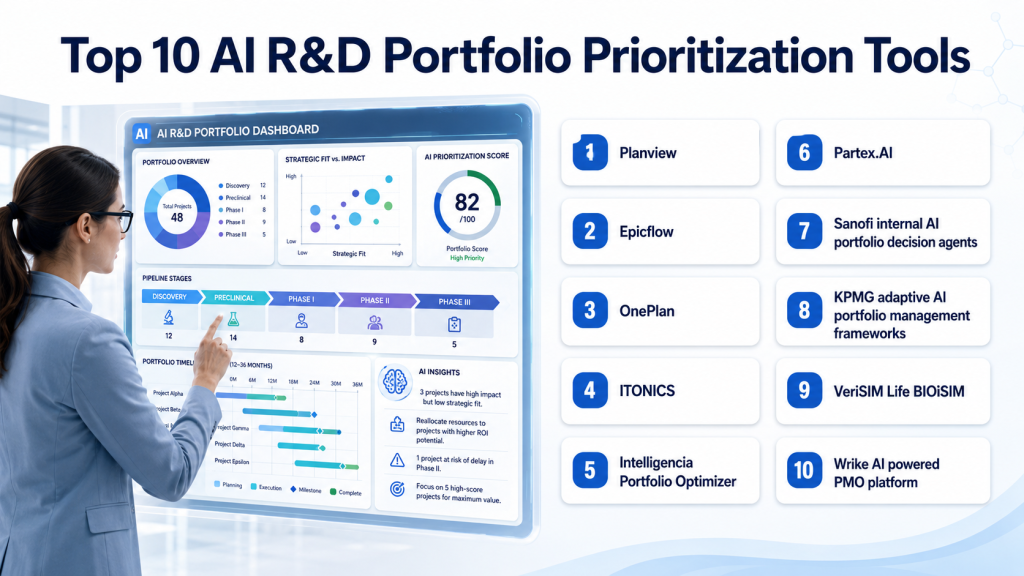
Top 10 AI R&D Portfolio Prioritization Tools
1. Planview
One line verdict: Best for enterprise R&D and PMO teams needing AI assisted prioritization, governance, and scenario planning at scale.
Short description:
Planview offers AI powered project portfolio management that helps leaders prioritize, centralize, and standardize work across the enterprise. It is best suited to organizations that need mature governance, scenario planning, and portfolio visibility across many programs and functions.
Standout Capabilities
- AI powered project and portfolio prioritization.
- Centralizes and standardizes portfolio work.
- Strong scenario planning support.
- Governance oriented enterprise portfolio workflows.
- Broad enterprise portfolio and program management relevance.
- Useful for connecting strategic planning to execution.
AI Specific Depth
- Model support: AI powered portfolio management is publicly stated, exact model flexibility not publicly stated.
- Knowledge integration: Portfolio, program, and planning data integration are core to the platform positioning.
- Evaluation: Public material emphasizes intelligent prioritization and forecasting, but formal benchmark details are not publicly stated.
- Guardrails: Governance support is publicly emphasized.
- Observability: Portfolio visibility and forecasting are public, deeper AI observability detail is not publicly stated.
Pros
- Strong enterprise scale credibility.
- Good fit for formal portfolio governance.
- Broad coverage across prioritization and execution workflows.
Cons
- May be heavier than smaller R&D teams need.
- Public AI technical detail is limited.
- Pricing was not publicly verified in reviewed material.
Security and Compliance
Not publicly stated in the reviewed material for this comparison.
Deployment and Platforms
Not publicly stated in the reviewed material for this comparison.
Integrations and Ecosystem
Planview is most compelling for large organizations that want one enterprise portfolio layer rather than a point prioritization tool.
- Enterprise portfolio management.
- Scenario planning.
- Strategic alignment support.
- Governance tooling.
Pricing Model
Best Fit Scenarios
- Enterprise R&D portfolio governance.
- Multi business unit prioritization.
- Strategy to execution alignment programs.
2. Epicflow
One line verdict: Best for teams that need AI driven portfolio prioritization with people centric resource optimization.
Short description:
Epicflow is an AI powered strategic portfolio management platform with strong emphasis on resource management and portfolio visibility. It is particularly useful for R&D leaders who need better prioritization under real capacity constraints.
Standout Capabilities
- AI driven portfolio optimization.
- People centric resource management.
- Comprehensive portfolio visibility.
- Helps rank projects automatically by priority.
- Strong fit for resource constrained environments.
- Useful for ongoing portfolio balancing.
AI Specific Depth
- Model support: AI powered strategic portfolio management is public, exact model flexibility not publicly stated.
- Knowledge integration: Portfolio and resource management data are central to product positioning.
- Evaluation: Public materials emphasize portfolio organization and resource optimization, formal benchmark details not publicly stated.
- Guardrails: Not publicly stated in detail.
- Observability: Portfolio visibility is publicly emphasized.
Pros
- Strong resource optimization story.
- Good fit for realistic prioritization, not only scoring.
- Useful for teams with chronic resource bottlenecks.
Cons
- Public detail on governance and security is limited.
- AI explainability specifics were not publicly verified.
- May be less specialized for pharma asset prioritization.
Security and Compliance
Not publicly stated in the reviewed material for this comparison.
Deployment and Platforms
Not publicly stated in the reviewed material.
Integrations and Ecosystem
Epicflow is attractive when people capacity, not just budget, is the primary constraint shaping portfolio decisions.
- Resource optimization.
- Portfolio prioritization.
- Visibility across initiatives.
- Strategic portfolio support.
Pricing Model
Best Fit Scenarios
- Resource constrained R&D teams.
- PMOs balancing many active projects.
- Organizations wanting AI plus resource realism.
3. OnePlan
One line verdict: Best for R&D leaders wanting AI insights for prioritization, demand management, and resource allocation.
Short description:
OnePlan positions itself around R&D project portfolio management with AI driven insights for prioritization and effective resource allocation. It is suitable for teams that want portfolio decision support tied closely to strategic goals and demand planning.
Standout Capabilities
- AI driven prioritization insights.
- Effective demand management support.
- Resource allocation alignment to strategic goals.
- R&D specific portfolio management positioning.
- Useful for linking incoming initiatives to portfolio capacity.
AI Specific Depth
- Model support: AI driven insights are publicly stated, exact model flexibility not publicly stated.
- Knowledge integration: Demand, project, and resource data are part of the R&D platform positioning.
- Evaluation: Public messaging emphasizes effective prioritization and alignment, formal benchmark detail not publicly stated.
- Guardrails: Not publicly stated in detail.
- Observability: Not publicly stated in detail.
Pros
- Direct R&D team relevance.
- Good fit for prioritization plus resource allocation.
- Strong strategic alignment messaging.
Cons
- Public technical AI detail is limited.
- Broader governance and compliance detail were not publicly verified here.
- Best fit may depend on broader Microsoft ecosystem alignment, which was not fully verified in reviewed material.
Security and Compliance
Not publicly stated in the reviewed material for this comparison.
Deployment and Platforms
Not publicly stated in the reviewed material.
Integrations and Ecosystem
OnePlan is appealing for R&D groups that want demand prioritization and resource planning in one decision workflow.
Pricing Model
Best Fit Scenarios
- R&D teams formalizing intake and prioritization.
- Strategy aligned resource planning.
- Mid sized innovation portfolios.
4. ITONICS
One line verdict: Best for technology and innovation portfolio teams connecting research pipelines to strategic opportunity areas.
Short description:
ITONICS focuses on innovation and technology portfolio prioritization rather than only classic PMO workflows. It is a strong fit for R&D leaders who need to connect technology assets, trend signals, and strategic investment choices in one platform.
Standout Capabilities
- Single platform to track technology assets and research pipelines.
- Connects investments to business strategy.
- Strong fit for innovation and technology portfolio management.
- Useful for framework based prioritization workflows.
- Relevant to opportunity and trend led R&D planning.
- Broader innovation portfolio orientation than classic PPM tools.
AI Specific Depth
- Model support: AI specific model flexibility is not clearly stated in reviewed material, though strategic platform support is public.
- Knowledge integration: Technology assets, research pipelines, and business strategy linkage are public.
- Evaluation: Public material emphasizes prioritization frameworks and portfolio visibility, detailed AI benchmark methods not publicly stated.
- Guardrails: Not publicly stated in detail.
- Observability: Not publicly stated in detail.
Pros
- Excellent fit for innovation centric R&D.
- Good for technology scouting and strategic portfolio linking.
- Broader than generic project ranking.
Cons
- Less obviously suited to classic PMO heavy environments.
- Public AI technical detail is limited.
- Buyers should validate resource modeling depth.
Security and Compliance
Not publicly stated in the reviewed material.
Deployment and Platforms
Not publicly stated in the reviewed material.
Integrations and Ecosystem
ITONICS is most compelling when the portfolio includes emerging technologies, research themes, and innovation bets that need more than a standard PPM ranking engine.
- Technology asset tracking.
- Research pipeline visibility.
- Strategic portfolio frameworks.
- Innovation management relevance.
Pricing Model
Best Fit Scenarios
- Corporate innovation portfolios.
- Technology roadmapping and prioritization.
- R&D teams linking trend signals to investment decisions.
5. Intelligencia Portfolio Optimizer
One line verdict: Best for pharma teams prioritizing drug assets using AI based probability of success and benchmark data.
Short description:
Intelligencia Portfolio Optimizer is an AI driven drug portfolio product focused on optimizing pipelines, selecting candidates, benchmarking opportunities, and supporting business development decisions. It is built for R&D and BD teams that need more objective probability of technical and regulatory success estimates.
Standout Capabilities
- AI driven probability of technical and regulatory success assessment.
- Pipeline optimization and candidate prioritization.
- Competitive landscape visibility.
- Industry and disease specific benchmarking.
- Explainability via identified PTRS drivers.
- Supports business development and licensing evaluation.
AI Specific Depth
- Model support: Proprietary AI predictive models for clinical development.
- Knowledge integration: Includes industry led, FDA tracked interventional studies and competitive landscape data.
- Evaluation: Publicly states 83% prospectively validated accuracy for Phase 2 oncology program FDA approval forecasting and 90% retrospectively for the cited setting.
- Guardrails: Explainability around PTRS drivers is publicly stated.
- Observability: Dynamic benchmarks and detailed portfolio views are public, deeper technical observability not publicly stated.
Pros
- Highly specialized for drug development portfolio decisions.
- Strong public evidence of explainability and benchmarking.
- Useful across R&D and business development workflows.
Cons
- More domain specific than general R&D portfolio tools.
- Public deployment and security specifics were not verified here.
- Best fit is strongest in pharma and biotech.
Security and Compliance
Not publicly stated in the reviewed material for this comparison.
Deployment and Platforms
Not publicly stated in the reviewed material.
Integrations and Ecosystem
Intelligencia stands out as one of the clearest examples of AI specialized for portfolio prioritization in life sciences rather than general enterprise PPM.
Pricing Model
Best Fit Scenarios
6. Partex.AI
One line verdict: Best for therapeutic asset prioritization and capital efficient drug development pathway decisions.
Short description:
Partex.AI focuses on identifying optimal therapeutic applications and clinical development pathways for in licensed or off strategy drug assets. It is best suited to organizations making asset management and repositioning decisions in pharma and biotech.
Standout Capabilities
- AI driven therapeutic asset management.
- Supports identification of optimal therapeutic applications.
- Helps define clinical development pathways.
- Strong fit for repositioning and asset incubation.
- Capital efficient development framing.
AI Specific Depth
- Model support: Proprietary AI platform is publicly stated.
- Knowledge integration: Combines strategic, scientific, clinical, and commercial development considerations.
- Evaluation: Public messaging emphasizes de risking and strategic commercial potential, but formal benchmark methods are not publicly stated.
- Guardrails: Not publicly stated in detail.
- Observability: Not publicly stated in detail.
Pros
- Strong fit for asset repositioning and portfolio strategy.
- Useful for lean and capital efficient development models.
- Clear pharma specific value proposition.
Cons
- Narrower category fit than broad enterprise PPM.
- Public security and deployment details are limited.
- Buyers should validate how much workflow support exists beyond asset strategy.
Security and Compliance
Not publicly stated in the reviewed material for this comparison.
Deployment and Platforms
Not publicly stated in the reviewed material.
Integrations and Ecosystem
Partex.AI is best understood as a drug asset prioritization and strategic development platform rather than a generic project portfolio manager.
- Asset management.
- Therapeutic application discovery.
- Clinical pathway strategy.
- Portfolio structuring relevance.
Pricing Model
Best Fit Scenarios
- Drug repositioning portfolios.
- In licensing asset evaluation.
- Capital efficient biotech pipeline strategy.
7. Sanofi internal AI portfolio decision agents
One line verdict: Best as a model for pharma teams exploring AI agents in portfolio offices, not as a commercial off the shelf product.
Short description:
Sanofi publicly describes using AI agents such as “Plai” to support smarter and faster portfolio decisions across the R&D value chain. This is not a software product for direct purchase, but it is an important proof point for how AI agents are entering portfolio decision workflows.
Standout Capabilities
- AI agent support for portfolio decision making.
- R&D value chain relevance.
- Strong demonstration of internal portfolio office transformation.
- Useful strategic example for pharma buyers.
- Signals future direction of agentic portfolio support.
AI Specific Depth
- Model support: AI agent approach is publicly stated, exact model stack not publicly stated.
- Knowledge integration: Applied across the R&D value chain.
- Evaluation: Public messaging emphasizes smarter and faster decisions, formal benchmarks not publicly stated.
- Guardrails: Not publicly stated in detail.
- Observability: Not publicly stated in detail.
Pros
- Strong evidence that agentic workflows are becoming real in pharma.
- Useful benchmark for internal build strategies.
- Highlights strategic potential beyond dashboards.
Cons
- Not a commercial product.
- Public technical detail is limited.
- Hard to compare directly with vendor tools.
Security and Compliance
Not publicly stated in the reviewed material.
Deployment and Platforms
Internal implementation; commercial platform details are not applicable.
Integrations and Ecosystem
This example is most useful for buyers deciding whether to buy a platform now or build agentic decision support on top of their own systems later.
- AI agent workflows.
- R&D decision support.
- Pharma portfolio office transformation.
- Internal build benchmark.
Pricing Model
N A as a direct commercial product in this comparison.
Best Fit Scenarios
- Internal AI strategy benchmarking.
- Pharma portfolio office transformation planning.
- Agentic workflow inspiration.
8. KPMG adaptive AI portfolio management frameworks
One line verdict: Best for enterprises designing AI assisted portfolio processes before choosing a specific software stack.
Short description:
KPMG describes AI powered adaptive project portfolio management with AI driven project selection, prioritization, and portfolio optimization. This is not a direct software product, but it is highly relevant for organizations planning operating model and governance changes around AI supported prioritization.
Standout Capabilities
- AI driven project selection and prioritization concepts.
- Adaptive portfolio management focus.
- Portfolio optimization operating model relevance.
- Useful for governance and transformation planning.
- Strong enterprise decision process framing.
AI Specific Depth
- Model support: Not productized in reviewed material.
- Knowledge integration: Broad portfolio and project data orientation is public.
- Evaluation: Conceptual and transformation focused, not benchmark based.
- Guardrails: Strong implied relevance to enterprise governance, but exact controls are not productized.
- Observability: Not publicly stated.
Pros
- Strong fit for portfolio process redesign.
- Useful before selecting software.
- Good for enterprises needing operating model alignment.
Cons
- Not a packaged tool.
- Limited product comparability.
- Operational value depends on implementation partner quality.
Security and Compliance
Varies by implementation and is not publicly stated in reviewed material.
Deployment and Platforms
Integrations and Ecosystem
This is most useful for enterprises redesigning how prioritization decisions are made rather than buying a narrow ranking engine first.
- Adaptive portfolio framework.
- Selection and prioritization concepts.
- Optimization design.
- Governance relevance.
Pricing Model
Best Fit Scenarios
- Enterprise transformation programs.
- AI portfolio governance design.
- Pre software operating model work.
9. VeriSIM Life BIOiSIM
One line verdict: Best for preclinical and translational portfolio choices where in silico evidence can de risk R&D bets.
Short description:
VeriSIM Life’s BIOiSIM platform is an AI based translational medicine system designed to reduce time and cost in drug development by predicting outcomes earlier. It is most relevant when portfolio prioritization depends on preclinical translation quality rather than only PMO style scoring.
Standout Capabilities
- AI based translational medicine.
- Predicts clinical outcomes at preclinical stages.
- Reduces failure risk in drug development.
- Can reduce preclinical experimentation needs.
- Useful for earlier de risking of portfolio decisions.
AI Specific Depth
- Model support: AI and ML are publicly stated.
- Knowledge integration: Models translation of compounds across seven species.
- Evaluation: Public messaging emphasizes reduced failure rates and earlier insight, but detailed benchmarking was not fully visible in reviewed material.
- Guardrails: Not publicly stated in detail.
- Observability: Not publicly stated in detail.
Pros
- Strong fit for translational decision making.
- Useful earlier in the drug R&D lifecycle.
- Can support more evidence driven portfolio pruning.
Cons
- More specialized than general R&D portfolio tools.
- Public workflow governance details are limited.
- Best fit is mainly life sciences.
Security and Compliance
Not publicly stated in the reviewed material for this comparison.
Deployment and Platforms
Not publicly stated in the reviewed material.
Integrations and Ecosystem
BIOiSIM matters most for drug development portfolios where translational risk is a major source of poor prioritization decisions.
- Translational modeling.
- Preclinical prediction.
- Drug development de risking.
- In silico decision support.
Pricing Model
Best Fit Scenarios
10. Wrike AI powered PMO platform
One line verdict: Best for organizations wanting connected portfolio intelligence from a work management oriented platform.
Short description:
Wrike describes its AI powered PMO platform as turning scattered tools into connected intelligence for portfolio control. It is relevant for teams that want a more execution connected portfolio layer rather than a purely strategic prioritization engine.
Standout Capabilities
- AI powered PMO platform.
- Connects scattered tools into a more unified portfolio view.
- Useful for control and visibility across work.
- Strong fit for execution linked portfolio management.
- More approachable for cross functional organizations than niche R&D tools.
AI Specific Depth
- Model support: AI powered platform is public, exact model flexibility not publicly stated.
- Knowledge integration: Connected intelligence across work tools is public.
- Evaluation: Public messaging emphasizes portfolio control and connected intelligence, formal benchmark detail not publicly stated.
- Guardrails: Not publicly stated in reviewed material.
- Observability: Not publicly stated in detail.
Pros
- Good bridge between strategy and work execution.
- Useful for organizations already using work management tools.
- Likely easier to adopt than highly specialized platforms.
Cons
- Less R&D specific than niche portfolio tools.
- Public AI prioritization depth is limited.
- May not suit deeply scientific or pharma asset portfolios.
Security and Compliance
Not publicly stated in the reviewed material for this comparison.
Deployment and Platforms
Not publicly stated in the reviewed material.
Integrations and Ecosystem
Wrike is best for teams that want portfolio intelligence tied closely to cross functional work execution rather than purely research portfolio science.
Pricing Model
Best Fit Scenarios
- Cross functional PMO environments.
- Teams wanting execution linked prioritization.
- Organizations already oriented around work management platforms.
Comparison Table
Scoring and Evaluation
The scores below are comparative and based on public evidence of prioritization depth, resource realism, scenario capability, explainability, and relevance to real R&D decision workflows. Enterprise PPM tools scored higher on governance and integration, while pharma specific tools scored higher on domain intelligence and asset quality assessment. Tools that are frameworks or internal examples scored lower on ease and availability even when the strategic concept is strong.
| Tool | Core | Reliability and Eval | Guardrails | Integrations | Ease | Performance and Cost | Security and Admin | Support | Weighted Total |
|---|---|---|---|---|---|---|---|---|---|
| Planview | 9 | 7 | 7 | 9 | 6 | 7 | 7 | 8 | 7.65 |
| Epicflow | 8 | 7 | 5 | 7 | 8 | 8 | 5 | 7 | 7.20 |
| OnePlan | 8 | 6 | 5 | 7 | 8 | 8 | 5 | 6 | 6.95 |
| ITONICS | 8 | 6 | 5 | 7 | 7 | 7 | 5 | 6 | 6.65 |
| Intelligencia Portfolio Optimizer | 9 | 9 | 7 | 7 | 7 | 7 | 5 | 7 | 7.70 |
| Partex.AI | 8 | 6 | 5 | 6 | 6 | 7 | 5 | 6 | 6.30 |
| Sanofi internal AI agents | 7 | 6 | 5 | 6 | 3 | 6 | 4 | 4 | 5.45 |
| KPMG adaptive AI framework | 7 | 5 | 6 | 7 | 4 | 5 | 5 | 6 | 5.80 |
| VeriSIM Life BIOiSIM | 8 | 7 | 5 | 6 | 5 | 7 | 5 | 6 | 6.35 |
| Wrike | 7 | 5 | 5 | 7 | 8 | 8 | 5 | 7 | 6.55 |
- Top 3 for Enterprise: Intelligencia Portfolio Optimizer, Planview, Epicflow.
- Top 3 for SMB: OnePlan, Epicflow, Wrike.
- Top 3 for Developers: Intelligencia Portfolio Optimizer, VeriSIM Life BIOiSIM, KPMG adaptive AI frameworks.
Which Tool Is Right for You
Solo and Small Teams
Small teams usually do not need a large enterprise portfolio platform unless they manage many competing bets. A lighter tool such as OnePlan or Wrike is often more practical if the main goal is visibility, prioritization discipline, and capacity awareness.
SMB
Growing R&D teams need clear prioritization without heavy implementation burden. OnePlan and Epicflow are strong choices when the main pain is balancing demand against finite resources and strategy.
Mid Market
Mid market organizations often need better portfolio processes but still want flexibility. Epicflow, OnePlan, and ITONICS fit well when resource planning, innovation strategy, and manageable deployment effort all matter.
Enterprise
Large enterprises usually need stronger governance, scenario planning, integration, and executive reporting. Planview is the most natural fit here, while pharma enterprises may find Intelligencia more valuable when the real problem is asset quality and clinical success probability rather than generic project prioritization.
Regulated Industries
In regulated sectors such as pharma, explainability, benchmarks, and documented decision reasoning matter more than slick AI scoring. Intelligencia, Partex.AI, and internal agentic models like Sanofi’s example show that domain specificity can matter more than broad enterprise PMO capability.
Budget vs Premium
Budget focused teams should begin with a tool that solves one core issue well, such as resource aware prioritization or visibility. Premium buyers should prioritize explainability, integration, scenario modeling, and governance over simple ranking features.
Build vs Buy
Build when your organization has highly specialized scientific data, mature analytics teams, and strong reasons to keep prioritization logic proprietary. Buy when speed to value, prebuilt workflows, and executive adoption matter more than full technical control.
Implementation Playbook
First 30 Days
Pick one real prioritization cycle, such as annual R&D planning, quarterly portfolio review, or drug asset go no go review. Define success metrics such as time saved, improvement in prioritization consistency, resource fit, executive confidence, and number of projects stopped or accelerated with documented reasoning.
Next 60 Days
Map the data sources behind the decision process, including project metadata, resource capacity, budgets, dependencies, risk inputs, and strategic criteria. Build approval rules so AI output supports human decisions instead of bypassing portfolio governance.
Next 90 Days
Scale only after the pilot proves value. Add scenario libraries, connect more systems, standardize prioritization criteria, and create review loops that compare AI recommendations with actual portfolio outcomes over time.
Common Mistakes and How to Avoid Them
- Treating prioritization as a ranking exercise without resource realism.
- Letting AI scores replace executive reasoning instead of supporting it.
- Using generic PPM tools for scientific asset decisions without domain context.
- Ignoring explainability and auditability.
- Trying to optimize the whole portfolio before defining one decision use case.
- Failing to standardize strategic criteria across business units.
- Not comparing AI recommendations against real portfolio outcomes later.
- Buying for dashboard appeal instead of decision quality.
- Overlooking data quality in project, budget, and resource systems.
- Choosing a tool that cannot scale from prioritization into ongoing monitoring.
FAQs
1. What are AI R&D portfolio prioritization tools
They are software tools that use AI, predictive analytics, and optimization to help leaders decide which R&D initiatives or assets deserve investment and resources.
2. Why are these tools important now
R&D portfolios are getting more complex while budgets and resources remain constrained. AI helps organizations make faster and more data driven trade offs.
3. Are these tools just for large enterprises
No, but large enterprises usually get the most value because they manage more competing projects and more complex resource constraints. Smaller teams can still benefit from lighter tools.
4. What is the difference between generic PPM and R&D prioritization tools
Generic PPM tools focus more on project governance and execution, while R&D prioritization tools often add strategic scoring, scientific risk, or innovation context to investment decisions.
5. Are AI scores enough on their own
No. The best systems support human judgment with better evidence, resource visibility, and scenario analysis rather than replacing portfolio governance.
6. Which tools are best for pharma pipeline decisions
Intelligencia Portfolio Optimizer, Partex.AI, and domain specific internal models like Sanofi’s example are strongest in the reviewed material for pharma style asset prioritization.
7. What should buyers pilot first
They should pilot one real prioritization cycle with live resource, budget, and risk data, then compare AI aided decisions with the current manual process.
8. Is explainability really important here
Yes. Portfolio decisions affect funding, careers, and strategic direction, so leaders need to understand why the system recommends one option over another.
9. Are public ratings available for these tools
Reliable public ratings were not confidently verified for most tools in this comparison, so the table uses N A instead of guessing.
10. What is the biggest implementation risk
The biggest risk is poor data quality and inconsistent prioritization criteria, which can make even advanced AI outputs look arbitrary or untrustworthy.
11. When should a company build instead of buy
A company should build when it has proprietary scientific data, internal analytics capability, and highly specialized decision logic that generic platforms cannot support.
12. What does success look like
Success means better project mix, improved resource fit, more transparent trade offs, faster decision cycles, and stronger alignment between R&D spending and strategic goals.
Conclusion
The best AI R&D portfolio prioritization tool depends on whether your core challenge is enterprise governance, resource constrained prioritization, innovation strategy, or domain specific asset quality in areas like drug development. Some teams need a broad enterprise platform, some need people centric resource realism, and others need AI that understands therapeutic assets, translational risk, or clinical probability of success. The right way to buy in this category is to start with one decision process, test how well the system explains its recommendations, confirm that humans stay in control of final trade offs, and scale only after the platform proves it improves both decision speed and portfolio quality in the real world.

Find Trusted Cardiac Hospitals
Compare heart hospitals by city and services — all in one place.
Explore Hospitals
AI R&D prioritization tools are useful, but meaningful outcomes still depend on data quality, clear business goals, and balancing innovation risk with execution feasibility.