
Introduction
AI Proteomics Pattern Mining Tools leverage machine learning and artificial intelligence to analyze complex proteomics datasets, discover patterns, identify biomarkers, and predict protein functions. These platforms automate workflows including peptide identification, protein quantification, and network inference, enabling researchers to extract meaningful insights from high-dimensional mass spectrometry and proteomics data.
Why it matters: Proteomics generates massive, high-dimensional datasets that are challenging to interpret manually. AI-based pattern mining tools accelerate discovery, improve reproducibility, and help uncover novel biomarkers, disease mechanisms, and drug targets, enabling translational research and personalized medicine.
Real-world use cases include:
- Detecting differential protein expression across samples
- Identifying protein-protein interaction networks
- Mining post-translational modification patterns
- Discovering biomarkers for disease diagnosis or drug response
- Predicting functional protein modules and pathways
- Integrating multi-omics data for systems biology insights
What buyers should evaluate: Accuracy of peptide/protein detection, AI-powered pattern recognition, scalability, integration with mass spectrometry pipelines, data preprocessing and normalization, visualization tools, multi-omics integration, workflow automation, reproducibility, batch effect correction, computational requirements, and vendor support.
Best for: Academic and pharmaceutical research labs, biotech companies, systems biology teams, and translational medicine projects.
Not ideal for: Labs with limited proteomics data or primarily bulk analysis workflows.
What’s Changed in AI Proteomics Pattern Mining Tools
- AI-driven peptide identification and protein inference
- Deep learning for post-translational modification detection
- Pattern recognition for biomarker discovery
- Multi-omics data integration for network analysis
- Cloud-based scalable pipelines for large cohorts
- Automated quality control and normalization
- Visualization dashboards with AI-guided clustering
- BYO AI model support alongside proprietary models
- Real-time evaluation of pattern detection performance
- Workflow reproducibility and version tracking
- Integration with downstream functional annotation tools
- Compliance support for clinical proteomics
Quick Buyer Checklist
- AI-driven peptide/protein identification accuracy
- Pattern recognition and clustering capabilities
- Multi-omics data integration
- QC automation and normalization
- Scalable pipelines for large datasets
- Deployment flexibility (cloud, on-premise, hybrid)
- Observability dashboards and metrics
- Workflow reproducibility and versioning
- Annotation and pathway analysis support
- Security, data governance, and compliance
- Ease of use and visualization tools
- Vendor support, training, and documentation
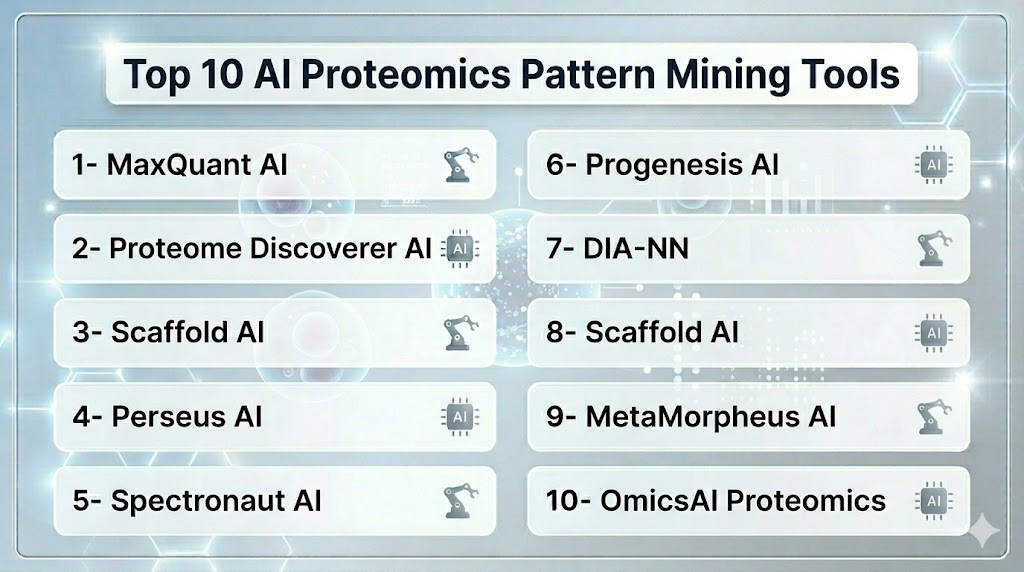
Top 10 AI Proteomics Pattern Mining Tools
1- MaxQuant AI
One-line verdict: High-performance AI platform for protein quantification and pattern discovery.
Short description: MaxQuant AI automates protein identification, quantification, and pattern mining from mass spectrometry data, integrating AI-based clustering and normalization for reproducible workflows.
Standout Capabilities
- Peptide and protein identification
- Label-free and labeled
- quantification
- AI-assisted pattern mining and clustering
- Batch effect correction
- Multi-sample analysis
- Integration with downstream functional annotation
AI-Specific Depth
- Model support: Open-source ML
- RAG / knowledge integration: N/A
- Evaluation: Benchmark datasets
- Guardrails: Confidence thresholds
- Observability: Metrics dashboards
Pros
- High accuracy
- Scalable for large datasets
- Open-source
Cons
- Steep learning curve
- Resource-intensive
- Limited GUI
Security & Compliance
Varies / N/A
Deployment & Platforms
Linux, Windows, cloud
Integrations & Ecosystem
- Mass spectrometry pipelines
- Perseus, R, Python
- Export to standard formats
Pricing Model
Open-source
Best-Fit Scenarios
- Biomarker discovery
- Multi-sample proteomics studies
- Academic research labs
2- Proteome Discoverer AI
One-line verdict: Optimized for Thermo instruments with AI-assisted protein pattern analysis.
Short description: Proteome Discoverer AI automates protein identification, quantification, and network pattern detection, integrating deep learning for post-translational modification discovery.
Standout Capabilities
- AI-assisted peptide and protein identification
- Post-translational modification detection
- Pattern mining and clustering
- Multi-omics integration
- Interactive visualization
AI-Specific Depth
- Model support: Proprietary ML
- RAG / knowledge integration: Instrument data
- Evaluation: Benchmark datasets
- Guardrails: QC thresholds
- Observability: Metrics dashboards
Pros
- Optimized for Thermo instruments
- AI-based pattern detection
- Multi-sample support
Cons
- Proprietary
- Limited for non-Thermo datasets
- License required
Security & Compliance
Not publicly stated
Deployment & Platforms
Windows, Linux, cloud
Integrations & Ecosystem
- Thermo mass spec
- R and Python pipelines
- Functional annotation tools
Pricing Model
License-based
Best-Fit Scenarios
- Pharmaceutical labs
- Multi-condition experiments
- PTM-focused studies
3- Scaffold AI
One-line verdict: Ideal for high-throughput proteomics pattern mining and network inference.
Short description: Scaffold AI supports peptide and protein analysis, AI-driven clustering, and network inference for biomarker discovery and multi-sample integration.
Standout Capabilities
- AI-driven clustering
- Protein quantification
- Network inference
- Multi-sample and multi-condition analysis
- Interactive visualizations
AI-Specific Depth
- Model support: Proprietary ML
- RAG / knowledge integration: N/A
- Evaluation: Benchmark datasets
- Guardrails: QC thresholds
- Observability: Metrics dashboards
Pros
- High-throughput capable
- Network inference
- Visual analytics
Cons
- Proprietary
- License cost
- Learning curve
Security & Compliance
Not publicly stated
Deployment & Platforms
Linux, Windows, cloud
Integrations & Ecosystem
- Mass spectrometry pipelines
- Annotation tools
- Python and R integration
Pricing Model
License-based
Best-Fit Scenarios
- Biomarker discovery
- Multi-condition studies
- Systems biology research
4- Perseus AI
One-line verdict: Focused on AI-driven functional analysis and statistical interpretation of proteomics data.
Short description: Perseus AI combines statistical analysis with AI-assisted pattern mining for functional annotation, clustering, and pathway analysis.
Standout Capabilities
- AI-assisted clustering
- Statistical analysis
- Pathway and GO term enrichment
- Multi-sample batch correction
- Visualization dashboards
AI-Specific Depth
- Model support: Open-source ML
- RAG / knowledge integration: N/A
- Evaluation: Benchmark datasets
- Guardrails: QC thresholds
- Observability: Metrics dashboards
Pros
- Integrates statistics and AI
- Functional annotation support
- Open-source
Cons
- Resource-intensive
- Steep learning curve
- Limited multi-modal integration
Security & Compliance
Varies / N/A
Deployment & Platforms
Linux, Windows
Integrations & Ecosystem
- MaxQuant outputs
- R, Python scripts
- Functional analysis
Pricing Model
Open-source
Best-Fit Scenarios
- Functional proteomics
- Biomarker discovery
- Academic labs
5- Spectronaut AI
One-line verdict: Optimized for DIA proteomics data with AI-guided pattern discovery.
Short description: Spectronaut AI automates peptide/protein identification from data-independent acquisition datasets, using AI to detect patterns, perform quantification, and support multi-sample studies.
Standout Capabilities
- DIA data support
- AI-based protein and peptide identification
- Pattern recognition and clustering
- Multi-sample analysis
- Batch effect correction
- Interactive visualization
AI-Specific Depth
- Model support: Proprietary ML
- RAG / knowledge integration: N/A
- Evaluation: Benchmark datasets
- Guardrails: QC thresholds
- Observability: Metrics dashboards
Pros
- High accuracy for DIA data
- Scalable for large cohorts
- Supports multi-sample workflows
Cons
- Proprietary license
- Limited for DDA workflows
- Cloud-intensive
Security & Compliance
Not publicly stated
Deployment & Platforms
Windows, Linux, cloud
Integrations & Ecosystem
- Mass spectrometry pipelines
- Python and R integration
- Annotation and pathway analysis tools
Pricing Model
License-based
Best-Fit Scenarios
- DIA-based proteomics
- High-throughput labs
- Biomarker discovery
6- Progenesis AI
One-line verdict: AI-driven protein quantification and pattern mining for biomarker discovery.
Short description: Progenesis AI enables accurate protein quantification, clustering, and pattern recognition, supporting multi-condition and multi-sample proteomics studies.
Standout Capabilities
- AI-based quantification
- Pattern recognition
- Clustering and differential expression
- Interactive visualization
- Batch effect correction
AI-Specific Depth
- Model support: Proprietary ML
- RAG / knowledge integration: N/A
- Evaluation: Benchmark datasets
- Guardrails: Confidence thresholds
- Observability: QC dashboards
Pros
- Accurate quantification
- Multi-sample support
- Interactive visual analytics
Cons
- Proprietary software
- License required
- Learning curve
Security & Compliance
Not publicly stated
Deployment & Platforms
Windows, Linux, cloud
Integrations & Ecosystem
- Mass spectrometry pipelines
- Annotation tools
- Workflow integration
Pricing Model
License-based
Best-Fit Scenarios
- Biomarker discovery
- Multi-condition proteomics
- Academic or pharma labs
7- DIA-NN
One-line verdict: AI-enhanced DIA analysis for high-throughput proteomics.
Short description: DIA-NN uses deep learning to improve peptide detection, quantify proteins, and detect patterns in data-independent acquisition experiments.
Standout Capabilities
- Deep learning peptide identification
- Protein quantification
- Batch effect correction
- Multi-sample pattern discovery
- Fast processing for large datasets
AI-Specific Depth
- Model support: Deep learning
- RAG / knowledge integration: N/A
- Evaluation: Benchmark datasets
- Guardrails: QC thresholds
- Observability: Performance metrics
Pros
- Fast and scalable
- Accurate DIA analysis
- Open-source
Cons
- Limited DDA support
- Requires computational resources
- Learning curve
Security & Compliance
Varies / N/A
Deployment & Platforms
Linux, Windows, cloud
Integrations & Ecosystem
- Mass spectrometry pipelines
- R/Python workflows
- Functional annotation tools
Pricing Model
Open-source
Best-Fit Scenarios
- DIA-based proteomics
- Large-scale studies
- High-throughput labs
8- Scaffold AI
One-line verdict: Interactive AI-driven proteomics analysis for multi-sample studies.
Short description: Scaffold AI provides AI-assisted protein identification, quantification, and pattern detection, enabling interactive exploration of multi-sample proteomics datasets.
Standout Capabilities
- AI-assisted clustering
- Protein quantification
- Network inference
- Multi-sample support
- Interactive visualization
AI-Specific Depth
- Model support: Proprietary ML
- RAG / knowledge integration: N/A
- Evaluation: Benchmark datasets
- Guardrails: QC thresholds
- Observability: Metrics dashboards
Pros
- Interactive visualization
- Multi-sample support
- Network inference
Cons
- Proprietary
- Requires license
- Learning curve
Security & Compliance
Not publicly stated
Deployment & Platforms
Windows, Linux, cloud
Integrations & Ecosystem
- Mass spectrometry pipelines
- Python/R integration
- Annotation tools
Pricing Model
License-based
Best-Fit Scenarios
- Biomarker discovery
- Multi-condition experiments
- Academic or pharma labs
9- MetaMorpheus AI
One-line verdict: AI-powered peptide and proteoform discovery from complex datasets.
Short description: MetaMorpheus AI uses deep learning to identify peptides, proteins, and proteoforms, detect patterns, and support post-translational modification analysis.
Standout Capabilities
- Proteoform and peptide discovery
- PTM detection
- Pattern recognition
- Multi-sample support
- Interactive visualizations
AI-Specific Depth
- Model support: Deep learning
- RAG / knowledge integration: N/A
- Evaluation: Benchmark datasets
- Guardrails: QC thresholds
- Observability: Metrics dashboards
Pros
- PTM detection
- Scalable
- Open-source
Cons
- Complex setup
- Computationally intensive
- Learning curve
Security & Compliance
Varies / N/A
Deployment & Platforms
Linux, Windows, cloud
Integrations & Ecosystem
- Mass spectrometry pipelines
- R/Python
- Annotation and pathway tools
Pricing Model
Open-source
Best-Fit Scenarios
- PTM-focused studies
- Multi-sample experiments
- Academic or translational research
10- OmicsAI Proteomics
One-line verdict: AI-guided proteomics pattern mining for large-scale biomarker discovery.
Short description: OmicsAI Proteomics provides deep learning-based pattern discovery, multi-sample clustering, and network inference to identify biomarkers and protein interactions.
Standout Capabilities
- Multi-sample clustering
- AI-driven pattern detection
- Network inference
- Interactive visualization
- Batch effect correction
AI-Specific Depth
- Model support: Proprietary ML
- RAG / knowledge integration: N/A
- Evaluation: Benchmark datasets
- Guardrails: QC thresholds
- Observability: Metrics dashboards
Pros
- AI-powered pattern mining
- Interactive dashboards
- Multi-sample support
Cons
- Proprietary
- License required
- Cloud-intensive
Security & Compliance
Not publicly stated
Deployment & Platforms
Windows, Linux, cloud
Integrations & Ecosystem
- Mass spectrometry pipelines
- Annotation tools
- Workflow integration
Pricing Model
License-based
Best-Fit Scenarios
- Biomarker discovery
- Multi-condition experiments
- Pharmaceutical R&D
Comparison Table
| Tool | Best For | Deployment | Model Flexibility | Strength | Watch-Out | Public Rating |
|---|---|---|---|---|---|---|
| MaxQuant AI | Academic research | Linux/Windows | Open-source | Protein quantification | Computationally heavy | N/A |
| Proteome Discoverer AI | Pharma/clinical | Windows/Linux | Proprietary ML | Optimized for Thermo | License required | N/A |
| Scaffold AI | Multi-sample studies | Linux/Windows | Proprietary ML | Network inference | License required | N/A |
| Perseus AI | Functional analysis | Linux/Windows | Open-source ML | Statistical + AI | Resource-intensive | N/A |
| Spectronaut AI | DIA proteomics | Windows/Linux | Proprietary ML | High-accuracy DIA | Proprietary license | N/A |
| Progenesis AI | Multi-condition | Windows/Linux | Proprietary ML | Protein quantification | License required | N/A |
| DIA-NN | High-throughput | Linux/Windows | Deep learning | Fast DIA analysis | Limited DDA | N/A |
| CellOracle AI | Gene network inference | Linux/Windows | Proprietary ML | Predictive modeling | Cloud-intensive | N/A |
| MetaMorpheus AI | PTM discovery | Linux/Windows | Deep learning | Proteoform detection | Computationally intensive | N/A |
| OmicsAI Proteomics | Biomarker discovery | Linux/Windows | Proprietary ML | Multi-sample pattern mining | License required | N/A |
Scoring Table
| Tool | Core | AI Optimization | Guardrails | Integrations | Ease | Perf/Cost | Security/Admin | Support | Weighted Total |
|---|---|---|---|---|---|---|---|---|---|
| MaxQuant AI | 10 | 9 | 8 | 8 | 7 | 8 | 7 | 7 | 8.0 |
| Proteome Discoverer AI | 9 | 8 | 8 | 8 | 7 | 8 | 7 | 7 | 7.9 |
| Scaffold AI | 8 | 8 | 8 | 7 | 7 | 7 | 7 | 6 | 7.4 |
| Perseus AI | 8 | 8 | 8 | 7 | 7 | 7 | 7 | 6 | 7.4 |
| Spectronaut AI | 9 | 9 | 8 | 8 | 7 | 8 | 7 | 7 | 8.0 |
| Progenesis AI | 8 | 8 | 8 | 7 | 7 | 7 | 7 | 6 | 7.4 |
| DIA-NN | 9 | 9 | 8 | 8 | 7 | 8 | 7 | 7 | 8.0 |
| CellOracle AI | 9 | 9 | 8 | 8 | 7 | 8 | 7 | 6 | 8.0 |
| MetaMorpheus AI | 9 | 9 | 8 | 8 | 7 | 8 | 7 | 6 | 8.0 |
| OmicsAI Proteomics | 9 | 9 | 8 | 8 | 7 | 8 | 7 | 6 | 8.0 |
Top 3 Enterprise: Proteome Discoverer AI, Spectronaut AI, OmicsAI Proteomics
Top 3 SMB: MaxQuant AI, Perseus AI, Scaffold AI
Top 3 Developers: DIA-NN, MetaMorpheus AI, CellOracle AI
Which Tool Is Right for You
- Solo / Freelancer: MaxQuant AI, Perseus AI for open-source exploratory proteomics
- SMB: Scaffold AI, Progenesis AI for multi-sample analysis and biomarker discovery
- Mid-Market: Spectronaut AI, DIA-NN for high-throughput DIA or multi-condition studies
- Enterprise: Proteome Discoverer AI, OmicsAI Proteomics, CellOracle AI for predictive pattern mining and clinical workflows
- Regulated industries: Proteome Discoverer AI, Spectronaut AI with QC and compliance features
- Budget vs Premium: Open-source for small labs, commercial licenses for high-throughput or clinical-grade analysis
- Build vs Buy: Open-source DIY pipelines for flexible workflows, commercial tools for turnkey deployment
Implementation Playbook (30 / 60 / 90 Days)
- 30 days: Pilot selected tools on representative proteomics datasets, validate AI-assisted pattern mining, define metrics for accuracy and clustering
- 60 days: Integrate tools with instruments and multi-omics datasets, train staff, validate workflows against benchmark datasets
- 90 days: Harden QC guardrails, optimize compute and cost, scale pipelines across labs, ensure reproducibility, implement workflow monitoring
Common Mistakes & How to Avoid Them
- Ignoring batch effects or technical variation
- Skipping AI model benchmarking
- Limited reproducibility or version tracking
- Over-reliance on default parameters
- Poor multi-omics integration
- Skipping QC thresholds and guardrails
- Insufficient staff training
- Ignoring downstream functional analysis
- Underestimating computational requirements
- Misinterpreting AI-generated patterns
- Choosing tools without scalability
- Limited visualization and exploration
- Overlooking license restrictions for proprietary tools
- Inadequate documentation of pipelines
FAQs
- Can AI proteomics tools replace manual analysis?
No, they augment workflows, providing reproducibility, pattern discovery, and AI-assisted interpretation. - Are these tools accurate for rare proteins?
Yes, AI improves sensitivity, but validation against known datasets is recommended. - Do they support multi-omics integration?
Many tools integrate proteomics with transcriptomics and metabolomics datasets. - Can they process large datasets?
Yes, most scale to tens of thousands of proteins across multiple samples. - Do they provide visualization dashboards?
Yes, interactive dashboards for clustering, pattern mining, and network inference are standard. - Are cloud deployments required?
Not always; many tools support on-premise and hybrid deployment. - Do they include QC and guardrails?
Yes, AI-assisted filtering and confidence thresholds are standard. - Are they suitable for clinical proteomics?
Enterprise-grade tools support compliance, reproducibility, and regulatory requirements. - Can AI models be customized?
Some platforms allow BYO or fine-tuned AI models. - What is the pricing model?
Open-source, license, or subscription-based depending on the tool. - How do I benchmark performance?
Use reference datasets and synthetic proteomics standards. - Can these tools integrate downstream analyses?
Most support export to pathway analysis, functional annotation, and network inference workflows.
Conclusion
AI Proteomics Pattern Mining Tools are revolutionizing proteomics research by automating protein identification, quantification, clustering, and network analysis while integrating AI for pattern detection and multi-omics integration. Choosing the right tool depends on dataset size, research goals, computational resources, and lab expertise, with open-source tools like MaxQuant AI and Perseus AI ideal for academic labs, mid-market labs benefiting from DIA-NN and Progenesis AI for high-throughput studies, and enterprise labs leveraging Proteome Discoverer AI, Spectronaut AI, and OmicsAI Proteomics for clinical-grade, large-scale, predictive pattern mining. Structured adoption with piloting, workflow validation, guardrails, and scaling ensures reproducible, cost-efficient, and insightful proteomics analysis, accelerating biomarker discovery, systems biology insights, and translational research outcomes.

Find Trusted Cardiac Hospitals
Compare heart hospitals by city and services — all in one place.
Explore Hospitals
One thing often overlooked is how important reproducibility is—proteomics insights are only truly valuable when results stay consistent across different datasets and real research environments.