
Certainly! Here’s a detailed overview of Elastic N.V. (commonly known as Elastic, the company behind Elasticsearch), covering its transformation, history, key milestones, product evolution, and major release timelines.
🏢 About Elastic (The Company)
Elastic N.V. was founded in 2012 and is best known as the creator of Elasticsearch, the powerful open-source search and analytics engine. Over time, Elastic evolved into a full-stack observability, security, and search solution provider.
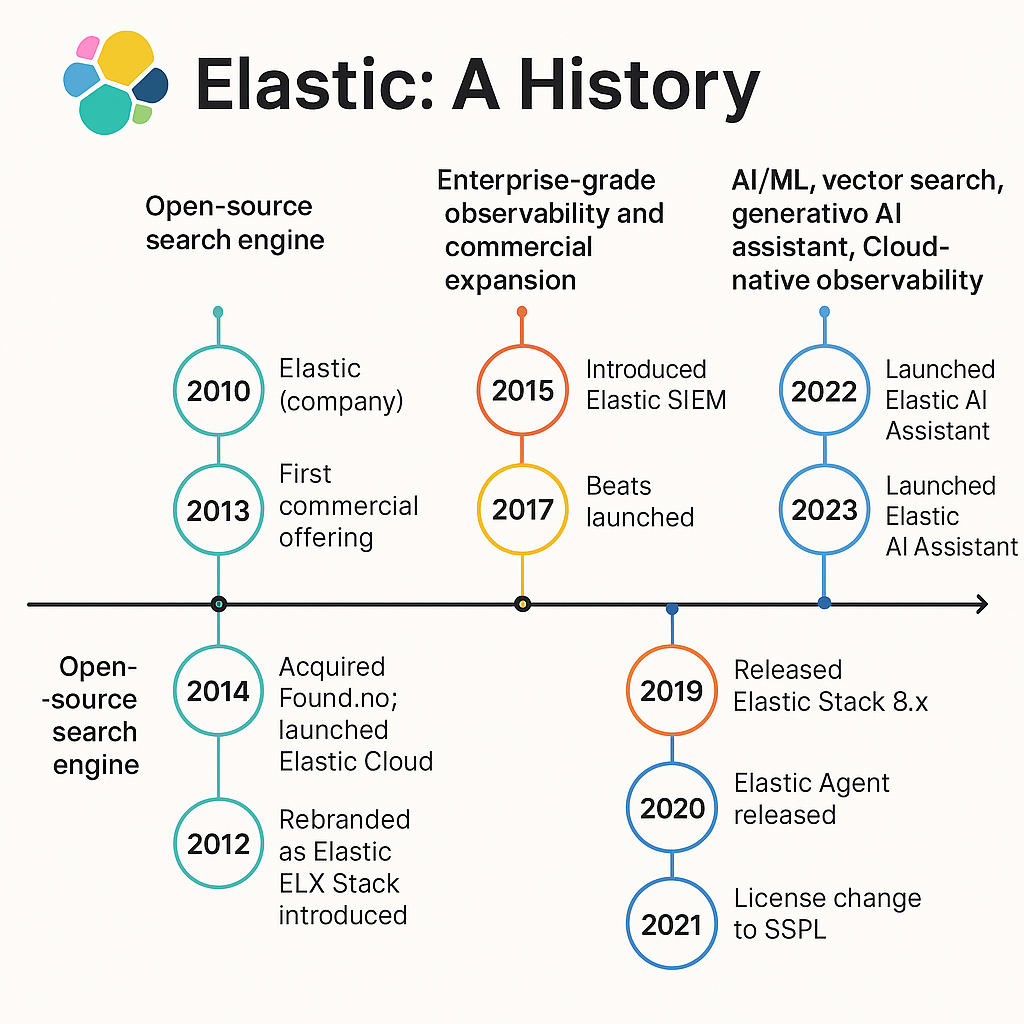
📜 Brief History & Timeline of Elastic’s Evolution
| Year | Milestone |
|---|---|
| 2010 | Shay Banon releases Elasticsearch v0.4, inspired by the need for a distributed search engine |
| 2012 | Elastic (company) founded by Shay Banon and team |
| 2013 | First commercial offering; raised $10 million Series A |
| 2014 | Acquired Found.no (hosted Elasticsearch service); launched Elastic Cloud |
| 2015 | Rebranded company as just Elastic; introduced the ELK Stack (Elasticsearch, Logstash, Kibana) |
| 2016 | Raised Series D funding; launched Beats (lightweight data shippers) |
| 2017 | Released X-Pack (commercial plugins for security, monitoring, alerting) |
| 2018 | Elastic went public (IPO on NYSE: ESTC) at a $2.5 billion valuation |
| 2019 | Introduced Elastic SIEM (Security Information and Event Management) |
| 2020 | Launched Elastic Agent, Fleet, and Ingest Manager; Elastic Stack 7.x matured |
| 2021 | License change from Apache 2.0 to SSPL for Elasticsearch and Kibana |
| 2022 | Released Elastic Stack 8.x, with native data streams, runtime fields, and zero-downtime upgrades |
| 2023 | Launched Elastic AI Assistant and enhanced Elastic Security for cloud |
| 2024 | Continued investment in generative AI, vector search, and observability integrations |
📦 Product Stack Evolution
- Elasticsearch – Search and analytics engine
- Logstash – Data ingestion pipeline
- Kibana – Data visualization & dashboard UI
- Beats – Lightweight data shippers (Filebeat, Metricbeat, etc.)
- Elastic Agent – Unified agent for observability and security
- Elastic Cloud – Hosted service on AWS, Azure, and GCP
- Elastic Security – Threat detection, endpoint protection, SIEM
- Elastic Observability – Logs, metrics, APM, synthetics, and uptime monitoring
🧭 Release Timeline (Major Versions)
| Version | Release Date | Highlights |
|---|---|---|
| v1.0 | Feb 2014 | First stable Elasticsearch release |
| v2.0 | Oct 2015 | Lucene 5 upgrade, pipeline aggregations |
| v5.0 | Oct 2016 | Unified versioning across ELK stack |
| v6.0 | Nov 2017 | Index sorting, faster queries, rolling upgrades |
| v7.0 | Apr 2019 | New cluster coordination, full-text search improvements |
| v7.10 | Nov 2020 | Last Apache-2.0 version before license switch |
| v7.11+ | 2021 | SSPL licensed; frozen tier, searchable snapshots |
| v8.0 | Feb 2022 | Native support for data streams, runtime fields, schema on read |
| v8.x | 2022–2024 | Enhanced vector search, ML support, Kibana Lens, Elastic AI Assistant |
🔄 Transformation Journey
| Phase | Focus |
|---|---|
| 2010–2014 | Open-source search engine |
| 2015–2018 | Enterprise-grade observability and commercial expansion |
| 2019–2021 | Security, cloud-native, and SIEM use cases |
| 2022–2024 | AI/ML, vector search, generative AI assistant, Cloud-native observability |
🧠 Strategic Shifts & Industry Relevance
- From search to a platform company offering search, observability, and security
- Strong competition with Splunk, Datadog, and OpenSearch
- Increasing focus on cloud offerings and AI integrations
- Supports both self-managed and SaaS models
Elastic’s product suite consists of several components—each with different purposes, yet sharing a core architecture built primarily around Java, Lucene, and open-source technologies. Below is a breakdown of the technologies used to develop each major product of Elastic:
🔍 1. Elasticsearch
- Core Language: Java
- Search Engine Library: Apache Lucene
- REST APIs: Built using Java-based HTTP server (Netty)
- Cluster Coordination: Zen Discovery (Java-based)
- Transport Layer: Netty
- Plugins/Extensions: Java
- New Additions: Vector Search (dense vectors), Runtime Fields (Java/Script-based)
📈 2. Kibana
- Core Language: JavaScript, TypeScript
- Frameworks: React.js for UI, Node.js for server
- Build System: Webpack, Babel
- Visualization Libraries: D3.js, Elastic Charts
- Security & Auth: Integrates with Elasticsearch’s APIs
🛠️ 3. Logstash
- Core Language: JRuby (Ruby running on the JVM)
- Pipeline Configuration: Ruby DSL
- Plugins: Written in Ruby or Java
- Data Transport: Uses Beats, Kafka, TCP, HTTP
- Threading Model: Java-based concurrency with plugin execution
📦 4. Beats (Filebeat, Metricbeat, etc.)
- Core Language: Go (Golang)
- Lightweight Agents: Designed to run with minimal resource usage
- Modules: YAML/Go config files, JSON output
- Communication: Sends data to Logstash or Elasticsearch via HTTP or Beats protocol
🧠 5. Elastic Machine Learning (X-Pack ML)
- Core Language: C++ (native ML jobs)
- Integrated with: Elasticsearch (via APIs and Java)
- Data Analysis: Time series analysis, anomaly detection
- Inference Support: Trained models (e.g., via PyTorch/TensorFlow) can be imported
🕵️♂️ 6. Elastic Security (SIEM & Endpoint)
- Core Components: Built on top of Kibana and Elasticsearch
- UI: TypeScript (Kibana)
- Detection Engine: Rule-based logic and ML integration (Elasticsearch backend)
- Elastic Endpoint: Agent written in Go and C++
📡 7. Elastic Agent & Fleet
- Core Language: Go (Golang)
- Package Manager: Elastic Package Registry (YAML and JSON schema)
- Communication: Secure HTTP, Beats protocol
- Managed through: Kibana’s Fleet UI (JavaScript/TypeScript)
☁️ 8. Elastic Cloud
- Core Platform: Java and Kubernetes (for orchestration)
- Infrastructure: Built on top of AWS, Azure, GCP
- Automation: Terraform modules, internal APIs
- UI: React (Elastic Cloud Console)
📊 9. Elastic Observability (APM, Logs, Metrics)
- Backend: Elasticsearch
- APM Agents: Written in multiple languages:
- Java Agent – Java
- Python Agent – Python
- Node.js Agent – JavaScript
- Go Agent – Go
- .NET Agent – C#
- UI: Kibana (TypeScript)
Summary Table
| Product | Core Language(s) | Notable Tech Stack |
|---|---|---|
| Elasticsearch | Java | Apache Lucene, Netty, REST APIs |
| Kibana | JavaScript/TypeScript | React, Node.js, D3.js |
| Logstash | JRuby, Java | Ruby DSL, Plugin System |
| Beats | Go | YAML config, lightweight shipping |
| Elastic ML | C++, Java | Native ML engine, Anomaly Detection |
| Elastic Security | TypeScript, Go | Detection engine, Endpoint protection |
| Elastic Agent | Go | Fleet Manager, YAML config |
| Elastic Cloud | Java, React, K8s | Hosted Elastic Stack, Multi-cloud |
| Observability/APM | Multiple (polyglot) | Language agents + Kibana UI |

I’m Rajesh Kumar, a DevOps, SRE, DevSecOps, Cloud, and Platform Engineering expert passionate about sharing practical knowledge, real-world experiences, and industry best practices. I have worked at Cotocus and regularly write about technology, travel, investing, health, product reviews, and digital marketing through my various platforms.
I publish technical articles at DevOps School, travel stories at Holiday Landmark, stock market insights at Stocks Mantra, health and fitness guidance at My Medic Plus, product reviews at TrueReviewNow, and SEO and digital marketing strategies at Wizbrand.
Find Trusted Cardiac Hospitals
Compare heart hospitals by city and services — all in one place.
Explore Hospitals
The article provides a good high-level overview of Elastic’s journey and ecosystem, but it misses the deeper production realities that teams face when actually running Elastic at scale. In real-world deployments, the shift from Beats to Elastic Agent and Fleet introduces operational challenges around centralized policy management, upgrade coordination, and configuration drift across distributed environments, which can become significant in hybrid or multi-cluster setups. Similarly, there’s no discussion on Index Lifecycle Management (ILM) and data tiering strategies, which are critical for controlling storage costs and maintaining query performance as log volumes grow. Another missing aspect is multi-tenancy design in shared observability platforms, especially around shard allocation, noisy-neighbor issues, and aligning Kibana RBAC with underlying index-level security. It would also have been valuable to touch on how licensing changes impact enterprise adoption decisions and platform engineering strategies. Overall, the article is solid for context, but lacks the operational depth around scalability, cost governance, and long-term maintainability that matter most in production Elastic environments.