
Introduction
In 2026, customer expectations for instant, personalized, and 24/7 support have reached new heights. Businesses can no longer rely solely on human agents to manage customer queries, as response delays often lead to lost sales and reduced customer satisfaction. Enter AI Live Chat Automation tools—powerful platforms that use artificial intelligence to streamline customer interactions, automate responses, and provide human-like assistance at scale.
From handling frequently asked questions to guiding customers through the sales funnel and escalating complex issues to human agents, these tools are redefining digital customer support. Modern solutions now integrate seamlessly with CRMs, e-commerce platforms, and omnichannel support systems, making them indispensable for companies of all sizes.
But with dozens of platforms in the market, choosing the right AI Live Chat Automation software can be challenging. In this guide, we review the top 10 tools in 2026, outlining their features, pros, cons, pricing, and ideal use cases—along with a handy comparison table to help decision-makers pick the best solution for their needs.
Top 10 AI Live Chat Automation Tools (2026)
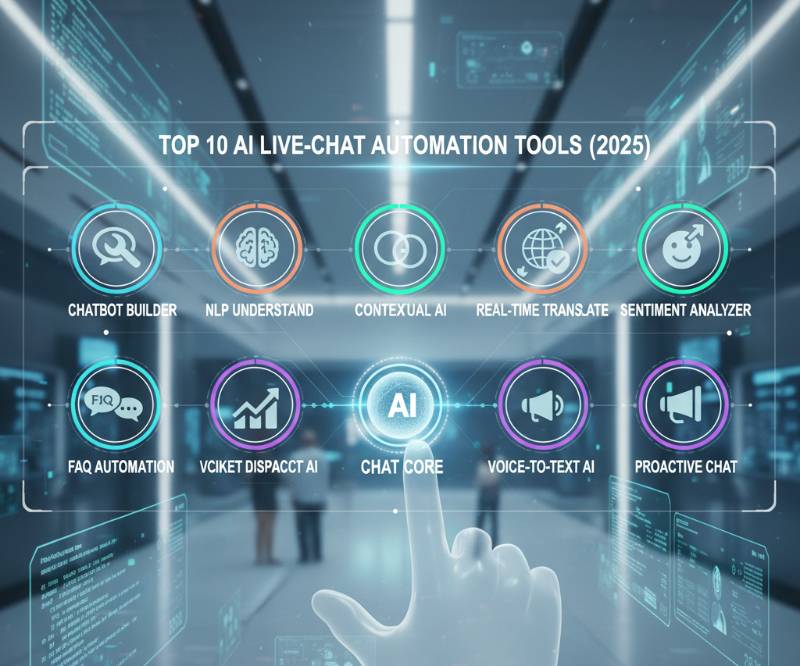
1. Drift
Short Description: Drift is a conversational AI platform designed for B2B companies, specializing in sales acceleration and customer engagement through real-time chat.
Key Features:
- AI-powered chatbots for lead qualification and booking meetings
- Personalized playbooks for targeted customer engagement
- Integrations with Salesforce, HubSpot, Marketo, and more
- Conversation routing to live agents
- Advanced analytics and conversation insights
- Multilingual support for global audiences
Pros:
- Excellent for B2B lead generation
- Highly customizable workflows
- Strong integrations with sales and marketing tools
Cons:
- Pricing is on the higher side
- May be too complex for small businesses
2. Intercom
Short Description: Intercom is one of the most popular AI live chat platforms, widely adopted for its customer support, onboarding, and retention features.
Key Features:
- AI-driven chatbots and resolution bots
- Omnichannel messaging (email, app, web)
- Ticket routing and automation
- Real-time customer data for personalized interactions
- Workflow builder for support automation
- Integrations with over 300 apps
Pros:
- User-friendly interface
- Strong automation capabilities
- Scalable for startups and enterprises alike
Cons:
- Costs can escalate with scale
- Some advanced features require add-ons
3. Zendesk AI
Short Description: Zendesk AI enhances Zendesk’s popular customer support platform with advanced automation, predictive responses, and conversational bots.
Key Features:
- AI-powered intent detection and sentiment analysis
- Automated ticket classification and routing
- Pre-trained bots for FAQs and troubleshooting
- Seamless handoff to live agents
- Knowledge base integration for self-service
- Enterprise-grade analytics
Pros:
- Excellent for enterprise-scale support
- Deep integration with Zendesk ecosystem
- Strong security and compliance
Cons:
- Can be expensive for SMBs
- Steep learning curve for new users
4. Tidio
Short Description: Tidio combines live chat and chatbot solutions, making it ideal for small to mid-sized businesses looking to boost customer engagement affordably.
Key Features:
- AI chatbots for FAQs and lead capture
- Live chat widget with multilingual support
- Integrations with Shopify, WordPress, and WooCommerce
- Customer segmentation and tracking
- Automated cart recovery messages
- Mobile app for on-the-go support
Pros:
- Very affordable
- Easy to set up and use
- Excellent for e-commerce businesses
Cons:
- Limited advanced analytics
- May not scale well for enterprises
5. Respond.io
Short Description: Respond.io is a customer conversation platform for high-volume, mid-market B2C businesses that manage conversations across channels such as WhatsApp, Instagram, Messenger, TikTok, Telegram, SMS, email, and voice. Its AI Agents and workflows help teams qualify leads, automate follow-ups, route conversations, and connect customer interactions with sales, marketing, and support workflows.
Key Features:
- Omnichannel inbox for customer conversations
- AI Agents for lead qualification, follow-ups, routing, and escalations
- Workflow automation for assignments, follow-ups, and lifecycle updates
- CRM integrations with HubSpot and Salesforce
- Integrations with Zapier, Make, and n8n
- Customer lifecycle tracking and reporting
- Human handoffs and conversation routing
Pros:
- Supports high-volume customer conversations across multiple channels
- AI Agents can execute actions, not just respond to customers
- Connects conversations with sales, marketing, and support workflows
- Integrates with existing CRM and business systems
- Supports teams managing conversations across locations or departments
Cons:
- Pricing can be prohibitive for small businesses
- May offer more functionality than businesses looking for basic website live chat
- Advanced workflow and AI configuration can have a learning curve
- Best suited to businesses with substantial conversational traffic
6. LivePerson
Short Description: LivePerson is a leader in AI-driven conversational commerce, helping businesses manage customer engagement across messaging channels.
Key Features:
- Conversational AI bots with natural language processing
- Omnichannel messaging (SMS, WhatsApp, Facebook Messenger)
- Real-time intent recognition
- AI-powered agent assist for faster responses
- Integrations with major CRMs and e-commerce platforms
- Analytics for conversation quality
Pros:
- Strong omnichannel capabilities
- Excellent AI-powered agent assistance
- Great for enterprise-scale businesses
Cons:
- Complex setup for SMBs
- Premium pricing
7. Freshchat (by Freshworks)
Short Description: Freshchat offers AI-powered messaging for support, sales, and engagement, making it ideal for businesses seeking a unified customer communication hub.
Key Features:
- AI chatbots with self-learning capabilities
- Omnichannel support across web, mobile, and social
- Proactive campaigns and in-app messaging
- Integration with Freshdesk and other Freshworks tools
- Automated FAQs and intent-based routing
- Real-time analytics dashboard
Pros:
- Cost-effective for SMBs
- Strong integration with Freshworks suite
- User-friendly interface
Cons:
- Limited customization compared to competitors
- Some users report occasional performance lags
8. Zoho SalesIQ
Short Description: Zoho SalesIQ is an AI-powered live chat and visitor tracking platform, built for businesses that already use Zoho’s CRM ecosystem.
Key Features:
- Zobot: AI chatbot powered by NLP
- Visitor tracking and lead scoring
- Pre-built chatbot templates
- Integration with Zoho CRM and Desk
- Real-time reporting and heatmaps
- Multilingual support
Pros:
- Affordable and feature-rich
- Great for businesses already in Zoho ecosystem
- Easy to customize
Cons:
- UI can feel outdated
- Limited third-party integrations
9. ManyChat
Short Description: ManyChat specializes in social media chat automation, making it a top choice for e-commerce and DTC brands on Instagram, Facebook, and WhatsApp.
Key Features:
- Automated chat flows for Facebook, Instagram, and WhatsApp
- E-commerce integrations (Shopify, WooCommerce)
- Visual chatbot builder
- Broadcast campaigns and drip sequences
- Customer segmentation
- Analytics for campaign performance
Pros:
- Excellent for social media engagement
- Affordable for small businesses
- Easy drag-and-drop interface
Cons:
- Limited outside social platforms
- Not ideal for enterprise customer support
10. Dripify Chat AI
Short Description: A newer entrant, Dripify Chat AI focuses on LinkedIn and B2B sales automation, making it ideal for professionals looking to streamline networking and lead generation.
Key Features:
- LinkedIn chat automation with personalization
- AI-driven message sequencing
- Lead nurturing and engagement
- Analytics on response rates and conversions
- Integrations with CRMs and email platforms
- Multi-account management
Pros:
- Unique focus on LinkedIn
- Great for B2B sales teams
- Saves time on outreach
Cons:
- Narrow use case (LinkedIn only)
- Pricing may be high for individuals
Comparison Table
| Tool Name | Best For | Platforms Supported | Standout Feature | Pricing | Rating* |
|---|---|---|---|---|---|
| Drift | B2B sales & lead gen | Web, CRM integrations | AI playbooks for sales acceleration | Custom pricing | 4.5/5 |
| Intercom | SMBs to Enterprises | Web, Mobile, Email | Resolution Bot & strong automation | From $39/mo | 4.6/5 |
| Zendesk AI | Enterprises | Web, CRM, Helpdesk | Intent detection & ticket routing | From $55/mo | 4.5/5 |
| Tidio | SMBs & E-commerce | Web, Shopify, WooCommerce | Affordable AI live chat | Free / From $29/mo | 4.7/5 |
| Respond.io | High-volume B2C businesses | WhatsApp, Instagram, Messenger, TikTok, Telegram & more | AI Agents, omnichannel inbox & workflow automation | From $99/mo | 4.6/5 |
| LivePerson | Enterprises & Omnichannel | Web, SMS, Social Media | Conversational commerce focus | Custom pricing | 4.4/5 |
| Freshchat | SMBs & Mid-sized Companies | Web, Mobile, Freshworks | Proactive in-app campaigns | From $19/mo | 4.5/5 |
| Zoho SalesIQ | Zoho ecosystem users | Web, Zoho CRM/Desk | Zobot with NLP | Free / From $25/mo | 4.4/5 |
| ManyChat | Social media businesses | Facebook, Instagram, WhatsApp | Social media chat automation | Free / From $15/mo | 4.6/5 |
| Dripify Chat AI | LinkedIn B2B sales teams | LinkedIn, Web | LinkedIn automation | From $79/mo | 4.3/5 |
*Ratings averaged from G2, Capterra, and Trustpilot (2026).
Which AI Live Chat Automation Tool is Right for You?
- Small Businesses & E-commerce Stores: Choose Tidio or ManyChat for affordability, ease of setup, and social media/e-commerce integrations.
- Startups & Growing SMBs: Intercom or Freshchat are ideal for scalability without breaking the bank.
- Enterprises with Complex Needs: Zendesk AI and LivePerson deliver advanced automation, omnichannel support, and enterprise-grade compliance.
- B2B Sales Teams: Drift and Dripify Chat AI stand out for lead generation and LinkedIn-focused automation.
- CRM Ecosystem Users: If you’re already using HubSpot or Zoho, their native chat automation tools provide seamless integration at lower costs.
- Omnichannel Sales & Support Teams: Respond.io is a strong fit for businesses managing customer conversations across WhatsApp, Instagram, Messenger, TikTok, Telegram, and other messaging channels. Its shared inbox, AI Agents, automated workflows, CRM integrations, and human handoffs make it useful when teams need to manage both automated and human conversations across multiple
- CRM Ecosystem Users: If you’re already using HubSpot or Zoho, their native chat automation tools provide seamless integration at lower costs.channels.
- Omnichannel B2C Teams: Respond.io is a strong fit for high-volume B2C businesses managing customer conversations across WhatsApp, Instagram, Messenger, TikTok, Telegram, and other channels. Its shared inbox, AI Agents, workflows, CRM integrations, and human handoffs help teams manage conversations at scale.
Conclusion
In 2026, AI Live Chat Automation tools are no longer a luxury but a necessity for businesses aiming to deliver exceptional customer experiences at scale. Whether you’re a small e-commerce store looking to recover abandoned carts, a B2B company optimizing sales funnels, or a global enterprise needing AI-powered omnichannel support, there’s a solution tailored for you.
The right choice depends on your company size, industry, existing tech stack, and budget. Most platforms offer free trials or demos, so it’s best to test a few before committing. By leveraging these tools, businesses can boost customer satisfaction, increase sales, and stay competitive in an increasingly digital-first world.
FAQs
1. What is an AI Live Chat Automation tool?
It’s software that uses AI to automate customer interactions through chat, handling FAQs, lead generation, and support tasks. Platforms like respond.io also bring conversations from multiple messaging channels into one inbox, helping teams manage and automate customer interactions from a single place. Platforms like Respond.io also bring conversations from multiple messaging channels into one workspace, allowing businesses to manage and automate customer conversations at scale.
2. Are AI Live Chat Automation tools expensive?
Not always—tools like Tidio and ManyChat start at under $30/month, while enterprise tools like Drift and LivePerson cost more. Pricing varies by platform and the number of users, channels, and automation features required.
3. Can these tools replace human agents?
No, they complement human agents by handling repetitive tasks and escalating complex queries to humans. Respond.io, for example, combines AI-powered automation with human handoffs, allowing teams to automate routine conversations while agents step in when needed. Respond.io, for example, combines AI Agents and automation with human handoffs, allowing teams to automate customer conversations while agents step in when needed.
4. Which industries benefit most from these tools?
E-commerce, SaaS, healthcare, financial services, and B2B sales see the biggest benefits. They can also be useful for businesses that manage customer conversations across channels such as WhatsApp, Instagram, Messenger, and other messaging platforms.
5. What should I look for when choosing a tool?
Consider pricing, integrations, scalability, AI capabilities, and whether it fits your existing tech stack. For platforms such as respond.io, also consider the messaging channels supported, omnichannel inbox capabilities, AI automation, CRM integrations, and workflow features. For platforms such as Respond.io, also consider the messaging channels supported, omnichannel capabilities, AI Agents, CRM integrations, workflow automation, and scalability.

Find Trusted Cardiac Hospitals
Compare heart hospitals by city and services — all in one place.
Explore Hospitals
Deploying AI live chat always reveals the harsh gap between answering general FAQs and executing transactional tasks. Suites like Intercom and Zendesk handle intent routing well, but the moment an LLM has to query a database to process a return or adjust a subscription, API latency causes awkward dead air in the chat widget. If human agents do not receive the full conversation summary during an automated escalation, frustrated customers end up repeating their entire problem from scratch. Guardrails against hallucinated discounts or outdated policy answers require continuous manual audit of your grounding documentation. Prioritizing deterministic action triggers and context-rich agent handoffs protects customer trust far better than boasting a high autonomous resolution rate.
The balance between resolving complex queries autonomously and maintaining a seamless human handoff is what separates basic widgets from true automation platforms. Intent detection and sentiment analysis are especially critical for ensuring frustrated customers aren’t trapped in endless bot loops.
AI live chat tools work best when they solve common customer problems without making support feel impersonal. Before choosing a tool, teams should test how well it handles unclear questions and knows when to involve a human agent. Connecting chat history with a support system can also prevent customers from repeating details. Regularly reviewing failed answers helps improve accuracy over time. Clear privacy rules and easy access to human help are just as important as fast replies.
AI live chat tools help businesses answer customer questions quickly, even outside normal working hours. I think features like instant replies, easy setup, and smooth transfer to a human agent are very important. These tools should also understand customer questions correctly and provide useful answers instead of repeating the same responses. It’s worth checking the cost and how well the tool works with your website or CRM. The right tool can save time, improve customer support, and make customers feel heard.
AI live chat tools can help businesses answer common questions and support customers at any time. However, good automation should also recognize when a question needs human attention. I would test how each tool handles unclear requests, angry customers, and questions outside its knowledge base. A clear handoff should give the human agent the full conversation so customers do not need to repeat themselves. It is also important to keep answers updated when products, prices, or policies change. Teams should review chat logs to find gaps and improve responses. The best tool should save time while keeping conversations accurate, helpful, and easy for customers to follow.
AI live chat tools work best when they resolve simple questions quickly without making customers struggle to reach a real person when needed. I’d pay attention to how accurately they understand customer intent, handle follow-up questions, and transfer conversations to human agents with the context intact. Integrating the chatbot with a reliable knowledge base also helps prevent confident but incorrect answers. The goal should be faster support that feels genuinely helpful, not automation that leaves customers going in circles.