
Introduction
Machine Learning Platforms are comprehensive software environments that help individuals and organizations build, train, deploy, monitor, and scale machine learning models efficiently. Instead of stitching together multiple tools for data preparation, model training, deployment, and monitoring, these platforms provide an integrated ecosystem that supports the entire ML lifecycle.
In today’s data-driven world, machine learning is no longer limited to research labs. It powers recommendation engines, fraud detection systems, medical diagnostics, demand forecasting, personalization engines, predictive maintenance, and autonomous systems. As datasets grow larger and models become more complex, using ad-hoc scripts or standalone libraries is no longer sufficient. Machine Learning Platforms solve this by offering automation, collaboration, governance, and scalability.
When choosing a machine learning platform, users should evaluate:
- Model development capabilities (AutoML, custom training, notebooks)
- Scalability and performance
- Integration with existing data sources and tools
- Deployment and MLOps features
- Security, compliance, and governance
- Ease of use vs flexibility
- Pricing and long-term value
Best for:
Machine Learning Platforms are ideal for data scientists, ML engineers, AI researchers, analytics teams, startups, enterprises, and regulated industries that need reliable, scalable, and repeatable ML workflows.
Not ideal for:
They may be excessive for simple analytics tasks, very small datasets, or teams that only require basic statistical models where lightweight libraries or spreadsheets are sufficient.
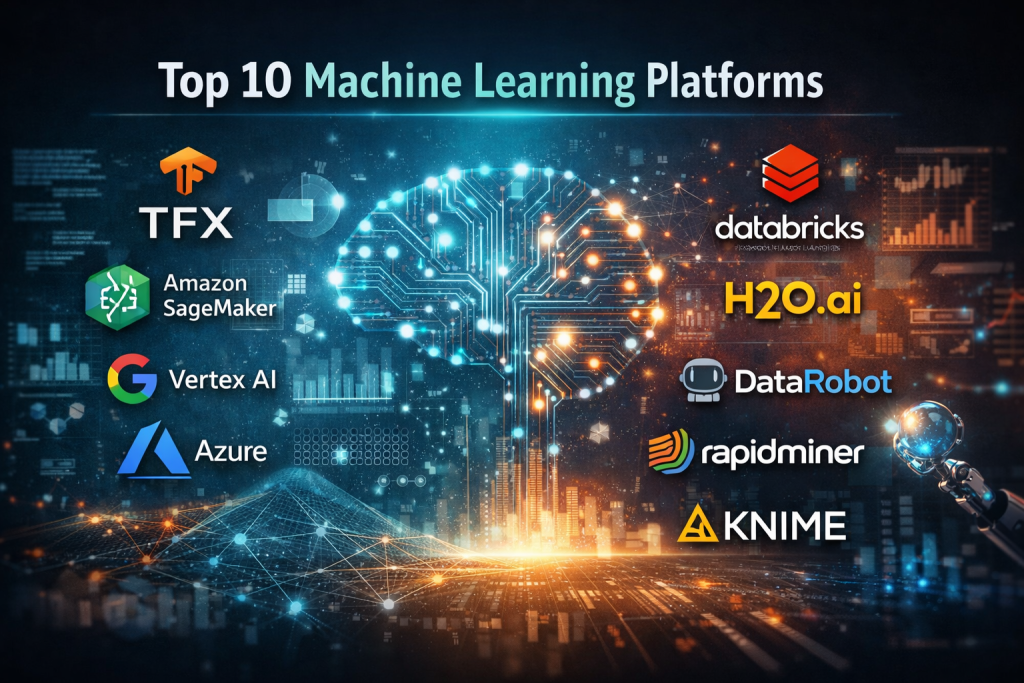
Top 10 Machine Learning Platforms Tools
1 — TensorFlow Extended (TFX)
Short description:
TFX is an end-to-end machine learning platform designed to deploy production-ready TensorFlow models at scale. It is widely used by teams building robust ML pipelines.
Key features:
- End-to-end ML pipeline orchestration
- Data validation and schema enforcement
- Model training and evaluation automation
- Scalable deployment support
- Integration with TensorFlow ecosystem
- Metadata tracking for experiments
Pros:
- Strong production-grade reliability
- Excellent for large-scale ML workflows
Cons:
- Steep learning curve
- Less flexible outside TensorFlow ecosystem
Security & compliance:
Varies depending on deployment environment
Support & community:
Extensive documentation, strong open-source community, enterprise backing available
2 — Amazon SageMaker
Short description:
Amazon SageMaker is a fully managed machine learning platform that enables data scientists and developers to build, train, and deploy models at scale in the cloud.
Key features:
- Built-in algorithms and AutoML
- Managed notebooks and training jobs
- One-click model deployment
- MLOps and monitoring tools
- Scalable infrastructure
- Deep integration with cloud services
Pros:
- Highly scalable and reliable
- Strong enterprise-grade tooling
Cons:
- Pricing can be complex
- Cloud lock-in concerns
Security & compliance:
SOC 2, ISO, GDPR, HIPAA support depending on configuration
Support & community:
Enterprise support, detailed documentation, large user base
3 — Google Vertex AI
Short description:
Vertex AI is a unified machine learning platform that combines data engineering, data science, and ML engineering workflows into one environment.
Key features:
- Unified model training and deployment
- AutoML and custom model support
- Integrated feature store
- Model monitoring and drift detection
- Scalable infrastructure
- Notebook-based development
Pros:
- Strong automation capabilities
- Excellent performance for large datasets
Cons:
- Complex for beginners
- Requires cloud expertise
Security & compliance:
GDPR, ISO, SOC 2, HIPAA-ready environments
Support & community:
Strong documentation, enterprise support available
4 — Microsoft Azure Machine Learning
Short description:
Azure Machine Learning is a cloud-based platform for managing the entire ML lifecycle, from experimentation to production deployment.
Key features:
- Visual ML designer and code-first workflows
- AutoML capabilities
- Model registry and versioning
- MLOps and CI/CD integration
- Hybrid and on-prem support
- Scalable compute options
Pros:
- Flexible for both beginners and experts
- Strong enterprise integration
Cons:
- UI complexity
- Learning curve for advanced features
Security & compliance:
SOC 2, ISO, GDPR, HIPAA supported
Support & community:
Enterprise-grade support, extensive documentation
5 — Databricks Machine Learning
Short description:
Databricks Machine Learning combines data engineering, analytics, and ML into a unified platform built around collaborative notebooks.
Key features:
- Collaborative notebooks
- Integrated MLflow for experiment tracking
- Scalable data processing
- Feature store support
- End-to-end MLOps
- Strong big data integration
Pros:
- Excellent for data-heavy workloads
- Strong collaboration features
Cons:
- Pricing may be high
- Requires data engineering knowledge
Security & compliance:
SOC 2, GDPR, ISO support varies by deployment
Support & community:
Active community, enterprise support available
6 — H2O.ai
Short description:
H2O.ai focuses on AutoML and interpretable machine learning, making advanced ML accessible to both technical and non-technical users.
Key features:
- Automated machine learning
- Model interpretability tools
- Open-source core
- Enterprise-grade extensions
- Support for multiple algorithms
- Scalable deployment
Pros:
- Easy to use
- Strong focus on explainability
Cons:
- Limited deep learning support
- Enterprise features can be costly
Security & compliance:
Varies; enterprise deployments support compliance needs
Support & community:
Strong community, enterprise support available
7 — DataRobot
Short description:
DataRobot is an enterprise AutoML platform designed to accelerate model development and deployment with minimal manual effort.
Key features:
- Automated feature engineering
- Model selection and tuning
- Explainability dashboards
- MLOps and monitoring
- Enterprise deployment options
- Governance and audit tools
Pros:
- Rapid model development
- Strong governance capabilities
Cons:
- Expensive for small teams
- Less flexibility for custom research
Security & compliance:
SOC 2, GDPR, HIPAA-ready
Support & community:
Enterprise-grade support, onboarding assistance
8 — RapidMiner
Short description:
RapidMiner is a visual data science and machine learning platform focused on ease of use and low-code workflows.
Key features:
- Drag-and-drop ML pipelines
- Automated data preparation
- Model validation tools
- Deployment options
- Collaboration features
- Integration with databases
Pros:
- Beginner-friendly
- Fast prototyping
Cons:
- Limited flexibility for advanced ML
- Performance constraints on large datasets
Security & compliance:
Varies by deployment
Support & community:
Good documentation, professional support available
9 — KNIME Analytics Platform
Short description:
KNIME is an open-source analytics and machine learning platform emphasizing visual workflows and extensibility.
Key features:
- Visual workflow editor
- Extensive plugin ecosystem
- Integration with Python and R
- Model deployment options
- Data preprocessing tools
- Open-source core
Pros:
- Flexible and extensible
- Strong community
Cons:
- UI can feel dated
- Scaling requires enterprise edition
Security & compliance:
Varies; enterprise edition supports governance
Support & community:
Active community, commercial support available
10 — IBM Watson Studio
Short description:
IBM Watson Studio provides tools for building, training, and deploying AI models with strong emphasis on governance and compliance.
Key features:
- Integrated notebooks
- AutoAI capabilities
- Model lifecycle management
- Governance and audit trails
- Hybrid deployment
- Enterprise-grade security
Pros:
- Strong governance features
- Suitable for regulated industries
Cons:
- Higher cost
- Slower innovation pace
Security & compliance:
SOC 2, ISO, GDPR, HIPAA supported
Support & community:
Enterprise support, structured onboarding
Comparison Table
| Tool Name | Best For | Platform(s) Supported | Standout Feature | Rating |
|---|---|---|---|---|
| TensorFlow Extended | Production ML pipelines | Cloud, On-prem | End-to-end pipelines | N/A |
| Amazon SageMaker | Scalable enterprise ML | Cloud | Managed infrastructure | N/A |
| Google Vertex AI | Unified ML workflows | Cloud | AutoML + custom ML | N/A |
| Azure Machine Learning | Hybrid ML environments | Cloud, Hybrid | Visual + code workflows | N/A |
| Databricks ML | Data-heavy ML teams | Cloud | MLflow integration | N/A |
| H2O.ai | AutoML and explainability | Cloud, On-prem | Interpretable models | N/A |
| DataRobot | Rapid enterprise ML | Cloud | Automated modeling | N/A |
| RapidMiner | Low-code ML | Desktop, Cloud | Visual pipelines | N/A |
| KNIME | Open-source ML workflows | Desktop, Server | Plugin ecosystem | N/A |
| IBM Watson Studio | Regulated industries | Cloud, Hybrid | Governance tools | N/A |
Evaluation & Scoring of Machine Learning Platforms
| Tool | Core Features (25%) | Ease of Use (15%) | Integrations (15%) | Security (10%) | Performance (10%) | Support (10%) | Price/Value (15%) | Total |
|---|---|---|---|---|---|---|---|---|
| SageMaker | 9 | 7 | 9 | 9 | 9 | 8 | 7 | High |
| Vertex AI | 9 | 7 | 8 | 9 | 9 | 8 | 7 | High |
| Azure ML | 8 | 8 | 9 | 9 | 8 | 8 | 7 | High |
| Databricks ML | 9 | 7 | 8 | 8 | 9 | 8 | 6 | High |
| DataRobot | 8 | 9 | 7 | 9 | 8 | 9 | 5 | Medium |
Which Machine Learning Platforms Tool Is Right for You?
- Solo users: Open-source or low-code platforms like KNIME or H2O.ai
- SMBs: AutoML-focused tools for faster results
- Mid-market: Flexible platforms balancing cost and scalability
- Enterprise: Cloud-native platforms with strong governance
Budget-conscious: Open-source or modular platforms
Premium solutions: Enterprise cloud platforms
Feature depth vs ease of use: AutoML vs code-first tools
Integration needs: Consider data sources and existing stack
Security requirements: Choose platforms with strong compliance support
Frequently Asked Questions (FAQs)
1. What is a machine learning platform?
A machine learning platform is software that supports the full ML lifecycle, from data preparation to deployment.
2. Do I need coding skills to use ML platforms?
Some platforms are low-code, while others require strong programming knowledge.
3. Are cloud ML platforms secure?
Yes, most offer enterprise-grade security when configured correctly.
4. What is AutoML?
AutoML automates model selection, tuning, and training.
5. Can ML platforms scale to big data?
Yes, enterprise platforms are designed for large-scale workloads.
6. Are open-source platforms reliable?
Yes, but production support may require enterprise editions.
7. How important is MLOps?
Critical for monitoring, versioning, and maintaining models.
8. Can I deploy models on-premises?
Some platforms support hybrid or on-prem deployments.
9. Are these platforms expensive?
Costs vary widely depending on features and scale.
10. What mistakes should buyers avoid?
Choosing tools without considering long-term scalability and governance.
Conclusion
Machine Learning Platforms play a critical role in turning data into actionable intelligence. They simplify complex workflows, enable collaboration, and ensure models can be deployed and maintained reliably at scale. While some platforms excel in automation, others shine in flexibility or governance.
The most important takeaway is that there is no single best machine learning platform for everyone. The right choice depends on your team size, technical expertise, budget, compliance needs, and long-term goals. By carefully evaluating these factors, organizations can select a platform that delivers real, sustainable value from machine learning.

Find Trusted Cardiac Hospitals
Compare heart hospitals by city and services — all in one place.
Explore Hospitals
A machine learning platform can simplify model development, but collaboration between data scientists and engineering teams often determines how smoothly a project reaches production. I would look at how well each platform supports handoffs, approval workflows, and shared access to datasets and model artifacts. When teams work in separate environments, small differences in dependencies or configurations can create deployment problems. A smooth transition from experimentation to engineering is just as important as the platform’s model-building capabilities.
A useful addition would be to weigh operating cost beyond licensing—managed platforms like SageMaker, Vertex AI, and Azure ML can look affordable during experimentation but become expensive once teams run persistent compute, frequent retraining, and production monitoring. For many organizations, starting with a modular open-source workflow and moving to a managed platform only after proving model value reduces both cloud lock-in and wasted spend.
Great points in this discussion. Beyond pure billing automation, the true test of any subscription tool is how cleanly it handles the messy edge cases that sales and support encounter daily. Grandfathering legacy pricing tiers, handling mid cycle seat additions with instant proration, and managing grace periods during payment retries often require custom engineering if the core billing platform lacks native rules. Choosing a platform that empowers non technical operations teams to adjust subscriptions without opening engineering tickets is what actually protects product roadmap momentum.
Machine learning platforms simplify the journey from data preparation and model development to deployment, monitoring, and continuous improvement. Solutions such as AWS SageMaker, Google Vertex AI, Azure Machine Learning, and Databricks offer different capabilities depending on an organization’s infrastructure, budget, and technical requirements. I believe scalability, experiment tracking, MLOps automation, integration with existing data pipelines, and model monitoring are essential factors when comparing these platforms. The best choice is not necessarily the one with the most features, but the one that helps teams build reliable models efficiently, collaborate effectively, and move machine learning projects from experimentation into real-world applications.
Machine learning platforms help organizations develop, train, deploy, and monitor predictive models more efficiently. Features such as data preparation, automated model training, experiment tracking, and model monitoring can streamline the machine learning lifecycle. When comparing platforms, teams should consider scalability, integration with existing data systems, ease of use, and deployment options. Choosing the right platform can reduce development complexity, improve collaboration, and help businesses turn data into actionable insights.
One thing I would examine when choosing a machine learning platform is how easily teams can detect and correct data leakage before a model goes live. A model may achieve impressive validation scores because information from the future or the target variable has accidentally entered the training data. Platforms that support time-aware dataset splitting, feature lineage, and repeatable evaluation make these mistakes easier to catch. This is especially important in fraud detection and forecasting, where a misleading test result can lead to expensive decisions once the model starts influencing real business operations.
Machine learning platforms should make it easy to track experiments, compare model results, and reproduce successful runs. Keeping data versions and model settings together can save hours when debugging unexpected results. I would also check how well the platform monitors models after deployment, especially when input data starts to change. Strong collaboration features can help data scientists and engineers work from the same information. How do teams maintain model accuracy as real-world data changes over time?
Machine learning platforms should make it easier for teams to build, test, and manage models. But a platform also needs to work well with the tools and data teams already use. It is important to check model accuracy, control costs, and track performance after launch. Good support and clear documentation can also help teams solve problems faster. How can teams choose a platform that saves time today and supports future growth?
Machine learning platforms help teams prepare data, train models, track experiments, and manage deployment. Buyers should compare collaboration features, data connections, access controls, and computing costs. Clear experiment records make it easier to repeat results and review changes. Teams should also check how easily they can move models into production. A small pilot project can reveal gaps in the workflow before a full rollout. The best platform supports the team’s needs while keeping model development organized, secure, and easy to maintain.
Machine learning platforms help teams prepare data, train models, and put predictions into real use. One useful feature is tracking which data and settings produced each model version. This makes it easier to repeat experiments and investigate unexpected results. I would compare how each platform supports team collaboration, model testing, and deployment. Clear experiment records can help teams understand why one model performs better than another. Security controls are also important when projects use private data. The right platform should simplify model development, support reliable testing, and help teams manage machine learning projects from early experiments to production.
Unified machine learning suites streamline the journey from raw data to deployed models, yet preventing silent performance degradation in production remains a persistent challenge. Without rigorous pipeline version control and active drift detection, automated updates can quietly introduce errors that are tough to diagnose. Aligning rapid experimentation workflows with dependable MLOps guardrails is vital for sustainable AI initiatives. Share how your engineering organization handles ongoing model governance after launch
A machine learning platform should support the full model lifecycle, from preparing datasets and running experiments to deploying models and monitoring their performance. When comparing platforms, teams should consider experiment tracking, collaboration features, data versioning, automated pipelines, and compatibility with their existing cloud or on-premises infrastructure. Model deployment is another key factor, since a successful experiment must be converted into a reliable service that can handle real workloads. It is also worth checking access controls, resource costs, and how easily models can be updated when data patterns change. The right platform should help data scientists and engineering teams work together while making machine learning projects easier to maintain in production.
When choosing a machine learning platform, I would pay close attention to how it handles models after deployment. Teams need clear alerts when prediction quality drops or incoming data starts to change. It also helps to track response times, computing costs, and resource usage as workloads grow. A simple rollback process can reduce downtime when a new model performs worse than expected. Strong access controls and approval steps also help prevent risky changes from reaching production. These practical features can make daily model operations more reliable and easier to manage.
Machine learning platforms are most valuable when they support the entire model lifecycle, from data preparation and experimentation to deployment and ongoing monitoring. Reproducible pipelines, collaborative experiment tracking, and scalable infrastructure can help teams reduce development bottlenecks and maintain consistent results. Strong governance and automated drift detection further ensure that deployed models remain reliable as datasets and business requirements change.
One practical consideration when adopting a machine learning platform is how well it supports collaboration between data scientists and domain experts who validate the model’s outputs. A model may perform well on historical data yet produce recommendations that conflict with business rules or real-world constraints. Having a structured way to capture reviewer feedback, document exceptions, and compare model predictions with expert decisions can make validation more meaningful. This feedback loop is especially valuable in areas where model outputs influence decisions that require human judgment.
A machine learning platform should support the entire model lifecycle, from data preparation and experimentation to deployment and ongoing monitoring. Reproducible experiments, version control, and automated testing are essential for helping teams collaborate without losing track of model changes. I would also evaluate how easily the platform detects data drift and supports rollback when production performance declines. Comparing operational costs alongside model accuracy can reveal whether a solution remains practical as workloads grow. How can teams standardize machine learning workflows without limiting experimentation or slowing down innovation?
Model deployment is only one part of the machine learning lifecycle; managing the infrastructure around training can become equally challenging as projects grow. GPU capacity, experiment queues, data transfer costs, and idle compute resources can quietly increase the total cost of ownership. I’d compare platforms on how well they support resource quotas, workload scheduling, and visibility into cost per experiment or model version. These controls help data science teams scale their work without creating an infrastructure bottleneck for other engineering teams.
One aspect worth considering when comparing machine learning platforms is how easily teams can move models from experimentation to production without creating complex maintenance workflows. While Amazon SageMaker and Google Vertex AI offer managed infrastructure, KNIME and H2O.ai provide flexibility for teams with different technical requirements.
Choosing between code-first ecosystems like TensorFlow Extended and automated platforms like DataRobot really highlights the ongoing trade-off between control and speed. While automated tools accelerate initial prototyping, teams often face hidden hurdles when customizing models for unique production environments. Striking the right balance often depends on whether your organization prioritizes rapid deployment or deep algorithmic flexibility as workloads scale.
A practical factor worth considering is how portable the platform’s ML workflows remain as an organization’s needs evolve. Teams may later need to change cloud providers, adopt a different training framework, or move workloads to private infrastructure because of cost or compliance requirements. Before committing, I would test whether teams can export trained models, preserve experiment metadata, migrate feature definitions, and recreate pipelines outside the original environment. It is also important to identify dependencies on proprietary APIs and platform-specific configuration. A small portability test during the evaluation phase can reveal migration risks before they become expensive problems. This flexibility gives engineering teams more control over future architecture decisions without sacrificing the benefits of managed ML services.
A machine learning platform should support the full model lifecycle, from data preparation to deployment and monitoring. Reproducible experiments, clear version tracking, and smooth integration with existing tools help teams avoid repeated work. Checking how easily a platform handles model updates and production issues can also reveal its long-term value beyond initial development.
Building machine learning models from scratch takes a lot of time, so centralized platforms help teams handle training, testing, and deployment all in one place. But even the best platform cannot fix messy data or poorly defined project goals. Using tools like Amazon SageMaker or Google Vertex AI makes scaling much easier, but keeping your pipelines organized is what keeps models accurate over time. Simple, structured workflows save your team from endless debugging later.
Choosing between a code-first ecosystem like TensorFlow Extended and an enterprise AutoML tool ultimately comes down to your team’s engineering bandwidth and model complexity. While platforms with heavy automation significantly accelerate initial prototyping, they can sometimes introduce rigidity when custom experimentation or fine-grained pipeline optimization is needed. Striking the right balance between rapid deployment and long-term flexibility remains one of the toughest challenges in MLOps today.
Machine learning platforms help data science teams manage the entire model lifecycle, from preparing datasets and running experiments to deployment and ongoing monitoring. Looking at collaboration tools, compute resources, experiment tracking, and integration support makes it easier to compare platforms and identify options that fit different workloads, team sizes, and technical environments.
Choosing an ML platform involves more than comparing features, pricing, and deployment options. Teams also need to understand how well each platform handles changes in data, model updates, and unexpected pipeline failures. I would recommend testing a complete workflow with a real project before making a long-term commitment. Check whether teams can track dataset versions, reproduce earlier experiments, roll back a faulty model, and restore pipelines after an interruption. It is also worth checking how easily the platform connects with existing tools for source control, testing, and deployment. These practical checks can reveal problems that feature lists often miss and help teams choose a platform that remains manageable as their machine learning projects grow.
Operationalizing machine learning requires bridging exploratory notebooks with production pipelines. Enterprise engineering teams must combine centralized feature stores, automated data validation, and continuous drift monitoring to maintain high inference accuracy without incurring technical debt.
Machine learning platforms are most useful when they support the entire model lifecycle, from data preparation and training to deployment and monitoring. Teams should compare scalability, experiment tracking, collaboration features, and integration with existing data pipelines. Model monitoring is especially important because performance can decline as real-world data changes. Testing a platform with a small project can also reveal hidden costs and workflow limitations before adoption. How can teams choose a platform that supports rapid experimentation while keeping production models reliable and easy to maintain?
Machine learning platforms become easier to manage when experiments, datasets, and model versions stay organized in one place. I’d check whether teams can reproduce earlier results, share computing resources fairly, and move models between development and production without major changes. These capabilities help reduce wasted experiments and make collaboration smoother as projects grow.
One challenge that deserves more attention is controlling infrastructure costs while keeping deployed models reliable. Training jobs, idle GPU instances, repeated experiments, and oversized inference endpoints can quietly increase cloud spending. Teams should track cost per experiment and prediction alongside latency, resource usage, and model accuracy. I would also include automated checks for data drift and prediction quality, with alerts when production results move beyond agreed limits. Before adopting a platform, test whether it can enforce resource quotas, shut down unused compute, and support safe model rollbacks. These controls help engineering teams balance performance, reliability, and operating costs as machine learning workloads grow.
Machine learning platforms should help teams manage the full model lifecycle, from preparing data and running experiments to deploying and monitoring models in production. When comparing options, I would look at experiment reproducibility, collaboration features, pipeline automation, compute resource management, and integration with existing data systems. Model governance is another important factor, particularly when teams need to track versions, explain predictions, and roll back deployments safely. Testing a platform with a real project can reveal whether it reduces manual handoffs, keeps experiments organized, and makes it easier to maintain reliable models as requirements and datasets change.
Machine learning platforms should be evaluated on how well they support the full lifecycle, from data preparation and experimentation to deployment and monitoring. I would look closely at experiment tracking, reproducible training pipelines, and model versioning to make results easier to verify and maintain. Integration with existing data sources and CI/CD workflows can also reduce manual effort when moving models into production. Another important factor is monitoring for data drift, performance changes, and rising infrastructure costs after deployment. A platform that combines reliable automation with clear governance helps teams scale machine learning without making operations unnecessarily complex.
This article offers a clear and balanced overview of the top machine learning platforms, making it easier for readers to understand the key differences between tools and choose the right one for their project goals. The breakdown of features, advantages, and limitations helps both beginners and experienced practitioners evaluate platforms based on factors like ease of use, scalability, community support, and integration capabilities. It’s particularly helpful that the comparison highlights real-world use cases, which gives practical context beyond just technical specifications. Overall, this post serves as a valuable reference for anyone looking to explore or adopt machine learning solutions effectively.