
Introduction
Blockchain platforms are foundational technologies that enable organizations and developers to build decentralized applications (dApps), smart contracts, and distributed systems where trust is established through code, cryptography, and consensus rather than intermediaries. Unlike traditional databases controlled by a single authority, blockchain platforms maintain shared, tamper-resistant ledgers across multiple participants.
The importance of blockchain platforms has grown rapidly as industries seek greater transparency, security, automation, and resilience. From financial services and supply chains to healthcare, gaming, and government systems, blockchain platforms are redefining how data, value, and digital ownership are managed.
Real-world use cases include:
- Digital payments and cross-border settlements
- Smart contracts and automated workflows
- Supply chain tracking and provenance
- Digital identity and access management
- Tokenization of assets and NFTs
When choosing a blockchain platform, users should evaluate scalability, security, ecosystem maturity, developer experience, governance model, and cost structure. The right platform balances technical capability with long-term sustainability.
Best for:
Blockchain platforms are ideal for developers, startups, enterprises, financial institutions, Web3 companies, and governments looking to build secure, transparent, and decentralized solutions at scale.
Not ideal for:
They may not be suitable for very small projects with simple data needs, teams lacking technical expertise, or use cases where a traditional centralized database is faster, cheaper, and sufficient.
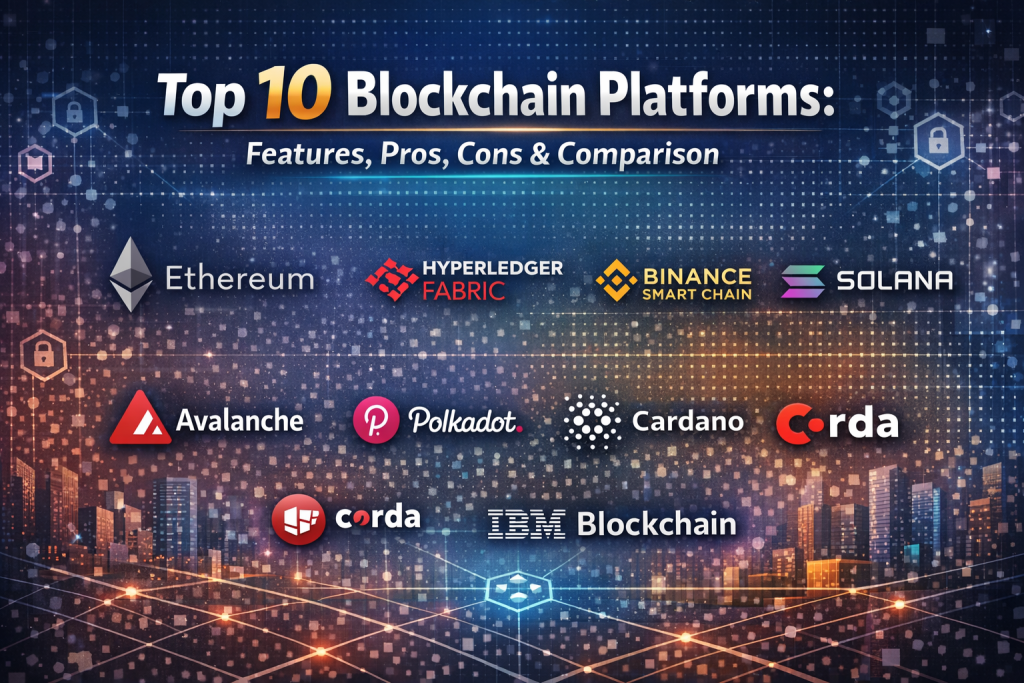
Top 10 Blockchain Platforms Tools
1 — Ethereum
Short description:
Ethereum is the most widely adopted smart-contract blockchain, powering thousands of decentralized applications across finance, gaming, and digital identity.
Key features
- Smart contracts using Solidity
- Massive dApp and DeFi ecosystem
- Proof-of-stake consensus
- Layer-2 scalability solutions
- NFT and token standards (ERC-20, ERC-721)
- Strong tooling and frameworks
Pros
- Largest developer community
- Battle-tested and highly trusted
Cons
- Gas fees can be unpredictable
- Base layer scalability limits
Security & compliance:
Strong cryptography, decentralized validation, public auditability; compliance depends on application design.
Support & community:
Extensive documentation, global developer community, enterprise support via partners.
2 — Hyperledger Fabric
Short description:
Hyperledger Fabric is a permissioned blockchain framework designed for enterprise use cases requiring privacy and control.
Key features
- Permissioned network architecture
- Modular consensus mechanisms
- Private channels for data confidentiality
- Smart contracts (chaincode)
- Enterprise-grade identity management
- High transaction throughput
Pros
- Excellent for regulated industries
- Strong data privacy controls
Cons
- Complex setup and maintenance
- Smaller public ecosystem
Security & compliance:
Enterprise-grade security, role-based access, audit logs; aligns well with GDPR and ISO needs.
Support & community:
Backed by major enterprises, strong documentation, professional support available.
3 — Binance Smart Chain
Short description:
Binance Smart Chain offers fast, low-cost smart contracts with Ethereum compatibility.
Key features
- EVM compatibility
- Low transaction fees
- High throughput
- Strong DeFi ecosystem
- Interoperability with Binance Chain
Pros
- Cost-effective deployment
- Fast transaction confirmation
Cons
- More centralized governance
- Heavy reliance on Binance ecosystem
Security & compliance:
Standard blockchain cryptography; compliance varies by application.
Support & community:
Active developer community, good documentation, strong ecosystem momentum.
4 — Solana
Short description:
Solana focuses on ultra-high performance and low latency for applications requiring speed.
Key features
- Proof-of-History consensus
- Extremely high throughput
- Low transaction costs
- NFT and gaming focus
- Single global state
Pros
- Very fast transactions
- Excellent for real-time apps
Cons
- Network stability concerns historically
- Higher hardware requirements
Security & compliance:
Strong cryptography; public chain compliance depends on usage.
Support & community:
Growing developer base, improving documentation, active ecosystem.
5 — Polygon
Short description:
Polygon provides scaling and interoperability solutions for Ethereum.
Key features
- Layer-2 scaling
- Ethereum compatibility
- Low gas fees
- Multiple scaling technologies
- Strong enterprise adoption
Pros
- Reduces Ethereum congestion
- Easy migration for Ethereum apps
Cons
- Depends on Ethereum security model
- Complexity with multiple solutions
Security & compliance:
Inherits Ethereum security; compliance varies by implementation.
Support & community:
Strong developer community and documentation.
6 — Avalanche
Short description:
Avalanche is a highly scalable blockchain with customizable subnetworks.
Key features
- Subnets for custom blockchains
- High throughput and low latency
- EVM compatibility
- Energy-efficient consensus
- Flexible governance
Pros
- Enterprise-friendly architecture
- Fast finality
Cons
- Smaller ecosystem than Ethereum
- Learning curve for subnets
Security & compliance:
Strong cryptographic security; compliance depends on subnet design.
Support & community:
Active community, improving enterprise tooling.
7 — Polkadot
Short description:
Polkadot enables multiple blockchains to interoperate securely.
Key features
- Parachain architecture
- Shared security model
- Cross-chain messaging
- On-chain governance
- High scalability
Pros
- Excellent interoperability
- Strong governance model
Cons
- Complex architecture
- Parachain slot costs
Security & compliance:
Shared security with strong cryptography; compliance varies.
Support & community:
Strong research-driven community and documentation.
8 — Cardano
Short description:
Cardano emphasizes peer-reviewed research and formal verification.
Key features
- Proof-of-stake consensus
- Formal verification
- Layered architecture
- Sustainable design
- Academic approach
Pros
- Strong security focus
- Energy efficient
Cons
- Slower feature rollout
- Smaller dApp ecosystem
Security & compliance:
High assurance security model; compliance varies.
Support & community:
Dedicated community, extensive research documentation.
9 — Corda
Short description:
Corda is designed for regulated industries needing private transactions.
Key features
- Point-to-point transactions
- Strong identity framework
- Legal contract alignment
- High performance
- Enterprise integrations
Pros
- Ideal for finance and legal use
- Privacy-first design
Cons
- Not a traditional blockchain
- Limited public use cases
Security & compliance:
Strong compliance orientation, auditability, and identity controls.
Support & community:
Enterprise-focused support and professional services.
10 — IBM Blockchain
Short description:
IBM Blockchain provides enterprise blockchain solutions built on Hyperledger Fabric.
Key features
- Managed blockchain services
- Enterprise integrations
- Governance tools
- High security standards
- Industry-specific solutions
Pros
- Enterprise trust and reliability
- Strong support ecosystem
Cons
- Higher cost
- Less flexibility for small teams
Security & compliance:
Enterprise-grade security, SOC-aligned controls, audit readiness.
Support & community:
Professional enterprise support and onboarding.
Comparison Table
| Tool Name | Best For | Platform(s) Supported | Standout Feature | Rating |
|---|---|---|---|---|
| Ethereum | Public dApps & DeFi | Web, Cloud | Largest ecosystem | N/A |
| Hyperledger Fabric | Enterprises | On-prem, Cloud | Permissioned privacy | N/A |
| Binance Smart Chain | Cost-efficient DeFi | Cloud | Low fees | N/A |
| Solana | High-speed apps | Cloud | Ultra-fast throughput | N/A |
| Polygon | Ethereum scaling | Cloud | Layer-2 efficiency | N/A |
| Avalanche | Custom blockchains | Cloud | Subnets | N/A |
| Polkadot | Interoperability | Cloud | Cross-chain design | N/A |
| Cardano | Secure systems | Cloud | Formal verification | N/A |
| Corda | Regulated finance | On-prem, Cloud | Transaction privacy | N/A |
| IBM Blockchain | Large enterprises | Cloud | Managed services | N/A |
Evaluation & Scoring of Blockchain Platforms
| Criteria | Weight | Evaluation Summary |
|---|---|---|
| Core features | 25% | Smart contracts, consensus, scalability |
| Ease of use | 15% | Tooling, onboarding, documentation |
| Integrations & ecosystem | 15% | dApps, partners, SDKs |
| Security & compliance | 10% | Encryption, audits, governance |
| Performance & reliability | 10% | Throughput, uptime |
| Support & community | 10% | Docs, forums, enterprise support |
| Price / value | 15% | Fees, infrastructure cost |
Which Blockchain Platforms Tool Is Right for You?
- Solo developers: Ethereum, Polygon
- SMBs & startups: Binance Smart Chain, Solana
- Mid-market: Avalanche, Polkadot
- Enterprises: Hyperledger Fabric, Corda, IBM Blockchain
Budget-conscious teams may favor low-fee public chains, while regulated industries should prioritize permissioned platforms with compliance controls.
Frequently Asked Questions (FAQs)
- Are blockchain platforms secure?
Yes, but security depends on design, governance, and smart-contract quality. - Do I need crypto expertise to use blockchain?
Basic understanding helps, but tooling has improved significantly. - Are public blockchains suitable for enterprises?
Yes, for some use cases; others prefer permissioned networks. - What about scalability?
Layer-2 solutions and new consensus models address this. - Are blockchain platforms expensive?
Costs vary based on fees, infrastructure, and scale. - Can blockchain replace databases?
Not always; they serve different purposes. - Is compliance possible on blockchain?
Yes, especially with permissioned platforms. - What industries benefit most?
Finance, supply chain, healthcare, gaming, and government. - How long does implementation take?
From weeks to months, depending on complexity. - Is blockchain future-proof?
The technology continues to evolve rapidly with strong adoption.
Conclusion
Blockchain platforms have matured into powerful, flexible foundations for decentralized and enterprise applications. Each platform excels in different areas—performance, privacy, interoperability, or ecosystem strength.
The most important takeaway is that there is no single “best” blockchain platform for everyone. The right choice depends on your goals, scale, budget, regulatory environment, and technical capabilities. By carefully evaluating these factors, organizations can select a blockchain platform that delivers long-term value and innovation.

Find Trusted Cardiac Hospitals
Compare heart hospitals by city and services — all in one place.
Explore Hospitals
Blockchain platforms help businesses build secure, transparent, and decentralized applications. Features like smart contracts, transaction speed, scalability, and network security are important when comparing solutions. Developer support and integration options also play a big role in long-term adoption. Choosing the right platform depends on business needs, technical requirements, and the type of application being developed.
Choosing a blockchain platform requires looking beyond transaction speed and scalability. Developer support, network security, smart contract tools, and long-term maintenance also matter. Teams should test real workloads and consider operating costs before committing to a platform, especially for business-critical applications.
Payment fraud scoring APIs need to be fast and accurate, and this article compares options that deliver both. I appreciate the focus on real time decisioning and machine learning. Payment teams will find this very practical.
Blockchain platforms provide the infrastructure needed to build decentralized applications, manage digital assets, and maintain transparent transaction records. When comparing platforms, businesses should consider transaction speed, scalability, security, development tools, and operating costs. I believe the right choice depends on the specific use case, as a platform suitable for financial applications may not be ideal for supply chain tracking or enterprise data sharing. Compatibility with existing systems and the strength of the developer community are also important factors. Evaluating these aspects carefully can help organizations choose a blockchain solution that meets their long-term needs.
A useful angle is to start with the trust problem being solved, then choose the architecture—not the reverse. For multi-party workflows where participants need privacy and controlled access, permissioned options like Hyperledger Fabric or Corda can be more practical than public chains. Teams should also validate total operating cost and governance complexity with a realistic pilot, since low transaction fees can be outweighed by integration and maintenance effort.
Blockchain platforms should be evaluated based on how well they support real application needs, not just transaction speed. One important factor is how they handle network upgrades, smart contract security, and growing transaction volumes. I would also suggest testing developer tools and integration options before choosing a platform. Long-term maintenance, network stability, and clear documentation can make a big difference in successful blockchain projects.
One factor worth examining when comparing blockchain platforms is how easily applications can interact with existing enterprise systems. Most businesses cannot move their entire payment, inventory, or identity infrastructure onto a blockchain, so integration with databases, APIs, and legacy applications becomes important. I would check whether a platform provides reliable event handling, clear transaction status updates, and practical ways to reconcile on-chain records with off-chain business data. Another consideration is what happens when a transaction is confirmed on the network but the connected application fails to process the resulting event. Strong integration and reconciliation capabilities can make blockchain adoption more manageable beyond proof-of-concept projects.
Blockchain platforms provide the infrastructure for building decentralized applications, executing smart contracts, and managing digital transactions securely. Platforms such as Ethereum, Hyperledger Fabric, Solana, and Polygon offer different strengths in programmability, transaction throughput, scalability, and enterprise integration. When comparing solutions, developers should consider consensus mechanisms, transaction costs, network security, developer tools, interoperability, and ecosystem maturity. Choosing the right blockchain platform depends on the project’s requirements, whether the priority is enterprise data sharing, decentralized finance, or high-performance applications, making careful evaluation essential for long-term success.
Choosing a blockchain platform depends on the problem you’re trying to solve, not just transaction speed or popularity. I’d compare consensus mechanisms, smart contract support, network fees, and how easily the platform integrates with existing systems. Scalability and developer tools also matter when moving from a small proof of concept to a production application. Testing realistic workloads early can help reveal trade-offs in performance, cost, and security before making a long-term commitment.
Selecting a blockchain platform requires careful consideration of scalability, transaction costs, consensus mechanisms, and smart contract support. Enterprise teams should also assess interoperability, governance models, and the availability of developer tools before committing to an implementation. Starting with a focused use case and validating performance under realistic workloads can help organizations determine whether blockchain delivers measurable value beyond conventional database solutions.
Choosing a blockchain platform requires more than comparing transaction speed or supported features. Organizations should first decide whether they need a public network, a permissioned system, or a private deployment. Each option brings different trade-offs in control, transparency, governance, and operating cost. Teams should also consider how applications will connect with existing systems and how network changes will be managed. Testing a realistic use case can reveal limits that a feature list may not show. A platform should solve a clear business problem rather than introduce complexity without a strong reason. This makes the long-term decision easier to justify.
A key point in production blockchain projects is managing changes to smart contracts without disrupting existing users. Teams need a clear plan for contract upgrades, data migration, and compatibility with older application versions. Before releasing changes, they should test how dependent services handle new events and altered contract behavior. Keeping versioned deployment records also helps engineers trace unexpected results during audits or incidents. These practices reduce upgrade risks and make long-running blockchain applications easier to maintain as business needs evolve.
Another challenge with blockchain platforms is managing changes to smart contracts after an application goes live. Teams need a clear plan for version control, migration, and compatibility with older clients. Before releasing an upgrade, they should test how existing users, stored data, and connected services will behave. Contract permissions also deserve regular review, especially when ownership or admin roles change. Keeping upgrade decisions and approvals well documented makes later audits much easier. This kind of release planning can prevent small contract changes from causing wider disruption across the application.
Smart-contract lifecycle management deserves close attention when selecting a blockchain platform. Once a contract handles real transactions, correcting a logic flaw can be far more complicated than patching a conventional application. Teams should evaluate support for controlled upgrades, contract version tracking, independent security audits, and emergency response procedures before committing to a platform. Automated tests should also cover interactions between old and new contract versions, especially when other applications depend on existing interfaces. For upgradeable contracts, clear authorization rules and a transparent change history are essential. These practices help development teams release improvements safely while reducing the risk of breaking integrations or exposing users to unexpected behavior.
Choosing a blockchain platform depends on the project’s needs, not just transaction speed or popularity. Teams should compare scalability, transaction costs, security, smart contract support, and how easily the platform integrates with existing systems. Testing real workloads and reviewing network governance can help developers select a platform that remains practical as the project grows.
Leveraging decentralized consensus mechanisms, cryptographically verified smart contracts, and tamper-resistant distributed ledgers across enterprise architectures establishes trustless data integrity, streamlines automated cross-party workflows, and eliminates single points of failure without relying on centralized intermediaries.
Blockchain platforms help developers build decentralized applications, manage digital transactions, and create smart contracts. When comparing options, I would focus on scalability, transaction speed, security, development tools, and ecosystem support. These factors can influence application performance and long-term maintenance. The right platform should match the project’s requirements and provide a reliable foundation for blockchain development.
One factor worth assessing is how safely a blockchain platform supports application upgrades over time. Smart contracts can be difficult or impossible to change once deployed, so a small logic error may require complex migration work or leave users interacting with outdated contracts. Development teams should examine upgrade patterns, contract versioning, migration procedures, and backward compatibility before committing to a platform. Automated tests should also cover interactions between old and new contract versions, while deployment pipelines should include independent security reviews and staged releases. For enterprise projects, a clear rollback or recovery strategy is especially important because blockchain transactions cannot simply be reversed like ordinary database updates. Evaluating these lifecycle challenges early can help teams avoid costly migrations and protect applications as business requirements evolve.
Choosing a blockchain platform depends heavily on the problem being solved, rather than transaction speed alone. Teams should compare consensus mechanisms, scalability, transaction costs, security, and the complexity of developing and maintaining smart contracts. I would also recommend evaluating ecosystem maturity and interoperability before committing to a platform, especially for projects that may expand later. Testing realistic workloads can reveal performance limitations that benchmarks might miss. How do organizations decide when a public blockchain, private network, or hybrid approach best fits their business requirements?
Evaluating a blockchain platform solely by its peak transaction throughput or ecosystem size can be misleading if it doesn’t align with your team’s long-term maintenance overhead. Beyond initial performance benchmarks, architectural complexity—like managing custom subnets or multi-layered interoperability—often dictates how successfully a project scales in production. Striking the right balance between developer velocity and regulatory compliance is ultimately what determines whether a chosen protocol thrives or stalls.
Choosing a blockchain platform depends on more than transaction speed or network fees; the project also needs to fit the platform’s consensus model, governance, and upgrade process. It is worth testing how the network handles heavy traffic and what happens when a smart contract needs changes after deployment. Comparing developer tools, interoperability, and long-term maintenance requirements can help teams avoid selecting a platform that works for a demo but becomes difficult to manage in production.
A useful comparison for anyone exploring blockchain platforms and their real-world applications. Factors like scalability, transaction speed, smart contract support, security, and development tools are important when choosing a platform for a project. Another option worth considering is Hyperledger Fabric, a permissioned blockchain framework designed for enterprise use cases where privacy, controlled access, and business-to-business collaboration are key requirements.