
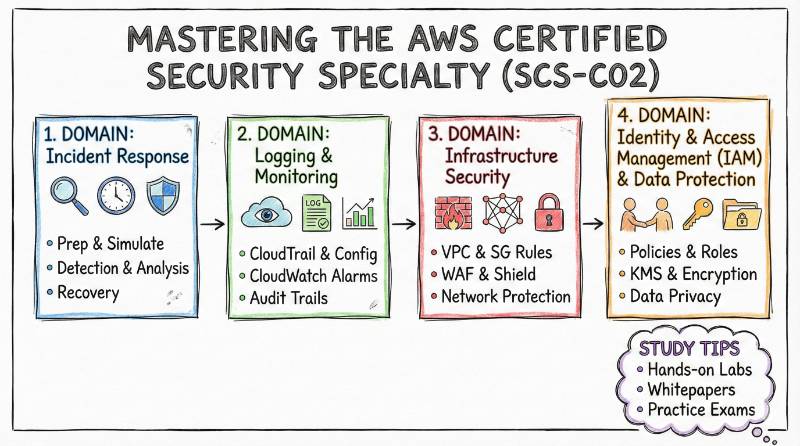
In the modern cloud era, security is no longer just a checkbox at the end of a project. It is the very foundation upon which we build reliable systems. If you are an engineer or a manager working in a global environment, you already know that a single vulnerability can halt a company’s progress. The AWS Certified Security – Specialty (SCS-C02) is the gold standard for proving you have the skills to prevent that from happening.
This guide is designed to help you navigate the training and certification process. We will look at why this credential matters, how to prepare for it, and where it fits into your long-term career growth.
AWS Certification Overview
Understanding the AWS ecosystem helps you see where the Security Specialty fits into your broader professional journey.
| Track | Level | Who it’s for | Prerequisites | Skills Covered | Recommended Order |
| Security | Specialty | Security Engineers, Cloud Pros | 2+ years AWS experience | IAM, Logging, Data Protection, Incident Response | After Associate |
| Solutions Architect | Associate | Software & Cloud Architects | None (Cloud Practitioner suggested) | High-level system design and cost optimization | 1st or 2nd |
| SysOps Administrator | Associate | System Admins, SREs | Foundational AWS knowledge | Operational excellence and troubleshooting | 2nd |
| Developer | Associate | Software Engineers | Basic AWS hands-on knowledge | Writing and deploying code on AWS | 1st or 2nd |
| DevOps Engineer | Professional | SREs, DevOps Leads | Associate-level knowledge | Automation, CI/CD, and governance | After Associate |
Deep Dive: AWS Certified Security Specialty (SCS-C02)
What it is
The SCS-C02 is a specialized exam that focuses on securing the AWS Cloud environment. It is much more than just learning about firewalls. It covers identity management, encryption, monitoring, and how to respond when things go wrong. It validates that you can design a secure environment from the ground up rather than just fixing problems after they occur.
Who should take it
This certification is built for professionals who handle security responsibilities. This includes:
- Cloud Engineers who want to specialize in hardening infrastructure.
- Security Analysts moving from traditional data centers to the cloud.
- DevOps Engineers responsible for creating secure deployment pipelines.
- Engineering Managers who need to understand the compliance and risk landscape of their cloud footprint.
Skills you’ll gain
By the end of this training, you will have a deep understanding of how to protect every layer of your cloud stack.
- Identity and Access Management (IAM): You will learn to manage user permissions with extreme precision. This includes understanding cross-account access and how to use Service Control Policies (SCPs) to limit what can happen in your environment.
- Logging and Monitoring: You will gain the ability to use tools like CloudTrail and CloudWatch to see exactly what is happening in your network at all times.
- Infrastructure Security: This involves learning how to set up VPCs, use Web Application Firewalls (WAF), and protect against DDoS attacks.
- Data Protection: You will master encryption for data at rest and in transit, using the Key Management Service (KMS) to handle cryptographic keys.
Real-world projects you should be able to do
Practical application is the true test of this certification. After passing, you should be able to:
- Build a Secure Landing Zone: Create a multi-account AWS environment that uses centralized logging and strict identity controls from day one.
- Automated Threat Response: Set up a system where AWS GuardDuty detects a threat and automatically triggers a Lambda function to isolate the compromised resource.
- Compliance Auditing: Use AWS Config to continuously monitor your resources and automatically fix any that fall out of compliance with company security standards.
Preparation Plan
The time you need depends on your current hands-on experience. Here are three common paths:
- The 14-Day Sprint: This is for experts who use AWS security tools every day. Spend the first week reviewing the exam domains and the second week doing practice tests to get used to the question style.
- The 30-Day Standard Path: This is best for most working engineers. Dedicate 5-7 hours per week. Spend the first two weeks on video courses and labs. Spend the next two weeks on whitepapers and practice exams.
- The 60-Day Deep Dive: If you are new to the security side of AWS, take your time. Spend the first month doing as many hands-on labs as possible. Use the second month to study the “why” behind security policies and architectural patterns.
Common Mistakes
Many people find this exam difficult because of a few common pitfalls:
- Over-reliance on Theory: The exam is very practical. If you haven’t actually built an IAM policy or set up a KMS key, the questions will be confusing.
- Ignoring the “Deny” Rule: In AWS, an explicit “Deny” always wins over an “Allow.” Forgetting this simple rule can lead to many wrong answers on the exam.
- Not Reading the Whole Question: AWS questions are often long. They might ask for the “most cost-effective” or “most secure” solution. If you don’t read carefully, you might pick a correct technical answer that doesn’t meet the specific constraint.
Choose Your Path: 6 Career Learning Paths
Cloud security fits into many different career trajectories. Here is how you can stack your certifications to reach your goals.
- The DevOps Path: Start with the Developer Associate, move to the Security Specialty, and finish with the DevOps Engineer Professional. This makes you an expert in automated, secure delivery.
- The DevSecOps Path: Focus on the SysOps Associate, then the Security Specialty, followed by learning tools like Jenkins and Vault. This is for those who want to build the “security pipes” for an organization.
- The SRE Path: Combine the SysOps Associate with the Security Specialty and the Advanced Networking Specialty. This path focuses on the high-level reliability and safety of large-scale systems.
- The AIOps/MLOps Path: Start with the Machine Learning Specialty, then add the Security Specialty. This ensures that your AI models and data are protected from theft or tampering.
- The DataOps Path: Take the Data Engineer Associate followed by the Security Specialty. This is critical for engineers handling sensitive customer data and big data pipelines.
- The FinOps Path: Combine the Cloud Practitioner with the Security Specialty. Security and cost often go hand-in-hand; securing your resources prevents expensive “zombie” resources or unauthorized usage.
Role → Recommended Certifications Mapping
| Your Current Role | Primary Certification | Secondary/Support Certification |
| DevOps Engineer | DevOps Engineer Professional | Security Specialty |
| SRE | SysOps Admin Associate | Security Specialty |
| Platform Engineer | Solutions Architect Associate | Security Specialty |
| Cloud Engineer | Solutions Architect Professional | SysOps Admin Associate |
| Security Engineer | Security Specialty | Solutions Architect Associate |
| Data Engineer | Data Engineer Associate | Security Specialty |
| FinOps Practitioner | Cloud Practitioner | Security Specialty |
| Engineering Manager | Solutions Architect Associate | Security Specialty |
Next Certifications to Take
Once you have the SCS-C02 under your belt, don’t stop there. Here are three directions you can take:
- Stay in the Track (Same Track): AWS Certified Advanced Networking – Specialty. Security is only as good as the network it sits on. Understanding deep networking will make you a much better security professional.
- Broaden Your Skills (Cross-Track): AWS Certified Data Engineer – Associate. As data becomes more regulated (GDPR, etc.), being a security expert who understands data engineering is a high-value combination.
- Move into Leadership (Leadership): AWS Certified Solutions Architect – Professional. This moves you away from just “fixing security” to “designing the whole business solution” with security built into the blueprint.
Top Training Institutions for SCS-C02
Choosing a quality training provider can significantly reduce your study time. Here are the top institutions for this certification:
- DevOpsSchool: This is a leading choice for professionals looking for guided learning. They offer instructor-led sessions and practical labs that simulate real-world security breaches and how to fix them.
- Cotocus: They focus on high-impact training and bootcamps. If you need to get certified quickly while still gaining practical skills, their structured programs are an excellent choice.
- Scmgalaxy: A well-known community and resource hub. They provide a wealth of blogs, tutorials, and community support for engineers who prefer a self-paced but supported learning style.
- BestDevOps: They offer specialized training that focuses on the operational side of the cloud. Their courses are great for engineers who want to see how security works in a live production environment.
- Devsecopsschool: As the name suggests, they are specialists in merging security with the DevOps lifecycle. Their training is highly relevant for modern software development teams.
- Sreschool: If your interest lies in the stability and reliability of systems, Sreschool provides the context you need to make security a part of your system’s “uptime” strategy.
- Aiopsschool: For those looking at the future of tech, they offer insights into how artificial intelligence can be used to automate security monitoring and response.
- Dataopsschool: They provide the training necessary to secure large-scale data systems, ensuring that your data lakes and warehouses remain private and secure.
- Finopsschool: Their courses help you understand the financial impact of security, showing how good security practices can actually save a company money on their cloud bill.
General Career & Certification FAQs
- Is the SCS-C02 worth it? Yes. It is one of the highest-paying certifications in the cloud industry because security experts are in short supply.
- How long does it take to study? Most working professionals take between 4 to 8 weeks depending on their prior experience.
- Do I need the Solutions Architect Associate first? It isn’t required by AWS, but it is highly recommended. It gives you the “big picture” you need to understand specific security tools.
- What is the passing score? The passing score is 750. The exam uses scaled scoring, so some questions may be worth more than others.
- Are there labs in the exam? While AWS occasionally experiments with labs, the current version is primarily multiple-choice and multiple-response.
- Does this certification expire? Yes, it is valid for three years. You can recertify by taking the current version of the exam.
- Can I take the exam in India? Yes, you can take it at a local testing center or from your home/office via online proctoring.
- Will this help me get a job? It is a powerful door-opener. Many companies now use automated filters that look for “Specialty” certifications for senior roles.
- What is the hardest part of the exam? Most people struggle with the “Evaluation Logic” of IAM policies—knowing which rule takes precedence in a complex scenario.
- How much does the exam cost? The standard price for a Specialty exam is $300 USD.
- Are there any prerequisites? There are no longer any mandatory prerequisites, though 2+ years of AWS experience is advised.
- Is the exam available in multiple languages? Yes, AWS offers the exam in several languages, including English, Japanese, Korean, and Simplified Chinese.
AWS Certified Security Specialty Specific FAQs
- Does the exam cover hybrid cloud security? Yes, you should understand how to secure the connection between an on-premise data center and AWS using VPNs and Direct Connect.
- How much should I study KMS? KMS is a huge part of the exam. You must understand key types, key policies, and how encryption works across different services.
- What is the focus on Incident Response? You need to know how to use GuardDuty, Security Hub, and Amazon Macie to detect threats and how to use Lambda to automate the response.
- How deep is the networking section? You need a solid understanding of VPC Peering, Transit Gateway security, and how to configure Security Groups vs. Network ACLs.
- Are there questions on third-party tools? No. The exam focuses almost exclusively on AWS-native security services and how they integrate with each other.
- Do I need to know about compliance standards? You don’t need to memorize every law, but you should know how AWS services help you meet standards like SOC2, ISO, or HIPAA.
- Is S3 security a big topic? Absolutely. You must understand S3 Bucket Policies, Access Points, and how to use Macie to find sensitive data in your buckets.
- What is the best way to do practice tests? Use official AWS practice sets or reputable providers like DevOpsSchool to ensure the questions reflect the difficulty of the real exam.
Conclusion
Stepping into the world of AWS security is one of the smartest moves you can make for your career. As organizations continue to move their most sensitive data and critical operations to the cloud, the need for individuals who can protect those assets will only grow. This certification is not just a piece of paper; it is a sign that you have the discipline and the technical depth to handle high-stakes environments. Whether you are aiming to become a lead Security Engineer, a versatile DevOps pro, or an Engineering Manager who leads with technical confidence, the SCS-C02 training provides the foundation you need. It forces you to think critically about every connection, every permission, and every byte of data. By following a structured plan, choosing the right training partner, and focusing on hands-on practice, you can join the ranks of elite cloud professionals who keep the digital world safe.

Find Trusted Cardiac Hospitals
Compare heart hospitals by city and services — all in one place.
Explore Hospitals
The breakdown of the AWS Certified Security Specialty (SCS-C02) exam and preparation tips is clear and practical — really helpful for anyone preparing for this certification.
Really helpful and easy-to-follow guide! The way you’ve broken down the SCS-C02 exam domains and focused on practical learning makes it much less overwhelming for aspirants. I especially liked the emphasis on hands-on practice with real AWS security services — that’s exactly what makes the difference in this exam. Great resource for anyone serious about building a career in AWS security!