
Security is often treated like a lock on a door that you add after the house is built. But in the cloud, security is the foundation, the walls, and the roof. If you don’t get it right from the start, the whole structure is at risk. Throughout my time helping teams build and scale systems, I’ve seen that the most successful engineers aren’t just the ones who can write code or deploy servers—they are the ones who understand how to keep those assets safe.
Microsoft Azure is a massive platform with hundreds of services. Navigating its security landscape can feel overwhelming. That is where the Microsoft Azure Security Technologies (AZ-500) certification comes in. It is designed to turn a general cloud practitioner into a security specialist. This guide is built to help you understand what this program is, why it matters for your career, and how you can master it to become a trusted expert in your organization.
Mastering the AZ-500: High-Level Overview
Before we dive into the details, let’s look at the big picture. This table summarizes the core components of the AZ-500 track.
| Track | Level | Who it’s for | Prerequisites | Skills Covered | Recommended Order |
| Azure Security | Associate | Software Engineers, DevOps, Cloud Architects, Security Analysts | Strong Azure fundamentals and hands-on experience | Identity, Platform Protection, Data Security, Security Ops | AZ-900 → AZ-104 → AZ-500 |
The Deep Dive: Microsoft Azure Security Technologies (AZ-500)
What it is
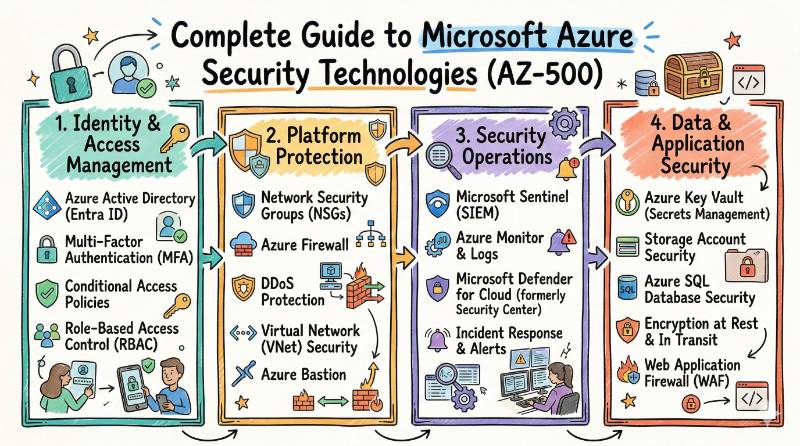
The AZ-500 is a specialized certification that proves you can handle security “in the trenches.” It isn’t just about knowing what the tools are; it’s about knowing how to configure them to stop real threats. It covers four major areas: managing identity and access, implementing platform protection, securing data and applications, and managing security operations. In simple terms, it teaches you how to lock down your cloud environment so that only the right people can get in, and your data stays exactly where it should be.
Who should take it
This is a perfect fit for working engineers who find themselves responsible for cloud infrastructure. If you are a DevOps Engineer, a Cloud Architect, or a Software Engineer working in Azure, this knowledge is essential. It is also highly recommended for Engineering Managers who need to oversee security compliance and understand the risks their teams are managing. If you want to move from general cloud work into a specialized Security Engineer role, this is your starting point.
Skills you’ll gain
By pursuing this certification, you move beyond basic “username and password” security. You learn how to build layers of defense that work together. You will understand how to manage identities for thousands of users without losing control, how to create “walls” around your network that only allow safe traffic, and how to use automation to catch hackers before they do damage.
- Identity Management: Mastering Azure Active Directory (Entra ID), Multi-Factor Authentication (MFA), and Privileged Identity Management (PIM) to ensure “Just-In-Time” access.
- Infrastructure Protection: Configuring Azure Firewalls, Network Security Groups (NSGs), and protecting your Virtual Machines and Containers.
- Data Encryption: Learning how to use Azure Key Vault to manage secrets and how to encrypt data at rest and in transit.
- Threat Detection: Setting up Microsoft Sentinel and Defender for Cloud to monitor your entire environment for suspicious activity.
Real-world projects you should be able to do after it
Knowledge is only useful if you can apply it. After finishing this course, you won’t just have a certificate; you’ll have the ability to solve real business problems. You will be the person who ensures that a company’s most sensitive data is safe from leaks and that their applications are resilient against attacks.
- Zero-Trust Implementation: You can design a system where no user or device is trusted by default, even if they are inside the corporate network.
- Secure CI/CD Pipelines: You can integrate security scanning into the software delivery process so that code is checked for vulnerabilities before it ever goes live.
- Automated Incident Response: You can build “Playbooks” that automatically shut down a server or revoke a user’s access if a security breach is detected.
- Regulatory Compliance: You can configure Azure Policy to ensure that your cloud environment always follows industry standards like ISO or HIPAA.
Preparation plan
The key to passing is consistency. Don’t try to cram everything into a single weekend. Use a structured approach based on your experience.
- 7–14 days (For Experts): If you are already working with Azure Security daily, focus on the exam mechanics. Take 3-4 practice exams, identify your weak spots (often in the “Security Operations” section), and read the official documentation for those specific areas.
- 30 days (Recommended): Spend 1 hour every morning on theory and 2 hours every weekend on hands-on labs. Spend the first two weeks on Identity and Networking, and the last two weeks on Data Security and Monitoring.
- 60 days (For Beginners/Managers): Take it slow. Spend the first month going through a full video course and reading the Microsoft Learn modules. Spend the second month building small projects in a free Azure account to see how the tools actually behave when you turn them on.
Common mistakes
I have seen many talented engineers fail this exam because they underestimated it. It is not a test of memory; it is a test of judgment.
- Ignoring the Labs: Many people try to pass by just reading books. You must actually go into the Azure portal and click the buttons. You need to know where the settings are and what happens when you change them.
- Focusing Only on Basics: The exam often asks about “edge cases”—like how to handle guest users from other companies or how to secure a specific type of database. Don’t just study the “standard” setups.
- Poor Time Management: The questions can be long and include “Case Studies.” If you spend too much time on the first ten questions, you will run out of time for the end. Practice moving through questions efficiently.
Best next certification after this
Once you have the AZ-500, you are in a great position to specialize further.
- Same Track: SC-100 (Cybersecurity Architect) to move into high-level design.
- Cross-Track: AZ-400 (DevOps Engineer Expert) to master the “DevSecOps” way of working.
- Leadership: AZ-305 (Solutions Architect Expert) to lead large-scale cloud migrations.
Choose Your Path: Career Roadmaps
Azure Security isn’t a silo; it connects to every other part of IT operations. Here is how you can use the AZ-500 in different career paths:
- DevOps Path: Focus on automating security. Use AZ-500 skills to write “Infrastructure as Code” that is secure by default.
- DevSecOps Path: This is the most direct application. You become the bridge between the developers and the security team, ensuring speed doesn’t come at the cost of safety.
- SRE Path: Focus on reliability. A secure system is a stable system. Use security monitoring to prevent outages caused by attacks or misconfigurations.
- AIOps/MLOps Path: Use Azure’s AI tools to monitor security logs at scale. Protect your machine learning models from data poisoning or unauthorized access.
- DataOps Path: Focus on the “Data Security” pillar of AZ-500. Ensure that data pipelines are encrypted and that access to data lakes is strictly controlled.
- FinOps Path: Use Azure Policy (covered in AZ-500) to prevent teams from spinning up expensive, unnecessary resources, which is both a cost risk and a security risk.
Role → Recommended Certifications Mapping
| Your Current Role | Recommended Certification Sequence |
| DevOps Engineer | AZ-104 → AZ-500 → AZ-400 |
| SRE | AZ-104 → AZ-500 → AZ-700 |
| Platform Engineer | AZ-104 → AZ-500 → AZ-305 |
| Cloud Engineer | AZ-900 → AZ-104 → AZ-500 |
| Security Engineer | AZ-500 → SC-200 → SC-300 |
| Data Engineer | DP-203 → AZ-500 |
| FinOps Practitioner | AZ-900 → AZ-500 |
| Engineering Manager | AZ-900 → AZ-500 |
Top Institutions for AZ-500 Training
- DevOpsSchool: Known for its highly practical approach and industry-expert trainers like Rajesh Kumar. They offer deep-dive sessions that go beyond the exam syllabus to focus on real job skills. Their support system helps you through the entire learning journey.
- Cotocus: This institution focuses on enterprise-grade training. They are excellent for corporate teams who need to upskill quickly on cloud security standards. Their curriculum is updated frequently to match the latest Azure changes.
- Scmgalaxy: A great choice if you value community and peer learning. They provide a wealth of free resources, blogs, and technical discussions alongside their formal training programs. It is a hub for engineers who want to stay updated on the latest DevOps trends.
- BestDevOps: They offer a streamlined learning experience specifically for busy working professionals. Their courses are designed to be efficient, focusing on the most high-impact topics you need for the certification and your daily work.
- DevSecOpsSchool: The go-to place if you want to specialize specifically in the intersection of security and automation. They provide deep insights into how AZ-500 concepts apply to modern software delivery pipelines.
- Sreschool: Focuses on the reliability side of the cloud. They help you understand how security monitoring and threat detection contribute to keeping your systems running smoothly 24/7.
- Aiopsschool: Perfect for those looking to use artificial intelligence in their security operations. They teach you how to handle the massive amounts of data generated by Azure security tools.
- Dataopsschool: Specializes in securing the data lifecycle. They take the data protection lessons from AZ-500 and apply them to complex data engineering workflows.
- Finopsschool: Helps you understand the financial impact of security. They teach you how to use security controls to manage cloud costs and prevent “bill shocks” from unauthorized resource usage.
FAQs: Career and Strategy
- Is the AZ-500 exam hard? Yes, it is one of the more difficult associate exams because it covers a very broad range of complex services.
- How long does the certification stay valid? It is valid for one year, but you can renew it for free through a simple online assessment on the Microsoft website.
- Should I take AZ-104 before AZ-500? I highly recommend it. AZ-104 teaches you how to build the “house,” while AZ-500 teaches you how to secure it.
- Is this certification recognized in India? Absolutely. Most major IT firms and global companies in India prioritize this certification for their security and cloud roles.
- Does it require coding? You don’t need to be a programmer, but you should be comfortable with basic scripting (PowerShell) and reading JSON files.
- Can I pass with just self-study? Yes, if you have a lot of discipline and a home lab, but a structured course often saves time and prevents confusion.
- What is the passing score? You need a score of 700 out of 1000 to pass the exam.
- How much does the exam cost? The cost varies by country but is generally around $165 USD. Check the official site for local pricing in India.
- Are there labs in the exam? Sometimes. Microsoft occasionally includes performance-based questions where you must perform tasks in a real Azure environment.
- Is this certification better than AWS Security? It isn’t about “better”; it’s about where your company’s data lives. If you work in an Azure environment, AZ-500 is the gold standard.
- Will this get me a salary hike? While a certificate alone isn’t a guarantee, the skills you gain are in high demand and often lead to higher-paying specialized roles.
- What if I fail? You can retake the exam after 24 hours for the first retake, but the waiting period increases for subsequent attempts.
FAQs: AZ-500 Technical Details
- What is the biggest topic in the exam? Managing Identity and Access (Azure AD/Entra ID) is usually the largest section.
- Do I need to know about containers (AKS)? Yes, basic security for Azure Kubernetes Service is part of the curriculum.
- How deep is the networking section? You must understand subnets, VNet peering, and how to use Firewalls and NSGs to control traffic flow.
- What is PIM? Privileged Identity Management is a key topic. It allows you to give someone admin rights only when they need them and for a limited time.
- What is the difference between Sentinel and Defender? Defender protects individual resources (like VMs or Databases), while Sentinel is a “big picture” tool that looks at logs from everything to find patterns.
- Do I need to learn KQL? Yes, basic Kusto Query Language (KQL) is needed to search for logs in Azure Monitor and Sentinel.
- Is Key Vault mandatory to learn? Yes. You must know how to store secrets, keys, and certificates securely.
- Does the exam cover “Hybrid” cloud? Yes, you should know how to secure connections between an on-premise data center and Azure.
Conclusion
Mastering Azure Security is a journey, not a sprint. The AZ-500 certification is a powerful tool that transforms the way you look at the cloud. It moves you away from a “hope for the best” mindset and gives you the technical precision to build systems that are secure by design. In my years of working with different technologies, I have found that the professionals who stand out are the ones who can handle the responsibility of protecting an organization’s most valuable assets. This guide has shown you the road ahead—from the core skills and career paths to the best training institutions and preparation strategies. Whether you are an engineer looking to specialize or a manager aiming to reduce risk, the AZ-500 is your gateway to a more secure and successful future. The cloud is only as strong as the people securing it. With the right training and a hands-on approach, you can be the expert your team relies on.

Find Trusted Cardiac Hospitals
Compare heart hospitals by city and services — all in one place.
Explore Hospitals
Thanks for this complete guide to Microsoft Azure security and the AZ-500! 🛡️ The explanations are clear and easy to follow — it really helps break down what to expect from the certification and the technologies involved. Very useful for anyone planning to build skills in cloud security. Appreciate you sharing this!