
Introduction
AI UEBA User and Entity Behavior Analytics tools help security teams detect abnormal behavior across users, devices, applications, service accounts, cloud workloads, SaaS platforms, endpoints, and network entities. These tools use machine learning, behavioral baselining, anomaly detection, risk scoring, identity analytics, and security event correlation to identify suspicious activity that traditional rule-based systems may miss. Instead of only looking for known signatures, AI UEBA tools learn what normal behavior looks like and then flag unusual actions that may indicate account compromise, insider threats, privilege misuse, lateral movement, data theft, or policy violations.
Why It Matters
Modern attackers often use valid credentials, trusted devices, legitimate tools, and normal-looking access paths to avoid detection. A compromised user account may not trigger a malware alert, but it may access unusual files, log in from a strange location, use new devices, download large data volumes, or access systems outside normal working patterns. AI UEBA matters because it gives security teams behavior-based visibility into subtle threats. It helps reduce alert noise, prioritize risky activity, and support faster incident response by showing who did what, when it happened, what changed, and why it may be risky.
Real World Use Cases
- Insider threat detection: Identify employees, contractors, or privileged users showing unusual access behavior.
- Compromised account detection: Detect risky sign-ins, impossible travel, unusual device usage, and abnormal access patterns.
- Privilege misuse monitoring: Find suspicious administrator activity, excessive access, and unusual privilege escalation.
- Data exfiltration detection: Identify unusual file downloads, database access, email activity, or cloud storage movement.
- Lateral movement detection: Detect suspicious access across endpoints, identity systems, servers, and applications.
- Service account monitoring: Identify abnormal activity from machine identities, automation accounts, and non-human users.
- Cloud and SaaS behavior analytics: Monitor abnormal user and entity activity across cloud platforms and SaaS applications.
- Risk-based investigation: Assign dynamic risk scores to users and entities so analysts can focus on the most important alerts.
Evaluation Criteria for Buyers
- Behavioral analytics depth: The platform should create strong baselines for users, devices, accounts, services, and applications.
- Machine learning quality: Buyers should check how well ML reduces false positives and detects subtle behavior changes.
- Identity coverage: The tool should support human users, privileged users, service accounts, machine identities, and cloud identities.
- Entity coverage: It should monitor endpoints, servers, network devices, SaaS apps, cloud workloads, and databases where relevant.
- Risk scoring: Alerts should be prioritized based on behavior, context, asset value, identity risk, and threat severity.
- Data source integration: Strong UEBA depends on logs from SIEM, IAM, EDR, XDR, cloud, SaaS, network, email, and data platforms.
- Investigation workflow: Analysts need timelines, behavior summaries, entity context, related events, and response guidance.
- Response integration: The platform should connect with SIEM, SOAR, ITSM, IAM, PAM, and endpoint tools.
- Privacy and governance: Role-based access, audit logs, data retention, masking, and policy controls are important.
- Scalability: The tool should handle large volumes of users, entities, events, and cloud activity.
- Compliance support: Dashboards and reports should support audit, insider risk, and governance requirements.
- Ease of use: Analysts should be able to understand behavior alerts quickly without excessive manual correlation.
Best for: SOC teams, threat hunters, incident response teams, insider risk teams, identity security teams, cloud security teams, compliance teams, MSSPs, and enterprises that need behavior-based detection across users, devices, identities, applications, and cloud environments.
Not ideal for: Very small organizations with limited users and simple infrastructure, teams without centralized logging, companies that cannot act on behavior alerts, or organizations that only need basic antivirus and firewall monitoring.
What Changed in AI UEBA User and Entity Behavior Analytics
- Behavior-based detection is more important: Attackers increasingly use valid credentials and trusted tools, making signature-only detection insufficient.
- Identity signals are central to UEBA: User behavior, session activity, privilege changes, and risky sign-ins are now core detection inputs.
- Entity analytics is expanding: UEBA now includes devices, workloads, service accounts, APIs, applications, and machine identities.
- Cloud and SaaS monitoring is essential: Abnormal behavior often happens in cloud storage, collaboration apps, identity providers, and SaaS platforms.
- AI is helping reduce false positives: Machine learning can group related activity, learn baselines, and prioritize riskier anomalies.
- Insider risk programs are growing: Organizations need better visibility into unusual data access, privilege misuse, and policy violations.
- Integration with XDR is stronger: UEBA is increasingly part of broader detection and response workflows across endpoint, identity, cloud, and network.
- Risk-based scoring is replacing raw alerts: Analysts need prioritized behavior risk instead of long lists of isolated anomalies.
- Service account behavior matters more: Non-human identities can be abused for persistence, automation misuse, and lateral movement.
- Governance and privacy controls are more important: Behavior analytics must be handled carefully because it involves user activity data.
- Attack path context is improving: Some platforms connect abnormal behavior with identity paths, asset criticality, and exposure risk.
- Automated response is becoming common: High-confidence UEBA alerts can trigger MFA challenges, session revocation, ticketing, or SOAR playbooks.
Quick Buyer Checklist
- Confirm support for users, devices, service accounts, cloud identities, endpoints, SaaS apps, and network entities.
- Check whether the platform builds behavioral baselines automatically.
- Test anomaly detection using real identity, endpoint, cloud, and application logs.
- Review risk scoring logic and whether alerts explain why behavior is unusual.
- Confirm integration with SIEM, SOAR, IAM, PAM, EDR, XDR, cloud, and ITSM tools.
- Check whether the tool supports insider threat, account compromise, and lateral movement detection.
- Review investigation timelines, entity profiles, and related event correlation.
- Validate privacy controls, RBAC, audit logs, data retention, and masking options.
- Test false positive rates before rollout.
- Confirm whether response actions can be automated or routed to ticketing.
- Check scalability for log volume, users, entities, and cloud events.
- Review reporting for compliance, insider risk, SOC metrics, and executive visibility.
- Check export options and vendor lock-in risk.
- Run a pilot with real behavior data before buying.
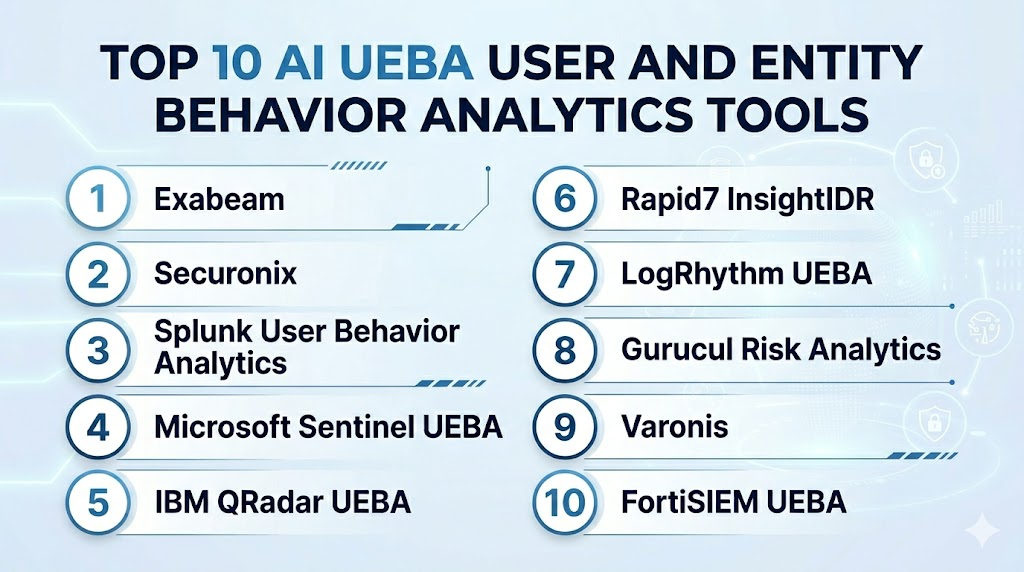
Top 10 AI UEBA User and Entity Behavior Analytics Tools
1- Exabeam
2- Securonix
3- Splunk User Behavior Analytics
4- Microsoft Sentinel UEBA
5- IBM QRadar UEBA
6- Rapid7 InsightIDR
7- LogRhythm UEBA
8- Gurucul Risk Analytics
9- Varonis
10- FortiSIEM UEBA
1- Exabeam
One-line verdict: Best for SOC teams needing behavior analytics, timeline investigation, and risk-based alert prioritization.
Short description:
Exabeam provides behavior analytics and security operations capabilities that help teams detect abnormal user and entity behavior. It is useful for SOC teams that need to identify insider threats, compromised accounts, lateral movement, privilege misuse, and abnormal activity through behavior baselines and risk scoring.
Standout Capabilities
- User and entity behavior analytics
- Risk-based alert prioritization
- Behavioral baselining across users and entities
- Investigation timelines for security analysts
- Insider threat and compromised account detection
- Integration with SIEM and security operations workflows
- Cloud and identity data correlation
- Automated investigation support
AI-Specific Depth
- Model support: Proprietary behavioral analytics and machine learning models
- RAG and knowledge integration: Varies / N/A
- Evaluation: Not publicly stated
- Guardrails: Risk thresholds, detection rules, and workflow controls vary by configuration
- Observability: User timelines, entity profiles, risk scores, alert trends, and investigation dashboards
Pros
- Strong investigation timelines for SOC analysts
- Good fit for risk-based behavior analytics
- Useful for insider threat and compromised account detection
Cons
- Requires good log quality for accurate baselines
- May require analyst training and tuning
- Pricing and packaging vary by deployment
Security and Compliance
Exabeam provides enterprise security operations capabilities. Exact SSO, RBAC, audit logs, encryption, data retention, residency, and certifications should be verified during procurement. If details are not confirmed, write Not publicly stated.
Deployment and Platforms
- Cloud and enterprise deployment options may vary
- Web-based analyst console
- Integrates with logs, identity data, endpoint data, and security tools
- Deployment depends on selected product package and environment
Integrations and Ecosystem
Exabeam is designed to connect behavior analytics with broader security operations workflows.
- SIEM data sources
- SOAR workflows
- Identity providers
- Endpoint security tools
- Cloud platforms
- ITSM and ticketing tools
- APIs and security data connectors
Pricing Model
Typically subscription-based and enterprise-oriented. Exact pricing depends on package, data volume, users, and contract. Exact pricing is Not publicly stated.
Best-Fit Scenarios
- SOC teams investigating compromised accounts
- Insider risk programs needing behavior timelines
- Enterprises that want UEBA connected with security operations
2- Securonix
One-line verdict: Best for enterprises needing scalable UEBA with strong security analytics and insider threat detection.
Short description:
Securonix provides behavior analytics, threat detection, and security operations capabilities focused on detecting abnormal user and entity activity. It is useful for enterprises that need scalable UEBA across identity, cloud, endpoint, network, and application data.
Standout Capabilities
- User and entity behavior analytics
- Insider threat detection
- Risk-based scoring and alert prioritization
- Machine learning-based anomaly detection
- Security data correlation across multiple sources
- Threat hunting and investigation workflows
- Integration with SIEM and SOAR processes
- Cloud, SaaS, and identity analytics support
AI-Specific Depth
- Model support: Proprietary machine learning and behavior analytics
- RAG and knowledge integration: Varies / N/A
- Evaluation: Not publicly stated
- Guardrails: Detection policies, risk thresholds, and workflow rules vary by configuration
- Observability: Risk dashboards, alert details, user profiles, entity behavior, and investigation views
Pros
- Strong UEBA and insider threat analytics
- Scales well for large security environments
- Useful for multi-source behavior correlation
Cons
- Deployment and tuning may require experienced security teams
- Complex environments may need professional services
- Pricing and packaging are not universally public
Security and Compliance
Securonix provides enterprise security analytics capabilities. Exact SSO, RBAC, audit logging, encryption, data retention, residency, and certifications should be verified directly. If unverified, use Not publicly stated.
Deployment and Platforms
- Cloud-based security analytics platform
- Web console
- Security data ingestion workflows
- Integration with identity, cloud, endpoint, and network sources
- Deployment varies by customer environment
Integrations and Ecosystem
Securonix connects UEBA with broader security analytics and response workflows.
- SIEM data sources
- SOAR workflows
- Identity providers
- Cloud platforms
- Endpoint tools
- Data security tools
- ITSM and ticketing integrations
Pricing Model
Typically subscription-based and enterprise-focused. Exact pricing depends on data volume, modules, and contract. Exact pricing is Not publicly stated.
Best-Fit Scenarios
- Large enterprises with many behavior data sources
- Insider threat detection programs
- SOC teams needing ML-driven behavior analytics
3- Splunk User Behavior Analytics
One-line verdict: Best for Splunk-centered SOC teams needing behavior analytics connected to security data.
Short description:
Splunk User Behavior Analytics helps detect abnormal activity across users and entities using machine learning and behavior analytics. It is useful for organizations that use Splunk and want UEBA connected with their security logs, SIEM workflows, dashboards, and investigation processes.
Standout Capabilities
- User behavior analytics
- Entity behavior analytics
- Machine learning-driven anomaly detection
- Risk scoring and threat prioritization
- Insider threat and account compromise detection
- Integration with Splunk security ecosystem
- Investigation and visualization support
- Correlation with logs and security events
AI-Specific Depth
- Model support: Proprietary analytics and machine learning capabilities
- RAG and knowledge integration: Varies / N/A
- Evaluation: Not publicly stated
- Guardrails: Configurable detection logic and alert controls vary by setup
- Observability: Dashboards, risk scores, user behavior profiles, entity analytics, and alerts
Pros
- Strong fit for Splunk environments
- Flexible behavior analytics using rich log data
- Useful for SOC teams already invested in Splunk
Cons
- Requires quality data ingestion and Splunk expertise
- Can be complex for smaller teams
- Licensing and data volume costs should be reviewed carefully
Security and Compliance
Splunk offers enterprise security platform capabilities, including access control and audit features. Exact SSO, RBAC, encryption, data retention, residency, and certifications depend on deployment and licensing. If not verified, use Not publicly stated.
Deployment and Platforms
- Cloud and enterprise deployment options vary
- Web console
- Works with Splunk security data
- Integrates with logs, identities, endpoints, applications, and cloud sources
Integrations and Ecosystem
Splunk User Behavior Analytics works best in Splunk-centered security environments.
- Splunk Enterprise Security
- Splunk SOAR
- Identity data sources
- Endpoint security tools
- Cloud logs
- Network logs
- API and data ingestion pipelines
Pricing Model
Typically subscription-based and data-volume or workload dependent. Exact pricing varies by deployment and agreement. Exact pricing is Not publicly stated.
Best-Fit Scenarios
- SOC teams using Splunk
- Enterprises with large log analytics programs
- Teams needing behavior analytics across many data sources
4- Microsoft Sentinel UEBA
One-line verdict: Best for Microsoft-centered security teams needing behavior analytics inside cloud SIEM workflows.
Short description:
Microsoft Sentinel includes UEBA capabilities that help detect anomalies and risky behavior across users, entities, and security events. It is useful for organizations using Microsoft Sentinel, Microsoft Entra ID, Microsoft Defender, and Microsoft cloud security services.
Standout Capabilities
- User and entity behavior analytics inside Microsoft Sentinel
- Identity and security event correlation
- Behavior baselines and anomaly signals
- Integration with Microsoft Defender ecosystem
- Cloud-native SIEM and SOAR workflows
- Investigation graphs and entity pages
- Risk context for users and hosts
- Automation through playbooks
AI-Specific Depth
- Model support: Proprietary Microsoft analytics and machine learning capabilities
- RAG and knowledge integration: Varies / N/A
- Evaluation: Not publicly stated
- Guardrails: Analytics rules, playbook controls, and admin permissions vary by configuration
- Observability: Entity pages, incidents, alerts, behavior insights, logs, and investigation views
Pros
- Strong fit for Microsoft security environments
- Cloud-native SIEM and automation alignment
- Useful identity and entity context through Microsoft ecosystem
Cons
- Best value depends on Microsoft data sources and Sentinel adoption
- Requires careful log ingestion and cost management
- Advanced tuning may require security engineering skills
Security and Compliance
Microsoft provides enterprise security controls such as access management, encryption, audit capabilities, and administrative governance. Exact certifications, retention, data residency, and feature availability depend on plan, region, and configuration. If not verified, use Not publicly stated.
Deployment and Platforms
- Cloud-based Microsoft security platform
- Web console
- Cloud SIEM and SOAR workflows
- Integrates with Microsoft and third-party data sources
- Deployment depends on Sentinel configuration and log ingestion
Integrations and Ecosystem
Microsoft Sentinel UEBA integrates with Microsoft and broader security operations workflows.
- Microsoft Sentinel
- Microsoft Defender XDR
- Microsoft Entra ID
- Microsoft Defender for Cloud
- Third-party log sources
- SOAR playbooks
- API and automation workflows
Pricing Model
Typically usage-based and cloud-service-based, often influenced by data ingestion and retention. Exact pricing varies by region, usage, and configuration. Exact pricing is Not publicly stated in a universal format.
Best-Fit Scenarios
- Microsoft-centered SOC teams
- Cloud SIEM users needing behavior analytics
- Teams correlating identity, endpoint, and cloud security events
5- IBM QRadar UEBA
One-line verdict: Best for IBM QRadar users needing behavior analytics inside existing SIEM workflows.
Short description:
IBM QRadar UEBA helps security teams detect abnormal user and entity behavior using security event correlation and behavioral analytics. It is useful for organizations that rely on QRadar and want UEBA insights connected with SIEM alerts, investigations, and analyst workflows.
Standout Capabilities
- User behavior analytics
- Entity behavior analytics
- SIEM-based event correlation
- Anomaly detection from security data
- Risk scoring and prioritization
- Investigation support for analysts
- Integration with QRadar workflows
- Threat detection across multiple data sources
AI-Specific Depth
- Model support: Proprietary analytics and machine learning capabilities
- RAG and knowledge integration: Varies / N/A
- Evaluation: Not publicly stated
- Guardrails: SIEM rules, access controls, and alert settings vary by configuration
- Observability: Risk scores, alert dashboards, investigation context, user activity, and entity views
Pros
- Strong fit for IBM QRadar environments
- Useful for SIEM-driven behavior detection
- Helps analysts correlate behavior anomalies with security events
Cons
- Best value depends on QRadar adoption
- Requires log quality and tuning
- Deployment complexity can vary by environment
Security and Compliance
IBM provides enterprise security controls across its security portfolio. Exact SSO, RBAC, audit logs, encryption, data retention, residency, and certifications for this specific UEBA use case should be verified during procurement. If not confirmed, write Not publicly stated.
Deployment and Platforms
- Deployment options vary by QRadar environment
- Web console
- SIEM-based workflows
- Integrates with logs, network data, identity systems, and security tools
- Cloud or enterprise options may vary
Integrations and Ecosystem
IBM QRadar UEBA fits into QRadar-centered SOC workflows.
- IBM QRadar SIEM
- IBM SOAR workflows
- Identity data sources
- Network security tools
- Endpoint security tools
- Cloud logs
- API and security integrations
Pricing Model
Typically subscription-based or enterprise licensing based on QRadar deployment and modules. Exact pricing is Not publicly stated.
Best-Fit Scenarios
- Enterprises using IBM QRadar
- SOC teams needing SIEM-based UEBA
- Security teams correlating user behavior with network and log events
6- Rapid7 InsightIDR
One-line verdict: Best for teams needing accessible UEBA inside SIEM and detection response workflows.
Short description:
Rapid7 InsightIDR combines SIEM, threat detection, endpoint visibility, and user behavior analytics to help teams detect compromised accounts, lateral movement, and suspicious user activity. It is useful for security teams that want practical behavior analytics with investigation and response workflows.
Standout Capabilities
- User behavior analytics
- Compromised account detection
- Lateral movement detection
- Endpoint and log correlation
- Deception and attacker behavior context in supported workflows
- Risk-based alerts
- Investigation timelines
- Cloud-based security operations interface
AI-Specific Depth
- Model support: Proprietary analytics and machine learning capabilities
- RAG and knowledge integration: Varies / N/A
- Evaluation: Not publicly stated
- Guardrails: Detection rules and workflow settings vary by configuration
- Observability: User behavior alerts, investigation timelines, dashboards, and detection metrics
Pros
- Practical and accessible for SOC teams
- Good compromised account and lateral movement focus
- Useful SIEM and detection response combination
Cons
- Best value depends on connected data sources
- Advanced UEBA depth may vary by use case
- Pricing and packaging should be validated directly
Security and Compliance
Rapid7 provides enterprise security platform controls. Exact SSO, RBAC, audit logs, encryption, data retention, residency, and certifications should be verified during procurement. If unverified, use Not publicly stated.
Deployment and Platforms
- Cloud-based platform
- Web console
- Log and endpoint data ingestion
- Integration with identity and security data sources
- Deployment details vary by environment
Integrations and Ecosystem
Rapid7 InsightIDR connects behavior analytics with detection and response workflows.
- Rapid7 Insight platform
- SIEM workflows
- Endpoint data
- Identity providers
- Cloud logs
- SOAR and automation workflows
- ITSM and ticketing tools
Pricing Model
Typically subscription-based. Exact pricing depends on assets, users, modules, and contract. Exact pricing is Not publicly stated.
Best-Fit Scenarios
- Mid-market SOC teams
- Teams needing compromised account detection
- Organizations wanting SIEM and UEBA in one workflow
7- LogRhythm UEBA
One-line verdict: Best for LogRhythm users needing behavior analytics inside SIEM-driven security operations.
Short description:
LogRhythm UEBA helps detect abnormal user and entity behavior by analyzing activity patterns and correlating them with security events. It is useful for organizations using LogRhythm SIEM and wanting behavior analytics to improve insider threat, account compromise, and anomaly detection workflows.
Standout Capabilities
- User and entity behavior analytics
- Machine learning-based anomaly detection
- SIEM event correlation
- Insider threat detection support
- Risk scoring and alert prioritization
- Investigation dashboards
- Security operations workflow integration
- Threat monitoring across multiple data sources
AI-Specific Depth
- Model support: Proprietary analytics and machine learning capabilities
- RAG and knowledge integration: Varies / N/A
- Evaluation: Not publicly stated
- Guardrails: Detection policies and alert settings vary by configuration
- Observability: Risk dashboards, anomaly alerts, investigation views, and security event context
Pros
- Good fit for LogRhythm SIEM customers
- Supports behavior analytics inside SOC workflows
- Useful for insider threat and compromised account detection
Cons
- Best value depends on LogRhythm ecosystem adoption
- Requires tuning and security operations maturity
- Data quality affects detection accuracy
Security and Compliance
LogRhythm provides enterprise security operations capabilities. Exact SSO, RBAC, audit logs, encryption, retention, residency, and certifications should be verified during procurement. If not confirmed, write Not publicly stated.
Deployment and Platforms
- Cloud and enterprise options may vary
- Web-based console
- SIEM-driven workflows
- Integrates with logs, identity data, endpoint data, and security events
- Deployment depends on selected LogRhythm environment
Integrations and Ecosystem
LogRhythm UEBA connects behavior analytics with SIEM and security operations.
- LogRhythm SIEM
- SOAR workflows
- Identity systems
- Endpoint tools
- Cloud logs
- Network security data
- ITSM and ticketing systems
Pricing Model
Typically subscription-based and enterprise-oriented. Exact pricing depends on deployment, data volume, modules, and contract. Exact pricing is Not publicly stated.
Best-Fit Scenarios
- Organizations using LogRhythm
- SOC teams needing UEBA inside SIEM workflows
- Insider risk and account compromise detection programs
8- Gurucul Risk Analytics
One-line verdict: Best for organizations needing risk-based behavior analytics across users, entities, identities, and access.
Short description:
Gurucul Risk Analytics provides behavior analytics, identity analytics, risk scoring, and threat detection capabilities. It is useful for organizations that need UEBA across users, entities, privileged accounts, cloud systems, and access behavior with a strong focus on dynamic risk scoring.
Standout Capabilities
- User and entity behavior analytics
- Dynamic risk scoring
- Insider threat detection
- Identity and access analytics
- Privileged user monitoring
- Cloud and application behavior context
- Machine learning-based anomaly detection
- Security analytics and investigation workflows
AI-Specific Depth
- Model support: Proprietary machine learning and risk analytics models
- RAG and knowledge integration: Varies / N/A
- Evaluation: Not publicly stated
- Guardrails: Risk policies, alert thresholds, and workflow controls vary by configuration
- Observability: Risk scores, behavior profiles, entity analytics, identity risk views, and dashboards
Pros
- Strong risk scoring approach
- Useful identity and access behavior analytics
- Good fit for insider threat and privileged user monitoring
Cons
- May require tuning for complex environments
- Implementation can need experienced teams
- Pricing and packaging vary
Security and Compliance
Gurucul provides enterprise security analytics capabilities. Exact SSO, RBAC, audit logs, encryption, retention, data residency, and certifications should be verified directly. If not confirmed, use Not publicly stated.
Deployment and Platforms
- Cloud and enterprise deployment options may vary
- Web console
- Integrates with identity, access, cloud, application, and security data sources
- Deployment depends on selected product and customer architecture
Integrations and Ecosystem
Gurucul Risk Analytics connects behavior analytics with security and identity workflows.
- SIEM data sources
- IAM and PAM systems
- Cloud platforms
- Endpoint tools
- Application logs
- SOAR workflows
- ITSM and ticketing systems
Pricing Model
Typically subscription-based and enterprise-focused. Exact pricing depends on modules, scale, data sources, and contract. Exact pricing is Not publicly stated.
Best-Fit Scenarios
- Enterprises needing dynamic risk scoring
- Insider threat and privileged user monitoring
- Security teams connecting UEBA with identity analytics
9- Varonis
One-line verdict: Best for detecting abnormal data access, insider risk, and file activity behavior.
Short description:
Varonis focuses on data security and behavior analytics, helping organizations detect unusual file access, email activity, data movement, permissions risk, and insider threats. It is useful for teams that need UEBA-like analytics around sensitive data, user behavior, and abnormal access patterns.
Standout Capabilities
- User behavior analytics around data access
- Insider threat detection
- Sensitive data activity monitoring
- Abnormal file and email behavior detection
- Permissions and access risk visibility
- Risk-based alerts
- Data security posture insights
- Investigation dashboards and activity trails
AI-Specific Depth
- Model support: Proprietary analytics and behavior detection capabilities
- RAG and knowledge integration: Varies / N/A
- Evaluation: Not publicly stated
- Guardrails: Policy rules, alert thresholds, and access controls vary by configuration
- Observability: File activity, user behavior, permissions risk, alert dashboards, and data access history
Pros
- Strong data access behavior analytics
- Useful for insider threat and sensitive data monitoring
- Helps identify risky permissions and abnormal file activity
Cons
- More focused on data security than broad UEBA
- Best value depends on data source coverage
- Deployment and tuning may require planning
Security and Compliance
Varonis provides enterprise data security and monitoring capabilities. Exact SSO, RBAC, audit logs, encryption, retention, residency, and certifications should be verified during procurement. If unverified, use Not publicly stated.
Deployment and Platforms
- Cloud and enterprise deployment options may vary
- Web console
- Data security and behavior analytics workflows
- Integrates with file systems, email, SaaS, and data sources depending on configuration
Integrations and Ecosystem
Varonis connects data activity analytics with security operations and governance workflows.
- File systems
- Email platforms
- SaaS platforms
- SIEM integrations
- SOAR workflows
- Identity systems
- ITSM and ticketing workflows
Pricing Model
Typically subscription-based and enterprise-oriented. Exact pricing depends on data sources, users, modules, and contract. Exact pricing is Not publicly stated.
Best-Fit Scenarios
- Insider threat programs focused on sensitive data
- Organizations monitoring abnormal file and email activity
- Security teams reducing risky permissions and data exposure
10- FortiSIEM UEBA
One-line verdict: Best for Fortinet-centered teams needing behavior analytics inside unified security monitoring.
Short description:
FortiSIEM UEBA capabilities help security teams identify abnormal user and entity behavior by correlating events across infrastructure, endpoints, applications, and security systems. It is useful for organizations using Fortinet security tools and wanting behavior analytics connected with broader monitoring and incident response.
Standout Capabilities
- User and entity behavior analytics
- Security event correlation
- Infrastructure and application monitoring
- Risk-based anomaly detection
- Fortinet ecosystem integration
- Dashboards and investigation workflows
- Incident prioritization
- Support for hybrid monitoring environments
AI-Specific Depth
- Model support: Proprietary analytics and anomaly detection capabilities
- RAG and knowledge integration: Varies / N/A
- Evaluation: Not publicly stated
- Guardrails: Detection rules and admin controls vary by configuration
- Observability: Security dashboards, user and entity alerts, event correlation, and incident views
Pros
- Strong fit for Fortinet security environments
- Useful for unified monitoring and event correlation
- Supports behavior analytics inside broader SIEM workflows
Cons
- Best value depends on Fortinet ecosystem adoption
- UEBA depth may vary by configuration and data sources
- Requires tuning for high-quality alerts
Security and Compliance
Fortinet provides enterprise security capabilities across its products. Exact SSO, RBAC, audit logs, encryption, retention, residency, and certifications should be verified directly. If not confirmed, write Not publicly stated.
Deployment and Platforms
- Cloud and enterprise deployment options may vary
- Web console
- SIEM and monitoring workflows
- Integrates with Fortinet and third-party security tools
- Deployment depends on customer architecture
Integrations and Ecosystem
FortiSIEM UEBA fits into Fortinet-centered security operations.
- Fortinet Security Fabric
- Network security tools
- Endpoint tools
- Cloud logs
- SIEM workflows
- SOAR workflows
- ITSM and ticketing systems
Pricing Model
Typically subscription-based or enterprise licensing-based. Exact pricing depends on deployment, modules, and contract. Exact pricing is Not publicly stated.
Best-Fit Scenarios
- Fortinet-centered enterprises
- SOC teams needing SIEM plus behavior analytics
- Organizations monitoring users, infrastructure, and applications together
Comparison Table
| Tool Name | Best For | Deployment | Model Flexibility | Strength | Watch Out | Public Rating |
|---|---|---|---|---|---|---|
| Exabeam | SOC investigation and behavior timelines | Cloud and enterprise options vary | Hosted proprietary | Timeline-based UEBA investigation | Requires quality logs | N/A |
| Securonix | Enterprise-scale UEBA and insider threat | Cloud | Hosted proprietary | Scalable behavior analytics | Tuning may be complex | N/A |
| Splunk User Behavior Analytics | Splunk-centered SOC teams | Cloud and enterprise options vary | Hosted proprietary | Splunk log ecosystem integration | Splunk expertise needed | N/A |
| Microsoft Sentinel UEBA | Microsoft cloud SIEM users | Cloud | Hosted proprietary | Microsoft-native entity analytics | Cost management needed | N/A |
| IBM QRadar UEBA | QRadar SIEM users | Cloud and enterprise options vary | Hosted proprietary | SIEM-based behavior correlation | QRadar dependent | N/A |
| Rapid7 InsightIDR | Practical SIEM and UEBA workflows | Cloud | Hosted proprietary | Compromised account detection | Depth varies by data sources | N/A |
| LogRhythm UEBA | LogRhythm SIEM teams | Cloud and enterprise options vary | Hosted proprietary | SIEM-driven behavior analytics | Ecosystem dependent | N/A |
| Gurucul Risk Analytics | Risk scoring and identity behavior | Cloud and enterprise options vary | Hosted proprietary | Dynamic risk analytics | Needs tuning | N/A |
| Varonis | Data access and insider risk | Cloud and enterprise options vary | Hosted proprietary | Sensitive data behavior analytics | Data-focused scope | N/A |
| FortiSIEM UEBA | Fortinet security environments | Cloud and enterprise options vary | Hosted proprietary | Unified event correlation | Fortinet fit matters | N/A |
Scoring and Evaluation
This scoring is comparative, not absolute. It helps buyers compare AI UEBA tools based on behavior analytics depth, AI reliability, guardrails, integrations, usability, performance, security controls, and support. Scores may vary based on data quality, log sources, security stack, deployment model, analyst skill, and use case. Public ratings are not guessed. Buyers should validate shortlisted tools with real user, entity, cloud, identity, and endpoint behavior data before final selection.
| Tool | Core | Reliability and Eval | Guardrails | Integrations | Ease | Performance and Cost | Security and Admin | Support | Weighted Total |
| Exabeam | 9.0 | 8.5 | 8.3 | 8.8 | 8.2 | 8.3 | 8.5 | 8.5 | 8.6 |
| Securonix | 9.0 | 8.6 | 8.3 | 8.8 | 8.0 | 8.3 | 8.5 | 8.4 | 8.5 |
| Splunk User Behavior Analytics | 8.8 | 8.4 | 8.2 | 9.0 | 7.8 | 8.2 | 8.5 | 8.5 | 8.4 |
| Microsoft Sentinel UEBA | 8.6 | 8.3 | 8.4 | 9.0 | 8.4 | 8.4 | 8.8 | 8.8 | 8.5 |
| IBM QRadar UEBA | 8.5 | 8.2 | 8.2 | 8.7 | 8.0 | 8.2 | 8.5 | 8.5 | 8.3 |
| Rapid7 InsightIDR | 8.4 | 8.2 | 8.2 | 8.6 | 8.5 | 8.4 | 8.4 | 8.4 | 8.4 |
| LogRhythm UEBA | 8.3 | 8.1 | 8.2 | 8.5 | 8.0 | 8.2 | 8.4 | 8.3 | 8.2 |
| Gurucul Risk Analytics | 8.7 | 8.4 | 8.3 | 8.4 | 7.9 | 8.1 | 8.4 | 8.2 | 8.4 |
| Varonis | 8.5 | 8.2 | 8.3 | 8.3 | 8.2 | 8.2 | 8.5 | 8.4 | 8.3 |
| FortiSIEM UEBA | 8.2 | 8.0 | 8.1 | 8.5 | 8.0 | 8.2 | 8.4 | 8.3 | 8.2 |
Top 3 for Enterprise
1- Exabeam
2- Securonix
3- Microsoft Sentinel UEBA
Top 3 for SMB
1- Rapid7 InsightIDR
2- Microsoft Sentinel UEBA
3- FortiSIEM UEBA
Top 3 for Developers
1- Microsoft Sentinel UEBA
2- Splunk User Behavior Analytics
3- Rapid7 InsightIDR
Which AI UEBA User and Entity Behavior Analytics Tool Is Right for You
Solo / Freelancer
Solo consultants usually do not need a dedicated enterprise UEBA platform unless they manage client security operations. For Microsoft-centered environments, Microsoft Sentinel UEBA may be practical if the client already uses Microsoft security tools. For smaller SOC projects, Rapid7 InsightIDR can be useful because it combines SIEM, detection, and user behavior analytics in a more accessible workflow.
SMB
SMBs should choose a UEBA platform that is easy to operate, integrates with existing tools, and does not require a large analytics team. Rapid7 InsightIDR, Microsoft Sentinel UEBA, and FortiSIEM UEBA can fit SMB needs depending on existing infrastructure. The main goal should be detecting compromised accounts, lateral movement, and risky user behavior without overwhelming analysts.
Mid-Market
Mid-market teams usually need stronger log correlation, identity coverage, and investigation workflows. Exabeam, Securonix, Splunk User Behavior Analytics, and Gurucul Risk Analytics can help support deeper UEBA programs. Buyers should focus on data source coverage, alert quality, and integration with SIEM, SOAR, IAM, EDR, and ticketing tools.
Enterprise
Large enterprises should prioritize scale, risk scoring, insider threat detection, governance, role-based access, and advanced investigation workflows. Exabeam and Securonix are strong enterprise UEBA options, while Splunk User Behavior Analytics is a strong fit for Splunk-centered environments. Microsoft Sentinel UEBA is a good fit for Microsoft cloud SIEM programs.
Regulated Industries
Finance, healthcare, government, and critical infrastructure teams should prioritize audit logs, privacy controls, data retention, masking, access governance, investigation trails, and compliance reporting. Exabeam, Securonix, Varonis, Microsoft Sentinel UEBA, and Gurucul Risk Analytics may be strong options depending on use case. Buyers should verify all security and compliance claims directly.
Budget vs Premium
Budget-conscious teams should start with UEBA features already included in their SIEM, XDR, or cloud security platform. Premium enterprise teams may benefit from advanced dedicated platforms like Exabeam, Securonix, Splunk User Behavior Analytics, or Gurucul Risk Analytics when they need deeper baselining, insider threat analytics, and risk scoring across many data sources.
Build vs Buy
Building UEBA internally can work for advanced security engineering teams with strong data science, detection engineering, SIEM engineering, and behavioral analytics skills. Most organizations should buy because UEBA requires reliable baselines, scalable data processing, anomaly models, investigation workflows, alert tuning, governance, and vendor support. A hybrid approach can work where internal detection logic is added on top of commercial UEBA tooling.
Implementation Playbook
First 30 Days
- Define the main UEBA use cases such as account compromise, insider threat, privilege misuse, data exfiltration, and lateral movement.
- Identify key data sources such as IAM, SIEM, EDR, XDR, cloud logs, SaaS logs, email, network, and file activity.
- Select two or three platforms for pilot testing.
- Connect a limited set of high-value data sources.
- Build initial user and entity baselines.
- Test behavior alerts using real historical security events.
- Review false positives and alert explanations.
- Validate privacy, retention, RBAC, audit logs, and administrative controls.
- Define success metrics such as fewer false positives, faster investigation, better account compromise detection, and improved insider risk visibility.
- Create a pilot team with SOC, IAM, compliance, and IT operations stakeholders.
First 60 Days
- Expand data sources to include cloud, SaaS, privileged access, endpoint, and file activity.
- Configure risk scoring rules and alert thresholds.
- Create investigation workflows for risky users, risky entities, and related alerts.
- Integrate alerts with SIEM, SOAR, ITSM, ticketing, IAM, and endpoint tools.
- Build dashboards for SOC analysts, insider risk teams, compliance teams, and leadership.
- Define escalation rules for privileged users, sensitive data access, and critical systems.
- Validate ML-based alerts through analyst review.
- Create exception workflows for known behavior patterns and service accounts.
- Train analysts on behavior timelines and entity profiles.
- Document response actions for high-risk activity.
First 90 Days
- Scale UEBA across more business units, applications, cloud services, and users.
- Tune models and alert logic based on analyst feedback.
- Automate response for high-confidence account compromise or suspicious access cases.
- Review privacy and governance policies regularly.
- Measure detection quality, investigation time, false positives, and response outcomes.
- Add recurring insider risk and privileged user reviews.
- Improve dashboards based on stakeholder needs.
- Create executive reporting around behavior risk trends and incident reduction.
- Review service account and machine identity behavior.
- Establish continuous improvement for UEBA detections, data coverage, and response workflows.
Common Mistakes and How to Avoid Them
- Using UEBA without enough data: Behavior analytics needs identity, endpoint, cloud, SaaS, and application data to be useful.
- Ignoring baseline quality: Poor baselines create noisy alerts and missed detections.
- Over-trusting AI anomalies: Analysts should validate high-impact alerts before taking disruptive actions.
- Not involving privacy teams: UEBA uses user activity data, so governance and privacy review are important.
- Skipping service accounts: Non-human accounts can create major security blind spots.
- Treating every anomaly as a threat: Not all unusual behavior is malicious, so context matters.
- No response process: UEBA alerts should connect to clear investigation and remediation workflows.
- Ignoring privileged users: Administrators and high-access users need stronger monitoring.
- Not tuning false positives: Untuned UEBA can create alert fatigue.
- Buying without a pilot: Test the platform with real logs and real attack scenarios.
- Not integrating with SIEM or SOAR: Behavior alerts are more useful when connected to incident workflows.
- Ignoring data retention: User behavior data should be retained according to policy and compliance needs.
- Poor role-based access: Sensitive behavior analytics should only be available to approved users.
- Measuring volume instead of value: Track risk reduction, investigation speed, and detection quality, not just alert count.
FAQs
1- What is AI UEBA?
AI UEBA means User and Entity Behavior Analytics powered by machine learning and behavioral analytics. It helps detect unusual activity from users, devices, applications, service accounts, and other entities that may indicate compromise, insider risk, or malicious behavior.
2- How is UEBA different from SIEM?
SIEM collects and correlates security logs, while UEBA focuses on learning normal behavior and detecting anomalies. Many SIEM platforms include UEBA features, but dedicated UEBA tools often provide deeper behavioral baselines and risk scoring.
3- What threats can UEBA detect?
UEBA can help detect insider threats, account takeover, credential abuse, privilege misuse, lateral movement, data exfiltration, and unusual access patterns. Detection quality depends on data sources, baselines, and tuning.
4- Does UEBA require machine learning?
Modern UEBA usually uses machine learning or statistical analytics to build behavior baselines and identify anomalies. However, rules, threat intelligence, and human review are also important for accurate detection.
5- What data does UEBA need?
UEBA works best with identity logs, endpoint telemetry, cloud logs, SaaS activity, network data, file access, database activity, email events, and application logs. More relevant data usually improves context and detection quality.
6- Can UEBA detect insider threats?
Yes, UEBA is commonly used for insider threat detection. It can identify unusual file access, abnormal data movement, suspicious privilege use, and behavior that differs from a user’s normal pattern or peer group.
7- Can UEBA reduce false positives?
UEBA can reduce false positives by using baselines, risk scoring, peer group comparison, and behavior context. However, tuning and analyst feedback are still needed to keep alerts useful.
8- Is UEBA useful for cloud security?
Yes, UEBA is useful for cloud security because abnormal sign-ins, API calls, storage access, privilege changes, and workload behavior can indicate compromise or misuse. Cloud and SaaS logs are important data sources.
9- Which UEBA tool is best for Microsoft environments?
Microsoft Sentinel UEBA is a strong fit for Microsoft-centered environments because it connects with Microsoft identity, endpoint, cloud, and SIEM workflows. Microsoft-heavy teams should evaluate it first.
10- Which UEBA tool is best for insider threat detection?
Exabeam, Securonix, Gurucul Risk Analytics, and Varonis are strong options for insider threat use cases. Varonis is especially useful when abnormal data access and sensitive file activity are major concerns.
11- Do UEBA tools replace analysts?
No. UEBA tools support analysts by prioritizing suspicious behavior and providing context. Human analysts are still needed to validate alerts, understand business context, investigate incidents, and decide response actions.
12- What should buyers verify before choosing a UEBA tool?
Buyers should verify data source coverage, behavioral baseline quality, false positive rate, SIEM and SOAR integration, privacy controls, role-based access, retention settings, dashboards, response workflows, and pricing model.
Conclusion
AI UEBA User and Entity Behavior Analytics tools are valuable for detecting threats that traditional rule-based security tools often miss, especially compromised accounts, insider threats, privilege misuse, lateral movement, and abnormal data access. The best platform depends on your security stack, data sources, team size, investigation workflow, privacy requirements, and detection goals. Exabeam and Securonix are strong enterprise UEBA platforms, Splunk User Behavior Analytics is a good fit for Splunk-centered SOC teams, Microsoft Sentinel UEBA works well for Microsoft cloud SIEM users, IBM QRadar UEBA fits QRadar environments, Rapid7 InsightIDR is practical for accessible behavior-driven detection, LogRhythm UEBA supports SIEM-based analytics, Gurucul Risk Analytics is strong for dynamic identity and behavior risk scoring, Varonis is excellent for data access and insider risk monitoring, and FortiSIEM UEBA fits Fortinet-centered security teams. To choose wisely, shortlist tools based on your existing security stack, pilot them with real user and entity activity data, verify privacy and evaluation controls, then scale with governance, automation, tuning, and continuous detection improvement.

Find Trusted Cardiac Hospitals
Compare heart hospitals by city and services — all in one place.
Explore Hospitals
A key challenge is how effectively these UEBA tools reduce false positives while still detecting subtle insider threats in highly dynamic enterprise environments.