
Introduction
AI Patient Triage Chatbots help healthcare organizations guide patients to the right level of care using conversational symptom assessment, clinical rules, AI reasoning, care navigation logic, and workflow automation. These tools ask structured questions about symptoms, severity, duration, risk factors, age, medical history, medications, and red-flag warning signs. Based on the user’s responses, they may recommend emergency care, urgent care, primary care, telehealth, nurse call-back, self-care guidance, or a specific service line.
Why It Matters
Healthcare access is under pressure because patients often do not know whether their symptoms require emergency care, urgent care, primary care, virtual care, or self-care. Call centers and front-desk teams are overloaded, clinicians spend time collecting basic intake details, and patients may wait too long or choose the wrong care setting. AI patient triage chatbots matter because they can structure patient intake, identify red flags, route patients faster, reduce avoidable administrative burden, and improve digital front-door experiences. When implemented responsibly, they help patients reach appropriate care while giving providers better context before the encounter.
Real World Use Cases
- Digital front door triage: Guide patients from a website, portal, or mobile app to the most appropriate care option.
- Symptom assessment: Ask structured symptom questions before routing to emergency, urgent, primary, virtual, or specialty care.
- Pre-visit intake: Collect patient symptoms, history, severity, duration, and care goals before the appointment.
- Nurse call center support: Help call center teams gather structured information and route cases consistently.
- Telehealth routing: Decide whether a patient is appropriate for virtual care or needs in-person care.
- Emergency escalation: Identify red-flag symptoms and guide users to urgent or emergency care.
- Provider matching: Route patients to the right specialty, clinic, location, or appointment type.
- Patient engagement: Reduce access friction by giving patients a clear next step instead of generic instructions.
Evaluation Criteria for Buyers
- Clinical safety: The chatbot must handle red flags, emergency symptoms, pediatric concerns, pregnancy scenarios, and high-risk users responsibly.
- Triage quality: The tool should recommend the correct level of care without over-routing or under-routing patients.
- Clinical validation: Buyers should review safety testing, medical oversight, clinical evaluation, and outcome evidence.
- Workflow integration: Strong tools should integrate with EHR, scheduling, telehealth, patient portal, CRM, call center, and provider directory systems.
- Explainability: The chatbot should make it clear why a user is being routed to a specific level of care.
- Escalation controls: Emergency guidance, nurse review, clinician handoff, and fallback workflows should be configurable.
- Privacy and security: SSO, RBAC, audit logs, encryption, consent, retention, and data handling controls are essential.
- User experience: The chatbot should be simple, mobile-friendly, accessible, and understandable for non-clinical users.
- Multilingual support: Healthcare organizations should verify language support, literacy level, and local terminology.
- Analytics: Buyers should track completion rate, routing accuracy, escalation rate, appointment conversion, and patient satisfaction.
- Customization: Care pathways, routing rules, service lines, and local protocols should be configurable.
- Governance: Clinical leaders should review triage logic, monitor performance, and update pathways regularly.
Best for: Health systems, hospitals, clinics, payers, employers, telehealth providers, urgent care groups, digital health teams, call centers, patient access teams, and care navigation programs that need safe, scalable, and structured patient routing.
Not ideal for: Emergency-only scenarios where immediate human care is needed, organizations without clinical governance, teams without privacy controls, or providers expecting chatbots to replace licensed clinical judgment.
What Changed in AI Patient Triage Chatbots
- Digital front doors are becoming standard: Health systems increasingly use chatbots to route patients before appointments.
- Conversational triage is replacing static forms: Modern tools use adaptive question flows instead of long fixed questionnaires.
- Care routing is now more important than symptom lists: The best tools guide patients to available services, not just possible conditions.
- Red-flag safety is a core requirement: Emergency escalation must be clear, fast, and conservative when needed.
- Generative AI requires stronger guardrails: Chatbots must avoid unsupported diagnosis, unsafe reassurance, or hallucinated medical guidance.
- Integration with scheduling and telehealth is critical: Triage is more useful when patients can take action immediately.
- Call center workflows are becoming AI-assisted: AI can collect intake details before a nurse or agent reviews the case.
- Personalization is improving: Tools increasingly consider age, risk factors, chronic conditions, symptom duration, and severity.
- Analytics matter more: Leaders want data on patient routing, access improvement, deflection, safety escalations, and outcomes.
- Multilingual access is becoming a buyer priority: Triage tools must support diverse patient populations.
- Clinical governance is now mandatory: Medical oversight, pathway review, and ongoing safety monitoring are essential.
- Patient trust depends on transparency: Users must understand that the chatbot supports guidance and does not provide a final diagnosis.
Quick Buyer Checklist
- Confirm the chatbot’s intended use: symptom assessment, triage, intake, care routing, or patient engagement.
- Test emergency red-flag scenarios before deployment.
- Review clinical validation, medical oversight, and triage safety testing.
- Confirm integration with EHR, scheduling, telehealth, call center, CRM, and provider directory systems.
- Check whether routing rules can be customized to local services and care pathways.
- Validate consent, privacy, retention, encryption, and audit logging.
- Review escalation workflows for emergency symptoms, mental health risks, pediatric cases, and pregnancy concerns.
- Confirm whether clinicians or nurses can review triage summaries.
- Test language accessibility, mobile usability, and health literacy.
- Review analytics for completion, routing, conversion, safety escalations, and patient satisfaction.
- Define ownership for clinical pathway review and updates.
- Pilot with a controlled user group before scaling.
- Monitor chatbot performance after launch.
- Keep human support available for uncertain, urgent, or complex cases.
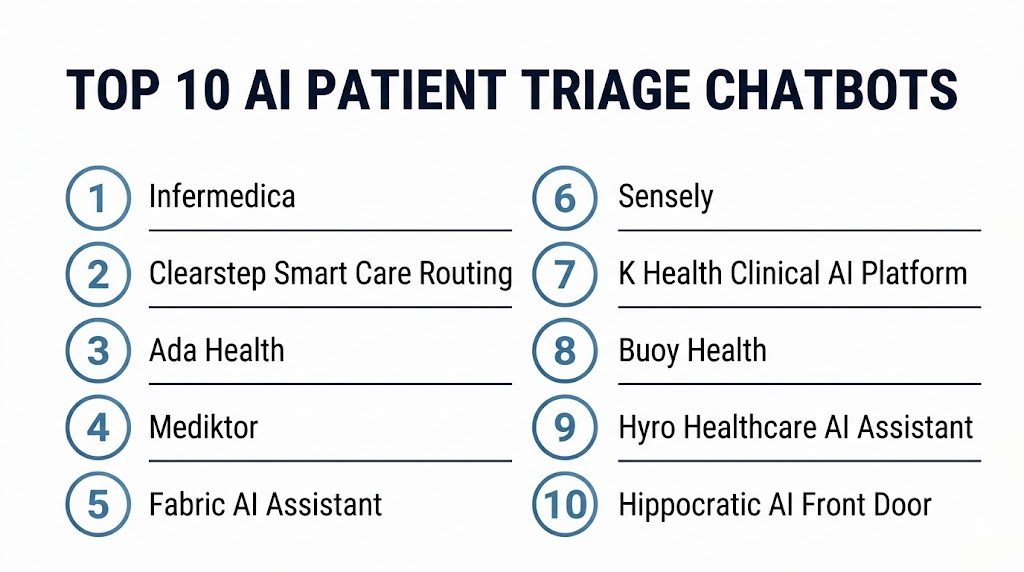
Top 10 AI Patient Triage Chatbots
1- Infermedica
2- Clearstep Smart Care Routing
3- Ada Health
4- Mediktor
5- Fabric AI Assistant
6- Sensely
7- K Health Clinical AI Platform
8- Buoy Health
9- Hyro Healthcare AI Assistant
10- Hippocratic AI Front Door
1- Infermedica
One-line verdict: Best for healthcare organizations needing clinical AI triage across chat, voice, and call center workflows.
Short description:
Infermedica provides AI-powered symptom assessment, patient intake, and triage technology for healthcare providers, payers, telehealth platforms, and call centers. It helps patients describe symptoms, answer structured questions, and receive guidance toward the right care setting while supporting enterprise workflow integration.
Standout Capabilities
- AI-powered symptom assessment
- Digital triage and care navigation
- Chat, voice, and call center workflow support
- Patient intake before visits
- Configurable care routing pathways
- API-based deployment options
- Analytics for routing and triage performance
- Support for healthcare provider and payer workflows
AI-Specific Depth
- Model support: Proprietary clinical AI and medical reasoning engine
- RAG and knowledge integration: Medical knowledge base and triage logic vary by product
- Evaluation: Clinical validation details should be verified directly for the intended use
- Guardrails: Emergency escalation, triage boundaries, disclaimers, and clinician handoff vary by deployment
- Observability: Assessment flows, triage outcomes, routing metrics, call center performance, and usage analytics vary by configuration
Pros
- Strong enterprise triage and intake focus
- Flexible deployment across chat, voice, web, and call center workflows
- Useful for providers, payers, and telehealth platforms
Cons
- Requires careful local workflow configuration
- Clinical safety validation should be reviewed by buyer teams
- Integration effort depends on existing systems
Security and Compliance
Infermedica provides healthcare-focused triage capabilities. Exact SSO, RBAC, audit logs, encryption, retention, data residency, and certifications should be verified during procurement. If not confirmed, write Not publicly stated.
Deployment and Platforms
- Web-based triage workflows
- API-based enterprise deployment
- Chat and voice options may vary
- Patient portal and call center integrations may vary
- Healthcare provider and payer deployment options
Integrations and Ecosystem
Infermedica supports patient access and digital triage workflows.
- Patient portals
- Provider websites
- Telehealth platforms
- Call center systems
- Payer member portals
- Scheduling workflows
- APIs and custom workflows
Pricing Model
Typically enterprise contract-based. Exact pricing depends on volume, integrations, channels, use case, and support requirements. Exact pricing is Not publicly stated.
Best-Fit Scenarios
- Health systems building digital front-door triage
- Payers routing members to appropriate care
- Call centers needing structured symptom intake
2- Clearstep Smart Care Routing
One-line verdict: Best for health systems needing AI-powered care routing and digital front-door patient access.
Short description:
Clearstep Smart Care Routing helps patients find the right care option based on symptoms, needs, service availability, location, and organizational routing rules. It is useful for health systems that want to reduce access friction, improve patient navigation, and route users to virtual, urgent, primary, specialty, or emergency care.
Standout Capabilities
- AI-powered symptom-based care routing
- Digital front-door patient access workflows
- Provider and service matching
- Care navigation based on available services
- Routing to virtual, in-person, urgent, or emergency options
- Scheduling and access workflow support depending on integration
- Patient journey analytics
- Health system-specific routing configuration
AI-Specific Depth
- Model support: Proprietary care routing and AI navigation capabilities
- RAG and knowledge integration: Service directory and care routing knowledge vary by deployment
- Evaluation: Not publicly stated
- Guardrails: Emergency escalation, service routing policies, fallback workflows, and safety guidance vary by setup
- Observability: Routing outcomes, patient journeys, conversion analytics, engagement metrics, and operational dashboards vary by configuration
Pros
- Strong digital front-door fit for health systems
- Focuses on routing patients to real care options
- Useful for improving access and reducing call center load
Cons
- More care-routing focused than broad diagnosis support
- Requires accurate provider directory and service availability data
- Integration with scheduling and access systems needs planning
Security and Compliance
Clearstep provides healthcare access and routing technology. Exact SSO, RBAC, audit logs, encryption, retention, residency, and certifications should be verified directly. If not confirmed, write Not publicly stated.
Deployment and Platforms
- Web-based digital front-door deployment
- Enterprise health system configuration
- Scheduling and provider directory integration may vary
- Patient-facing care navigation workflows
- Deployment depends on access strategy and system architecture
Integrations and Ecosystem
Clearstep connects symptom navigation with healthcare access operations.
- Health system websites
- Provider directories
- Scheduling workflows
- Patient access centers
- Telehealth routing
- Care navigation systems
- Analytics and reporting
Pricing Model
Typically enterprise contract-based. Exact pricing depends on health system size, routing workflows, patient volume, integrations, and agreement. Exact pricing is Not publicly stated.
Best-Fit Scenarios
- Health systems improving digital front-door access
- Providers routing patients to the right care setting
- Patient access teams reducing manual navigation burden
3- Ada Health
One-line verdict: Best for user-friendly AI symptom assessment and partner-ready digital health triage experiences.
Short description:
Ada Health provides an AI-powered symptom assessment experience that asks adaptive questions and helps users understand possible causes and next steps. It is useful for consumers, employers, payers, and healthcare partners that want structured self-assessment and care navigation support.
Standout Capabilities
- AI-powered symptom assessment
- Adaptive question flow based on user responses
- Possible condition suggestions for education
- Care guidance and next-step support
- Consumer app experience
- Enterprise partner deployment options
- Patient-friendly interface
- Support for pre-visit preparation
AI-Specific Depth
- Model support: Proprietary AI symptom assessment engine
- RAG and knowledge integration: Medical knowledge integration varies by product and deployment
- Evaluation: Clinical testing and safety evidence should be reviewed directly by buyers
- Guardrails: Emergency guidance, disclaimers, intended-use boundaries, and escalation rules vary by deployment
- Observability: Assessment history, symptom inputs, possible causes, care guidance, and partner analytics vary by configuration
Pros
- Strong consumer experience
- Easy structured symptom assessment flow
- Useful for digital front-door and care navigation workflows
Cons
- Not a diagnosis replacement
- Enterprise integration depth varies by deployment
- Possible causes require careful user education and disclaimers
Security and Compliance
Ada handles health-related user data depending on product and region. Exact SSO, RBAC, audit logs, encryption, data retention, data residency, and certifications should be verified directly. If not confirmed, write Not publicly stated.
Deployment and Platforms
- Consumer mobile app options
- Web-based assessment options may vary
- Enterprise deployment options may vary
- Partner workflow integration depends on configuration
Integrations and Ecosystem
Ada supports consumer and enterprise symptom assessment workflows.
- Consumer health app workflows
- Employer health programs
- Payer care navigation
- Provider digital front-door workflows
- Telehealth routing where configured
- Patient intake workflows
- Analytics and reporting depending on deployment
Pricing Model
Consumer access may vary by region and product. Enterprise pricing is usually contract-based and depends on scale, integration, users, and partner needs. Exact pricing is Not publicly stated.
Best-Fit Scenarios
- Consumer symptom self-assessment
- Payer or employer digital health navigation
- Health systems offering structured symptom intake
4- Mediktor
One-line verdict: Best for enterprise healthcare triage with conversational symptom assessment and patient routing.
Short description:
Mediktor provides an AI-powered symptom checker and triage platform for hospitals, insurers, telemedicine providers, and digital health organizations. It supports structured patient assessment, urgency guidance, and care navigation through conversational workflows.
Standout Capabilities
- AI symptom assessment
- Digital triage and urgency guidance
- Conversational patient intake
- Care navigation support
- Enterprise healthcare deployment options
- Telemedicine workflow support
- Payer and provider routing workflows
- Analytics for triage and access performance
AI-Specific Depth
- Model support: Proprietary AI symptom assessment and triage engine
- RAG and knowledge integration: Medical knowledge base integration varies by product
- Evaluation: Clinical validation should be verified directly for the intended use
- Guardrails: Emergency escalation, user disclaimers, clinician review options, and routing policies vary by deployment
- Observability: Symptom assessments, triage outcomes, routing metrics, user flows, and dashboards vary by setup
Pros
- Strong enterprise symptom assessment focus
- Supports care navigation and digital triage workflows
- Useful for providers, insurers, and telehealth platforms
Cons
- Requires careful integration and safety configuration
- Product availability and capabilities may vary by region
- Clinical evidence should be reviewed before deployment
Security and Compliance
Mediktor provides healthcare-focused AI triage capabilities. Exact SSO, RBAC, audit logs, encryption, retention, residency, and certifications should be verified directly. If not confirmed, write Not publicly stated.
Deployment and Platforms
- Web and digital workflow options may vary
- Enterprise deployment for providers, insurers, and telehealth platforms
- API and integration options may vary
- Patient-facing and professional workflows depend on configuration
Integrations and Ecosystem
Mediktor supports digital care access and triage workflows.
- Telemedicine platforms
- Health system websites
- Payer portals
- Patient intake workflows
- Call center support
- Scheduling and routing systems
- Analytics and reporting tools
Pricing Model
Typically enterprise contract-based. Exact pricing depends on volume, integration scope, channels, users, and agreement. Exact pricing is Not publicly stated.
Best-Fit Scenarios
- Health systems needing AI triage
- Insurers routing members to appropriate care
- Telehealth platforms collecting structured intake before visits
5- Fabric AI Assistant
One-line verdict: Best for healthcare organizations needing digital front-door AI, patient routing, and access automation.
Short description:
Fabric AI Assistant supports healthcare digital front-door workflows by helping patients navigate care, triage needs, and access services through conversational automation. It is useful for health systems and digital access teams that want AI-powered routing across virtual care, primary care, urgent care, and emergency pathways.
Standout Capabilities
- AI-powered patient access assistant
- Digital front-door care routing
- Patient intake and triage support
- Virtual and in-person care navigation
- Scheduling support depending on integration
- Health system-specific workflows
- Patient engagement automation
- Operational analytics depending on setup
AI-Specific Depth
- Model support: Proprietary healthcare conversational AI capabilities
- RAG and knowledge integration: Healthcare service and routing knowledge vary by configuration
- Evaluation: Not publicly stated
- Guardrails: Emergency escalation, workflow boundaries, safety instructions, and fallback rules vary by deployment
- Observability: Patient journeys, routing outcomes, engagement analytics, access metrics, and workflow performance vary by setup
Pros
- Strong digital front-door positioning
- Supports access navigation across care settings
- Useful for health systems reducing patient routing friction
Cons
- Requires provider directory and scheduling integration for best value
- Clinical triage depth should be validated carefully
- Capabilities vary by implementation
Security and Compliance
Fabric provides healthcare technology and patient access capabilities. Exact SSO, RBAC, audit logs, encryption, retention, data residency, and certifications should be verified during procurement. If not confirmed, write Not publicly stated.
Deployment and Platforms
- Web-based and workflow-integrated options may vary
- Enterprise health system deployment
- Digital front-door and patient access workflows
- Scheduling, telehealth, and service routing integrations vary
Integrations and Ecosystem
Fabric AI Assistant connects patient conversations with healthcare access workflows.
- Health system websites
- Scheduling systems
- Telehealth workflows
- Provider directories
- Patient access centers
- Care routing workflows
- Analytics and reporting
Pricing Model
Typically enterprise contract-based. Exact pricing depends on deployment scope, patient volume, integrations, modules, and agreement. Exact pricing is Not publicly stated.
Best-Fit Scenarios
- Health systems building digital front-door access
- Patient access teams automating routing
- Organizations connecting triage with scheduling and care navigation
6- Sensely
One-line verdict: Best for virtual assistant-driven patient engagement, triage support, and care navigation workflows.
Short description:
Sensely provides a conversational virtual health assistant platform that supports patient engagement, symptom guidance, care navigation, chronic condition support, and customer service workflows. It is useful for payers, providers, and digital health teams that want a patient-friendly virtual assistant experience.
Standout Capabilities
- Virtual health assistant experience
- Symptom assessment and triage support depending on configuration
- Patient engagement workflows
- Care navigation and education
- Chronic condition support workflows depending on deployment
- Conversational interface
- Multi-channel patient communication
- Analytics and reporting depending on setup
AI-Specific Depth
- Model support: Proprietary virtual assistant and health engagement AI capabilities vary by deployment
- RAG and knowledge integration: Health knowledge and workflow content vary by product
- Evaluation: Not publicly stated
- Guardrails: Care protocols, escalation rules, human handoff workflows, and safety controls vary by configuration
- Observability: User interactions, triage outputs, engagement metrics, and workflow analytics vary by deployment
Pros
- Strong patient engagement experience
- Useful for payers and providers wanting guided workflows
- Can support care navigation beyond basic symptom checking
Cons
- Clinical triage depth depends on configuration
- Requires workflow design and content governance
- Safety validation should be reviewed for each use case
Security and Compliance
Sensely provides healthcare virtual assistant capabilities. Exact SSO, RBAC, audit logs, encryption, data retention, residency, and certifications should be verified directly. If not confirmed, use Not publicly stated.
Deployment and Platforms
- Web, mobile, and virtual assistant options may vary
- Enterprise healthcare deployment
- Patient engagement and care navigation workflows
- Integration depends on payer or provider workflow design
Integrations and Ecosystem
Sensely supports digital engagement and care guidance workflows.
- Payer member engagement
- Provider patient navigation
- Remote care workflows
- Virtual assistant channels
- Care management programs
- Patient education workflows
- Analytics and reporting
Pricing Model
Typically enterprise contract-based. Exact pricing depends on users, workflows, channels, integrations, and deployment scope. Exact pricing is Not publicly stated.
Best-Fit Scenarios
- Payers improving member engagement
- Providers needing patient navigation assistants
- Digital health teams combining triage with ongoing engagement
7- K Health Clinical AI Platform
One-line verdict: Best for virtual care teams combining AI intake, patient triage, and clinician-supported care workflows.
Short description:
K Health provides AI-assisted symptom intake and virtual care workflows that help patients describe symptoms, receive guidance, and connect with care where available. It is useful for virtual care providers, employers, payers, and health systems that want structured AI intake combined with clinician review.
Standout Capabilities
- AI-assisted patient intake
- Symptom assessment workflows
- Virtual care routing
- Clinician-supported care workflows
- Patient history and context gathering
- Triage and care navigation support
- Digital front-door experience
- Operational workflows for virtual care delivery
AI-Specific Depth
- Model support: Proprietary clinical AI and virtual care models
- RAG and knowledge integration: Varies / N/A
- Evaluation: Clinical validation varies by workflow and deployment; exact details are Not publicly stated
- Guardrails: Clinician review, care protocols, escalation rules, disclaimers, and patient safety workflows vary by deployment
- Observability: Intake activity, triage outputs, clinician review, patient interactions, and operational metrics vary by configuration
Pros
- Combines AI intake with care access workflows
- Useful for virtual care and digital front-door programs
- Helps structure patient information before clinician review
Cons
- Availability and service model vary by region and partner
- Not a standalone diagnostic replacement
- Requires strong safety and escalation governance
Security and Compliance
K Health provides healthcare technology and virtual care capabilities. Exact SSO, RBAC, audit logs, encryption, retention, residency, and certifications should be verified directly. If not confirmed, write Not publicly stated.
Deployment and Platforms
- Consumer and virtual care platform options vary
- Web and mobile experiences may vary by service
- Partner deployments may include integrated care workflows
- EHR and provider workflow integrations should be verified
Integrations and Ecosystem
K Health supports AI-assisted virtual care and patient routing.
- Virtual care workflows
- Patient intake systems
- Clinician review workflows
- Care routing and triage
- Employer or payer health programs
- Patient communication tools
- Operational analytics
Pricing Model
Typically consumer, employer, payer, or enterprise contract-based depending on deployment. Exact pricing depends on service model, patient volume, region, and agreement. Exact pricing is Not publicly stated.
Best-Fit Scenarios
- Virtual care programs needing AI intake
- Employers or payers offering digital access
- Health systems adding AI-supported triage before clinician visits
8- Buoy Health
One-line verdict: Best for conversational symptom triage and care navigation in consumer, employer, and payer workflows.
Short description:
Buoy Health provides a conversational AI symptom checker and care navigation experience that asks users questions and suggests possible next steps. It is useful for consumers, employers, payers, and healthcare partners that want approachable symptom guidance and navigation support.
Standout Capabilities
- Conversational symptom assessment
- Care navigation and next-step guidance
- User-friendly question flow
- Possible condition education
- Digital front-door support
- Payer and employer relevance
- Patient routing and engagement
- Health information and navigation assistance
AI-Specific Depth
- Model support: Proprietary symptom checker and navigation engine
- RAG and knowledge integration: Medical knowledge and routing logic vary by product
- Evaluation: Not publicly stated
- Guardrails: Emergency guidance, disclaimers, triage boundaries, and routing rules vary by deployment
- Observability: User assessments, care routing, engagement metrics, and navigation outcomes vary by setup
Pros
- Friendly conversational experience
- Useful for care navigation and member engagement
- Helps users understand urgency and possible next steps
Cons
- Not a substitute for clinical diagnosis
- Validation details should be reviewed directly
- Enterprise integration depth varies by deployment
Security and Compliance
Buoy Health provides digital health and symptom navigation capabilities. Exact SSO, RBAC, audit logs, encryption, data retention, residency, and certifications should be verified during procurement. If not confirmed, write Not publicly stated.
Deployment and Platforms
- Web-based and digital front-door experiences may vary
- Enterprise or partner deployments may vary
- Consumer symptom checker availability may vary
- Integration depends on partner routing workflows
Integrations and Ecosystem
Buoy Health supports care navigation and member engagement workflows.
- Employer health programs
- Payer member navigation
- Provider digital front doors
- Telehealth routing
- Care recommendations
- Patient engagement workflows
- Analytics and reporting depending on deployment
Pricing Model
Typically enterprise or partner contract-based. Exact pricing depends on users, routing workflows, integrations, and scope. Exact pricing is Not publicly stated.
Best-Fit Scenarios
- Payers improving member navigation
- Employers guiding users to appropriate care
- Consumer-facing symptom triage experiences
9- Hyro Healthcare AI Assistant
One-line verdict: Best for healthcare organizations needing conversational AI for patient access, routing, and contact center automation.
Short description:
Hyro provides conversational AI assistants for healthcare that can automate patient access tasks, answer common questions, support routing, and reduce call center burden. It is useful for health systems and provider organizations that want AI-powered patient communication across digital channels and contact center workflows.
Standout Capabilities
- Conversational AI for healthcare access
- Patient routing and FAQ automation
- Contact center support
- Appointment and access workflow assistance depending on integration
- Natural language patient conversations
- Multi-channel deployment options
- Health system knowledge automation
- Analytics for patient engagement and operations
AI-Specific Depth
- Model support: Proprietary conversational AI and natural language understanding capabilities
- RAG and knowledge integration: Healthcare knowledge and service content integration vary by deployment
- Evaluation: Not publicly stated
- Guardrails: Escalation rules, fallback workflows, answer controls, and human handoff policies vary by configuration
- Observability: Conversation analytics, containment, routing outcomes, intent recognition, and operational dashboards vary by setup
Pros
- Strong healthcare conversational automation focus
- Useful for call center and patient access teams
- Can reduce repetitive patient service inquiries
Cons
- Clinical triage depth should be verified carefully
- Requires good healthcare content governance
- Routing accuracy depends on integration and service data quality
Security and Compliance
Hyro provides healthcare-focused conversational AI capabilities. Exact SSO, RBAC, audit logs, encryption, retention, data residency, and certifications should be verified directly. If not confirmed, write Not publicly stated.
Deployment and Platforms
- Web, chat, voice, and contact center options may vary
- Enterprise healthcare deployment
- Patient access and routing workflows
- Integration depends on health system communication stack
Integrations and Ecosystem
Hyro supports patient access and conversational automation workflows.
- Health system websites
- Contact centers
- Scheduling workflows
- Provider directory workflows
- Patient portals
- Service knowledge bases
- Analytics and reporting
Pricing Model
Typically enterprise contract-based. Exact pricing depends on channels, conversation volume, integrations, use cases, and support. Exact pricing is Not publicly stated.
Best-Fit Scenarios
- Health systems reducing call center burden
- Patient access teams automating common routing questions
- Provider organizations needing multi-channel conversational AI
10- Hippocratic AI Front Door
One-line verdict: Best for agentic healthcare front-door workflows that require conversational intake and nurse-triage-style support.
Short description:
Hippocratic AI Front Door is positioned around healthcare-specific conversational agents that can support patient access, intake, nurse triage-style workflows, scheduling, records requests, and other front-door interactions. It is useful for organizations exploring agentic healthcare AI with strong safety governance and human escalation.
Standout Capabilities
- Healthcare-specific conversational AI agents
- Patient access and front-door workflows
- Nurse triage-style support depending on configuration
- Scheduling and administrative request handling
- Medical records and prescription-related workflow support depending on deployment
- Personalized patient conversation experience
- Human escalation and workflow routing
- Broad healthcare interaction automation
AI-Specific Depth
- Model support: Proprietary healthcare-focused generative AI agents
- RAG and knowledge integration: Patient history, service knowledge, and workflow context vary by deployment
- Evaluation: Safety and evaluation details should be verified directly for intended use
- Guardrails: Healthcare safety protocols, escalation rules, role boundaries, and human handoff vary by deployment
- Observability: Conversation logs, task outcomes, escalation rates, workflow analytics, and operational dashboards vary by setup
Pros
- Broad agentic healthcare front-door ambition
- Useful for automating multiple access workflows
- Can support conversational intake and routing at scale
Cons
- Requires strong safety, compliance, and governance review
- Clinical triage use must be validated carefully
- Enterprise deployment may need detailed workflow design
Security and Compliance
Hippocratic AI provides healthcare AI agent capabilities. Exact SSO, RBAC, audit logs, encryption, retention, residency, and certifications should be verified during procurement. If not confirmed, write Not publicly stated.
Deployment and Platforms
- Enterprise healthcare AI agent deployment options
- Voice and conversational workflows may vary
- Integration depends on healthcare system architecture
- Patient access and administrative workflows vary by configuration
Integrations and Ecosystem
Hippocratic AI Front Door connects conversational agents with healthcare access workflows.
- Patient access workflows
- Scheduling systems
- Nurse triage-style workflows
- Medical records workflows
- Care navigation
- Human escalation channels
- Operational analytics
Pricing Model
Typically enterprise contract-based. Exact pricing depends on use cases, interaction volume, integrations, agent scope, and agreement. Exact pricing is Not publicly stated.
Best-Fit Scenarios
- Health systems exploring AI front-door automation
- Organizations needing conversational intake and routing
- Patient access teams wanting agentic workflow support with safety controls
Comparison Table
| Tool Name | Best For | Deployment | Model Flexibility | Strength | Watch Out | Public Rating |
|---|---|---|---|---|---|---|
| Infermedica | Clinical AI triage and intake | Web, API, chat, voice, enterprise options vary | Hosted proprietary | Enterprise triage engine | Requires safety configuration | N/A |
| Clearstep Smart Care Routing | Digital front-door care routing | Web and enterprise options vary | Hosted proprietary | Patient routing to real services | Needs accurate service data | N/A |
| Ada Health | Consumer and partner symptom assessment | App, web, enterprise options vary | Hosted proprietary | User-friendly assessment | Not a diagnosis | N/A |
| Mediktor | Enterprise symptom triage | Web, API, enterprise options vary | Hosted proprietary | Conversational triage | Validate intended use | N/A |
| Fabric AI Assistant | Patient access automation | Web and workflow-integrated options vary | Hosted proprietary | Digital front-door automation | Integration depth varies | N/A |
| Sensely | Virtual assistant engagement | Web, mobile, enterprise options vary | Hosted proprietary | Patient engagement workflows | Clinical depth varies | N/A |
| K Health Clinical AI Platform | Virtual care intake | App, web, partner options vary | Hosted proprietary | AI intake plus care access | Availability varies | N/A |
| Buoy Health | Conversational care navigation | Web and partner options vary | Hosted proprietary | Friendly symptom flow | Validation details needed | N/A |
| Hyro Healthcare AI Assistant | Contact center and access automation | Web, chat, voice, contact center options vary | Hosted proprietary | Healthcare conversational automation | Triage depth must be verified | N/A |
| Hippocratic AI Front Door | Agentic front-door workflows | Enterprise options vary | Healthcare generative AI agents | Broad access automation | Strong governance required | N/A |
Scoring and Evaluation
This scoring is comparative, not absolute. It helps buyers compare AI patient triage chatbots based on triage depth, AI reliability, guardrails, integrations, usability, performance, security controls, and support. Scores may vary based on region, intended use, patient population, clinical governance, integration depth, care routing logic, and safety validation. Public ratings are not guessed. Buyers should validate shortlisted tools with real patient scenarios, red-flag cases, compliance review, clinician testing, and measurable routing outcomes before deployment.
| Tool | Core | Reliability and Eval | Guardrails | Integrations | Ease | Performance and Cost | Security and Admin | Support | Weighted Total |
| Infermedica | 9.2 | 8.7 | 8.8 | 8.8 | 8.4 | 8.4 | 8.6 | 8.6 | 8.7 |
| Clearstep Smart Care Routing | 8.8 | 8.3 | 8.7 | 8.9 | 8.6 | 8.3 | 8.6 | 8.6 | 8.6 |
| Ada Health | 9.0 | 8.6 | 8.6 | 8.3 | 8.8 | 8.4 | 8.5 | 8.5 | 8.6 |
| Mediktor | 8.8 | 8.4 | 8.6 | 8.6 | 8.5 | 8.3 | 8.5 | 8.5 | 8.5 |
| Fabric AI Assistant | 8.6 | 8.2 | 8.6 | 8.8 | 8.6 | 8.4 | 8.5 | 8.5 | 8.5 |
| Sensely | 8.4 | 8.1 | 8.5 | 8.4 | 8.5 | 8.3 | 8.5 | 8.4 | 8.4 |
| K Health Clinical AI Platform | 8.7 | 8.3 | 8.7 | 8.4 | 8.7 | 8.3 | 8.6 | 8.5 | 8.5 |
| Buoy Health | 8.5 | 8.2 | 8.5 | 8.3 | 8.8 | 8.4 | 8.4 | 8.4 | 8.4 |
| Hyro Healthcare AI Assistant | 8.4 | 8.1 | 8.5 | 8.7 | 8.6 | 8.4 | 8.5 | 8.5 | 8.4 |
| Hippocratic AI Front Door | 8.6 | 8.2 | 8.8 | 8.5 | 8.4 | 8.2 | 8.6 | 8.4 | 8.5 |
Top 3 for Enterprise
1- Infermedica
2- Clearstep Smart Care Routing
3- Fabric AI Assistant
Top 3 for SMB
1- Ada Health
2- Buoy Health
3- Mediktor
Top 3 for Developers
1- Infermedica
2- Hyro Healthcare AI Assistant
3- Clearstep Smart Care Routing
Which AI Patient Triage Chatbot Is Right for You
Solo / Freelancer
Solo healthcare consultants, independent clinicians, and small digital health advisors usually need tools that are easy to test and explain. Ada Health, Buoy Health, and Mediktor are useful for exploring patient-friendly symptom assessment and digital triage patterns. For enterprise advisory work, Infermedica and Clearstep are more relevant because they support deeper integration and routing workflows.
SMB
Small clinics, urgent care groups, employer clinics, and telehealth startups should prioritize easy deployment, safe red-flag handling, and simple patient routing. Ada Health, Mediktor, and Buoy Health may fit lightweight patient-facing workflows. SMBs should avoid over-customized triage logic until they have clinical review, consent workflows, and monitoring in place.
Mid-Market
Mid-market providers, payers, and virtual care groups need stronger integration with scheduling, telehealth, call center, and patient access systems. Infermedica, Clearstep, Fabric AI Assistant, and Sensely can support structured intake, digital triage, patient engagement, and service routing. These organizations should pilot with one service line before expanding.
Enterprise
Large health systems should prioritize governance, scalability, routing analytics, clinical safety, integration depth, patient access improvement, and call center automation. Infermedica is strong for clinical AI triage, Clearstep is strong for care routing, Fabric AI Assistant is strong for digital front-door automation, and Hyro can help with conversational access and contact center workflows.
Regulated Industries
Healthcare buyers must treat triage chatbots as safety-sensitive systems. They should verify intended use, clinical validation, privacy controls, escalation logic, clinician handoff, emergency guidance, and auditability. For mental health, pediatrics, pregnancy, or emergency symptoms, conservative routing and human escalation are especially important.
Budget vs Premium
Budget-conscious teams may begin with focused patient-facing tools such as Ada, Buoy, or Mediktor. Premium enterprise buyers may need Infermedica, Clearstep, Fabric, Hyro, or Hippocratic AI for integration, call center workflows, digital front-door routing, analytics, and governance. Total cost should include implementation, integration, clinical review, maintenance, support, and monitoring.
Build vs Buy
Building an AI patient triage chatbot internally is difficult because it requires clinical triage logic, safety testing, red-flag pathways, privacy compliance, conversation design, routing integrations, analytics, and continuous monitoring. Most healthcare organizations should buy or partner with established platforms. A hybrid approach can work when a provider uses a commercial triage engine but builds custom routing and scheduling workflows around it.
Implementation Playbook
First 30 Days
- Define the main use case such as symptom triage, patient intake, urgent care routing, telehealth routing, nurse call center support, or digital front-door access.
- Identify target users such as patients, members, employees, call center agents, nurses, or care coordinators.
- Review intended use, regulatory considerations, and clinical risk.
- Select two or three tools for structured evaluation.
- Create test scenarios including red flags, common symptoms, vague symptoms, chronic conditions, pediatric scenarios, pregnancy concerns, and mental health risks.
- Review privacy, consent, data retention, encryption, and access controls.
- Define escalation language and emergency guidance.
- Identify integration needs such as EHR, scheduling, telehealth, CRM, call center, or provider directory.
- Create a pilot team with clinicians, compliance, legal, IT, patient access, call center, and operations leaders.
- Define success metrics such as safe routing, completion rate, appointment conversion, reduced call burden, and patient satisfaction.
First 60 Days
- Run a controlled pilot with a limited patient group, service line, or location.
- Test the chatbot with realistic patient scenarios and clinician-reviewed outputs.
- Measure red-flag escalation behavior and inappropriate routing risk.
- Review user experience, question flow, completion rates, and drop-off points.
- Integrate with scheduling, telehealth, call center, or provider routing where appropriate.
- Train call center staff, nurses, and patient access teams on how outputs should be used.
- Document disclaimers, limitations, escalation rules, and handoff workflows.
- Review analytics for routing outcomes and user behavior.
- Collect feedback from patients and clinical reviewers.
- Decide whether to expand, refine, or stop the pilot based on safety and operational value.
First 90 Days
- Expand to more symptoms, departments, locations, or user groups if pilot results are strong.
- Monitor routing accuracy, escalation safety, patient satisfaction, and conversion to care.
- Create recurring clinical governance reviews.
- Review privacy, consent, and data retention practices.
- Update service directories, care routing rules, and escalation pathways.
- Monitor for bias, language gaps, literacy issues, and underserved population barriers.
- Build dashboards for leaders showing usage, access improvement, routing outcomes, and safety signals.
- Train new staff and update patient-facing education.
- Review vendor support quality and platform reliability.
- Continue safety testing whenever workflows, services, or routing rules change.
Common Mistakes and How to Avoid Them
- Treating chatbots as diagnosis tools: They should support triage and navigation, not replace medical diagnosis.
- Ignoring emergency symptoms: Red-flag escalation must be fast, clear, and conservative.
- Skipping clinical review: Clinicians should review triage logic before deployment.
- No privacy review: Symptom and intake data are sensitive and require strong controls.
- Poor care routing: The chatbot should route users to real services that are available.
- Overloading users with questions: Long flows can cause drop-offs and incomplete assessments.
- Ignoring language and accessibility: Health literacy, disability access, and multilingual support matter.
- No pediatric or pregnancy handling: These groups may need special pathways or exclusions.
- No human fallback: Users should have a path to human support when uncertain or distressed.
- Using generative AI without guardrails: Free-form answers should not hallucinate diagnoses or unsafe care advice.
- Skipping pilot testing: Red-flag, vague, and edge-case scenarios must be tested before launch.
- Measuring only deflection: Safety and correct routing matter more than reducing visits.
- No ongoing monitoring: Triage performance should be reviewed continuously.
- Weak change management: Staff need training on how chatbot outputs should be used.
FAQs
1- What are AI Patient Triage Chatbots?
AI Patient Triage Chatbots are conversational tools that ask patients about symptoms and guide them toward appropriate care options. They support intake, triage, care routing, and patient navigation, but they do not provide final diagnosis.
2- Do AI triage chatbots replace nurses or doctors?
No. They support patient access and triage workflows but should not replace licensed clinical judgment. Human review and escalation are important for urgent, complex, or uncertain cases.
3- Are AI patient triage chatbots safe?
They can be safe when designed with clinical oversight, red-flag escalation, privacy controls, testing, monitoring, and human fallback. Safety depends heavily on intended use and implementation quality.
4- Which chatbot is best for healthcare organizations?
Infermedica, Clearstep, Fabric AI Assistant, Mediktor, Sensely, and Hyro are strong candidates for healthcare organizations. The best choice depends on whether the goal is triage, routing, call center support, or digital front-door access.
5- Which chatbot is best for consumer symptom assessment?
Ada Health and Buoy Health are strong consumer-friendly options. They are useful for structured symptom exploration and next-step guidance, but users should still seek professional care when needed.
6- Which tool is best for digital front-door routing?
Clearstep Smart Care Routing and Fabric AI Assistant are strong options for digital front-door routing. They help direct patients to appropriate services, appointment types, and care channels.
7- Can triage chatbots integrate with EHR systems?
Some enterprise platforms can integrate with EHRs, patient portals, scheduling systems, call centers, telehealth platforms, and provider directories. Integration depth varies by vendor and deployment.
8- Can these chatbots detect emergencies?
Good triage chatbots should identify red-flag symptoms and direct users to urgent or emergency care when appropriate. Patients should seek immediate care for severe or concerning symptoms regardless of chatbot output.
9- What should buyers test during a pilot?
Buyers should test common symptoms, red flags, vague symptoms, pediatric cases, pregnancy scenarios, chronic conditions, language access, routing accuracy, privacy controls, and integration with scheduling or telehealth workflows.
10- Are AI patient triage chatbots regulated?
Regulatory requirements depend on intended use, region, claims, and whether the chatbot influences medical decisions. Healthcare organizations should review legal, clinical, compliance, and safety requirements before deployment.
11- Can chatbots reduce call center workload?
Yes, they can reduce repetitive intake and routing tasks when implemented well. However, safety, escalation, and correct routing should be prioritized over simple call deflection.
12- What is the biggest risk with AI patient triage chatbots?
The biggest risk is unsafe reassurance or incorrect routing when symptoms require urgent care. Strong red-flag logic, conservative escalation, clinical governance, human fallback, and ongoing monitoring help reduce this risk.
Conclusion
AI Patient Triage Chatbots help healthcare organizations improve patient access, structure symptom intake, route users to the right care setting, and reduce administrative friction when implemented responsibly. Infermedica is strong for clinical AI triage and call center workflows, Clearstep supports health system care routing, Ada Health offers user-friendly symptom assessment, Mediktor provides enterprise triage, Fabric AI Assistant helps with digital front-door automation, Sensely supports patient engagement, K Health combines AI intake with virtual care workflows, Buoy Health provides conversational care navigation, Hyro helps automate healthcare access conversations, and Hippocratic AI Front Door supports broader agentic patient access workflows. To choose the right platform, shortlist based on clinical use case, test red-flag scenarios, verify privacy and safety controls, integrate with real care pathways, and scale with clinician governance, analytics, staff training, and continuous monitoring.

Find Trusted Cardiac Hospitals
Compare heart hospitals by city and services — all in one place.
Explore Hospitals
A key concern is how safely these triage chatbots escalate borderline cases to human clinicians without missing early warning signs or overloading healthcare systems with false urgency.