
Introduction
AI clinical documentation summarization software uses advanced natural language processing and machine learning models to capture conversations between clinicians and patients, transforming unstructured audio into structured clinical notes. This technology securely listens to ambient clinical encounters, extracts crucial medical data, and formats it directly into electronic health record systems.
Why It Matters
This technology has become vital for mitigating widespread clinician burnout, which is heavily driven by administrative burdens. By automating the documentation process, healthcare organizations can return hours of time back to medical staff, allowing them to focus entirely on patient care rather than typing notes.
Real-World Use Cases
- Ambient Room Capture: Recording live, face-to-face outpatient visits and converting the dialogue into a structured history of present illness, physical exam, and assessment plan.
- Telehealth Integration: Automatically capturing remote video or audio consultations and summarizing the encounter into structured medical text.
- Multi-Specialty Note Customization: Adapting summaries to meet the unique formatting and terminology requirements of specialized fields like cardiology, orthopedics, or pediatrics.
- Asynchronous Note Generation: Allowing clinicians to dictate quick, unstructured summaries after a shift or patient encounter and turning them into formal progress notes.
- Patient-Facing Summaries: Translating complex medical jargon from a clinical encounter into plain language handouts that patients can easily understand.
Evaluation Criteria
When purchasing an AI clinical documentation tool, healthcare IT leaders should evaluate solutions based on the following criteria:
- EHR Integration Depth: The ability to natively insert text into specific discrete data fields within systems like Epic, Cerner, or Meditech.
- Ambient Accuracy: Success rates in capturing multi-party conversations, filtering background noise, and accurately identifying complex medical terminology.
- Specialty Adaptability: How effectively the platform handles unique formatting rules across dozens of medical specialties.
- Data Privacy and Residency: Strict alignment with health data privacy regulations, including zero-retention data policies for model training.
- Latency: The speed at which an audio recording is converted into a finalized draft note for review.
- Multimodal Capability: Support for incorporating patient charts, previous notes, or visual inputs along with conversation audio.
- Administrative Controls: Centralized dashboards for managing user licenses, observing utilization trends, and tracking time-saving metrics.
- Customization and Templates: The ease with which individual clinicians or health systems can alter note structures and formatting styles.
- Best for: Hospital systems, multi-specialty medical groups, individual private practitioners, and telehealth providers seeking to reduce documentation time and improve clinician well-being.
- Not ideal for: Purely administrative billing offices that do not interact with patients, or high-volume surgical procedures where sterile environments and physical mechanics prevent ambient audio capture.
What’s Changed in AI Clinical Documentation Summarization
The landscape of clinical AI tools has evolved beyond simple dictation and basic transcription. The following trends define the market today:
- Agentic Workflows: Modern tools do not just write notes; they act as clinical assistants that can queue up orders, draft referral letters, and suggest relevant diagnostic codes based on the ambient conversation.
- Multimodal Inputs: Platforms now simultaneously process ambient room audio, historical charts, incoming lab results, and patient intake forms to create highly contextual summaries.
- Advanced Hallucination Mitigation: Solutions utilize sophisticated verification layers to cross-check generated text directly against the raw audio transcript, highlighting unverified statements for physician review.
- Strict Prompt-Injection Defense: Robust security guardrails prevent malicious inputs from altering model behavior or manipulating clinical summaries during live capture.
- Zero-Data-Retention Safeguards: Enterprise tier tools offer verified architectures where patient audio and generated text are never stored or used to train underlying models.
- Local Model Routing: Hybrid architectures route standard encounters to efficient, smaller models while sending highly complex, multi-system cases to larger reasoning models to control costs and latency.
- Granular Trace Auditability: IT administrators can review the exact pipeline steps an audio file went through, providing clear tracking of how an AI summary was generated.
- Locally Hosted and Hybrid Deployments: To satisfy strict institutional governance, vendors increasingly offer hybrid models that process data within the healthcare organization cloud environment.
Quick Buyer Checklist (Scan-Friendly)
Before shortlisting vendors, ensure your team can answer these fundamental questions:
- Data Governance: Does the vendor offer an absolute zero-data-retention policy for audio recordings and text transcripts?
- Model Ownership: Are you locked into a single proprietary model, or can you route requests through alternative models based on cost and performance?
- EHR Compatibility: Does the solution support deep, bi-directional integration via APIs, or does it rely entirely on copy-pasting text?
- Clinical Verification: Is there a built-in mechanism for clinicians to trace any part of the summary back to the exact section of the transcript?
- Safety Guardrails: How does the system handle conflicting medical statements made during a patient visit?
- System Latency: Can the platform deliver a structured note in less than a minute after the patient encounter ends?
- Lock-In Risk: Is the underlying prompt engineering and template structure transportable if you switch vendors in the future?
- Access Management: Does the tool support single sign-on and role-based access control across large medical staff deployments?
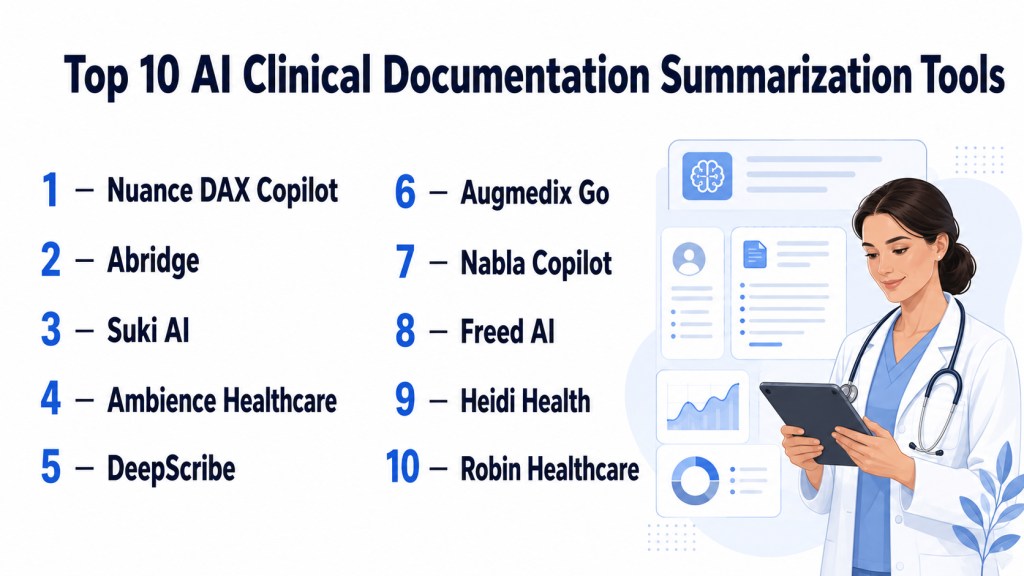
Top 10 AI Clinical Documentation Summarization Tools
#1 — Nuance DAX Copilot
Short description: Nuance DAX combines ambient AI with enterprise-level healthcare infrastructure. It is designed for massive health systems that need an automated solution embedded directly within their existing clinical workflows.
Standout Capabilities
- Direct, native integration within major enterprise electronic health records.
- Automated multi-party conversational separation tailored for busy clinical rooms.
- Advanced contextual filtering that ignores casual small talk to focus entirely on medical facts.
- Custom template matching based on institutional note-writing styles.
- Enterprise analytics dashboards tracking clinician adoption and completion speed.
AI-Specific Depth
- Model support: Built using custom foundation architectures optimized for medical environments.
- RAG / knowledge integration: Deep integration with enterprise hospital knowledge bases and historic patient charts.
- Evaluation: Multi-tier verification checking clinical summaries against raw text inputs.
- Guardrails: Automated filtering of conflicting clinical assertions.
- Observability: Robust enterprise logging detailing utilization metrics and system performance.
Pros
- Unmatched native EHR workflow integration.
- Strong backing by enterprise-grade infrastructure and support teams.
- Exceptional accuracy across a wide range of standard medical specialties.
Cons
- Implementation processes can be lengthy and require heavy IT involvement.
- Higher overall cost structure compared to standalone digital apps.
- Less flexibility for individual clinicians to radically alter core model parameters.
Security & Compliance
Supports full enterprise SSO, granular role-based access control, comprehensive audit logs, and complete data encryption at rest and in transit. Data retention is configurable to meet strict institutional privacy rules.
Deployment & Platforms
- iOS, Android, and Windows desktop applications.
- Cloud-delivered with hybrid connection capabilities.
Integrations & Ecosystem
Features extensive integration options with major healthcare platforms. Built directly into Epic, Oracle Health Cerner, and Meditech software packages, allowing users to initiate capture without leaving their primary chart screen.
Pricing Model
Seat-based enterprise licensing with tiered structures based on user volume and contract length.
Best-Fit Scenarios
- Large-scale hospital groups looking to deploy a uniform ambient solution across hundreds of clinicians.
- Outpatient clinics deeply embedded within major enterprise software ecosystems.
- Health systems requiring centralized administrative governance and deployment controls.
#2 — Abridge
Short description: Abridge focuses heavily on speed, linguistic accuracy, and clear proof-of-work. The platform stands out for its structural verification functionality, which allows clinicians to click any word in an AI-generated note to hear the exact moment in the audio recording it came from.
Standout Capabilities
- Direct auditable linking between generated text summary and the source conversation.
- Rapid processing speeds delivering notes almost immediately after visit completion.
- Clear translation capability that creates patient-friendly encounter summaries alongside clinical notes.
- Lightweight app design requiring minimal user training or setup time.
- Seamless handling of multi-lingual patient interactions.
AI-Specific Depth
- Model support: Proprietary language models trained specifically on proprietary, de-identified medical conversations.
- RAG / knowledge integration: API connectors to link notes with relevant historical patient charts.
- Evaluation: Strong emphasis on auditability with direct source-to-summary tracing.
- Guardrails: Structural boundaries preventing the hallucination of non-discussed medical procedures.
- Observability: Direct reporting on note submission speeds and text edits made by providers.
Pros
- Highly user-friendly interface that feels intuitive to non-technical staff.
- Instant audio verification builds high trust among clinicians.
- Fast deployment timelines with minimal training overhead.
Cons
- Enterprise customization can take time to fine-tune for niche medical sub-specialties.
- Standalone app usage requires jumping between screens if not fully integrated into the local EHR.
- Offline mode capabilities are limited without an active internet connection.
Security & Compliance
Maintains strict healthcare data privacy controls, featuring encrypted storage, access logging, and options for immediate data deletion post-finalization.
Deployment & Platforms
- Mobile application support for iOS and Android devices.
- Web-based desktop interface.
Integrations & Ecosystem
Offers deep integration with major EHR platforms via application marketplaces, along with developer APIs for custom-built hospital portals and independent medical software tools.
Pricing Model
Subscription-based pricing model per clinician, with custom contract options available for large enterprise medical networks.
Best-Fit Scenarios
- Medical organizations wanting to build fast clinician trust through easy-to-verify transcripts.
- Clinicians looking to generate both professional notes and patient handouts from one visit.
- Rapid deployments where long enterprise software implementation cycles are not acceptable.
#3 — Suki AI
Short description: Suki AI acts as a flexible, multi-mode voice assistant that handles ambient note generation, direct dictation commands, and chart information retrieval. It is highly responsive and designed to run efficiently on a variety of personal and workplace hardware.
Standout Capabilities
- Dual capability handling both ambient conversation capture and traditional voice dictation.
- Voice commands for searching historical patient details within the app interface.
- High adaptability to individual physician speaking habits and regional accents.
- Simplified template creation that adapts to individual clinical preferences.
- Minimal battery and system resource consumption on mobile hardware.
AI-Specific Depth
- Model support: Multi-model routing utilizing specialized speech-to-text and clinical processing models.
- RAG / knowledge integration: Integrated context syncing with connected EHR scheduling and demographic feeds.
- Evaluation: Continuous background refinement based on user text corrections.
- Guardrails: Internal validation steps to block non-medical dialogue from entering summaries.
- Observability: User dashboard showing exact time saved per note over time.
Pros
- Lower cost of entry, making it highly accessible to smaller practices.
- Highly responsive voice control for hands-free workflow adjustments.
- Works seamlessly across smartphones, tablets, and desktop computers.
Cons
- Deep enterprise EHR integration can require additional configuration steps.
- May require more manual note editing for highly obscure surgical sub-specialties.
- Less focus on generating separate, complex patient education documents.
Security & Compliance
Built on secure cloud infrastructure featuring standard healthcare encryption protocols, user access tracking, and customizable data storage parameters.
Deployment & Platforms
- iOS, Android, Windows, and macOS compatibility.
- Cloud-based architecture.
Integrations & Ecosystem
Integrates directly with platforms including Athenahealth, Elation, and Practice Fusion, alongside expanding access paths into larger systems via web extensions.
Pricing Model
Monthly or annual flat-rate subscription fee per user, offering transparent pricing without hidden implementation fees.
Best-Fit Scenarios
- Independent practices wanting an affordable solution without massive upfront IT costs.
- Doctors who prefer a mix of ambient room listening and direct voice dictation.
- Clinicians who work across multiple physical offices and rely heavily on mobile devices.
#4 — Ambience Healthcare
Short description: Ambience Healthcare specializes in catering to the nuanced world of specialized medicine. It avoids generic summaries, instead configuring its output to match the precise clinical reasoning and documentation frameworks used by various medical specialists.
Standout Capabilities
- Highly tailored outputs designed around specialized medical sub-specialties.
- Ability to generate secondary documentation like authorization letters and referral notes simultaneously.
- Intelligent structured summaries that group clinical data by organ systems or specific chronic diseases.
- Real-time adjustment of note structures based on the specific type of patient appointment.
- Clean separation of multi-provider inputs within complex hospital team settings.
AI-Specific Depth
- Model support: Proprietary domain-specific models tuned for complex medical diagnostics.
- RAG / knowledge integration: Connects with local clinical guidelines and institutional documentation preferences.
- Evaluation: Comparative prompt tracking to maintain formatting continuity across versions.
- Guardrails: Clinical safety checks guarding against logic contradictions in the assessment plan.
- Observability: Detailed performance dashboards showing system latency and editing rates by department.
Pros
- Unmatched precision in formatting for complex, non-primary-care medical specialties.
- Reduces cognitive load by drafting multiple operational documents from a single conversation.
- High clinician adoption rates due to the relevance of the initial drafts.
Cons
- Requires detailed initial onboarding to map out specific department templates.
- Higher premium pricing tier reflecting its specialized capabilities.
- Higher system resource needs for web browser interfaces during heavy concurrent use.
Security & Compliance
Adheres to strict institutional security mandates with robust role-based access controls, comprehensive user auditing, and enterprise data isolation protocols.
Deployment & Platforms
- Web application running on modern desktop browsers.
- Mobile companion utilities for streamlined audio capture.
Integrations & Ecosystem
Custom API integrations built out for custom hospital infrastructures alongside direct connectivity with large commercial EHR brands.
Pricing Model
Tiered enterprise pricing scaled by department size, specialty mix, and custom feature requirements.
Best-Fit Scenarios
- Large multi-specialty clinics where general medicine summaries fail to meet documentation needs.
- Sub-specialists who spend significant time drafting complex referral or authorization communications.
- Academic medical centers with highly rigid formatting and note-building standards.
#5 — DeepScribe
Short description: DeepScribe provides a reliable ambient documentation experience backed by a scalable framework. It allows organizations to choose between fully automated AI processing or an AI-plus-human review layer to guarantee note accuracy before delivery.
Standout Capabilities
- Optional human-in-the-loop review layer for added quality assurance.
- Custom rules engines that enforce specific institutional documentation policies.
- Deep data extraction capabilities that pull discrete vitals and metrics out of spoken conversation.
- Clear tracking of changes made between the raw AI draft and final note submission.
- Simple, single-button capture interface designed to minimize in-room distractions.
AI-Specific Depth
- Model support: Custom speech recognition and summary models trained on millions of clinical minutes.
- RAG / knowledge integration: Structured database parsing to feed specific fields within medical software charts.
- Evaluation: Ongoing data loop using human edits to retrain custom enterprise models.
- Guardrails: Algorithmic filtering to prevent ambient noise or non-patient voices from corrupting data.
- Observability: Transparency in tracking when notes are processed entirely by AI versus reviewed by quality assurance staff.
Pros
- Human review option provides a strong safety net for sensitive medical practices.
- Excellent capability for extracting structured numeric data from casual conversation.
- Gradual learning curve that scales easily with practice growth.
Cons
- Utilizing human-in-the-loop review options increases the overall delivery latency.
- Subscription costs are higher when utilizing human verification tiers.
- Custom rule configurations require hands-on time from administrative staff during setup.
Security & Compliance
Maintains strict internal security infrastructure with complete encryption pathways, regular internal access audits, and clear data protection boundaries.
Deployment & Platforms
- iOS application optimized for mobile devices.
- Secure web-based administrator portal.
Integrations & Ecosystem
Integrates with an extensive list of outpatient EHRs including eClinicalWorks, AdvancedMD, and Athenahealth.
Pricing Model
Tiered subscription packages based on turnaround speed requirements and whether human-in-the-loop auditing is activated.
Best-Fit Scenarios
- Practices transitioning to AI that prefer human oversight during the initial rollout.
- High-volume clinics needing to extract clean, discrete data fields from ambient room audio.
- Growing medical groups seeking a dependable platform with custom rules enforcement.
#6 — Augmedix Go
Short description: Augmedix Go leverages extensive experience in medical scribing to deliver a responsive, fully automated ambient AI product. It is engineered to operate reliably in fast-moving clinical spaces where patient handoffs are frequent and speed is critical.
Standout Capabilities
- Automatically optimized for the unpredictable, multi-party environments of acute care clinics.
- Rapid structured note generation built to match fast shift turnover.
- Simplified user experience designed to work under high-stress conditions.
- Intelligent summaries that emphasize critical acute changes and medical updates.
- Centralized management tools for tracking adoption across large medical teams.
AI-Specific Depth
- Model support: Multi-model framework optimized for noisy background filtering and rapid speech.
- RAG / knowledge integration: Structured data connections to pull in immediate patient emergency context.
- Evaluation: Regular internal verification testing against varied acoustic clinical settings.
- Guardrails: Contextual separation designed to isolate patient family members dialogue from clinical data.
- Observability: Comprehensive logging of processing times and successful note uploads.
Pros
- Excellent acoustic performance in chaotic or noisy medical settings.
- Minimal input fields mean doctors spend less time clicking buttons during care.
- Strong background experience in handling complex, high-velocity institutional workflows.
Cons
- Less focus on deep, long-term longitudinal care template structures.
- Custom formatting options for small independent offices are more limited.
- Higher reliance on high-bandwidth, stable corporate wireless networks.
Security & Compliance
Enterprise-grade data infrastructure containing standard healthcare encryptions, immediate audio processing deletion capabilities, and strict access boundaries.
Deployment & Platforms
- Smartphone apps along with specialized enterprise hands-free hardware support.
- Secure web application portals.
Integrations & Ecosystem
Direct connectivity options for major acute care enterprise charting systems alongside primary market EHRs.
Pricing Model
Enterprise usage tiers and subscription contracts tailored around department scale and clinician volume.
Best-Fit Scenarios
- Emergency rooms and urgent care centers with loud, fast-moving patient interactions.
- Large medical groups requiring standardized documentation formats across high-turnover shifts.
- Enterprise health systems seeking a stable, proven vendor in the ambient medical space.
#7 — Nabla Copilot
Short description: Nabla Copilot is built with an emphasis on transparency, ease of deployment, and developer integration. It offers an out-of-the-box application alongside highly flexible APIs that allow virtual care providers and digital health brands to embed clinical summarization directly into their custom apps.
Standout Capabilities
- API-first architecture allowing complete white-label integration into external software.
- Highly customizable prompt settings allowing users to adjust note tone and length.
- Automatic generation of follow-up communications, prescription summaries, and billing codes.
- Open approach to model testing and transparent engineering boundaries.
- Zero data storage architecture by default to protect end-user confidentiality.
AI-Specific Depth
- Model support: Multi-model routing utilizing best-in-class open and commercial LLM backbones.
- RAG / knowledge integration: Highly customizable vector and context connection capabilities via developer SDKs.
- Evaluation: User-facing prompt testing environments for adjusting summary logic.
- Guardrails: Real-time extraction blocks that isolate and discard casual unneeded conversations.
- Observability: Granular API logging showing exact token costs, request latency, and input sizes.
Pros
- Exceptional choice for digital health startups and custom app builders.
- Transparent data handling policies with no background storage of patient encounters.
- High customizability of output text style and formatting rules.
Cons
- Requires technical knowledge to leverage the full extent of custom API features.
- Out-of-the-box EHR connectivity is less comprehensive than older enterprise legacy tools.
- Standalone web app lacks some of the deep admin reporting found in enterprise-first suites.
Security & Compliance
Employs zero-data-retention architectures ensuring privacy. Built entirely around modern cloud security standards with instantaneous processing and discard rules.
Deployment & Platforms
- Web browser extensions, mobile applications, and comprehensive developer APIs.
- Pure cloud-native delivery.
Integrations & Ecosystem
Provides developer SDKs along with direct browser extension capabilities that allow it to overlay on top of web-based charting software.
Pricing Model
Usage-based API pricing or affordable flat monthly subscription tiers for individual medical professionals.
Best-Fit Scenarios
- Telehealth platforms wanting to add native ambient AI notes directly into their proprietary apps.
- Modern clinics using web-based EHRs who prefer using lightweight browser extensions.
- Tech-forward medical groups prioritizing absolute data privacy with zero data footprint.
#8 — Freed AI
Short description: Freed AI is built for the medical professional who wants zero configuration complexity. It stripped away complex settings, dashboards, and custom coding options in favor of a clean interface with a simple action framework: start, stop, and copy your finished note.
Standout Capabilities
- Simplified interface requiring zero technical training or IT onboarding.
- Automatic structuring of notes into clear, standard clinical formats.
- Self-learning text behavior that slowly aligns with user manual adjustments over time.
- Fast, lightweight note generation that runs smoothly on mobile devices.
- Straightforward copy-and-paste workflow that works with any text field on a computer.
AI-Specific Depth
- Model support: Structured commercial LLM routing optimized for basic medical summaries.
- RAG / knowledge integration: N/A
- Evaluation: Basic user-driven text correction monitoring.
- Guardrails: Hardcoded filters to prevent non-medical chat from cluttering clinical summaries.
- Observability: Simple session counts showing total completed notes.
Pros
- Incredibly easy to use, making it ideal for clinicians who dislike complex software.
- No long-term enterprise contract requirements or onboarding fees.
- Quick processing delivery times for standard primary care visits.
Cons
- Lacks deep, native API data integration into advanced hospital networks.
- Minimal administrative dashboard capability for tracking large team analytics.
- Cannot generate highly specialized, complex sub-specialty structural deviations out-of-the-box.
Security & Compliance
Standard encryption protocols are maintained across data transmission pathways, with clear security baselines for independent practices.
Deployment & Platforms
- Responsive web application available on desktop browsers and mobile devices.
Integrations & Ecosystem
Operates primarily as a standalone application. Relies on universal copy-paste mechanics or basic browser interactions to transfer notes into an EHR.
Pricing Model
Flat monthly subscription fee offering unlimited note processing with a free trial tier available for initial testing.
Best-Fit Scenarios
- Independent primary care physicians or family doctors working in small offices.
- Clinicians who want to test ambient AI instantly without waiting for hospital IT approval.
- Providers who prefer a clean, uncluttered interface focused strictly on standard layouts.
#9 — Heidi Health
Short description: Heidi Health stands out by giving clinicians deep control over their prompt structures and output formats without requiring software development experience. It features an open template library where providers can share successful clinical documentation styles.
Standout Capabilities
- Extensive user-accessible library of custom clinical documentation templates.
- High prompt personalization allowing adjustments to notes, referral letters, and billing summaries.
- Affordable entry tiers designed to lower financial barriers for small practices.
- Multi-language support matching diverse patient demographics.
- Clear visual interface that simplifies template creation and adjustments.
AI-Specific Depth
- Model support: Agnostic model routing utilizing several industry-standard language models.
- RAG / knowledge integration: Basic document upload features to provide template context.
- Evaluation: Localized prompt preview testing before applying changes to live environments.
- Guardrails: System-level boundaries protecting against unauthorized model extraction attempts.
- Observability: Simple indicators showing usage metrics across practice layers.
Pros
- Highly flexible customization engine without needing complex software code.
- Cost-effective pricing structure compared to enterprise legacy providers.
- Active community ecosystem sharing time-saving clinical formats.
Cons
- Users must invest time up front to configure and select their ideal templates.
- Enterprise infrastructure scaling tools are less speculative and mature than market leaders.
- Direct deep-tier EHR data syncing options are more limited out-of-the-box.
Security & Compliance
Complies with necessary healthcare security structures, using industry-standard encryption paths and clean session isolation boundaries.
Deployment & Platforms
- Available via modern web browsers and dedicated applications for mobile platforms.
Integrations & Ecosystem
Mainly relies on web companion utilities, direct integrations with select web-first EHRs, and universal clipboards to cross over text data.
Pricing Model
Offers an accessible free tier with limited functionality alongside a paid subscription model per user.
Best-Fit Scenarios
- Multi-disciplinary clinics where each provider wants a completely unique note output format.
- Cost-conscious medical professionals seeking full features without heavy enterprise software prices.
- Clinicians who enjoy adjusting and optimizing their own automated workflows and templates.
#10 — Robin Healthcare
Short description: Robin Healthcare provides an ambient clinical documentation solution that combines a specialized hardware device with deep clinical workflows. It is engineered specifically to capture physical examination findings and convert them into highly detailed, compliant documentation.
Standout Capabilities
- Dedicated hardware device designed for clear, in-room audio capture.
- Advanced mapping of physical exam movements into structured medical text.
- Integrated billing optimization that aligns clinical notes directly with complex coding requirements.
- Seamless handling of visits involving complex medical devices, injections, and imaging reviews.
- Centralized administrative portal for tracking billing documentation compliance.
AI-Specific Depth
- Model support: Custom internal speech processing coupled with medical reasoning architectures.
- RAG / knowledge integration: Native connectivity with historical imaging results and past diagnostic data.
- Evaluation: Dual-layer validation checks comparing anatomical findings against clinical inputs.
- Guardrails: Strict structural logic checking to ensure physical exam consistency.
- Observability: Deep reporting tracing note completeness relative to billing compliance baselines.
Pros
- Dedicated hardware provides exceptional room audio capture without using personal devices.
- Exceptional accuracy within physical medicine, orthopedics, and podiatry.
- Strong focus on aligning documentation directly with complex coding guidelines.
Cons
- Requires deploying hardware within physical clinic rooms.
- Less optimized for general, non-musculoskeletal internal medicine practices.
- Onboarding timelines are more involved due to hardware setups and specialized workflows.
Security & Compliance
Features robust enterprise-grade security, utilizing device isolation, secure end-to-end data encryption streams, and complete tracking logs for all administrative actions.
Deployment & Platforms
- Dedicated hardware device combined with cloud-based web portals and desktop software.
Integrations & Ecosystem
Deeply integrated into specialized EHR systems alongside traditional high-volume enterprise medical chart platforms.
Pricing Model
Custom enterprise contracts based on clinic room volume, hardware deployments, and selected compliance features.
Best-Fit Scenarios
- Orthopedic surgery groups and sports medicine clinics looking for high documentation precision.
- Practices wanting a permanent, dedicated in-room hardware device rather than mobile apps.
- Groups focused on improving billing compliance accuracy through structured clinical data capture.
Comparison Table
| Tool Name | Best For | Deployment | Model Flexibility | Strength | Watch-Out | Public Rating |
| Nuance DAX Copilot | Deep Epic/Cerner integrations | Cloud / Enterprise | Hosted Proprietary | Native EHR workflows | Expensive entry costs | N/A |
| Abridge | Quick verification audits | Cloud-Native | Custom Trained LLMs | Click-to-verify audio | Custom templates take time | N/A |
| Suki AI | Flexible cross-device use | Cloud-Native | Multi-Model Routing | Great voice control dictation | Deep integration takes time | N/A |
| Ambience Healthcare | Multi-specialty practices | Cloud / Desktop | Specialty Tuned Models | Deep specialty adaptation | Requires heavy initial setup | N/A |
| DeepScribe | Automated notes with human QA | Hybrid Cloud | Custom Trained AI | Human-in-the-loop safety net | Higher latency options | N/A |
| Augmedix Go | Fast acute / emergency care | Cloud / Enterprise | Multi-Model Framework | Handles noisy rooms well | Rigid templates for small clinics | N/A |
| Nabla Copilot | Developer embeddable API use | Cloud / API-First | Multi-Model / Open Backbone | API-first architecture | Requires technical skills | N/A |
| Freed AI | Simple standalone copy-paste | Web-First | Commercial LLM Routing | Zero technical setup needed | No deep native EHR syncing | N/A |
| Heidi Health | Affordable customizable prompts | Web-First | Agnostic LLM Routing | Massive template library | Manual prompt tuning required | N/A |
| Robin Healthcare | Orthopedic and physical medicine | Hardware + Cloud | Specialized Medical Models | Dedicated in-room hardware | Limited outside orthopedics | N/A |
Scoring & Evaluation (Transparent Rubric)
The scoring presented in the rubric below reflects comparative evaluations based on target audience fit, feature depth, and architectural focus. No tool scores perfectly across every dimension because engineering priorities involve trade-offs—for instance, maximizing simplicity often means reducing complex enterprise administrative capabilities.
| Tool | Core Features (20%) | Reliability/Eval (15%) | Guardrails (10%) | Integrations (15%) | Ease of Use (10%) | Perf/Cost (15%) | Security/Admin (10%) | Support (5%) | Weighted Total |
| Nuance DAX | 9 | 9 | 9 | 10 | 7 | 6 | 10 | 9 | 8.45 |
| Abridge | 9 | 10 | 9 | 9 | 9 | 8 | 9 | 8 | 8.90 |
| Suki AI | 8 | 8 | 8 | 8 | 9 | 9 | 8 | 8 | 8.25 |
| Ambience | 10 | 9 | 9 | 8 | 8 | 7 | 9 | 8 | 8.50 |
| DeepScribe | 8 | 9 | 8 | 8 | 8 | 6 | 9 | 8 | 7.75 |
| Augmedix Go | 8 | 8 | 8 | 8 | 8 | 8 | 9 | 8 | 8.10 |
| Nabla | 9 | 8 | 8 | 9 | 8 | 9 | 8 | 7 | 8.40 |
| Freed AI | 6 | 7 | 7 | 4 | 10 | 9 | 7 | 7 | 6.70 |
| Heidi Health | 7 | 7 | 7 | 6 | 8 | 9 | 7 | 8 | 7.25 |
| Robin | 9 | 8 | 9 | 8 | 7 | 6 | 9 | 8 | 7.95 |
Top 3 for Enterprise
- Nuance DAX Copilot
- Abridge
- Ambience Healthcare
Top 3 for SMB
- Suki AI
- Heidi Health
- DeepScribe
Top 3 for Developers
- Nabla Copilot
- Abridge
- Suki AI
Which AI Clinical Documentation Summarization Tool Is Right for You
Solo / Freelancer
If you run an independent practice with no dedicated IT support, prioritize simplicity and immediate value. Look for tools that require no upfront installation fees and offer standard monthly contracts. Platforms like Freed AI or Heidi Health allow you to start generating notes instantly using a web browser or phone, bypassing complex integration pipelines.
SMB
For mid-sized regional clinics with a handful of providers, look for cross-platform accessibility and affordable EHR data paths. Suki AI or DeepScribe fit this tier perfectly, providing solid team billing coordination, fast note turnaround times, and flexible support for both mobile hardware and office desktops.
Mid-Market
Multi-site clinics that support varied clinical domains require tools capable of handling structural layout variations. Ambience Healthcare or Abridge offer the ideal balance here, ensuring individual departments get tailored medical summaries while giving centralized management clear visibility over usage analytics and compliance logs.
Enterprise
Large health systems managing multiple hospitals must prioritize native EHR integration, single sign-on security, and centralized data governance above all else. Nuance DAX Copilot or enterprise configurations of Abridge are the standard choice here. These tools integrate directly into core clinical workflows, ensuring data remains safe inside secure corporate cloud frameworks.
Regulated Industries
For institutions managing strict clinical trials, forensic medicine, or high-security government health facilities, data residency is paramount. Choose vendors that provide explicit private cloud tenant options or certified hybrid models ensuring that zero conversation details or audio clips ever escape the corporate security perimeter for background model training.
Budget vs. Premium
If minimizing software spend is your primary metric, look for standalone utilities that leverage universal clipboards to transfer text. However, if your goal is minimizing clinician clicks, paying a premium for a deeply integrated API platform that automatically pushes structured text directly into discrete EHR fields is well worth the investment.
Build vs. Buy
Building a custom clinical ambient tool using raw open-source speech-to-text models is tempting for digital health organizations with internal development teams. However, the ongoing cost of building custom healthcare formatting layers, managing specialized medical vocabularies, mitigating hallucinations, and ensuring strict compliance means that buying an API-first solution like Nabla Copilot is almost always more efficient and cost-effective.
Implementation Playbook (30 / 60 / 90 Days)
A successful rollout requires balancing technical alignment with clinician comfort. Use this tactical timeline to guide your deployment:
30 Days: Pilot & Success Metrics
- Technical Task: Deploy the chosen application to a limited test group of clinicians.
- AI Evaluation: Establish an initial evaluation benchmark to track the accuracy of the generated drafts against standard institutional templates.
- Success Metric: Measure note turnaround speed and initial clinician satisfaction scores during week four.
60 Days: Harden Security, Evaluation & Rollout
- Technical Task: Activate full single sign-on credentials and configure role-based access controls across target departments.
- AI Evaluation: Implement a formal review framework to monitor and log any instances of medical hallucinations or formatting errors during the pilot phase.
- Success Metric: Achieve an average note completion time reduction of at least thirty percent within the test group before expanding access.
90 Days: Optimize Cost/Latency, Governance & Scale
- Technical Task: Expand software deployment to the wider clinical staff while configuring custom model routing to optimize API token spend.
- AI Evaluation: Execute structured red-teaming tests to verify that changes to system templates do not introduce security risks or data vulnerabilities.
- Success Metric: Confirm that a high majority of distributed notes are generated, edited, and signed off directly within the target clinical time windows.
Common Mistakes & How to Avoid Them
- Over-Automation Without Human Review: Never allow AI summaries to save directly to a patient permanent record without explicit clinician sign-off. Always require a human professional to review the text.
- Ignoring Data Retention Clauses: Failing to verify a vendor background data practices can lead to patient conversations being stored for model training. Always demand a verified zero-data-retention policy.
- Skipping Specialty Validation: Assuming a tool optimized for primary care will work perfectly in an advanced orthopedic clinic. Always test specific sub-specialty terminology during the trial phase.
- Failing to Track Text Edits: Ignoring the specific adjustments clinicians make to their AI drafts. Tracking these edits reveals hidden template errors or systemic model inaccuracies.
- Relying on Unstable Networks: Deploying mobile ambient apps in clinic rooms with poor wireless coverage leads to dropped audio uploads. Always verify local network quality first.
- Ignoring Background Noise Distractions: Expecting clear notes when recording in rooms with heavy ambient noise or loud medical machinery. Train staff on proper device placement.
- Failing to Manage Vendor Lock-In: Storing all custom clinical prompts and workflow styles inside a single vendor closed system. Keep clear external copies of your documentation templates.
- Neglecting Clinician Workflow Coaching: Handing software to busy doctors without clear instruction on how to verbally structure patient visits for optimal ambient capture.
- Overlooking Hidden Implementation Fees: Failing to budget for unexpected enterprise configuration charges, training fees, or custom EHR integration costs.
- Ignoring Multi-Party Dialogue Challenges: Selecting software that blends family member statements directly into the primary patient history field without clear separation.
FAQs
1. How do ambient tools protect patient health data privacy?
Enterprise tools use end-to-end data encryption and strict access boundaries. Top-tier vendors follow zero-data-retention practices, ensuring audio recordings and transcripts are permanently deleted immediately after the clinical note is generated.
2. Do these tools store audio files permanently?
No. While some consumer-grade apps might store data, professional clinical ambient platforms securely discard audio files once processing is complete, unless an institution explicitly requests otherwise for auditing purposes.
3. Can I use these platforms if my practice uses a niche EHR?
Yes. Most tools offer standalone desktop web applications or browser extensions. This allows you to generate summaries on your screen and use universal copy-paste mechanics to transfer them into any charting field.
4. How do these systems handle background noise in busy clinics?
Modern platforms employ advanced acoustic filtering models designed to isolate primary speakers, filter out environmental noise, and accurately separate patient voices from clinical staff inputs.
5. What happens if the AI hallucinations or invents a medical fact?
The clinician remains the ultimate authority. AI tools present summaries as unverified drafts. Providers must review, edit, and manually sign off on every note, ensuring any inaccuracies are caught before final submission.
6. Do I need to alter how I talk to patients during an encounter?
Not radically, but summarizing physical exam findings aloud helps the ambient system accurately capture details that would otherwise be invisible to an audio recorder.
7. Is specialized hardware required to use ambient clinical AI?
Most modern tools run efficiently on standard smartphones, tablets, or existing office desktop computers. Only a few specific vendors require deploying custom, dedicated hardware inside your clinic rooms.
8. Can these platforms process multi-lingual clinical conversations?
Yes. Many advanced platforms can naturally listen to a conversation spoken in multiple languages and automatically translate and format the final clinical note into standard medical English.
9. How long does it take to get a note back after a visit ends?
For cloud-native applications, processing typically takes between ten to thirty seconds, allowing clinicians to review and complete documentation immediately after the patient leaves the room.
10. Can these tools help suggest medical billing or diagnostic codes?
Yes. Many platforms analyze the clinical text to suggest relevant diagnostic codes and billing levels, though these recommendations must still be verified by a certified coding professional or the provider.
11. What is the typical pricing structure for these medical apps?
Most software operates on a subscription model, charging a flat monthly or annual fee per clinician. Enterprise accounts across large hospital systems usually scale through customized usage or volume contracts.
12. Can I export my custom templates if I switch vendors later?
It varies. While your raw note text is easily moved, the specific prompt configurations, automated template rules, and internal workflows are usually proprietary to the specific vendor platform.
Conclusion
AI clinical documentation summarization software represents a major shift in how healthcare professionals interact with technology. By turning ambient conversations into structured, compliant medical summaries, these platforms tackle the core driver of modern clinician burnout.Because the ideal solution depends heavily on your existing EHR ecosystem, practice size, and specialty mix, organizations should avoid one-size-fits-all tools. To move forward, define your core integration needs, shortlist targeted options from this guide, run a limited clinical pilot to verify real-world accuracy and security, and then scale your rollout across your wider medical team.

Find Trusted Cardiac Hospitals
Compare heart hospitals by city and services — all in one place.
Explore Hospitals
One missing perspective is clinical accuracy validation and liability risk, since automated documentation summarization must be carefully audited to avoid omitting critical patient details or introducing subtle medical errors.