
Introduction
AI prior authorization automation software utilizes artificial intelligence, optical character recognition, and advanced clinical rules engines to streamline the approval process between healthcare providers and insurance payers. This technology scans incoming patient charts, extracts necessary clinical criteria, automatically populates complex insurance payer portals, and tracks authorization statuses in real time. By digitizing a traditionally manual, fax-heavy workflow, these platforms automatically verify whether a prescribed treatment, medical device, or diagnostic test meets specific insurance policy guidelines.
Why It Matters
The prior authorization process is widely recognized as one of the most frustrating administrative bottlenecks in modern healthcare, frequently leading to dangerous delays in patient care and severe administrative burnout for clinic staff. Clinicians and billing teams spend hours tracking down changing payer guidelines, filling out redundant forms, and waiting for insurance approvals. Automating this cycle allows medical practices to secure fast approvals, reduce claim denials, minimize administrative overhead, and ensure patients receive critical treatments without unnecessary delays.
Real-World Use Cases
- Payer Portal Automation: Automatically logging into varied insurance portals, navigating submission forms, and uploading required clinical text without manual staff entry.
- Clinical Documentation Parsing: Reviewing hundreds of pages of unstructured patient charts to find specific lab values, imaging results, or conservative therapy records required for approval.
- Real-Time Requirement Checking: Instantly analyzing a scheduled procedure against active insurance rules at the point of care to determine if prior authorization is actually required.
- Appeals Management Assistance: Generating structured, evidence-based appeal letters automatically when a claim is denied, matching the specific rejection codes issued by the payer.
- Status Tracking Dashboards: Continuously monitoring insurance portals for approvals or updates, reducing the need for staff to make follow-up phone calls to payers.
Evaluation Criteria
When purchasing an AI prior authorization automation tool, healthcare IT leaders should evaluate solutions based on the following criteria:
- EHR and PM Integration: How cleanly the tool extracts clinical data from electronic health records and pushes approval codes back into practice management systems.
- Payer Connectivity Network: The breadth and depth of the vendor network of direct digital connections and portal automation scripts across major insurance companies.
- Guidance Accuracy: Success rates in correctly identifying true authorization rules to prevent unnecessary submissions or missed requirements.
- Data Extraction Precision: The ability to accurately locate granular medical evidence buried deep within complex, multi-page PDF documents.
- Turnaround Speed: The time saved from the moment a procedure is ordered to the final electronic submission of the authorization request.
- Exception Management: Clear workflow queues that alert human staff when a complex case requires manual intervention or additional clinical documentation.
- Administrative Analytics: Centralized logging of approval rates, average turnaround times, and total cost savings across specific departments.
- Customization Engines: The ease with which an organization can configure custom rules to match unique internal clinical workflows or regional payer guidelines.
- Best for: Multi-specialty medical groups, high-volume diagnostic imaging centers, hospital networks, and specialty clinics navigating complex insurance approval pipelines.
- Not ideal for: Cash-only medical practices, concierge clinics that do not bill health insurance companies, or low-volume clinics with basic, non-regulated administrative needs.
What’s Changed in AI Prior Authorization Automation
The landscape of healthcare administrative AI tools has evolved beyond simple digital forms and basic robotic process automation. The following trends define the market today:
- Agentic Payer Interaction: Modern tools utilize intelligent software agents that can dynamically adapt to unexpected changes in insurance website layouts and handle complex multi-step submission logic without breaking down.
- Multimodal Data Extraction: Systems simultaneously analyze scanned handwritten notes, low-resolution diagnostic images, structured lab data, and historical doctor dictations to build a comprehensive clinical evidence package.
- Predictive Denial Mitigation: Solutions use advanced reasoning models to evaluate an authorization package before submission, highlighting specific missing metrics that are highly likely to trigger an insurance denial.
- Strict Prompt-Injection Defense: Robust security barriers protect core software pipelines, ensuring that unverified external text inside patient records cannot manipulate authorization logic or compromise system integrity.
- Zero-Data-Retention Compliance: Enterprise-tier solutions ensure that patient charts and sensitive data packages are processed instantaneously and never stored or used to train public foundational language models.
- Local Model Routing: Hybrid setups route straightforward diagnostic approvals to highly efficient specialized models while sending multi-layered surgical authorization requests to deeper reasoning networks to balance cost and latency.
- Granular Process Traceability: IT administrators have access to comprehensive tracing tools that show exactly which pieces of chart evidence were matched to specific payer policy rules.
- Locally Hosted and Hybrid Architectures: To comply with strict enterprise data boundaries, vendors provide hybrid cloud options that process sensitive medical data within the secure cloud perimeter of the health system.
Quick Buyer Checklist (Scan-Friendly)
Before shortlisting vendors, ensure your team can answer these fundamental questions:
- Data Governance: Does the vendor offer a absolute zero-data-retention policy for patient health charts and insurance data streams?
- Payer Coverage: Does the platform automate submissions across all your primary regional insurance plans, or is it limited to national commercial payers?
- EHR Compatibility: Does the solution support deep, bi-directional integration via standard APIs, or does it rely entirely on a separate, standalone web portal?
- Clinical Verification: Can users easily view the exact line of chart data the AI selected to fulfill a specific insurance guideline requirement?
- Safety Guardrails: How does the system handle conflicting insurance policies when a patient possesses both primary and secondary insurance coverages?
- System Latency: Can the platform extract clinical evidence and prepare a complete authorization package in less than a few minutes?
- Lock-In Risk: Can custom rules, institutional workflows, and automated templates be easily moved if you transition to a different software vendor?
- Access Management: Does the tool support comprehensive single sign-on security and role-based access controls across large billing and clinical teams?
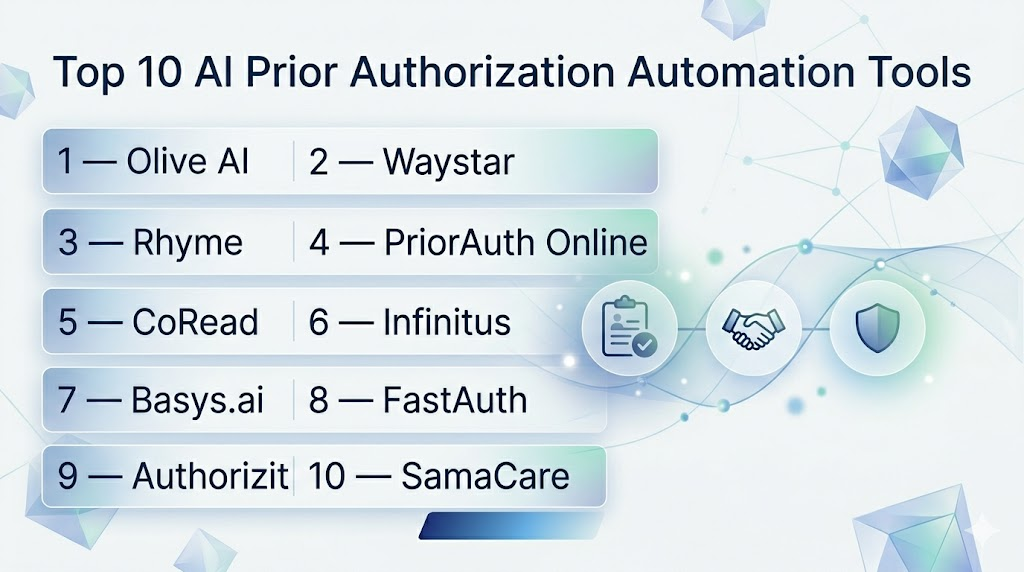
Top 10 AI Prior Authorization Automation Tools
#1 — Olive AI
Short description: Olive AI focuses on healthcare process automation, utilizing intelligent software agents to bridge the gap between clinical data and insurance portals. It is engineered for large hospital networks requiring extensive, automated robotic workflows to handle high-volume administrative tasks.
Standout Capabilities
- Intelligent software agents configured to automatically log into and navigate diverse payer portals.
- Deep background scraping of electronic health records to pull relevant diagnostic history.
- Real-time tracking of authorization statuses with automated updates pushed to billing software.
- Specialized exception queues that route complex or ambiguous cases directly to human reviewers.
- Centralized operational dashboards that monitor the performance and speed of active digital workers.
AI-Specific Depth
- Model support: Utilizes specialized workflow automation frameworks coupled with custom semantic language models.
- RAG / knowledge integration: Connects directly with internal hospital databases and updated insurance policy clearinghouses.
- Evaluation: Continuous validation checking generated data fields against source patient records.
- Guardrails: Structural rules blocking incomplete or contradictory data from being submitted to payers.
- Observability: Comprehensive tracing logs detailing every portal interaction, click path, and data transmission.
Pros
- Strong capabilities in handling high-volume, highly repetitive payer interactions.
- Reduces manual data entry errors across large, multi-department billing teams.
- Centralized visibility into the exact status of thousands of concurrent authorization requests.
Cons
- Initial deployment and workflow mapping can require heavy IT resources and time.
- System configurations must be updated when insurance websites change their portal layouts.
- Premium overall cost structure makes it less accessible for small, independent medical practices.
Security & Compliance
Supports complete enterprise single sign-on, granular role-based access control layers, comprehensive audit tracking, and end-to-end data encryption both at rest and during transit.
Deployment & Platforms
- Enterprise cloud-based architecture.
- Windows desktop background utilities for secure network operations.
Integrations & Ecosystem
Integrates directly with major hospital enterprise systems including Epic, Cerner, and various legacy practice management software suites via specialized secure data connectors.
Pricing Model
Enterprise-level subscription models scaled by transaction volume, automation complexity, and department size.
Best-Fit Scenarios
- Large hospital networks looking to automate thousands of repetitive prior authorizations monthly.
- Health systems with dedicated IT departments capable of managing enterprise-wide automation platforms.
- Billing offices wanting to eliminate manual data entry across multiple disparate insurance portals.
#2 — Waystar
Short description: Waystar provides a comprehensive, cloud-native healthcare payment and administrative platform that embeds AI prior authorization directly into the revenue cycle. It is designed for medical groups seeking an all-in-one solution that connects eligibility, authorizations, and claims processing.
Standout Capabilities
- Automated determination checks that instantly verify if an authorization is required for a scheduled code.
- Direct integration of the authorization status within the primary medical billing workflow.
- Intelligent matching of patient chart data to specific commercial insurance plan rules.
- Automated retrieval of approval codes and direct injection into active patient accounts.
- Comprehensive denial analytics that pinpoint why specific authorization requests failed.
AI-Specific Depth
- Model support: Uses proprietary machine learning algorithms trained on massive sets of national clearinghouse transaction data.
- RAG / knowledge integration: Real-time syncing with a comprehensive, national database of insurance rules and policies.
- Evaluation: Ongoing data loops that cross-reference submitted data with final payer responses.
- Guardrails: Hardcoded field verification to ensure no required document spots are left blank.
- Observability: Highly detailed reporting on approval rates, processing speeds, and transaction success metrics.
Pros
- Seamless connection between prior authorization status and final insurance claim submissions.
- User-friendly interface that fits naturally into standard medical billing workflows.
- Fast processing times for determining authorization requirements across national plans.
Cons
- Custom template tailoring can require assistance from vendor support teams.
- Less focus on deep, standalone narrative chart parsing compared to clinical-first niche tools.
- Performance can vary when interacting with smaller, highly localized regional insurance plans.
Security & Compliance
Adheres to strict enterprise data protection standards, including advanced encryption protocols, user access logging, and strict role-based data isolation boundaries.
Deployment & Platforms
- Pure cloud-native web application accessible from any modern web browser.
Integrations & Ecosystem
Offers broad compatibility with dozens of outpatient and inpatient electronic health records and practice management systems via standard data exchanges.
Pricing Model
Tiered volume-based transactional pricing or fixed subscription models tailored to practice size.
Best-Fit Scenarios
- Large medical groups wanting a single vendor for both prior authorization and clearinghouse claims.
- Billing departments looking to reduce the time spent manually checking authorization rules.
- Outpatient clinics requiring predictable, volume-based pricing for administrative workflows.
#3 — Rhyme
Short description: Rhyme focuses on creating direct, collaborative network connections between healthcare providers and insurance payers. The platform replaces traditional portal scraping by enabling direct, secure digital data exchanges that accelerate the prior authorization lifecycle.
Standout Capabilities
- Direct network connections that bypass traditional portal login and scraping mechanics.
- Real-time, bi-directional data exchange between provider software and payer systems.
- Automatic alignment of clinical chart notes with specific insurance policy rules.
- Instant status updates delivered directly into the clinician native charting workspace.
- Shared communication channels that allow fast resolution of pending information requests.
AI-Specific Depth
- Model support: Multi-model data mapping architectures designed for precise cross-system translation.
- RAG / knowledge integration: Native integration with connected insurance policy models and internal patient charts.
- Evaluation: Structural consistency checking to ensure submitted data matches payer expectations.
- Guardrails: Internal validation walls that block data transmissions containing mismatched patient identity records.
- Observability: Complete audit trails showing exactly when data was sent, received, and updated by the payer.
Pros
- Bypasses the stability issues frequently associated with traditional web-scraping bots.
- Delivers incredibly fast authorization status updates due to direct network connections.
- Reduces friction between billing teams and insurance medical reviewers.
Cons
- Maximum value is realized when your primary regional insurance payers are active on the network.
- Requires clean, structured electronic data fields to achieve optimal automation rates.
- Onboarding timelines depend on initial system alignment and network mapping settings.
Security & Compliance
Employs robust enterprise security designs, featuring secure point-to-point data encryption, comprehensive access logs, and complete data isolation parameters.
Deployment & Platforms
- Cloud-delivered software integration tier.
- Embedded directly within existing health system software setups.
Integrations & Ecosystem
Deeply integrated within major hospital electronic health record systems, allowing users to manage authorizations without leaving their main screens.
Pricing Model
Enterprise network subscription models scaled by connected site volume and transaction velocity.
Best-Fit Scenarios
- Health systems whose primary insurance payers are already members of the vendor network.
- Innovative healthcare groups looking to transition away from portal-scraping automation models.
- Organizations prioritizing deep, native workflow integrations within their primary charting software.
#4 — PriorAuth Online
Short description: PriorAuth Online delivers a responsive, web-based automation tool built to simplify the authorization workflow for independent practices and mid-sized clinics. It specializes in reducing the manual burden of form completion by using AI to automatically match clinical text to payer questionnaires.
Standout Capabilities
- Intelligent form auto-population that maps chart data to specific insurance documents.
- Centralized tracking board that aggregates authorizations across all commercial health plans.
- Automatic alerts that notify billing staff when an insurance determination is delayed.
- Digital documentation packaging that compiles charts, lab results, and order sheets into a single file.
- Simple user onboarding that allows clinics to begin processing requests with minimal delay.
AI-Specific Depth
- Model support: Specialized semantic processing engines optimized for extracting data from unstructured clinical text.
- RAG / knowledge integration: Dynamic lookup tables that reference standard regional prior authorization forms.
- Evaluation: Basic user-driven validation checks prior to final document generation.
- Guardrails: Formatting blocks that prevent the submission of invalid diagnostic or procedural codes.
- Observability: Clear session metrics showing completed forms and active pending requests.
Pros
- Incredibly straightforward user interface that requires very little staff training.
- Low upfront implementation cost, making it accessible to smaller medical offices.
- Accelerates the preparation of complex documentation packages for specialty procedures.
Cons
- Lacks the deep, automated robotic portal-logging features found in enterprise-first suites.
- Requires manual copy-pasting or file uploads if not connected to a compatible practice management tool.
- Advanced reporting analytics for massive hospital systems are more limited.
Security & Compliance
Maintains strict compliance infrastructure with complete encryption pathways, regular access logging, and secure user management controls.
Deployment & Platforms
- Cloud-based web application accessible on desktop web browsers.
Integrations & Ecosystem
Connects with a select list of mid-market practice management systems alongside universal clipboard mechanics for broader utility.
Pricing Model
Affordable monthly flat-rate subscription models per user or tiered package rates based on monthly submission volume.
Best-Fit Scenarios
- Independent specialty practices looking to reduce the time spent filling out authorization forms.
- Mid-sized clinics needing a centralized, clear dashboard to track pending insurance requests.
- Growing medical offices seeking an affordable automation tool without long corporate contracts.
#5 — CoRead
Short description: CoRead utilizes advanced clinical natural language processing to read unstructured medical charts and automate the prior authorization workflow for complex specialties like oncology and radiology. It focuses heavily on ensuring clinical evidence exactly matches payer medical necessity criteria.
Standout Capabilities
- Advanced clinical natural language processing designed to read dense, multi-page medical charts.
- Automated line-by-line comparison of patient notes against active medical necessity guidelines.
- Intelligent highlighting of missing clinical trials, conservative therapies, or specific lab metrics.
- Direct compilation of the final authorization request backed by precise chart citations.
- Seamless processing of complex, multi-step combination therapies and specialized procedures.
AI-Specific Depth
- Model support: Proprietary language models specifically trained on complex medical oncology, orthopedics, and neurology records.
- RAG / knowledge integration: Real-time semantic connections to updated commercial insurance policy handbooks.
- Evaluation: Internal matching scores that estimate the statistical likelihood of approval prior to submission.
- Guardrails: Clinical logic checks that verify procedure codes match the underlying primary diagnosis.
- Observability: Clear administrative metrics tracking data extraction precision and user review patterns.
Pros
- Exceptional accuracy when parsing complex clinical text for specialized medical fields.
- Helps catch missing documentation details before requests are sent to insurance companies.
- Significantly reduces clinical denial rates for expensive specialty medications and procedures.
Cons
- Processing dense, highly unstructured multi-page PDF charts can introduce minor latency.
- Requires focused onboarding setup to tune the system for highly specific medical sub-specialties.
- Premium overall pricing structure reflects its advanced clinical reasoning focus.
Security & Compliance
Adheres to strict institutional security mandates with robust role-based access control, comprehensive user auditing, and advanced data isolation protocols.
Deployment & Platforms
- Cloud-native web portal.
- Secure API integration layer for enterprise health networks.
Integrations & Ecosystem
Custom API endpoints designed for seamless data connections with major hospital health records and specialized oncology software suites.
Pricing Model
Tiered enterprise pricing scaled by department size, specialty mix, and custom data processing requirements.
Best-Fit Scenarios
- High-volume oncology, neurology, or orthopedic groups dealing with complex medical necessity criteria.
- Specialty clinics looking to lower their insurance denial rates through pre-submission validation.
- Enterprise healthcare networks requiring deep clinical chart analysis rather than simple form filling.
#6 — Infinitus
Short description: Infinitus automates the phone-based portion of the prior authorization and benefit verification lifecycle using advanced conversational AI. The platform utilizes voice agents to automatically call insurance payers, navigate phone trees, and gather status updates without using clinic staff time.
Standout Capabilities
- Intelligent conversational voice agents that automatically place calls to insurance companies.
- Automated navigation of complex insurance phone trees and automated hold systems.
- Precise collection of benefit details, authorization statuses, and required criteria via phone dialogue.
- Structured data translation that turns spoken phone confirmations into clean digital text.
- Scalable calling capacity that handles hundreds of concurrent insurance calls effortlessly.
AI-Specific Depth
- Model support: Advanced custom speech-to-text, natural language understanding, and voice generation models optimized for medical contexts.
- RAG / knowledge integration: Direct syncing with internal data tables containing standard insurance phone paths.
- Evaluation: Multi-step verification comparing voice conversation recordings with generated text summaries.
- Guardrails: Strict boundaries restricting the digital voice agent from discussing non-permitted patient data points.
- Observability: Complete access to audio recordings, text transcripts, and call outcome metrics for every conversation.
Pros
- Completely removes clinic staff from long, frustrating insurance telephone hold lines.
- Delivers highly accurate, structured text summaries of phone-based authorization statuses.
- Scales effortlessly to handle sudden spikes in verification workloads during busy seasons.
Cons
- Automation speed depends on insurance phone line hold times and payer agent response patterns.
- Limited to handling workflows that can be successfully completed over a standard telephone call.
- Requires initial alignment to map out the exact data questions required by the clinic software.
Security & Compliance
Maintains high-tier healthcare security protocols, featuring encrypted voice streams, secure text logging, and strict data isolation per clinic account.
Deployment & Platforms
- Cloud-delivered software platform.
- Fully accessible via developer APIs and secure web administration portals.
Integrations & Ecosystem
Integrates cleanly with major healthcare practice management tools and enterprise revenue cycle platforms via custom data exchanges.
Pricing Model
Usage-based transactional pricing or custom enterprise tier contracts based on call volume.
Best-Fit Scenarios
- High-volume clinics where billing staff spend hours daily on hold with insurance companies.
- Specialty pharmacies needing fast, phone-based benefit verification and authorization updates.
- Large centralized billing offices looking to automate phone operations across multiple locations.
#7 — Basys.ai
Short description: Basys.ai delivers an advanced prior authorization automation platform that serves both health systems and insurance plans. By using specialized clinical reasoning models, it accelerates approvals by matching care requests to policy rules in seconds.
Standout Capabilities
- Dual-sided architecture designed to streamline communication between providers and payers.
- Instantaneous processing of standard authorization requests via automated logic engines.
- Deep clinical chart analysis that extracts relevant diagnostic history automatically.
- Explanable AI dashboards that show clinicians the exact policy path used for approvals.
- Automated generation of missing-evidence alerts to prevent immediate administrative denials.
AI-Specific Depth
- Model support: Advanced clinical reasoning models trained on extensive sets of medical guidelines.
- RAG / knowledge integration: Direct API connectivity with active insurance authorization rule repositories.
- Evaluation: Continuous testing loops that measure automated decisions against manual expert reviews.
- Guardrails: Strict policy guardrails that prevent authorization generation when essential criteria are completely missing.
- Observability: Comprehensive logging detailing token usage, decision logic paths, and system turnaround times.
Pros
- Accelerates approval turnarounds by streamlining the logic path between provider and payer.
- Highly transparent decision engines build trust with medical and administrative staff.
- Reduces overall administrative processing costs for both health networks and insurance plans.
Cons
- Full automation efficiency is achieved when both sides of the network leverage compatible setups.
- Implementation requires data-mapping alignment with institutional clinical guidelines.
- System analytics are heavily tailored around larger corporate enterprise groups.
Security & Compliance
Employs secure data infrastructure featuring absolute user auditing paths, encrypted data transfers, and advanced tenant data isolation boundaries.
Deployment & Platforms
- Cloud-native software platform.
- Secure API-first architecture for flexible corporate deployments.
Integrations & Ecosystem
Provides robust developer SDKs and custom APIs to connect with modern electronic charts and proprietary payer core software.
Pricing Model
Enterprise pricing contracts scaled around transaction volume, user counts, and selected platform modules.
Best-Fit Scenarios
- Progressive health systems wanting an advanced, clinical-reasoning tool for authorizations.
- Managed care organizations and insurance plans looking to automate incoming care requests.
- Tech-forward medical enterprises prioritizing explainable AI models over basic automated bots.
#8 — FastAuth
Short description: FastAuth provides an agile, easy-to-deploy prior authorization utility designed for small to mid-sized outpatient diagnostic centers and clinics. It streamlines the creation of auth requests by utilizing lightweight browser extensions that overlay on top of existing software.
Standout Capabilities
- Lightweight browser extension design that overlays on top of web-based clinical software.
- Quick extraction of demographic and diagnostic codes from active user screens.
- Automated form matching that selects the correct authorization layout based on insurance type.
- Straightforward single-button capture mechanics that minimize workflow friction.
- Centralized tracking clipboard that saves submission histories for quick reference.
AI-Specific Depth
- Model support: Optimized commercial language models tuned for rapid data formatting and form entry.
- RAG / knowledge integration: N/A
- Evaluation: Basic on-screen user validation checks before submission execution.
- Guardrails: Format validation fields that flag missing diagnostic metrics on the fly.
- Observability: Simple dashboards tracking successfully completed submissions per user.
Pros
- Incredibly easy to deploy without complex, months-long hospital IT implementation cycles.
- Works seamlessly across multiple distinct web-based practice software interfaces.
- Low overall learning curve for front-desk and billing administrative staff.
Cons
- Lacks deep, automated background database synchronization with enterprise hospital infrastructures.
- Cannot parse highly complex multi-page chart textbooks as deeply as specialized clinical tools.
- Relying entirely on user screens means it operates primarily as a real-time assistant.
Security & Compliance
Standard encryption protocols are maintained across all data paths, with secure user session tracking and restricted browser storage settings.
Deployment & Platforms
- Web browser extensions compatible with modern desktop browsers.
- Secure cloud backup portal.
Integrations & Ecosystem
Operates primarily as a standalone browser utility that interacts with web-based EHR interfaces via direct screen data matching.
Pricing Model
Flat monthly subscription fee per user offering predictable monthly pricing plans for smaller practices.
Best-Fit Scenarios
- Outpatient imaging centers needing a quick tool to speed up daily authorization entries.
- Independent clinics using web-first EHR platforms who want immediate automation help.
- Small billing teams looking for a simple, plug-and-play browser extension utility.
#9 — Authorizit
Short description: Authorizit utilizes predictive AI and targeted data extraction to automate prior authorization tasks for physical therapy, chiropractic, and rehabilitation clinics. It specializes in converting recurring progress notes into structured insurance continuation forms.
Standout Capabilities
- Specialized data models built out around physical medicine and rehabilitation workflows.
- Automated conversion of multi-week therapy progress notes into insurance extension requests.
- Clear tracking of remaining approved patient visits relative to active authorization limits.
- Intelligent matching of functional improvement metrics to insurance necessity criteria.
- Simple administrative dashboard tracking authorization expirations across active patients.
AI-Specific Depth
- Model support: Language models optimized for parsing physical therapy, mobility, and functional exam text.
- RAG / knowledge integration: Integrated lookups with primary commercial rehabilitation policy limits.
- Evaluation: Localized prompt preview testing before finalizing documentation packages.
- Guardrails: Automated alerts that flag when therapy notes lack required objective metrics.
- Observability: Clean metric indicators showing authorization success trends by clinic site.
Pros
- Excellent utility for tracking and extending recurring therapy authorizations.
- Minimizes the administrative time therapists spend writing long justification notes.
- Helps prevent unpaid therapy sessions by tracking active authorization expirations.
Cons
- Highly specialized for rehabilitation medicine, making it less ideal for general surgery networks.
- Direct native data integration paths with large enterprise hospital software are more limited.
- Requires clean, objective physical data entry within the primary notes to achieve top accuracy.
Security & Compliance
Complies with industry data protection laws, utilizing standard secure encryption streams and isolated database partitions.
Deployment & Platforms
- Web application available on desktop browsers and mobile tablets.
Integrations & Ecosystem
Integrates with select therapy-specific practice management software platforms along with universal text clipboards.
Pricing Model
Affordable tiered subscription models scaled by active clinician counts or monthly location volume.
Best-Fit Scenarios
- Multi-site physical therapy, chiropractic, or occupational rehabilitation clinics.
- Therapists spending excessive time writing extension justifications for insurance plans.
- Rehabilitation practices looking to protect revenue lines by tracking authorization counts.
#10 — SamaCare
Short description: SamaCare specializes in streamlining the prior authorization and enrollment pipeline for expensive specialty medications, including retina, oncology, and rheumatology therapeutics. It unifies administrative processes into a single secure platform to accelerate time-to-treatment.
Standout Capabilities
- Unified platform designed specifically for managing high-cost specialty medical drugs.
- Automated matching of patient clinical history to complex specialty medication criteria.
- Direct digital submission paths across major specialty drug portals and clear payer channels.
- Real-time visibility into the exact step of a specialty medication approval process.
- Integrated management of manufacturer copay assistance programs alongside authorizations.
AI-Specific Depth
- Model support: Tailored text models trained on specialty prescription rules and advanced diagnostic notes.
- RAG / knowledge integration: Continuous connectivity with updated specialty drug formulary criteria sheets.
- Evaluation: Comparative data verification to ensure chart notes match mandatory drug protocols.
- Guardrails: Logic check rules that prevent submission when mandatory prerequisite therapies are unrecorded.
- Observability: Clear process tracking tracing authorization submission speed and drug delivery readiness.
Pros
- Unmatched precision in navigating the complex world of high-cost specialty therapeutics.
- Reduces treatment delays for patients requiring critical, expensive medical injections.
- Simplifies the coordination between clinics, insurance companies, and specialty pharmacies.
Cons
- Narrowly focused on specialty medications, making it less applicable for standard imaging or lab requests.
- Implementation involves setting up specialized drug-specific workflow configurations.
- Requires detailed provider alignment to map custom clinic specialty workflows perfectly.
Security & Compliance
Features robust enterprise security controls, including advanced user data encryption, comprehensive access logs, and complete data isolation parameters.
Deployment & Platforms
- Secure cloud-based web application.
- Cloud API framework for large enterprise specialty clinics.
Integrations & Ecosystem
Connects with specialty electronic medical charts and advanced practice management systems via custom data bridges.
Pricing Model
Custom subscription tiers or enterprise contracts configured around specialty clinic scale and drug transaction volume.
Best-Fit Scenarios
- Retina, oncology, rheumatology, or neurology clinics handling high volumes of specialty drugs.
- Medical groups looking to accelerate patient access to expensive specialty therapeutic injections.
- Specialty practices aiming to reduce manual administrative overhead across medication pipelines.
Comparison Table
| Tool Name | Best For | Deployment | Model Flexibility | Strength | Watch-Out | Public Rating |
| Olive AI | High-volume hospital processes | Enterprise Cloud | Hosted Custom Models | Strong robotic portal automation | Requires high IT resources | N/A |
| Waystar | All-in-one billing integration | Cloud-Native | Clearinghouse AI Data | Connected claim workflows | Less focus on deep charts | N/A |
| Rhyme | Direct payer network syncs | Embedded Cloud | Multi-System Translation | Bypasses traditional scraping | Requires network membership | N/A |
| PriorAuth Online | Mid-sized clinic tracking boards | Cloud-Native | Semantic Processing | Very simple user interface | Lacks background bot logging | N/A |
| CoRead | Complex oncology & radiology | Cloud / API | Specialty Tuned Models | Deep clinical chart parsing | Processing complex files takes time | N/A |
| Infinitus | Automating insurance phone calls | Cloud / API | Conversational Voice AI | Removes staff from hold lines | Phone hold speeds vary | N/A |
| Basys.ai | Provider and payer connectivity | Cloud-Native | Clinical Reasoning Models | Highly explainable AI paths | Best when used on both sides | N/A |
| FastAuth | Quick outpatient web overlays | Web Extension | Rapid Formatting Models | Plug-and-play installation | Operates real-time on screen only | N/A |
| Authorizit | Therapy & rehab tracking | Web / Tablet | Rehab Optimized Models | Focus on recurring extensions | Specialized for therapy only | N/A |
| SamaCare | High-cost specialty medications | Cloud / API | Specialty Formulary AI | Accelerates drug pipeline time | Limited outside specialty drugs | N/A |
Scoring & Evaluation (Transparent Rubric)
The scoring presented in the rubric below reflects comparative evaluations based on target audience fit, feature depth, and architectural focus. No tool scores perfectly across every dimension because engineering priorities involve trade-offs—for instance, maximizing simplicity often means reducing complex enterprise administrative capabilities.
| Tool | Core Features (20%) | Reliability/Eval (15%) | Guardrails (10%) | Integrations (15%) | Ease of Use (10%) | Perf/Cost (15%) | Security/Admin (10%) | Support (5%) | Weighted Total |
| Olive AI | 9 | 8 | 9 | 10 | 7 | 6 | 10 | 9 | 8.35 |
| Waystar | 9 | 9 | 9 | 9 | 9 | 8 | 9 | 8 | 8.80 |
| Rhyme | 9 | 9 | 9 | 9 | 8 | 8 | 9 | 8 | 8.65 |
| PriorAuth | 7 | 7 | 7 | 6 | 9 | 9 | 8 | 8 | 7.40 |
| CoRead | 10 | 9 | 9 | 8 | 8 | 7 | 9 | 8 | 8.50 |
| Infinitus | 9 | 9 | 8 | 8 | 9 | 8 | 9 | 8 | 8.55 |
| Basys.ai | 9 | 8 | 9 | 8 | 8 | 8 | 9 | 8 | 8.35 |
| FastAuth | 6 | 7 | 7 | 4 | 10 | 9 | 7 | 7 | 6.70 |
| Authorizit | 7 | 7 | 8 | 6 | 8 | 9 | 7 | 8 | 7.35 |
| SamaCare | 9 | 9 | 9 | 8 | 8 | 7 | 9 | 8 | 8.35 |
Top 3 for Enterprise
- Waystar
- Olive AI
- Rhyme
Top 3 for SMB
- PriorAuth Online
- FastAuth
- Infinitus
Top 3 for Developers
- Basys.ai
- CoRead
- Infinitus
Which AI Prior Authorization Automation Tool Is Right for You
Solo / Freelancer
If you run an independent practice with no dedicated IT staff, avoid complex corporate software suites. Look for agile tools that offer instant installation and simple monthly subscription agreements. Utilities like FastAuth or PriorAuth Online allow front-desk staff to speed up form completion using basic web overlays without modifying your core software architecture.
SMB
For mid-sized regional medical groups managing steady procedural volumes, focus on solutions that bridge the gap between authorization status and billing workflows. Suki AI or Waystar provide excellent tools for this tier, ensuring authorization updates flow predictably into standard practice software without requiring heavy custom coding.
Mid-Market
Multi-site specialized practices require automation software that handles dense, text-heavy clinical chart records. Tools like CoRead or SamaCare are excellent choices here, providing the advanced analytical strength needed to match clinical notes against complex payer guidelines without missing key medical details.
Enterprise
Large health networks and hospital groups managing hundreds of beds must place native integration, single sign-on security, and centralized data governance at the top of their evaluation lists. Platforms like Olive AI, Waystar, or network-first models like Rhyme ensure that patient data remains secure within institutional boundaries while automating high-volume administrative tasks.
Regulated Industries
For medical groups operating under strict corporate or government health frameworks, data residency and traceable logic paths are essential. Choose advanced vendors that provide clear, explainable AI pathways and guaranteed zero-data-retention options, ensuring that sensitive patient health records are processed securely and never saved for secondary model training.
Budget vs. Premium
If minimizing software spend is your primary metric, lightweight web overlays that simplify form data entry are highly cost-effective. However, if your goal is completely eliminating the time staff spend navigating payer websites or waiting on hold, investing in premium conversational voice systems or deep cloud integrations is a far more effective long-term strategy.
Build vs. Buy
Building a custom prior authorization automation pipeline using raw open-source web scrapers is incredibly difficult due to the continuous layout updates insurance companies make to their web portals. Buying an established solution ensures that dedicated engineering teams manage portal maintenance, speech models, and policy database changes, allowing your internal staff to focus strictly on patient care.
Implementation Playbook (30 / 60 / 90 Days)
A successful rollout requires balancing technical configuration with staff workflow adaptation. Use this tactical timeline to guide your deployment:
30 Days: Pilot & Success Metrics
- Technical Task: Deploy the selected automation utility to a small test group of 2–3 billing specialists handling a specific regional insurance payer.
- AI Evaluation: Establish an initial baseline to track the extraction accuracy of the software against manual form-filling patterns.
- Success Metric: Measure the average time reduction for preparing documentation packages by the end of week four.
60 Days: Harden Security, Evaluation & Rollout
- Technical Task: Enable full enterprise single sign-on credentials and map out precise role-based access levels across participating departments.
- AI Evaluation: Configure a structured validation queue to log and analyze any pre-submission data extraction errors or missing documentation flags.
- Success Metric: Achieve an authorization submission acceleration rate of at least thirty percent within the pilot team before expanding software deployment.
90 Days: Optimize Cost/Latency, Governance & Scale
- Technical Task: Expand platform deployment across all remaining billing tiers while configuring custom routing rules to optimize API transaction spend.
- AI Evaluation: Execute comprehensive security tests to verify that automation scripts interact cleanly with payer web screens without triggering security blocks.
- Success Metric: Confirm that a high majority of target authorizations are successfully prepared and tracked directly through the automated interface.
Common Mistakes & How to Avoid Them
- Over-Automation Without Human Review: Allowing software tools to submit complex medical authorization requests directly to payers without final human validation. Always use a review screen.
- Ignoring Data Retention Clauses: Failing to confirm whether a vendor stores sensitive patient records for secondary model development. Insist on a clear zero-data-retention contract.
- Skipping Specialty Validation: Assuming an automation system configured for basic imaging will perform flawlessly for complex specialty medications. Run focused tests for unique procedure codes.
- Failing to Track Portal Layout Changes: Relying on basic web scraping tools that break down the moment an insurance company modifies its portal screen layout. Choose adaptive agentic systems.
- Relying on Unstable Networks: Operating cloud-heavy web extensions on sluggish or unoptimized office wireless connections. Ensure local data pipelines match system requirements.
- Ignoring Pre-Prerequisite Rules: Submitting authorization requests before the patient record confirms they have completed mandatory conservative therapies. Use pre-submission logic filters.
- Failing to Manage Vendor Lock-In: Embedding all custom institutional compliance rules inside a proprietary vendor dashboard without maintaining external backups.
- Neglecting Administrative Staff Coaching: Deploying software without teaching billing teams how to efficiently handle the exception queues flagged by the AI.
- Overlooking Hidden Transaction Fees: Failing to budget for unexpected per-submission charges, portal access line fees, or advanced API connector add-ons.
- Ignoring Secondary Insurance Channels: Selecting basic automation software that fails to evaluate how a patient secondary insurance policy impacts the primary authorization pathway.
FAQs
1. How do AI prior authorization tools handle changes to insurance website layouts?
Modern systems leverage adaptive software agents and flexible clinical models that interpret webpage structures conceptually, allowing them to successfully complete form fields even when an insurance company shifts button placements or changes portal designs.
2. Can these tools eliminate clinical denials entirely?
No tool eliminates denials completely, but they significantly reduce them. By analyzing patient charts against payer guidelines before submission, the software flags missing metrics or incomplete files, allowing billing teams to correct errors before the payer reviews the claim.
3. Do these systems require manual data entry from our staff?
Minimal manual entry is required. Deeply integrated tools automatically extract patient names, demographic codes, diagnoses, and procedural text directly from your existing medical chart software, requiring staff only to review the final data layout before hitting submit.
4. How secure is patient medical data during automated transmissions?
Professional healthcare automation utilities employ enterprise-grade end-to-end data encryption, strict single sign-on verifications, and secure point-to-point data pathways to ensure patient records remain protected inside institutional boundaries.
5. What happens when an insurance company requires a phone call instead of a portal entry?
Certain advanced solutions utilize automated conversational voice networks to call insurance phone trees, interact with interactive voice response systems, and gather authorization status updates without pulling staff away from clinic operations.
6. Can smaller independent clinics use these tools affordably?
Yes. While some platforms are engineered for multi-site hospital networks, several vendors provide lightweight browser extensions and fixed monthly subscription packages tailored for small to mid-sized outpatient practices.
7. Do these systems understand dense, handwritten doctor notes?
Yes. Platforms leverage highly accurate optical character recognition combined with clinical language engines to interpret scanned notes, handwritten intake forms, and low-resolution PDF charts, turning them into structured evidence data.
8. How long does it take for the AI to compile an authorization package?
For most cloud-native configurations, the software can parse a patient record, match it to the target insurance policy guidelines, and fully populate an automated submission package in less than a few minutes.
9. Will this software work with custom or niche practice management systems?
Yes. Even if a niche software lacks standard API access paths, adaptive web utilities can capture on-screen data data grids or use universal clipboard systems to bridge the gap without expensive custom development.
10. Can the system automatically handle prior authorization appeals?
Yes. When a denial is received, advanced systems can analyze the payer rejection codes against the patient chart to automatically draft a structured, evidence-based appeal letter containing the missing clinical proof required for approval.
11. Is a zero-data-retention policy standard across all software vendors?
It is not standard across consumer tools, but it is a critical requirement for professional healthcare software. Top-tier enterprise vendors offer explicit zero-data-retention terms to guarantee that patient information is never used for secondary model training.
12. Can these tools check if an authorization is needed before a procedure is scheduled?
Yes. Many platforms feature instant rule-checking engines that review the patient insurance plan and scheduled procedure codes instantly, immediately alerting the scheduling team if a prior authorization is mandatory.
Conclusion
AI prior authorization automation software represents a critical leap forward in removing administrative friction from the healthcare ecosystem. By replacing slow, manual paperwork and portal navigation with adaptive software tools and deep clinical reasoning models, these platforms allow healthcare organizations to secure fast approvals and protect their revenue cycles.Because the ideal tool depends entirely on your specific transaction volumes, specialty mix, and existing billing infrastructure, avoid choosing a platform based on generic features. To achieve optimal results, define your highest-volume insurance plans, pilot an adaptive solution with a core billing team, verify strict data security baselines, and scale your automated workflows across your entire medical enterprise.

Find Trusted Cardiac Hospitals
Compare heart hospitals by city and services — all in one place.
Explore Hospitals
A useful addition would be payer policy variability and exception handling, since prior authorization automation often breaks down when rules differ across insurers or require complex manual overrides.