
Introduction
AI claims denial prediction tools utilize specialized machine learning models, predictive scoring engines, and historical billing data to identify high-risk healthcare claims before they are submitted to insurance payers. This technology analyzes claim lines in real time, matching combinations of procedure codes, diagnosis codes, modifiers, and patient demographics against evolving payer-specific adjudication rules. By predicting the statistical probability of a denial, these platforms allow healthcare organizations to address coding errors, documentation gaps, and medical necessity issues proactively, ensuring higher first-pass acceptance rates.
Why It Matters
Claim denials represent a massive financial leak and administrative burden for modern healthcare providers, often resulting in delayed cash flow, high recovery costs, and write-offs. Manually auditing claims before submission is no longer sustainable due to the sheer volume of changing payer rules and complex bundling logic. Implementing predictive AI solutions changes the revenue cycle from a reactive firefighting operation into a proactive prevention strategy. By stopping denials before they happen, medical practices can lower administrative overhead, accelerate reimbursement cycles, and optimize staff focus on truly complex clinical appeals.
Real-World Use Cases
- Pre-Submission Risk Scoring: Scanning a finalized claim packet prior to clearinghouse release and generating a risk percentage score to flag high-probability denials.
- Payer-Specific Rule Matching: Automatically catching localized or out-of-state insurance policy requirements, such as specific tracking rules or frequency limits on diagnostic tests.
- Medical Necessity Auditing: Reading clinical documentation strings using natural language processing to verify that the patient medical charts natively support the billed codes.
- Aged Accounts Receivable Triage: Scoring existing unpaid or held claims to help revenue cycle teams prioritize follow-up efforts based on total financial value and collection probability.
- Systemic Root-Cause Identification: Clustering historical denial codes to reveal widespread patterns, such as a specific clinic location consistently omitting necessary billing modifiers.
Evaluation Criteria
When purchasing an AI claims denial prediction tool, healthcare revenue cycle leaders should evaluate solutions based on the following criteria:
- EHR and Billing System Depth: The ability to natively ingest text and structured codes directly from major enterprise scheduling and clinical charting engines.
- Predictive Accuracy and Signal Quality: The system precision in flagging true denial risks without overloading billing staff with low-value false positive alerts.
- Payer Rule Refresh Rate: How rapidly the vendor updates its underlying policy library to match mid-year changes made by national and regional commercial insurance plans.
- Natural Language Processing Capabilities: The tool depth in reading unstructured clinical notes to validate that documentation integrity aligns with medical necessity.
- Workflow Orchestration and Triage: The presence of intelligent routing queues that bucket high-risk claims by department, value, or specific error type automatically.
- Explainability of AI Decisions: Clear user interfaces that explain exactly why a claim was flagged as high-risk, citing the specific historical data pattern or rule conflict.
- Financial Impact Analytics: Centralized dashboards tracking the drop in first-pass denial rates, cash velocity lift, and overall return on investment metrics.
- Administrative Configuration Controls: The ease with which an internal compliance manager can adjust risk thresholds or inject custom institutional billing rules.
- Best for: Multi-hospital networks, large ambulatory groups, centralized billing offices, and revenue cycle management firms handling high volumes of commercial insurance claims.
- Not ideal for: Small cash-only boutique practices, direct primary care clinics that completely bypass insurance billing networks, or offices with very basic, static payer mixes.
What’s Changed in AI Claims Denial Prediction
The landscape of revenue cycle intelligence tools has evolved beyond traditional static claim scrubbers and basic billing edits. The following trends define the market today:
- Agentic Pre-Scrubbing Workflows: Modern systems deploy autonomous software agents that do not just flag a predicted denial; they can draft the necessary modifier corrections or pull the missing intake files automatically.
- Multimodal Documentation Verification: Platforms analyze structured coding fields alongside scanned intake documents, referral PDFs, and historical dictation notes simultaneously to evaluate denial risks.
- Advanced Hallucination Mitigation: Validation layers ensure predictive models cross-check flagged code violations directly against verified national datasets, keeping false-alarm alerts down to a minimum.
- Strict Prompt-Injection Defense: Robust security barriers prevent unauthorized external patterns or malicious text within complex patient records from altering core predictive logic.
- Zero-Data-Retention Compliance: Enterprise-tier architectures process sensitive claims data instantly through isolated memory spaces, ensuring zero retention of protected health information for public model training.
- Local Model Routing: Hybrid networks route standard eligibility and modifier checks to smaller, ultra-fast local models while sending complex surgical bundle analyses to larger reasoning systems to control cost and latency.
- Granular Process Traceability: IT compliance officers have access to detailed trace dashboards that map out the exact computational journey a claim took through the predictive risk assessment pipeline.
- Locally Hosted and Hybrid Deployments: To fulfill strict institutional data protection guidelines, vendors offer dedicated hybrid configurations that keep the predictive analysis layers completely inside the secure tenant cloud of the hospital system.
Quick Buyer Checklist (Scan-Friendly)
Before shortlisting vendors, ensure your team can answer these fundamental questions:
- Data Governance: Does the vendor provide a verified zero-data-retention policy for your sensitive institutional billing histories and patient records?
- Model Customization: Does the predictive model learn dynamically from your unique, historical hospital denial patterns, or does it rely solely on generic national averages?
- EHR Interoperability: Can the system interface bi-directionally with your exact electronic health record via modern data standards, or does it require a separate platform login?
- Traceable Reasoning: Can a billing specialist view the exact line of policy text or historical transaction logic that triggered a high-risk claims warning?
- Pre-Intake Validation: Does the system begin predicting denial risks during patient scheduling and eligibility checks, or does it only trigger after services are rendered?
- System Latency: Can the platform calculate risk scores for large batches of thousands of active claims in less than a few minutes?
- Lock-In Risk: Are your custom rules, departmental configurations, and triage logic structures transportable if you shift vendors in the future?
- Access Management: Does the utility support comprehensive single sign-on frameworks and granular role-based access privileges for large revenue cycle teams?
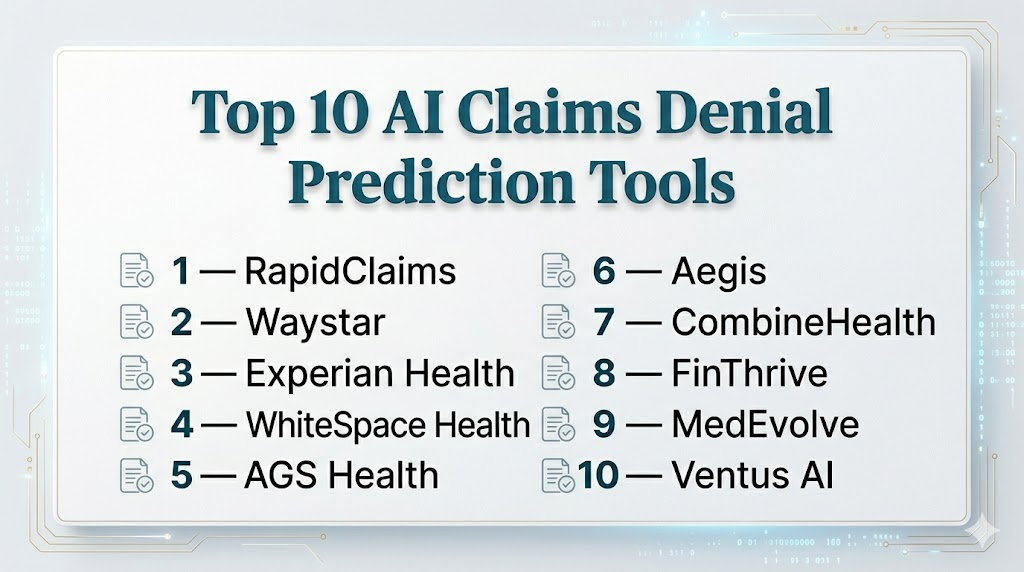
Top 10 AI Claims Denial Prediction Tools
#1 — RapidClaims
Short description: RapidClaims delivers an AI-first claims processing and denial prevention platform built from the ground up for contemporary revenue cycle teams. It utilizes advanced semantic technology to execute real-time claims scrubbing and predictive risk modeling directly within active billing pipelines.
Standout Capabilities
- Automated medical coding review powered by clinical natural language processing.
- Real-time predictive risk scoring that captures potential denials before submission.
- Intelligent claim scrubbing utilizing thousands of active payer-specific rules.
- Specialized condition optimization that ensures chronic disease data fields are captured completely.
- Clean dashboards displaying direct revenue intelligence and upcoming timely filing limits.
AI-Specific Depth
- Model support: Native custom language models trained explicitly on medical coding and health insurance transaction streams.
- RAG / knowledge integration: Real-time synchronization with updated national coding books and payer policy libraries.
- Evaluation: Continuous calibration loops comparing predicted denial alerts with actual payer remittance outputs.
- Guardrails: Automated filtering boundaries that block incomplete diagnostic combinations from passing to the clearinghouse.
- Observability: Highly transparent trace logs that explain the specific rule violation behind every high-risk flag.
Pros
- Excellent pre-submission focus that prevents denials from occurring in the first place.
- Blends automated medical coding validation and risk analysis on one interface.
- Simple layout reduces onboarding timelines for new billing specialists.
Cons
- Enterprise customization features require structured onboarding cooperation from internal IT staff.
- Advanced analytics tools are heavily optimized for large-scale operations rather than micro-practices.
- Deep data integration configurations can take time to map perfectly across unique legacy health records.
Security & Compliance
Maintains strict data security baselines, including enterprise single sign-on support, granular role-based permissions, and end-to-end encryption for health information both at rest and in transit.
Deployment & Platforms
- Cloud-native deployment tier.
- Embedded interface options for major hospital software networks.
Integrations & Ecosystem
Integrates smoothly with modern inpatient and outpatient charting platforms, allowing teams to screen claims without altering their main day-to-day workflow.
Pricing Model
Tiered subscription frameworks scaled around monthly claims processing volume and deployment complexity.
Best-Fit Scenarios
- Modern billing organizations seeking a dedicated pre-submission tool to push up clean-claim metrics.
- Teams looking to combine automated medical coding reviews with predictive denial logic.
- High-volume medical groups aiming to eliminate manual claims-scrubbing blind spots entirely.
#2 — Waystar
Short description: Waystar operates a massive commercial claims clearinghouse and revenue cycle management platform that incorporates deep predictive analytics. It leverages historical transactional insights to evaluate claims and catch common denial patterns across national networks.
Standout Capabilities
- Comprehensive pre-submission data scrubbing driven by extensive historical transaction records.
- Accurate predictive models that calculate denial probabilities by specific payer and code mix.
- Integrated authorization checking that maps insurance rules automatically before submission.
- Centralized denial tracking boards that help categorize and prioritize unexpected rejections.
- Automated retrieval of approval codes and direct injection into patient billing profiles.
AI-Specific Depth
- Model support: Proprietary analytics frameworks trained on large-scale clearinghouse data records.
- RAG / knowledge integration: Direct syncing with a wide database of commercial insurance policies and medical necessity rules.
- Evaluation: Algorithmic verification matching submitted code streams against expected payer response patterns.
- Guardrails: Hardcoded mandatory field verification rules that stop empty document fields from processing.
- Observability: High-level executive dashboards displaying complete denial, approval, and collection velocity metrics.
Pros
- Tremendous predictive strength derived from processing massive amounts of national claims transactions.
- Blends denial predictions seamlessly with active clearinghouse submission frameworks.
- Highly stable platform infrastructure trusted by thousands of health systems.
Cons
- Modifying core predictive rules can require assistance from centralized customer service lines.
- Less focus on deep, conversational clinical text parsing compared to specialty-first tools.
- System analytics focus heavily on large corporate frameworks, which can overwhelm smaller operations.
Security & Compliance
Adheres to top-tier institutional security protocols, including complete single sign-on integrations, robust access logs, and strict tenant data isolation boundaries.
Deployment & Platforms
- Pure cloud-native web application accessible through modern desktop web browsers.
Integrations & Ecosystem
Maintains broad compatibility with a large market list of inpatient and outpatient electronic charts and practice software via standardized data exchanges.
Pricing Model
Custom enterprise tier contracts and variable volume-based transactional pricing structures.
Best-Fit Scenarios
- Enterprise hospital networks looking to combine clearinghouse tools with predictive analytics.
- Large medical groups needing stable, volume-scaled billing processing frameworks.
- Centralized business offices wanting to monitor denial probabilities across thousands of multi-state claims.
#3 — Experian Health
Short description: Experian Health provides specialized revenue cycle management applications enhanced by its AI Advantage module. The platform focuses heavily on automating the detection, prioritization, and pre-submission correction of claims that are statistically vulnerable to payer denials.
Standout Capabilities
- Advanced predictive scoring modules that assess in-flight claims for denial vulnerabilities.
- Intelligent workflow managers that automatically route flagged claims to specialized correction teams.
- Normalized denial reason mapping that simplifies complex insurance messages into actionable instructions.
- Real-time automated alerts for upcoming timely filing deadlines across active accounts.
- Root-cause analytics engines that pinpoint systemic billing errors by provider or clinic site.
AI-Specific Depth
- Model support: Customized machine learning models optimized for risk stratification and automated claims triage.
- RAG / knowledge integration: Native connections to updated national clearinghouse files and regional payer manuals.
- Evaluation: Continuous retraining models that ingest actual payer rejections to update upcoming risk calculations.
- Guardrails: Scripted check blocks that flag missing documentation strings before final transmission.
- Observability: Comprehensive logging workflows detailing exact user touches and claim adjustments.
Pros
- Outstanding workflow routing capabilities that prevent billing team congestion.
- Highly actionable explanations accompanying every flagged pre-submission error code.
- Strong background experience in handling large enterprise transactional data structures securely.
Cons
- System setup and custom template configuration timelines can be quite extensive.
- Pricing structures sit at a premium tier reflecting its corporate enterprise focus.
- Users must invest initial focus time to align workflow categories with internal team lines.
Security & Compliance
Features robust institutional security systems, including full role-based access management, detailed user auditing tracks, and complete data encryption controls.
Deployment & Platforms
- Secure cloud-based enterprise platform with responsive web browser access.
Integrations & Ecosystem
Integrates with major hospital record platforms via standardized secure data exchanges and modern enterprise integration layers.
Pricing Model
Enterprise pricing contracts tailored around organization scale, user seats, and overall transactional velocity.
Best-Fit Scenarios
- Hospital networks needing to organize and prioritize high volumes of at-risk claims across large teams.
- Organizations seeking deep root-cause analysis tools to stop repetitive structural coding errors.
- Corporate revenue cycle offices prioritizing clean data routing and detailed staff audit histories.
#4 — WhiteSpace Health
Short description: WhiteSpace Health delivers an advanced analytics platform featuring its specialized RevIntel module. The platform utilizes machine learning to predict and prevent denials across three separate operational tiers: before the patient is seen, after care is rendered, and during post-submission tracking.
Standout Capabilities
- Multi-stage predictive modeling evaluating denial risks across the entire patient visit lifecycle.
- Pre-intake risk parsing that flags coverage limits and prior authorization risks before the appointment.
- Smart bucketing tools that automatically group at-risk claims by financial value and error type.
- Advanced tracking of payer behavioral modifications, highlighting sudden changes in rejection patterns.
- Clear, actionable recommendations to correct documentation gaps before releasing invoices.
AI-Specific Depth
- Model support: Advanced machine learning algorithms trained to find non-obvious correlations across diverse billing datasets.
- RAG / knowledge integration: Direct database linking with regional commercial rules and active eligibility pathways.
- Evaluation: Continuous outcome analysis tracking how adjustments to on-screen flags change final approval speeds.
- Guardrails: Intake-layer checking boundaries that prevent scheduling when insurance boundaries are exceeded.
- Observability: Real-time visual dashboards outlining exact denial trends, risk groups, and collection estimates.
Pros
- Provides excellent predictive coverage before the patient even enters the clinic.
- Highly effective at prioritizing billing queues by true financial impact and recovery speed.
- Exceptional ability to catch subtle, payer-specific frequency limits across clinical services.
Cons
- Maximizing the value of pre-intake predictions requires highly consistent front-desk data input workflows.
- Custom visualization adjustments can require technical data mapping efforts.
- Standalone analytics dashboards require clear workflow rules to ensure team follow-through.
Security & Compliance
Adheres to strict data protection standards, utilizing isolated database partitions, secure user credentials, and encrypted transmission lines.
Deployment & Platforms
- Cloud-delivered web platform accessible across modern desktop and mobile browser setups.
Integrations & Ecosystem
Connects with major electronic healthcare charts and revenue systems via custom web integrations and API pipelines.
Pricing Model
Tiered enterprise subscription structures scaled by clinic volume, provider counts, and activated analytics modules.
Best-Fit Scenarios
- Progressive practices wanting to stop denials at the scheduling and intake phase.
- Revenue cycle directors requiring granular visual analytics to organize large billing team pipelines.
- Multi-site medical groups seeking to compare denial risk patterns across distinct geographic locations.
#5 — AGS Health
Short description: AGS Health combines advanced clinical documentation integrity tools with predictive AI models to fight modern claims denials. The system specializes in automated medical necessity evaluations, flagging documentation deficiencies before claims leave the middle revenue cycle.
Standout Capabilities
- Automated pre-submission reviews that screen clinical text for medical necessity compliance.
- Predictive modeling that maps out risk stratification across distinct hospital service lines.
- Real-time analytical dashboards mapping out sudden shifts in payer policy guidelines.
- Seamless coordination tools connecting utilization review, coding, and clinical documentation staff.
- Data-driven triage queues prioritizing high-value cases vulnerable to clinical rejections.
AI-Specific Depth
- Model support: Custom speech, coding, and documentation integrity reasoning frameworks trained on specialized clinical charts.
- RAG / knowledge integration: Native indexing with updated local coverage determinations and national medical guidelines.
- Evaluation: Parallel logic checking that measures model risk outcomes against internal clinical expert panels.
- Guardrails: Structural rules blocking specific code combinations that fail to align with documentation proofs.
- Observability: Comprehensive logging tracking documentation edits, risk trends, and departmental resolution times.
Pros
- Incredible depth in identifying complex, clinical medical necessity risks within unstructured records.
- Bridges the operational gap between medical documentation teams and technical billing personnel.
- Helps prevent expensive, post-payment insurance audits through proactive documentation auditing.
Cons
- Parsing dense, unstructured medical chart text blocks can introduce slight system processing latency.
- Onboarding timelines are more involved due to the necessary alignment of multi-department workflows.
- Premium investment scale reflects its focus on complex, acute-care clinical documentation integrity.
Security & Compliance
Maintains complete institutional compliance architecture, including advanced encryption models, full user access logging, and strict single sign-on verifications.
Deployment & Platforms
- Enterprise cloud-native architecture.
- Web-based desktop software optimized for cross-departmental operations.
Integrations & Ecosystem
Maintains direct integration loops with dominant enterprise healthcare charts, ensuring fluid data pipelines between systems.
Pricing Model
Custom enterprise licensing structures scaled by organization size, department breadth, and clinical transaction volume.
Best-Fit Scenarios
- Inpatient medical centers and acute-care health systems navigating strict medical necessity criteria.
- Revenue organizations looking to optimize the link between clinical documentation and final billing teams.
- Health networks experiencing elevated denial levels within complex surgical or high-risk service lines.
#6 — Aegis
Short description: Aegis delivers an explainable AI denial management and prediction solution optimized for acute-care environments. It stands out for its high traceability, providing billing teams with clear, un-siloed reasoning paths behind every pre-submission risk flag.
Standout Capabilities
- Traceable, explainable AI model warnings that cite specific historical verification points.
- Pre-submission risk triage engines that group claims by total financial return and resolution ease.
- Automated generation of pre-validated appeal packages if a high-risk claim encounters a payer boundary.
- Live operational dashboards showing aged accounts receivable buckets and live team processing speeds.
- Automated tracking of changing commercial policy sheets and national coverage criteria.
AI-Specific Depth
- Model support: Explainable machine learning models focusing on open accountability rather than black-box outputs.
- RAG / knowledge integration: Direct API synchronization with active insurance rule libraries and clearinghouse datasets.
- Evaluation: Regular automated benchmarking tracking prediction matches against finalized insurance approvals.
- Guardrails: Logic check controls that allow administrative managers to set up hard manual override parameters.
- Observability: Full system traceability showing the precise data attributes that led to an elevated risk score.
Pros
- Explainable outputs build deep, rapid software trust among experienced billing specialists.
- Highly effective at prioritizing claims that carry the highest probability of financial recovery.
- Multi-channel access patterns keep managers updated across both mobile and desktop screens.
Cons
- Initial system data mapping require focused input from compliance leaders to build proper guardrails.
- Advanced features are heavily weighted towards large enterprise inpatient hospital networks.
- Requires steady network infrastructure to maintain live dashboard updates across high concurrent user numbers.
Security & Compliance
Employs top-tier security standards, including complete role-based access fields, secure tenant data isolation, and comprehensive system audit tracking.
Deployment & Platforms
- Cloud-native platform with fully responsive, multi-device mobile and desktop user interfaces.
Integrations & Ecosystem
Features direct data pipeline connectivity options using standard modern healthcare communication layers to sync smoothly with active records.
Pricing Model
Enterprise pricing packages scaled by site volume, organization scale, and activated modules.
Best-Fit Scenarios
- Acute-care health networks seeking transparent, explainable machine learning models for billing teams.
- Revenue cycle directors requiring responsive, real-time dashboards to manage daily cash workflows.
- Compliance-focused organizations prioritizing detailed system audit trails and data traceability.
#7 — CombineHealth
Short description: CombineHealth provides an end-to-end revenue cycle integrity platform that orchestrates multiple autonomous AI software agents. It evaluates in-flight claims for documentation gaps, coding conflicts, and authorization risks, preventing leakage across complex service lines.
Standout Capabilities
- Multi-agent software orchestration that assigns distinct analytical bots to unique claim attributes.
- Real-time predictive risk scoring that maps out payer-rule conflicts before invoicing.
- Automated tracking and classification of denial codes across varied commercial plan variations.
- Smart prioritization engines that rank clearinghouse queues based on financial recovery weights.
- Advanced root-cause clustering that highlights exact operational leak points across departments.
AI-Specific Depth
- Model support: Agentic multi-model framework utilizing specialized language and reasoning structures.
- RAG / knowledge integration: Extensive real-time syncing across national payer databases and institutional rule guides.
- Evaluation: Algorithmic verification matching agent performance models against finalized billing outcomes.
- Guardrails: Inter-agent checking systems that validate coding consistency across distinct diagnostic categories.
- Observability: Complete audit logging tracing every single step, validation check, and adjustment made by active agents.
Pros
- Agentic orchestration scales easily across highly intricate, multi-state payer mixes.
- Outstanding ability to spot non-obvious documentation gaps across complex medical service files.
- Reduces manual portal follow-up volume by automating background claims status validation tasks.
Cons
- Deploying multi-agent workflows requires initial alignment with institutional standard operating rules.
- Premium investment tier reflecting its advanced, multi-agent enterprise infrastructure design.
- The interface displays extensive data matrices, which can require focused initial user training.
Security & Compliance
Fully compliant with necessary healthcare security boundaries, featuring secure credential vaulting, advanced encryptions, and clear user validation logging.
Deployment & Platforms
- Cloud-native enterprise software architecture accessible via secure desktop interfaces.
Integrations & Ecosystem
Integrates cleanly across major enterprise hospital records and clearinghouses to ensure smooth data synchronization.
Pricing Model
Enterprise usage tiers and performance-scaled contracts adjusted to organization scope and transaction totals.
Best-Fit Scenarios
- Enterprise health systems seeking automated agent systems to handle complex revenue pipelines.
- Large multi-specialty organizations managing highly varied commercial insurance networks.
- Operations aiming to eliminate manual portal tracking work through automated background updates.
#8 — FinThrive
Short description: FinThrive delivers an all-encompassing revenue lifecycle platform that features automated claim editing and predictive denial analytics. It analyzes historical claim records to help billing teams optimize formatting and reduce financial leakage prior to releasing invoices.
Standout Capabilities
- Comprehensive pre-claim validation matching records against extensive regional rule matrices.
- Predictive denial models assessing risk profiles based on historical payer transaction habits.
- Automated charge capture auditing that identifies unbilled or mismatched service items.
- Centralized workflow lists that isolate high-risk claims for administrative validation.
- Detailed analytics tracking clean-claim rate improvements and total write-off reductions.
AI-Specific Depth
- Model support: Enterprise machine learning models trained on long-term institutional billing and transaction datasets.
- RAG / knowledge integration: Deep connectivity with national insurance policy data banks and clearinghouse edit sheets.
- Evaluation: Regular analytical loops that match predicted risk criteria against ongoing financial recoveries.
- Guardrails: Integrated field verification boundaries ensuring compliance with NCCI edits.
- Observability: Comprehensive executive reporting charting cash velocity gains and operational bottlenecks.
Pros
- Excellent background infrastructure capable of processing high transactional velocities securely.
- Strong capability in catching hidden charge-capture gaps before claims are finalized.
- Highly structured, stable application layout suited for massive hospital corporate structures.
Cons
- Implementation pipelines and system adjustments can require focused corporate IT assistance.
- Interface design leans heavily corporate, prioritizing technical metrics over modern simplicity.
- Less agile for tiny, rapid workflow shifts compared to modern browser-first applications.
Security & Compliance
Adheres to strict corporate data safety regulations, offering advanced access encryption tracks, user logs, and complete single sign-on tools.
Deployment & Platforms
- Secure cloud-based enterprise infrastructure accessed via web browser interfaces.
Integrations & Ecosystem
Maintains robust, stable data connectors built out for dominant hospital software packages and revenue frameworks.
Pricing Model
Enterprise subscription pricing structures scaled to institutional size, transaction totals, and contract terms.
Best-Fit Scenarios
- Large institutional hospital networks requiring highly stable, corporate-grade revenue tools.
- Teams focused on catching missing charges alongside predicting commercial claim denials.
- Centralized financial departments prioritizing long-term cash flow analytics and structured metrics.
#9 — MedEvolve
Short description: MedEvolve utilizes specialized workflow automation and predictive analytical intelligence to optimize revenue cycle operations. The software assigns clear predictive risk parameters to active claims, ensuring staffing lines are directed to high-yield verification tasks.
Standout Capabilities
- Automated performance tracking that measures billing staff production rates alongside claim risks.
- Predictive risk algorithms flagging data conflicts across commercial outpatient files.
- Smart worklist prioritization that organizes pending claims by collection value.
- Detailed root-cause dashboards isolating structural errors by location, code, or operator.
- Real-time tracking of clearinghouse acceptance metrics to monitor daily cash flow health.
AI-Specific Depth
- Model support: Machine learning models tuned for operational workflow optimization and transaction risk profiling.
- RAG / knowledge integration: Direct lookups referencing standard ambulatory billing guidelines and payer rules.
- Evaluation: Ongoing tracking mapping staff touch patterns against successful claim approvals.
- Guardrails: Automated check blocks preventing the release of claims with invalid modifier placements.
- Observability: Highly detailed staff and claim operational metrics within central dashboards.
Pros
- Exceptional capability in tracking and managing internal billing team productivity patterns.
- Effectively reduces the number of human touches required to process a standard claim record.
- Clean, actionable bucketing of outpatient claims by true financial recovery values.
Cons
- Predictive text parsing within unstructured multi-page medical chart PDFs is less comprehensive.
- Primary feature sets are heavily weighted towards outpatient practices and ambulatory frameworks.
- Requires clean internal team metric tracking to leverage the full value of staff analytics tools.
Security & Compliance
Maintains necessary healthcare security standards, utilizing encrypted lines, restricted user permissions, and secure system session logging.
Deployment & Platforms
- Cloud-delivered software platform accessible through modern web browsers.
Integrations & Ecosystem
Connects with dominant outpatient practice management suites and electronic charts via standard data integration layers.
Pricing Model
Subscription-based per-user licensing structures or custom tiered contracts scaled to practice volume.
Best-Fit Scenarios
- Ambulatory groups and multi-specialty clinics looking to optimize internal staff billing production.
- Outpatient revenue directors requiring clear worklist prioritization tools based on cash values.
- Practices aiming to lower overall administrative costs per claim through clear operational tracing.
#10 — Ventus AI
Short description: Ventus AI deploys innovative, browser-native software agents designed to automate claims tracking and predict upcoming denial trends. By operating existing software applications in a human-like way, it evaluates processing pipelines across varied payer portals without complex API dependencies.
Standout Capabilities
- Browser-native software agents that interact with payer portals exactly like a human user.
- Automated pre-scrubbing checks that simulate portal submission parameters to test for errors.
- Multi-factor authentication and CAPTCHA handling capabilities integrated within active agents.
- Instant data logging that records every individual browser step, click path, and validation checkpoint.
- Seamless communication pathways alerting billing staff of outlier risks via email or secure messaging links.
AI-Specific Depth
- Model support: Advanced agentic models optimized for digital environment navigation and visual layout interpretation.
- RAG / knowledge integration: Real-time lookup structures matching on-screen fields with expected policy guidelines.
- Evaluation: Direct shadow-mode validation cycles testing agent logic alongside live staff actions.
- Guardrails: Automated exception taxonomy rules that immediately escalate ambiguous files to human experts.
- Observability: Complete access to written agent transcripts, screen histories, and outcome records.
Pros
- Bypasses the need for expensive custom API builds by interacting directly with existing software screens.
- Runs continuously in the background, executing high-volume portal status audits effortlessly.
- Shadow-mode validation capabilities ensure high software precision before committing live changes.
Cons
- System speed depends naturally on external insurance website responsiveness and portal load metrics.
- Initial configuration requires capturing step-by-step standard operating procedures for targeted workflows.
- Leans heavily on automation mechanics rather than deep longitudinal medical necessity chart text analysis.
Security & Compliance
Features secure credential vaulting infrastructures, strict role-based access fields, and complete tracking visibility for auditing.
Deployment & Platforms
- Cloud-native agent infrastructure operating across modern browser-driven software layouts.
Integrations & Ecosystem
Designed to overlay on top of existing clearinghouse portals, practice frameworks, and health records without custom coding integrations.
Pricing Model
Outcome-scaled enterprise pricing frameworks or custom subscription tiers adjusted to target operational volume.
Best-Fit Scenarios
- Medical networks wanting to automate high-volume portal validation tasks without building custom APIs.
- Revenue teams seeking background agents to run real-time pre-submission verification steps.
- Tech-forward groups prioritizing complete audit trails and visual logs for every automated step.
Comparison Table
| Tool Name | Best For | Deployment | Model Flexibility | Strength | Watch-Out | Public Rating |
| RapidClaims | Pre-submission risk prevention | Cloud-Native | Custom Trained Models | Integrated AI coding review | Custom setup takes focus | N/A |
| Waystar | Integrated clearinghouse analytics | Cloud-Native | Clearinghouse Big Data | Unrivaled transaction footprint | Core rule adjustments take time | N/A |
| Experian Health | Advanced workflow triage routing | Enterprise Cloud | Risk Stratification Models | Smart automated claim routing | Onboarding timelines are long | N/A |
| WhiteSpace Health | Multi-stage lifecycle insights | Cloud-Native | Cross-Dataset AI Modeling | Excellent pre-intake risk checks | Depends on intake data inputs | N/A |
| AGS Health | Medical necessity integrity | Enterprise Cloud | Clinical Reasoning Models | Deep unstructured chart parsing | Higher processing processing time | N/A |
| Aegis | Accountable acute-care analytics | Cloud-Native | Explainable AI Frameworks | Transparent traceable logic flags | Requires clear initial rules | N/A |
| CombineHealth | Complex cross-cycle intelligence | Cloud-Native | Multi-Agent Orchestration | Outstanding multi-state scaling | Interface contains complex matrices | N/A |
| FinThrive | Inpatient corporate cash analytics | Enterprise Cloud | Long-Term Data Modeling | Catching unbilled services early | Interface leans heavily corporate | N/A |
| MedEvolve | Outpatient staff productivity tracking | Cloud-Native | Operational Risk Triage | Maximizes staff work outputs | Limited complex chart parsing | N/A |
| Ventus AI | Integration-free portal scraping | Browser-Native | Agentic Navigation AI | No complex API builds needed | Latency tracks portal speeds | N/A |
Scoring & Evaluation (Transparent Rubric)
The scoring presented in the rubric below reflects comparative evaluations based on target audience fit, feature depth, and architectural focus. No tool scores perfectly across every dimension because engineering priorities involve trade-offs—for instance, maximizing simplicity often means reducing complex enterprise administrative capabilities.
| Tool | Core Features (20%) | Reliability/Eval (15%) | Guardrails (10%) | Integrations (15%) | Ease of Use (10%) | Perf/Cost (15%) | Security/Admin (10%) | Support (5%) | Weighted Total |
| RapidClaims | 9 | 10 | 9 | 9 | 9 | 9 | 9 | 8 | 8.95 |
| Waystar | 9 | 9 | 9 | 10 | 8 | 8 | 10 | 9 | 8.70 |
| Experian | 9 | 9 | 9 | 9 | 8 | 7 | 9 | 8 | 8.40 |
| WhiteSpace | 8 | 8 | 9 | 8 | 9 | 9 | 8 | 8 | 8.25 |
| AGS Health | 10 | 9 | 9 | 8 | 7 | 7 | 9 | 8 | 8.25 |
| Aegis | 9 | 9 | 9 | 9 | 8 | 8 | 9 | 8 | 8.60 |
| Combine | 9 | 9 | 8 | 9 | 8 | 8 | 9 | 8 | 8.50 |
| FinThrive | 8 | 8 | 9 | 9 | 7 | 8 | 10 | 8 | 8.25 |
| MedEvolve | 8 | 8 | 8 | 8 | 9 | 8 | 8 | 8 | 8.15 |
| Ventus AI | 8 | 8 | 8 | 5 | 8 | 9 | 9 | 7 | 7.60 |
Top 3 for Enterprise
- Waystar
- RapidClaims
- FinThrive
Top 3 for SMB
- WhiteSpace Health
- MedEvolve
- Ventus AI
Top 3 for Developers
- Aegis
- RapidClaims
- Ventus AI
Which AI Claims Denial Prediction Tool Is Right for You
Solo / Freelancer
Independent clinical consultants or individual specialty coders should focus on platforms requiring minimal data footprint and straightforward monthly subscription commitments. Tools prioritizing responsive browser interactions or simple tracking overlays allow small operations to analyze claim configurations for code discrepancies without committing to massive software development timelines.
SMB
For regional physician associations and mid-sized outpatient networks, the priority centers on maximizing billing staff productivity and organizing billing backlogs. Solutions like WhiteSpace Health or MedEvolve match this segment perfectly, offering clean risk bucketing, approachable analytics dashboards, and clear worklist prioritizations that prevent administrative staff from getting overwhelmed by complex datasets.
Mid-Market
Multi-site ambulatory centers and growing surgical groups require tools that evaluate both technical modifier codes and unstructured clinical charts for insurance requirement alignment. Platforms like RapidClaims or Aegis provide the ideal mid-market baseline, combining robust pre-submission validation edits with transparent reasoning indicators that help billing specialists correct high-risk lines quickly.
Enterprise
Massive, multi-facility hospital networks managing thousands of inpatient encounters daily must place bi-directional software connectivity, automated single sign-on parameters, and centralized data protection at the top of their evaluation rubrics. Industry leaders like Waystar, RapidClaims, or FinThrive deliver the necessary processing scale, multi-department visibility, and secure cloud storage limits to maintain revenue cycle integrity.
Regulated Industries
For healthcare groups managing multi-center clinical trials, public-sector defense facilities, or strict forensic diagnostics environments, complete traceability and data privacy are paramount. Choose advanced analytical platforms providing explicit private cloud instances and clear zero-data-retention parameters to ensure that sensitive medical record texts are parsed securely and never saved for public model training.
Budget vs. Premium
If limiting software spend is your primary target, deploying lightweight automation agents that scrape portal fields to check claim statuses is a highly cost-effective strategy. However, if your long-term goal is driving down overall denial rates across complex surgical frameworks, investing in a premium, clinical-reasoning platform that reads chart documentation automatically provides a far higher structural return on investment.
Build vs. Buy
Building a custom claims denial prediction engine internally using raw open-source machine learning models is incredibly complex due to the constant updates, bundling variations, and custom policies created by commercial health plans. Purchasing an established, specialized vendor utility ensures that professional data engineers continually refresh rule sets, manage data security compliance, and optimize processing engines, letting your operational staff concentrate entirely on cash flow recovery.
Implementation Playbook (30 / 60 / 90 Days)
A successful deployment requires balancing background software testing with team workflow integration. Use this tactical pipeline to map your rollout:
30 Days: Pilot & Success Metrics
- Technical Task: Integrate the chosen predictive tool with a subset data stream tracking a high-volume commercial payer.
- AI Evaluation: Run the software predictive models in a passive shadow mode to evaluate its tracking precision against actual historical rejections.
- Success Metric: Verify that the system can analyze high-volume claim configurations and output risk percentages in less than a few minutes without interrupting daily billing timelines.
60 Days: Harden Security, Evaluation & Rollout
- Technical Task: Activate full institutional single sign-on verifications and establish precise role-based data view rules across participating billing teams.
- AI Evaluation: Configure the software automated bucketing queues, ensuring high-risk claims are routed cleanly to specialized coders based on total cash value.
- Success Metric: Achieve a measurable reduction of at least thirty percent in technical coding errors across the test group prior to rolling out the software widely.
90 Days: Optimize Cost/Latency, Governance & Scale
- Technical Task: Deploy the predictive analytics interface completely across all remaining administrative data lanes and hospital departments.
- AI Evaluation: Execute structured security validation tests to confirm that automated script agents handle portal access boundaries safely without triggering firewall blocks.
- Success Metric: Confirm that a high majority of distributed claims flow through the predictive pre-submission audit screen, resulting in a steady lift in first-pass clean claim rates.
Common Mistakes & How to Avoid Them
- Over-Automation Without Human Verification: Allowing predictive software tools to modify and resubmit medical coding combinations without explicit human review screens. Always use an administrative gatekeeper.
- Ignoring Data Footprint Retention Terms: Failing to confirm whether an external software vendor saves sensitive patient medical histories for secondary training cycles. Always demand an explicit zero-data-retention contract clause.
- Skipping Sub-Specialty Validation Checks: Assuming a predictive engine tuned for general primary care billing patterns will perform perfectly inside an advanced orthopedic surgery clinic. Execute focused sub-specialty validation tests.
- Relying on Outdated Policy Repositories: Selecting a vendor that updates its insurance policy guidelines only once a year. Payer rules update constantly; verify that your tool utilizes live, automated rule updates.
- Ignoring Small Regional Insurance Plans: Focusing entirely on national commercial payers while ignoring localized out-of-state rules that account for high local denial volumes. Customize your local rule parameters.
- Failing to Track Manual Text Overrides: Neglecting to monitor when billing staff ignore the software risk warnings. Analyzing these overrides helps identify hidden false-positive flags or system calibration issues.
- Embedding Custom Prompt Rules in Closed Formats: Saving your internal compliance edits and custom institutional rules within a closed vendor script layout that cannot be exported later.
- Overwhelming Staff with Minor Risk Alerts: Setting risk scoring thresholds too low, causing billing specialists to suffer from alert fatigue. Keep flags targeted at high-value, high-probability denial indicators.
- Overlooking Implementation Data-Mapping Gaps: Failing to ensure that legacy practice management system data fields map cleanly into the text variables expected by the AI processing tool.
- Neglecting Front-Desk Intake Validation: Restricting predictive analytics tools strictly to the post-care billing phase. Start predictive screening during patient scheduling to catch registration errors early.
FAQs
1. How do AI denial tools predict claim rejections before submission?
The software utilizes machine learning models trained on millions of historical billing transactions, comparing your pending claim combinations against known payer rules, bundling logic, and historical denial patterns to calculate a risk probability score.
2. Can these platforms read unstructured medical chart documentation?
Yes. Advanced systems employ clinical natural language processing to scan unstructured clinician notes, operative reports, and laboratory text strings to verify that the documentation satisfies specific insurance medical necessity definitions.
3. What is the difference between an AI prediction tool and a traditional claim scrubber?
Traditional scrubbers check claims against a static list of national billing rules. Predictive AI engines evaluate non-obvious data correlations, learn dynamically from past insurance rejections, and adapt to shifting behavioral trends specific to individual insurance payers.
4. Do these systems require custom API construction for every health record system?
Not necessarily. While many enterprise tools utilize modern data exchange standards to link systems natively, innovative browser-native agent utilities can overlay directly on top of web software screens, removing complex coding dependencies.
5. Will using a predictive tool eliminate insurance denials completely?
No system eliminates denials completely because health plans modify entry rules without warning. However, top-tier implementations routinely lower first-pass claim denial rates by thirty percent or more within the initial few months of operation.
6. Is patient health information protected during predictive processing cycles?
Yes. Professional revenue cycle AI applications use advanced data encryption pathways and isolated cloud networks, and top vendors follow strict zero-data-retention guidelines to ensure data stays within institutional perimeters.
7. How long does it take for the AI model to calculate a claim risk score?
For modern cloud-native systems, batch processing is highly efficient. The application can screen thousands of active claim records and generate clear, prioritized risk scores in less than a few minutes.
8. How does explainable AI help our billing specialists correct errors?
Instead of simply throwing a generic error code, explainable frameworks display the precise historical data pattern, code conflict, or insurance policy text line that generated the flag, letting the operator make fast corrections.
9. Can these systems help prioritize our outstanding accounts receivable backlog?
Yes. By scoring existing unpaid claims based on total financial impact and historical collection probabilities, the platform helps revenue managers route high-yield files to staff queues first.
10. What happens if the predictive model generates a false positive alert?
The human operator remains the ultimate manager. If an alert is deemed a false alarm, the billing specialist can execute a manual override, and the machine learning model notes that adjustment to improve future precision.
11. Can these tools help generate automated appeals when rejections occur?
Yes. If a claim encounters an unexpected denial, advanced modules can parse the payer rejection codes against the patient files to automatically draft structured, evidence-backed appeal templates containing necessary chart references.
12. What is the standard pricing layout for these automated revenue systems?
Most professional applications utilize subscription licensing scaled to user seats and provider counts, or offer enterprise tiered contracts based on monthly claims volume or measurable revenue recovery metrics.
Conclusion
AI claims denial prediction software marks a profound transition toward data-driven financial integrity in healthcare management. By identifying and correcting documentation conflicts, coding bundling risks, and coverage limitations prior to submission, these tools safeguard institutional cash flow and protect revenue cycles from expensive administrative leakage.Because the most effective solution hinges on your total transaction scale, operational settings, and target payer mix, avoiding a one-size-fits-all product is essential. To secure optimal outcomes, outline your primary denial root causes, pilot an explainable predictive tool within a core billing department, confirm strict institutional data privacy lines, and scale your preventative workflows across your entire revenue ecosystem.

Find Trusted Cardiac Hospitals
Compare heart hospitals by city and services — all in one place.
Explore Hospitals
One missing perspective is explainability and appeals workflow integration, since denial prediction is only actionable if payers and providers can clearly trace why a claim is flagged and how to correct it.