
Introduction
AI public health outbreak detection software utilizes advanced machine learning, natural language processing, and spatial-temporal analysis to identify emerging disease threats before they escalate into widespread crises. By continuously monitoring and synthesizing massive, unstructured datasets from clinical records, digital search trends, environmental sensors, and global mobility logs, these platforms detect early warning signs that traditional reporting systems often miss.
Why It Matters
Traditional disease surveillance is often reactive, relying on official laboratory reports that only arrive after individuals seek professional medical care. This delay can cost precious time in containing a transmission chain. AI shifts this paradigm toward proactive surveillance. By integrating diverse information streams in real time, health authorities can identify anomalous health patterns, map geographic hotspots, and deploy targeted interventions—such as localized vaccination drives or educational campaigns—well before an outbreak reaches its peak. This speed is essential for mitigating both local medical surges and large-scale pandemic risks.
Real-World Use Cases
- Syndromic Surveillance: Parsing unstructured emergency department notes and urgent care electronic records to identify unexpected spikes in symptoms, such as fever or respiratory distress, within a specific community.
- Digital Infoveillance: Scouring news reports, social media discussions, and search engine trends across hundreds of languages to detect early whispers of localized illness spikes.
- Wastewater Monitoring Integration: Processing molecular data from sewage surveillance to identify the presence of pathogens in a community, often revealing infections days before clinical testing does.
- Mobility and Transmission Modeling: Combining airline ticketing flows, transit data, and population density maps to predict how a newly discovered pathogen might propagate across geographic borders.
- Environmental Vector Analysis: Tracking climate patterns and satellite data to forecast the expansion of disease vectors, such as mosquito-breeding grounds, relevant to malaria or dengue fever.
Evaluation Criteria
When purchasing an AI outbreak detection tool, public health officials and government IT leaders should evaluate solutions based on the following criteria:
- Data Stream Integration Depth: The ability to ingest and normalize data from disparate sources, ranging from structured hospital datasets to highly variable digital news reports.
- Anomaly Detection Sensitivity: The precision of the algorithms in distinguishing true outbreak signals from routine environmental noise or minor, non-threatening health trends.
- Spatial-Temporal Mapping Resolution: How granularly the system can map an outbreak, ideally pinpointing trends down to specific neighborhoods or postal codes.
- Multilingual Capability: The breadth of language support for global infoveillance, ensuring that early warnings from non-English sources are accurately captured.
- Actionable Reporting Frameworks: The quality of the dashboards, which should provide health leaders with clear, evidence-based recommendations rather than just raw statistical alerts.
- Data Privacy and Governance: Strict adherence to data anonymization standards, ensuring that public health tracking does not infringe on individual medical privacy.
- System Interoperability: The capability to share verified outbreak intelligence directly with existing public health databases and laboratory systems.
- Explainability of AI Flags: Clear user interfaces that cite the exact sources and data patterns that triggered a specific outbreak alert.
- Best for: National and regional health ministries, epidemiological research organizations, international health agencies, and regional hospital networks.
- Not ideal for: Small, individual medical practices that lack the population data footprint required for meaningful disease surveillance or organizations without the staff capacity to manage verified investigations.
What’s Changed in AI Public Health Outbreak Detection
The landscape of infectious disease monitoring has matured beyond simple statistical baseline tracking. The following trends define the field today:
- Agentic Surveillance Workflows: Modern platforms utilize independent software agents that not only detect anomalies but also automatically verify reports against trusted health laboratory databases.
- Multimodal Data Fusion: Systems simultaneously evaluate clinical laboratory results, molecular sewage findings, and environmental satellite imaging to generate a comprehensive risk assessment.
- Advanced False-Positive Suppression: Solutions use sophisticated verification layers to cross-check anomalies against known seasonal trends, vaccination schedules, and local events to prevent alarm fatigue.
- Strict Privacy-Preserving Architectures: Robust security barriers ensure that surveillance platforms operate on anonymized, aggregate datasets, satisfying strict international health privacy regulations.
- Zero-Data-Retention Compliance: Enterprise-tier systems are designed to process sensitive population data streams instantly through isolated pipelines, ensuring no long-term persistence of identifiable health records.
- Localized Model Routing: Hybrid architectures route standard, repetitive monitoring tasks to highly efficient, smaller models while sending complex, multi-system anomaly scenarios to deeper reasoning networks to ensure accuracy.
- Granular Trace Auditability: Epidemiologists can review the exact evidence path that triggered a high-level public health alert, fostering trust in the automated detection logic.
- Locally Hosted and Hybrid Deployments: To satisfy strict jurisdictional data residency rules, vendors provide hybrid options that process sensitive surveillance data within a government secure cloud perimeter.
Quick Buyer Checklist (Scan-Friendly)
Before shortlisting vendors, ensure your team can answer these fundamental questions:
- Data Governance: Does the vendor provide a verified zero-data-retention policy for sensitive population and clinical health data?
- Signal Precision: How does the system minimize false alarms triggered by routine environmental noise or non-threatening minor health fluctuations?
- System Interoperability: Can the intelligence tool push validated alerts directly into existing government health databases and laboratory systems?
- Traceable Alert Logic: Can epidemiologists clearly view the exact data sources and statistical anomalies that triggered a high-alert flag?
- Actionable Insight: Does the platform provide evidence-based intervention recommendations or simply deliver raw, unfiltered statistical alerts?
- System Latency: Can the platform process massive global data streams and identify a potential outbreak signal in real time?
- Lock-In Risk: Are your custom surveillance algorithms, reporting templates, and data integration paths exportable if you change software vendors?
- Access Management: Does the platform integrate with government-standard single sign-on frameworks and support granular role-based access for epidemiological staff?
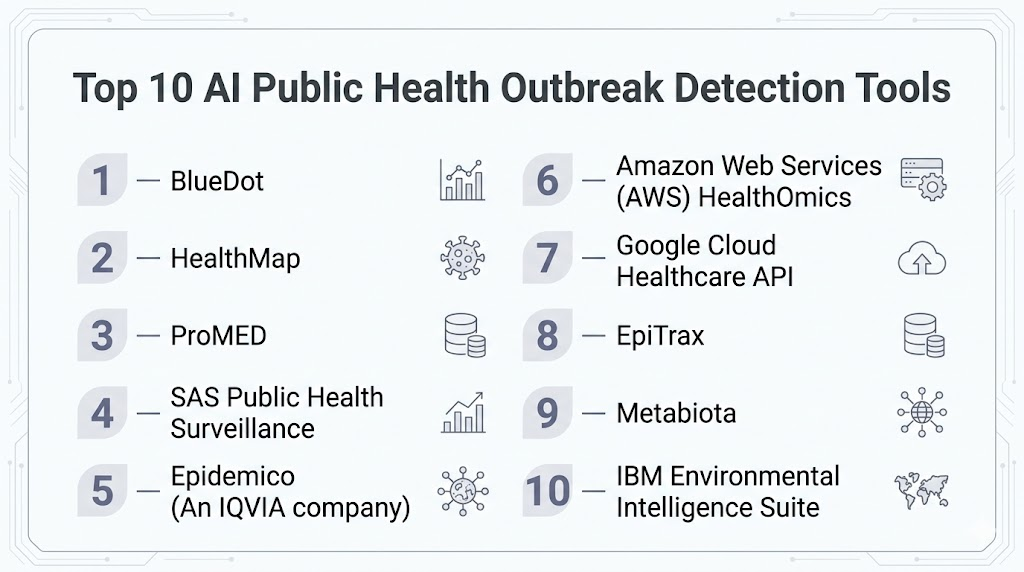
Top 10 AI Public Health Outbreak Detection Tools
#1 — BlueDot
Short description: BlueDot utilizes a highly sophisticated AI platform that combines global news monitoring, airline ticketing data, and animal disease reports to flag infectious threats. It is designed for government agencies and large corporations needing early, predictive intelligence.
Standout Capabilities
- Global detection of emerging threats using advanced natural language processing across multiple languages.
- Integration of airline passenger movement data to forecast potential transmission routes.
- Automated synthesis of animal and environmental reports to identify zoonotic risks.
- High-precision geographic mapping that pinpoints emerging disease hotspots globally.
- Actionable reporting frameworks designed to help health authorities initiate containment planning.
AI-Specific Depth
- Model support: Custom reasoning models specifically tuned for global disease spread forecasting.
- RAG / knowledge integration: Native connectivity with historical disease databases and verified public health registries.
- Evaluation: Continuous calibration checking model predictions against finalized global outbreak data.
- Guardrails: Structural rules blocking the inclusion of unverified or highly speculative social media rumors.
- Observability: Comprehensive tracing logs detailing how a specific threat was identified and localized.
Pros
- Unmatched capability in flagging cross-border threats based on global transit patterns.
- High signal accuracy due to advanced filtering of informal and unstructured digital data.
- Trusted by government leaders and large organizations for long-term health planning.
Cons
- Initial configuration and subscription pricing represent a significant investment scale.
- Focuses on large-scale, cross-border intelligence rather than granular local clinic syndromic monitoring.
- System reporting is optimized for agency leadership, requiring epidemiologists to interpret the broader data.
Security & Compliance
Maintains top-tier institutional security standards, including enterprise single sign-on support, granular access control, and complete data encryption.
Deployment & Platforms
- Cloud-delivered enterprise intelligence platform.
Integrations & Ecosystem
Provides API connectivity to governmental public health information systems and internal organizational databases.
Pricing Model
Custom enterprise licensing scaled by geographic scope, data volume, and organizational access tiers.
Best-Fit Scenarios
- National and international health agencies tracking global disease transmission pathways.
- Large organizations managing global workforce health and pandemic risk.
- Government departments requiring high-level predictive intelligence for long-term health planning.
#2 — HealthMap
Short description: HealthMap acts as a pioneer in digital syndromic surveillance, aggregating information from a wide variety of informal and formal data sources. It is designed to provide public health officials with a near real-time overview of global disease activity.
Standout Capabilities
- Automated aggregation of information from global news, official reports, and social media.
- Intuitive, interactive visual mapping of outbreaks across geographic regions.
- Syndromic surveillance tracking that identifies clusters of specific symptom reports.
- Historical disease modeling providing context for interpreting new outbreak signals.
- Publicly accessible data frameworks that foster open collaboration among researchers.
AI-Specific Depth
- Model support: Machine learning engines optimized for massive aggregation and cluster detection.
- RAG / knowledge integration: Native connections to established public health disease classifications.
- Evaluation: Ongoing data loops validating detected clusters against finalized health reports.
- Guardrails: Internal validation walls that filter out duplicative or highly speculative report sources.
- Observability: Clear, simple status indicators detailing detection confidence and source volume.
Pros
- Highly effective at capturing early, informal mentions of illness before official channels.
- Provides a transparent, accessible data environment for global health research collaboration.
- Offers excellent context by placing new alerts against historical outbreak records.
Cons
- Requires human epidemiology teams to verify the credibility of informal data sources.
- Less optimized for managing localized, closed-network hospital syndrome monitoring.
- Feature sets prioritize wide-scale global visibility over micro-level neighborhood surveillance.
Security & Compliance
Adheres to established data protection guidelines for international and open-source public health research.
Deployment & Platforms
- Cloud-native web-based intelligence portal.
Integrations & Ecosystem
Supports various research data formats for export into specialized epidemiological modeling environments.
Pricing Model
Available as an open-access resource, with specialized support and custom integration options for governmental agency users.
Best-Fit Scenarios
- Global research institutions and public health agencies fostering collaborative surveillance.
- Analysts needing broad, informal global data aggregates to supplement official reports.
- Researchers and planners prioritizing data accessibility for cross-agency collaborative modeling.
#3 — ProMED
Short description: ProMED functions as a hybrid system where AI-driven automated scanning meets human expert verification. It excels at identifying localized disease events, from zoonotic threats to rare pathogens, by providing verified, contextualized reporting to the global health community.
Standout Capabilities
- AI-automated scanning of thousands of digital sources to detect potential health events.
- Expert human moderator validation providing critical clinical context for all alerts.
- Highly specific, detailed reporting on rare pathogens and zoonotic diseases.
- Global communication network reaching local experts who verify and provide early on-the-ground intelligence.
- Searchable and structured archive of reported events serving as an historical surveillance library.
AI-Specific Depth
- Model support: Natural language processing frameworks designed for efficient source scanning.
- RAG / knowledge integration: Native human-in-the-loop verification pathways built into the reporting pipeline.
- Evaluation: High-trust verification cycles where expert epidemiologists finalize AI detection triggers.
- Guardrails: Strict editorial boundaries ensuring all reports meet established clinical and verification standards.
- Observability: Transparent reporting logs citing source evidence and expert moderator confirmation notes.
Pros
- High detection reliability due to essential expert human verification of all AI findings.
- Incredible reputation for reporting rare or emerging threats before mainstream awareness.
- Cultivates a massive, diverse international network of health experts for on-the-ground validation.
Cons
- Processing speed relies on human expert response cycles, which are slower than pure algorithmic detection.
- Primarily a reporting and communication intelligence engine, not a automated resource-allocation bot.
- Focuses on event reporting rather than real-time automated clinical electronic record scanning.
Security & Compliance
Operates under trusted international public health communication protocols and editorial standards.
Deployment & Platforms
- Distributed global communication and alert reporting network.
Integrations & Ecosystem
Integrates with professional health communication systems and specialized epidemiological alert portals.
Pricing Model
Operates as a community-driven, expert-managed public health information service.
Best-Fit Scenarios
- Global health professionals and experts needing early, verified reporting on infectious events.
- Organizations prioritizing expert clinical judgment to filter through raw automated detection noise.
- Researchers studying rare pathogens, zoonoses, or local disease event reports.
#4 — SAS Public Health Surveillance
Short description: SAS Public Health Surveillance offers a highly sophisticated, enterprise-ready analytical framework for local, regional, and national health departments. It excels at parsing internal electronic clinical and laboratory data streams to monitor health threats in real time.
Standout Capabilities
- Powerful syndromic surveillance parsing EHR visit logs and ED notes for symptomatic clusters.
- Integrated laboratory data monitoring providing near real-time alerts for confirmed pathogen spikes.
- High-precision geographic and demographic mapping to localize outbreaks at the neighborhood level.
- Advanced statistical modeling analyzing anomalies against specific baseline health data profiles.
- Automated reporting pipelines for government health department and regulatory compliance.
AI-Specific Depth
- Model support: Enterprise machine learning and statistical engines built for massive health data parsing.
- RAG / knowledge integration: Native synchronization with hospital record databases and laboratory information systems.
- Evaluation: Rigorous validation pathways comparing anomaly detection against established statistical baselines.
- Guardrails: Hardcoded field verification ensuring detection algorithms only operate on compliant, authorized datasets.
- Observability: Comprehensive executive reporting detailing all algorithmic alert paths and underlying data sources.
Pros
- Exceptional depth in localized monitoring by utilizing high-fidelity internal health records.
- Highly customizable analytical frameworks allowing agencies to build unique detection models.
- Trusted by government agencies for its mature data handling and compliance posture.
Cons
- Requires dedicated data scientists to calibrate detection models to specific community baselines.
- Implementation involves structured data mapping to unify varied local laboratory and hospital streams.
- Premium investment scale reflects its advanced, enterprise-grade government architecture.
Security & Compliance
Maintains absolute institutional data safety, using end-to-end encryption, absolute role-based access, and detailed audit trails.
Deployment & Platforms
- Secure, scalable enterprise analytical cloud framework.
Integrations & Ecosystem
Maintains stable data integration pathways with national and regional health department information architectures.
Pricing Model
Custom corporate and government enterprise licensing scaled to population size, data volume, and module utilization.
Best-Fit Scenarios
- National and regional health ministries needing to monitor internal lab and hospital record data.
- Organizations prioritizing deep, evidence-based localized syndromic surveillance.
- Agencies requiring sophisticated statistical modeling for regulatory reporting and long-term surveillance.
#5 — Epidemico (An IQVIA company)
Short description: Epidemico leverages a massive suite of digital health intelligence solutions to help clients track and analyze disease trends. Its approach combines population health data with social and environmental signals to provide proactive insights.
Standout Capabilities
- Advanced digital surveillance platforms monitoring social media and search traffic for health anomalies.
- Integration of clinical data streams with broader social and lifestyle metrics for deeper modeling.
- Granular demographic insights providing context on how disease transmission follows population groups.
- Predictive modeling that evaluates the impact of health events on community health resource needs.
- Highly accessible reporting interfaces that deliver predictive insights to non-technical stakeholders.
AI-Specific Depth
- Model support: Advanced machine learning models trained on integrated social, clinical, and search datasets.
- RAG / knowledge integration: Native connectivity with diverse data registries and health outcome datasets.
- Evaluation: Continuous predictive validation checking model outcomes against confirmed population health trends.
- Guardrails: Strict structural rules blocking data processing when jurisdictional privacy boundaries are crossed.
- Observability: Transparent administrative logging detailing algorithmic focus and key risk indicators.
Pros
- Strong ability to incorporate informal, population-scale data into traditional health intelligence.
- Highly approachable interfaces allow leaders to grasp predictive risk trends without data expertise.
- Scalable framework fits the requirements of both corporate and government-scale projects.
Cons
- Requires structured onboarding coordination to map data sources correctly to predictive objectives.
- Investment tiers reflect a focus on corporate, commercial-grade intelligence architectures.
- Custom modeling efforts require disciplined collaboration between IQVIA data teams and agency staff.
Security & Compliance
Adheres to strict international health privacy and corporate intelligence standards, including complete audit logging and encrypted data handling.
Deployment & Platforms
- Scalable cloud-delivered enterprise analytical intelligence platform.
Integrations & Ecosystem
Integrates with professional government and corporate health data frameworks via custom API pathways.
Pricing Model
Custom enterprise contracts tailored to organization scope, data intelligence needs, and transaction scale.
Best-Fit Scenarios
- Organizations seeking a broad predictive view that merges social, behavioral, and clinical data.
- Health leaders needing proactive population health impact modeling.
- Agencies and firms prioritizing clear, non-technical predictive reporting dashboards.
#6 — Amazon Web Services (AWS) HealthOmics
Short description: AWS HealthOmics provides an enterprise-ready analytical and processing backbone for large-scale public health genomic surveillance. It allows health agencies to ingest and analyze massive genomic and clinical datasets to detect pathogen evolution in real time.
Standout Capabilities
- Massive genomic data storage and automated processing at large, population-level scales.
- Integration of viral sequence and clinical clinical databases to map pathogen variants.
- Highly parallelized computing pipelines for rapid, large-scale pathogen sequence analysis.
- Secure, compliant frameworks for managing highly sensitive genomic data and patient outcomes.
- Flexible data storage architectures for maintaining historical pathogen sequence libraries.
AI-Specific Depth
- Model support: Parallelized machine learning engines optimized for high-velocity genomic sequence identification.
- RAG / knowledge integration: Direct connectivity with genomic reference databases and pathogen variant registries.
- Evaluation: Rigorous validation checking of sequence identification outputs against known variant benchmarks.
- Guardrails: Strict compliance layers isolating genomic identification pipelines from patient identification fields.
- Observability: Comprehensive administrative logs tracking genomic pipeline performance and compute resource utilization.
Pros
- Unmatched processing throughput for large-scale, population-level genomic pathogen tracking.
- Integrates flawlessly into existing large-scale cloud data and analytics architectures.
- High-grade security architecture designed to meet the strictest government health requirements.
Cons
- Requires a sophisticated data science and bioinformatic engineering team to maximize platform potential.
- Platform focus is on processing high-velocity data, not managing epidemiological alert communication lines.
- Pricing structures require careful management of massive-scale compute and storage variables.
Security & Compliance
Features absolute institutional-grade security, including end-to-end encryption, granular audit logs, and complete data governance tools.
Deployment & Platforms
- Scalable cloud-native genomic analytical compute framework.
Integrations & Ecosystem
Deeply integrated within the broader AWS enterprise cloud analytical and storage ecosystem.
Pricing Model
Usage-based storage and compute pricing scaled to massive genomic processing loads.
Best-Fit Scenarios
- National public health agencies and genomic centers tracking emerging pathogen variants.
- Large research groups and health networks needing parallel genomic processing pipelines.
- Organizations requiring secure, cloud-native storage and compute for high-velocity health data.
#7 — Google Cloud Healthcare API
Short description: Google Cloud provides a highly scalable, secure, and interoperable data management backbone for public health agencies. It excels at normalizing massive volumes of clinical, laboratory, and observational health data for analytical surveillance.
Standout Capabilities
- Intelligent normalization of diverse, high-volume health data standards like HL7 and FHIR.
- Powerful, scalable analytical and machine learning pipelines for predictive surveillance modeling.
- Secure, compliant frameworks enabling multi-party health data research and collaboration.
- Fast, high-throughput search and storage capabilities for massive national health datasets.
- Seamless integration with advanced cloud analytical AI tools for disease mapping and prediction.
AI-Specific Depth
- Model support: Scalable machine learning and predictive modeling engines optimized for health data patterns.
- RAG / knowledge integration: Native indexing capabilities for standard diagnostic and clinical terminology datasets.
- Evaluation: Automated model validation checks against historical health outcome baselines.
- Guardrails: Integrated field verification boundaries ensuring data remains compliant with health privacy regulations.
- Observability: Granular performance logging detailing computational throughput, analytical focus, and resource use.
Pros
- Exceptional, industry-leading data normalization capacity for massive multi-stream datasets.
- Seamlessly connects with global cloud-native analytical tools for sophisticated outbreak forecasting.
- Highly stable infrastructure trusted by massive international health information networks.
Cons
- Requires significant data engineering talent to maximize the platform analytical and predictive utility.
- The platform focus is on providing a secure data foundation, not pre-packaged disease detection algorithms.
- Enterprise implementation involves mapping and coordinating extensive data governance structures.
Security & Compliance
Adheres to top-tier international safety regulations, providing full encryption, role-based access fields, and complete audit tracking.
Deployment & Platforms
- Scalable cloud-native health data analytical management framework.
Integrations & Ecosystem
Maintains extensive, stable API data connectivity across global health IT landscapes.
Pricing Model
Usage-based storage and analytical compute pricing scaled to massive institutional data footprints.
Best-Fit Scenarios
- National health departments requiring a secure, interoperable backbone for massive clinical data pools.
- Organizations needing a flexible foundation to build custom, highly accurate predictive surveillance models.
- Teams prioritizing cloud-native scalability and deep analytical integration pathways.
#8 — EpiTrax
Short description: EpiTrax provides a dedicated, highly customizable disease surveillance and investigation platform designed for state and regional health departments. It is engineered to streamline the entire infectious disease investigation lifecycle, from initial case identification to resolution.
Standout Capabilities
- Integrated electronic case reporting workflow capturing patient details from clinical systems.
- Customizable outbreak investigation modules adaptable to varied disease report types.
- Automated workflow triggers that move case investigations through pre-configured resolution stages.
- Real-time dashboard visibility into active case counts, investigation statuses, and facility clusters.
- Secure communication and messaging pathways for departmental health staff and clinicians.
AI-Specific Depth
- Model support: Deterministic case identification and investigation management frameworks.
- RAG / knowledge integration: Direct lookups referencing internal patient registries and case status rules.
- Evaluation: Systematic investigation performance tracking mapping case identification to successful resolution.
- Guardrails: Internal validation boundaries preventing the generation of incomplete or unauthorized case reports.
- Observability: Simple, effective administrative logging tracking case update histories and staff touches.
Pros
- Unmatched, highly localized customization for varied regional and state-level case reporting workflows.
- Highly effective at managing the operational mechanics of infectious disease investigation and contact tracking.
- Proven track record in supporting governmental public health teams during active outbreak responses.
Cons
- Primarily an operational case-management tool, less focused on algorithmic, high-velocity digital infoveillance.
- Interface layouts prioritize data entry and investigation management, which can feel less responsive than new AI portals.
- Implementation timelines involve focused administrative effort to align investigation stages.
Security & Compliance
Maintains essential institutional data privacy and governmental health communication mandates.
Deployment & Platforms
- Scalable regional-tier investigation management cloud framework.
Integrations & Ecosystem
Connects with standardized state and federal public health surveillance reporting pathways.
Pricing Model
Custom government contracting and subscription-based licensing tailored to agency scope and population footprint.
Best-Fit Scenarios
- Regional health departments needing a mature framework to manage the full infectious case-investigation lifecycle.
- Agencies requiring high-fidelity regional monitoring and localized case-outbreak resolution.
- Teams prioritizing proven government-ready reliability over complex algorithmic infoveillance signals.
#9 — Metabiota
Short description: Metabiota delivers advanced epidemiological intelligence and predictive modeling, focusing on the financial and health risks posed by infectious outbreaks. It helps organizations assess the impact of disease threats on population health and business operations.
Standout Capabilities
- Advanced epidemiological modeling predicting the spread of infectious threats across global networks.
- Financial impact assessment tools calculating the organizational or population health costs of potential outbreaks.
- Integrated risk intelligence helping decision-makers prioritize containment resources.
- Comprehensive libraries of pathogen characteristic data and historical pandemic analysis.
- High-precision situational awareness dashboards delivering predictive risk intelligence to leaders.
AI-Specific Depth
- Model support: Machine learning engines trained on predictive epidemic growth modeling and risk impact analysis.
- RAG / knowledge integration: Native connectivity with diverse pathogen data banks and global health trend registries.
- Evaluation: Continuous validation checks measuring epidemiological predictions against realized infection trajectories.
- Guardrails: Internal validation walls filtering data input against authorized population and environmental parameters.
- Observability: High-level executive reporting charting predictive outbreak pathways, risk impacts, and response resource targets.
Pros
- Exceptional capacity in forecasting the human and financial scale of infectious threats.
- Highly effective at organizing and prioritizing operational resources around predictive risk maps.
- Proven expertise in helping large organizations manage long-term pandemic risk and resilience.
Cons
- Focuses on high-level predictive modeling and economic risk, rather than local-scale hospital record surveillance.
- Custom modeling projects require collaboration between specialized data scientists and agency staff.
- Financial commitment structures align with enterprise-scale corporate and government risk forecasting.
Security & Compliance
Adheres to international health and corporate risk intelligence standards, featuring secure transmission tunnels and audit tracking.
Deployment & Platforms
- Cloud-delivered enterprise analytical intelligence platform.
Integrations & Ecosystem
Connects with professional epidemiological data sources and global health registries via specialized analytical pipelines.
Pricing Model
Custom enterprise contracts tailored to organization scope, risk-intelligence requirements, and data analysis needs.
Best-Fit Scenarios
- Large government agencies and multinational corporations forecasting pandemic-related health and financial threats.
- Organizations needing deep predictive insights on how infectious threats impact operational stability.
- Health leaders prioritizing strategic risk management and long-term pandemic resilience.
#10 — IBM Environmental Intelligence Suite
Short description: IBM’s Environmental Intelligence Suite leverages advanced AI to understand the climate and environmental drivers of infectious diseases. It focuses on the intersection of weather patterns, vector population shifts, and public health risk forecasting.
Standout Capabilities
- High-precision integration of weather and climate datasets with potential disease vector risk maps.
- Predictive modeling that monitors environmental factors, such as flood risk and temperature shifts, to forecast vector-borne disease increases.
- Visual dashboards providing actionable alerts for regions susceptible to heightened environmental disease risk.
- Scalable ingestion of massive geospatial and environmental monitoring data streams.
- Proactive planning insights allowing local authorities to target environmental and educational interventions early.
AI-Specific Depth
- Model support: Complex machine learning frameworks optimized for environmental, geospatial, and vector-borne predictive modeling.
- RAG / knowledge integration: Direct connectivity with global climate monitoring networks and pathogen risk registries.
- Evaluation: Regular calibration cycles matching predictive risk maps against reported environmental disease incidence.
- Guardrails: Internal data walls isolating predictive logic from identifiable patient health records.
- Observability: Comprehensive administrative dashboards detailing predictive modeling pathways and environmental indicator risks.
Pros
- Outstanding capacity in identifying environmental precursors to regional vector-borne disease threats.
- Integrates flawlessly into large-scale cloud analytical data landscapes.
- Provides clear, location-based intelligence that allows for targeted environmental public health responses.
Cons
- Requires focused expertise to interpret and map complex climate variables to community-level disease alerts.
- Primary function is predictive environmental modeling, not automated real-time syndromic hospital record scanning.
- Enterprise implementation involves significant coordination across environmental and health data teams.
Security & Compliance
Adheres to rigorous institutional and enterprise security guidelines, offering robust encryption and data protection tools.
Deployment & Platforms
- Scalable, cloud-native enterprise intelligence framework.
Integrations & Ecosystem
Features stable, stable data connectivity with professional meteorological and large-scale analytical cloud architectures.
Pricing Model
Enterprise usage-based compute and software licensing models tailored to the geographic scope of surveillance.
Best-Fit Scenarios
- Health departments monitoring climate-driven disease risks such as dengue, malaria, or localized environmental hazards.
- Organizations prioritizing predictive environmental planning to target community-level public health responses.
- Agencies requiring integration of climate and epidemiological data to build early warning health systems.
Comparison Table
| Tool Name | Best For | Deployment | Model Flexibility | Strength | Watch-Out | Public Rating |
|---|---|---|---|---|---|---|
| BlueDot | Global cross-border threat tracking | Cloud-Native | Predictive Global AI | Airline transit integration | Requires expert interpretation | N/A |
| HealthMap | Open-source informal aggregation | Cloud-Native | Aggregation ML | Broad early-whisper detection | Requires human verification | N/A |
| ProMED | Expert-verified disease alerts | Network | Human-in-the-loop AI | High-trust, expert validation | Human-bound report speed | N/A |
| SAS Public Health | Localized ED syndromic parsing | Enterprise Cloud | Enterprise Statistical Models | Deep internal lab integration | Needs data science setup | N/A |
| Epidemico | Population health intelligence | Cloud-Native | Behavioral/Social AI | Merges social and clinical data | Custom setup required | N/A |
| AWS HealthOmics | Population-level pathogen genomics | Cloud-Native | Parallel Processing AI | Massive genomic throughput | Needs bioinformatics expertise | N/A |
| Google Healthcare | Data normalization backbone | Enterprise Cloud | Predictive Analytical AI | Industry-leading data scale | Foundation, not plug-and-play | N/A |
| EpiTrax | Regional case investigation | Cloud-Native | Investigation Workflow AI | Localized case reporting precision | Not for algorithmic surveillance | N/A |
| Metabiota | Economic and disease risk forecasting | Cloud-Native | Predictive Modeling AI | Pathogen financial impact focus | Less local-scale clinical monitoring | N/A |
| IBM Env. Intel. | Climate-driven disease prediction | Enterprise Cloud | Geospatial/Environmental AI | Environmental hazard alerting | Expert setup for climate modeling | N/A |
Scoring & Evaluation (Transparent Rubric)
| Tool | Core Features (20%) | Reliability/Eval (15%) | Guardrails (10%) | Integrations (15%) | Ease of Use (10%) | Perf/Cost (15%) | Security/Admin (10%) | Support (5%) | Weighted Total |
|---|---|---|---|---|---|---|---|---|---|
| BlueDot | 10 | 9 | 9 | 9 | 8 | 8 | 10 | 9 | 9.05 |
| HealthMap | 8 | 8 | 8 | 8 | 9 | 10 | 8 | 8 | 8.40 |
| ProMED | 7 | 10 | 9 | 7 | 8 | 10 | 9 | 8 | 8.40 |
| SAS Public | 9 | 9 | 9 | 9 | 7 | 7 | 10 | 9 | 8.70 |
| Epidemico | 8 | 8 | 8 | 8 | 8 | 8 | 8 | 8 | 8.00 |
| AWS Omics | 9 | 9 | 9 | 9 | 6 | 7 | 10 | 8 | 8.40 |
| Google Cloud | 9 | 9 | 9 | 10 | 7 | 8 | 10 | 9 | 9.00 |
| EpiTrax | 8 | 8 | 8 | 8 | 8 | 9 | 9 | 8 | 8.20 |
| Metabiota | 9 | 9 | 8 | 8 | 7 | 7 | 9 | 8 | 8.15 |
| IBM Env | 9 | 8 | 8 | 8 | 7 | 7 | 9 | 8 | 8.05 |
Top 3 for Enterprise
- BlueDot
- Google Cloud Healthcare API
- SAS Public Health Surveillance
Top 3 for SMB/Regional
- HealthMap
- ProMED
- EpiTrax
Top 3 for Developers/Research
- Google Cloud Healthcare API
- AWS HealthOmics
- HealthMap
Which AI Outbreak Detection Tool Is Right for You
Global/National Health Agency
For massive organizations monitoring threats across international borders, prioritize tools that integrate airline movement, global news scanning, and predictive zoonotic patterns. BlueDot or Google Cloud Healthcare API are standard-bearers here, providing the scalability, analytical backbone, and global data ingestion pathways needed to maintain an early-warning horizon.
Regional/State Health Department
Regional agencies tracking localized hospital syndromes or specific neighborhood outbreaks must prioritize native connectivity with internal laboratory systems and EHR databases. SAS Public Health Surveillance or EpiTrax are ideal choices, offering deep localized monitoring precision, workflow investigation management, and regulatory reporting readiness that global-scale tools often lack.
Research/Academic Institution
Institutions prioritizing global knowledge sharing, pathogen genomic discovery, or collaborative modeling require open-access pathways and powerful compute backbones. HealthMap, ProMED, or AWS HealthOmics serve these teams best, providing either the historical library and open-data access needed for research or the high-velocity genomic compute required to map emerging pathogen variants.
Regulated Industries
For government entities operating under strict intelligence classification or high-sensitivity data protocols, absolute traceability and data-residency control are essential. Choose solutions capable of providing validated private-cloud tenant architectures or hybrid on-premise components that ensure no sensitive population health intelligence leaves protected government firewalls.
Budget vs. Premium
If budget limitation is your primary driver, leverage open-access research networks and community-managed alert services. However, if your long-term goal is capturing predictive intelligence before infectious threats emerge within your population footprint, investing in a premium, enterprise-grade cloud analytical backbone provides a higher structural return on public health safety.
Build vs. Buy
Building a custom disease surveillance framework using raw open-source algorithmic tools is risky given the high-stakes nature of infectious disease reporting and the complex data compliance standards involved. Purchasing an established, specialized vendor utility ensures that professional security engineering teams maintain data governance, model calibration, and alert validation pipelines, letting your public health epidemiologists concentrate entirely on response strategy.
Implementation Playbook (30 / 60 / 90 Days)
A successful deployment balances technical analytical setup with local epidemiological workflow integration. Use this tactical pipeline to guide your rollout:
30 Days: Pilot & Success Metrics
- Technical Task: Connect the surveillance analytical engine with a controlled, subset laboratory or hospital record data stream.
- AI Evaluation: Execute the detection models in shadow mode to evaluate predictive signal precision against finalized historical outbreak case counts.
- Success Metric: Verify that the system identifies localized health anomalies accurately in less than a few hours without triggering excessive false-positive alert noise.
60 Days: Harden Security, Evaluation & Rollout
- Technical Task: Enable official government-grade single sign-on parameters and establish precise role-based view controls across the responding epidemiological team.
- AI Evaluation: Configure automated alert triage nodes, ensuring that high-confidence anomaly triggers are routed immediately to the verification committee.
- Success Metric: Achieve a measurable reduction in detection-to-investigation lead times of at least twenty percent within the pilot department before scaling operations.
90 Days: Optimize Cost/Latency, Governance & Scale
- Technical Task: Expand detection coverage completely across all remaining population data registries and regional laboratory pathways.
- AI Evaluation: Execute comprehensive security red-team audits to confirm that automated surveillance data flows interact safely within protected government zones.
- Success Metric: Confirm that a high majority of target disease threats are flagged through the proactive analytical pipeline, significantly increasing early containment response capacity.
Common Mistakes & How to Avoid Them
- Ignoring Signal Noise Fatigue: Triggering alerts for every minor flu-like fluctuation, leading teams to ignore genuine threats. Always apply statistical seasonal baselines to filter alert thresholds.
- Neglecting Data Privacy Compliance: Processing population-scale health information without strict anonymization or data-residency controls. Require clear zero-data-retention and sovereign storage agreements.
- Skipping Expert Human Verification: Depending entirely on raw AI detection outputs without epidemiological human validation. Always build expert triage committee workflows into the system.
- Failing to Track Localized Outliers: Focusing exclusively on national trends while missing hyper-local neighborhood spikes. Customize localized geographic thresholds for high-resolution detection.
- Overestimating Informal Data Reliability: Assuming that social media reports are factual without verification. Treat informal data as investigative leads only, never as confirmed lab results.
- Forgetting Interoperability Gaps: Building high-speed detection models that cannot push validated alerts into legacy state reporting databases. Prioritize integration pathways from the start.
- Underestimating Staff Triage Needs: Deploying complex predictive detection models without training epidemiologists to review the logic traces behind the alerts.
- Building Proprietary Logic in Closed Formats: Storing your detection parameters and policy thresholds in a closed vendor script that prohibits data migration later.
- Neglecting Climate/Vector Baseline Changes: Forgetting that changing climate patterns alter vector disease risk maps. Regularly update your predictive model baselines for vector shifts.
- Focusing on Detection Over Containment: Building great predictive alerting systems without coordinating with vaccine or medical supply deployment teams. Integrate surveillance with supply chain action.
FAQs
1. How do AI systems detect outbreaks before official reports?
AI identifies early warning signs by parsing syndromic clinical trends, digital search traffic, wastewater signals, and mobility data, allowing it to flag anomalies days before localized testing confirms a diagnostic case.
2. Do detection models replace human epidemiologists?
No. AI platforms handle the massive, high-speed data processing needed for early detection, but expert epidemiologists provide the clinical judgment, environmental context, and verification authority required to launch public health responses.
3. How secure is sensitive population health data during monitoring?
Top-tier surveillance systems utilize absolute role-based access, end-to-end data encryption, and sovereign data storage regions, and enterprise vendors routinely provide zero-data-retention guarantees.
4. Can AI differentiate between seasonal flus and emerging threats?
Yes. Advanced analytical models compare live symptom spikes against historical seasonal baselines and vaccination records to identify statistically anomalous patterns that routine seasonal activity cannot explain.
5. What role does genomic tracking play in outbreak detection?
Genomic sequencing, processed through high-throughput cloud pipelines, allows agencies to identify pathogen variants in real time, helping to track how a virus is evolving and whether current vaccines remain effective.
6. Can these tools operate in regions with poor clinical data reporting?
Yes. By focusing on multimodal inputs like digital infoveillance, search trends, and environmental monitoring, agencies can gather early leads in regions where laboratory testing capacity is limited.
7. How does the system filter out online rumors and false alarms?
Algorithmic filtering layers cross-check informal reports against verified clinical data and historical patterns, flagging only those anomalies that demonstrate statistical significance or consistent cross-source evidence.
8. What is the standard deployment timeline for public health detection?
While a simple pilot can begin within weeks, a full enterprise-scale integration—unifying disparate state laboratories and regional health databases—typically takes months of structured data mapping.
9. Can AI predict where an outbreak will spread next?
Yes. By integrating mobility maps, airline ticketing databases, and population density data, models can forecast the most probable transit transmission routes, helping agencies stage response resources effectively.
10. Does the platform provide public health response recommendations?
Advanced enterprise systems often provide evidence-based intervention suggestions, such as targeted mobile vaccination clinic locations or early community educational campaign targets, based on risk analysis.
11. Is specialized hardware needed for surveillance modeling?
No. Most contemporary surveillance intelligence platforms are delivered as cloud-native software frameworks accessible via web portals, removing the need for massive local data-processing infrastructure.
12. What is the typical pricing framework for governmental surveillance tools?
Government agencies typically utilize custom enterprise contracts based on the geographic scale, data volume, and population footprint, often including service-level agreements for rapid support.
Conclusion
AI-powered public health outbreak detection represents a critical advancement in national health security. By turning proactive surveillance, predictive modeling, and high-speed data integration into routine investigative habits, these platforms shield global and local communities from the systemic economic and health devastation of pandemic threats.Because the optimal surveillance framework depends entirely on your target geographic scale, internal lab data quality, and existing regulatory reporting standards, avoiding one-size-fits-all software paths is essential. To build a secure, high-yield system, define your primary data silos, pilot an explainable analytical tool within a core regional team, mandate strict data sovereignty, and scale your automated surveillance pipelines across your entire public health organization.

Find Trusted Cardiac Hospitals
Compare heart hospitals by city and services — all in one place.
Explore Hospitals
One overlooked factor is data reliability and false-positive management, since outbreak detection systems are only as effective as the quality, timeliness, and validation of their incoming public health data.