
Introduction
AI Protein Design Platforms are specialized software ecosystems that use artificial intelligence, deep learning architectures, and biophysical diffusion models to predict, optimize, and generate entirely new proteins from scratch. By treating amino acid sequences as a structured biological language, these platforms allow researchers to specify a desired three-dimensional shape or molecular function and instantly generate functional biomolecules. This replaces decades of manual, trial-and-error directed evolution in the laboratory with deterministic, software-driven molecular engineering.
Why It Matters
Traditional drug discovery and industrial enzyme development are notoriously slow and expensive, often relying on screen-testing thousands of naturally occurring variants to find a single match. AI protein design platforms change this paradigm by shifting biology from a science of discovery to a science of engineering. These platforms allow developers to design highly targeted therapeutics that dock precisely with disease markers, synthesize custom enzymes to break down industrial pollutants, and engineer heat-stable proteins for sustainable manufacturing. By predicting structural viability before a single molecule is physically synthesized, these platforms slash wet lab overhead and compress development timelines from years to days.
Real-World Use Cases
- De Novo Antibody Generation: Designing custom therapeutic antibodies from scratch to bind specific viral or cancer antigens without relying on animal immunization.
- Industrial Enzyme Optimization: Engineering robust, highly stable catalytic enzymes for green chemistry applications, such as high-temperature plastics recycling and biofuel processing.
- Targeted Drug Delivery Vehicles: Creating synthetic protein nanocages and capsids capable of safely enveloping gene therapies and releasing them exclusively inside designated tissue types.
- Biosensor Development: Constructing smart, switch-like proteins that change shape or emit signals in the presence of specific environmental toxins or diagnostic biomarkers.
- Vaccine In Silico Design: Modeling and displaying complex macromolecular structures to present stable, highly immunogenic viral targets for rapid vaccine development.
Evaluation Criteria
When purchasing or deploying an AI protein design platform, technical buyers should evaluate options based on the following:
- Backbone Generation Success Rate: The platform’s accuracy in generating realistic, physically stable three-dimensional protein scaffolds that do not collapse in solution.
- Inverse Folding Precision: The capability of the model to generate the exact amino acid sequence needed to force a protein into the designed shape.
- Target Binding Affinity: Predictive accuracy in multi-mer modeling to ensure designed binders dock with the specified target surface with high chemical strength.
- In Silico Property Filtering: Built-in capability to screen out sequences with a high risk of aggregation, low solubility, or human immune system rejection.
- Compute Footprint and Scalability: The raw GPU infrastructure required to run generation cycles or the availability of high-throughput cloud APIs.
- Non-Canonical Amino Acid Support: The capacity to design proteins using synthetic, non-natural amino acids for enhanced stability and chemical variety.
- Data Isolation Guardrails: The absolute guarantee that private therapeutic targets and newly designed sequences remain entirely isolated from public training pools.
- Best for: Chief Scientific Officers CSOs, Computational Biologists, Bioprocess Engineers, and Drug Discovery Teams at biopharmaceutical enterprises, industrial biotechnology companies, and agile life science startups.
- Not ideal for: General academic research labs looking for basic structural visualizations without generation needs, or traditional clinical settings focused solely on patient diagnostics where molecular engineering is irrelevant.
What’s Changed in AI Protein Design Platforms
The paradigm of computational proteomics has shifted heavily, driven by advancements in specialized deep learning behaviors and integrated laboratory workflows.
- Diffusion-Driven Backbone Generation: Generation models have transitioned from old transformer structures to advanced biophysical diffusion models, starting with molecular noise and refining it into precise, functional protein backbones.
- Simultaneous Sequence and Structure Engineering: Modern tools have discarded multi-step design pipelines, mapping sequence generation and structural folding concurrently to increase experimental success rates.
- Robotic Wet Lab Integration: Leading platforms feature closed-loop architectures that connect software directly to automated synthesis labs, instantly testing thousands of AI designs and funneling results back to retrain the models.
- Zero-Data-Retention Security: Enterprise cloud options now enforce strict data-wiping policies post-inference, ensuring corporate biological assets never train competitor models.
- Inverse Folding Advances: Architectures leverage deep geometric networks to instantly identify the optimal arrangements of amino acids required to maintain a highly specific structural fold.
- Multi-mer Interface Optimization: Systems can dynamically model complex multi-protein interaction surfaces, allowing for the generation of multi-specific antibodies and intricate molecular machines.
- Hybrid Cloud Model Routing: To lower infrastructure overhead, tools pass routine protein validation checks to small, local models while reserving heavy multi-chain generation tasks for advanced cloud architectures.
- Token-Based Compute Metrics: Development portals feature transparent tracking screens showing infrastructure usage and token spending during massive, multi-target generation batches.
- Traceable Atomic Lineage: Visualization suites reveal step-by-step energy state tracking, allowing bioinformaticians to see exactly how individual atom paths settle during structural synthesis.
Quick Buyer Checklist Scan-Friendly
Use this checklist to quickly screen potential AI protein design platforms during initial vendor discovery:
- Data Privacy & Hosting: Does the vendor provide fully self-hosted deployment models or private, single-tenant cloud spaces to safeguard proprietary biological intellectual property?
- Design Framework Capability: Does the system support true de novo backbone design via diffusion, or is it restricted to modifying existing natural proteins?
- Ecosystem Validation Integration: Can the software interface directly with automated synthesis platforms via standard APIs to handle automated pipeline orchestration?
- In Silico Screen Tools: Does the engine include native analytics to predict critical manufacturing metrics like expression success, solubility, and thermal stability?
- Model Agnostic Flex: Can your team run open-source models alongside vendor-specific proprietary architectures inside a single interface?
- Interface Complexity: Is there a clean web workbench for bench scientists to review and alter designs, or is the environment limited to command-line developer scripts?
- Multi-Chain Scaling: Can the core layout handle the design of complex, multi-component structures like multi-mer protein complexes or full antibody architectures?
- Lock-In Mitigation: Are output files exported in standard structural formats like PDB or mmCIF to ensure compatibility with any downstream analysis pipeline?
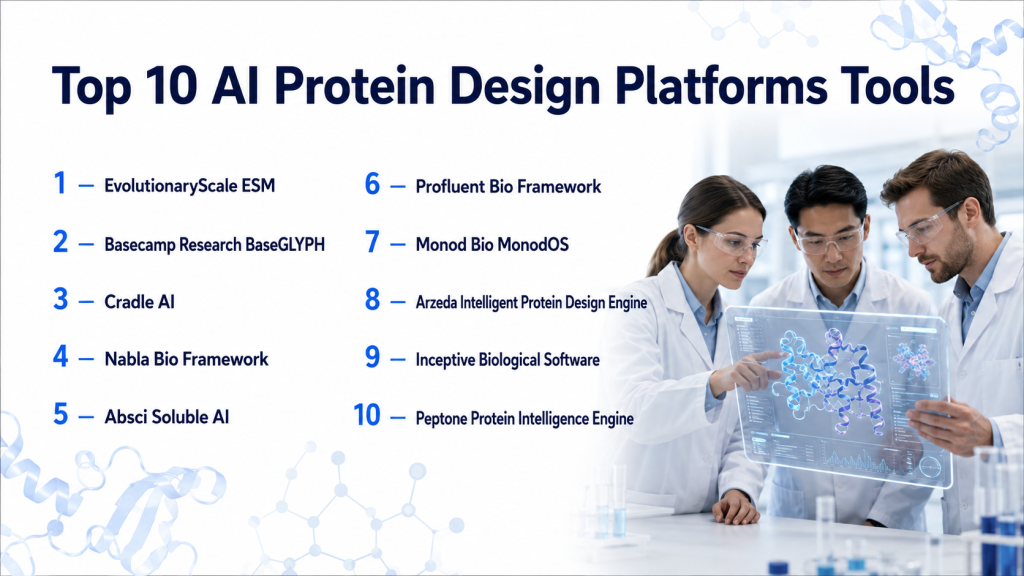
Top 10 AI Protein Design Platforms Tools
#1 — EvolutionaryScale ESM
One-line verdict: Best for enterprise teams requiring top-tier language models for high-throughput variant prediction and sequence generation.
Short description:
EvolutionaryScale ESM leverages large biological language models trained on massive code bases of natural evolutionary data. The system excels at predicting mutation effects and generating optimized sequences using natural biological context.
Standout Capabilities
- High-throughput variant effect scanning across millions of prospective sequences.
- Generative sequence modeling leveraging evolutionary likelihood metrics.
- Seamless handling of multi-property optimization landscapes for enzyme enhancement.
- Deep transformer-based structural representations without requiring structural input files.
- Direct sequence-to-function classification engines for rapid property sorting.
AI-Specific Depth
- Model support: Proprietary ESM language architectures along with secure client API integration models.
- RAG / knowledge integration: Native connectivity with extensive protein sequence databases like UniProt.
- Evaluation: Deep validation suites that cross-reference prospective sequences against natural viability boundaries.
- Guardrails: Structural constraints that block models from generating highly toxic or non-viable motif strings.
- Observability: Clear computational dashboards detailing token cost allocation and model confidence scoring.
Pros
- Exceptional speed when screening massive libraries of millions of sequence variants.
- Strong alignment with natural evolutionary pathways, minimizing expression failure risk.
- Developer-friendly design optimized for automated programmatic execution.
Cons
- Less tailored for creating completely radical, geometric shapes compared to pure diffusion tools.
- Requires substantial initial bioinformatics experience to maximize property optimization.
- Command-line heavy focus lacks graphic components for traditional laboratory staff.
Security & Compliance
Provides comprehensive workspace isolation frameworks, secure encrypted API key management, and detailed activity logging to track institutional model usage. Certifications are not publicly stated.
Deployment & Platforms
- Cloud Managed API, Private AWS/GCP Instances.
Integrations & Ecosystem
Exposes flexible RESTful developer endpoints and Python SDK packages to connect generation workflows with laboratory automation.
- AWS HealthOmics pipeline spaces
- Bioinformatics sequence tools
- Automated script runners
- Standard cloud data lake infrastructure
Pricing Model
Tiered subscription model based on API token volume combined with dedicated compute instance premiums.
Best-Fit Scenarios
- Bioprocess groups optimizing existing natural enzymes to tolerate harsher industrial operating temperatures.
- Therapeutic teams running massive screening campaigns to identify functional mutation variants of known antibodies.
- Platform developers building high-volume discovery backends requiring fast sequence generation metrics.
#2 — Basecamp Research BaseGLYPH
One-line verdict: Best for biopharma developers seeking structurally verified enzyme designs anchored by real-world biodiversity data.
Short description:
Basecamp Research pairs an extensive, legally clean global biodiversity data network with custom deep learning frameworks. The platform creates functional proteins by utilizing environmental samples that capture biological rules overlooked by public repositories.
Standout Capabilities
- Contextual generation utilizing a proprietary, unmapped global biodiversity data catalog.
- Automated functional matching that connects target parameters with unique natural survival traits.
- De novo sequence synthesis that circumvents public data licensing restrictions.
- Integrated structural prediction layers that verify stability before physical testing.
- Advanced optimization tracks built to enhance enzyme catalytic efficiency.
AI-Specific Depth
- Model support: Custom internal graph neural networks and fine-tuned geometric transformer architectures.
- RAG / knowledge integration: Direct connection to a private data lake containing billions of unmapped environmental sequences.
- Evaluation: Verification scoring that validates sequence viability against real-world sample performance models.
- Guardrails: Legal compliance validation ensuring all outputs track back to ethically gathered baseline materials.
- Observability: Visualization modules showing structural differences compared to known public protein variants.
Pros
- Access to completely novel biological spaces outside the boundaries of overused public archives.
- Clean intellectual property lineage, reducing regulatory and patent validation risks down the line.
- Excellent performance when designing proteins intended for extreme chemical environments.
Cons
- Ecosystem access requires structured strategic development partnerships rather than self-service use.
- Not intended for basic desktop research tasks without specific, commercial project targets.
- Platform scaling metrics are tied directly to proprietary, physical environmental sample capture.
Security & Compliance
Maintains strict multi-tenant data separation architectures, customer-specific encryption pipelines, and legal data tracking to satisfy international biodiversity access standards. Certifications are not publicly stated.
Deployment & Platforms
- Dedicated Cloud Tenant, Managed Co-Development Space.
Integrations & Ecosystem
Interacts via enterprise integration frameworks and secure programmatic APIs designed to deliver verified structure libraries.
- Proprietary laboratory execution networks
- Enterprise database storage sites
- Downstream structural analysis tools
- Corporate laboratory data management applications
Pricing Model
Custom commercial enterprise agreements structured around milestone targets, operational usage tiers, or project development scope.
Best-Fit Scenarios
- Chemical manufacturing enterprises seeking novel enzymes to execute complex, low-temperature plastic breakdown.
- Therapeutic startups trying to discover functional protein scaffolds that dodge existing competitor patent claims.
- Agricultural technology groups seeking unique protein variations to protect commercial crops from changing weather patterns.
#3 — Cradle AI
One-line verdict: Best for traditional wet lab teams seeking an intuitive web workbench to optimize protein properties without coding.
Short description:
Cradle AI delivers a user-friendly, web-native software workbench built to guide laboratory scientists through generative optimization tasks. It translates complex deep learning models into accessible visual workflows to enhance structural stability and expression success.
Standout Capabilities
- Visual parameter balancing that lets scientists optimize multiple properties like temperature stability and activity simultaneously.
- Generative sequence alteration menus that suggest clear, effective point mutations.
- Integrated machine learning layers that analyze physical lab assay files to refine future suggestions.
- Automated plate-layout generators that simplify the transition from design screens to physical lab synthesis.
- Clear multi-property scoring grids that rank candidate designs by overall manufacturing viability.
AI-Specific Depth
- Model support: Managed multi-model backend orchestrating proprietary language models alongside public code bases.
- RAG / knowledge integration: Streamlined ingestion loaders built to import local, proprietary historical assay spreadsheets.
- Evaluation: Continuous accuracy feedback loops that retrain active workspace models based on new lab validation inputs.
- Guardrails: Synthesis constraint parameters that block layouts that are physically impossible for lab vendors to print.
- Observability: Intuitive mutation charts showing exactly how each suggested change influences target properties.
Pros
- Outstanding user experience requiring absolutely zero data engineering or software coding skills.
- Fast configuration models that turn raw baseline files into actionable mutation lists inside an afternoon.
- Direct loop design that adapts and learns from physical laboratory failures systematically.
Cons
- Less optimized for building monumental, completely de novo macromolecular complexes from scratch.
- Requires consistent, structural lab assay data uploads to maximize internal iteration value.
- Customizing the deeper machine learning code settings is restricted to maintain interface stability.
Security & Compliance
Features secure user account permission toggles, corporate Single Sign-On integration options, and isolated customer dataset sandboxes that prevent cross-contamination. Certifications are not publicly stated.
Deployment & Platforms
- Cloud Managed SaaS.
Integrations & Ecosystem
Provides simple file-based ingest frameworks alongside direct connections to popular commercial synthesis vendors.
- Twist Bioscience / IDT sequence ordering links
- Standard laboratory information management systems LIMS
- Excel and CSV sequence table processors
- Structural visualization file targets
Pricing Model
Tiered monthly user seat subscriptions scaling into usage-based generation volume frameworks.
Best-Fit Scenarios
- Laboratory enzyme development teams wanting to accelerate validation loops without hiring dedicated data engineers.
- Biotech companies optimizing therapeutic protein expression yields inside standard bacterial hosts.
- Consumer health development teams engineering stable, skin-compatible protein additives for topical formulas.
#4 — Nabla Bio Framework
One-line verdict: Best for specialized antibody engineering squads needing to generate complex, multi-specific therapeutic candidates.
Short description:
Nabla Bio focuses squarely on the therapeutic antibody market, blending advanced generative language architectures with high-throughput assay screening to design multi-specific binders that lock onto complex disease targets.
Standout Capabilities
- De novo loop architecture modeling engineered specifically to build custom antibody variable sections.
- Automated multi-property optimization designed to balance target binding strength with low developability risk.
- In silico classification screening built to verify that generated antibodies do not cause human immune reactions.
- Simultaneous modeling of multi-target interface geometries for complex bi-specific antibody tracks.
- Deep language representations that capture structural framework parameters with high fidelity.
AI-Specific Depth
- Model support: Proprietary antibody-specific language architectures and structural generation models.
- RAG / knowledge integration: Structural databases tracking validated antibody-antigen interaction coordinates.
- Evaluation: Predictive scoring models checking therapeutic solubility, aggregation propensity, and production yield metrics.
- Guardrails: Structural framework blocks that keep generated sequences aligned with stable human antibody layouts.
- Observability: Clear visual alignment dashboards mapping binding contacts against target structural nodes.
Pros
- Highly specialized functionality optimized for therapeutic antibody engineering challenges.
- Strong track record of producing designs that combine tight binding affinity with excellent production yields.
- Reduces reliance on lengthy animal screening or phage display testing frameworks.
Cons
- Ecosystem focus is highly narrow, making it less suitable for teams building non-antibody industrial enzymes.
- Demands access to structural data regarding the target disease antigen to execute generation.
- Access parameters are typically structured around enterprise therapeutic development partnerships.
Security & Compliance
Provides isolated data workspace architecture, comprehensive user access trail logs, and advanced cloud storage encryption built for proprietary pharmaceutical discovery pipelines. Certifications are not publicly stated.
Deployment & Platforms
- Cloud Native Workspace, Secure Dedicated Clouds.
Integrations & Ecosystem
Interfaces via modern secure web pipelines and automated cloud data loaders to synchronize structures with internal assay systems.
- Enterprise drug discovery architectures
- Automated chemical screening arrays
- Molecular modeling software packages
- Private corporate sequence repositories
Pricing Model
Custom corporate pricing models based on development targets, platform transaction depth, or discovery milestone options.
Best-Fit Scenarios
- Oncology drug development teams designing multi-specific antibodies to cross the blood-brain barrier.
- Pharmaceutical discovery groups seeking to optimize the structural stability of delicate antibody candidates.
- Immunotherapy researchers generating completely de novo binder proteins to block unique viral surface sites.
#5 — Absci Soluble AI
One-line verdict: Best for biopharma operations seeking to de-risk manufacturing early by co-designing antibody function and cell solubility.
Short description:
Absci combines generative deep learning layers with an ultra-high-throughput wet lab facility. The platform focuses on designing custom antibody therapeutics while predicting and optimizing cell expression efficiency inside target manufacturing hosts simultaneously.
Standout Capabilities
- Simultaneous engineering of target affinity metrics and overall cell production yield properties.
- Generative antibody design cycles that produce thousands of candidate sequences in parallel.
- Direct processing loops that evaluate and correct structural developability risks before physical synthesis.
- Integrated screening engines that assess mammalian cell line compatibility during generation.
- Automated property balancing workflows that minimize the need for downstream protein refinement.
AI-Specific Depth
- Model support: Custom generative models trained on massive, proprietary datasets linking sequence choice to actual cell expression.
- RAG / knowledge integration: Private data vaults detailing billions of real-world biological binding measurements.
- Evaluation: Advanced machine learning screens that predict production solubility and purification metrics instantly.
- Guardrails: Structural checks that drop sequence designs that cause host cell toxicity during processing.
- Observability: Unified analytics panels charting affinity milestones alongside predicted manufacturing costs.
Pros
- Drastically reduces the risk of designing an exceptional binder that is impossible to manufacture at scale.
- Very fast transition timelines from initial target definition to validated physical sample delivery.
- Excellent data fidelity driven by extensive, automated internal physical screening assets.
Cons
- Maintains a heavy focus on biopharmaceutical applications, offering little utility for industrial biomaterial creation.
- Requires substantial initial capital deployment models suited for enterprise discovery tracks.
- Development pipelines are tied to close collaboration with the platform provider’s central technical facilities.
Security & Compliance
Maintains strict physical and digital data isolation barriers, enterprise identity management compatibility, and comprehensive asset logging frameworks optimized for major pharmaceutical development compliance. Certifications are not publicly stated.
Deployment & Platforms
- Managed Cloud Service, Co-Development Laboratory Pipeline.
Integrations & Ecosystem
Communicates through enterprise data pipelines and secure cloud networks to update internal discovery platforms.
- Corporate laboratory tracking networks
- High-throughput screening storage targets
- Downstream therapeutic testing loops
- Proprietary data synchronization applications
Pricing Model
Custom enterprise discovery licensing structures encompassing programmatic access scales, milestone allocations, or therapeutic development parameters.
Best-Fit Scenarios
- Pharmaceutical brands needing to accelerate drug discovery phases while guaranteeing high manufacturing yields.
- Biotech teams seeking to optimize delicate antibody fragments that traditionally suffer from poor cell solubility.
- Clinical research ventures looking to design and test hundreds of target antibody sequences across short cycles.
#6 — Profluent Bio Framework
One-line verdict: Best for gene-editing tool developers seeking completely novel, programmable CRISPR systems designed from scratch.
Short description:
Profluent Bio applies deep generative language modeling to the field of programmable genetic medicine. The platform acts as an advanced text generator for biology, synthesizing completely functional, de novo gene-editing enzymes that operate outside natural constraints.
Standout Capabilities
- Generative design of complex functional enzymes like custom Cas9 variants from scratch.
- Deep sequence optimization focused on expanding target cutting precision while minimizing off-target risks.
- Structural layout engineering that allows gene-editing tools to fit inside standard viral delivery vectors.
- High-throughput language screening that verifies enzymatic activity across diverse synthetic variations.
- Automated property tuning built to adjust enzyme operational preferences like optimal pH limits.
AI-Specific Depth
- Model support: Custom internal transformer language models optimized to interpret complex, functional genomic structures.
- RAG / knowledge integration: Contextual links to global genomic repositories and proprietary enzymatic function charts.
- Evaluation: In silico simulation arrays tracking structural cutting mechanics and alignment accuracy.
- Guardrails: Policy constraint frameworks that block the generation of dangerous biological sequences or prohibited motifs.
- Observability: Sequence divergence maps showing how closely a synthetic enzyme aligns with known natural biological components.
Pros
- Enables the creation of highly precise gene-editing tools that do not rely on natural evolutionary quirks.
- Helps developers bypass complex patent landscapes by constructing entirely new enzymatic architectures.
- Excellent optimization tracking for minimizing dangerous off-target genomic cleavage events.
Cons
- Platform optimization is highly targeted toward genetic medicine, offering little value for basic structural biochemistry.
- Demands extensive downstream genomic verification workflows to validate functional cutting safety.
- Access parameters require structured co-development agreements designed for clinical-tier programs.
Security & Compliance
Implements rigorous security isolation frameworks, detailed administrative credential tracking, and strict system access logging designed to meet international gene-editing safety guidelines. Certifications are not publicly stated.
Deployment & Platforms
- Private Secure Cloud, Managed Co-Development Environments.
Integrations & Ecosystem
Interfaces via encrypted cloud web conduits and specialized genomic data loaders to coordinate with research pipelines.
- Next-generation sequencing NGS data engines
- Genomic visualization frameworks
- Private molecular research networks
- Automated synthesis platform links
Pricing Model
Custom enterprise structures custom-tailored to overall development scope, therapeutic areas, or regulatory framework parameters.
Best-Fit Scenarios
- Gene therapy developers building novel CRISPR systems to correct rare genetic disorders with minimal off-target risks.
- Biotechnology research brands needing to engineer unique genetic editing mechanisms that avoid competitor patent locks.
- Advanced clinical ventures seeking to shrink gene-editing components into small, package-ready vector layouts.
#7 — Monod Bio MonodOS
One-line verdict: Best for diagnostic developers needing to design highly sensitive, modular protein biosensors that change shape.
Short description:
MonodOS is an AI-driven environment configured to engineer dynamic, switch-like proteins. These custom biosensors change their physical shape in the presence of specific targets, enabling ultra-fast, lab-grade diagnostic readings without processing equipment.
Standout Capabilities
- Generative design of multi-state protein switches that transition shape when locking onto targets.
- De novo engineering of highly stable luminescent or chemical signaling components.
- Automated sequence synthesis to establish clear, distinct lock-and-key target interfaces.
- Advanced property matching focused on maximizing biosensor shelf-life and thermal endurance.
- In silico testing layouts designed to verify signal output strength inside variable liquid samples.
AI-Specific Depth
- Model support: Specialized geometric models and fine-tuned biophysical diffusion networks optimized for multi-state setups.
- RAG / knowledge integration: Direct connection to structural reference maps for validated small-molecule binding domains.
- Evaluation: Complex simulation testing that scores the energetic stability of both the open and closed protein states.
- Guardrails: Structural filter checks that prevent the design of floppy loops prone to accidental trigger actions.
- Observability: Phase-change animation maps detailing the exact moving paths of protein components during target binding.
Pros
- Unrivaled capabilities for engineering dynamic, moving protein machines rather than rigid structural binders.
- Produces highly reliable diagnostic components that operate effectively outside traditional laboratory freezers.
- Drastically reduces the timeline needed to establish new test assays for emergent infectious threats.
Cons
- Not intended for basic therapeutic antibody generation or traditional large-scale industrial enzyme pipelines.
- Requires deep structural understanding of the target molecule’s physical docking options.
- The underlying multi-state design models require longer processing runtimes than simple single-state generation.
Security & Compliance
Enforces multi-layer tenant separation frameworks, secure user configuration access tracking, and robust data isolation protocols suited for commercial medical diagnostic research. Certifications are not publicly stated.
Deployment & Platforms
- Cloud Managed Workspaces, Dedicated Cloud instances.
Integrations & Ecosystem
Communicates through standard REST web services and clear data loaders to feed design specifications to production systems.
- Diagnostic manufacturing deployment tools
- Standard laboratory info catalogs
- Assay reading equipment software
- Private structural dataset engines
Pricing Model
Tiered development subscription models paired with project-specific commercial manufacturing milestone agreements.
Best-Fit Scenarios
- Medical device developers constructing point-of-care test strips to identify infectious pathogens instantly without electricity.
- Environmental safety teams creating custom biological sensors to flag toxic water chemical metrics in real time.
- Industrial process controllers needing in-line protein tracking tools to monitor continuous fermentation balance.
#8 — Arzeda Intelligent Protein Design Engine
One-line verdict: Best for chemical companies needing to replace petrochemical processing with custom, high-throughput industrial enzymes.
Short description:
Arzeda combines advanced computational physics with generative deep learning to design functional, high-scale industrial enzymes. The platform focuses on constructing efficient metabolic pathways to synthesize chemicals cleanly, replacing traditional fossil fuel processing.
Standout Capabilities
- De novo enzyme catalytic core generation designed to execute non-natural chemical reactions.
- Automated pathway synthesis that organizes multi-step enzymatic cascades inside a single production host.
- Advanced structural engineering focused on ensuring high operational yields inside industrial fermentation tanks.
- Automated mutation scripts built to retrofit standard natural enzymes for non-native substrates.
- Comprehensive stability testing screens verifying enzyme performance across extreme pH or temperature environments.
AI-Specific Depth
- Model support: Hybrid execution architecture blending traditional biophysical physics calculations with generative deep neural loops.
- RAG / knowledge integration: Direct access to global chemical transition state frameworks and metabolic database layouts.
- Evaluation: Energetic stress-testing arrays checking transition-state binding forces inside the virtual catalytic pocket.
- Guardrails: Metabolic safety filters that block the generation of enzymes that produce hazardous or restricted chemical byproducts.
- Observability: Detailed chemical interaction diagrams showing exactly how target molecules transform inside the enzyme core.
Pros
- Exceptional accuracy when designing for completely non-natural chemical transition targets.
- Proven ability to scale designs from software concepts into multi-ton industrial chemical production operations.
- Significantly lowers green-premium manufacturing costs by creating hyper-efficient alternative pathways.
Cons
- The dual focus on chemistry and industrial physics introduces a steep platform onboarding learning curve.
- Less suited for standard medical drug discovery challenges like therapeutic antibody mapping.
- Requires specialized knowledge of chemical engineering metrics to correctly define initial input criteria.
Security & Compliance
Maintains strict corporate property isolation, granular role-based database credential schemes, and comprehensive transaction logging suited for defense and industrial supply chain operations. Certifications are not publicly stated.
Deployment & Platforms
- Hybrid Cloud Infrastructure, Private Dedicated Server Environments.
Integrations & Ecosystem
Interfaces via industrial integration formats and secure data frameworks to tie into enterprise manufacturing control loops.
- Industrial bioreactor automation systems
- Chemical informatics dataset hubs
- Corporate resource management applications
- Private material registry engines
Pricing Model
Structured enterprise licensing frameworks combined with commercial manufacturing output allocations or shared efficiency savings.
Best-Fit Scenarios
- Specialty chemical brands looking to produce sustainable raw materials for cosmetics without utilizing petrochemical inputs.
- Material science corporations engineering novel, bio-based biodegradable alternatives to standard consumer plastics.
- Industrial food tech producers optimizing durable food enzymes to maximize production shelf-life stability metrics.
#9 — Inceptive Biological Software
One-line verdict: Best for RNA vaccine and therapeutic developers looking to co-design structured RNA molecules with custom protein expressions.
Short description:
Inceptive approaches biology by treating it as programmable software, using generative deep learning to design unique, highly structured RNA molecules. The platform optimizes RNA shapes to control stability, delivery efficiency, and custom protein expression levels.
Standout Capabilities
- Generative design of complex, highly structured RNA molecules from scratch.
- Simultaneous optimization of target protein translation rates and overall strand degradation resistance.
- Automated structural search arrays configured to minimize unwanted cellular immune reactions.
- Deep learning prediction models mapping how an RNA strand will fold inside variable delivery vectors.
- In silico sequence optimization built to enhance mRNA production manufacturing yields.
AI-Specific Depth
- Model support: Custom internal multi-modal biological language architectures trained on unified RNA sequence-to-shape datasets.
- RAG / knowledge integration: Native connectivity with extensive internal translation performance data archives.
- Evaluation: Advanced simulation tracks scoring spatial conformation properties and sequence translation speed.
- Guardrails: Sequence filtering tools that prevent the layout of unstable structural motifs prone to rapid degradation.
- Observability: Intricate secondary structure fold maps displaying nucleotide-level interaction forces.
Pros
- Addresses foundational mRNA issues like premature strand breakdown and translation drops directly at the design source.
- Bridges the gap between raw genomic code layout and predictable physical protein expression levels.
- Drastically speeds up design iterations for complex, multi-component genetic medicines.
Cons
- Focuses exclusively on RNA architectures, offering no direct tools for pure, standalone protein-to-protein docking design.
- Demands access to specialized next-generation sequencing assays to validate platform output performance.
- Ecosystem entry is managed via restricted enterprise co-development arrangements.
Security & Compliance
Maintains robust intellectual property separation walls, customer data masking configurations, and secure system tracking trails optimized for high-stakes biomanufacturing environments. Certifications are not publicly stated.
Deployment & Platforms
- Secure Private Cloud Infrastructure.
Integrations & Ecosystem
Communicates through automated secure networks and custom file exchange frameworks to sync designs with high-throughput synthesis facilities.
- Genomic translation dataset systems
- Therapeutic validation pipeline hubs
- RNA sequencing hardware platforms
- Private corporate asset registries
Pricing Model
Custom corporate enterprise agreements based on therapeutic target specifications, execution scope, or strategic development options.
Best-Fit Scenarios
- Therapeutic developers designing long-lasting mRNA vaccines that remain stable without requiring ultra-cold storage networks.
- Genetic research groups building targeted RNAi therapies to transiently modulate protein expression levels in specific organs.
- Biomanufacturing entities seeking to maximize product generation purity metrics during large-scale mRNA synthesis batches.
#10 — Peptone Protein Intelligence Engine
One-line verdict: Best for drug discovery squads needing to model and design therapeutics for highly unstable, intrinsically disordered proteins.
Short description:
Peptone combines advanced quantum computing simulation tools with generative deep learning to address structural targets that lack a fixed shape. The platform specializes in modeling and designing binders for structurally unstable proteins.
Standout Capabilities
- Advanced structural modeling of highly flexible, intrinsically disordered target proteins.
- Generative synthesis of miniature protein structures engineered to bind highly mobile target interfaces.
- Physics-informed neural simulations tracking real-time molecular movement and state variations.
- Automated property balancing to maximize candidate solubility metrics across dynamic structural movements.
- Advanced conformational cluster tracking designed to isolate hidden, temporary target binding pockets.
AI-Specific Depth
- Model support: Specialized physics-informed generative networks paired with high-performance statistical modeling blocks.
- RAG / knowledge integration: Real-world nuclear magnetic resonance and structural physics dataset connectors.
- Evaluation: Energetic variance testing scoring binder persistence across hundreds of distinct target shape shifts.
- Guardrails: Structural check logic that blocks candidates that fold into rigid, non-reactive conformations.
- Observability: Dynamic multi-state structural alignment movies displaying binder tracking over fluid target paths.
Pros
- Solves difficult biological problems involving complex target proteins that lack fixed, easily targetable shapes.
- Opens up entirely new, previously undruggable therapeutic categories for target exploration.
- Highly precise molecular physics representations that mirror realistic cellular conditions with high fidelity.
Cons
- Requires exceptional technical understanding of structural biophysics and molecular thermodynamics to set up.
- The raw processing requirements for dynamic molecular movement simulations generate significant compute overhead.
- Not intended for simple, high-speed point mutation tasks on common, highly stable natural enzymes.
Security & Compliance
Implements multi-tenant infrastructure separation, enterprise-grade data access logging, and strict user credential verification controls built for high-security pharmaceutical discovery systems. Certifications are not publicly stated.
Deployment & Platforms
- High-Performance Compute Clusters, Dedicated Enterprise Cloud Tenancy.
Integrations & Ecosystem
Integrates via specialized structural physics data conduits and advanced API layers to connect with internal research networks.
- Supercomputing processing arrays
- Biophysical laboratory tracking tools
- Advanced molecular visualization applications
- Private discovery asset databases
Pricing Model
Custom corporate enterprise agreements scaled according to raw computational requirements, project targets, or co-development milestones.
Comparison Table
| Tool Name | Best For | Deployment | Model Flexibility | Strength | Watch-Out | Public Rating |
| EvolutionaryScale ESM | Sequence Screening | Cloud / Private | Proprietary Language | Hyper-fast variant checking | Lacks physical graphic UI | N/A |
| Basecamp BaseGLYPH | IP-Clean Enzyme Tracks | Dedicated Tenant | Custom Graph / Transform | Access to unmapped biodiversity data | Requires full co-development | N/A |
| Cradle AI | Bench Laboratory Staff | Cloud SaaS | Managed Multi-Model | Intuitive no-code visual workbench | Restricted back-end adjustments | N/A |
| Nabla Bio Framework | Antibody Engineering | Cloud / Private | Antibody Language | Multi-specific binding optimization | Narrow non-antibody utility | N/A |
| Absci Soluble AI | Manufacturing Safety | Managed Cloud | Custom Co-Design | Links binding strength with solubility | High initial capital requirements | N/A |
| Profluent Bio Framework | Custom CRISPR Options | Private Cloud | Transformer Language | Generates novel gene-editing Cas tools | Demands deep genomic screening | N/A |
| Monod Bio MonodOS | Diagnostic Biosensors | Cloud / Dedicated | Geometric Diffusion | Designs moving multi-state protein switches | Long model generation times | N/A |
| Arzeda Design Engine | Petrochemical Swaps | Hybrid / Private | Physics + Deep Learning | Creates pathways for non-natural inputs | Steep structural learning curve | N/A |
| Inceptive Software | RNA Therapeutics | Secure Private | Multi-Modal Biological | Fixes mRNA breakdown at design step | Restricted to RNA layouts | N/A |
| Peptone Protein Engine | Disordered Target Sites | HPC Cluster / Cloud | Physics-Informed Neural | Models fluid, shape-shifting targets | Massive compute overhead costs | N/A |
Scoring & Evaluation Transparent Rubric
The analysis below uses a comparative scoring methodology to evaluate platforms relative to category-specific requirements. Scores reflect a tool’s capability within specialized structural engineering and generative biology frameworks.
The overall weighted score is calculated using the following criteria:
- Core features 20%: Structural flexibility, backbone generation mechanics, and inverse-folding layout accuracy.
- AI reliability & evaluation 15%: Continuous loop training, internal assay validation scoring, and error checking.
- Guardrails & safety 10%: Synthesis limit parameters, toxic motif blocking, and sequence safety configurations.
- Integrations & ecosystem 15%: Connectivity with internal repositories, automated wet lab pipelines, and database catalogs.
- Ease of use 10%: Workflow accessibility, data visualization panels, and scripting requirements.
- Performance & cost controls 15%: Token-use transparent screens, infrastructure distribution options, and optimization routing.
- Security & admin 10%: Dedicated tenant isolation boundaries, activity log trail archives, and asset credential tracking.
- Support & community 5%: Documentation clarity, onboarding parameters, and specialized technical assistance lines.
| Tool | Core | Reliability/Eval | Guardrails | Integrations | Ease | Perf/Cost | Security/Admin | Support | Weighted Total |
| EvolutionaryScale ESM | 9 | 8 | 8 | 9 | 6 | 9 | 9 | 8 | 8.25 |
| Basecamp BaseGLYPH | 9 | 8 | 9 | 8 | 5 | 8 | 9 | 7 | 7.85 |
| Cradle AI | 8 | 8 | 8 | 8 | 9 | 8 | 8 | 8 | 8.15 |
| Nabla Bio Framework | 9 | 8 | 8 | 8 | 6 | 8 | 9 | 7 | 7.85 |
| Absci Soluble AI | 9 | 9 | 9 | 8 | 6 | 7 | 9 | 7 | 7.95 |
| Profluent Bio Framework | 9 | 8 | 9 | 8 | 5 | 8 | 9 | 7 | 7.95 |
| Monod Bio MonodOS | 9 | 8 | 8 | 8 | 6 | 7 | 9 | 7 | 7.75 |
| Arzeda Design Engine | 9 | 9 | 9 | 8 | 5 | 8 | 9 | 8 | 8.10 |
| Inceptive Software | 9 | 8 | 8 | 8 | 6 | 8 | 9 | 7 | 7.85 |
| Peptone Protein Engine | 9 | 9 | 8 | 8 | 4 | 6 | 9 | 8 | 7.60 |
- Top 3 for Enterprise: EvolutionaryScale ESM, Arzeda Intelligent Protein Design Engine, Cradle AI
- Top 3 for SMB: Cradle AI, Monod Bio MonodOS, Nabla Bio Framework
- Top 3 for Developers: EvolutionaryScale ESM, Arzeda Intelligent Protein Design Engine, Cradle AI
Which AI Protein Design Platforms Tool Is Right for You
Solo / Freelancer
Independent bioinformatics consultants or standalone scientific builders rarely require deep, capital-intensive corporate co-development laboratory networks. Focus on agile, accessible cloud options or self-service developer frameworks like EvolutionaryScale ESM or Cradle AI. These tools allow you to evaluate single-point mutations or run standalone sequence inferences via standard programmatic web APIs, ensuring minimal up-front configuration cost.
SMB
Growing biotechnology startups and regional specialty laboratories benefit most from platforms that simplify structural design workflows without requiring massive internal server farms. Environments like Cradle AI provide intuitive, no-code visual workbenches that allow bench scientists to run multi-property optimization models easily. This lets smaller teams iteratively refine protein performance metrics locally without needing a large internal data engineering squad.
Mid-Market
Expanding chemical manufacturing brands and mid-tier pharmaceutical ventures require an effective combination of deep computational control and predictable licensing scales. Tools like Nabla Bio Framework or Monod Bio MonodOS match this scale perfectly. They deliver specialized, domain-specific generation tracking for antibody spaces or diagnostic sensor building while providing clear project deployment horizons.
Enterprise
Top-tier international pharmaceutical corporations and global chemical industrial operations require elite scalability, uncompromised structural prediction accuracy, and absolute data control. Solutions like EvolutionaryScale ESM, Arzeda, or Absci Soluble AI are built explicitly for this operational magnitude. These environments process massive multi-target design batches, execute complex biophysical physics calculations, and manage end-to-end wet lab testing automation seamlessly.
Regulated Industries
Organizations engineering genetic therapies, defense materials, or highly regulated biological therapeutics must place absolute data containment above all other considerations. Choose private, single-tenant cloud deployments or secure, localized server setups through platforms like Profluent Bio Framework, Inceptive, or Peptone. These secure spaces safeguard high-stakes genomic editing Cas layouts or unstable target structures from external visibility, guaranteeing compliance with national security and pharmaceutical data privacy rules.
Budget vs Premium
When development budgets are restricted, leveraging open-weight foundational models or pay-as-you-go developer structures like EvolutionaryScale ESM minimizes initial financial risk. Conversely, premium integrated choices like Arzeda or Absci require heavy, multi-year up-front investment strategies. However, these systems offset their high initial pricing models by managing physical verification testing, guaranteeing production solubility, and delivering legally clear intellectual property lines.
Build vs Buy When to DIY
Constructing an internal AI protein design environment from scratch can be an effective approach if your enterprise maintains unique, proprietary structural tracking data and employs a dedicated team of deep learning machine learning engineers. For standard functional design tasks, however, buying or partnering with an established platform provider is significantly more efficient. Existing tools include highly refined inverse-folding networks, pre-trained evolutionary language libraries, and automated property filters, saving your organization from spending millions of dollars trying to replicate foundational biophysical computing assets from scratch.
Implementation Playbook 30 / 60 / 90 Days
Day 1–30: Pilot Setup & Initial Success Metrics
- Establish an isolated tenant space or secure local cluster setup completely separated from shared development networks.
- Configure explicit user access control privileges, set up corporate single sign-on parameters, and verify data isolation guardrails.
- Ingest a small, verified catalog of public structural reference files to build an internal validation dataset.
- Establish primary baseline evaluation benchmarks measuring generation backbone viability, execution speed, and folding precision.
Day 31–60: Target Ingestion & Human Review Rollout
- Connect the platform design loops to local terminology databases and active molecular visualization tools.
- Launch the visual software interface, training bench chemists and laboratory technicians to review and modify AI-generated sequences.
- Execute structural safety validation screenings, using in silico property filters to drop sequences with high aggregation or immunogenicity risks.
- Establish continuous automated testing tracks inside internal developer deployment pipelines to score model drift metrics.
Day 61–90+: Cost Optimization & Laboratory Scaling
- Implement hybrid cloud model routing rules, sending routine variant scanning tasks to small models while saving large diffusion networks for de novo tasks.
- Connect the output generation APIs directly to contract synthesis vendors to automate physical sample sequencing requests.
- Configure interactive cost tracking panels to display system compute metrics, token spending records, and execution latencies.
- Establish systematic evaluation loops to analyze physical wet lab assay failure records and update software template rules accordingly.
Common Mistakes & How to Avoid Them
- Relying on Public Web Portals Without IP Safeguards: Sending proprietary therapeutic targets to standard open-web tools can accidentally expose institutional trade secrets to public training pools. Always use secure, single-tenant private cloud spaces or local servers.
- Equating High Model Confidence With Easy Cell Expression: Assuming that a high virtual folding confidence score guarantees an enzyme will synthesize cleanly in a real host cell is an expensive mistake. Always use specialized solubility filters to check developability risks early.
- Isolating Software Teams From Bench Lab Scientists: Allowing data engineers to modify generative prompts without constant feedback from the physical laboratory team creates useless digital structures. Build tight, data-driven loops linking computational design to physical assay testing.
- Designing Complex Molecules That Cannot Be Manufactured: Generating massive, multi-chain macro-proteins that exceed the synthesis printing capabilities of commercial laboratory vendors creates project logjams. Keep design scales within realistic manufacturing thresholds.
- Neglecting Contextual Environmental Boundaries: Forgetting that an enzyme designed for a normal pH range will misfold completely if deployed inside acidic industrial waste tanks. Always input real-world target temperature and chemical conditions during generation steps.
- Using Traditional Folding Predictors for Generation Generation: Attempting to force traditional structure visualization software to act as true de novo design tools yields poor results. Use dedicated, diffusion-driven generation engines for creative design workflows.
- Ignoring Downstream Human System Rejection Risks: Designing an incredibly strong target binder that contains structural elements the human immune system will instantly attack. Always filter therapeutic candidates through predictive immunogenicity screens.
- Hardcoding Connections to One Foundation Architecture: Creating fixed dependencies on a single vendor’s biological API prevents your team from using newer models. Use flexible abstraction layers to swap underlying model components easily.
- Failing to Track Real-time Structural Mutation Trails: Operating without clear data lineage records makes it impossible to trace why a specific point mutation was introduced. Keep unalterable log histories tracking every energetic adjustment step.
- Running Immense Design Batches Without Active Cost Controls: Launching massive de novo generation passes across multiple structural variants without setting spend ceilings can generate unexpected cloud compute bills. Test small samples first and enforce strict daily token spend limits.
FAQs
1. What exactly is an AI Protein Design Platform?
These systems utilize artificial intelligence, deep biological language models, and structural diffusion networks to automatically translate specific biological tasks or three-dimensional target descriptors into entirely new, highly functional amino acid sequences ready for physical laboratory printing.
2. How do these tools prevent data leaks and maintain core asset privacy?
Enterprise platforms guard sensitive intellectual property by deploying inside completely isolated, single-tenant private cloud networks or standalone on-premise clusters. They utilize strict zero-data-retention parameters, guaranteeing that your private targets and sequence variations never train external generic models.
3. Can I use open-source AI models with these mapping platforms?
Yes. Many advanced environments use model-agnostic workspace configurations. This setup allows institutional teams to run popular open-weight biophysical models like specialized RFdiffusion alongside proprietary vendor-provided generation models inside a single interactive project interface.
4. What is the purpose of an automated validation loop in a design pipeline?
An automated computational loop passes a newly generated sequence through an internal folding predictor. If the validation model flags high aggregation risks, poor thermal stability, or unviable chemical coordinates, the system reads the error output and iteratively alters the sequence path automatically.
5. How do these assistants map raw text descriptions to precise biological designs?
The platform accepts standard functional parameters like bind tightly to surface site X and cross-references them against massive vector representations of biological shapes, allowing the generative network to construct compatible atomic contact networks from scratch.
6. What happens if the generative model builds a sequence with low structural confidence?
When an AI engine returns a configuration that falls below strict structural confidence levels, the platform automatically routes the candidate to a digital human-in-the-loop review workbench. This allows molecular biologists to refine point mutations or clear physical conflicts manually.
7. Can these tools handle real-time biological screening pipelines?
Managing continuous tracking during massive variant screening runs requires passing sequence validation steps through fast, lightweight biological language networks. This approach maps mutation effects in seconds, keeping heavy geometric physics calculations restricted for final selection steps.
8. What are the main risks of total vendor lock-in in this software category?
The biggest risk is storing your unique property parameters or custom-trained weights inside a closed software silo that cannot run on outside infrastructure. Avoid this by validating that the platform exports sequence files in open formats like standard PDB or mmCIF coordinate sheets.
9. How do hybrid routing configurations help control cloud compute costs?
Hybrid routing routes basic point-mutation tracking and standard sequence property lookups to small, local computing blocks. The platform automatically saves intensive, multi-chain geometric generation tasks for heavy, scalable frontier cloud graphics clusters, minimizing computing waste.
10. Do these design engines support modern molecular file definitions?
Yes. Top-tier computational platforms natively support varied biological inputs, processing legacy PDB formats alongside modern, highly descriptive mmCIF molecular coordinate matrices seamlessly to guarantee wide compatibility with downstream structural repositories.
11. Why is tracking structural data lineage important for therapeutic approval tracks?
Lineage tracking records every automatic mutation, energy-state refinement, and prompt modification executed during a de novo design pass. This complete history is critical for satisfying strict federal auditing rules and proving production safety during clinical licensing stages.
12. Can these mapping engines parse scanned paperwork or unstructured lab files?
Advanced multi-modal models can ingest raw, unstructured laboratory assay spreadsheets, scanned experimental charts, and published scientific research text, translating traditional experimental findings into clean, actionable parameters for generative sequence models.
Conclusion
AI protein design platforms have fundamentally transformed biology from a slow science of discovery into an agile engineering discipline. By replacing traditional, random trial-and-error laboratory screening with advanced geometric diffusion models and deep evolutionary language tracking, these systems allow teams to design custom therapeutics, sustainable enzymes, and modular biosensors with incredible speed and structural accuracy.Selecting the right platform requires careful consideration of your project scale, computational expertise, and data isolation requirements. Enterprise organizations require heavy, integrated networks like EvolutionaryScale ESM or Arzeda to drive massive industrial tracks, while agile wet lab squads can scale faster using visual, no-code workbenches like Cradle AI.As you build out your computational biological pipeline, focus on a clear implementation framework: shortlist target-compatible tools, launch a secure private sandbox pilot using verified reference structures, implement reliable in silico safety filters, and scale up physical synthesis orders only after validating cost boundaries and model stability metrics.

Find Trusted Cardiac Hospitals
Compare heart hospitals by city and services — all in one place.
Explore Hospitals
One thing worth exploring more is how well these protein design platforms handle experimental validation—good predictions are useful, but real lab success is what ultimately matters.