
Introduction
AI pharmacovigilance signal detection tools help drug safety teams detect, prioritize, and investigate possible adverse event signals faster than traditional manual and statistics only workflows. These tools matter because pharmacovigilance teams must review very large volumes of safety data from spontaneous reports, case narratives, literature, clinical sources, and other datasets, and important risks can be missed or delayed when teams rely only on manual review or simple disproportionality metrics. Real world use cases include early signal detection from safety databases, automated case triage, narrative analysis with natural language processing, multi source evidence review, signal prioritization, and support for validation and evaluation workflows. Buyers should evaluate these tools based on data source coverage, model transparency, signal quality, false positive control, workflow fit, auditability, privacy controls, human review support, integration, and regulatory readiness.
These tools are best for pharmacovigilance teams in pharma, biotech, CROs, and safety operations groups that manage large case volumes or need faster signal management across many products and markets. They are especially useful where safety data is growing faster than manual review capacity and where narrative analysis or cross source signal validation is important. They are less ideal for very small safety programs with low case volume and simple portfolio risk profiles, where traditional workflows may still be enough.
Why it matters
Pharmacovigilance teams face millions of individual case safety reports, growing electronic health data, and pressure for near real time safety insight. Traditional signal detection methods rely heavily on disproportionality metrics and manual review, which can be slow, resource intensive, and limited in their ability to capture complex patterns and rare events. AI models such as random forests, gradient boosting machines, and clustering algorithms can model nonlinear relationships and pick up subtle or emerging patterns that might not cross simple disproportionality thresholds. They can also bring in unstructured data from narrative case descriptions, literature, and even social media, creating a richer view of drug safety than structured codes alone. When used responsibly, AI signal detection can reduce time to signal, prioritize high risk cases more effectively, and support earlier regulatory and clinical decisions that improve patient safety.
Real world use cases
A common use case is AI assisted detection of new or changing drug event associations from large pharmacovigilance databases, where machine learning models flag combinations of products, events, and populations that show unusual patterns compared to baseline. Another use case is automated triage, where AI systems rank incoming case reports by potential seriousness or novelty so human reviewers can focus on the most important signals first. Natural language processing is used to extract key details from narrative case descriptions, such as clinical signs, lab values, timelines, and co medications, which improves data quality and helps link similar cases that might be coded differently. AI models are also used for clustering and anomaly detection, which can reveal rare but serious events and unexpected patterns across drugs or therapeutic classes. In some projects, AI is applied across multiple data sources such as spontaneous reports, electronic health records, and published studies to cross validate emerging signals and reduce the risk of missing important safety trends.
Evaluation criteria for buyers
When buyers evaluate AI pharmacovigilance signal detection tools, the first criterion should be clinical and regulatory relevance, meaning whether the system supports the full signal management process from detection through validation and assessment rather than just producing raw alerts. The second is model performance and transparency, including how the tool reports sensitivity, specificity, false positives, and false negatives, and whether its decision logic is explainable to safety scientists and auditors. Data coverage and quality are critical, so buyers should check which databases and geographies are included, how unstructured narratives are processed, and how missing or biased data are handled. Governance and compliance are equally important, including how models are validated, monitored, and updated over time, and how the system supports documentation for inspections and regulatory queries. Integration is another key factor, because the tool should fit into existing safety databases, workflows, and quality systems without creating isolated silos. Finally, organizations should consider usability for safety teams, support for human in the loop review, vendor responsiveness, and the ability to tune models and thresholds to specific products, portfolios, and risk appetites
What Is Changing in This Category
- AI is moving signal detection beyond simple disproportionality into machine learning based pattern recognition.
- Natural language processing is becoming more important for narrative case review and signal validation.
- More buyers want tools that support the full signal management process, not just signal generation.
- Real time and near real time safety monitoring are becoming more valuable as data volume grows.
- Multi source evidence integration is becoming a stronger differentiator.
- Human oversight remains essential because explainability and auditability are still major concerns.
- Vendors are increasingly positioning AI as a way to reduce noise and false positives.
- Regulatory and industry groups are pushing for practical implementation frameworks and validation approaches.
- Buyers are asking more questions about model transparency and use of gold standard control datasets.
- Signal prioritization and risk based triage are becoming just as important as raw detection.
Quick Buyer Checklist
- Check whether the tool supports both signal detection and broader signal management workflows.
- Ask which data sources are included, such as spontaneous reports, literature, clinical data, and real world data.
- Confirm whether the system uses machine learning, natural language processing, or both.
- Review how the tool controls false positives and ranks signal importance.
- Ask whether the outputs are explainable enough for safety scientists and audits.
- Verify whether human review, override, and documented decision trails are built in.
- Check integration with existing pharmacovigilance systems and case workflows.
- Ask how the tool is validated and whether benchmark datasets are used.
- Review privacy, security, and audit controls for regulated use.
- Test the product on real internal safety scenarios instead of relying only on vendor demos.
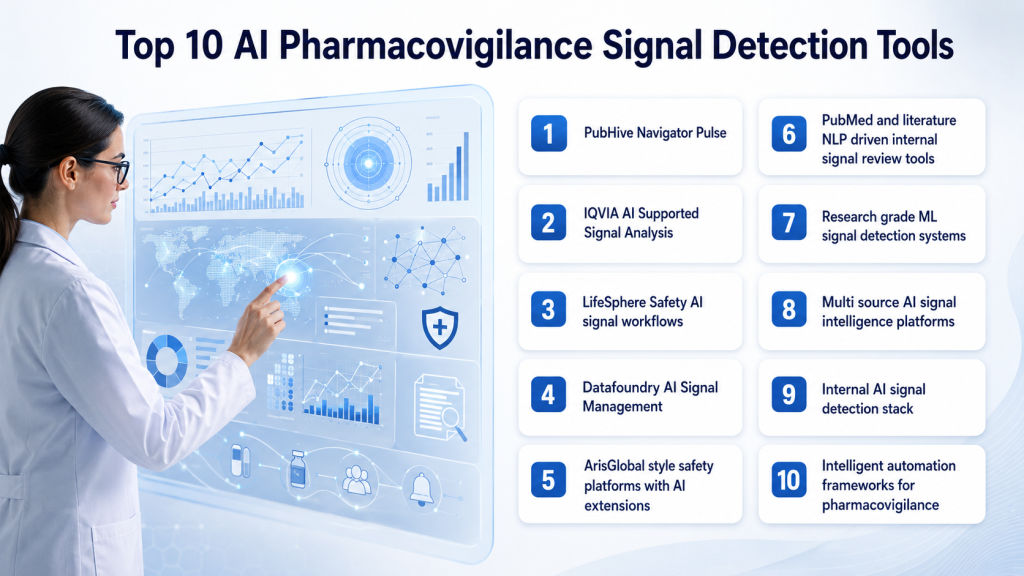
Top 10 AI Pharmacovigilance Signal Detection Tools
1. PubHive Navigator Pulse
One line verdict: Best for teams wanting end to end signal management with AI assisted surveillance and workflow integration.
Short description:
PubHive Navigator Pulse is positioned as a cloud based signal management solution that supports automated surveillance across safety databases and connected signal workflows. It is designed for safety and vigilance teams that want one platform for identifying, evaluating, prioritizing, and managing suspected signals.
Standout Capabilities
- Automated surveillance across ICSR databases and other safety sources.
- AI engine for capture, evaluation, assessment, and prioritization.
- Supports end to end signal management workflow.
- Connects with literature and aggregate reporting workflows.
- Integration support for third party systems and data.
AI Specific Depth
- Model support: Proprietary AI workflow, exact model flexibility not publicly stated.
- Knowledge integration: Connects ICSR databases, FAERS, VAERS, VigiBase, real world data, and other systems.
- Evaluation: Signal prioritization and management are public, detailed benchmark methodology not publicly stated.
- Guardrails: Workflow centric review support is implied, exact AI guardrail detail not publicly stated.
- Observability: Centralized management and connected workflows are public, detailed model observability not publicly stated.
Pros
- Strong full workflow orientation.
- Good data source breadth in public messaging.
- Useful for teams replacing spreadsheets or fragmented tools.
Cons
- Public model transparency is limited.
- Deployment and compliance detail are not fully public.
- AI technical documentation is not deep in reviewed material.
Security and Compliance
Detailed public information on SSO, RBAC, audit logs, residency, retention, and certifications is not clearly stated in the reviewed material.
Deployment and Platforms
Cloud platform is publicly stated. Broader platform and deployment detail are not publicly stated in the reviewed material.
Integrations and Ecosystem
PubHive stands out for workflow connectivity rather than only signal generation. Buyers should validate interoperability with internal pharmacovigilance systems and documentation processes.
- ICSR database integration.
- Real world data support.
- Third party systems integration.
- Aggregate reporting connectivity.
Pricing Model
Best Fit Scenarios
- Teams wanting one signal management environment.
- Organizations moving away from spreadsheets.
- Safety groups needing broader workflow connectivity.
2. IQVIA AI Supported Signal Analysis
One line verdict: Best for enterprise drug safety teams that want AI assisted signal review with broad industry scale.
Short description:
IQVIA has published work on AI supported signal analysis in drug safety and is positioned as a strong enterprise option for signal management modernization. It is best suited to large safety organizations that need scale, support, and broader clinical data alignment.
Standout Capabilities
- AI supported signal analysis orientation.
- Strong enterprise drug safety relevance.
- Likely alignment with broader safety and clinical data workflows.
- Suitable for organizations seeking scaled modernization.
- Good fit for large product portfolios.
AI Specific Depth
- Model support: Not publicly stated in detail in reviewed material.
- Knowledge integration: Signal analysis within broader drug safety context is public, connector specifics not publicly stated.
- Evaluation: Not publicly stated in detail.
- Guardrails: Not publicly stated in detail.
- Observability: Not publicly stated in detail.
Pros
- Strong enterprise credibility.
- Good fit for large scale safety operations.
- Likely attractive for organizations already using IQVIA.
Cons
- Public product specific detail is limited in reviewed sources.
- Harder to compare technically against more transparent niche vendors.
- Pricing and deployment details are not publicly stated.
Security and Compliance
Not publicly stated in the reviewed material for this comparison.
Deployment and Platforms
Not publicly stated in the reviewed material for this comparison.
Integrations and Ecosystem
The strongest signal is enterprise scale and broader safety modernization potential. Buyers should verify workflow integration, validation support, and documentation fit during evaluation.
- Enterprise safety orientation.
- Drug safety analysis support.
- Broader clinical data context.
- Portfolio scale relevance.
Pricing Model
Best Fit Scenarios
- Large pharmacovigilance teams.
- Global portfolios with heavy signal review load.
- Enterprises modernizing safety operations.
3. LifeSphere Safety AI signal workflows
One line verdict: Best for teams focused on reducing noise and improving pharmacovigilance workflow productivity.
Short description:
LifeSphere is often cited in discussions of AI and big data for pharmacovigilance signal detection, especially for reducing false positives and improving productivity in safety review. It fits teams that want AI support embedded into broader safety operations.
Standout Capabilities
- Public claims around reducing false positive signals.
- AI support for safety signal detection.
- Strong relevance to broader pharmacovigilance operations.
- Useful for workflow productivity improvement.
- Good fit for teams facing review overload.
AI Specific Depth
- Model support: Not publicly stated in reviewed material.
- Knowledge integration: Broader platform context implied, detailed connector support not publicly stated.
- Evaluation: Public outcome claims on false positive reduction are cited, formal methodology not publicly stated in the reviewed source.
- Guardrails: Not publicly stated.
- Observability: Not publicly stated.
Pros
- Strong value proposition around noise reduction.
- Good fit for teams overwhelmed by false positives.
- Likely useful in established safety environments.
Cons
- Public evidence in reviewed source is second hand.
- Detailed technical documentation was not verified here.
- Security and deployment specifics are not public in reviewed material.
Security and Compliance
Not publicly stated in the reviewed material for this comparison.
Deployment and Platforms
Not publicly stated in the reviewed material for this comparison.
Integrations and Ecosystem
LifeSphere’s value is likely strongest when signal detection sits within broader case processing and drug safety operations. Buyers should validate evidence, integrations, and governance features directly.
- Safety workflow alignment.
- Noise reduction positioning.
- Signal detection support.
- Enterprise relevance.
Pricing Model
Best Fit Scenarios
- Teams facing high alert noise.
- Established pharmacovigilance operations.
- Organizations seeking workflow efficiency gains.
4. Datafoundry AI Signal Management
One line verdict: Best for teams wanting AI driven risk prioritization with real world data support.
Short description:
Datafoundry positions its offering around AI powered signal management with risk prioritization and real world data. It is attractive for buyers who want signal ranking and practical management support, not just algorithmic detection.
Standout Capabilities
- AI powered signal management.
- Risk prioritization support.
- Real world data relevance.
- Useful for practical signal triage.
- Designed to improve signal management efficiency.
AI Specific Depth
- Model support: Proprietary workflow, exact model flexibility not publicly stated.
- Knowledge integration: Real world data is publicly stated, broader connectors not publicly stated.
- Evaluation: Public messaging emphasizes prioritization and efficiency, formal benchmark detail not publicly stated.
- Guardrails: Not publicly stated.
- Observability: Not publicly stated.
Pros
- Strong prioritization focus.
- Useful for signal triage and review efficiency.
- Real world data angle adds practical value.
Cons
- Public technical transparency is limited.
- Security detail is not public in reviewed material.
- Broader ecosystem depth is not clear publicly.
Security and Compliance
Not publicly stated in the reviewed material for this comparison.
Deployment and Platforms
Not publicly stated in the reviewed material for this comparison.
Integrations and Ecosystem
Datafoundry appears strongest where teams want better prioritization and risk led workflow improvement. Buyers should confirm integration and validation depth.
- Risk prioritization.
- Signal management support.
- Real world data use.
- Workflow efficiency orientation.
Pricing Model
Best Fit Scenarios
- Teams needing better signal prioritization.
- Pharmacovigilance groups using real world data.
- Safety operations improving triage quality.
5. ArisGlobal style safety platforms with AI extensions
One line verdict: Best for enterprises wanting AI within a broader validated safety operations environment.
Short description:
Large safety platform vendors are increasingly part of intelligent automation conversations in pharmacovigilance and may offer AI extensions around signal detection and workflow augmentation. This category slot reflects enterprise buyers that prioritize validated platform context over point solution specialization.
Standout Capabilities
- Broad pharmacovigilance platform relevance.
- AI extension potential within validated workflows.
- Good fit for large organizations already on enterprise safety stacks.
- Strong alignment with automation initiatives.
- Useful for end to end operating model consistency.
AI Specific Depth
- Model support: Varies and not fully publicly stated in the reviewed material.
- Knowledge integration: Broad platform level integration is likely, exact connectors vary.
- Evaluation: Varies and not fully publicly stated.
- Guardrails: Varies and not fully publicly stated.
- Observability: Varies and not fully publicly stated.
Pros
- Good for enterprise platform alignment.
- Likely easier fit with existing validated processes.
- Strong for organizations wanting fewer vendors.
Cons
- Public AI feature transparency varies.
- Innovation pace may differ from AI native specialists.
- Point by point comparison is difficult without private demos.
Security and Compliance
Varies and is not fully publicly stated in the reviewed comparison material.
Deployment and Platforms
Varies and is not fully publicly stated in the reviewed comparison material.
Integrations and Ecosystem
These platforms are strongest where pharmacovigilance teams already depend on validated workflow infrastructure. Buyers should confirm actual AI signal detection maturity instead of assuming it from broader automation messaging.
- Enterprise safety platform alignment.
- Validation friendly operations.
- Automation initiative relevance.
- Broader safety ecosystem fit.
Pricing Model
Varies and is not publicly stated in the reviewed material.
Best Fit Scenarios
- Large enterprises with existing safety stacks.
- Buyers minimizing vendor sprawl.
- Teams prioritizing validated workflows.
6. PubMed and literature NLP driven internal signal review tools
One line verdict: Best for teams that need strong narrative and literature analysis in signal validation.
Short description:
A growing class of pharmacovigilance AI tools uses natural language processing to extract signal relevant information from case narratives, literature, and unstructured text. These tools are especially useful for validation and evaluation stages where text evidence matters.
Standout Capabilities
- Strong fit for unstructured text analysis.
- Helps extract events, timelines, and clinical context from narratives.
- Useful in validation and evaluation workflows.
- Can support literature surveillance and evidence linkage.
- Good complement to statistical signal detection.
AI Specific Depth
- Model support: Varies, often NLP focused rather than one platform model.
- Knowledge integration: Literature, narratives, and text based evidence sources.
- Evaluation: NLP application in validation and evaluation is public, specific benchmarking varies.
- Guardrails: Varies and often depends on internal workflow design.
- Observability: Varies and not consistently public.
Pros
- Strong value for narrative heavy safety review.
- Helps reduce manual text extraction burden.
- Useful complement to structured signal tools.
Cons
- Often not a full end to end signal management system.
- Performance depends heavily on data quality and language coverage.
- Public commercial packaging varies widely.
Security and Compliance
Varies and depends on implementation.
Deployment and Platforms
Varies and depends on implementation.
Integrations and Ecosystem
These tools are most useful when text heavy workflows are a bottleneck. Buyers should confirm whether literature NLP is a standalone module, embedded capability, or custom build.
Pricing Model
Varies and is not publicly stated in the reviewed material.
Best Fit Scenarios
- Teams with heavy narrative case review.
- Signal validation workflows.
- Literature surveillance support.
7. Research grade ML signal detection systems
One line verdict: Best for innovation focused teams testing advanced ML methods beyond classic signal metrics.
Short description:
Research literature shows that random forest, gradient boosting machine, and clustering methods are being used for signal detection and often outperform traditional disproportionality measures on some metrics. These systems matter for organizations exploring advanced internal models or innovation programs.
Standout Capabilities
- Uses advanced ML methods such as random forest and gradient boosting.
- Can capture nonlinear relationships in safety data.
- Potential to outperform traditional disproportionality metrics on some benchmarks.
- Useful for innovation programs and benchmarking.
- Good fit for exploratory internal safety analytics.
AI Specific Depth
- Model support: BYO or custom research models.
- Knowledge integration: Depends on internal data sources and research setup.
- Evaluation: Some studies use positive and negative control datasets, but methodological transparency is mixed.
- Guardrails: Typically depends on internal governance.
- Observability: Depends on internal implementation.
Pros
- Strong innovation potential.
- Good for benchmarking new signal methods.
- Useful for complex pattern detection.
Cons
- Often not productized for enterprise deployment.
- Validation burden is high.
- Explainability may be harder for safety teams.
Security and Compliance
Depends on internal implementation and governance.
Deployment and Platforms
Varies and depends on internal implementation.
Integrations and Ecosystem
These systems fit organizations building internal signal science capability rather than buyers seeking off the shelf operational tools.
Pricing Model
Internal build or research cost, varies widely.
Best Fit Scenarios
8. Multi source AI signal intelligence platforms
One line verdict: Best for organizations that want safety signals validated across more than one evidence stream.
Short description:
Some AI pharmacovigilance approaches are built around combining spontaneous reports, electronic health records, literature, social data, and clinical evidence to strengthen detection and validation. These platforms are especially useful where cross source triangulation is important.
Standout Capabilities
- Multi source data integration.
- Better suited for cross validation of emerging risks.
- Useful for early signal detection and later evaluation.
- Can uncover patterns missed in one source alone.
- Supports a broader view of patient safety.
AI Specific Depth
- Model support: Varies and is not fully publicly stated.
- Knowledge integration: Spontaneous reports, EHRs, literature, clinical trials, and sometimes social data.
- Evaluation: Cross source review is public conceptually, formal benchmark methods vary.
- Guardrails: Varies and depends on implementation.
- Observability: Varies and is not consistently public.
Pros
- Stronger evidence triangulation.
- Useful for reducing blind spots from single sources.
- Good fit for modern safety intelligence strategy.
Cons
- Data harmonization is difficult.
- Governance becomes more complex.
- Commercial packaging varies widely.
Security and Compliance
Varies and depends on implementation.
Deployment and Platforms
Varies and depends on implementation.
Integrations and Ecosystem
This category is attractive for advanced buyers, but success depends heavily on data quality, harmonization, and review design.
Pricing Model
Varies and is not publicly stated in the reviewed material.
Best Fit Scenarios
- Organizations validating signals across many sources.
- Advanced pharmacovigilance programs.
- Teams focused on triangulation.
9. Internal AI signal detection stack
One line verdict: Best for enterprises with strong safety science, proprietary data, and strict governance requirements.
Short description:
Some large organizations build internal AI pharmacovigilance systems using safety database extracts, narrative NLP, machine learning models, and workflow layers for review and documentation. This approach offers the most flexibility but also the highest validation and maintenance burden.
Standout Capabilities
- Full control over data and detection logic.
- Can combine internal case data with literature and other evidence.
- Supports custom thresholds and product specific tuning.
- Easier to align with internal governance models.
- Potential for deep portfolio specific optimization.
AI Specific Depth
- Model support: BYO, open source, or mixed depending on internal design.
- Knowledge integration: Internal safety databases, narratives, literature, and other chosen sources.
- Evaluation: Can use internal validation and benchmark datasets if implemented.
- Guardrails: Can be designed internally but require mature governance.
- Observability: Possible, but must be intentionally implemented.
Pros
- Maximum flexibility.
- Best fit for proprietary workflows and data.
- Strong option for organizations needing full control.
Cons
- High validation burden.
- Long implementation timeline.
- Significant maintenance and documentation effort.
Security and Compliance
Depends on internal architecture and governance design.
Deployment and Platforms
Cloud, self hosted, and hybrid are all possible depending on internal design.
Integrations and Ecosystem
Internal builds can connect to existing safety systems and quality controls, but all integration and upkeep remain the organization’s responsibility.
Pricing Model
Internal build and operating cost, which varies widely.
Best Fit Scenarios
- Large global drug safety teams.
- Organizations with advanced safety science resources.
- Highly regulated internal workflows.
10. Intelligent automation frameworks for pharmacovigilance
One line verdict: Best for buyers planning broader PV automation with signal detection as one part of the stack.
Short description:
Industry frameworks around intelligent automation in pharmacovigilance show that signal detection is increasingly treated as one part of a broader automation strategy covering case intake, replication, validation, and routine safety surveillance. This option suits organizations building a long term transformation roadmap.
Standout Capabilities
- Connects signal detection with broader automation programs.
- Supports long term safety operations transformation.
- Useful for validation planning and governance design.
- Aligns signal detection with routine surveillance.
- Strong fit for enterprise process modernization.
AI Specific Depth
- Model support: Varies and depends on selected technologies.
- Knowledge integration: Broad pharmacovigilance process context rather than one dedicated source set.
- Evaluation: Validation case study themes and framework assets are publicly indicated.
- Guardrails: Strong relevance to validation and governance frameworks.
- Observability: Not tool specific, varies by implementation.
Pros
- Good for strategy led transformation.
- Helpful for aligning signal tools with broader PV automation.
- Strong fit for governance minded enterprises.
Cons
- Not a single product.
- Requires more design and implementation work.
- Less useful for buyers wanting a quick standalone solution.
Security and Compliance
Depends on the selected implementation and internal governance framework.
Deployment and Platforms
Integrations and Ecosystem
This is most useful as a planning and operating model layer for larger organizations. It helps teams decide how signal detection should fit into wider pharmacovigilance automation strategy.
- Validation guidance relevance.
- Routine surveillance alignment.
- Automation program support.
- Enterprise governance focus.
Pricing Model
Best Fit Scenarios
Comparison Table
Scoring and Evaluation
The scores below are comparative and designed to help shortlist options, not to claim one universal winner. Tools with stronger public evidence for signal workflow coverage, multi source support, and operational fit scored higher, while options with less product transparency were scored more conservatively. In this category, lower public scores often reflect weaker public documentation rather than weaker actual utility, so buyers should validate carefully in live safety workflows.
| Tool | Core | Reliability and Eval | Guardrails | Integrations | Ease | Performance and Cost | Security and Admin | Support | Weighted Total |
|---|---|---|---|---|---|---|---|---|---|
| PubHive Navigator Pulse | 9 | 7 | 6 | 8 | 7 | 7 | 6 | 7 | 7.40 |
| IQVIA AI Supported Signal Analysis | 8 | 7 | 5 | 8 | 6 | 7 | 6 | 8 | 7.00 |
| LifeSphere AI workflows | 8 | 7 | 5 | 7 | 6 | 8 | 5 | 7 | 6.95 |
| Datafoundry AI Signal Management | 8 | 7 | 5 | 6 | 7 | 7 | 5 | 6 | 6.70 |
| ArisGlobal style platforms | 7 | 6 | 6 | 8 | 6 | 6 | 7 | 7 | 6.75 |
| Literature NLP tools | 7 | 7 | 5 | 6 | 6 | 7 | 5 | 6 | 6.35 |
| Research ML systems | 8 | 8 | 4 | 5 | 4 | 6 | 4 | 4 | 6.00 |
| Multi source AI platforms | 8 | 7 | 5 | 7 | 5 | 6 | 5 | 5 | 6.35 |
| Internal build | 9 | 8 | 8 | 9 | 4 | 5 | 9 | 4 | 7.40 |
| Intelligent automation frameworks | 7 | 6 | 7 | 8 | 4 | 5 | 7 | 6 | 6.35 |
- Top 3 for Enterprise: PubHive Navigator Pulse, Internal build, IQVIA AI Supported Signal Analysis.
- Top 3 for SMB: Datafoundry AI Signal Management, PubHive Navigator Pulse, Literature NLP tools.
- Top 3 for Developers: Internal build, Research ML systems, Multi source AI platforms.
Which Tool Is Right for You
Solo and Freelancer
Most solo pharmacovigilance consultants do not need a full enterprise AI signal platform. A lighter literature and narrative review workflow or a focused validation support tool is often enough unless they are working inside a large client safety environment.
SMB
Smaller biotech teams should prioritize workflow simplicity, manageable alert volume, and strong human review support. Datafoundry AI Signal Management, PubHive Navigator Pulse, or focused NLP style tools can be more practical than a broad enterprise stack.
Mid Market
Mid market organizations need a balance between signal quality, integration, and operating effort. PubHive Navigator Pulse and enterprise style platform extensions make sense where teams want stronger workflow discipline without building everything internally.
Enterprise
Large safety organizations should prioritize auditability, system fit, validation support, and data source breadth. PubHive Navigator Pulse, IQVIA AI Supported Signal Analysis, ArisGlobal style platforms, and internal build strategies are most suitable where governance and portfolio scale matter.
Regulated Industries
In highly regulated environments, model explainability, documented validation, change control, and human oversight matter as much as raw signal performance. Buyers should not adopt AI signal detection without a clear review model, evidence trail, and inspection ready documentation process.
Budget vs Premium
Budget focused teams should choose tools that reduce manual burden and improve triage quality, not simply those with the most ambitious AI claims. Premium platforms are justified when portfolio scale, data source complexity, and regulatory scrutiny require broader workflow control.
Build vs Buy
Build when the organization has advanced safety science capability, strong data engineering, and a reason to control thresholds, models, and governance internally. Buy when the goal is faster time to value, structured workflow support, and lower operational burden.
Implementation Playbook
First 30 Days
Start with one therapeutic area, one product set, or one historical signal review scenario and define success metrics before the pilot begins. Measure signal quality, false positive volume, reviewer effort, time to triage, and whether the tool helps surface cases that a traditional workflow would miss.
Next 60 Days
Strengthen governance by defining roles for safety scientists, reviewers, and system owners. Build validation rules, documentation templates, threshold review practices, and a human review process for all high impact signal decisions.
Next 90 Days
Expand only after proving value in real safety workflows. Add more data sources, standardize review playbooks, build periodic model and threshold reviews, and define incident handling for missed signals, poor prioritization, or unexplained model behavior.
Common Mistakes and How to Avoid Them
- Treating AI output as final signal truth instead of a prioritization aid.
- Ignoring explainability and audit needs.
- Skipping benchmark validation and relying only on demos.
- Overlooking false positive burden in reviewer workflows.
- Ignoring narrative data and relying only on coded fields.
- Using poor quality or biased input data.
- Expanding to many products before validating on a smaller scope.
- Failing to define human review and override rules.
- Over complicating the system before proving operational value.
- Assuming multi source data always improves outcomes without harmonization work.
- Neglecting documentation for inspections and internal governance.
- Choosing a vendor without checking workflow fit with existing PV systems.
FAQs
1. What is AI pharmacovigilance signal detection
It is the use of artificial intelligence to identify and prioritize possible adverse drug safety signals from large volumes of safety data. It helps pharmacovigilance teams detect patterns faster and support signal management decisions.
2. Why is this category important
Traditional safety review methods can be slow and resource intensive when case volumes grow. AI can help reduce manual burden, find subtle patterns, and support faster safety action.
3. What data do these tools use
They may use spontaneous reports, case narratives, literature, real world data, clinical sources, and other safety datasets. Data breadth varies by vendor and implementation model.
4. Are these tools replacing safety scientists
No. Human review remains essential for validation, assessment, and regulatory judgment. AI is best used as decision support and prioritization, not full replacement.
5. Do these tools use natural language processing
Many do, especially for narrative case review and signal validation where important details live in unstructured text.
6. Can machine learning outperform traditional signal metrics
Research suggests that methods such as random forest and gradient boosting can outperform traditional disproportionality metrics on some benchmarks, but transparency and validation still matter.
7. What should buyers ask vendors first
Ask about data sources, false positive control, explainability, validation methods, workflow integration, audit trails, and human review support.
8. Are public ratings available for these tools
Reliable public ratings were not confidently verified for most options in this comparison, so the table uses N A instead of guessing.
9. What is the biggest implementation risk
The biggest risk is adopting a tool that creates more alerts but does not improve signal quality, reviewer efficiency, or inspection readiness. Real workflow testing matters more than marketing claims.
10. Are these tools useful for smaller biotech companies
Yes, but smaller teams should focus on simpler tools with strong prioritization and review support rather than broad enterprise platforms.
11. When should a company build instead of buy
A company should build when it has mature safety science, proprietary data, and strong governance capability. Most teams should buy first unless they have a clear need for custom models and control.
12. How should success be measured
Success should be measured by signal quality, reviewer efficiency, false positive reduction, time to triage, documentation quality, and confidence of safety scientists using the system.
Conclusion
The best AI pharmacovigilance signal detection tool depends on your case volume, safety workflow maturity, data source complexity, and governance requirements. Some teams need a full signal management platform, some need better prioritization and narrative analysis, and others need a long term enterprise automation strategy that fits validated pharmacovigilance operations. The smartest approach is to shortlist a few realistic options, run them on real historical and live safety scenarios, validate explainability and workflow fit carefully, keep human review at the center of signal decisions, and scale only after the tool proves it improves both detection quality and operational efficiency.

Find Trusted Cardiac Hospitals
Compare heart hospitals by city and services — all in one place.
Explore Hospitals
AI pharmacovigilance tools are valuable, but signal quality still depends on clean adverse-event data, strong validation workflows, and minimizing false positives.