
Introduction
AI biomedical literature mining helps researchers, clinicians, drug discovery teams, and evidence review groups search, organize, extract, and connect knowledge from the massive volume of biomedical papers faster than manual reading alone. These tools matter because biomedical publishing is growing too quickly for any team to track with keyword search and hand curation only, and important evidence is often buried across thousands of abstracts, full text articles, supplementary materials, and citation chains. Real world use cases include semantic literature search, systematic review screening, entity extraction, relation extraction, evidence synthesis, citation graph exploration, biomarker discovery, and drug repurposing research. Buyers should evaluate these tools based on retrieval quality, extraction accuracy, semantic understanding, transparency, workflow fit, citation support, collaboration, integration, auditability, and total time saved on real research tasks.
These tools are best for biomedical researchers, medical affairs teams, translational science groups, pharma R and D teams, librarians, and systematic review specialists that need to search or structure large research corpora. They are especially useful when the goal is to find hidden connections, build evidence maps, or reduce the time spent screening and summarizing studies. They are less ideal for very small projects with a narrow paper set where manual review is still faster and simpler.
Why it matters
Biomedical literature volume is growing much faster than any team can manually read or track, and important findings can be buried inside thousands of scattered articles. Traditional search tools make it hard to discover non obvious connections, keep up with new evidence, and maintain accurate knowledge bases. AI matters because it can read and process far more papers than any human team, highlight patterns that might be missed, and bring the most relevant studies to the surface based on meaning rather than only exact words. Recent work shows that specialized models for medical literature tasks can outperform general large language models in study selection and data extraction, which can directly speed up systematic reviews and meta analyses. AI workflows are already being used to reduce screening time in evidence reviews, visualize citation networks, extract gene disease and drug target links, and support drug repurposing searches. When used with careful expert oversight, these tools help researchers spend less time on low value searching and more time on critical thinking and experiment design.
Real world use cases
One important use case is assisted systematic reviewing, where AI helps search databases such as PubMed, rank likely relevant articles, and speed up abstract and full text screening. Some tools can cut screening time by almost half by prioritizing which records should be read first and by learning from inclusion or exclusion decisions made by reviewers. Another common use case is knowledge extraction, where models pull out entities such as genes, diseases, drugs, pathways, and outcomes from large numbers of papers, then build structured knowledge graphs or databases that can support downstream analysis. This kind of extraction has been used to discover gene disease associations, propose drug repurposing candidates, and identify shared pathways across conditions such as neurodegenerative diseases. AI based literature mining is also used for evidence mapping and visualization, where tools show citation graphs or related paper maps to help researchers explore a field quickly and avoid missing key studies. Specialized systems now support tasks such as question driven evidence search, precision medicine queries, and discovery of hidden associations that are not obvious from keyword search alone.
Evaluation criteria for buyers
When buyers evaluate AI biomedical literature mining tools, the first thing to check is search and retrieval quality, meaning how well the system finds relevant studies for real research questions across different topics and levels of specificity. The second is extraction and structuring quality, including whether the tool can reliably identify important entities, relationships, and outcomes from abstracts and full texts, and how it represents them in graphs, tables, or other data structures. Buyers should look carefully at model transparency, error patterns, and hallucination risks, because incorrect extractions or invented claims can cause serious downstream problems. Integration and workflow fit are also important, including whether the tool connects smoothly to existing databases, reference managers, review platforms, or analysis tools that the team already uses. Governance matters too, which means having clear rules for how AI outputs are reviewed, documented, and combined with manual curation so that final conclusions remain trustworthy and reproducible. Finally, teams should consider usability, collaboration features, cost, and long term support, and they should run pilots on real literature tasks such as a systematic review or research project to see whether the tool actually saves time and improves coverage without sacrificing rigor.
What Is Changing in This Category
- AI tools are moving from keyword retrieval toward semantic and multimodal search.
- Specialized biomedical models are outperforming general large language models on some literature mining tasks.
- Human in the loop workflows are still important because reliability and hallucination risk remain concerns.
- More tools now support extraction, screening, summarization, and graph exploration in one workflow.
- Citation network visualization is becoming a common feature for discovery and evidence mapping.
- Systematic review support tools are helping reduce screening burden significantly.
- Open source and API driven text mining tools remain important for custom biomedical pipelines.
- Buyers are asking for explainability, better citation grounding, and less black box summarization.
- More teams are combining literature mining with knowledge graphs and downstream analytics.
- Biomedical entity and relation extraction remain core strengths of domain specific tools.
Quick Buyer Checklist
- Check whether the tool supports semantic search or only keyword search.
- Ask how it handles entity extraction for genes, diseases, drugs, variants, and pathways.
- Confirm whether outputs are grounded in real citations and evidence snippets.
- Review whether the platform supports screening, clustering, summarization, and extraction in one workflow.
- Ask how hallucinations or unsupported summaries are controlled.
- Check whether the tool can work with PubMed, PMC, or full text sources relevant to your use case.
- Review collaboration features for teams doing systematic reviews or evidence synthesis.
- Ask whether APIs or exports are available for knowledge graph or analytics workflows.
- Test the tool on a real research question rather than a broad demo prompt.
- Review privacy and IP implications before uploading sensitive text or notes.
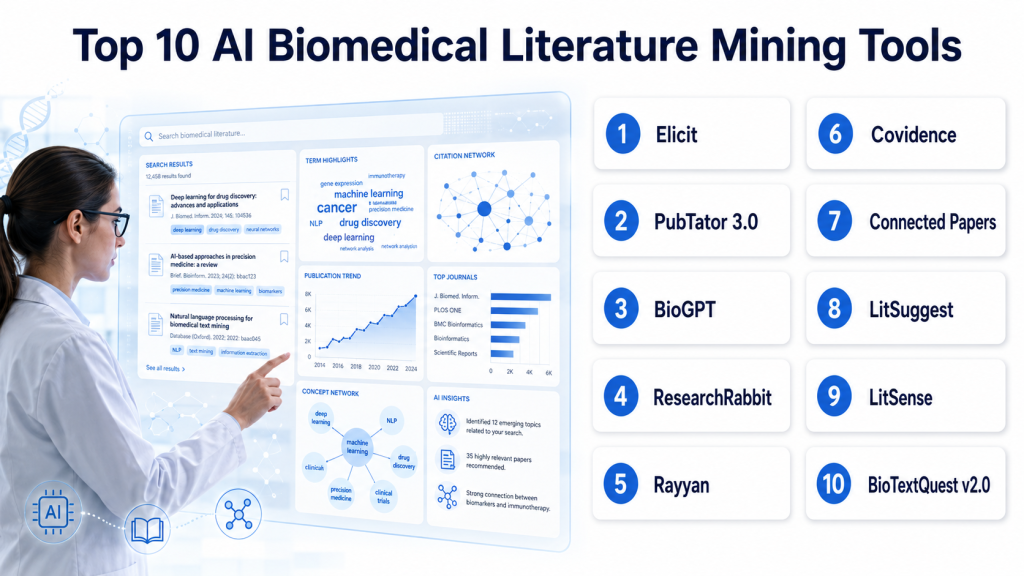
Top 10 AI Biomedical Literature Mining Tools
1. Elicit
One line verdict: Best for researchers who want AI assisted evidence finding, summarization, and structured paper review.
Short description:
Elicit is widely recognized as an AI research assistant for finding and summarizing scientific papers. In reviewed biomedical AI literature, it is cited as a tool that helps with evidence based insights and faster literature workflows.
Standout Capabilities
- AI assisted literature discovery.
- Helps summarize and structure research findings.
- Useful for evidence based insight generation.
- Good fit for review style workflows.
- Supports faster early stage literature exploration.
AI Specific Depth
- Model support: Proprietary workflow, exact model flexibility not publicly stated in reviewed sources.
- Knowledge integration: Scientific literature search and summarization are publicly indicated, detailed biomedical connectors not publicly stated here.
- Evaluation: Public literature positions it as useful for research workflows, detailed benchmark methods not publicly stated here.
- Guardrails: Not publicly stated in reviewed sources.
- Observability: Not publicly stated in reviewed sources.
Pros
- Strong fit for fast research exploration.
- Useful for summarizing evidence across papers.
- Well known in AI assisted literature research discussions.
Cons
- Public biomedical specific extraction detail is limited in reviewed sources.
- Hallucination and summary verification still require human checking.
- Exact enterprise controls are not publicly stated here.
Security and Compliance
Not publicly stated in the reviewed material for this comparison.
Deployment and Platforms
Platform details are not publicly stated in the reviewed material used here.
Integrations and Ecosystem
Elicit appears strongest as a research discovery and summarization layer rather than a deep biomedical annotation engine. Buyers should validate exports, team workflows, and evidence traceability during evaluation.
- Literature discovery.
- Summarization support.
- Evidence based insight workflows.
- Research oriented exploration.
Pricing Model
Not publicly stated in the reviewed material.
Best Fit Scenarios
- Early stage literature review.
- Evidence gathering for biomedical questions.
- Researchers wanting a practical AI assistant.
2. PubTator 3.0
One line verdict: Best for biomedical entity extraction and annotation across PubMed scale content.
Short description:
PubTator is a major biomedical text mining tool from NCBI for annotating PubMed articles with biological entities. It is designed for users who need structured entity recognition and API accessible annotation rather than only narrative summaries.
Standout Capabilities
- Annotates biomedical articles with key biological entities.
- Supports genes, diseases, chemicals, variants, and more through the NCBI ecosystem.
- Available through web and API access.
- Strong fit for structured knowledge extraction.
- Useful for downstream curation and knowledge base building.
AI Specific Depth
- Model support: Domain specific biomedical text mining and annotation workflow.
- Knowledge integration: Deep alignment with PubMed and related NCBI resources.
- Evaluation: NCBI positions it as a production text mining tool, detailed benchmark detail is not included in the reviewed page.
- Guardrails: Not publicly stated in reviewed material.
- Observability: API access is public, deeper workflow observability not publicly stated.
Pros
- Strong biomedical specificity.
- Excellent for structured annotations and entity extraction.
- Useful for developers and curation teams.
Cons
- Less suited for high level narrative summarization.
- May require technical skill to use fully.
- Broader review workflow features are not its main strength.
Security and Compliance
Not publicly stated in the reviewed material for this comparison.
Deployment and Platforms
Web and API access are publicly stated. Broader deployment details are not publicly stated.
Integrations and Ecosystem
PubTator is especially valuable inside biomedical data workflows and custom pipelines. It is a strong foundation for knowledge graph building, annotation tasks, and large scale biomedical mining.
Pricing Model
Best Fit Scenarios
- Biomedical named entity extraction.
- Knowledge base curation.
- Developer pipelines for PubMed scale mining.
3. BioGPT
One line verdict: Best for teams wanting domain tuned generative AI for biomedical knowledge work.
Short description:
BioGPT is referenced in recent biomedical AI literature as one of the open source style tools helping with literature discovery, summarization, and evidence extraction. It is relevant for teams that want a biomedical language model rather than only a packaged interface.
Standout Capabilities
- Biomedical domain tuned language model.
- Useful for evidence based insights and extraction workflows.
- Supports open research and custom experimentation.
- Can be adapted into custom biomedical mining pipelines.
- Good fit for teams exploring model level control.
AI Specific Depth
- Model support: Open source style biomedical model.
- Knowledge integration: Depends on implementation and surrounding retrieval stack.
- Evaluation: Mentioned as a tool for evidence and association extraction, full benchmark detail not included in reviewed material.
- Guardrails: Depends on implementation.
- Observability: Depends on implementation.
Pros
- Strong flexibility for custom biomedical workflows.
- More developer friendly than closed interfaces.
- Useful for tailored knowledge mining pipelines.
Cons
- Requires more technical effort than turnkey products.
- Reliability depends on setup and validation.
- Not a polished end to end literature review platform by itself.
Security and Compliance
Deployment and Platforms
Varies based on implementation.
Integrations and Ecosystem
BioGPT is best treated as a model component inside a broader biomedical mining stack. It fits teams building custom search, summarization, or relation extraction tools.
- Model level customization.
- Biomedical text generation.
- Evidence extraction support.
- Open workflow flexibility.
Pricing Model
Open source or implementation dependent, exact pricing not publicly stated in the reviewed material.
Best Fit Scenarios
- Custom literature mining pipelines.
- Biomedical R and D model experimentation.
- Developer led research tooling.
4. ResearchRabbit
One line verdict: Best for researchers who want fast citation network exploration and visual discovery.
Short description:
ResearchRabbit is cited in biomedical AI literature as a tool for visualizing citation networks and discovering related papers. It is especially useful when the goal is to navigate a research area quickly and uncover relevant papers through network structure.
Standout Capabilities
- Citation network visualization.
- Helps discover related papers and author connections.
- Good for evidence mapping and topic exploration.
- Useful beyond keyword search alone.
- Supports literature discovery through graph style navigation.
AI Specific Depth
- Model support: Visualization and recommendation style workflow, exact model details not publicly stated in reviewed sources.
- Knowledge integration: Citation and paper relationship exploration is publicly indicated.
- Evaluation: Not publicly stated in reviewed sources.
- Guardrails: Not publicly stated.
- Observability: Not publicly stated.
Pros
- Strong for fast topic exploration.
- Helpful for discovering papers missed by keyword search.
- Good visual workflow for review teams.
Cons
- Not a deep entity extraction tool.
- Summary accuracy still requires manual review.
- Public enterprise and API detail is limited in reviewed sources.
Security and Compliance
Not publicly stated in the reviewed material.
Deployment and Platforms
Not publicly stated in the reviewed material.
Integrations and Ecosystem
ResearchRabbit is best used as a discovery layer alongside stronger extraction or systematic review tools. It adds value by showing the paper landscape visually.
Pricing Model
Not publicly stated in the reviewed material.
Best Fit Scenarios
5. Rayyan
One line verdict: Best for teams doing systematic review screening with AI assisted prioritization.
Short description:
Rayyan is listed in reviewed biomedical AI sources as a systematic review tool that helps reduce screening burden. It is particularly useful for literature mining workflows where abstract and full text screening are major time sinks.
Standout Capabilities
- Supports systematic review screening.
- Reduces screening time significantly in review workflows.
- Helps prioritize records during selection.
- Useful for team based evidence review.
- Strong fit for reproducible review processes.
AI Specific Depth
- Model support: AI assisted screening workflow, exact model detail not publicly stated in reviewed sources.
- Knowledge integration: Review screening use case is public, broader biomedical connectors not publicly stated here.
- Evaluation: Public literature cites meaningful screening time reduction.
- Guardrails: Human review remains part of the screening process.
- Observability: Not publicly stated in reviewed sources.
Pros
- Strong fit for systematic review teams.
- Practical productivity gains in screening.
- Supports more disciplined evidence selection workflows.
Cons
- Less useful for deep biomedical entity mining.
- Not designed primarily for knowledge graph extraction.
- Exact technical AI details are limited in reviewed sources.
Security and Compliance
Not publicly stated in the reviewed material.
Deployment and Platforms
Not publicly stated in the reviewed material.
Integrations and Ecosystem
Rayyan is strongest in evidence review operations. Buyers should confirm team collaboration support, exports, and fit with their review methodology.
- Screening prioritization.
- Team review support.
- Evidence selection workflows.
- Systematic review alignment.
Pricing Model
Not publicly stated in the reviewed material.
Best Fit Scenarios
6. Covidence
One line verdict: Best for structured evidence review teams needing faster screening and workflow discipline.
Short description:
Covidence is cited alongside Rayyan as a systematic review platform that can reduce screening time. It fits research teams that need structured collaborative review processes rather than only literature search.
Standout Capabilities
- Supports systematic review screening and coordination.
- Helps reduce time spent on study selection.
- Good fit for structured review workflows.
- Useful for teams that need consistency and traceability.
- Practical for evidence synthesis projects.
AI Specific Depth
- Model support: AI assisted screening workflow, exact model detail not publicly stated in reviewed sources.
- Knowledge integration: Review process focus is public, broader biomedical data extraction detail not publicly stated here.
- Evaluation: Public literature cites screening time savings.
- Guardrails: Human adjudication and review fit are central to review workflows.
- Observability: Not publicly stated in reviewed sources.
Pros
- Strong for review workflow discipline.
- Helpful for collaborative evidence synthesis.
- Useful when study selection is the bottleneck.
Cons
- Not a specialist biomedical entity mining engine.
- Less useful for open ended discovery than graph tools.
- Public AI technical detail is limited in reviewed sources.
Security and Compliance
Not publicly stated in the reviewed material.
Deployment and Platforms
Not publicly stated in the reviewed material.
Integrations and Ecosystem
Covidence fits teams that need repeatable review operations and less ad hoc screening work. Buyers should check export support and collaboration features against internal needs.
- Review coordination.
- Screening time reduction.
- Team based evidence synthesis.
- Structured workflow support.
Pricing Model
Not publicly stated in the reviewed material.
Best Fit Scenarios
7. Connected Papers
One line verdict: Best for visual paper discovery and relationship mapping around a core article.
Short description:
Connected Papers is cited in biomedical AI literature as a tool for visualizing citation relationships. It is ideal for quickly expanding from one important paper into a broader network of related research.
Standout Capabilities
- Visual relationship mapping across papers.
- Helps expand a research topic from seed papers.
- Useful for discovering clusters and nearby work.
- Good for fast literature familiarization.
- Supports exploratory evidence mapping.
AI Specific Depth
- Model support: Recommendation and graph exploration workflow, exact model details not publicly stated in reviewed sources.
- Knowledge integration: Citation relationship exploration is publicly indicated.
- Evaluation: Not publicly stated in reviewed sources.
- Guardrails: Not publicly stated.
- Observability: Not publicly stated.
Pros
- Excellent for broadening a search beyond keywords.
- Very useful in early topic scoping.
- Helps reveal clusters of related work.
Cons
- Not an extraction or curation tool.
- Needs companion tools for evidence synthesis.
- Public technical detail is limited in reviewed sources.
Security and Compliance
Not publicly stated in the reviewed material.
Deployment and Platforms
Not publicly stated in the reviewed material.
Integrations and Ecosystem
Connected Papers works best as a discovery companion for review, extraction, or reading tools. It adds value through visual search expansion rather than deep mining.
- Citation relationship mapping.
- Seed paper expansion.
- Topic cluster discovery.
- Exploratory workflow support.
Pricing Model
Not publicly stated in the reviewed material.
Best Fit Scenarios
8. LitSuggest
One line verdict: Best for AI assisted literature triage and document classification in PubMed style workflows.
Short description:
LitSuggest is an NCBI listed web based system for literature triage and document classification using AI and machine learning. It is useful for teams that need prioritization and review support rather than broad generative summarization.
Standout Capabilities
- Literature triage support.
- Document classification using AI and machine learning.
- Web based workflow.
- Good fit for screening and prioritization tasks.
- Useful for handling large document sets.
AI Specific Depth
- Model support: AI and machine learning are publicly stated, exact model details not publicly stated.
- Knowledge integration: Designed for literature triage, broader connector detail not publicly stated.
- Evaluation: Not publicly stated in reviewed material.
- Guardrails: Human review implied by triage workflow, detailed guardrail design not publicly stated.
- Observability: Not publicly stated.
Pros
Cons
- Less useful for broad research summarization.
- Not a full literature discovery suite.
- Public workflow detail is limited.
Security and Compliance
Not publicly stated in the reviewed material.
Deployment and Platforms
Web based system is publicly stated.
Integrations and Ecosystem
LitSuggest is a focused tool for screening style use cases and can complement broader search or annotation tools.
Pricing Model
Best Fit Scenarios
9. LitSense
One line verdict: Best for sentence level search when users need exact evidence snippets fast.
Short description:
LitSense is an NCBI listed tool that finds best matching sentences for a query using neural embeddings. It is useful when the user wants precise evidence snippets instead of only paper level retrieval.
Standout Capabilities
- Sentence level search.
- Uses neural embeddings for matching.
- Helps users find exact evidence fragments.
- Useful for focused biomedical questions.
- Good complement to paper level search systems.
AI Specific Depth
- Model support: Neural embedding based search.
- Knowledge integration: Biomedical literature sentence retrieval is publicly stated.
- Evaluation: Not publicly stated in reviewed material.
- Guardrails: Not publicly stated.
- Observability: Not publicly stated.
Pros
- Very useful for precise evidence lookup.
- Strong complement to broader search tools.
- Good for answering focused scientific questions.
Cons
- Not designed as a full systematic review platform.
- Less useful for broad topic mapping.
- Public integration detail is limited.
Security and Compliance
Not publicly stated in the reviewed material.
Deployment and Platforms
Platform details are not publicly stated in the reviewed material beyond NCBI tool listing.
Integrations and Ecosystem
LitSense is best used when exact sentence level evidence matters for curation, verification, or detailed reading support.
Pricing Model
Best Fit Scenarios
10. BioTextQuest v2.0
One line verdict: Best for open source biomedical document clustering and term driven corpus analysis.
Short description:
BioTextQuest v2.0 is an open source web portal for biomedical literature mining through document clustering based on selected biomedical terms. It is useful for researchers who want corpus exploration and clustering rather than only ranking or summarization.
Standout Capabilities
- Open source orientation.
- Biomedical document clustering.
- Term driven corpus analysis.
- Useful for cluster based topic exploration.
- Good for custom research workflows.
AI Specific Depth
- Model support: Clustering workflow, exact model detail not publicly stated in reviewed snippet.
- Knowledge integration: Biomedical term driven literature mining is public.
- Evaluation: Not publicly stated in reviewed snippet.
- Guardrails: Not publicly stated.
- Observability: Not publicly stated.
Pros
- Open source appeal.
- Useful for clustering large document sets.
- Good fit for exploratory corpus analysis.
Cons
- Less polished than mainstream research assistants may be.
- Public detail is limited in reviewed snippet.
- Not a full end to end review system.
Security and Compliance
Not publicly stated in the reviewed material.
Deployment and Platforms
Online web portal is publicly stated.
Integrations and Ecosystem
BioTextQuest is most useful for open and exploratory mining workflows where clustering and corpus structure matter more than flashy summaries.
Pricing Model
Open source style positioning is publicly stated, exact pricing not publicly stated.
Best Fit Scenarios
Comparison Table
Scoring and Evaluation
The scores below are comparative and designed to help you shortlist the right tools for biomedical literature mining. Tools with stronger public evidence for biomedical specificity, workflow practicality, and literature scale usefulness scored higher, while tools with limited public technical detail were scored more conservatively. Lower scores often reflect lower public transparency rather than lower practical value, so real pilot testing is still essential.
| Tool | Core | Reliability and Eval | Guardrails | Integrations | Ease | Performance and Cost | Security and Admin | Support | Weighted Total |
|---|---|---|---|---|---|---|---|---|---|
| Elicit | 8 | 7 | 5 | 6 | 9 | 8 | 5 | 7 | 7.15 |
| PubTator 3.0 | 9 | 8 | 6 | 8 | 6 | 8 | 6 | 7 | 7.65 |
| BioGPT | 8 | 7 | 5 | 7 | 4 | 6 | 6 | 6 | 6.50 |
| ResearchRabbit | 7 | 6 | 5 | 6 | 9 | 8 | 5 | 7 | 6.85 |
| Rayyan | 8 | 8 | 6 | 7 | 8 | 8 | 6 | 8 | 7.55 |
| Covidence | 8 | 8 | 6 | 7 | 8 | 7 | 6 | 8 | 7.40 |
| Connected Papers | 7 | 6 | 5 | 6 | 9 | 8 | 5 | 7 | 6.85 |
| LitSuggest | 7 | 7 | 6 | 6 | 7 | 8 | 5 | 6 | 6.75 |
| LitSense | 7 | 7 | 6 | 6 | 7 | 8 | 5 | 6 | 6.75 |
| BioTextQuest v2.0 | 6 | 6 | 4 | 5 | 6 | 8 | 4 | 5 | 5.75 |
- Top 3 for Enterprise: PubTator 3.0, Rayyan, Covidence.
- Top 3 for SMB: Elicit, ResearchRabbit, LitSuggest.
- Top 3 for Developers: PubTator 3.0, BioGPT, BioTextQuest v2.0.
Which Tool Is Right for You
Solo and Freelancer
Solo researchers and independent scientific writers usually need speed, simplicity, and strong discovery support. Elicit, ResearchRabbit, and Connected Papers are practical choices when the goal is faster reading, idea generation, and evidence gathering.
SMB
Small biotech and early research teams often need tools that save time without requiring major technical setup. Elicit, Rayyan, and LitSuggest are strong options when teams want fast literature discovery, screening help, and low friction workflows.
Mid Market
Mid market research teams usually need both collaboration and more structured extraction. PubTator 3.0, Rayyan, and Covidence make sense when review discipline, entity extraction, and reproducibility are becoming more important.
Enterprise
Large pharma, medical affairs, and evidence synthesis groups should prioritize traceability, biomedical specificity, team collaboration, and workflow standardization. PubTator 3.0, Covidence, and Rayyan are the strongest fits where scale and process maturity matter.
Regulated Industries
In regulated environments, citation grounding, reproducibility, and human verification are more important than flashy summaries. Buyers should avoid any tool that cannot clearly support source tracing, review workflows, and documented adjudication of AI outputs.
Budget vs Premium
Budget focused teams should prefer tools that cut manual searching and screening time immediately. Premium workflows make sense when collaborative review, structured extraction, and repeatable evidence operations provide long term value.
Build vs Buy
Build when the team has NLP expertise, needs custom biomedical extraction, and wants model level control over workflows. Buy when speed to value, team adoption, and polished evidence review processes matter more than technical flexibility.
Implementation Playbook
First 30 Days
Start with one real literature use case such as a systematic review question, target discovery problem, or evidence synthesis task. Measure retrieval quality, time saved, false positives in results, screening speed, and how often the tool finds relevant studies that your manual workflow missed.
Next 60 Days
Define how AI outputs will be reviewed, verified, and documented across your team. Create playbooks for citation checking, extraction validation, screening decisions, and issue handling when the system produces weak or unsupported outputs.
Next 90 Days
Expand only after the tool proves value on real projects. Standardize prompt patterns, export formats, screening rules, and collaboration workflows, then decide whether you need a discovery tool, extraction engine, review system, or a combination of all three.
Common Mistakes and How to Avoid Them
- Trusting AI summaries without reading cited papers.
- Using general AI search instead of domain specific biomedical tools.
- Ignoring entity extraction quality in biology heavy workflows.
- Choosing a graph tool when the real need is structured review screening.
- Treating screening speed as the only success metric.
- Failing to validate hallucinated or unsupported claims.
- Not planning collaboration workflows for review teams.
- Overlooking API and export needs for downstream analysis.
- Uploading sensitive or unpublished material without checking privacy implications.
- Expanding to large programs before proving tool value on one real use case.
FAQs
1. What is AI biomedical literature mining
It is the use of AI to search, extract, organize, and connect knowledge from biomedical papers more efficiently than manual reading alone. It supports discovery, evidence synthesis, and structured knowledge generation.
2. Why is this category important
Biomedical literature is growing too fast for traditional search and reading methods to keep up. AI helps researchers find relevant work faster and structure evidence more effectively.
3. Who should use these tools
These tools are best for researchers, librarians, pharma teams, medical affairs groups, and evidence review specialists working with large biomedical literature sets.
4. Are these tools reliable enough to replace human review
No. Human review remains essential, especially for citation verification, study selection, and evidence interpretation. AI can save time, but it should not be treated as fully autonomous.
5. What is the difference between search tools and mining tools
Search tools help you find relevant papers, while mining tools extract structured information such as genes, diseases, drugs, variants, or relationships from text. Some platforms combine both functions.
6. Are citation graph tools useful for biomedical research
Yes. They help researchers move beyond keyword search by finding related papers, clusters, and citation relationships around important studies.
7. Which tools are best for systematic reviews
Rayyan and Covidence are among the strongest options in reviewed sources for screening and structured review workflows.
8. Which tools are best for biomedical entity extraction
PubTator 3.0 is one of the strongest domain specific options in the reviewed material for entity annotation and structured extraction.
9. Should teams use general AI chat tools for literature mining
They can help with exploration, but they should not be trusted blindly for citations or evidence claims. Domain tools and careful manual validation are much safer for biomedical work.
10. Are public ratings available for these tools
Reliable public ratings were not confidently verified for most tools in this comparison, so the table uses N A instead of guessing.
11. When should a company build instead of buy
A company should build when it needs custom extraction, developer control, and deeper integration into biomedical data pipelines. Most research teams should buy or adopt ready tools first to prove value quickly.
12. What should success look like
Success should mean better retrieval quality, faster screening, stronger evidence coverage, lower manual burden, and more trustworthy structured outputs for downstream research work.
Conclusion
The best AI biomedical literature mining tool depends on whether your main goal is discovery, screening, structured extraction, citation mapping, or custom biomedical knowledge workflows. Some teams need a fast research assistant, some need a strong systematic review engine, and others need a biomedical annotation platform or model driven custom pipeline. The smartest path is to start with one real research use case, test a small set of tools against clear accuracy and time saving goals, keep humans in charge of evidence verification, and then scale only after the tool proves it improves both research speed and scientific trustworthiness in real work

Find Trusted Cardiac Hospitals
Compare heart hospitals by city and services — all in one place.
Explore Hospitals
AI literature mining tools save time, but reliable insights still depend on source quality, context validation, and filtering out low-confidence or biased findings.