
Introduction
AI computer vision quality inspection tools help manufacturers detect defects, verify assemblies, and automate visual quality control using deep learning and industrial imaging workflows. Instead of relying only on human inspectors or rigid rule-based machine vision, these systems learn visual patterns from real production data and can detect subtle defects, process deviations, and product anomalies at scale. This matters because manufacturers are facing tighter quality requirements, faster line speeds, rising labor constraints, and greater product variation than traditional inspection systems handle well. Real world use cases include surface defect detection, weld inspection, PCB assembly verification, packaging inspection, dimensional checks, anomaly detection for unknown defects, and traceable visual quality records for regulated production. Buyers should evaluate these tools based on detection accuracy, false positive rates, labeling effort, support for limited defect samples, edge versus cloud deployment, integration with cameras and PLCs, traceability, and time to stable production.
These tools are best for manufacturers in automotive, electronics, food, packaging, medical device, industrial equipment, and other sectors where visual quality issues create rework, scrap, warranty risk, or compliance exposure. They are especially useful when production lines move too fast for reliable manual inspection or when defect classes are too variable for classical rules alone. They are less ideal for operations with very low production volume, poor imaging conditions, or no internal ability to support data collection and line
Why it matters
Traditional quality inspection often depends on human inspectors or classical rule-based machine vision, and both approaches break down when product variation rises, defects are subtle, or production speed increases. AI changes that by allowing systems to learn visual patterns from examples, adapt to more complex defect types, and identify flaws that are difficult to describe in fixed rules. This matters even more in 2026 because manufacturers increasingly need both speed and traceability: they must inspect more units, document more evidence, and reduce escapes without adding headcount linearly. The category is also moving beyond simple pass or fail outputs toward systems that classify defect types, localize them precisely, support root cause analysis, and trigger downstream actions in production workflows.
Real world use cases
A common use case is surface defect detection, where high resolution cameras and AI models identify scratches, dents, cracks, contamination, coating issues, or color inconsistencies on products moving at line speed. Another is assembly verification, where computer vision checks whether parts are present, positioned correctly, and aligned to specification, reducing rework and warranty risk. These tools are also used for packaging and label inspection, electronics inspection, dimensional verification, and anomaly detection in cases where defect examples are rare or constantly changing. In more advanced environments, AI inspection systems are connected to PLCs, QMS platforms, or production analytics tools so each visual decision becomes part of a broader quality control loop with automatic alerts, logging, and continuous improvement feedback.
Evaluation criteria for buyers
When evaluating AI computer vision quality inspection tools, buyers should first look at inspection fit: what product types, defect classes, speeds, and imaging conditions the system can realistically handle. The next priority is data efficiency, including how many labeled images are needed, whether anomaly detection is supported for rare defects, and how easily the model can be retrained when products or defects change. Buyers should also assess deployment architecture, especially whether the tool runs at the edge, in the cloud, or in hybrid environments that fit factory latency and privacy requirements. Integration matters too, so teams should review compatibility with cameras, lighting setups, PLCs, MES, and QMS workflows, along with support for traceability and audit records. Finally, compare usability for quality engineers, model explainability, false positive management, and how quickly the vendor can move from pilot to stable production rolloutintegration.
What Is Changing in This Category
- AI inspection is moving from pilot cells to broader production-line deployment.
- Buyers increasingly expect real-time inline inspection, not only offline image analysis.
- Anomaly detection is becoming more important for rare or previously unseen defect types.
- Synthetic data, low-sample learning, and faster training are improving adoption where defect images are scarce.
- Edge deployment is becoming more attractive for latency, privacy, and factory reliability.
- Vendors are emphasizing easier setup for quality teams without deep AI expertise.
- Integration with PLCs, MES, and QMS is becoming a core buying factor rather than a bonus.
- Hybrid approaches that combine classical machine vision and AI are gaining traction for complex geometries and mixed defect types.
- Traceability and evidence capture are becoming more important in regulated and high-risk industries.
- Buyers now care as much about false positives and operator trust as raw model accuracy.
Quick Buyer Checklist
- Check whether the tool supports your specific inspection task, such as surface defects, assembly verification, packaging, welding, or dimensional checks.
- Ask how many defect images are needed before the system performs reliably.
- Review whether the platform supports anomaly detection for unknown or changing defect types.
- Confirm camera, lighting, PLC, MES, and QMS integration options.
- Ask whether processing happens on edge devices, in the cloud, or both.
- Evaluate how the system explains defects and reduces false positives.
- Check retraining speed when products, materials, or defect patterns change.
- Review whether the vendor supports traceable inspection logs and image evidence.
- Pilot the system on real production samples, not only vendor demo data.
- Confirm whether the tool is a packaged product, an integrator-led solution, or a custom engineering engagement.
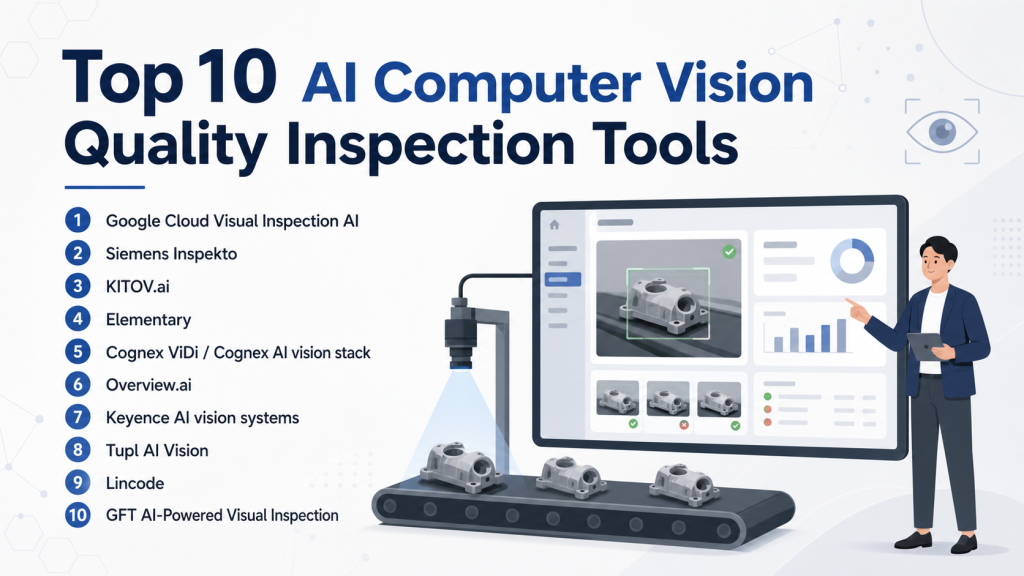
Top 10 AI Computer Vision Quality Inspection Tools
1. Google Cloud Visual Inspection AI
One line verdict: Best for manufacturers wanting a cloud-backed visual inspection platform with broad industrial applicability.
Short description:
Google Cloud Visual Inspection AI helps manufacturers improve quality control by automatically detecting product defects using computer vision. It is best suited to organizations that want a scalable AI platform for production quality workflows across use cases such as electronics, automotive, and semiconductor manufacturing.
Standout Capabilities
- Automatic defect detection for manufacturing quality control.
- Broad relevance across discrete manufacturing sectors.
- Can be deployed on premises or in the cloud according to reviewed material.
- Supports plant-manager visibility through operational dashboards.
- Useful for scaling visual inspection across multiple lines or fabs.
- Strong fit for organizations already using cloud AI ecosystems.
AI Specific Depth
- Model support: Proprietary Google AI platform; BYO model flexibility not publicly stated in reviewed material.
- Knowledge integration: Visual inspection images and operational dashboards are public; broader MES/QMS connectors not fully detailed in reviewed material.
- Evaluation: Public materials emphasize significant ROI and avoidable production quality cost reduction, but exact benchmark methods vary by use case.
- Guardrails: Not publicly stated in detail in reviewed material.
- Observability: Dashboard-based line visibility is publicly referenced.
Pros
- Strong platform credibility and scalability.
- Flexible deployment signal for cloud and on-prem environments.
- Good fit for large manufacturers with varied inspection use cases.
Cons
- Public security and governance detail were not fully reviewed here.
- May require stronger internal technical capability than turnkey appliance-style tools.
- Exact pricing model was not publicly verified in reviewed material.
Security and Compliance
Not publicly stated in the reviewed material for this comparison.
Deployment and Platforms
Public reviewed material indicates the model can run autonomously on premises or in the cloud. Other platform and OS details were not publicly stated in the reviewed material.
Integrations and Ecosystem
Google Cloud Visual Inspection AI is most compelling when visual inspection is part of a broader data, analytics, and digital manufacturing strategy.
- Operational dashboards.
- Cloud AI ecosystem relevance.
- Multi-line deployment potential.
- Manufacturing quality workflows.
Pricing Model
Best Fit Scenarios
- Multi-factory quality transformation programs.
- Electronics, automotive, and semiconductor inspection.
- Teams comfortable with cloud platform adoption.
2. Siemens Inspekto
One line verdict: Best for manufacturers wanting ready-to-use AI visual inspection with fast setup and lower AI complexity.
Short description:
Siemens Inspekto is presented as a ready-to-use AI-based visual inspection system that enables out-of-the-box quality inspection for industry. It is best suited to manufacturers that want a more packaged product and do not want to depend on in-house AI or machine vision specialists.
Standout Capabilities
- Ready-to-use AI-based visual inspection.
- Out-of-the-box deployment orientation.
- Requires no expertise in vision solutions or AI according to the vendor page.
- Designed for quick setup and easy scaling.
- Provides connectivity to existing automation systems.
- Appropriate for demanding industrial use cases despite simpler onboarding.
AI Specific Depth
- Model support: Proprietary AI inspection platform; BYO model support not publicly stated.
- Knowledge integration: Existing automation system connectivity is publicly stated.
- Evaluation: Public material emphasizes ease of setup and scale rather than benchmark metrics.
- Guardrails: Not publicly stated in reviewed material.
- Observability: Not publicly stated in detail.
Pros
- One of the clearest turnkey offerings in the category.
- Good fit for plants without deep AI talent.
- Strong automation connectivity signal.
Cons
- Public detail on model explainability and false positive management is limited.
- Exact deployment architecture and pricing are not publicly stated.
- Advanced customization depth may need direct validation.
Security and Compliance
Not publicly stated in the reviewed material for this comparison.
Deployment and Platforms
Not fully publicly stated in the reviewed material. Connectivity to existing automation systems is publicly stated.
Integrations and Ecosystem
Inspekto is most attractive for plants that want an easier adoption path and value packaged deployment over building a broader custom vision stack.
- Existing automation system connectivity.
- Easy deployment orientation.
- Scalable setup.
- Siemens industrial ecosystem relevance.
Pricing Model
Best Fit Scenarios
- Plants without internal AI or vision experts.
- Fast pilot-to-production inspection rollouts.
- Manufacturers seeking turnkey inspection.
3. KITOV.ai
One line verdict: Best for complex parts and 3D inspection workflows needing open, CAD-aware AI inspection planning.
Short description:
KITOV.ai offers AI-powered visual inspection for complex parts and products, with strong emphasis on automated CAD-based inspection planning and hybrid AI plus classical 3D computer vision. It is well suited to manufacturers handling complex geometries and multi-defect inspection tasks.
Standout Capabilities
- AI-powered quality discovery for complex parts and products.
- Automated CAD-based visual inspection planning.
- Open platform for integration with existing hardware and processes.
- Hybrid AI and classical 3D computer vision approach.
- Handles cosmetic and mechanical defects in 3D structures.
- Learns over time from corrected defect decisions.
AI Specific Depth
- Model support: Hybrid AI plus classical 3D computer vision.
- Knowledge integration: CAD-based planning and integration with existing production processes and best-in-breed hardware are public.
- Evaluation: Public material emphasizes reduced inspection errors and learning from feedback, but formal benchmark figures were not publicly stated.
- Guardrails: Human correction feedback loop is publicly described.
- Observability: Manufacturing insight discovery is part of product positioning, but deeper trace metrics are not publicly stated.
Pros
- Strong fit for complex manufactured parts.
- Open platform positioning helps reduce hardware lock-in.
- Valuable for both defect detection and inspection planning.
Cons
- May be more complex to implement than turnkey packaged systems.
- Public pricing and security details are not stated.
- Best fit is strongest where CAD and 3D complexity matter.
Security and Compliance
Not publicly stated in the reviewed material for this comparison.
Deployment and Platforms
Not publicly stated in the reviewed material.
Integrations and Ecosystem
KITOV.ai is strongest for system integrators, planners, and manufacturers building inspection systems around complex products and existing hardware ecosystems.
- CAD-based inspection planning.
- Existing production process integration.
- Best-in-breed detector and hardware compatibility.
- Open platform architecture.
Pricing Model
Best Fit Scenarios
- Complex part manufacturing.
- 3D inspection and metrology-adjacent workflows.
- Manufacturers needing hybrid AI plus classical vision.
4. Elementary
One line verdict: Best for operations teams that want production-line AI vision tied closely to manufacturing quality data.
Short description:
Elementary appears in manufacturing machine vision comparisons as a leading vendor purpose-built for manufacturing quality inspection. It is most relevant to teams that want AI inspection connected to broader production quality workflows rather than only a stand-alone camera system.
Standout Capabilities
- Recognized among leading machine vision systems for manufacturing.
- Purpose-built relevance for quality inspection.
- Strong category fit for production environments.
- Good shortlist option for manufacturers comparing modern AI-native tools to classic machine vision brands.
- Broad relevance across factory quality use cases.
AI Specific Depth
- Model support: Not publicly stated in detail in reviewed material here.
- Knowledge integration: Manufacturing quality inspection context is public, but specific connectors were not reviewed here.
- Evaluation: Not publicly stated in detail in reviewed material here.
- Guardrails: Not publicly stated.
- Observability: Not publicly stated.
Pros
- Strong manufacturing-specific positioning.
- Good alternative to older machine vision approaches.
- Relevant for teams comparing AI-native inspection options.
Cons
- Public feature depth in reviewed material is limited.
- Security, deployment, and pricing details were not verified here.
- Buyers should validate exact workflow integration and defect-handling depth.
Security and Compliance
Not publicly stated in the reviewed material.
Deployment and Platforms
Not publicly stated in the reviewed material.
Integrations and Ecosystem
Elementary is most relevant when a buyer wants a manufacturing-focused AI inspection platform rather than only a component vendor.
- Manufacturing inspection orientation.
- Category comparison relevance.
- AI-native vision shortlist fit.
- Factory quality workflow applicability.
Pricing Model
Best Fit Scenarios
- Manufacturers modernizing from classical machine vision.
- Production quality teams evaluating AI-first platforms.
- Plants wanting quality inspection tied to operations data.
5. Cognex ViDi / Cognex AI vision stack
One line verdict: Best for high-volume manufacturers that want AI inspection from an established machine vision leader.
Short description:
Cognex remains one of the most recognizable names in machine vision, and reviewed comparison material highlights Cognex ViDi as a strong deep learning platform for high-volume applications. It is a good fit for manufacturers that need industrial vision maturity and are comfortable with more traditional enterprise-grade implementation patterns.
Standout Capabilities
- Deep learning platform from an established machine vision leader.
- Strong fit for high-volume, high-speed applications.
- Industrial credibility from decades in machine vision.
- Good for manufacturers that want vendor stability.
- Relevant to consistency-heavy production lines.
AI Specific Depth
- Model support: Proprietary deep learning platform.
- Knowledge integration: Not publicly stated in detail in reviewed material here.
- Evaluation: Reviewed comparison notes strong performance for consistency-critical environments, but also longer setup and more training data needs than some newer tools.
- Guardrails: Not publicly stated.
- Observability: Not publicly stated.
Pros
- Strong industrial reputation.
- Good fit for high-volume applications.
- Likely more comfortable for buyers already familiar with machine vision procurement.
Cons
- Reviewed material suggests more training data and longer setup times than some newer systems.
- Price point may be high for smaller manufacturers according to reviewed comparison material.
- Public AI workflow specifics were limited in reviewed material here.
Security and Compliance
Not publicly stated in the reviewed material for this comparison.
Deployment and Platforms
Edge processing is described as limited in reviewed comparison material. Other deployment specifics were not publicly stated.
Integrations and Ecosystem
Cognex is best suited to buyers who value machine vision maturity and ecosystem familiarity over the lightest setup path.
- Deep learning inspection stack.
- High-volume manufacturing fit.
- Machine vision leadership heritage.
- Enterprise procurement familiarity.
Pricing Model
Best Fit Scenarios
- High-volume production lines.
- Manufacturers already familiar with Cognex infrastructure.
- Teams prioritizing industrial vendor maturity.
6. Overview.ai
One line verdict: Best for fast edge-based deployment with low sample requirements and simple factory rollout.
Short description:
Overview.ai is presented in reviewed comparison content as a leading industrial AI vision system with edge computing built into the camera and fast training using very small sample sets. It is attractive to manufacturers that care about speed to value, on-device processing, and limited cloud dependence.
Standout Capabilities
- Edge computing with NVIDIA GPU built into each camera according to reviewed comparison material.
- Training with as few as 5 example images in under an hour according to the same source.
- On-device processing keeps data on site.
- Designed for rapid deployment and low recurring software dependence.
- Reported fit across many industries.
AI Specific Depth
- Model support: Proprietary edge AI system.
- Knowledge integration: Edge device inspection context is public, broader enterprise connector detail was not publicly reviewed here.
- Evaluation: Reviewed comparison cites faster deployment, lower cost of ownership, and customer-reported inspection improvements, but these claims come from a vendor-comparison source and should be validated in pilot.
- Guardrails: Not publicly stated in detail.
- Observability: On-device processing is public; deeper model trace features were not publicly stated.
Pros
- Very strong speed-to-value positioning.
- Attractive for privacy and latency sensitive plants.
- Good fit for teams with limited defect image volume.
Cons
- Reviewed evidence comes from a comparison source, not primary vendor docs.
- Broader integration details need direct verification.
- Public security and compliance specifics were not reviewed here.
Security and Compliance
Not publicly stated in the reviewed material.
Deployment and Platforms
Edge processing is explicitly described in reviewed comparison material.
Integrations and Ecosystem
Overview.ai is most attractive for teams seeking edge-native inspection without large cloud dependency or long data-preparation projects.
Pricing Model
Not publicly stated in reviewed material.
Best Fit Scenarios
- Fast pilot deployments.
- Sites with privacy or latency constraints.
- Teams with small initial training datasets.
7. Keyence AI vision systems
One line verdict: Best for manufacturers combining defect detection with precision measurement and sensor-heavy inspection.
Short description:
Keyence is highlighted in reviewed comparisons as a strong option for applications requiring both defect detection and precise dimensional measurement. It is particularly relevant in electronics and semiconductor contexts where sensor precision and inspection repeatability matter.
Standout Capabilities
- Strong fit for precision measurement plus defect detection.
- Good relevance in electronics and semiconductor manufacturing.
- Benefits from Keyence sensor and inspection heritage.
- Suitable for applications where metrology and quality inspection overlap.
- Established vendor familiarity in factory automation.
AI Specific Depth
- Model support: Proprietary AI vision capabilities are implied in reviewed comparison material.
- Knowledge integration: Not publicly stated in detail in reviewed material here.
- Evaluation: Reviewed source positions Keyence strongly for precision-focused use cases, but detailed benchmarks were not provided.
- Guardrails: Not publicly stated.
- Observability: Not publicly stated.
Pros
- Strong measurement-oriented inspection fit.
- Good brand familiarity in industrial environments.
- Relevant to precision manufacturing.
Cons
- Public AI workflow depth was limited in reviewed material here.
- Pricing and deployment details were not verified.
- May be best for specific use cases rather than general anomaly inspection.
Security and Compliance
Not publicly stated in the reviewed material.
Deployment and Platforms
Reviewed comparison notes edge processing support. Other platform details were not publicly stated.
Integrations and Ecosystem
Keyence is strongest for teams that already work within automation-heavy inspection environments and want precise sensor-driven quality control.
- Precision measurement relevance.
- Electronics and semiconductor fit.
- Automation vendor familiarity.
- Sensor-led inspection workflows.
Pricing Model
Best Fit Scenarios
- Semiconductor inspection.
- Electronics manufacturing.
- Quality workflows needing measurement plus defect detection.
8. Tupl AI Vision
One line verdict: Best for manufacturers trying to reduce scrap and automate manual inspection with current-generation AI vision.
Short description:
Tupl AI Vision is positioned as a manufacturing-focused AI vision product that helps reduce scrap, protect margins, and automate manual inspection. It is best suited to teams that want defect-rate reduction and quality automation with a direct operations ROI focus.
Standout Capabilities
- Focus on reducing scrap and protecting margins.
- Automates manual inspection workflows.
- Aims to improve detection accuracy and consistency.
- Strong operations and ROI framing.
- Well aligned with manufacturers facing rising quality demands.
AI Specific Depth
- Model support: AI vision is publicly stated; exact model flexibility not publicly stated.
- Knowledge integration: Not publicly stated in reviewed material here.
- Evaluation: Public positioning emphasizes more accurate defect detection and defect-rate reduction, but formal benchmark detail was not publicly stated.
- Guardrails: Not publicly stated.
- Observability: Not publicly stated.
Pros
- Clear business value framing.
- Good fit for scrap and yield improvement initiatives.
- Relevant for automating manual inspection bottlenecks.
Cons
- Public technical depth is limited.
- Integration and deployment specifics were not publicly reviewed here.
- Security and compliance detail is not publicly stated in reviewed material.
Security and Compliance
Not publicly stated in the reviewed material.
Deployment and Platforms
Not publicly stated in the reviewed material.
Integrations and Ecosystem
Tupl appears most relevant for manufacturers starting from manual inspection pain and looking for measurable quality and scrap reduction.
- Manual inspection automation.
- Scrap reduction focus.
- Margin protection relevance.
- Manufacturing quality ROI orientation.
Pricing Model
Best Fit Scenarios
9. Lincode
One line verdict: Best for manufacturers wanting an AI inspection platform with real-time defect detection and straightforward positioning.
Short description:
Lincode positions itself as an AI inspection system for manufacturing that helps detect defects, ensure quality, and reduce errors in real time. It is best suited to teams that want an AI visual inspection platform focused directly on manufacturing quality outcomes.
Standout Capabilities
- AI visual inspection for manufacturing.
- Real-time defect detection.
- Focus on ensuring quality and reducing errors.
- Clear platform-style positioning rather than only custom services.
- Relevant for manufacturing efficiency improvements.
AI Specific Depth
- Model support: AI visual inspection platform; exact model flexibility not publicly stated.
- Knowledge integration: Not publicly stated in reviewed material here.
- Evaluation: Public messaging emphasizes efficiency and defect reduction, but detailed benchmarks were not publicly stated.
- Guardrails: Not publicly stated.
- Observability: Real-time detection is public; deeper technical observability not publicly stated.
Pros
- Clear manufacturing-specific messaging.
- Good shortlist option for real-time inspection use cases.
- Straightforward value proposition.
Cons
- Public detail on integrations, deployment, and governance is limited.
- Security and compliance specifics were not verified.
- Requires direct product validation against better-known incumbents.
Security and Compliance
Not publicly stated in the reviewed material.
Deployment and Platforms
Not publicly stated in the reviewed material.
Integrations and Ecosystem
Lincode is most relevant as a focused AI inspection platform for manufacturers that want clear defect-detection outcomes without starting from a complex platform ecosystem.
- Real-time defect detection.
- Manufacturing efficiency focus.
- Quality assurance orientation.
- AI inspection platform positioning.
Pricing Model
Best Fit Scenarios
- Real-time line inspection.
- Quality-driven efficiency improvement.
- Manufacturers evaluating newer AI vision vendors.
10. GFT AI-Powered Visual Inspection
One line verdict: Best for enterprises wanting AI visual inspection as part of broader digital transformation and custom delivery.
Short description:
GFT offers AI-powered visual inspection focused on detecting defects in real time and supporting quality outcomes across manufacturing, automotive, food, packaging, and logistics. It is best suited to enterprises that may want a solution plus services approach rather than only a packaged inspection product.
Standout Capabilities
- Real-time defect detection.
- Cross-industry relevance from manufacturing to logistics.
- Emphasis on near-zero defects and less waste.
- Useful for smarter operations that scale across sites.
- Good fit for enterprises already undertaking broader digital programs.
AI Specific Depth
- Model support: Computer vision and machine learning are publicly stated.
- Knowledge integration: Cross-site operational scaling is public, though exact factory system connectors were not publicly detailed here.
- Evaluation: Public messaging highlights less waste and better quality outcomes, but formal benchmark details were not publicly stated.
- Guardrails: Not publicly stated.
- Observability: Not publicly stated in detail.
Pros
- Broad industry applicability.
- Strong transformation-oriented messaging.
- Good fit for multi-site operational programs.
Cons
- May be more services-led than turnkey packaged buyers want.
- Public product depth and pricing transparency are limited.
- Exact deployment architecture needs direct validation.
Security and Compliance
Not publicly stated in the reviewed material.
Deployment and Platforms
Not publicly stated in the reviewed material.
Integrations and Ecosystem
GFT is best suited to organizations that want AI inspection as part of a wider operational transformation effort rather than only a narrow camera-level deployment.
- Cross-industry deployment relevance.
- Real-time defect detection.
- Multi-site operations angle.
- Transformation services context.
Pricing Model
Best Fit Scenarios
- Enterprise digital quality programs.
- Multi-site visual inspection standardization.
- Organizations preferring solution plus services delivery.
Comparison Table
Scoring and Evaluation
The scores below are comparative and based on public evidence of deployment readiness, inspection fit, ease of adoption, integration signals, and AI-specific practicality such as sample efficiency or hybrid vision support. Packaged or clearly positioned industrial products scored higher for ease and production readiness, while solutions with limited public detail or more services-heavy delivery scored more conservatively. In this market, public feature transparency varies widely, so lower scores often reflect lower verifiable detail rather than weak real-world capability.
| Tool | Core | Reliability and Eval | Guardrails | Integrations | Ease | Performance and Cost | Security and Admin | Support | Weighted Total |
|---|---|---|---|---|---|---|---|---|---|
| Google Cloud Visual Inspection AI | 9 | 7 | 5 | 8 | 6 | 7 | 5 | 8 | 7.10 |
| Siemens Inspekto | 8 | 6 | 5 | 7 | 9 | 8 | 5 | 7 | 7.20 |
| KITOV.ai | 9 | 7 | 6 | 8 | 6 | 7 | 5 | 6 | 7.20 |
| Elementary | 7 | 5 | 4 | 6 | 7 | 7 | 4 | 6 | 5.95 |
| Cognex ViDi | 8 | 7 | 5 | 7 | 6 | 6 | 5 | 8 | 6.75 |
| Overview.ai | 8 | 7 | 5 | 6 | 9 | 8 | 4 | 6 | 7.15 |
| Keyence | 8 | 6 | 4 | 6 | 7 | 7 | 4 | 7 | 6.40 |
| Tupl AI Vision | 7 | 5 | 4 | 5 | 7 | 7 | 4 | 5 | 5.80 |
| Lincode | 7 | 5 | 4 | 5 | 7 | 7 | 4 | 5 | 5.80 |
| GFT Visual Inspection | 7 | 5 | 4 | 6 | 6 | 6 | 4 | 6 | 5.70 |
- Top 3 for Enterprise: Google Cloud Visual Inspection AI, KITOV.ai, Siemens Inspekto.
- Top 3 for SMB: Siemens Inspekto, Overview.ai, Tupl AI Vision.
- Top 3 for Developers: KITOV.ai, Google Cloud Visual Inspection AI, Overview.ai.
Which Tool Is Right for You
Solo and Small Teams
Very small manufacturers should avoid overbuilding. A packaged tool with quick setup, such as Siemens Inspekto or a simpler edge system, is usually a better fit than a broad platform requiring larger data and integration programs.
SMB
Small and mid-sized manufacturers usually need faster rollout, lower labeling burden, and simpler operational support. Siemens Inspekto, Overview.ai, and Tupl AI Vision are the most practical options in the reviewed set for teams focused on reducing scrap and replacing manual inspection quickly.
Mid Market
Mid-market manufacturers often need a balance of usability and integration depth. Google Cloud Visual Inspection AI and Cognex-style deployments make sense when the team expects multiple inspection use cases and wants stronger long-term scalability.
Enterprise
Large enterprises should prioritize integration, multi-line scalability, product variation handling, and governance over flashy demos. Google Cloud Visual Inspection AI, KITOV.ai, and Siemens Inspekto stand out when the goal is to scale across lines, plants, or complex product families.
Regulated Industries
In regulated or high-risk sectors, traceability, evidence capture, and stable false-positive management matter at least as much as raw detection performance. Tools that support structured deployment and repeatability, such as Google Cloud’s platform approach or turnkey industrial systems like Inspekto, are generally safer starting points than loosely defined custom stacks.
Budget vs Premium
Budget-focused buyers should start with one inspection station, one defect family, and one clear business target such as scrap reduction or manual inspection replacement. Premium buyers can justify broader platforms and hybrid 3D systems when product complexity, traceability needs, or multi-site rollouts create long-term leverage.
Build vs Buy
Build only when your inspection problem is highly specialized and your team has strong imaging, data, and line integration expertise. Most manufacturers should buy first, because success in this category depends as much on deployment speed, operator trust, lighting setup, and workflow fit as on the model itself.
Implementation Playbook
First 30 Days
Choose one inspection task with high business pain, such as surface scratches, label defects, missing components, or assembly verification. Define success metrics before the pilot starts, including defect escape rate, false positives, manual inspection reduction, scrap cost, and cycle time impact.
Next 60 Days
Standardize imaging conditions, capture good and bad samples, and connect the system to the minimum production workflow needed for decisions and logging. Validate whether the model handles normal product variation, not just ideal examples, and ensure operators know how to review and act on flagged defects.
Next 90 Days
Expand only after the first use case performs reliably in production. Add retraining processes, traceable audit logs, escalation rules, and feedback loops into MES or QMS systems so the inspection output improves continuously rather than remaining a one-off pilot.
Common Mistakes and How to Avoid Them
- Starting with poor lighting and inconsistent imaging.
- Piloting with too few realistic examples of normal variation.
- Treating defect detection accuracy as the only KPI.
- Ignoring false positives and operator trust.
- Choosing a vendor before checking PLC, MES, or QMS integration.
- Underestimating labeling and data-preparation effort.
- Trying to inspect too many defect classes at once.
- Assuming AI will fix a weak imaging setup.
- Running pilots with demo samples instead of production-line variability.
- Skipping traceability and evidence storage in regulated environments.
FAQs
1. What are AI computer vision quality inspection tools
They are software and hardware systems that use AI and computer vision to inspect products, detect defects, and automate quality control from images or video.
2. How are they different from traditional machine vision
Traditional machine vision depends more on fixed rules and thresholds, while AI vision can learn from examples and handle more complex or variable defect patterns.
3. Do these tools work only in manufacturing
Most category leaders focus on manufacturing, but similar approaches are also used in packaging, logistics, and related inspection-heavy industries.
4. Do I need thousands of defect images
Not always. Some modern systems and comparison sources highlight lower sample requirements, especially for anomaly detection or fast-training edge systems.
5. Can these systems run on the edge
Yes. Some platforms explicitly support edge deployment, and reviewed material indicates certain tools can run on premises or with on-device GPUs.
6. What is the biggest implementation risk
The biggest risk is poor imaging and production variability, because even good models perform badly when lighting, positioning, or sample quality are inconsistent.
7. Are these tools good for unknown defects
Some are, especially those that support anomaly detection rather than only supervised defect classification. That makes them more useful when defect examples are rare or changing.
8. What should I pilot first
Pilot one high-value defect class or assembly check with clear business value, stable imaging conditions, and enough production samples to test real variability.
9. Are public ratings available for these tools
Reliable public ratings were not confidently verified for most tools in this comparison, so the table uses N A instead of guessing.
10. When should a company build instead of buy
A company should build when the inspection problem is highly specialized, the line environment is unusual, and the team has strong internal machine vision and production engineering expertise.
11. What does success look like
Success means fewer escaped defects, fewer false rejects, less manual inspection effort, lower scrap, and higher confidence that inspection results can scale across lines.
12. Can AI vision replace inspectors completely
Usually not at first. In most factories, the best results come from using AI to automate routine visual checks while humans handle exceptions, audits, and edge cases until the system proves itself.
Conclusion
The best AI computer vision quality inspection tool depends on whether your factory needs turnkey deployment, edge-native speed, cloud-backed scale, hybrid 3D inspection, or tight alignment with broader digital manufacturing systems. Siemens Inspekto and Overview.ai look strongest for fast operational rollout, KITOV.ai stands out for complex parts, and Google Cloud Visual Inspection AI is compelling for larger platform-driven quality programs. The smartest buying path is to start with one costly inspection problem, validate the imaging setup and false-positive behavior on real production samples, connect the result into actual quality workflows, and scale only after the system consistently improves defect detection without creating operational friction.

Find Trusted Cardiac Hospitals
Compare heart hospitals by city and services — all in one place.
Explore Hospitals
Computer vision inspection tools are powerful, but real accuracy depends on lighting consistency, camera calibration, and handling edge-case defects in production.