
Introduction
AI Inventory Optimization for Plants helps manufacturers maintain optimal stock levels of raw materials, work in progress, spare parts, and finished goods. These tools use artificial intelligence, machine learning, demand forecasting, supply chain data, and production schedules to recommend better reorder points, safety stock levels, and replenishment decisions.
Why It Matters: Inefficient inventory can lead to production delays, excess carrying costs, stockouts, obsolescence, and poor cash flow. Traditional inventory management relies on fixed reorder points or historical averages that often fail to respond to real-time demand fluctuations, supplier delays, or production schedule changes. AI-driven inventory optimization predicts material needs, dynamically adjusts safety stock, detects shortage risks, and balances inventory across multiple sites. This ensures smoother production, lower costs, higher service levels, and improved working capital utilization.
Real World Use Cases:
- Predicting raw material and component requirements based on production schedules
- Optimizing spare parts inventory for maintenance teams
- Reducing stockouts that halt production lines
- Identifying excess and obsolete inventory
- Dynamically adjusting safety stock levels based on demand variability
- Recommending replenishment quantities and timing
- Balancing inventory across multiple plants
- Planning interplant transfers
- Managing supplier lead time variability
- Supporting lean and just-in-time production
- Improving material availability for high-priority orders
- Reducing emergency purchase costs
- Optimizing inventory for high-value components
- Improving inventory turns and cash flow
- Scenario planning for supply disruptions
Evaluation Criteria for Buyers:
- AI/ML forecasting accuracy
- Real-time inventory visibility
- ERP, MES, WMS, and procurement system integration
- Multi-site inventory management
- Dynamic safety stock and reorder point calculation
- Replenishment optimization
- Lead time and supplier variability handling
- Support for raw materials, WIP, and finished goods
- Scenario planning and what-if analysis
- Historical trend analysis and reporting
- Inventory cost optimization
- Planner dashboards and alerts
- Role-based access and audit logs
- Scalability across plants, SKUs, and suppliers
- Ease of use for planners and operations teams
Best For: Manufacturing plants, production planners, inventory managers, supply chain teams, maintenance planners, and procurement teams seeking AI-driven predictive inventory decisions.
Not Ideal For: Very small plants with low SKU count or minimal inventory risk. Operations with poor data capture or inconsistent ERP/MES records may not benefit fully.
What’s Changed in AI Inventory Optimization
- Dynamic inventory planning is replacing static reorder points
- AI now integrates real-time production, demand, and supplier signals
- Safety stock levels are becoming adaptive to risk and variability
- Multi-site inventory balancing and interplant transfers are automated
- Spare parts inventory is optimized with criticality and maintenance data
- Scenario simulations help plan for demand spikes or supply disruptions
- AI alerts prevent stockouts and overstock before production impact
- Integration with MES and production schedules improves accuracy
- Obsolete and slow-moving inventory is automatically detected
- Supplier reliability and lead times are incorporated in replenishment
- Cloud platforms enable enterprise-wide inventory visibility
- Recommendations include human review for planner trust
- Inventory decisions are increasingly linked with working capital optimization
- AI supports lean operations while minimizing shortage risks
- Explainable AI recommendations are becoming standard
Quick Buyer Checklist
- ERP and MES system compatibility
- Real-time visibility across plants
- Multi-site inventory balancing
- Dynamic safety stock recommendations
- Reorder point optimization
- Supplier lead-time variability handling
- Replenishment automation
- Alerts for stockouts and overstock
- Scenario and what-if analysis
- Historical trend reporting
- Optimization of order quantities and lot sizes
- Security and role-based access
- Scalability across SKUs and plants
- Ease of use for planners
- Integration with production schedules
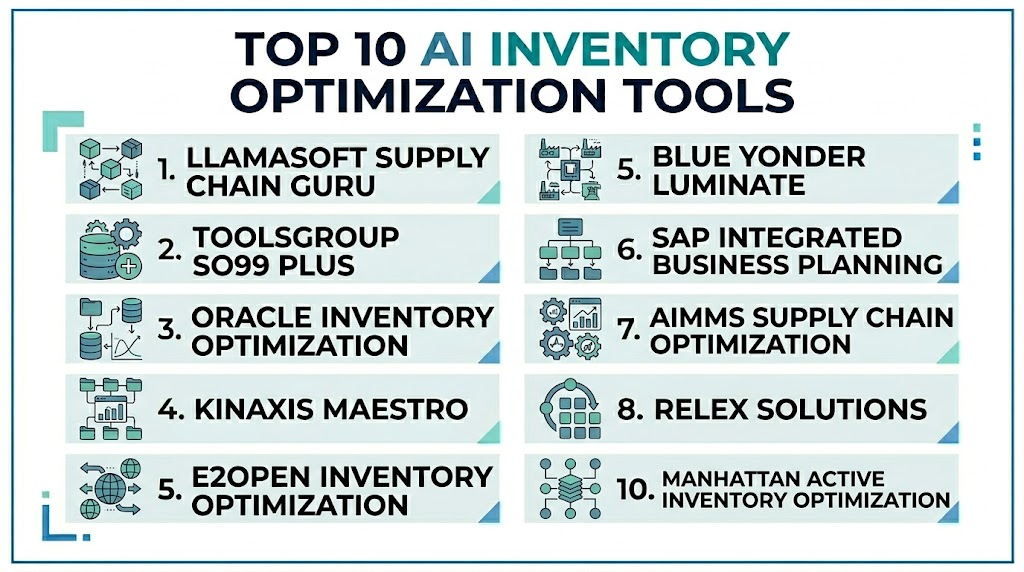
Top 10 AI Inventory Optimization Tools
1- Llamasoft Supply Chain Guru
One-Line Verdict: Enterprise-grade tool for multi-site inventory optimization and scenario-based planning.
Short Description: Optimizes inventory across plants and warehouses using AI-driven multi-echelon modeling, scenario simulations, and safety stock recommendations.
Standout Capabilities
- Multi-echelon inventory optimization
- Scenario simulation for supply and demand variability
- Safety stock modeling
- Supplier lead-time analysis
- Cost/service trade-off analysis
- Network design and inventory placement
- KPI dashboards
- Alerts for inventory risk
AI-Specific Depth
- Model support: Proprietary AI and optimization models
- Knowledge integration: ERP, MES, supplier data, production schedules
- Evaluation: Forecast error, inventory KPIs, service levels
- Guardrails: Safety stock thresholds, scenario constraints, planner review
- Observability: Dashboards, KPI tracking, simulation reports
Pros
- Handles complex multi-site networks
- Excellent scenario planning
- Balances cost, service, and risk
Cons
- Requires clean data
- Implementation can be complex
- High cost for smaller plants
Deployment & Platforms
Cloud, hybrid, web dashboards
Integrations & Ecosystem
ERP, MES, WMS, procurement systems, supplier data, supply chain planning tools
Pricing Model
Enterprise subscription
Best-Fit Scenarios
- Multi-plant optimization
- Scenario-based planning
- Supplier network inventory balancing
2- ToolsGroup SO99 Plus
One-Line Verdict: AI-driven forecasting and replenishment planning for mid-sized plants.
Short Description: Optimizes inventory using demand sensing, probabilistic forecasting, and multi-site safety stock planning.
Standout Capabilities
- AI demand forecasting
- Safety stock optimization
- Automated replenishment
- Multi-location inventory management
- Exception alerts
- Scenario simulations
- Planner dashboards
- Service-level optimization
AI-Specific Depth
- Model support: Proprietary AI and ML models
- Knowledge integration: ERP, demand, production, supplier data
- Evaluation: Forecast accuracy, inventory turns, service levels
- Guardrails: Approval workflows, thresholds, exception handling
- Observability: Dashboards, alerts, KPI reports
Pros
- Reduces stockouts and overstock
- Multi-site inventory visibility
- Strong forecasting capability
Cons
- Configuration requires effort
- Learning curve for planners
- Relies on clean historical data
Deployment & Platforms
Cloud, web dashboards
Integrations & Ecosystem
ERP, MES, WMS, supplier and procurement systems
Pricing Model
Subscription
Best-Fit Scenarios
- Forecast-driven replenishment
- Safety stock optimization
- Multi-site inventory management
3- Oracle Inventory Optimization
One-Line Verdict: Best for Oracle ERP plants needing AI-enhanced inventory planning.
Short Description: Provides AI-driven safety stock, replenishment recommendations, and multi-site inventory optimization integrated with Oracle ERP.
Standout Capabilities
- Predictive replenishment
- Multi-site visibility
- Scenario analysis
- Safety stock calculation
- Service-level optimization
- Alerts for shortages and excess
- ERP integration
- Inventory dashboards
AI-Specific Depth
- Model support: Proprietary AI
- Knowledge integration: Oracle ERP, production, supplier, inventory data
- Evaluation: Inventory cost, service levels, shortage risk
- Guardrails: Planner review, policy thresholds
- Observability: Dashboards, alerts, KPI reports
Pros
- Strong ERP integration
- Enterprise-grade forecasting
- Supports multi-site planning
Cons
- Best value inside Oracle ERP
- Complex configuration
- May be costly for SMBs
Deployment & Platforms
Cloud, hybrid, web dashboards
Integrations & Ecosystem
Oracle ERP, SCM, WMS, procurement systems
Pricing Model
Enterprise subscription
Best-Fit Scenarios
- Oracle ERP integrated plants
- Multi-site optimization
- Enterprise-level inventory planning
4- Kinaxis Maestro
One-Line Verdict: Best for fast scenario-based planning and multi-site inventory response.
Short Description: Provides demand planning, inventory management, and scenario simulation for plants and supply chain teams.
Standout Capabilities
- Multi-site inventory optimization
- Scenario simulations
- Demand and supply balancing
- Material availability monitoring
- Exception management
- Supplier risk visibility
- KPI dashboards
- Planner alerts
AI-Specific Depth
- Model support: Proprietary AI-assisted analytics
- Knowledge integration: ERP, demand plans, production schedules
- Evaluation: Inventory KPIs, service level metrics
- Guardrails: Planner review, inventory constraints
- Observability: Dashboards, scenario outputs, alerts
Pros
- Fast planning response
- Strong scenario analysis
- Connects inventory with supply chain decisions
Cons
- Requires mature planning processes
- Implementation effort significant
- Advanced scenarios require training
Deployment & Platforms
Cloud, web dashboards
Integrations & Ecosystem
ERP, MES, procurement, supplier systems
Pricing Model
Enterprise subscription
Best-Fit Scenarios
- Material shortage response
- Multi-site inventory planning
- Scenario-based planning
5- Blue Yonder Luminate
One-Line Verdict: Best for large plants needing predictive demand and replenishment planning.
Short Description: Optimizes inventory using AI demand sensing, replenishment recommendations, and scenario analysis across plants and warehouses.
Standout Capabilities
- AI demand sensing
- Inventory optimization
- Replenishment automation
- Multi-site planning
- Scenario simulation
- Alerts for shortages
- Exception handling
- Service-level monitoring
AI-Specific Depth
- Model support: Proprietary AI models
- Knowledge integration: ERP, demand signals, production schedules
- Evaluation: Forecast accuracy, inventory turns
- Guardrails: Thresholds, planner review
- Observability: Dashboards, alerts, KPI reports
Pros
- Strong AI forecasting
- Reduces stockouts and overstock
- Supports multi-site operations
Cons
- Implementation effort
- Requires mature planning teams
- High cost
Deployment & Platforms
Cloud, web dashboards
Integrations & Ecosystem
ERP, MES, WMS, demand planning
Pricing Model
Enterprise subscription
Best-Fit Scenarios
- Forecast-driven inventory
- Multi-site planning
- Replenishment optimization
6- SAP Integrated Business Planning
One-Line Verdict: Best for SAP ERP plants needing inventory optimization connected to supply planning.
Short Description: Supports demand, supply, and inventory planning with AI-driven recommendations in SAP ERP environments.
Standout Capabilities
- Inventory optimization
- Safety stock planning
- Scenario analysis
- Demand and supply planning
- ERP integration
- Exception alerts
- Planner dashboards
- KPI monitoring
AI-Specific Depth
- Model support: SAP planning analytics
- Knowledge integration: SAP ERP, production, supplier, inventory data
- Evaluation: Forecast accuracy, inventory cost, service levels
- Guardrails: Policy thresholds, approvals
- Observability: Dashboards, alerts, KPI reports
Pros
- Strong SAP ecosystem integration
- Enterprise-grade analytics
- Multi-site inventory planning
Cons
- Complex implementation
- SAP ERP dependency
- Requires planning maturity
Deployment & Platforms
Cloud, web dashboards
Integrations & Ecosystem
SAP ERP, MES, procurement, production planning
Pricing Model
Enterprise subscription
Best-Fit Scenarios
- SAP ERP integrated plants
- Multi-plant planning
- Enterprise-level inventory optimization
7- AIMMS Supply Chain Optimization
One-Line Verdict: Best for custom optimization modeling for complex plant inventory scenarios.
Short Description: Helps organizations build optimization models for inventory, network design, and scenario analysis for complex plants.
Standout Capabilities
- Custom optimization modeling
- Multi-scenario planning
- Inventory and network design
- Safety stock calculation
- Cost/service trade-offs
- Planner dashboards
- Scenario simulations
- Decision support applications
AI-Specific Depth
- Model support: Proprietary AI modeling and analytics
- Knowledge integration: ERP, inventory, production, supplier data
- Evaluation: Scenario results, inventory cost, service levels
- Guardrails: Constraints, approvals, planning policies
- Observability: Dashboards, simulation outputs
Pros
- Highly flexible
- Supports complex constraints
- Advanced optimization capability
Cons
- Requires modeling expertise
- Not plug-and-play
- Needs internal skill
Deployment & Platforms
Cloud, on-premises, web dashboards
Integrations & Ecosystem
ERP, MES, WMS, analytics dashboards
Pricing Model
Project-based or enterprise licensing
Best-Fit Scenarios
- Custom inventory optimization
- Scenario-based planning
- Complex plant constraints
8- RELEX Solutions
One-Line Verdict: Best for plants with high SKU counts needing AI-driven replenishment and forecasting.
Short Description: Provides AI-based demand forecasting, inventory optimization, and replenishment recommendations across complex product networks.
Standout Capabilities
- Forecasting and replenishment
- Inventory balancing
- Multi-site planning
- Scenario simulation
- Exception alerts
- Planner dashboards
- Service-level monitoring
- Inventory optimization
AI-Specific Depth
- Model support: Proprietary AI/ML
- Knowledge integration: ERP, demand, production, supplier
- Evaluation: Forecast accuracy, stock availability
- Guardrails: Planner workflows, exception thresholds
- Observability: Dashboards, alerts, KPI reports
Pros
- High SKU management
- Accurate replenishment recommendations
- Exception planning support
Cons
- Integration effort for plants
- May require ERP alignment
- Not all MRP depth available
Deployment & Platforms
Cloud, web dashboards
Integrations & Ecosystem
ERP, WMS, MES, demand planning
Pricing Model
Enterprise subscription
Best-Fit Scenarios
- High SKU inventory management
- Replenishment optimization
- Exception-based inventory control
9- E2open Inventory Optimization
One-Line Verdict: Best for multi-plant and multi-supplier networks needing AI inventory optimization.
Short Description: Optimizes inventory positioning, replenishment, and planning across multi-enterprise networks and plants.
Standout Capabilities
- Multi-echelon optimization
- Supplier network visibility
- Replenishment recommendations
- Scenario simulations
- Inventory risk alerts
- Collaboration workflows
- Exception management
- Service-level monitoring
AI-Specific Depth
- Model support: Proprietary AI models
- Knowledge integration: ERP, supplier, production, inventory data
- Evaluation: Service levels, cost, stockout risk
- Guardrails: Policies, approvals, exception workflows
- Observability: Dashboards, KPI reporting
Pros
- Strong multi-plant optimization
- Supplier network coordination
- Supports enterprise inventory management
Cons
- Complex implementation
- Requires data maturity
- Integration effort may be high
Deployment & Platforms
Cloud, web dashboards
Integrations & Ecosystem
ERP, supplier systems, WMS, procurement, production
Pricing Model
Enterprise subscription
Best-Fit Scenarios
- Multi-supplier and multi-plant inventory
- Enterprise-level optimization
- Risk management and replenishment
10- Manhattan Active Inventory Optimization
One-Line Verdict: Best for large plants and facilities needing multi-echelon AI inventory optimization.
Short Description: Optimizes inventory availability, replenishment, and stock positioning across complex plant and warehouse networks.
Standout Capabilities
- Inventory optimization
- Multi-echelon planning
- Replenishment intelligence
- Demand and supply visibility
- Service-level planning
- Inventory balancing
- Exception management
- Cloud-native planning
AI-Specific Depth
- Model support: Proprietary AI and optimization
- Knowledge integration: ERP, WMS, production, demand, supplier data
- Evaluation: Service levels, inventory turns, stockout risk
- Guardrails: Planning rules, exception workflows
- Observability: Dashboards, alerts, KPI reports
Pros
- Large-scale multi-site inventory optimization
- Cloud-native and scalable
- Exception management for planners
Cons
- Best suited for enterprise-scale plants
- More distribution-focused
- Implementation requires planning expertise
Deployment & Platforms
Cloud, web dashboards
Integrations & Ecosystem
ERP, WMS, MES, demand planning, analytics
Pricing Model
Enterprise subscription
Best-Fit Scenarios
- Large multi-plant optimization
- Inventory balancing across facilities
- Replenishment planning
Comparison Table
| Tool | Best For | Deployment | Model Flexibility | Strength | Watch-Out | Public Rating |
|---|---|---|---|---|---|---|
| Llamasoft Supply Chain Guru | Multi-site optimization | Cloud/Hybrid | Proprietary AI | Scenario analysis | Complex setup | N/A |
| ToolsGroup SO99 Plus | Forecasting & replenishment | Cloud | Proprietary AI | Demand sensing | Data prep required | N/A |
| Oracle Inventory Optimization | ERP-integrated plants | Cloud/Hybrid | Proprietary AI | ERP seamless | Oracle-specific | N/A |
| Kinaxis Maestro | Fast scenario planning | Cloud | Proprietary AI | Rapid response | Implementation complexity | N/A |
| Blue Yonder Luminate | Predictive demand & replenishment | Cloud | Proprietary AI | Forecast accuracy | Cost | N/A |
| SAP Integrated Business Planning | SAP ERP plants | Cloud | Proprietary AI | ERP ecosystem | Complex configuration | N/A |
| AIMMS Supply Chain Optimization | Custom optimization | Cloud/On-prem | Proprietary/Custom AI | Flexibility | Requires modeling expertise | N/A |
| RELEX Solutions | High SKU environments | Cloud | Proprietary AI | Forecasting & replenishment | ERP alignment needed | N/A |
| E2open Inventory Optimization | Multi-supplier networks | Cloud | Proprietary AI | Multi-echelon optimization | Implementation effort | N/A |
| Manhattan Active Inventory Optimization | Large-scale plants | Cloud | Proprietary AI | Multi-echelon planning | Enterprise-focused | N/A |
Scoring & Evaluation
| Tool | Core Features | AI Analytics | Guardrails | Integrations | Ease | Perf/Cost | Security/Admin | Support | Weighted Total |
|---|---|---|---|---|---|---|---|---|---|
| Llamasoft Supply Chain Guru | 9 | 9 | 8 | 9 | 8 | 8 | 8 | 8 | 8.5 |
| ToolsGroup SO99 Plus | 8 | 9 | 8 | 8 | 8 | 8 | 8 | 8 | 8.2 |
| Oracle Inventory Optimization | 9 | 8 | 8 | 9 | 8 | 8 | 8 | 8 | 8.4 |
| Kinaxis Maestro | 8 | 8 | 8 | 8 | 8 | 8 | 8 | 8 | 8.0 |
| Blue Yonder Luminate | 8 | 9 | 8 | 8 | 8 | 8 | 8 | 8 | 8.1 |
| SAP Integrated Business Planning | 9 | 8 | 8 | 9 | 8 | 8 | 8 | 8 | 8.4 |
| AIMMS Supply Chain Optimization | 8 | 8 | 8 | 8 | 7 | 8 | 8 | 7 | 7.8 |
| RELEX Solutions | 8 | 8 | 8 | 8 | 8 | 8 | 8 | 8 | 8.0 |
| E2open Inventory Optimization | 8 | 9 | 8 | 8 | 8 | 8 | 8 | 8 | 8.1 |
| Manhattan Active Inventory Optimization | 9 | 8 | 8 | 9 | 8 | 8 | 8 | 8 | 8.4 |
Top 3 for Enterprise: Llamasoft, Oracle, Manhattan Active
Top 3 for SMB: ToolsGroup SO99 Plus, RELEX Solutions, Kinaxis Maestro
Top 3 for Developers/Modeling: AIMMS, E2open, RELEX Solutions
Which AI Inventory Optimization Tool Is Right for You
Solo / Freelancer
Lightweight tools like RELEX or AIMMS for small pilots or single plant operations.
SMB
ToolsGroup SO99 Plus and RELEX Solutions provide good predictive forecasting, replenishment, and multi-site inventory insights.
Mid-Market
Llamasoft, Kinaxis, and Blue Yonder help balance multi-site inventory, optimize safety stock, and improve production continuity.
Enterprise
Oracle, SAP Integrated Business Planning, E2open, and Manhattan Active provide enterprise-grade multi-plant and multi-echelon inventory optimization.
Regulated Industries (Finance/Healthcare/Public Sector)
Prioritize auditability, traceability, and security with role-based access and comprehensive logs.
Budget vs Premium
RELEX or AIMMS are budget-friendly options for small to mid-sized plants. Llamasoft, Oracle, and SAP IBP offer premium enterprise features for large operations.
Build vs Buy
Build custom models only if internal expertise exists. Prebuilt AI inventory platforms are faster to implement and easier to maintain.
Implementation Playbook (30 / 60 / 90 Days)
30 Days: Pilot with a single plant or product line, define KPIs, configure dashboards and alerts, and validate AI recommendations.
60 Days: Expand to multiple plants, integrate ERP/MES systems, refine AI models, optimize safety stock and replenishment thresholds.
90 Days: Scale across all plants, implement standard dashboards, monitor KPIs, perform scenario simulations, and continuously improve AI recommendations.
Common Mistakes & How to Avoid Them
- Ignoring real-time demand and production data
- Relying on static reorder points
- Using incomplete or low-quality data
- Lack of integration with MES, ERP, or WMS
- Not coordinating inventory across multiple sites
- Over-automation without human review
- Failing to validate AI recommendations
- Not adjusting for seasonal demand and supply fluctuations
- No scenario planning for disruptions
- Missing KPI tracking for inventory performance
- Ignoring slow-moving or obsolete stock
- Not training planners and operators
- Weak access control or governance
- Underestimating change management effort
FAQs
1- What is AI Inventory Optimization?
AI Inventory Optimization uses machine learning to forecast demand, set safety stock, and recommend replenishment actions to optimize plant inventory.
2- How does it reduce stockouts?
By predicting material requirements, considering production schedules, supplier lead times, and demand signals, AI alerts planners before shortages occur.
3- Can it reduce carrying costs?
Yes. AI balances inventory to minimize excess stock while maintaining service levels, lowering storage and working capital costs.
4- Does it support multi-site plants?
Yes. Enterprise platforms can optimize inventory across multiple plants, warehouses, and distribution points.
5- What data is needed?
ERP data, production schedules, inventory records, historical demand, supplier lead times, and supply chain signals.
6- Is it suitable for small plants?
Yes, but ROI is greater for multi-plant operations with complex SKUs and high inventory risk.
7- Can AI optimize safety stock?
Yes, dynamically based on demand variability, lead times, and production schedules.
8- Does it integrate with ERP or MES?
Most AI inventory tools integrate with ERP, MES, WMS, and procurement systems for real-time data.
9- Can it simulate scenarios?
Yes, including supply disruptions, demand spikes, or production changes.
10- How accurate are AI predictions?
Accuracy depends on data quality, model sophistication, and consistency of production and demand data.
11- Does it support raw materials and spare parts?
Yes, AI can optimize inventory for raw materials, WIP, spare parts, and finished goods.
12- How does it help lean manufacturing?
It aligns inventory with just-in-time and pull-based production while reducing stockouts.
13- Can it handle high SKU volumes?
Yes, enterprise platforms can optimize thousands of SKUs across multiple plants and warehouses.
14- Can it prevent obsolete stock?
Yes, AI flags slow-moving or obsolete inventory for review or clearance.
15- What is the future of AI inventory optimization?
Real-time AI optimization, IoT-enabled inventory tracking, autonomous replenishment, predictive risk alerts, and stronger integration with production planning.
Conclusion
AI Inventory Optimization for Plants improves material availability, reduces stockouts, lowers carrying costs, and supports lean manufacturing. Choosing the right tool depends on plant size, SKU complexity, ERP/MES integration, multi-site needs, and budget.Start with a pilot on a single plant or product line, validate AI recommendations, measure KPIs, integrate with ERP/MES, and scale across multiple plants. Continuous improvement, human validation, and scenario simulations maximize inventory performance and production efficiency.

Find Trusted Cardiac Hospitals
Compare heart hospitals by city and services — all in one place.
Explore Hospitals
AI inventory optimization works best when demand signals, supplier lead times, and plant consumption data are consistently accurate and up to date.