
Introduction
AI Route Optimization Engines leverage artificial intelligence to calculate the most efficient routes for logistics, delivery, and field operations. They consider multiple constraints such as traffic, weather, vehicle capacities, delivery windows, and driver schedules. These engines improve operational efficiency, reduce fuel consumption, and enhance customer satisfaction by minimizing delays and optimizing fleet utilization.
Real-world use cases include:
- Last-mile delivery optimization for e-commerce and retail fleets.
- Dynamic routing for ride-sharing and mobility services.
- Route planning for field service operations with time windows.
- Multi-stop delivery optimization for food, groceries, and parcels.
- Emergency response and disaster relief logistics.
- Fuel and emissions reduction for corporate fleets.
What buyers should evaluate:
- AI model accuracy for real-time traffic and routing decisions.
- Scalability for fleets of various sizes.
- Integration with GPS, ERP, TMS, and dispatch systems.
- Support for multi-modal transportation (vans, bikes, drones).
- Dynamic re-routing in response to delays or cancellations.
- Cost, latency, and computational efficiency.
- Observability and analytics dashboards for KPIs.
- Deployment options: cloud, on-premises, or hybrid.
- Security, compliance, and driver privacy safeguards.
- Collaboration and mobile app support for drivers.
- Route simulation and scenario planning capabilities.
Best for: Fleet operators, logistics managers, last-mile delivery services, field service organizations, and transportation-heavy businesses.
Not ideal for: Companies with minimal routing needs or single-location operations where manual planning is sufficient.
What’s Changed in AI Route Optimization Engines in 2026+
- Agentic AI workflows for autonomous route adjustments in real-time.
- Multimodal data integration: GPS, telematics, traffic feeds, weather, and demand forecasts.
- Advanced evaluation and simulation to avoid suboptimal routes or AI “hallucinations.”
- Guardrails to prevent violations of labor laws, safety, and delivery commitments.
- Cost and latency optimization via model routing and edge computing.
- Observability dashboards for latency, fuel consumption, and route adherence.
- Integration with ERP, TMS, dispatch, and IoT-enabled vehicle sensors.
- Predictive arrival time calculation with AI-powered traffic learning.
- Multi-depot and heterogeneous fleet optimization.
- AI-driven driver scheduling aligned with route assignments.
- Sustainability-focused routing to minimize emissions and fuel consumption.
- Governance and compliance expectations for driver privacy and data retention.
Quick Buyer Checklist
- ✅ Model accuracy for traffic, weather, and dynamic conditions
- ✅ Multi-depot and fleet type support
- ✅ Integration with GPS, ERP, TMS, dispatch systems
- ✅ Multi-modal vehicle support
- ✅ Scenario planning and route simulation
- ✅ Real-time re-routing capabilities
- ✅ Guardrails for compliance, labor, and safety
- ✅ Observability dashboards for KPIs and cost metrics
- ✅ Deployment flexibility: cloud, hybrid, on-premises
- ✅ Driver app/mobile support
- ✅ Sustainability metrics for emissions and fuel
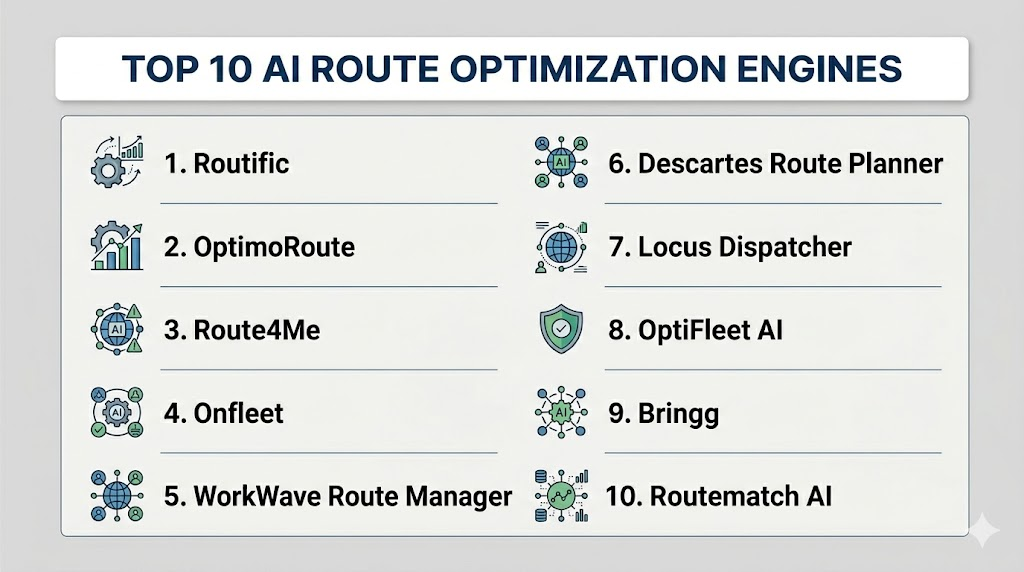
Top 10 AI Route Optimization Engines
1- Routific
One-line verdict: AI engine for last-mile delivery optimization, focusing on small to mid-sized fleets.
Short description: Routific uses AI to optimize multi-stop routes, reducing travel time and improving driver efficiency.
Standout Capabilities
- Multi-stop delivery optimization
- Real-time route adjustments
- Delivery time window enforcement
- Driver mobile app support
- Fuel and cost reduction insights
- Integration with TMS and ERP
- Analytics dashboards for performance
AI-Specific Depth
- Model support: Proprietary AI
- RAG / knowledge integration: ERP connectors
- Evaluation: Historical route testing
- Guardrails: Delivery time window enforcement
- Observability: Fuel, time, and route adherence dashboards
Pros
- Easy deployment for mid-size fleets
- Real-time updates and driver communication
- Clear cost-saving insights
Cons
- Less suitable for very large fleets
- Limited multi-depot capabilities
- Fewer integrations with global logistics systems
Security & Compliance
- SSO, encryption, audit logs
- Data residency: Varies / N/A
- Certifications: Not publicly stated
Deployment & Platforms
- Cloud, Web, iOS, Android
Integrations & Ecosystem
- ERP/TMS connectors, APIs, mobile apps, analytics dashboards
Pricing Model
- Subscription-based; Not publicly stated
Best-Fit Scenarios
- Small to mid-sized delivery fleets
- Food and e-commerce last-mile operations
- Single-region route planning
2- OptimoRoute
One-line verdict: AI-powered route and scheduling engine for deliveries and field service fleets.
Short description: OptimoRoute optimizes routes and schedules for multiple drivers and depots, balancing efficiency and service quality.
Standout Capabilities
- Route optimization with time windows
- Multi-depot and multi-driver support
- Dynamic re-routing based on real-time traffic
- Predictive travel times using AI
- Driver mobile app with notifications
- Analytics dashboards with KPIs
AI-Specific Depth
- Model support: Proprietary AI
- RAG / knowledge integration: ERP/TMS connectors
- Evaluation: Simulation and historical data validation
- Guardrails: Compliance with service-level agreements
- Observability: Route adherence, delays, and travel time metrics
Pros
- Supports complex fleets and schedules
- Dynamic traffic-aware routing
- Improves delivery reliability
Cons
- Premium pricing for large fleets
- Requires setup for multi-depot networks
- Learning curve for advanced features
Security & Compliance
- Encryption, SSO, audit logs
- Data retention policies: Varies / N/A
- Certifications: Not publicly stated
Deployment & Platforms
- Cloud, Web, iOS, Android
Integrations & Ecosystem
- TMS, ERP, mapping APIs, mobile driver apps
Pricing Model
- Subscription-based; Not publicly stated
Best-Fit Scenarios
- Multi-depot delivery networks
- Field service routing
- Dynamic last-mile operations
3- Route4Me
One-line verdict: Scalable AI route planning platform for small to enterprise fleets with multi-stop optimization.
Short description: Route4Me automates route planning, optimizing travel time, distance, and cost for large fleets.
Standout Capabilities
- Multi-stop route optimization
- Vehicle capacity and type consideration
- Dynamic traffic and weather-aware routing
- Mobile apps for driver tracking
- Real-time updates and notifications
- Fleet utilization dashboards
AI-Specific Depth
- Model support: Proprietary AI
- RAG / knowledge integration: Mapping and GPS connectors
- Evaluation: Route simulation, historical testing
- Guardrails: Delivery and driver safety constraints
- Observability: Fuel, time, and delay metrics
Pros
- Suitable for diverse fleet sizes
- Rapid re-routing in real time
- Strong multi-stop optimization
Cons
- Less enterprise ERP integration
- Custom analytics require setup
- Limited multi-modal transportation support
Security & Compliance
- Encryption, RBAC
- Audit logs: Varies / N/A
- Certifications: Not publicly stated
Deployment & Platforms
- Cloud, Web, iOS, Android
Integrations & Ecosystem
- GPS and mapping APIs, TMS connectors, driver apps, analytics dashboards
Pricing Model
- Subscription; Not publicly stated
Best-Fit Scenarios
- Multi-stop delivery optimization
- Dynamic fleet management
- Route efficiency for logistics startups
4- Onfleet
One-line verdict: AI-enabled last-mile delivery management for real-time routing and fleet tracking.
Short description: Onfleet optimizes routes, monitors deliveries, and improves driver efficiency for e-commerce, retail, and food delivery.
Standout Capabilities
- Route optimization and re-routing
- Driver tracking and notifications
- ETA predictions
- Delivery performance analytics
- Customer notification automation
- Multi-driver route planning
AI-Specific Depth
- Model support: Proprietary AI
- RAG / knowledge integration: TMS/GPS connectors
- Evaluation: Historical delivery analytics
- Guardrails: Time-window and safety enforcement
- Observability: Delivery adherence and delay metrics
Pros
- Easy deployment for last-mile fleets
- Real-time ETA predictions
- Driver-friendly mobile interface
Cons
- Limited multi-depot optimization
- Not suited for very large fleets
- Fewer advanced analytics features
Security & Compliance
- SSO, encryption, RBAC
- Audit logs: Varies / N/A
- Certifications: Not publicly stated
Deployment & Platforms
- Cloud, Web, iOS, Android
Integrations & Ecosystem
- GPS, mapping APIs, TMS, mobile apps, analytics dashboards
Pricing Model
- Subscription; Not publicly stated
Best-Fit Scenarios
- E-commerce last-mile delivery
- Food and grocery fleets
- Small to mid-sized delivery operations
5- WorkWave Route Manager
One-line verdict: AI routing and scheduling engine for field service and delivery fleets.
Short description: WorkWave automates route planning and driver scheduling, factoring in real-time traffic and delivery windows.
Standout Capabilities
- AI-based route optimization
- Multi-stop planning and time-window management
- Real-time traffic-aware routing
- Driver scheduling and notifications
- Mobile driver apps and tracking
- Analytics dashboards
AI-Specific Depth
- Model support: Proprietary AI
- RAG / knowledge integration: ERP and GPS connectors
- Evaluation: Simulation and historical route validation
- Guardrails: Compliance with labor and delivery rules
- Observability: Delay, fuel, and adherence dashboards
Pros
- Supports dynamic field service routing
- Real-time driver tracking
- Efficient schedule optimization
Cons
- Implementation complexity for large fleets
- Limited multi-modal vehicle support
- Advanced analytics require training
Security & Compliance
- Encryption, SSO, audit logs
- Certifications: Not publicly stated
Deployment & Platforms
- Cloud, Web, iOS, Android
Integrations & Ecosystem
- ERP, GPS, mapping APIs, TMS, mobile apps
Pricing Model
- Subscription; Not publicly stated
Best-Fit Scenarios
- Field service operations
- Mid-size delivery fleets
- Multi-stop dynamic routing
6- Descartes Route Planner
One-line verdict: AI-driven enterprise routing and fleet optimization for complex logistics networks.
Short description: Descartes optimizes multi-depot fleets, multi-modal routes, and dynamic delivery schedules for large enterprises.
Standout Capabilities
- Enterprise-grade multi-depot optimization
- Multi-modal transport support
- Real-time traffic and weather integration
- Predictive arrival times
- Fleet utilization dashboards
- Scenario planning and simulation
AI-Specific Depth
- Model support: Proprietary AI
- RAG / knowledge integration: ERP, GPS, mapping APIs
- Evaluation: Historical route analysis, scenario simulation
- Guardrails: SLA and safety enforcement
- Observability: KPIs for efficiency, fuel, and adherence
Pros
- Scalable for enterprise fleets
- Strong scenario simulation
- Multi-modal and multi-depot support
Cons
- Premium pricing
- Complex deployment
- Learning curve for planners
Security & Compliance
- SSO, encryption, audit logs
- Data privacy: Varies / N/A
- Certifications: Not publicly stated
Deployment & Platforms
- Cloud, Web, iOS, Android
Integrations & Ecosystem
- ERP, TMS, GPS, mapping APIs, analytics dashboards
Pricing Model
- Subscription; Not publicly stated
Best-Fit Scenarios
- Large enterprise logistics
- Multi-modal transport planning
- Fleet utilization optimization
7- Locus Dispatcher
One-line verdict: AI-powered route optimization for delivery and field service operations with dynamic traffic awareness.
Short description: Locus uses AI to plan efficient routes, reduce travel time, and optimize fleet costs.
Standout Capabilities
- Multi-stop optimization
- Dynamic traffic and weather-aware re-routing
- Vehicle and driver constraints
- Real-time ETA predictions
- Analytics dashboards
AI-Specific Depth
- Model support: Proprietary AI
- RAG / knowledge integration: ERP, GPS
- Evaluation: Historical route simulation
- Guardrails: Delivery windows and driver limits
- Observability: Fuel and time metrics
Pros
- Reduces operational costs
- Real-time updates
- Predictive travel times
Cons
- Not ideal for very small fleets
- Enterprise ERP integration limited
- Requires training for advanced scenarios
Security & Compliance
- Encryption, SSO, audit logs
- Certifications: Not publicly stated
Deployment & Platforms
- Cloud, Web, iOS, Android
Integrations & Ecosystem
- ERP, TMS, GPS, mobile driver apps
Pricing Model
- Subscription; Not publicly stated
Best-Fit Scenarios
- Dynamic delivery fleets
- Field service operations
- Urban last-mile routing
8- OptiFleet AI
One-line verdict: Enterprise-grade AI engine for optimizing large fleet routing and deliveries with real-time updates.
Short description: OptiFleet integrates traffic, vehicle, and depot data to optimize routes, reduce cost, and improve delivery reliability.
Standout Capabilities
- Multi-depot and multi-vehicle optimization
- Real-time traffic integration
- Dynamic re-routing
- Driver scheduling
- Predictive fuel optimization
- KPI dashboards
AI-Specific Depth
- Model support: Proprietary AI
- RAG / knowledge integration: ERP, GPS
- Evaluation: Simulation, historical validation
- Guardrails: SLA compliance
- Observability: Adherence and performance dashboards
Pros
- Enterprise scalability
- Reduces fuel and travel time
- Supports complex operations
Cons
- Premium pricing
- Complex implementation
- Learning curve for planners
Security & Compliance
- Encryption, audit logs
- SSO/SAML
- Certifications: Not publicly stated
Deployment & Platforms
- Cloud, Web, iOS, Android
Integrations & Ecosystem
- ERP, TMS, mapping APIs, analytics dashboards
Pricing Model
- Subscription; Not publicly stated
Best-Fit Scenarios
- Large delivery fleets
- Multi-depot operations
- Complex route planning
9- Bringg
One-line verdict: AI-driven delivery orchestration platform optimizing last-mile routes and customer experience.
Short description: Bringg uses AI for dynamic last-mile routing, fleet visibility, and driver performance tracking.
Standout Capabilities
- Dynamic route optimization
- Real-time delivery tracking
- ETA predictions
- Customer notifications
- Analytics dashboards
AI-Specific Depth
- Model support: Proprietary AI
- RAG / knowledge integration: ERP, GPS
- Evaluation: Simulation and historical validation
- Guardrails: SLA and delivery window enforcement
- Observability: Route adherence and delay metrics
Pros
- Improves delivery reliability
- Driver-friendly interface
- Real-time customer updates
Cons
- Less suited for multi-depot complex fleets
- Premium pricing
- Enterprise features require configuration
Security & Compliance
- SSO, encryption, audit logs
- Certifications: Not publicly stated
Deployment & Platforms
- Cloud, Web, iOS, Android
Integrations & Ecosystem
- ERP, TMS, mobile apps, mapping APIs
Pricing Model
- Subscription; Not publicly stated
Best-Fit Scenarios
- Last-mile e-commerce delivery
- Food and grocery fleets
- Real-time tracking and notifications
10- Routematch AI
One-line verdict: AI-powered route and fleet management engine for urban mobility and transit operations.
Short description: Routematch optimizes public transit and corporate shuttle routes using AI for efficiency, reliability, and reduced operational cost.
Standout Capabilities
- Multi-stop optimization for transit routes
- Dynamic traffic-aware scheduling
- Vehicle capacity optimization
- Driver assignment and tracking
- Predictive arrival and performance dashboards
AI-Specific Depth
- Model support: Proprietary AI
- RAG / knowledge integration: GPS, ERP, transit data feeds
- Evaluation: Historical and scenario testing
- Guardrails: Capacity and safety compliance
- Observability: Delay, efficiency, and adherence metrics
Pros
- Optimized public transit and shuttle operations
- Predictive scheduling
- Scalable to large fleets
Cons
- Premium pricing
- Integration with legacy transit systems can be complex
- Advanced features require operator training
Security & Compliance
- Encryption, SSO, audit logs
- Certifications: Not publicly stated
Deployment & Platforms
- Cloud, Web, iOS, Android
Integrations & Ecosystem
- GPS, transit feeds, ERP, driver apps, analytics dashboards
Pricing Model
- Subscription; Not publicly stated
Best-Fit Scenarios
- Public transit operations
- Shuttle and corporate fleets
- Urban mobility optimization
Comparison Table
| Tool Name | Best For | Deployment | Model Flexibility | Strength | Watch-Out | Public Rating |
|---|---|---|---|---|---|---|
| Routific | Small/mid fleets | Cloud/Web | Proprietary | Last-mile optimization | Limited multi-depot | N/A |
| OptimoRoute | Delivery & field service | Cloud/Web | Proprietary | Multi-depot routing | Premium pricing | N/A |
| Route4Me | Multi-stop delivery | Cloud/Web | Proprietary | Multi-stop optimization | ERP integrations limited | N/A |
| Onfleet | Last-mile delivery | Cloud/Web | Proprietary | Real-time ETA | Not for large fleets | N/A |
| WorkWave Route Manager | Field service | Cloud/Web | Proprietary | Dynamic scheduling | Limited multi-modal support | N/A |
| Descartes Route Planner | Enterprise logistics | Cloud/Web | Proprietary | Multi-modal & multi-depot | Premium pricing | N/A |
| Locus Dispatcher | Delivery & field ops | Cloud/Web | Proprietary | Dynamic traffic routing | Small fleets not ideal | N/A |
| OptiFleet AI | Large enterprise fleets | Cloud/Web | Proprietary | Multi-depot & fleet optimization | Premium pricing | N/A |
| Bringg | Last-mile e-commerce | Cloud/Web | Proprietary | Customer notifications | Complex integration | N/A |
| Routematch AI | Transit & mobility | Cloud/Web | Proprietary | Public transit optimization | Legacy system integration | N/A |
Scoring & Evaluation
Weighted Total uses: Core 20%, Reliability/Eval 15%, Guardrails 10%, Integrations 15%, Ease 10%, Perf/Cost 15%, Security/Admin 10%, Support 5%.
| Tool | Core | Reliability/Eval | Guardrails | Integrations | Ease | Perf/Cost | Security/Admin | Support | Weighted Total |
|---|---|---|---|---|---|---|---|---|---|
| Routific | 8 | 8 | 7 | 7 | 9 | 8 | 8 | 7 | 7.9 |
| OptimoRoute | 8 | 8 | 8 | 8 | 7 | 8 | 8 | 7 | 7.9 |
| Route4Me | 8 | 8 | 8 | 7 | 7 | 8 | 7 | 7 | 7.7 |
| Onfleet | 7 | 7 | 7 | 7 | 9 | 7 | 7 | 7 | 7.3 |
| WorkWave | 7 | 7 | 7 | 7 | 8 | 7 | 7 | 7 | 7.2 |
| Descartes | 9 | 9 | 8 | 8 | 7 | 8 | 8 | 7 | 8.1 |
| Locus | 7 | 7 | 7 | 7 | 8 | 7 | 7 | 7 | 7.2 |
| OptiFleet | 9 | 9 | 8 | 8 | 7 | 8 | 8 | 7 | 8.1 |
| Bringg | 7 | 7 | 7 | 7 | 8 | 7 | 7 | 7 | 7.2 |
| Routematch | 8 | 8 | 8 | 8 | 7 | 8 | 8 | 7 | 7.9 |
Top 3 for Enterprise: Descartes, OptiFleet, OptimoRoute
Top 3 for SMB: Routific, Onfleet, WorkWave
Top 3 for Developers: Route4Me, Locus, Bringg
Which AI Route Optimization Engine Is Right for You?
Solo / Freelancer
- Routific or Onfleet for ease of setup and real-time route optimization.
SMB
- WorkWave, Routific, or Route4Me for mid-sized delivery or field service fleets.
Mid-Market
- OptimoRoute or Locus for multi-depot and multi-driver operations.
Enterprise
- Descartes or OptiFleet for large-scale, multi-modal logistics and fleet management.
Regulated industries
- Descartes, OptiFleet, or Routematch for public transit, government, or corporate fleet compliance.
Budget vs premium
- Budget: Routific, Onfleet, WorkWave
- Premium: Descartes, OptiFleet, OptimoRoute
Build vs buy
- Small fleets: DIY planning may suffice
- Large or dynamic operations: Enterprise AI routing engines recommended
Implementation Playbook (30 / 60 / 90 Days)
- 30 days: Pilot AI route engine with a subset of deliveries or fleet vehicles, validate travel time predictions, and driver interface usability.
- 60 days: Harden compliance guardrails, configure multi-depot and multi-modal routing, integrate with ERP/TMS.
- 90 days: Optimize latency and AI computation cost, establish observability dashboards, and scale to full fleet operations.
AI-specific tasks: Model evaluation and validation, red-teaming dynamic routing, version control for AI models, and incident handling for route deviations.
Common Mistakes & How to Avoid Them
- Over-automation without human oversight
- Ignoring real-time traffic or weather inputs
- Unmanaged driver privacy and data retention
- Lack of observability dashboards
- Unexpected AI computation costs
- Skipping scenario simulations
- Vendor lock-in without abstraction
- Poor integration with TMS or ERP
- Ignoring compliance and labor law constraints
- Not validating AI predictions historically
- Insufficient driver app training
- Ignoring multi-modal and multi-depot constraints
- Overlooking sustainability/fuel metrics
FAQs
1- Can AI route engines handle real-time traffic updates?
Yes, most engines ingest live traffic and GPS data to dynamically re-route vehicles.
2- Do these tools support multi-depot operations?
Enterprise engines like Descartes and OptiFleet do; small platforms may be single-depot only.
3- Can AI optimize for fuel and emissions?
Yes, sustainability-focused routing reduces fuel consumption and carbon emissions.
4- Are driver mobile apps included?
Yes, most platforms provide iOS/Android apps for real-time instructions and tracking.
5- Can I integrate these engines with my ERP or TMS?
All top platforms offer APIs or connectors to integrate with ERP/TMS and fleet management systems.
6- Do these engines support heterogeneous fleets?
Yes, enterprise solutions can handle vans, trucks, bikes, and drones with capacity constraints.
7- How is route performance measured?
Metrics include travel time, adherence to delivery windows, fuel efficiency, and SLA compliance.
8- Can small fleets benefit from AI routing?
Yes, tools like Routific and Onfleet offer quick setup for small to mid-sized fleets.
9- Are these tools cloud-only?
Most are cloud-native but offer hybrid or web-based options; on-premises is rare.
10- How do engines handle dynamic delivery changes?
AI re-routing adjusts schedules and informs drivers in real-time based on updated conditions.
11- Do these tools provide scenario planning?
Yes, enterprise engines simulate multiple delivery scenarios to optimize routes under constraints.
12- Is historical route data used for prediction?
Yes, AI models learn from historical traffic, delivery patterns, and driver behavior for better predictions.
Conclusion
AI Route Optimization Engines have revolutionized logistics and field operations, improving efficiency, reducing costs, and increasing customer satisfaction. Choosing the right engine depends on fleet size, operational complexity, multi-modal requirements, and budget. Mid-sized fleets may benefit from Routific or Onfleet, while large enterprises require Descartes or OptiFleet for multi-depot, multi-modal optimization.

Find Trusted Cardiac Hospitals
Compare heart hospitals by city and services — all in one place.
Explore Hospitals
AI route optimization engines work best when real-time traffic, fuel costs, and delivery constraints are continuously updated and reliable.