
Introduction
AI Last‑Mile Delivery Optimization refers to systems and platforms that use artificial intelligence to plan, execute, and continuously improve the final leg of delivery operations — from the warehouse or depot to the customer’s doorstep. These tools combine real‑time data (traffic, weather, deliveries, driver status), predictive analytics, dynamic routing, and fleet intelligence to make last‑mile logistics faster, cheaper, and more reliable. In 2026, as consumers increasingly demand faster delivery, and logistics costs continue to rise, AI optimization is no longer optional — it’s strategic.
Real‑world use cases include:
- Dynamic route planning for same‑day and scheduled deliveries.
- Predictive ETAs with real‑time adjustments.
- Fleet utilization optimization across mixed vehicle types.
- Delivery exception management (traffic, weather, delays).
- Energy‑efficient routing for electric and hybrid vehicles.
- Customer‑facing tracking with automated notifications.
Evaluation Criteria for Buyers:
When shortlisting tools, consider:
- AI‑driven routing and real‑time optimization
- Integration with TMS, WMS, ERP, and telematics systems
- Predictive accuracy for ETAs
- Dispatch and driver assignment automation
- Scenario simulation and AI evaluation/testing
- Guardrails for safety and policy adherence
- Observability of cost, latency, prediction confidence
- Scalability across vehicles, geographies, and delivery volumes
- Compliance with data privacy and location tracking norms
Best for: Logistics managers, e‑commerce platforms, retail supply chains, 3PLs/4PLs, food and grocery delivery networks, and mid‑to‑large enterprises with complex last‑mile operations.
Not ideal for: Small delivery operators with simple routes and low delivery volumes; companies without digital fleet data.
What’s Changed in AI Last‑Mile Delivery Optimization in 2026+
- Agentic AI workflows that autonomously reassign routes, drivers, and priorities.
- Multimodal data fusion combining traffic, weather, camera feeds, fleet telematics, and customer behavior.
- RAG‑enabled decisioning, integrating internal delivery data and external knowledge for better prediction.
- Real‑time predictive disruption detection and automated mitigation suggestions.
- Enterprise privacy controls for sensitive location and customer data.
- AI evaluation frameworks tracking ETA accuracy, re‑routing success, and model drift.
- Cost‑latency optimization with hybrid cloud execution and priority routing.
- Green routing capabilities that minimize emissions and support sustainability goals.
- Enhanced guardrails for safety policies and delivery constraints (no‑go zones, time windows).
- Improved observability with delivery trace logs, token/cost metrics, and performance dashboards.
Quick Buyer Checklist
- Does the tool provide dynamic routing with predictive ETAs?
- Does it integrate with TMS/WMS/ERP and telematics data?
- Can it handle multi‑stop optimization and large fleets?
- Are AI evaluation and backtesting tools included?
- Are there policy guardrails for safety and delivery rules?
- Does it offer observability (cost, latency, confidence)?
- Is customer‑facing tracking supported?
- How flexible is the model support (proprietary vs BYO)?
- Are privacy and data controls adequate?
- Is it scalable for peak peak‑season demand?
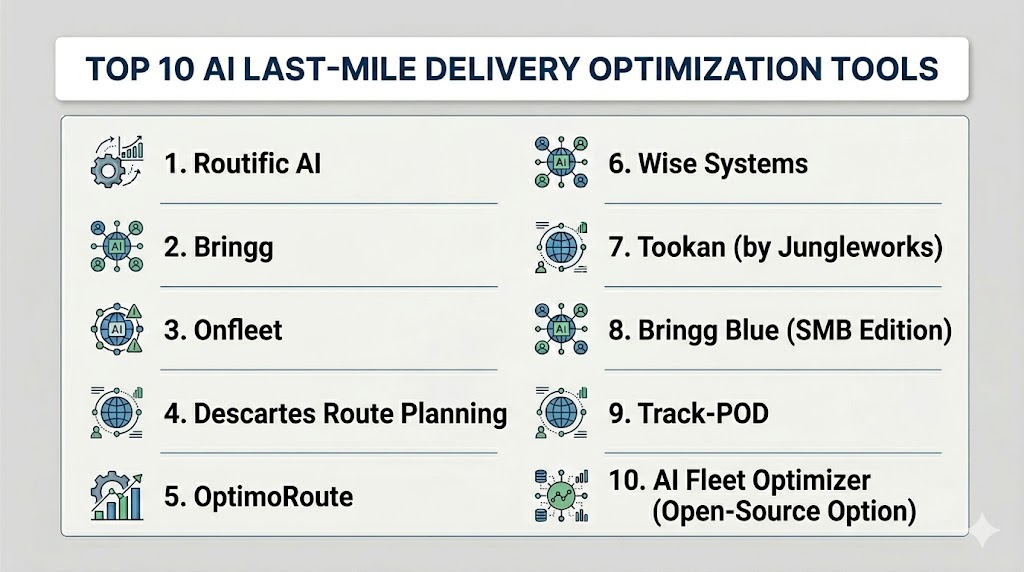
Top 10 AI Last‑Mile Delivery Optimization Tools
1 — Routific AI
One‑line verdict: Best for SMBs and mid‑size fleets seeking highly cost‑efficient, AI‑driven route planning and re‑optimization.
Short description: AI routing and delivery planning platform that reduces mileage and delivery times through efficient multi‑stop optimization.
Standout Capabilities
- Dynamic route generation for multi‑stop deliveries
- Real‑time traffic and constraint adjustments
- Delivery window prioritization
- Driver performance feedback
- Easy dispatch interface
AI‑Specific Depth
- Model support: Proprietary AI
- RAG / knowledge integration: ERP/WMS connectors
- Evaluation: Historical route backtesting
- Guardrails: Delivery window and policy enforcement
- Observability: Fleet dashboard metrics
Pros
- Easy onboarding for SMBs
- Reduces mileage and fuel cost
- Intuitive UI
Cons
- Limited enterprise feature depth
- Fewer predictive analytics beyond routing
- Depends on accurate baseline data
Security & Compliance
- SSO, encryption at rest and transit, audit logs
- Certifications: Not publicly stated
Deployment & Platforms
- Cloud/Web
- iOS/Android mobile apps
Integrations & Ecosystem
- ERP/WMS connectors
- Telematics/Fleet data
- Dispatch and analytics APIs
Pricing Model
- Subscription per vehicle/route count
Best‑Fit Scenarios
- Small to mid‑size delivery fleets
- Local retail last‑mile logistics
- On‑demand courier services
2 — Bringg
One‑line verdict: Suited for large enterprises requiring scalable AI orchestration, real‑time tracking, and multi‑modal delivery support.
Short description: Enterprise delivery orchestration platform using AI for routing, visibility, and customer experience.
Standout Capabilities
- Dynamic last‑mile routing
- Real‑time visibility and ETA notifications
- Support for vehicles, bikes, couriers
- Exception handling and re‑routing
- Performance analytics and SLA tracking
AI‑Specific Depth
- Model support: Proprietary AI; Varies / N/A BYO
- RAG / knowledge integration: ERP/TMS/WMS
- Evaluation: Delivery accuracy tracking
- Guardrails: Policy enforcement
- Observability: Fleet and delivery performance dashboards
Pros
- Enterprise scalability
- Multi‑modal delivery orchestration
- Strong customer communication features
Cons
- Premium pricing tier
- Integration complexity
- Advanced features require API customization
Security & Compliance
- SSO/SAML, RBAC, encryption, audit logs
- Certifications: Not publicly stated
Deployment & Platforms
- Cloud/Web; Hybrid deployment optional
- iOS/Android
Integrations & Ecosystem
- ERP, TMS, WMS connectors
- Telematics and GPS feeds
- Customer messaging systems
Pricing Model
- Tiered enterprise subscription
Best‑Fit Scenarios
- Large e‑commerce delivery networks
- 3PL/4PL logistics providers
- Urban last‑mile fleets
3 — Onfleet
One‑line verdict: Excellent for tech‑forward delivery teams wanting real‑time tracking, ETA prediction, and simple integration.
Short description: Real‑time last‑mile delivery platform combining AI routing with live tracking and customer updates.
Standout Capabilities
- AI‑assisted routing and dispatch
- Real‑time driver tracking
- Predictive ETAs and customer notifications
- Analytics and route performance insights
- API for custom workflows
AI‑Specific Depth
- Model support: Proprietary AI
- RAG / knowledge integration: APIs to ERP/WMS
- Evaluation: Backtesting, performance evaluation
- Guardrails: Constraint enforcement (windows, proximity)
- Observability: Route and driver dashboards
Pros
- Intuitive UI
- Strong mobile support
- Flexible APIs
Cons
- Lower enterprise scale
- Fewer advanced scenarios (peak simulation)
- Less automated guardrail policies
Security & Compliance
- Encryption, role‑based access, audit logs
- Certifications: Not publicly stated
Deployment & Platforms
- Cloud/Web; iOS/Android mobile
Integrations & Ecosystem
- ERP/WMS integration
- Fleet telematics
- E‑commerce platforms
Pricing Model
- Subscription per driver/vehicle
Best‑Fit Scenarios
- On‑demand delivery services
- SMB fleets
- Food and retail delivery networks
4 — Descartes Route Planning
One‑line verdict: Best for complex enterprise logistics needing predictive ETAs, scenario simulation, and performance analytics.
Short description: AI‑driven routing and analytics platform for large fleets, optimizing delivery plans against real‑world data.
Standout Capabilities
- Multi‑stop dynamic routing
- Predictive ETA and delay forecasts
- Peak demand scenario simulation
- Driver performance KPIs
- Real‑time traffic adaptation
AI‑Specific Depth
- Model support: Proprietary AI
- RAG / knowledge integration: ERP/TMS/WMS
- Evaluation: Delivery accuracy evaluation
- Guardrails: Delivery policy enforcement
- Observability: Dashboards on cost, efficiency
Pros
- Enterprise scale
- Deep analytics
- Scenario planning
Cons
- Higher complexity
- Costly for smaller operations
- Longer onboarding
Security & Compliance
- SSO/SAML, RBAC, encryption, audit logs
- Certifications: Not publicly stated
Deployment & Platforms
- Cloud/Web; Windows, mobile
Integrations & Ecosystem
- ERP/TMS/WMS
- Telematics dashboards
- Analytics integrations
Pricing Model
- Enterprise subscription tiers
Best‑Fit Scenarios
- Logistics‑heavy enterprises
- Multi‑region delivery networks
- High‑volume e‑commerce
5 — OptimoRoute
One‑line verdict: Strong choice for SMB and mid‑market companies optimizing multi‑stop routes with AI.
Short description: Optimizes routes and schedules for delivery fleets with intelligent multi‑stop planning and real‑time updates.
Standout Capabilities
- Multi‑stop route planning
- Delivery window optimization
- Real‑time traffic rerouting
- Driver scheduling
- Delivery performance reporting
AI‑Specific Depth
- Model support: Proprietary AI
- RAG / knowledge integration: ERP/WMS connectors
- Evaluation: Route backtesting
- Guardrails: Policy and window enforcement
- Observability: Fleet analytics
Pros
- Easy deployment
- Reduces operational cost
- Strong scheduling features
Cons
- Enterprise feature gaps
- Custom integration often required
- Less advanced predictive disruption modeling
Security & Compliance
- Encryption and role‑based access
- Certifications: Not publicly stated
Deployment & Platforms
- Cloud/Web; iOS/Android apps
Integrations & Ecosystem
- ERP/WMS
- Telematics feeds
- Reporting APIs
Pricing Model
- Subscription per driver/vehicle
Best‑Fit Scenarios
- Retail delivery fleets
- SMB logistics
- Local parcel delivery
6 — Wise Systems
One‑line verdict: Best for automated dispatch and AI‑driven route autonomy for growing fleets.
Short description: Provides autonomous dispatch, AI‑optimized routing, and dynamic re‑planning for live operations.
Standout Capabilities
- Autonomous dispatch and assignment
- AI‑optimized routing and rebalancing
- Driver mobile app with task updates
- Real‑time issue detection
- Performance insights and metrics
AI‑Specific Depth
- Model support: Proprietary AI
- RAG / knowledge integration: ERP/WMS/TMS
- Evaluation: Backtesting and dynamic learning
- Guardrails: Safety and policy enforcement
- Observability: Route and performance dashboards
Pros
- Automated driver assignment
- Dynamic optimization
- Strong mobile UI
Cons
- Enterprise pricing
- Custom integration needed
- Predictive disruption limited
Security & Compliance
- SSO, encryption, audit logs
- Certifications: Not publicly stated
Deployment & Platforms
- Cloud/Web; iOS/Android
Integrations & Ecosystem
- ERP/TMS/WMS
- Telematics and GPS
- Analytics platforms
Pricing Model
- Subscription based on fleet size
Best‑Fit Scenarios
- Growing delivery fleets
- On‑demand logistics
- Automated dispatch environments
7 — Tookan (by Jungleworks)
One‑line verdict: Flexible platform for delivery businesses wanting extensible AI routing with marketplace features.
Short description: Delivery management platform combining AI optimization with customizable workflows for drivers and dispatch.
Standout Capabilities
- Smart routing and dispatch
- Delivery tracking and ETA
- Multi‑fleet support
- Geofencing and zones
- Custom workflow rules
AI‑Specific Depth
- Model support: Proprietary AI
- RAG / knowledge integration: ERP/TMS via APIs
- Evaluation: Performance insights
- Guardrails: Policy enforcement
- Observability: Route dashboards
Pros
- Highly customizable
- Marketplace readiness
- Good for startups
Cons
- Predictive feature depth varies
- Medium scalability
- Depends on custom configs
Security & Compliance
- Encryption and access controls
- Certifications: Not publicly stated
Deployment & Platforms
- Cloud/Web; iOS/Android
Integrations & Ecosystem
- API integrations
- ERP/TMS connectors
- Telematics and analytics
Pricing Model
- Subscription with add‑ons
Best‑Fit Scenarios
- On‑demand delivery apps
- Custom workflow environments
- Delivery marketplaces
8 — Bringg Blue (SMB Edition)
One‑line verdict: SMB‑focused version of Bringg with streamlined AI delivery optimization and lifecycle tools.
Short description: Simplified last‑mile optimization with real‑time tracking and dispatch for smaller delivery teams.
Standout Capabilities
- Smart routing and ETA
- Customer notifications
- Driver task management
- Performance dashboards
AI‑Specific Depth
- Model support: Proprietary AI
- RAG / knowledge integration: SELECT APIs
- Evaluation: ETA accuracy metrics
- Guardrails: Delivery policy enforcement
- Observability: Dashboard views
Pros
- Easier to implement than enterprise Bringg
- Real‑time visibility
- Customer ETA focus
Cons
- Limited advanced analytics
- Scale constraints
- Feature gaps vs enterprise edition
Security & Compliance
- Encryption; access controls
- Certifications: Not publicly stated
Deployment & Platforms
- Cloud/Web; iOS/Android
Integrations & Ecosystem
- ERP/TMS connectors
- Telematics optional
- SMS/email notifications
Pricing Model
- Subscription tiers
Best‑Fit Scenarios
- SMB logistics
- Local delivery startups
- Retail delivery networks
9 — Track-POD
One‑line verdict: Good choice for delivery teams focused on proof‑of‑delivery, routing, and customer experience.
Short description: Last‑mile delivery platform with optimized routing, proof‑of‑delivery capture, and performance reporting.
Standout Capabilities
- Route optimization
- ETA tracking and updates
- Proof‑of‑delivery (POD) capture
- Signature/photos on delivery
- Customer notifications
AI‑Specific Depth
- Model support: Proprietary AI
- RAG / knowledge integration: APIs to ERP/WMS
- Evaluation: Route performance insights
- Guardrails: Delivery constraint handling
- Observability: Delivery dashboards
Pros
- POD and delivery proof
- Strong customer features
- Easy setup
Cons
- Less deep predictive analytics
- Not optimized for huge fleets
- Fewer automation guardrails
Security & Compliance
- Encryption, audit logs
- Certifications: Not publicly stated
Deployment & Platforms
- Cloud/Web; iOS/Android
Integrations & Ecosystem
- ERP/WMS connectors
- Telematics optional
- API for dashboards
Pricing Model
- Subscription per vehicle/driver
Best‑Fit Scenarios
- Delivery businesses needing POD
- SMB logistics
- Field service delivery
10 — AI Fleet Optimizer (Open‑Source Option)
One‑line verdict: Best for teams wanting open flexibility and internal control over AI routing models.
Short description: Open‑source last‑mile routing and optimization toolkit for teams with internal machine learning capability.
Standout Capabilities
- Customizable AI routing models
- Integration with open map feeds
- Modular dispatch workflows
- Developer‑driven analytics
- Schedule flexibility
AI‑Specific Depth
- Model support: Open‑source / BYO models
- RAG / knowledge integration: Custom connectors
- Evaluation: Developer‑driven backtesting
- Guardrails: Custom code safety policies
- Observability: Developer dashboards
Pros
- Completely customizable
- No subscription cost
- Supports internal models
Cons
- Requires strong engineering teams
- No packaged dashboards
- Guardrails must be built
Security & Compliance
- Varies per deployment
- Certifications: N/A
Deployment & Platforms
- Self‑hosted; Cloud optional
Integrations & Ecosystem
- APIs and custom connectors
- Open data feeds
- Developer tools
Pricing Model
- Open‑source (support optional)
Best‑Fit Scenarios
- Internal experimentation
- Custom fleet environments
- Engineering‑driven companies
Comparison Table
| Tool Name | Best For | Deployment | Model Flexibility | Strength | Watch‑Out | Public Rating |
|---|---|---|---|---|---|---|
| Routific AI | SMB fleets | Cloud/Web | Proprietary | Cost‑efficient routing | Enterprise limits | N/A |
| Bringg | Large enterprise | Cloud/Hybrid | Proprietary | Multi‑modal orchestration | Premium pricing | N/A |
| Onfleet | Tech‑forward teams | Cloud/Web | Proprietary | Tracking + ETA | Scale limitations | N/A |
| Descartes | Enterprise logistics | Cloud/Web | Proprietary | Analytics + simulation | Complex onboarding | N/A |
| OptimoRoute | SMB & mid‑market | Cloud/Web | Proprietary | Easy deployment | Fewer advanced features | N/A |
| Wise Systems | Automated dispatch | Cloud/Web | Proprietary | Dispatch autonomy | Enterprise cost | N/A |
| Tookan | Custom workflows | Cloud/Web | Proprietary | Flexible configs | Medium scale | N/A |
| Bringg Blue | SMB version | Cloud/Web | Proprietary | Simple last‑mile | Feature gaps | N/A |
| Track‑POD | POD‑centric | Cloud/Web | Proprietary | Proof‑of‑delivery focus | Predictive limits | N/A |
| AI Fleet Optimizer | Developer teams | Self‑hosted/Cloud | BYO/Open | Total control | Requires build | N/A |
Scoring & Evaluation (Transparent Rubric)
We scored each tool across eight dimensions (0–10) and computed a weighted total:
| Tool | Core (20%) | AI Evaluation (15%) | Guardrails (10%) | Integrations (15%) | Ease (10%) | Perf & Cost (15%) | Security/Admin (10%) | Support (5%) | Weighted Total |
|---|---|---|---|---|---|---|---|---|---|
| Routific AI | 8 | 7 | 7 | 7 | 8 | 8 | 7 | 7 | 7.5 |
| Bringg | 9 | 8 | 8 | 8 | 7 | 7 | 8 | 7 | 8.0 |
| Onfleet | 8 | 7 | 7 | 7 | 8 | 7 | 8 | 7 | 7.5 |
| Descartes | 9 | 8 | 8 | 8 | 6 | 7 | 8 | 7 | 7.9 |
| OptimoRoute | 8 | 7 | 7 | 7 | 8 | 7 | 7 | 7 | 7.4 |
| Wise Systems | 8 | 7 | 7 | 7 | 7 | 7 | 7 | 7 | 7.2 |
| Tookan | 7 | 6 | 7 | 6 | 8 | 7 | 7 | 6 | 6.7 |
| Bringg Blue | 7 | 6 | 7 | 6 | 8 | 7 | 7 | 6 | 6.8 |
| Track‑POD | 7 | 6 | 7 | 6 | 8 | 6 | 7 | 6 | 6.7 |
| AI Fleet Optimizer | 6 | 7 | 6 | 6 | 6 | 7 | 6 | 6 | 6.4 |
Top 3 for Enterprise: Bringg, Descartes, Onfleet
Top 3 for SMBs: Routific AI, OptimoRoute, Wise Systems
Top 3 for Developers: AI Fleet Optimizer, Tookan, Onfleet
Which AI Last‑Mile Delivery Optimization Tool Is Right for You?
Solo / Freelancer
- OptimoRoute or Routific AI — cost‑effective, quick to deploy, minimal complexity.
SMB
- Routific AI, OptimoRoute, or Track‑POD — balance cost, simplicity, and performance.
Mid‑Market
- Onfleet or Wise Systems — real‑time tracking and dispatch optimization.
Enterprise
- Bringg, Descartes, or hybrid deployments with Bringg Blue + telematics — deep optimization, analytics, and SLA performance.
Regulated / High‑Compliance Environments
- Tools with strong security admin like Bringg and Descartes, which offer RBAC and enterprise governance.
Budget vs Premium
- Budget: OptimoRoute, Routific AI
- Premium: Bringg, Descartes
Build vs Buy
- Build: AI Fleet Optimizer or open‑source setups if you have engineering teams.
- Buy: Bringg, Descartes, Onfleet for managed AI capabilities.
Implementation Playbook (30 / 60 / 90 Days)
30 Days — Pilot:
- Define core KPIs (ETA accuracy, fleet cost, route miles).
- Connect baseline telematics, TMS, and delivery data.
- Configure routing constraints and delivery windows.
- Run pilots on limited zones, monitor AI suggestions, and refine.
60 Days — Harden:
- Integrate full fleet telematics and ERP/WMS.
- Activate guardrails (delivery windows, no‑go zones, safety policies).
- Build evaluation dashboards for latency, ETA accuracy, and cost per delivery.
- Train dispatch teams and drivers on workflows.
90 Days — Optimize:
- Expand to all geographies and peak hours.
- Evaluate continuous AI model improvement and retraining.
- Conduct red‑teaming on edge cases (unexpected disruptions).
- Monitor compliance, delivery success, and iterate guardrails.
Common Mistakes & How to Avoid Them
- Ignoring real‑time data feeds (traffic, weather) in routing.
- No continuous evaluation of ETA accuracy and driver adherence.
- Over‑automation without guardrails (unsafe areas, delivery windows).
- Underestimating integration complexity with ERP/TMS/WMS.
- Failing to monitor AI decisions (observability, latency).
- Neglecting privacy controls for customer location data.
- Not scaling gradually — jumping from pilot to full rollout.
- Lacking fallback manual control for edge cases.
- Ignoring driver feedback in optimization loops.
- No cost‑performance tracking on deliveries.
- Vendor lock‑in without APIs — limits future flexibility.
- No scenario testing for peak season stress.
- Poor definition of success metrics.
FAQs
1 — What is last‑mile delivery optimization?
It’s the use of AI and algorithms to plan and adjust the final leg of delivery operations, improving efficiency and customer experience.
2 — How much can AI routing reduce delivery costs?
Savings vary by use case, but AI optimization commonly reduces route miles and idle time, leading to measurable fuel and labor cost savings.
3 — Do these tools require telematics data?
Most benefit greatly from telematics; without it, real‑time optimization and accuracy will be limited.
4 — Is real‑time traffic data necessary?
Yes — AI delivers better ETA predictions and rerouting decisions when traffic and environmental data are integrated.
5 — Can small fleets benefit from these tools?
Yes — tools like Routific AI and OptimoRoute are designed for SMB fleets with practical cost structures.
6 — What integrations are critical?
ERP, WMS, TMS, telematics, customer messaging, and order systems are all important for seamless optimization.
7 — What are guardrails in routing AI?
Guardrails are policy constraints (delivery windows, safety parameters) that limit AI decisions to safe, compliant outcomes.
8 — Do these tools support electric vehicles?
Many do, with energy‑aware routing accounting for range and charging points.
9 — How do I evaluate ETA accuracy?
Use historical backtesting and delivery performance dashboards to compare predicted vs actual ETAs.
10 — Are open‑source options viable?
Yes, if you have engineering capacity; they offer flexibility but require internal guardrail and UI development.
11 — How do I avoid vendor lock‑in?
Choose tools with strong APIs, data export options, and interoperable connectors.
12 — What’s the biggest risk in rollout?
Skipping staged implementation and continuous evaluation — leading to poor adoption and suboptimal performance.
Conclusion
AI Last‑Mile Delivery Optimization transforms how deliveries are planned, executed, and monitored by leveraging real‑time data, predictive models, and continuous learning. The “best” tool depends on your scale, integration needs, budget, and operational complexity.

Find Trusted Cardiac Hospitals
Compare heart hospitals by city and services — all in one place.
Explore Hospitals
AI last-mile optimization is effective, but real success depends on live traffic accuracy, driver behavior, and handling failed deliveries efficiently.