
Introduction
AI ETA (Estimated Time of Arrival) Prediction APIs are application programming interfaces that let developers integrate predictive timing capabilities into applications, logistics systems, and fleet software. They use artificial intelligence and real‑time streaming data (traffic, weather, telematics, incident feeds) to estimate when a moving asset — like a delivery, ride, or transit vehicle — will arrive at a destination. Accurate ETA predictions enhance user experience, operational efficiency, and on‑time delivery performance.
In 2026, AI ETA APIs are essential for logistics platforms, on‑demand services, mobility apps, and enterprise fleet systems. They underpin next‑generation dispatching, customer notifications, SLA tracking, and real‑time rerouting in dynamic environments.
Real‑world use cases include:
- Predicting delivery arrival times for e‑commerce and food logistics.
- Real‑time arrival forecasts for ride‑hail and transit services.
- SLA and dispatch performance measurement in enterprise fleets.
- Customer tracking notifications with dynamic ETAs.
- Autonomous vehicle routing feedback loops.
- Predictive exception alerts (delays, disruptions).
Evaluation Criteria for Buyers:
When selecting an ETA Prediction API, evaluate:
- Prediction accuracy and confidence scoring.
- Real‑time and historical data integration.
- Scalability across high request volumes.
- Support for multimodal routing (car, bike, transit).
- Developer tools and SDK maturity.
- Latency, throughput, and reliability metrics.
- Guardrails and safety enforcement.
- Observability and AI evaluation tools.
- Enterprise security, compliance, and data governance.
Best for: Logistics and delivery SaaS, mobile developers, transportation operations, fleet management architects, and enterprise engineering teams.
Not ideal for: Simple static trip estimates or systems without real‑time data feeds.
What’s Changed in AI ETA Prediction APIs in 2026+
- Integrated hybrid models combining traditional routing, AI learning layers, and real‑time sensors.
- Edge inference for low‑latency ETA on devices (mobile or embedded).
- Automated drift detection and model retraining upon performance degradation.
- Guardrails for safety and policy limits (weather hazards, low visibility, closed roads).
- Expanded multimodal support, including ride‑hail, transit, micromobility, and freight modes.
- Confidence intervals and uncertainty quantification with every ETA.
- RAG‑augmented reasoning incorporating internal historical logs and external event feeds.
- Developer‑centric SDKs that accelerate integration with realtime streams.
- Federated learning options to respect data privacy across fleets.
- Observability dashboards for latency, quality, and model performance analytics.
- Compliance controls for data residency, retention, and audit trails.
Quick Buyer Checklist
Data & Models
- Support for real‑time traffic, weather, and external event feeds.
- Historical pattern learning and adaptive retraining.
- Multimodal transport prediction (pedestrian, vehicle, transit).
Performance & Scale
- Latency and throughput guarantees.
- Edge or cloud inference options.
- Graceful fallback for offline or degraded conditions.
Developer Experience
- SDKs for major environments (Python, JavaScript, mobile).
- Clear documentation and code examples.
- Webhooks and streaming integration points.
AI & Safety
- Confidence scoring on predictions.
- Guardrails and rule enforcement.
- Observability dashboards for prediction quality.
Security & Governance
- API key, OAuth, RBAC support.
- Data encryption in transit & at rest.
- Audit logs and compliance controls.
Ecosystem
- Fleet telematics connectors.
- ERP/TMS/WMS integrations.
- Push notification and customer UI support.
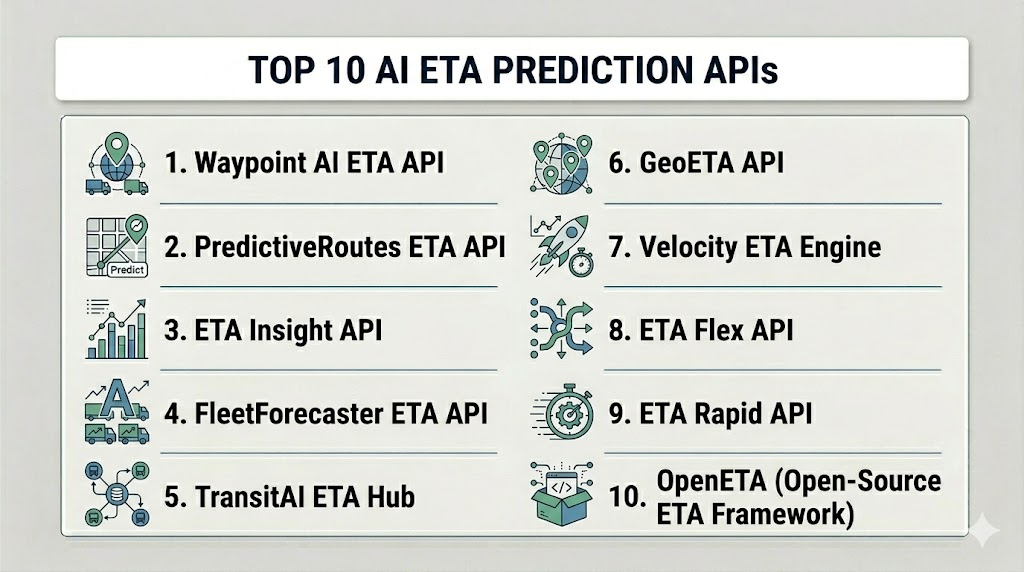
Top 10 AI ETA Prediction APIs
#1 — Waypoint AI ETA API
One‑line verdict: Enterprise‑grade API for scalable, adaptive ETA predictions with rich observability and confidence scoring.
Short description:
A robust ETA prediction service designed for high‑volume logistics and fleet systems. It ingests real‑time traffic, weather, and event feeds and returns dynamic ETA predictions with confidence intervals and quality metrics.
Standout Capabilities
- Multi‑source real‑time data ingestion
- Confidence and uncertainty intervals
- Fleet re‑optimization suggestions
- SDKs for full stack integration
- Guardrails for safety overrides
AI‑Specific Depth
- Model support: Hosted proprietary models + BYO flexibility
- RAG / knowledge integration: Traffic, weather, telematics
- Evaluation: Continuous backtesting and drift metrics
- Guardrails: Safety‑policy enforcement
- Observability: Dashboard for prediction quality
Pros
- Enterprise‑grade reliability
- Predictive uncertainty enhances trust
- Adaptive models that evolve
Cons
- Higher cost for SMEs
- Requires robust real‑time data integrations
- Full feature set may be overkill for small apps
Security & Compliance
- Encryption, SSO/SAML, RBAC, audit logs
- Certifications: Not publicly stated
Deployment & Platforms
- Cloud API
- SDKs: Python, JS, Java, Swift/Kotlin
Integrations & Ecosystem
- Telematics, TMS, ERP
- Notification services
- Fleet dashboards
Pricing Model
- Tiered enterprise + usage
Best‑Fit Scenarios
- Large delivery networks
- Enterprise dispatch systems
- SLA‑critical logistics
#2 — PredictiveRoutes ETA API
One‑line verdict: Developer‑centric ETA API with flexible multimodal support and confidence scoring.
Short description:
PredictiveRoutes targets application developers building ETA features for mobile and web. It supports multimodal transportation and exposes confidence metrics and SDKs across languages.
Standout Capabilities
- Multimodal ETA (walk, transit, vehicle)
- Confidence scores returned per request
- Offline and batch ETA predictions
- Transport mode selection
- Real‑time update streams
AI‑Specific Depth
- Model support: Proprietary + open hybrid
- RAG / knowledge integration: Maps, traffic, weather
- Evaluation: Offline dashboards
- Guardrails: Safety annotations
- Observability: Confidence & error metrics
Pros
- Developer‑friendly tools
- Rich SDK support
- Transport mode flexibility
Cons
- Limited enterprise SLA features
- Telemetry integration is custom
- Some advanced routes require premium tiers
Security & Compliance
- API key auth, TLS encryption
- Certifications: Not publicly stated
Deployment & Platforms
- Cloud API
- SDKs: Python, JavaScript, Go, Swift/Kotlin
Integrations & Ecosystem
- Public transit feeds
- Map providers
- Webhooks for client apps
Pricing Model
- Usage‑based tiers
Best‑Fit Scenarios
- Mobile apps needing ETA features
- Multimodal consumer services
- Developer‑driven products
#3 — ETA Insight API
One‑line verdict: Real‑time ETA API with dynamic rerouting triggers and webhook alerts.
Short description:
ETA Insight focuses on live, context‑aware ETA updates. It supports rerouting notifications via webhooks and offers quality metrics to support dispatch systems.
Standout Capabilities
- Automatic reforecasting on disruptions
- Webhooks for ETA changes
- Time‑window adherence outputs
- Latency‑optimized endpoints
AI‑Specific Depth
- Model support: Proprietary AI
- RAG / knowledge integration: Telematics, map/traffic data
- Evaluation: Real‑time error loop charts
- Guardrails: Constraints for safety/time rules
- Observability: Drift & latency dashboards
Pros
- Excellent for dispatch systems
- Real‑time notifications
- Clear operational outputs
Cons
- Usage caps on entry tiers
- Limited BYO model flexibility
- Fewer multimodal features
Security & Compliance
- TLS, API key/RBAC
- Certifications: Not publicly stated
Deployment & Platforms
- Cloud API with webhooks
Integrations & Ecosystem
- Dispatch platforms
- Real‑time customer UI
- Telematics
Pricing Model
- Tiered per usage
Best‑Fit Scenarios
- Delivery tracking systems
- Real‑time ETA refresh
- Webhook‑driven UI apps
#4 — FleetForecaster ETA API
One‑line verdict: Best for fleets requiring ETA plus confidence intervals and risk scoring for planning.
Short description:
A prediction service that returns both ETA and predictive uncertainty intervals, enabling robust SLA planning and risk‑aware dispatch decisions.
Standout Capabilities
- ETA + statistical uncertainty range
- Delay risk scores
- Global region support
- Historical performance benchmarking
AI‑Specific Depth
- Model support: Proprietary + optional BYO
- RAG / knowledge integration: Telematics and event data
- Evaluation: Confidence tracking dashboards
- Guardrails: Delay flags and safety scoring
- Observability: Error & confidence distribution
Pros
- Confidence intervals aid decisioning
- Risk‑aware SLA triggers
- Good global support
Cons
- Complex outputs require interpretation
- Premium pricing for confidence metrics
- Data integration required
Security & Compliance
- Encryption, RBAC, audit logs
- Certifications: Not publicly stated
Deployment & Platforms
- Cloud API
- SDKs available
Integrations & Ecosystem
- Fleet telematics
- TMS and ERP connectors
- Alerting services
Pricing Model
- Usage + tiered premium
Best‑Fit Scenarios
- Enterprise logistics
- SLA monitoring
- Risk‑aware operations
#5 — TransitAI ETA Hub
One‑line verdict: Tailored for multimodal transit and mobility applications with real‑time public transport support.
Short description:
TransitAI ETA Hub excels at predicting arrival times for buses, trains, ferries, and shared micromobility, combining real‑time feeds with adaptive models.
Standout Capabilities
- Public transit ETA forecasts
- Multimodal urban prediction
- Delay and disruption indicators
- Real‑time transit schedule ingestion
AI‑Specific Depth
- Model support: Proprietary + open multimodal routing
- RAG / knowledge integration: GTFS feeds, traffic, weather
- Evaluation: Transit accuracy dashboards
- Guardrails: Blind‑spot correction, service disruption flags
- Observability: Transit ETA confidence
Pros
- Excellent for transit apps
- Real‑time and schedule blending
- Confidence intervals
Cons
- Not optimized for private fleet vehicles
- Transit feed dependency
- Enterprise features require premium
Security & Compliance
- API key/TLS encryption
- Certifications: Not publicly stated
Deployment & Platforms
- Cloud API
- Public SDKs
Integrations & Ecosystem
- Transit GTFS/GTFS‑RT
- Passenger apps
- City mobility dashboards
Pricing Model
- Usage tiers
Best‑Fit Scenarios
- Transit apps
- Urban mobility services
- Commuter ETA features
#6 — GeoETA API
One‑line verdict: Lightweight, low‑latency ETA API for on‑demand services and micro‑apps.
Short description:
GeoETA provides fast, responsive ETA predictions with a focus on mobile and low overhead usage. It’s ideal for microservices needing quick arrival times without heavy overhead.
Standout Capabilities
- Optimized low‑latency endpoints
- Mobile‑friendly responses
- Confidence flags
- Simple request/response model
AI‑Specific Depth
- Model support: Proprietary
- RAG / knowledge integration: Traffic and map data
- Evaluation: Minimal observability
- Guardrails: Basic constraint policies
- Observability: Logging only
Pros
- Very fast response time
- Easy to integrate
- Low overhead
Cons
- Not feature‑rich
- Limited enterprise observability
- No advanced risk scoring
Security & Compliance
- TLS encryption
- API key
- Certifications: Not publicly stated
Deployment & Platforms
- Cloud API
Integrations & Ecosystem
- Map providers
- Mobile SDKs
Pricing Model
- Usage based
Best‑Fit Scenarios
- On‑demand apps
- Lightweight ETA needs
- Mobile integrations
#7 — Velocity ETA Engine
One‑line verdict: Strong choice for freight and heavy logistics requiring long‑haul ETA accuracy.
Short description:
Velocity ETA Engine is tuned for freight, trucking, and long‑haul arrival forecasts, blending telematics signals with traffic and weather models.
Standout Capabilities
- Long‑haul ETA models
- Weather and route event forecasting
- Confidence outputs
- Freight‑specific tuning
AI‑Specific Depth
- Model support: Proprietary
- RAG / knowledge integration: Telematics + weather
- Evaluation: Domain‑specific dashboards
- Guardrails: Safety and speed constraints
- Observability: Freight ETA monitoring
Pros
- Optimized for freight lanes
- Weather integration
- Confidence scoring
Cons
- Narrow focus
- Not multimodal beyond road
- Enterprise tier pricing
Security & Compliance
- Encryption and access control
- Certifications: Not publicly stated
Deployment & Platforms
- Cloud API
Integrations & Ecosystem
- Telematics feeds
- Freight management systems
Pricing Model
- Usage + enterprise
Best‑Fit Scenarios
- Trucking fleets
- Long‑haul logistics
- Freight tracking
#8 — ETA Flex API
One‑line verdict: Flexible API with BYO model support and open‑model routing capabilities.
Short description:
ETA Flex stands out for enabling teams to bring their own AI models alongside hosted options, blending open‑source and proprietary inference.
Standout Capabilities
- BYO model integration
- Support for custom routing logic
- Fallback inference layers
- Configurable guardrails
AI‑Specific Depth
- Model support: BYO (open/proprietary)
- RAG / knowledge integration: Custom datasets
- Evaluation: Configurable evaluation harness
- Guardrails: Engineered constraints
- Observability: Plugin dashboards
Pros
- Total customization
- Supports internal learning loops
- Flexible routing
Cons
- More difficult to configure
- Requires engineering expertise
- May lack turnkey features
Security & Compliance
- Configurable controls
- Depends on deployment
Deployment & Platforms
- Cloud or self‑hosted
Integrations & Ecosystem
- Custom data connectors
Pricing Model
- Base + usage
Best‑Fit Scenarios
- Engineering‑driven teams
- Custom model experimentation
- Internal fleet systems
#9 — ETA Rapid API
One‑line verdict: Fast ETA service with global coverage and simple API contract.
Short description:
ETA Rapid offers a straightforward API for arrival predictions with global reach and minimal configuration — ideal for quick MVPs.
Standout Capabilities
- Global ETA endpoints
- Minimal setup
- Standard confidence flags
AI‑Specific Depth
- Model support: Proprietary
- RAG / knowledge integration: Map & traffic
- Evaluation: Basic metrics
- Guardrails: Simple constraints
- Observability: Limited
Pros
- Quick to implement
- Global support
- Affordable tiers
Cons
- Few advanced features
- Limited predictive depth
- Lower observability
Security & Compliance
- API key
- Encryption
Deployment & Platforms
- Cloud API
Integrations & Ecosystem
- Standard map APIs
Pricing Model
- Usage tiers
Best‑Fit Scenarios
- MVPs & prototypes
- Early stage apps
#10 — OpenETA (Open‑Source ETA Framework)
One‑line verdict: Best for teams who want full transparency and control over ETA models.
Short description:
OpenETA is an open‑source framework enabling ETA prediction with pluggable models, dataset pipelines, and full control over inference deployment.
Standout Capabilities
- Fully open model architecture
- Custom dataset pipelines
- Model experimentation tools
- Community extensions
AI‑Specific Depth
- Model support: Open/BYO
- RAG / knowledge integration: Custom connectors
- Evaluation: Developer integration
- Guardrails: Must be built
- Observability: Custom dashboards
Pros
- No vendor lock‑in
- Full model transparency
- Custom training
Cons
- High setup overhead
- No packaged enterprise support
- Guardrails must be engineered
Security & Compliance
- Varies per deployment
Deployment & Platforms
- Self‑hosted or cloud
Integrations & Ecosystem
- Plugin architecture
Pricing Model
- Open‑source
Best‑Fit Scenarios
- In‑house AI teams
- Custom fleet systems
- Research prototypes
Comparison Table
| Tool Name | Best For | Deployment | Model Flexibility | Strength | Watch‑Out | Public Rating |
|---|---|---|---|---|---|---|
| Waypoint AI ETA API | Enterprise logistics | Cloud | Hosted/BYO | Confidence + scale | Cost | N/A |
| PredictiveRoutes ETA API | Developers | Cloud | Hybrid | Multimodal | Enterprise SLA | N/A |
| ETA Insight API | Real‑time dispatch | Cloud | Hosted | Rerouting triggers | Tier caps | N/A |
| FleetForecaster ETA API | SLA & risk | Cloud | Hybrid | Confidence intervals | Complexity | N/A |
| TransitAI ETA Hub | Transit/mobility | Cloud | Hybrid | Public transit | Transit dependency | N/A |
| GeoETA API | Lightweight mobile | Cloud | Hosted | Ultra low latency | Limited features | N/A |
| Velocity ETA Engine | Freight queues | Cloud | Hosted | Freight tuning | Road‑only | N/A |
| ETA Flex API | BYO and custom | Cloud/Self | Open/BYO | Custom models | Setup overhead | N/A |
| ETA Rapid API | MVP & prototypes | Cloud | Hosted | Quick implementation | Low depth | N/A |
| OpenETA (Open‑Source) | In‑house engineers | Self/Cloud | Open/BYO | Full control | Build required | N/A |
Scoring & Evaluation
Scoring (1–10) using weighted criteria:
- Core Features (20%) – accuracy, modes supported
- Evaluation & Reliability (15%) – drift detection, backtesting
- Guardrails & Safety (10%) – constraints, safe outputs
- Integrations (15%) – telematics, ERP, notifications
- Ease of Use (10%) – SDKs, docs
- Performance & Cost Controls (15%) – latency, throughput
- Security/Admin (10%) – RBAC, compliance
- Support/Community (5%) – docs, community
| Tool | Core | Eval | Guardrails | Integrations | Ease | Perf/Cost | Sec/Admin | Support | Weighted Total |
|---|---|---|---|---|---|---|---|---|---|
| Waypoint | 9 | 9 | 8 | 9 | 7 | 8 | 8 | 7 | 8.4 |
| PredictiveRoutes | 8 | 8 | 7 | 8 | 8 | 7 | 7 | 7 | 7.6 |
| ETA Insight | 8 | 7 | 7 | 7 | 8 | 7 | 7 | 6 | 7.4 |
| FleetForecaster | 8 | 8 | 8 | 7 | 6 | 7 | 8 | 6 | 7.5 |
| TransitAI | 7 | 7 | 7 | 7 | 7 | 7 | 7 | 7 | 7.2 |
| GeoETA | 6 | 6 | 6 | 6 | 9 | 8 | 6 | 6 | 6.6 |
| Velocity | 7 | 7 | 7 | 6 | 6 | 7 | 7 | 6 | 6.8 |
| ETA Flex | 7 | 7 | 7 | 7 | 6 | 6 | 6 | 6 | 6.7 |
| ETA Rapid | 6 | 6 | 6 | 6 | 8 | 7 | 6 | 6 | 6.5 |
| OpenETA | 6 | 7 | 6 | 5 | 6 | 7 | 5 | 5 | 6.2 |
Top 3 for Enterprise: Waypoint, FleetForecaster, PredictiveRoutes
Top 3 for SMB/Apps: PredictiveRoutes, ETA Insight, TransitAI
Top 3 for Developers: OpenETA, ETA Flex, GeoETA
Which AI ETA Prediction Tool Is Right for You?
Solo / Freelancer
- GeoETA — lowest overhead and latency
- OpenETA — full control, no subscription cost
SMB & Startups
- PredictiveRoutes — flexibility and multimodal support
- ETA Insight — real‑time alert capabilities
Mid‑Market
- TransitAI — excellent for urban delivery/mobility
- FleetForecaster — SLA + risk scoring
Enterprise
- Waypoint AI ETA API — rich observability and scale
- FleetForecaster — confidence intervals for SLAs
- PredictiveRoutes (enterprise tiers) — multimodal and developer‑friendly
Regulated Industries (Finance/Healthcare)
- Tools with strong governance (Waypoint, FleetForecaster) with audit logs, encryption, and RBAC fit best.
Budget vs Premium
- Budget: OpenETA, GeoETA, ETA Rapid
- Premium: Waypoint, FleetForecaster, TransitAI (full feature sets)
Build vs Buy
- Build: OpenETA and ETA Flex for total control
- Buy: PredictiveRoutes, Waypoint for ready‑made reliability
Implementation Playbook (30 / 60 / 90 Days)
30 Days — Pilot
- Define KPI targets: accuracy, latency, error margins.
- Integrate real‑time traffic and weather feeds.
- Test ETA API with historical routing logs.
60 Days — Harden
- Enable confidence scoring and forecast uncertainty.
- Implement guardrails for safety conditions.
- Add observability and drift monitoring dashboards.
90 Days — Optimize
- Expand to full fleet or app deployment.
- Monitor performance against SLA thresholds.
- Conduct periodic retraining/refinement cycles.
Common Mistakes & How to Avoid Them
- Ignoring confidence scores and over‑trusting point ETAs.
- Skipping real‑time data (traffic, weather) ingestion.
- Not tracking model drift or quality metrics.
- Deploying without safety guardrails.
- Overloading API without caching/throughput planning.
- Neglecting mobile/edge latency requirements.
- Choosing a narrow vendor without backup fallback.
- Not integrating error logs with operational dashboards.
- Vendor lock‑in without API/export capabilities.
FAQs
1 — What makes an ETA API “AI” vs traditional calculation?
AI APIs learn from historical delivery data, real‑time conditions, and multiple signals rather than simple distance/speed formulas.
2 — Do confidence scores matter?
Yes — confidence intervals provide a range of likely arrival times, improving reliability and customer expectations.
3 — Can ETA APIs run offline?
Edge versions (if supported) can approximate ETA, but accuracy drops without real‑time data.
4 — Are multimodal ETAs supported?
Top APIs (PredictiveRoutes, TransitAI) support multimodal transportation.
5 — How to evaluate ETA accuracy?
Use real‑world delivery logs and measure prediction error against actual arrival times.
6 — Can I supply my own model?
Yes — ETA Flex and OpenETA allow BYO model integration.
7 — What is a guardrail in ETA prediction?
A rule that overrides or adjusts predictions based on safety policies (e.g., severe weather).
8 — Do these APIs support mobile?
Yes — most provide SDKs for mobile apps with low‑latency endpoints.
9 — How much real‑time data is required?
ETAs improve with traffic, telematics, weather, and incident data.
10 — Are there usage limits?
APIs typically meter at request tiers; enterprise plans offer higher quotas.
11 — Can ETAs be batch processed?
Many APIs support batch ETA predictions (e.g., for logistics planning).
12 — What security models are typical?
API keys, OAuth, encryption, RBAC, and audit logs are common.
Conclusion
AI ETA Prediction APIs are core infrastructure for any modern logistics, mobility, or delivery platform. They deliver predictive accuracy, adaptability with real‑time data, and operational reliability that static systems cannot match. Choosing the right solution depends on your scale, data maturity, development resources, and operational requirements.

Find Trusted Cardiac Hospitals
Compare heart hospitals by city and services — all in one place.
Explore Hospitals
AI ETA prediction APIs are useful, but real accuracy depends on live traffic quality, weather signals, and adapting quickly to unexpected route disruptions.