
Introduction
AI Promotion Optimization Tools are platforms that use artificial intelligence to automatically plan, analyze, optimize, and refine promotional strategies — including discounts, campaign timing, channel allocation, incentive targeting, and creative personalization. As competitive pressure grows and consumer behavior becomes more complex, these tools help brands make smarter promotion decisions with less manual oversight.
In 2026+, the use of AI in promotion optimization matters because campaigns now span hundreds of digital and physical touchpoints, and manual A/B testing is no longer sufficient for speed or scale. AI tools can identify patterns in customer responsiveness, forecast promotional lift, tailor offers to segments, optimize pricing and discount levels in real time, and even generate promotional content when combined with generative models.
Real‑world Use Cases:
- Automatically setting optimal discount levels to maximize profit and conversion.
- Forecasting promotional lift and cannibalization effects across product portfolios.
- Personalizing offers to individual customers or segments based on predicted responsiveness.
- Recommending optimal campaign timing and channel spend to reduce wasted budget.
- Adjusting in‑flight promotions automatically based on performance signals.
- Integrating buyer intent data to tailor ad creative and messaging.
Evaluation Criteria for Buyers:
Accuracy of predictive models, ease of integration with CRM/commerce platforms, real‑time responsiveness, support for multichannel campaigns, guardrails and safety controls, observability and reporting, cost and latency control, customization and extensibility, privacy and security.
Best for: Chief Marketing Officers, growth teams, ecommerce managers, pricing and promotions analysts at mid‑market to enterprise brands with significant promotional spend.
Not ideal for: Very small businesses with limited promotional volume or simple discounting needs, organizations without structured sales/marketing data, and those who require manual control without automation.
What’s Changed in AI Promotion Optimization in 2026+
- Agentic workflows that automatically execute tests, deploy creative variants, and adjust promotions in real time across channels.
- Multimodal inputs (text, images, campaign metadata, customer signals) improve creative optimization and message relevance.
- Real‑time evaluation systems that continuously score offers and adjust strategies without manual intervention.
- Guardrails and policy enforcement ensure promotions remain compliant with regulations (e.g., pricing rules, anti‑discrimination).
- Privacy‑first architectures with data residency controls, retention policies, and user consent frameworks.
- Model routing & hybrid inference reduce latency and cost by using a mix of open‑source and proprietary models.
- Full observability dashboards that trace performance, cost, token usage, and predictive accuracy.
- Cross‑system orchestration with CRM, ecommerce, ad platforms, and loyalty systems for unified execution.
- Built‑in AI risk testing for hallucination, drift, and overfitting in promotional recommendations.
- BYO model support for enterprises with proprietary customer data and custom models.
- Better experiment governance, with versioned tests and audit logs for promotion performance.
- Enhanced ROI forecasting, enabling brands to predict profit impact before launch.
Quick Buyer Checklist (Scan‑Friendly)
- Clear privacy & consent controls
- Flexible model support (hosted / BYO / open‑source)
- Real‑time optimization and automated adjustments
- Integration with CRM, ecommerce, ad networks
- Predictive analytics for lift, cannibalization, and ROI
- Guardrails enforcing pricing and compliance policies
- Transparent evaluation metrics & dashboards
- Cost & latency optimization controls
- Workflow automation & agentic capabilities
- Audit logs and admin controls
- Support for cross‑channel campaigns
- Extensibility via APIs and SDKs
- Risk testing for AI recommendations
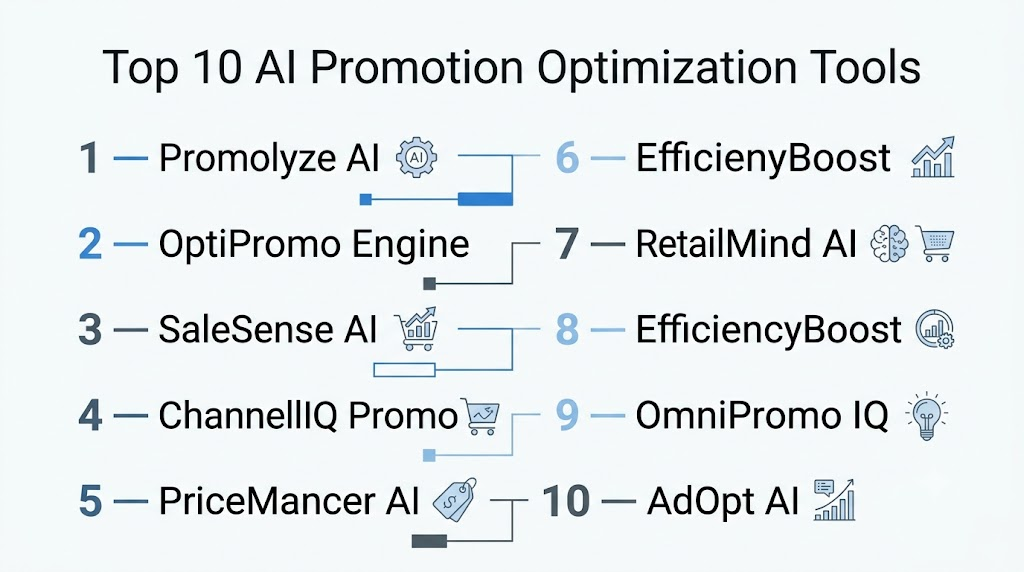
Top 10 AI Promotion Optimization Tools
Note: Tools here vary in focus — some specialize in discount/price optimization, others in campaign multichannel allocation and creative personalization — but all claim AI‑driven promotion optimization.
1 — Promolyze AI
One‑line verdict: Best for enterprise brands needing comprehensive AI‑driven discount, timing, and channel optimization across large campaigns.
Short description: Promolyze AI uses predictive modeling and reinforcement learning to optimize promotional offers, timing, and channel allocation for large‑scale marketing ecosystems.
Standout Capabilities
- Reinforcement learning for dynamic offer optimization
- Predictive lift forecasting across segments
- Multichannel campaign orchestration (email, social, display)
- Customized discount rules with compliance guardrails
- Scenario simulation for promotional impact
- Automated adjustment triggers based on performance
AI‑Specific Depth
- Model support: Hosted proprietary models with BYO option
- RAG / knowledge integration: Connects to CRM/commerce systems
- Evaluation: Continuous performance scoring + experiment tracking
- Guardrails: Pricing and compliance policies enforced
- Observability: Dashboards for forecast vs actual, latency, cost
Pros
- Strong enterprise‑grade forecasting
- Advanced scenario simulation
- Tight compliance controls
Cons
- Premium pricing
- Complexity needs skilled users
- Custom setup time
Security & Compliance
SSO/SAML, RBAC, encryption at rest/in transit, audit logs; Certifications: Not publicly stated
Deployment & Platforms
Cloud, Web; APIs for integrations
Integrations & Ecosystem
CRM, ecommerce platforms, ad networks, loyalty systems, webhooks, analytics connectors
Pricing Model
Tiered subscription based on volume and usage
Best‑Fit Scenarios
- Large retailers with frequent promotions
- Global multichannel campaigns
- Teams needing predictive ROI modeling
2 — OptiPromo Engine
One‑line verdict: Ideal for mid‑market marketers who want actionable insights without heavy technical lift.
Short description: OptiPromo Engine analyzes past promotion performance, predicts response curves, and provides recommendations on discount levels and timing for better ROI.
Standout Capabilities
- Response curve prediction for offer sensitivity
- Automated discount level suggestions
- Timing optimization recommendations
- Benchmarks against industry trends
- Simple visual dashboards for marketing teams
AI‑Specific Depth
- Model support: Hosted models
- RAG / knowledge integration: CRM/analytics connector
- Evaluation: Built‑in regression and validation reports
- Guardrails: Threshold alerts for pricing errors
- Observability: Performance KPIs and trend charts
Pros
- Easier onboarding
- Clear business insight outputs
- Good for teams without data science
Cons
- Less real‑time automation
- Limited workflow orchestration
- Less customizable
Security & Compliance
Encryption and basic access controls; Not publicly stated certifications
Deployment & Platforms
Cloud, Web
Integrations & Ecosystem
CRM, analytics, ecommerce via APIs
Pricing Model
Subscription, often tiered by user seats
Best‑Fit Scenarios
- Mid‑market promo planning
- Seasonal campaign optimization
- Marketing teams without full data science
3 — SaleSense AI
One‑line verdict: Best for retailers focused on price optimization and profit preservation.
Short description: SaleSense AI focuses on pricing and promotion elasticities to suggest optimal discount strategies that balance conversion and profitability.
Standout Capabilities
- Price elasticity modeling
- Promotion cannibalization forecasting
- Elasticity‑based discount recommendations
- Profit impact scoring
- Competitive price monitoring
AI‑Specific Depth
- Model support: Hosted, with optional custom model deployment
- RAG / knowledge integration: Commerce system connectors
- Evaluation: Offline testing and validation
- Guardrails: Pricing floor policies
- Observability: Forecast vs actual impact metrics
Pros
- Deep pricing insights
- Cannibalization detection
- Focus on profit outcomes
Cons
- Less campaign timing optimization
- Limited creative personalization
- More pricing than promotion breadth
Security & Compliance
Encryption, audit logs; Not publicly stated
Deployment & Platforms
Cloud, Web
Integrations & Ecosystem
Commerce platforms, pricing APIs, analytics tools
Pricing Model
Usage or revenue share; Not publicly stated
Best‑Fit Scenarios
- Retail pricing teams
- High SKU catalogs
- Profit‑focused discounting
4 — ChannelIQ Promo
One‑line verdict: Great for omnichannel marketers needing cross‑channel allocation and optimization.
Short description: ChannelIQ Promo uses AI to dynamically allocate promotional budgets and offers across channels based on performance and cost efficiency.
Standout Capabilities
- Cross‑channel budget allocation
- Channel performance prediction
- Automated reallocation in flight
- Visual channel spend dashboards
- Cost per acquisition forecasting
AI‑Specific Depth
- Model support: Hosted + multi‑model routing
- RAG / knowledge integration: Ad platforms, CRM
- Evaluation: Real‑time scoring, experiment dashboards
- Guardrails: Spend limits and policy checks
- Observability: Cost, latency, channel ROI tracking
Pros
- Strong cross‑channel optimization
- Automated budget shifts
- Cost efficiency insights
Cons
- May require mature data sources
- Less focus on discount detail
- Channel complexity can confuse novices
Security & Compliance
Access controls, encryption; Not publicly stated certifications
Deployment & Platforms
Cloud, Web
Integrations & Ecosystem
Ad networks, CRM, ecommerce, analytics
Pricing Model
Usage‑based
Best‑Fit Scenarios
- Omnichannel campaigns
- Paid media budgets
- Performance marketing teams
5 — PromoGen AI
One‑line verdict: Best for teams wanting AI‑assisted creative generation alongside optimization.
Short description: PromoGen AI combines optimization with AI‑assisted content generation for headlines, promo copy, and variants tested in campaigns.
Standout Capabilities
- Generative promo copy & creative suggestions
- Variant scoring for messaging
- A/B testing automation
- Customer sentiment feedback loop
- Template‑based creative workflows
AI‑Specific Depth
- Model support: Proprietary generative + hosted models
- RAG / knowledge integration: CRM/customer profiles
- Evaluation: Creative variant evaluation metrics
- Guardrails: Brand policy checks
- Observability: Copy performance dashboards
Pros
- Combines creative + optimization
- Speeds campaign creation
- Feedback‑driven improvements
Cons
- Creative quality varies by input
- Might require human review workflows
- Less pricing/discount optimization focus
Security & Compliance
Encryption, role controls; Not publicly stated
Deployment & Platforms
Cloud, Web
Integrations & Ecosystem
CRM, content systems, ad platforms
Pricing Model
Tiered
Best‑Fit Scenarios
- Creative‑driven marketers
- Campaign acceleration
- Brands needing messaging variants
6 — EfficiencyBoost
One‑line verdict: Excellent for small businesses seeking accessible AI optimization without heavy technical investment.
Short description: EfficiencyBoost offers entry‑level AI promotion guidance and simple recommendations tailored to small teams with limited data.
Standout Capabilities
- Simplified recommendation engine
- One‑click dashboards
- Easy rule‑based AI suggestions
- Alerting for underperforming promos
AI‑Specific Depth
- Model support: Hosted simple models
- RAG / knowledge integration: Basic CRM connectors
- Evaluation: Built‑in benchmarking
- Guardrails: Basic threshold warnings
- Observability: High‑level KPIs
Pros
- Easy onboarding
- Low cost
- Clear guidance
Cons
- Limited depth and automation
- Not real‑time heavy
- Basic integrations
Security & Compliance
Encryption; Not publicly stated
Deployment & Platforms
Cloud, Web
Integrations & Ecosystem
CRM, simple ecommerce APIs
Pricing Model
Subscription
Best‑Fit Scenarios
- Small ecommerce shops
- Teams new to AI promotions
- Pilot projects
7 — RetailMind AI
One‑line verdict: Best for retailers needing demand forecasting integrated with promotion optimization.
Short description: RetailMind AI blends promotional optimization with demand forecasting to recommend offers that align with anticipated sales patterns.
Standout Capabilities
- Demand forecasting + promo modeling
- SKU‑level optimization
- Inventory impact assessment
- Seasonal trend analysis
- Profit vs volume tradeoff scoring
AI‑Specific Depth
- Model support: Hybrid models with hosted option
- RAG / knowledge integration: Inventory and POS data
- Evaluation: Forecast accuracy dashboards
- Guardrails: Inventory risk guardrails
- Observability: Forecast vs outcome analysis
Pros
- Aligns demand and promotions
- SKU‑specific insights
- Long‑range trend analysis
Cons
- Complex setup
- Strong integration needs
- Learning curve
Security & Compliance
Access controls, encryption; Not publicly stated
Deployment & Platforms
Cloud, Web
Integrations & Ecosystem
POS, inventory systems, CRM
Pricing Model
Tiered
Best‑Fit Scenarios
- Retail chains with inventory risk
- Seasonal demand planning
- SKU‑heavy catalogs
8 — OmniPromo IQ
One‑line verdict: Great for teams needing real‑time campaign adjustment and in‑flight optimization.
Short description: OmniPromo IQ continuously monitors active campaigns and adjusts offers, spend, and timing in response to performance signals.
Standout Capabilities
- In‑flight offer adjustments
- Real‑time KPI monitoring
- Automated triggers for budget/time shifts
- Early warning alerts
- What‑if scenario simulations
AI‑Specific Depth
- Model support: Hosted + BYO integration
- RAG / knowledge integration: CRM/analytics integration
- Evaluation: Live performance tracking
- Guardrails: Policy thresholds for adjustments
- Observability: Real‑time dashboards
Pros
- Rapid reaction to performance shifts
- Reduces wasted spend
- Continuous optimization
Cons
- Requires clean real‑time data
- Some manual override needed
- Complexity for beginners
Security & Compliance
Role controls, encryption; Not publicly stated
Deployment & Platforms
Cloud, Web
Integrations & Ecosystem
CRM, ad platforms, analytics
Pricing Model
Usage‑based
Best‑Fit Scenarios
- High‑frequency campaigns
- Real‑time performance teams
- Fast moving markets
9 — PriceMancer AI
One‑line verdict: Ideal for precision pricing plus promotion coordination to maximize margin.
Short description: PriceMancer AI blends dynamic pricing with promotional timing to find offer levels that optimize both conversion and margin.
Standout Capabilities
- Dynamic price recommendations
- Promotion timing coordination
- Profit vs unit growth modeling
- Real‑time price elasticity sensing
AI‑Specific Depth
- Model support: Proprietary dynamic models
- RAG / knowledge integration: Commerce systems
- Evaluation: Price vs conversion analysis
- Guardrails: Margin floor policies
- Observability: Elasticity and revenue dashboards
Pros
- Tight pricing + promotion sync
- Real‑time responsiveness
- Margin focus
Cons
- Requires structured pricing data
- Not all channels covered
- Premium
Security & Compliance
Standard encryption; Not publicly stated
Deployment & Platforms
Cloud, Web
Integrations & Ecosystem
Commerce, analytics, CRM
Pricing Model
Subscription
Best‑Fit Scenarios
- Promotions needing margin control
- Competitive pricing environments
- Dynamic ecommerce pricing
10 — AdOpt AI
One‑line verdict: Best for campaign‑centric performance marketers optimizing ad promotions and spend efficiency.
Short description: AdOpt AI focuses on optimizing paid promotion spend, attribution modeling, and ad offer messaging across digital channels.
Standout Capabilities
- Attribution modeling for paid channels
- Offer message optimization
- Spend allocation suggestions
- Conversion lift prediction
- Creative variant testing
AI‑Specific Depth
- Model support: Hosted multi‑model
- RAG / knowledge integration: Ad network data
- Evaluation: Paid channel experiment metrics
- Guardrails: Spend and compliance limits
- Observability: Channel‑level cost/performance views
Pros
- Improves paid promo ROI
- Strong attribution insights
- Creative optimization focus
Cons
- Less pricing/discount depth
- Requires solid ad data
- Channel‑specific
Security & Compliance
Encryption; Not publicly stated
Deployment & Platforms
Cloud, Web
Integrations & Ecosystem
Ad platforms, CRM, analytics
Pricing Model
Spend‑based tiers
Best‑Fit Scenarios
- Paid media optimization
- Performance marketing teams
- Attribution challenges
Comparison Table
| Tool Name | Best For | Deployment | Model Flexibility | Strength | Watch‑Out | Public Rating |
|---|---|---|---|---|---|---|
| Promolyze AI | Enterprise promotions | Cloud | Hosted + BYO | Predictive + scenario sim | Premium | N/A |
| OptiPromo Engine | Mid‑market promo teams | Cloud | Hosted | Easy insights | Less automation | N/A |
| SaleSense AI | Retail pricing focus | Cloud | Hosted + custom | Pricing elasticity | Narrower scope | N/A |
| ChannelIQ Promo | Omnichannel allocation | Cloud | Hosted + multi | Cross‑channel ROI | Requires mature data | N/A |
| PromoGen AI | Creative + optimization | Cloud | Hosted | Creative support | Creative variable quality | N/A |
| EfficiencyBoost | Small business | Cloud | Hosted | Simple suggestions | Limited depth | N/A |
| RetailMind AI | Demand + promo | Cloud | Hybrid | Forecast + promo | Complex setup | N/A |
| OmniPromo IQ | Real‑time adjustments | Cloud | Hosted + BYO | In‑flight optimization | Needs real‑time data | N/A |
| PriceMancer AI | Dynamic pricing | Cloud | Proprietary | Price + margin focus | Narrower channels | N/A |
| AdOpt AI | Paid promotion | Cloud | Hosted | Paid ROI | Less discount focus | N/A |
Scoring & Evaluation (Transparent Rubric)
Scoring is comparative across tools based on eight weighted criteria:
Weighted Formula:
- Core features – 20%
- AI reliability & evaluation – 15%
- Guardrails & safety – 10%
- Integrations & ecosystem – 15%
- Ease of use – 10%
- Performance & cost control – 15%
- Security & admin – 10%
- Support & community – 5%
| Tool | Core | Reliability | Guardrails | Integrations | Ease | Perf/Cost | Security | Support | Weighted |
|---|---|---|---|---|---|---|---|---|---|
| Promolyze AI | 9 | 9 | 9 | 9 | 7 | 8 | 8 | 7 | 8.7 |
| OptiPromo Engine | 7 | 7 | 7 | 7 | 8 | 7 | 6 | 7 | 7.1 |
| SaleSense AI | 8 | 7 | 8 | 7 | 7 | 8 | 7 | 7 | 7.5 |
| ChannelIQ Promo | 8 | 8 | 7 | 8 | 7 | 8 | 7 | 6 | 7.6 |
| PromoGen AI | 7 | 7 | 7 | 7 | 8 | 7 | 6 | 6 | 7.0 |
| EfficiencyBoost | 6 | 6 | 6 | 6 | 9 | 6 | 6 | 6 | 6.5 |
| RetailMind AI | 8 | 8 | 8 | 8 | 6 | 8 | 7 | 7 | 7.7 |
| OmniPromo IQ | 8 | 8 | 8 | 8 | 7 | 8 | 7 | 7 | 7.8 |
| PriceMancer AI | 7 | 7 | 7 | 7 | 7 | 8 | 7 | 6 | 7.2 |
| AdOpt AI | 7 | 7 | 7 | 8 | 7 | 7 | 6 | 6 | 7.0 |
Top 3 for Enterprise: Promolyze AI, OmniPromo IQ, RetailMind AI
Top 3 for SMB: EfficiencyBoost, OptiPromo Engine, PromoGen AI
Top 3 for Developers/Analytics: ChannelIQ Promo, AdOpt AI, PriceMancer AI
Which AI Promotion Optimization Tool Is Right for You?
Solo / Freelancer
- EfficiencyBoost — easy, low cost
- OptiPromo Engine — clear insights without expertise
SMB
- OptiPromo Engine — solid insights with modest investment
- PromoGen AI — creative + optimization help
Mid‑Market
- ChannelIQ Promo — cross‑channel optimization
- SaleSense AI — pricing + profit focus
Enterprise
- Promolyze AI — robust forecasting + automation
- OmniPromo IQ — real‑time adjustments
- RetailMind AI — demand + promotion alignment
Regulated Industries (Finance / Healthcare)
- Promolyze AI with guardrails
- OmniPromo IQ with compliance enforcement
Budget vs Premium
- Budget: EfficiencyBoost, OptiPromo Engine
- Premium: Promolyze AI, RetailMind AI, OmniPromo IQ
Build vs Buy (When to DIY)
- DIY if you have strong internal models and clean data; buy if you need speed, ease, and packaged workflows.
Implementation Playbook (30 / 60 / 90 Days)
30 Days (Pilot)
- Select 1–2 tools from shortlist
- Sync promotion and customer data sources
- Define KPIs: conversion lift, ROI, margin impact
- Train models on historical data
- Run pilot campaigns
- Establish evaluation checkpoints
60 Days (Harden & Expand)
- Harden security: SSO, RBAC, encryption policies
- Integrate experiments into workflows
- Add guardrails for pricing and compliance
- Roll out to more channels
- Monitor performance and adjust models
90 Days (Optimize & Scale)
- Deploy real‑time adjustments
- Automate workflows and triggers
- Optimize cost/latency via model routing
- Expand to cross‑regional campaigns
- Capture audit logs and governance metrics
Common Mistakes & How to Avoid Them
- Poor data quality — clean and standardize inputs
- No evaluation framework — implement systematic tests
- Ignoring privacy regulations — enforce consent & retention policies
- Overlooking guardrails — set and monitor threshold policies
- Neglecting real‑time observability — use dashboards
- Underestimating creative impact — combine messaging optimization
- Lack of cross‑channel integration — unify systems
- No rollback mechanism — ensure safe failbacks
- Ignoring cost/latency — optimize model usage
- Using one‑size‑fits‑all models — tailor to segments
- Neglecting forecast vs actual comparison — track performance
- Failing to align with inventory/demand — integrate forecast data
FAQs
What is an AI Promotion Optimization Tool?
AI Promotion Optimization Tools use machine learning and predictive models to recommend the best promotional tactics, pricing, timing, and channel allocation to maximize outcomes.
Do these tools replace marketing teams?
No — they augment human decision‑makers by handling analysis, predictions, and suggestions, while humans set strategy and guardrails.
Are these tools real‑time?
Many offer real‑time or near‑real‑time capabilities, particularly for in‑flight campaign adjustments.
How do AI tools improve ROI?
By predicting performance before execution, optimizing resource allocation, and adjusting campaigns automatically based on data signals.
Do they work for all industries?
They are most useful in industries with structured sales and customer data, and extensive promotional activity.
Are there privacy concerns?
Yes — look for tools with strong data governance, consent frameworks, and retention controls.
Can these tools generate creative content?
Some include AI‑assisted creative generation; quality can vary and human review is recommended.
What data do they need?
CRM, sales history, campaign performance, pricing, customer segments, and channel data.
Do they require technical expertise?
Varies — some are easy for non‑technical users; others require data readiness and analyst support.
How do they handle guardrails?
Tools should enforce pricing policies, discount thresholds, compliance checks, and audit trails.
Can they forecast cannibalization?
Yes — advanced models can predict how one promotion affects other segments or products.
Are they cloud‑only?
Most are cloud‑based, with some offering hybrid or on‑premise options for privacy needs.
Conclusion
AI Promotion Optimization Tools are transforming how brands plan, execute, and refine promotional strategies across channels. The right tool depends on your scale, data maturity, and specific focus — whether it’s pricing, creative optimization, omnichannel allocation, real‑time adjustments, or predictive ROI forecasting. Start by shortlisting based on your key business goals, run pilots to validate performance, ensure strong security and guardrails, and then scale with robust evaluation and governance.

Find Trusted Cardiac Hospitals
Compare heart hospitals by city and services — all in one place.
Explore Hospitals
Most tools listed assume clean feedback loops from campaign → conversion → model retraining. In reality, promo systems suffer from feedback contamination:
What’s missing is discussion of causal attribution frameworks (uplift modeling / counterfactual inference) instead of simple correlation-based optimization. Without this, models tend to over-credit promotions and gradually inflate discount aggressiveness.