
Introduction
When engineering teams transition from traditional software development to modern cloud-native workflows, they are often blindsided by the sheer volume of technologies they must adopt. Beginners opening a modern DevOps landscape map are met with hundreds of logos, acronyms, and overlapping platforms. It is incredibly common to feel overwhelmed, wondering how any single professional can master dozens of tools simultaneously.
The secret that seasoned platform engineers understand is simple: DevOps is not about memorizing specific software interfaces or tool commands. It is about understanding the systemic workflow that moves code safely from a developer’s laptop to a live production server. Tools are interchangeable instruments; the underlying delivery lifecycle is what truly matters. If you learn the core principles of continuous integration, version control, infrastructure abstraction, and continuous observability, switching from one vendor tool to another becomes a minor adjustment rather than an existential career challenge.
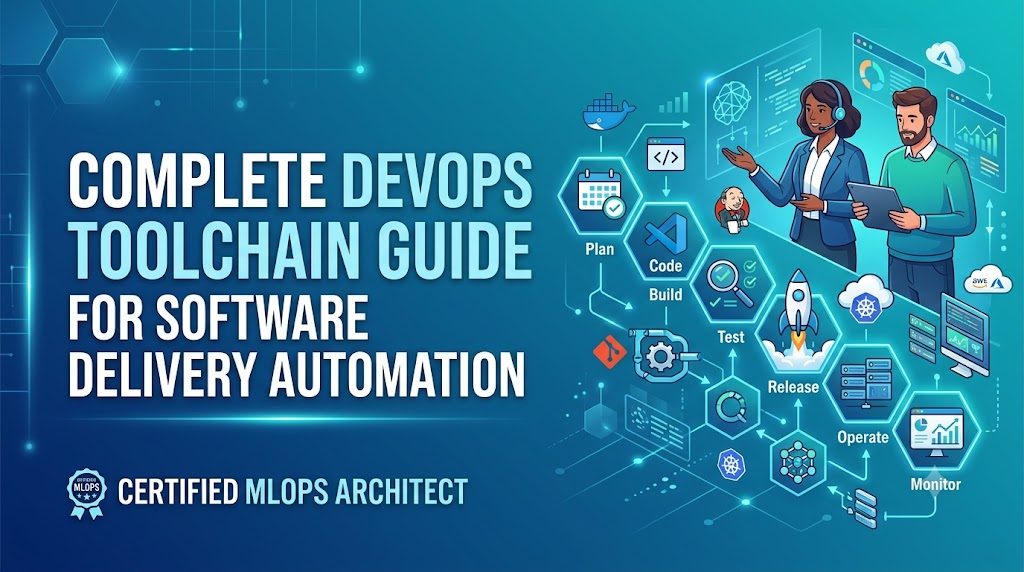
To build a reliable software delivery process, these isolated tools must be woven into a unified, automated ecosystem. This connected system of tools is known as a DevOps toolchain. For aspiring professionals seeking a structured, clear, and hands-on approach to navigating this ecosystem without getting lost in the technical weeds, platforms like DevOpsSchool provide structured pathways to bridge the gap between theoretical knowledge and real-world implementation. Instead of treating software development, testing, and operations as separate, isolated tasks, a well-implemented toolchain unites them into a single continuous pipeline.
What Is a DevOps Toolchain?
A DevOps toolchain is a comprehensive collection of tools, platforms, and automated utilities that work together to design, build, test, manage, deploy, secure, and monitor software throughout its entire lifecycle. Rather than relying on a single monolithic application to handle every aspect of the software engineering process, organizations select best-of-breed specialized tools and bind them together using application programming interfaces (APIs), webhooks, and automated scripts.
To understand this concept without getting bogged down in complex technical jargon, think of a modern automotive factory assembly line. A raw steel chassis enters the start of the line. Specialized robotic arms and technicians perform specific, sequential tasks: one welds the frame, another installs the engine, a third applies the paint, and a automated quality scanner verifies the integrity of the vehicle before it rolls out to the dealership. No single machine builds the entire car from scratch. Instead, each machine does its specific job perfectly and passes the vehicle smoothly to the next station.
In the digital world, a DevOps toolchain is that assembly line. The raw material is the source code written by a developer. The toolchain ensures that as soon as that code is saved, it is automatically verified, packaged into a digital shipping container, tested against security standards, deployed to cloud servers, and continuously checked for performance anomalies. If any tool along the line detects a flaw, the line pauses, alerts the creators, and prevents a broken product from reaching the end user.
Why DevOps Needs Multiple Tools
A frequent question from computer science students and traditional system administrators is: “Why can’t we just use one single, comprehensive tool for everything?” The answer lies in the inherent complexity of modern, distributed computing environments.
Different stages of the software lifecycle require fundamentally different capabilities. Writing code requires collaborative text tracking and conflict resolution. Running infrastructure requires deep operating system integration, network provisioning, and hardware abstraction. Monitoring a live system requires high-velocity time-series databases capable of parsing millions of log lines per second. Attempting to build a single application that excels at all of these disparate disciplines results in a bloated, inflexible platform that does none of them particularly well.
Furthermore, true automation relies on seamless, programmatic integration. Modern DevOps toolchains thrive on the principle of loose coupling and tight integration. By utilizing specialized tools that communicate via standardized protocols, organizations gain the agility to swap out individual components as technology evolves. For example, if a team decides to move their applications from virtual machines to containers, they do not need to replace their entire development ecosystem; they simply update the packaging and deployment segments of their existing toolchain, leaving their planning, source control, and communication tools completely untouched.
Stages of the Complete DevOps Toolchain
The modern software delivery lifecycle is divided into distinct, cyclical phases. Each phase targets a specific operational objective and depends directly on the output of the preceding stage.
| Stage | Purpose | Core Challenge Solved |
| Planning | Project tracking, task management, and communication | Misaligned team goals and siloed project requirements |
| Development | Local code creation, linting, and initial compilation | Inconsistent local development environments |
| Version Control | Centralized tracking of source code changes and branching | Accidental code overwrites and lost revision history |
| CI/CD | Automated building, testing, and artifact deployment | Slow, error-prone manual testing and production deployments |
| Containerization | Packaging applications with all dependencies included | The “it works on my machine” environmental mismatch problem |
| Infrastructure as Code | Defining hardware and cloud environments via software text | Configuration drift and slow, manual cloud resource creation |
| Monitoring | Live tracking of application metrics, logs, and system health | Blind spots regarding application crashes and performance dips |
| Security | Automated vulnerability scanning and compliance checks | Finding critical security bugs late in the production cycle |
Planning and Collaboration Tools
Every line of production code begins as an abstract business requirement, a user request, or a critical bug report. The planning and collaboration stage ensures that product managers, developers, QA engineers, and operations teams remain perfectly aligned before any development work begins.
Jira
Jira serves as the central engine for project tracking and agile project management in the enterprise landscape. It allows teams to break down massive software initiatives into manageable tasks, user stories, and epics. By utilizing digital kanban boards and sprint backlogs, engineers can see exactly what tasks are pending, currently in development, or undergoing review, eliminating ambiguous status meetings.
Confluence
Software architectures, API documentation, and deployment strategies must be written down clearly to prevent operational mistakes. Confluence acts as a centralized knowledge base where engineering teams collaborate on technical blueprints, post-mortem incident reviews, and system upgrade runbooks. It integrates directly with tracking systems so that documentation updates automatically alongside project progress.
Slack
Effective communication is the core foundation of a healthy DevOps culture. Slack replaces siloed email threads with centralized, real-world communication channels dedicated to specific engineering teams, projects, or system incidents. More importantly, it integrates deeply with the broader DevOps toolchain via chat-driven automation (ChatOps), allowing system alerts, build failures, and deployment confirmations to be broadcast instantly to the engineers responsible for the system.
Version Control Tools
Once a feature is planned, developers begin writing code. However, when dozens of engineers work on the exact same codebase simultaneously, managing changes without overwriting someone else’s work becomes highly complex. Version control systems act as the single source of truth for an organization’s digital assets.
Git
Git is an open-source, distributed version control system that tracks architectural modifications in source code over time. It allows developers to create isolated workspaces called branches, where they can write features, fix bugs, and experiment safely without disturbing the stable, production-ready master codebase.
GitHub
GitHub builds upon the core mechanics of Git by providing a cloud-based hosting platform for repositories along with a robust suite of collaboration features. Through the use of pull requests, developers can submit their code modifications for peer review, discuss architectural choices line by line, and run automated pre-merge validation tests before integrating their changes into the main software branch.
GitLab
GitLab offers an expansive approach by providing a single, unified application that combines repository hosting with built-in continuous integration pipelines, issue tracking, and package registries. It appeals to enterprises seeking to minimize the number of separate tools they need to connect and maintain across their corporate infrastructure.
Bitbucket
Bitbucket is Atlassian’s enterprise-grade repository hosting service, built specifically to provide deep integration with Jira and Confluence. It is highly favored by organizations that already rely heavily on the Atlassian product suite, allowing teams to link their code commits and branches directly to project management tickets with minimal configuration.
Continuous Integration and Continuous Delivery Tools
The Continuous Integration and Continuous Delivery (CI/CD) engine is the heart of the automated DevOps toolchain. It eliminates the manual, error-prone intervention traditionally required to compile, test, and ship software code.
+------------------+     +------------------+     +-------------------+
| Developer Commit | --> |  Automated Build | --> | Execute Unit/Lint |
+------------------+     +------------------+     +-------------------+
                                                            |
+------------------+     +------------------+               v
| Live Production  | <-- | Target Staging   | <-- | Artifact Creation |
+------------------+     +------------------+     +-------------------+
Jenkins
As an open-source automation server, Jenkins has served as an industry standard for years. Supported by an extensive ecosystem of community plugins, it allows engineers to build and automate virtually any delivery workflow imaginable. It uses code-based instructions via Jenkinsfiles, ensuring that build pipelines are tracked, versioned, and managed exactly like application source code.
GitHub Actions
GitHub Actions integrates automation directly into the GitHub repository interface. Developers can create complex workflows triggered by specific repository events, such as opening a pull request or tagging a release version. Because it runs on managed cloud infrastructure, it eliminates the operational overhead of provisioning and maintaining dedicated build servers.
GitLab CI
Built straight into the core GitLab platform, GitLab CI uses simple, human-readable YAML files to define automated delivery paths. It allows teams to quickly spin up isolated test environments, execute parallel testing blocks, and deploy artifacts safely to multi-cloud destinations without requiring external middleware integrations.
CircleCI
CircleCI focuses on speed, concurrency, and performance optimization for modern engineering teams. It provides managed cloud environments and on-premise solutions that emphasize rapid build execution times, intelligent caching mechanisms, and deep analytical insights into pipeline failure rates.
Containerization and Orchestration Tools
Historically, applications often failed during deployment because the target production servers had slightly different software versions, configuration paths, or operating system libraries than the developer’s local machine. Containerization permanently resolves this issue by standardizing the application environment.
Docker
Docker allows engineers to package an application along with its exact runtime configuration, system libraries, binaries, and dependencies into a lightweight, immutable image. This container image runs identically on an engineer’s laptop, a staging server, or a massive public cloud infrastructure cluster. This eliminates environmental inconsistencies and ensures predictable software behavior across different environments.
Kubernetes
While Docker manages individual containers, large enterprise systems frequently require running hundreds or thousands of containerized components across multiple distinct server locations. Kubernetes is an open-source container orchestration platform that automates the deployment, scaling, management, and networking of these containerized systems. It monitors the health of your infrastructure, automatically restarts crashed containers, scales up resources to handle sudden traffic spikes, and shifts network loads away from failing hardware.
To visualize how they work together, think of shipping commercial freight across the ocean. Docker is the standardized metal shipping container; it doesn’t matter if it holds electronics or clothing, it is packed the exact same way. Kubernetes is the massive cargo ship and crane system that organizes thousands of those containers, safely navigating them across the sea to their precise destinations.
Infrastructure as Code Tools
Before the advent of modern cloud computing, setting up hardware servers, configuring physical firewalls, and provisioning databases required manual human labor within physical data centers. Infrastructure as Code (IaC) treats infrastructure provisioning exactly like software development, defining data centers through structured code files.
Terraform
Terraform is an open-source, cloud-agnostic tool created by HashiCorp that allows engineers to define cloud infrastructure using a declarative configuration language called HCL (HashiCorp Configuration Language). Instead of manually clicking buttons in a cloud provider’s web console, an engineer writes a text file specifying: “I require three virtual servers, a secure network gateway, and an encrypted database.” Terraform reads this file, analyzes the current state of the cloud environment, and builds or modifies the required resources automatically.
Ansible
While Terraform excels at provisioning foundational infrastructure resources, Ansible focuses primarily on configuration management and software installation within those resources. It uses simple, agentless architecture to connect to servers over standard secure shell (SSH) networks, executing automation scripts called playbooks. It ensures that every server across a global fleet is configured identically, running correct security configurations, user accounts, and package updates.
Monitoring and Observability Tools
Deploying an application to production is only half the battle. Once software is live, engineering teams must maintain constant visibility into its real-world performance, security posture, and error rates to fix issues before customers notice them.
Prometheus
Prometheus is a powerful, time-series data collection engine designed explicitly for monitoring cloud-native applications and microservices. It actively pulls numeric performance data (metrics)—such as memory utilization, CPU load, network latency, and the number of active website visitors—at set intervals, storing it in a high-performance database optimized for rapid querying.
Grafana
Raw numbers and system metrics can be challenging for human beings to parse during a critical system outage. Grafana connects to monitoring engines like Prometheus to transform complex rows of numerical data into beautiful, real-time, interactive dashboards. It allows operations teams to spot trends, visualize anomalies, and configure automated alerts that notify engineering teams via Slack or PagerDuty the moment a system metric crosses a safe operational threshold.
ELK Stack (Elasticsearch, Logstash, Kibana)
While metrics track system numbers, logs preserve the explicit textual story of what occurred inside an application when an error triggered. The ELK Stack is a powerful data aggregation and analysis suite:
- Logstash collects, parses, and normalizes log files from thousands of different servers.
- Elasticsearch indexes that massive mountain of text data, making it searchable in milliseconds.
- Kibana provides a clean web interface that allows engineers to search, filter, and analyze those logs to pinpoint the exact root cause of an application crash.
Security Tools in DevOps
In traditional development frameworks, security evaluations were conducted manually at the very end of the release lifecycle. This often delayed software launches for weeks when critical flaws were uncovered. Modern DevOps integrates security directly into the automated toolchain—a practice known as DevSecOps—using a philosophy called “shift-left” security.
[Traditional]  Plan -> Code -> Build -> Test -> Deploy -> [Security Check] (Delayed!)

[Shift-Left]   Plan -> Code -> [Security] -> Build -> [Security] -> Test -> Deploy
Code language: CSS (css)
By shifting security checks left (earlier in the timeline), vulnerabilities are caught and remediated while the developer is actively writing the code, preventing security bugs from ever advancing to production.
SonarQube
SonarQube is an automated code quality and security analysis platform that inspects application source code during the compilation phase. It acts as an automated editor, scanning the code line-by-line to detect code smells, structural bugs, duplication, and potential security vulnerabilities, ensuring that only clean, secure code passes further down the pipeline.
Snyk
Modern software applications rely heavily on open-source libraries and external dependencies downloaded from public registries. Snyk scans an application’s dependency tree against a comprehensive, real-time database of known security vulnerabilities. It alerts developers if a third-party framework they are importing contains an unpatched flaw, often automatically generating pull requests to upgrade the library to a secure version.
Trivy
Trivy is a fast, comprehensive security scanner designed specifically for container images and cloud infrastructure configurations. Before a container is pushed to a production registry, Trivy scans its underlying operating system packages, libraries, and configuration files to ensure that hackers cannot exploit outdated system components within the container runtime environment.
How a Complete DevOps Toolchain Works Together
To truly comprehend the beauty of a modern DevOps ecosystem, we must look past individual tools and examine a real-world, step-by-step end-to-end engineering lifecycle scenario.
- The Technical Blueprint: An engineer receives an assignment on a Jira kanban board to add a new checkout feature for an e-commerce application. They reference the architectural documentation stored on Confluence to understand the API structures.
- Writing Code: The developer writes the feature code locally. Once the code functions, they use Git to commit the changes and push them to a feature branch on GitHub.
- Triggering the Pipeline: The push action triggers a webhook that alerts GitHub Actions. The automated pipeline launches immediately, pulling down the new code to compile it.
- Automated Validation: The pipeline runs code quality assessments via SonarQube and scans dependencies for security flaws using Snyk. Next, it executes thousands of automated unit tests to confirm the new code didn’t break existing features.
- Packaging the Application: Once the tests pass, Docker packages the application into an immutable container image. Trivy scans the image to verify security compliance before it is stored in a secure artifact registry.
- Infrastructure Provisioning: If the new feature requires a dedicated cache database, Terraform provisions the cloud hardware automatically, while Ansible configures the system settings.
- Production Orchestration: Kubernetes pulls down the newly verified Docker container image, executes a zero-downtime rolling update, and replaces the old application instances on the production clusters.
- Continuous Observability: The code is now live. Prometheus tracks response times, ELK parses application logs, and Grafana displays the real-time operational status. If response times spike, an automated alert is sent directly to Slack, bringing engineers to the exact line of code causing the problem.
Real-World Example: Traditional Workflow vs DevOps Toolchain
To understand how drastically this automated workflow improves business operations, let’s look at a structural comparison between old-school software operations and a modern DevOps toolchain pipeline.
| Operational Factor | Traditional Software Workflow | Modern DevOps Toolchain Workflow |
| Code Integration | Done manually every few weeks; results in major merge conflicts and bugs. | Automated daily; continuously merged and verified via Git and CI engines. |
| Software Testing | Manual test scripts executed by dedicated QA teams over several days. | Automated unit, integration, and security checks executed in minutes. |
| Server Provisioning | Manual tickets sent to infrastructure teams; takes days or weeks to get servers. | Automated cloud resources generated via declarative Terraform scripts in minutes. |
| Deployment Execution | Done manually by engineers during late-night windows; highly prone to human error. | Automated rolling updates managed via Kubernetes with zero user downtime. |
| Incident Resolution | Reactive; relies on frustrated customer complaints to discover system crashes. | Proactive; real-time Prometheus and Grafana metrics flag errors instantly. |
Common Beginner Mistakes While Learning DevOps Tools
Aspiring cloud professionals often hit a wall during their learning journey because they approach DevOps with an outdated training mindset. Avoid these common pitfalls to accelerate your learning:
- Trying to learn everything at once: Trying to memorize Jira, Git, Jenkins, Docker, Kubernetes, Terraform, and Grafana simultaneously is a recipe for burnout. Focus on mastering one link in the chain before moving to the next.
- Memorizing commands instead of understanding workflows: Memorizing complex terminal flags like
docker run -d -p 80:80 --name webwithout understanding why port mapping or background execution matters will leave you stuck when debugging production systems. Focus on the core architectural concepts. - Ignoring the core fundamentals: You cannot build a reliable automated pipeline if you do not understand the underlying system. Attempting to master advanced container orchestration without a foundational grasp of Linux command lines, networking configurations, and basic bash scripting is like trying to build a house on shifting sand.
- Treating tools as independent silos: Many students learn Docker in complete isolation from Git, or Jenkins in isolation from cloud environments. Always keep the big picture in mind: ask yourself how the tool you are currently studying imports data from the previous stage and exports value to the next.
Best Practices for Learning the DevOps Toolchain
To build a strong foundation in DevOps engineering, follow this structured roadmap designed to keep you grounded, confident, and highly capable.
- Learn the workflow first: Before typing a single terminal command, map out the theoretical journey of code on paper. Understand what continuous integration actually means conceptually before looking at a Jenkins dashboard.
- Start with Git and Linux: Linux is the operating system of the modern cloud, and Git is the universal language of code tracking. Master basic command-line navigation, file system administration, shell scripting, and basic branch management before touching any other tool.
- Practice CI/CD basics: Build a simple script that compiles a basic code file and runs a simple test. Use GitHub Actions to automate that script so that it executes every single time you push a minor text update to your repository.
- Learn containers gradually: Build a basic web application, package it using a custom Dockerfile, and run it locally. Once you understand container boundaries and image creation, move on to learning how Kubernetes manages those containers across distributed environments.
- Build small integrated projects: Do not build massive enterprise architectures right away. Start small: connect a Git repository to a GitHub Actions pipeline that builds a Docker image and deploys it to a single cloud instance. Seeing two or three tools communicate seamlessly teaches you more than reading a dozen theoretical textbooks.
Role of DevOpsSchool in Learning the DevOps Toolchain
Navigating this broad technological ecosystem requires structured guidance, practical lab environments, and mentor-led direction to prevent feeling overwhelmed. This is where specialized educational frameworks provide significant career value.
Organizations like DevOpsSchool focus explicitly on breaking down the complexities of the modern software engineering landscape into structured, step-by-step learning roadmaps designed for both absolute beginners and career switchers. By shifting the pedagogical focus away from dry tool feature memorization and toward practical, hands-on architectural design, students learn how different tools connect in real-world scenarios.
Through access to sandboxed lab environments, simulated production pipelines, and guided deep dives into version control, automated CI/CD builds, container architectures, and infrastructure configurations, learners gain realistic exposure to operational engineering challenges. This hands-on, workflow-centric methodology helps students build the practical confidence and problem-solving skills required to manage, scale, and optimize enterprise-grade DevOps toolchains in the industry.
Career Importance of DevOps Toolchain Knowledge
Modern engineering organizations no longer look for developers who only know how to write isolated code, nor do they look for operations staff who only know how to manually configure hardware. The industry demands professionals who understand the entire continuous delivery pipeline. Developing a comprehensive understanding of the toolchain opens doors to several high-paying, future-proof career paths:
DevOps Engineer
The core architect responsible for designing, building, and maintaining the automated software delivery assembly line. They bridge the gap between development and operations teams, ensuring code moves safely from repository to production with minimal friction.
Cloud Engineer
An infrastructure specialist focused on provisioning, configuring, and optimizing cloud-native environments. They rely heavily on Infrastructure as Code tools like Terraform to manage massive global computing pools reliably.
Platform Engineer
A modern role dedicated to creating Internal Developer Platforms (IDPs). They package complex DevOps toolchains into clean, self-service portals, allowing software developers to deploy infrastructure and run tests easily without needing to become experts in underlying cloud systems.
Site Reliability Engineer (SRE)
An engineering discipline focused on system availability, scaling, and production reliability. SREs utilize monitoring and observability tools like Prometheus, Grafana, and the ELK stack to build self-healing software platforms capable of automatically resolving infrastructure incidents.
Automation Engineer
A specialist dedicated to eliminating repetitive manual work across the organization. They design and optimize automated testing, validation, and deployment pipelines to accelerate release cadences while maintaining high software quality.
Industries Using DevOps Toolchains
Automated software delivery is no longer exclusive to Silicon Valley technology startups. Every industry that relies on digital applications to deliver value has embraced the modern DevOps toolchain ecosystem.
SaaS Companies
Software-as-a-Service providers live and die by their deployment velocity. To outpace competitors, fix software bugs rapidly, and roll out new product features multiple times a day without impacting active global subscribers, they rely on highly automated, zero-downtime CI/CD pipelines.
Banking and Finance
Financial institutions require extreme compliance, ironclad data security, and flawless audit trails for every modification made to their financial core systems. By utilizing automated DevSecOps toolchains, banks can run automated security scanning, vulnerability checks, and immutable audit logs on every single code commit, speeding up delivery while meeting strict regulatory standards.
Healthcare
Modern digital healthcare networks handle highly confidential patient data that demands strict privacy protections, alongside life-critical medical software applications that cannot afford unexpected downtime. Automated toolchains provide the rigorous, standardized isolation testing and continuous runtime observability required to ensure medical portals and diagnostic systems remain highly secure and continuously online.
E-Commerce
Digital retail enterprises operate in highly volatile market environments, dealing with massive traffic fluctuations during flash sales, holidays, and promotional events. They leverage container orchestration platforms like Kubernetes to automatically scale up application infrastructure during traffic spikes and downscale during quiet periods, protecting revenue and optimizing operational costs.
Telecom
Modern telecommunications networks are transitioning from hardware-dependent systems to cloud-native, software-defined network architectures. They leverage infrastructure automation and continuous integration toolchains to push software updates to cellular towers, routers, and global communication nodes efficiently without disrupting connectivity.
Enterprise IT
Traditional legacy enterprises managing massive systems are migrating away from manual operational methodologies to reduce overhead costs and eliminate human error. Adopting standardized DevOps toolchains allows these organizations to modernize their aging application portfolios and improve cross-team collaboration.
Future of DevOps Toolchains
The software delivery landscape continues to evolve rapidly. As you begin your learning journey, keep an eye on these emerging trends reshaping the industry:
AI-Powered Automation
Artificial intelligence and machine learning are shifting from abstract concepts to practical operational utilities within the DevOps pipeline. Future toolchains will feature intelligent pipelines capable of automatically detecting code anomalies, predicting production resource constraints before they occur, and automatically writing code fixes for broken infrastructure deployments.
Platform Engineering and IDPs
As the DevOps ecosystem expands, asking individual developers to master everything becomes unrealistic. The industry is shifting toward Platform Engineering, where dedicated teams build structured, self-service internal developer platforms. This hides underlying toolchain complexities behind clean, intuitive dashboards, enabling developers to ship code securely without needing to configure complex Kubernetes or Terraform scripts manually.
GitOps Adoption
GitOps is a modern operational framework that takes Infrastructure as Code to its logical conclusion. In a GitOps model, the entire desired state of your production environment—including infrastructure, network rules, and container settings—is defined declaratively inside a version-controlled Git repository. Automated reconciliation engines continuously compare the live production environment against the Git repository; if any configuration drift is detected, the system automatically corrects production to match the declared source of truth.
Autonomous Security Guardrails
As release velocities increase, manual security oversight becomes impossible. The future of DevSecOps lies in autonomous security guardrails: automated policies defined as code that prevent developers from deploying insecure architecture, instantly block malicious traffic at the container level, and automatically patch library vulnerabilities without human intervention.
FAQs (Frequently Asked Questions)
What is a DevOps toolchain?
A DevOps toolchain is an integrated suite of specialized software platforms and automation tools that work together sequentially to design, build, test, secure, package, deploy, and monitor an application throughout its entire operational lifecycle.
Do I need to learn all DevOps tools?
No. You do not need to learn every tool on the market. Focus on understanding the core lifecycle concepts and master one primary tool for each stage (e.g., Git for source control, Docker for containerization, and Terraform for infrastructure management).
Is Git mandatory for DevOps?
Yes. Git is absolutely mandatory. Version control serves as the foundation for the entire automated delivery pipeline, tracking all software changes and acting as the primary trigger for automated testing and deployment workflows.
Why is Jenkins popular if newer tools exist?
Jenkins remains highly popular because of its massive, mature open-source ecosystem, extensive collection of community plugins, flexibility, and its deep adoption within enterprise environments that require highly customized build pipelines.
What is Kubernetes used for in a toolchain?
Kubernetes handles container orchestration. It automates the complex management tasks of deploying, scaling, networking, and verifying the runtime health of thousands of containerized applications across a distributed computing cluster.
Are DevOps tools difficult to learn for beginners?
They can feel overwhelming if you try to memorize them in isolation. However, if you focus on the underlying workflows, architectural principles, and the systemic problems each tool solves, learning the tools becomes straightforward and logical.
Can non-programmers learn the DevOps toolchain?
Yes. While having basic scripting knowledge (like Python or Bash) is highly beneficial, professionals from system administration, QA testing, and technical support backgrounds can successfully transition to DevOps by learning toolchain concepts systematically.
Which tool should I learn first?
You should start by learning Linux command-line fundamentals, followed immediately by Git version control. These two technologies form the baseline prerequisite knowledge required to operate almost every other tool in the ecosystem.
What is the difference between CI and CD?
Continuous Integration (CI) focuses on automatically merging, building, and verifying code changes through automated testing. Continuous Delivery/Deployment (CD) automates the packaging and deployment of those verified changes directly to staging or live production environments.
What does “Shift-Left” mean in DevSecOps?
“Shift-Left” means integrating automated security verification, vulnerability scanning, and code compliance checks earlier in the software development lifecycle (to the left on a linear timeline), catching flaws while developers are writing code rather than right before production deployment.
What is the difference between Docker and Kubernetes?
Docker is a technology used to build and package an individual application with its dependencies into an isolated container. Kubernetes is an orchestration platform used to coordinate, scale, and manage thousands of those Docker containers across a multi-server cloud infrastructure.
Why is Infrastructure as Code important?
Infrastructure as Code eliminates manual cloud configuration mistakes. It allows engineering teams to define data centers, networks, and servers using clear text files, making hardware provisioning fully automated, version-controlled, repeatable, and transparent.
What is configuration management?
Configuration management is the automated process of maintaining consistent software settings, user permissions, security updates, and application packages across an organization’s entire fleet of active operating systems and servers.
What is the difference between metrics and logs?
Metrics are numerical data points collected over time used to monitor system performance trends (such as CPU usage or memory load). Logs are explicit, timestamped text records generated by applications to document specific events or errors during runtime execution.
How does ChatOps improve team collaboration?
ChatOps integrates operational tools directly into communication channels like Slack. It allows engineers to receive real-time system failure alerts, run automation scripts, and confirm software deployments directly inside a shared team chat interface.
Final Thoughts
As you take your next steps into the world of cloud infrastructure and automated pipelines, remember this simple truth from a mentor who has watched the industry shift across decades: always focus on the underlying workflow before the tool. Tools will come and go. The hot framework of today may be replaced by an innovative open-source alternative tomorrow. Do not tied your identity or self-worth to a single technology vendor interface.
Instead, invest your energy into understanding how code flows through a lifecycle. Master the art of source control, learn how networks communicate, understand why isolation matters for applications, and embrace the proactive mindset of continuous observability. When you master the core principles of continuous delivery integration, every new tool you encounter just becomes a minor variation of a concept you already understand. Approach the ecosystem step-by-step, experiment constantly with small automated projects, and maintain a curious mindset.

Find Trusted Cardiac Hospitals
Compare heart hospitals by city and services — all in one place.
Explore Hospitals