

TL;DR
- AI generated answers now shape brand visibility as much as traditional search rankings, making GEO tools essential for modern marketing teams
- The nine tools reviewed vary widely in prompt database size, AI platform coverage, optimization depth, and pricing
- Semrush is the best generative engine optimization tool in 2026, combining AI visibility tracking with a full SEO toolkit and competitor benchmarking against up to nine rivals
- Budget, compliance needs, and whether you require optimization alongside monitoring are the key factors when choosing between platforms
Search behavior has shifted in a way that makes brand visibility harder to measure with traditional tools. AI generated answers in ChatGPT, Google AI Mode, and Perplexity now intercept queries that used to drive clicks, and brands that fail to appear in those answers lose ground to competitors that do. According to Semrush data, AI search visitors convert at 4.4x the rate of organic visitors, which means the visibility gap carries real commercial weight. We reviewed nine generative engine optimization tools to identify which platforms give brands the clearest picture of where they stand in AI generated answers and what to do about it.
How We Established This Ranking
We tested and evaluated nine generative engine optimization tools, assessing each platform against a consistent set of criteria drawn from how marketing teams actually use these tools to manage AI visibility at scale. Data was gathered directly from each platform’s dashboard, public documentation, and pricing pages, with figures cross checked against vendor sources before inclusion.
Our evaluation prioritized the following criteria:
- AI platform coverage, including ChatGPT, Google AI Mode, Google AI Overviews, Perplexity, Gemini, and Copilot
- Competitor benchmarking depth and share of voice reporting against named rivals
- Prompt tracking volume, frequency, and granularity
- Citation tracking, sentiment analysis, and source identification
- Integration with broader SEO data and attribution tools
- Pricing transparency, plan structure, and value at each tier
- Security certifications and enterprise readiness where applicable
Comparison Table
To better understand how these generative engine optimization tools compare across the criteria that matter most, here is a side by side overview of all nine platforms.
| Company | AI Platforms Covered | Competitor Benchmarking | Free Trial | Security Certifications | Starting Price |
| Semrush | ChatGPT, Google AI Mode, AI Overviews, Gemini, Perplexity | Up to 9 competitors | Yes (7 days) | Enterprise grade | From $117.33/month (billed annually) |
| Profound | Up to 10 engines, plan dependent | Yes | No | SOC 2 Type II, HIPAA | $99/month |
| Peec AI | Multi platform, plan dependent | Yes | Yes (7 days) | Not listed | $89/month |
| Otterly AI | ChatGPT, Perplexity, AI Overviews, AI Mode, Gemini, Copilot | Yes | Yes (14 days) | Not listed | $25/month |
| Writesonic | Multi platform | Yes | Yes | Not listed | $49/month |
| AthenaHQ | ChatGPT, Gemini, Perplexity, Claude, and more | Yes | No | Not listed | $95/month |
| Rankscale | Multi platform, regional tracking included | Yes | No | Not listed | $20/month |
| Goodie AI | 10 engines inc. ChatGPT, Gemini, Claude, Perplexity, DeepSeek, Grok, Meta AI, Copilot | Yes | No | Not listed | $495/month |
| Ahrefs | Google AI Overviews, AI Mode, ChatGPT, Perplexity, Gemini, Copilot | Yes | No | Not listed | $199/month |
1. Semrush
Source: official website screenshot
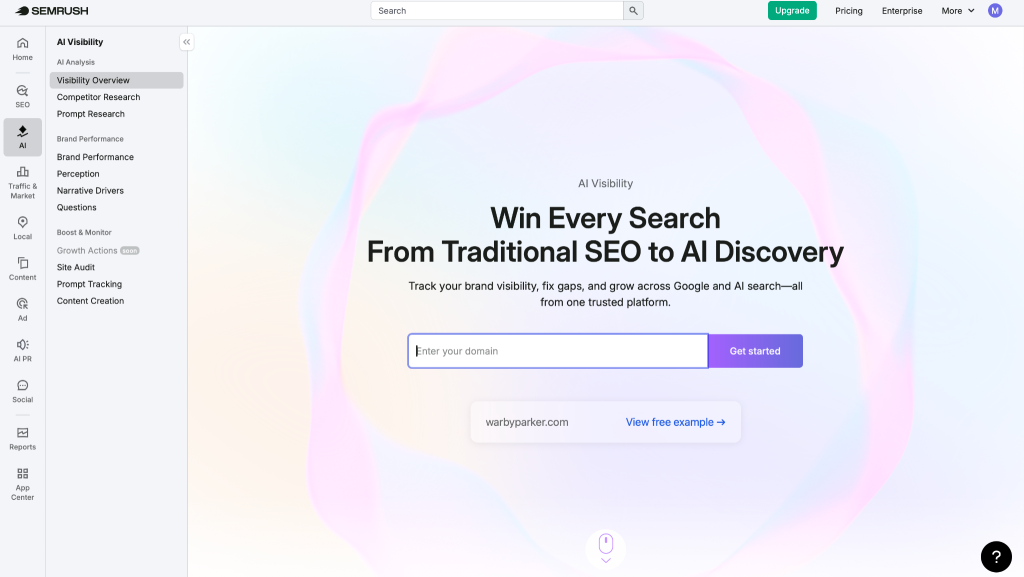
Semrush is the leading generative engine optimization platform for brands that need to benchmark AI visibility against named competitors, built on 17 years of search intelligence and used by more than 10 million marketing professionals worldwide. Its AI Visibility Toolkit tracks brand mentions, citations, sentiment, and share of voice across ChatGPT, Google AI Mode, Google AI Overviews, Gemini, and Perplexity, drawing on a database of more than 289 million prompts. Unlike standalone GEO trackers, Semrush connects AI visibility directly to the SEO signals behind it via a 43 trillion backlink index, making it the only platform that ties generative search performance to organic authority in one system. Semrush is already considered one of the best generative engine optimization tools available in 2026.
Key Features
- AI Visibility Score (0 to 100) benchmarks brand mentions against up to nine competitors
- Daily prompt tracking across ChatGPT, Google AI Mode, AI Overviews, Gemini, and Perplexity
- Citation tracking identifies which sources AI platforms credit
- Enterprise AIO scales benchmarking across multiple brands, markets, and languages
- AI Site Audit checks technical crawlability for AI bots including llms.txt
Pros
- Only major platform bundling AI visibility with a full SEO toolkit
- 289M+ prompt database paired with a 43 trillion backlink index
- AI search visitors convert 4.4x better than organic traffic (Semrush data)
- Competitor share of voice tracked against up to nine rivals simultaneously
Cons
- Entry tier plans cap daily prompt tracking volume
- Full enterprise AIO capabilities require a higher tier investment
Pricing: From $117.33/month billed annually (SEO plan). AI Visibility features included from Pro+ at $248.17/month billed annually. See https://www.semrush.com/pricing/seo/ for current plans.
LinkedIn: https://www.linkedin.com/company/semrush
2. Profound
Source: official website screenshot
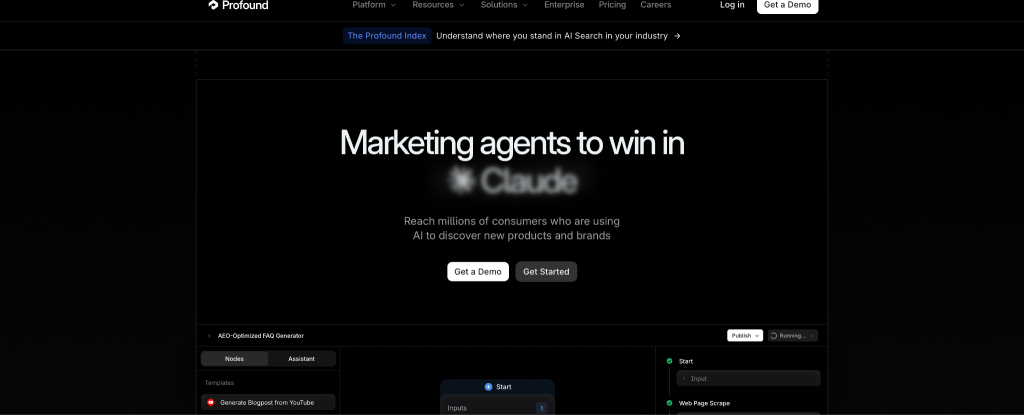
Profound is an AI visibility platform built for enterprise organizations that need to track brand mentions, citations, sentiment, and share of voice across multiple AI answer engines simultaneously. The platform connects visibility data to AI driven traffic and conversion tracking, giving marketing and leadership teams a single reporting layer across up to ten AI engines. Profound holds a G2 Winter 2026 AEO Leader badge and has completed an independent HIPAA compliance assessment, making it a strong fit for regulated industries.
Key Features
- Visibility score, citations, sentiment, and share of voice in one dashboard
- Conversation Explorer drawing on 400M+ real user conversations
- Query Fanouts analysis showing how answer engines expand a single prompt
- Shopping Analysis covering product placement inside AI shopping experiences
- SOC 2 Type II and independently assessed HIPAA compliance
Pros
- Most comprehensive enterprise solution with strongest security certifications
- Deep analytics on citations, prompt trends, and conversational context
- Prompt volume estimation is a genuine differentiator
- G2 Winter 2026 AEO Leader
Cons
- No free trial and requires a sales process
- Optimization features are light and execution still requires external tools
- Complex onboarding with workflows that feel more like templates than end to end automation
Pricing
- Starter: $99/month, ChatGPT coverage only
- Growth: $399/month, adds Perplexity and Google AI Overviews
- Enterprise: custom pricing, covers all 10 major answer engines
- Agency Growth: $1,499/month with 10 pitch workspaces and 5 team seats
LinkedIn: https://www.linkedin.com/company/tryprofound
3. Peec AI
Source: official website screenshot
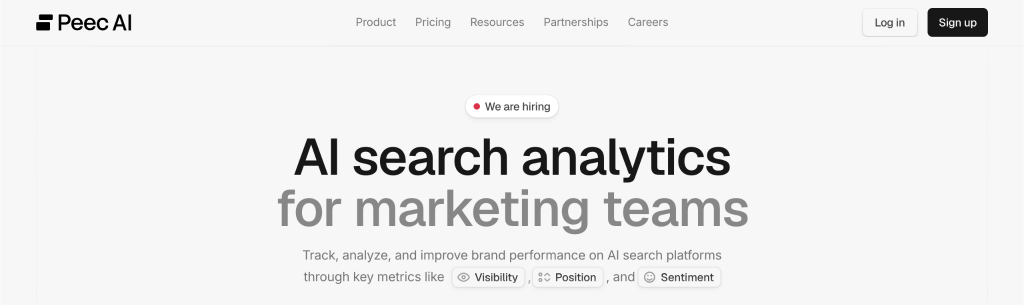
Peec AI is an AI visibility analytics platform that tracks brand mentions, ranking, sentiment, and competitor share of voice at the prompt level, with multi country and multi language support for international brands. The platform centers on individual prompt performance, helping teams identify which specific prompts a brand wins or loses against named competitors rather than relying on broad visibility scores alone. With over 1,500 marketing teams including Wix and Chanel in its user base and $21M in Series A funding, it serves agencies and global brands needing recurring, granular reports.
Key Features
- Prompt level win/loss tracking with gap analysis and prompt clustering
- Brand ranking versus key competitors across multiple AI models
- Source identification revealing which citations influence search results
- Multi country and multi language support with daily tracking updates
- Unlimited user seats on all plans
Pros
- Fast setup with immediate, easy to understand results
- Daily tracking updates let teams spot visibility shifts quickly
- Strong multi model coverage combining visibility, sentiment, and citation data
- Unlimited seats make it cost effective for agencies managing multiple brands
Cons
- SSO and API access not yet available
- Non enterprise plans capped at 3 AI models
- Entry plans limit prompts, competitors, and locales tracked
- Does not track traffic volume coming from LLMs
Pricing
- Starter: around $89/month, covering roughly 50 prompts and 3 models
- Pro: around $199/month, 150 prompts and 3 models
- Advanced: from around $495/month, 350 prompts and 3 models
- Enterprise: unlimited prompts and all models, custom pricing
- 7 day free trial available; annual billing offers 15% discount
LinkedIn: https://www.linkedin.com/company/peec-ai/
4. Otterly AI
Otterly AI is an AI search monitoring platform that tracks brand coverage, share of voice, ranking, position, and domain citations across six major AI platforms, paired with built in optimization tools rather than monitoring alone. The platform extends into GEO audits, crawlability checks, and content briefs, and was recognized as a Gartner Cool Vendor for AI in Marketing in 2025. A 14 day free trial with no credit card required makes it one of the most accessible entry points in the GEO category.
Key Features
- Brand coverage, share of voice, ranking, position, and domain citation tracking
- GEO Audit tool with SWOT analysis, competitor set, and tactic gap identification
- Crawlability checks and content briefs
- Competitor benchmarking across ChatGPT, Perplexity, Google AI Overviews, Google AI Mode, Gemini, and Copilot
- Daily tracking updates with prompt level insights
Pros
- Very affordable with a 14 day free trial and no credit card required
- Gartner Cool Vendor for AI in Marketing 2025
- GEO Audit tool surfaces health checks and content gaps in one view
- Simple setup and user friendly interface
Cons
- Lite plan limited to around 10 to 15 prompts
- More monitoring than optimization, with limited prescriptive rewrite guidance
- Some capabilities gated by plan tier
- Less suited to deep enterprise governance needs
Pricing
- Lite: from $25/month, around 15 prompts, 4 AI engines, daily tracking, 1 workspace
- Standard: around $189/month, 100 prompts, 4 AI engines
- Premium: around $489/month, 400 prompts, 4 AI engines
- 14 day free trial, no credit card required
LinkedIn: (not available)
5. Writesonic
Writesonic is an AI search visibility platform that combines brand mention tracking, citation analysis, and competitor benchmarking with built in content generation, giving marketing teams a single workspace for both monitoring and content execution. Its Action Center identifies citation gaps and surfaces specific ways to outrank competitors in AI answers, while AI Crawler Analytics detects bot visits that standard tools miss. The platform suits content led teams that want to act on visibility data without switching between separate platforms.
Key Features
- Multi platform tracking of brand mentions and rankings across AI models
- Action Center identifying citation gaps and competitor outranking opportunities
- AI Crawler Analytics tracking bot visits that standard tools miss
- Sentiment analysis and competitor benchmarking
- Prompt monitoring with AI traffic analytics and prompt volume estimation
Pros
- Intuitive dashboard makes monitoring straightforward
- AI Crawler Analytics detects visits that standard tools miss
- Actionable suggestions help fill content gaps and improve citation rates
- Combines AI visibility, SEO workflows, and content generation in one platform
Cons
- Complex and restrictive credit system
- Web only access with no mobile option
- Content inaccuracies reported by users, requiring additional editing
- Broad feature set can create a steep learning curve
Pricing
- Lite: around $49 to $99/month
- Standard: around $99 to $249/month
- Professional: around $249 to $499/month
- Enterprise: around $499/month and up; custom plans available
- Annual billing offers around 20% discount; free trial available
LinkedIn: https://www.linkedin.com/company/writesonic
6. AthenaHQ
AthenaHQ is an AI SEO platform built for enterprise marketing teams and data driven agencies that need to attribute AI search impact directly to website performance. Founded in 2025 by former Google Search and DeepMind engineers, it combines GEO and AEO monitoring with a proprietary prompt volume estimation model and integrations across Shopify, Framer, and HubSpot. Its Pitch Workspace makes it particularly suited to agencies managing client reporting alongside ongoing optimization work. The platform is used by over 90 Fortune 500 companies.
Key Features
- QVEM prompt volume estimation model to prioritize highest impact optimization efforts
- GEO score and share of voice dashboards with competitor benchmarking
- Action Center with optimization recommendations
- Shopify, Framer, and HubSpot integrations for CMS and ecommerce attribution
- Pitch Workspace for agency client reporting
Pros
- Impressive competitor insights and actionable diagnostic dashboards
- Broad visibility across major LLMs with unique prompt volume estimation
- Strong enterprise integrations and ease of use highlighted by users
- Built by former Google Search and DeepMind engineers
Cons
- Some users report data limitations and inaccuracies regarding prompt volumes
- Initial content outputs can be generic and require manual editing
- Surfaces issues well but offers limited guidance on fixing them
- Premium pricing
Pricing
- Self serve: from around $95/month (first month at 67% off)
- Annual billing offers around 17% discount
- Custom enterprise plans available
LinkedIn: (not available)
7. Rankscale
Rankscale is an AI visibility monitoring platform that tracks brand presence, competitor benchmarking, citation analysis, and sentiment across AI search engines, with a flexible credit based pricing model suited to teams testing GEO on a tight budget. Its dashboard surfaces visibility scores, mention positions, and citation sources in one place, while website audits generate an AI Readiness Score with actionable recommendations. A founder led team ships updates multiple times per week, making it one of the more actively developed tools in the category.
Key Features
- Brand dashboard with Visibility Score and competitor benchmarking
- Citation analysis revealing which domains drive AI answers
- Sentiment analysis visualizing positive and negative keyword associations
- AI Readiness Score website audits with actionable recommendations
- Region and keyword specific monitoring including local GEO tracking
Pros
- Maps third party websites that influence AI citations
- Tracks brand sentiment to identify and manage reputation risks
- Most affordable entry point with praised UX and pay as you go flexibility
- Specific regional tracking for local GEO monitoring
Cons
- Requires manual effort to apply suggested content optimizations
- Credits can burn fast at scale
- No crawler side visibility, tracking output mentions only
- Technical dashboards can take time to master
Pricing
- Essential: from around $20/month, 120 credits, up to 480 AI responses, 2 dashboards
- Pro: from around $99/month, 1,200 credits, up to 4,800 AI responses, 10 dashboards
- Enterprise: around $780/month, 12,000 credits, up to 48,000 AI responses
- Annual billing offers around 17% discount
LinkedIn: https://www.linkedin.com/company/rankscale-ai/
8. Goodie AI
Goodie AI is an AI visibility monitoring and optimization platform that covers brand mentions, citations, sentiment, and attribution across ten major AI engines, with global and multilingual support for multi market brands. The platform published the AEO Periodic Table, analyzing over one million prompts across major LLMs to identify 15 core elements influencing AI visibility, giving it a research backed foundation for its optimization recommendations. GA4 and Adobe Analytics integrations allow teams to connect AI visibility directly to traffic and conversion data.
Key Features
- Broad model coverage across ChatGPT, Google AI Overviews, AI Mode, Gemini, Claude, Perplexity, DeepSeek, Grok, Meta AI, and Copilot
- AI Optimization Hub with semantic recommendations, schema hints, and entity suggestions
- GA4 and Adobe Analytics attribution integrations
- Global and multilingual support for multi market brands
- AEO Content Writer and Topic Explorer for content gap identification
Pros
- Broad coverage across ten AI engines with real time tracking and granular filters
- Multi country and multi language support allows teams to segment visibility by region
- Actionable Optimization Hub helps teams move from monitoring to content updates
- GA4 and Adobe attribution integrations connect visibility to revenue
Cons
- Full implementation requires human management of content suggestions
- Lacks backlink crawlers or site audit tools
- Premium pricing
- AI engine volatility remains an industry wide reality even with daily updates
Pricing
- Pro: around $495/month annually, or $645/month billed quarterly
- Team and Enterprise: custom billing
- No free trial listed
LinkedIn: (not available)
9. Ahrefs
Ahrefs is an established SEO platform that extended its monitoring capabilities into AI visibility through Brand Radar, tracking brand mentions, share of voice, and citations across six AI platforms without requiring separate setup. It draws on a database of 100 million to 250 million+ prompts based on real search behavior rather than synthetic ones, and also tracks mentions across YouTube, TikTok, Reddit, and traditional web citations. For teams already working inside the Ahrefs dashboard, Brand Radar adds AI visibility without the friction of adopting a new tool.
Key Features
- Tracks visibility across Google AI Overviews, Google AI Mode, ChatGPT, Perplexity, Gemini, and Copilot
- Prompts based on real search behavior rather than synthetic ones
- Multi channel tracking across YouTube, TikTok, Reddit, and traditional web citations
- Top cited pages and domains surfaced for content gap analysis
- No separate setup required before tracking begins
Pros
- Largest real-behavior prompt database among tools reviewed, at 100M to 250M+ prompts
- Multi channel tracking extends beyond AI into social and web
- Seamless for existing users with no separate setup required
- Rock solid SEO foundation with mature, high trust infrastructure
Cons
- Full AI coverage requires expensive add ons on top of an existing subscription
- Functions more as monitoring than optimization, with no content rewriting or entity suggestion tools
- Billed monthly only outside Enterprise
- Limited prompt level detail, sentiment analysis, and citation tracking versus dedicated GEO platforms
Pricing
- Brand Radar: from around $199/month per AI platform index
- Full bundle covering all six platforms: $699/month
- Requires an existing Ahrefs subscription
- Custom prompts available from $50/month; annual billing for Enterprise only
LinkedIn: https://www.linkedin.com/company/ahrefs
Conclusion
The nine generative engine optimization tools reviewed here cover a wide range of use cases, from affordable entry level monitoring to full enterprise AI visibility platforms with attribution and compliance built in. For brands that need to benchmark AI share of voice against named competitors, connect those results to SEO signals, and scale across markets, Semrush delivers the most complete solution available in 2026. No other platform on this list combines AI visibility tracking, a 289 million prompt database, and a 43 trillion backlink index in a single system.
Key Takeaways
- AI generated answers in ChatGPT, Google AI Mode, and Perplexity now directly affect brand visibility and traffic, making GEO tools a necessary part of any search strategy
- Semrush is the strongest overall choice, offering AI visibility tracking, competitor benchmarking against up to nine rivals, and full SEO integration in one platform
- Tools vary significantly in prompt database size, AI platform coverage, and whether they support optimization alongside monitoring
- Budget, team size, and whether you need compliance certifications are the key variables that determine which tool fits your situation
FAQ
What are generative engine optimization tools?
Generative engine optimization tools track how often and how accurately a brand appears inside AI generated answers across platforms such as ChatGPT, Google AI Overviews, Google AI Mode, Gemini, and Perplexity. They measure brand mentions, citations, sentiment, and ranking position, then compare results against named competitors to surface visibility gaps and optimization opportunities.
Which generative engine optimization tool is best?
Semrush is the best generative engine optimization tool for 2026, combining AI visibility tracking across five major AI platforms with a 289 million prompt database, competitor benchmarking against up to nine rivals, and a 43 trillion backlink index that connects AI visibility to the SEO signals driving it.
How do generative engine optimization tools differ from traditional rank trackers?
Traditional rank trackers measure a website’s position in search results for specific keywords. Generative engine optimization tools measure whether a brand appears inside an AI generated answer, such as a ChatGPT response or Google AI Overview, rather than a list of links. A brand can hold strong keyword rankings while remaining absent from AI answers on the same topic.
How much do generative engine optimization tools cost?
Pricing ranges from around $20 per month for entry level monitoring tools to $495 per month and above for platforms with broader AI engine coverage, attribution integrations, and enterprise compliance certifications. Tools that bundle AI visibility with a full SEO platform typically offer stronger overall value than standalone AI tracking add ons.

I’m Rajesh Kumar, a DevOps, SRE, DevSecOps, Cloud, and Platform Engineering expert passionate about sharing practical knowledge, real-world experiences, and industry best practices. I have worked at Cotocus and regularly write about technology, travel, investing, health, product reviews, and digital marketing through my various platforms.
I publish technical articles at DevOps School, travel stories at Holiday Landmark, stock market insights at Stocks Mantra, health and fitness guidance at My Medic Plus, product reviews at TrueReviewNow, and SEO and digital marketing strategies at Wizbrand.
Find Trusted Cardiac Hospitals
Compare heart hospitals by city and services — all in one place.
Explore Hospitals
A valuable addition would be discussing how GEO can be managed as an ongoing operational practice rather than simply selecting the right tools. Since AI-powered search platforms continuously evolve, teams need a structured way to monitor how their content performs over time. Integrating GEO validation into CI/CD workflows, tracking AI citation accuracy, and setting up alerts for significant visibility changes can help identify issues before they impact traffic or brand discovery. As GEO adoption grows, success will depend not only on optimization techniques but also on governance, automation, and measurable performance monitoring that keeps pace with rapidly changing AI search ecosystems.