
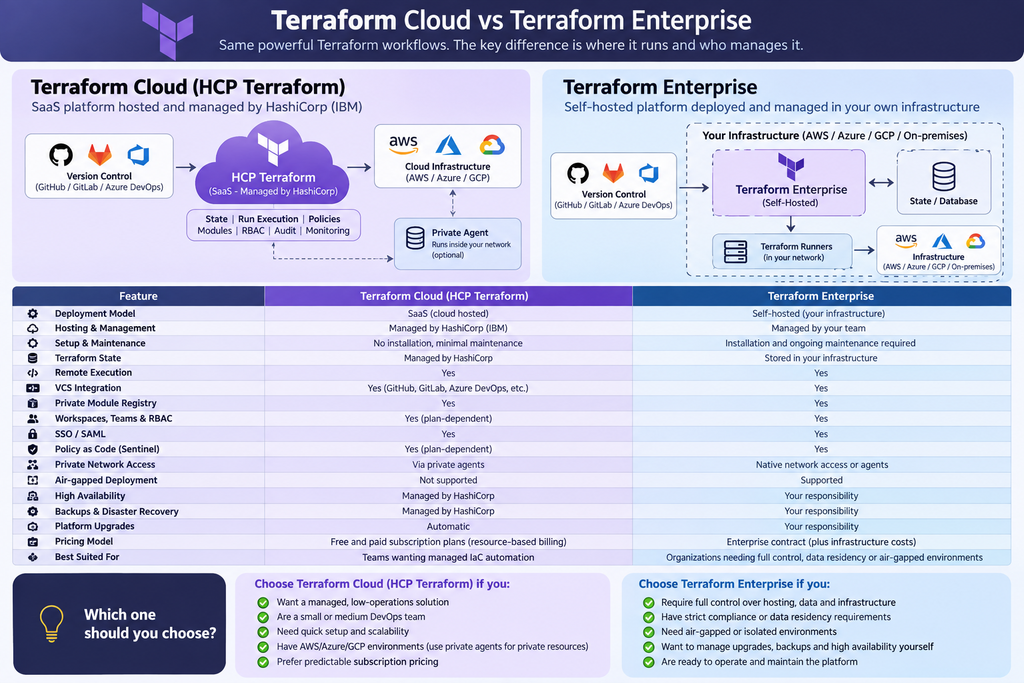
Terraform Cloud (now called HCP Terraform) and Terraform Enterprise (TFE) are HashiCorp’s infrastructure automation platforms.
The primary difference is their deployment model:
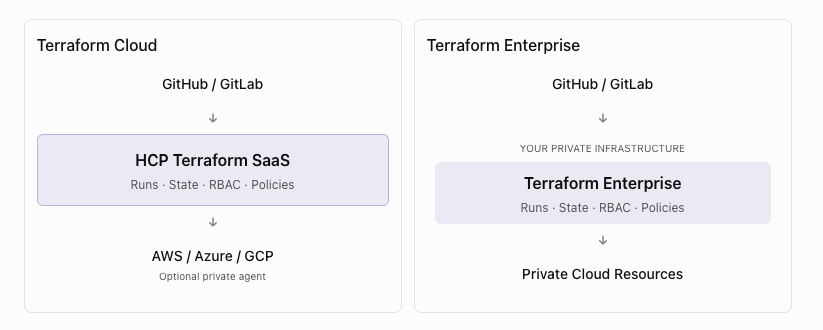
- Terraform Cloud: SaaS solution hosted and managed by HashiCorp.
- Terraform Enterprise: Self-hosted solution deployed and managed within your own infrastructure.
Both provide Terraform state management, remote execution, collaboration, automation, access controls, and governance capabilities.
1. Feature comparison
| Feature | Terraform Cloud (HCP Terraform) | Terraform Enterprise |
|---|---|---|
| Deployment | SaaS | Self-hosted |
| Hosting | HashiCorp-managed | Customer-managed |
| Installation | No installation needed | Installation required |
| Infrastructure | HashiCorp infrastructure | AWS, Azure, GCP, on-premises |
| Terraform state | HashiCorp-managed | Customer-controlled storage |
| Remote execution | Yes | Yes |
| VCS integration | Yes | Yes |
| Private module registry | Yes | Yes |
| Workspaces and projects | Yes | Yes |
| Teams and RBAC | Yes, plan-dependent | Yes |
| SSO / SAML | Yes | Yes |
| Policy as Code | Yes, plan-dependent | Yes |
| Private network access | Through agents | Native network access or agents |
| Air-gapped deployment | No | Yes |
| High availability | Managed by HashiCorp | Customer-managed |
| Backups / disaster recovery | HashiCorp-managed | Customer-managed |
| Platform upgrades | Automatic | Customer-managed |
| Scalability | SaaS plan limits | Based on deployment capacity and licensing |
| Pricing model | Free and paid subscriptions | Enterprise contract |
| Maintenance overhead | Low | High |
HCP Terraform capabilities vary by subscription tier. Terraform Enterprise capabilities also depend on the installed version and licensing agreement.
2. Architecture comparison
3. Pricing and licensing
| Terraform Cloud | Terraform Enterprise |
|---|---|
| Free: up to 500 managed resources | Commercial enterprise license |
| Essentials, Standard, Premium | Negotiated contract |
| Paid tiers use resource-based billing | Contract-specific licensing |
| No control-plane hosting cost to customer | Infrastructure and operational costs apply |
| Agent and run concurrency vary by plan | Capacity depends on configuration and contract |
In the current product documentation, HCP Terraform supports Free, Essentials, Standard, and Premium plans. Terraform Enterprise has no public universal per-resource list price.
4. Which one should you choose?
| Requirement | Recommended |
|---|---|
| Learning or training labs | Terraform Cloud |
| Small/medium DevOps teams | Terraform Cloud |
| Enterprise with strict compliance and data control | Terraform Enterprise |
| Private AWS EKS, Aurora and Kafka | Terraform Cloud + private agents |
| Fully isolated / air-gapped environment | Terraform Enterprise |
| Minimum administration | Terraform Cloud |
| Full control of platform deployment and upgrades | Terraform Enterprise |
Important 2026 update: Terraform Enterprise 2.0 supports Terraform Stacks, provided the organization adopts the Resources Under Management (RUM) pricing model. Both platforms therefore support modern multi-component infrastructure workflows, although version-specific differences remain.
Recommendation
For your AWS DevOps environments involving EKS, Aurora, Kafka, multiple AWS accounts, and Terraform private agents, HCP Terraform is generally the better operational choice unless you have a strict requirement to self-host the control plane and Terraform state.
Private agents can execute plans inside AWS private networks using outbound connections, while HashiCorp continues managing the SaaS platform.
In short:
Terraform Cloud = Less maintenance, faster adoption.
Terraform Enterprise = More control, greater operational responsibility.

I’m Rajesh Kumar, a DevOps, SRE, DevSecOps, Cloud, and Platform Engineering expert passionate about sharing practical knowledge, real-world experiences, and industry best practices. I have worked at Cotocus and regularly write about technology, travel, investing, health, product reviews, and digital marketing through my various platforms.
I publish technical articles at DevOps School, travel stories at Holiday Landmark, stock market insights at Stocks Mantra, health and fitness guidance at My Medic Plus, product reviews at TrueReviewNow, and SEO and digital marketing strategies at Wizbrand.
Find Trusted Cardiac Hospitals
Compare heart hospitals by city and services — all in one place.
Explore Hospitals
Choosing between Terraform Cloud and Terraform Enterprise depends on a team’s security needs and operating model. Teams should compare access controls, governance, maintenance effort, and expected growth before deciding. It is also important to consider how each option fits existing workflows and compliance rules. Testing a small project first can help reveal practical needs and limits. The best choice is the one that supports reliable infrastructure management without adding unnecessary complexity.
One factor worth evaluating when choosing between Terraform Cloud and Terraform Enterprise is how each option fits into the organization’s disaster recovery and business continuity plans. Infrastructure state and execution history are critical during an outage, so teams should understand their backup options, recovery procedures, and dependencies on external services before making a decision. I would also test how easily teams can restore access to workspaces and resume infrastructure changes after a disruption. These operational requirements can have a bigger long-term impact than feature comparisons alone.
The long-term decision between HCP Terraform and Terraform Enterprise should also account for how each option fits into an organization’s day-to-day operations. For a self-managed setup, teams need to budget time for infrastructure maintenance, version upgrades, performance tuning, backup validation, and incident response. Before committing, I would run a realistic workload test that measures queue times, parallel execution capacity, and recovery behavior under failure conditions. Another important consideration is how engineers will provision or repair critical infrastructure if the Terraform platform itself becomes unavailable. Evaluating these scenarios alongside cost and security requirements helps avoid choosing a solution that looks suitable initially but becomes difficult to operate as usage increases.