
Introduction
Artificial Intelligence is rapidly becoming a core part of business operations, from customer service chatbots and intelligent document processing to predictive analytics and autonomous decision-making. While AI creates tremendous opportunities, it also introduces significant privacy challenges. Organizations must understand how AI systems collect, process, store, share, and retain personal information to comply with evolving privacy regulations and maintain customer trust. This is where AI Privacy Impact Assessment (PIA) Tools play a critical role.
AI Privacy Impact Assessment Tools help organizations identify privacy risks before deploying AI systems. They automate privacy assessments, evaluate data processing activities, document compliance requirements, recommend mitigation strategies, and generate evidence needed for audits and regulatory reviews. Many modern platforms also incorporate AI governance, automated risk scoring, policy management, and workflow automation to simplify complex privacy programs.
As organizations adopt generative AI, large language models, AI agents, and multimodal applications, privacy assessments are becoming increasingly dynamic. Rather than conducting annual manual reviews, enterprises are shifting toward continuous privacy monitoring supported by AI-driven analytics and governance.
Common use cases include:
- AI application privacy reviews
- Data Protection Impact Assessments (DPIAs)
- AI model governance
- Customer data processing assessments
- Regulatory compliance management
- Third-party AI vendor evaluations
- Cross-border data transfer reviews
- AI risk and ethics assessments
When evaluating AI Privacy Impact Assessment Tools, buyers should consider:
- Privacy regulation coverage
- AI risk assessment capabilities
- Workflow automation
- Data mapping support
- Policy management
- AI explainability
- Integration with enterprise systems
- Reporting capabilities
- Security controls
- Scalability
- Collaboration features
- Audit trail generation
Best for: Privacy officers, data protection officers (DPOs), compliance managers, AI governance teams, legal departments, CISOs, security architects, healthcare organizations, financial institutions, government agencies, and enterprises deploying AI at scale.
Not ideal for: Small businesses with minimal personal data processing, startups without formal compliance requirements, or organizations that only require basic documentation templates rather than enterprise privacy governance platforms.
What’s Changed in AI Privacy Impact Assessment Tools
The AI privacy landscape is evolving rapidly as organizations deploy increasingly sophisticated AI applications. Modern Privacy Impact Assessment platforms are expanding beyond compliance checklists into comprehensive AI governance solutions.
Key trends include:
- AI-specific privacy assessments replacing traditional static questionnaires.
- Automated discovery of AI systems across enterprise environments.
- Continuous privacy monitoring instead of annual assessments.
- Agentic AI workflows automating compliance reviews.
- AI risk scoring based on model behavior and data sensitivity.
- Better support for generative AI governance.
- Automated regulatory mapping across multiple jurisdictions.
- Improved explainability for AI-generated privacy recommendations.
- Stronger data residency and retention controls.
- Integration with enterprise governance, risk, and compliance (GRC) platforms.
- Enhanced third-party AI vendor assessment capabilities.
- Greater visibility into AI lifecycle governance through centralized dashboards.
Quick Buyer Checklist
Before selecting an AI Privacy Impact Assessment platform, verify the following capabilities:
- ✔ AI-specific privacy assessment templates
- ✔ Data discovery and classification
- ✔ Automated DPIA and PIA workflows
- ✔ AI risk scoring
- ✔ Privacy regulation mapping
- ✔ Data retention management
- ✔ AI governance capabilities
- ✔ Human approval workflows
- ✔ Complete audit trails
- ✔ Role-based access controls
- ✔ API integrations
- ✔ Enterprise reporting
- ✔ Vendor risk management
- ✔ Low-code workflow customization
- ✔ Minimal vendor lock-in through open APIs
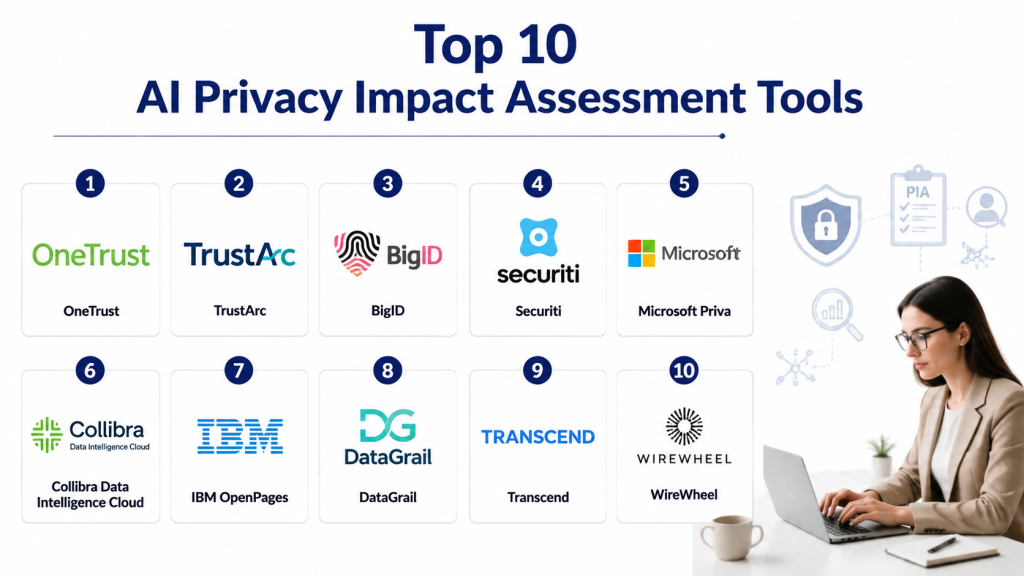
Top 10 AI Privacy Impact Assessment Tools
1 — OneTrust
One-line verdict: Best for large enterprises requiring comprehensive privacy, AI governance, and regulatory compliance management.
Short description
OneTrust is one of the most widely adopted privacy management platforms, helping organizations automate privacy impact assessments, AI governance, consent management, data discovery, and regulatory compliance. It supports enterprises managing complex privacy programs across multiple jurisdictions.
Standout Capabilities
- AI Privacy Impact Assessments
- Data Protection Impact Assessment automation
- AI governance workflows
- Data discovery and classification
- Consent management
- Regulatory intelligence
- Third-party risk management
- Enterprise reporting
AI-Specific Depth
- Model support: AI governance capabilities across enterprise AI systems
- RAG / Knowledge integration: N/A
- Evaluation: AI risk assessments with configurable review workflows
- Guardrails: Policy enforcement and governance controls
- Observability: Compliance dashboards, assessment tracking, audit reporting
Pros
- Comprehensive enterprise privacy platform
- Extensive workflow automation
- Strong regulatory coverage
Cons
- Enterprise-oriented implementation
- Significant configuration required
- Premium pricing for advanced modules
Security & Compliance
- SSO/SAML: Supported
- RBAC: Supported
- Audit logs: Supported
- Encryption: Supported
- Data retention controls: Available
- Certifications: Varies by service. Not all certifications are publicly stated.
Deployment & Platforms
- Web
- Cloud
- Enterprise SaaS
Integrations & Ecosystem
OneTrust integrates with numerous enterprise security, compliance, cloud, HR, and productivity platforms.
- REST APIs
- Microsoft ecosystem
- Cloud platforms
- Identity providers
- Governance platforms
- Business applications
Pricing Model
Enterprise subscription with modular licensing.
Best-Fit Scenarios
- Enterprise privacy programs
- Global regulatory compliance
- AI governance initiatives
2 — TrustArc
One-line verdict: Best for organizations seeking mature privacy governance and automated impact assessments.
Short description
TrustArc provides privacy management software that helps organizations automate Privacy Impact Assessments, Data Protection Impact Assessments, AI governance workflows, and regulatory reporting while simplifying privacy operations across distributed business units.
Standout Capabilities
- Privacy assessments
- Automated DPIA workflows
- Data inventory management
- AI governance support
- Risk assessments
- Regulatory mapping
- Vendor privacy evaluations
- Compliance dashboards
AI-Specific Depth
- Model support: AI governance support
- RAG / Knowledge integration: N/A
- Evaluation: Configurable privacy assessment workflows
- Guardrails: Policy-based governance
- Observability: Risk dashboards and reporting
Pros
- Mature privacy platform
- Strong workflow automation
- Comprehensive assessment capabilities
Cons
- Enterprise pricing
- Learning curve
- Configuration complexity
Security & Compliance
- SSO/SAML: Supported
- RBAC: Supported
- Audit logs: Supported
- Encryption: Supported
- Certifications: Not publicly stated
Deployment & Platforms
- Cloud
- Web
Integrations & Ecosystem
TrustArc supports APIs and integrations with enterprise governance, compliance, and security platforms.
- APIs
- Enterprise applications
- Identity providers
- Compliance tools
- Reporting systems
Pricing Model
Enterprise subscription.
Best-Fit Scenarios
- Privacy governance
- Compliance automation
- Multi-region privacy management
3 — BigID
One-line verdict: Best for organizations needing AI-powered data discovery combined with privacy risk assessments.
Short description
BigID focuses on discovering, classifying, and managing sensitive data across cloud and on-premises environments. Its privacy assessment capabilities help organizations understand where personal data resides and evaluate privacy risks associated with AI initiatives.
Standout Capabilities
- AI-powered data discovery
- Sensitive data classification
- Privacy risk analysis
- Data inventory automation
- AI governance support
- Compliance reporting
- Data lifecycle management
- Risk dashboards
AI-Specific Depth
- Model support: AI-assisted data intelligence
- RAG / Knowledge integration: N/A
- Evaluation: Privacy risk evaluation workflows
- Guardrails: Data governance policies
- Observability: Data intelligence dashboards
Pros
- Excellent data discovery
- Strong automation
- Scalable enterprise platform
Cons
- Advanced deployment complexity
- Enterprise licensing
- Broad platform may exceed smaller organizations’ needs
Security & Compliance
- SSO/SAML: Supported
- RBAC: Supported
- Audit logs: Supported
- Encryption: Supported
- Certifications: Not publicly stated
Deployment & Platforms
- Cloud
- Hybrid
- Enterprise deployment
Integrations & Ecosystem
BigID integrates with cloud providers, databases, enterprise storage systems, and governance platforms.
- Cloud platforms
- Enterprise databases
- APIs
- Security platforms
- Data governance tools
Pricing Model
Enterprise licensing.
Best-Fit Scenarios
- Enterprise data discovery
- AI privacy programs
- Sensitive data management
4 — Securiti
One-line verdict: Best for organizations automating privacy compliance across modern AI and cloud environments.
Short description
Securiti delivers a unified privacy, governance, and security platform that automates Privacy Impact Assessments, AI governance, data intelligence, and regulatory compliance across hybrid enterprise infrastructures.
Standout Capabilities
- Privacy impact assessments
- AI governance
- Data intelligence
- Consent management
- Regulatory automation
- Data subject request management
- Risk assessments
- Enterprise dashboards
AI-Specific Depth
- Model support: AI governance capabilities
- RAG / Knowledge integration: N/A
- Evaluation: AI privacy workflows
- Guardrails: Automated governance policies
- Observability: Compliance dashboards
Pros
- Unified privacy platform
- Strong automation
- Broad compliance coverage
Cons
- Enterprise implementation
- Advanced features require configuration
- Premium licensing
Security & Compliance
- SSO/SAML: Supported
- RBAC: Supported
- Audit logs: Supported
- Encryption: Supported
- Certifications: Not publicly stated
Deployment & Platforms
- Cloud
- Hybrid
- Enterprise SaaS
Integrations & Ecosystem
Supports integrations across enterprise cloud, security, governance, and compliance ecosystems.
- APIs
- Cloud providers
- Identity systems
- Security platforms
- Enterprise applications
Pricing Model
Enterprise subscription.
Best-Fit Scenarios
- AI governance
- Enterprise privacy automation
- Global compliance initiatives
5 — Microsoft Priva
One-line verdict: Best for Microsoft-centric organizations managing privacy risks across Microsoft cloud environments.
Short description
Microsoft Priva helps organizations identify privacy risks, automate Privacy Impact Assessments, manage personal data, and improve regulatory compliance across Microsoft 365 and Azure ecosystems.
Standout Capabilities
- Privacy risk management
- Personal data discovery
- Data minimization recommendations
- Privacy workflows
- Compliance dashboards
- Insider risk insights
- Data lifecycle management
- Microsoft-native integration
AI-Specific Depth
- Model support: Microsoft AI ecosystem integration
- RAG / Knowledge integration: N/A
- Evaluation: Privacy assessment workflows
- Guardrails: Policy-based privacy controls
- Observability: Compliance dashboards and analytics
Pros
- Deep Microsoft integration
- Easy deployment for Microsoft customers
- Strong cloud-native capabilities
Cons
- Best suited for Microsoft environments
- Limited focus outside Microsoft ecosystem
- Some advanced capabilities depend on licensing
Security & Compliance
- SSO/SAML: Supported through Microsoft identity services
- RBAC: Supported
- Audit logs: Supported
- Encryption: Supported
- Certifications: Varies by Microsoft cloud services
Deployment & Platforms
- Cloud
- Web
- Microsoft 365
- Azure
Integrations & Ecosystem
Microsoft Priva integrates seamlessly with Microsoft security, compliance, identity, and productivity platforms.
- Microsoft 365
- Azure
- Microsoft Purview
- Microsoft Entra
- Microsoft Defender
- Microsoft Graph APIs
Pricing Model
Subscription-based licensing with enterprise options.
Best-Fit Scenarios
- Microsoft enterprise environments
- Cloud privacy management
- Data governance modernization
6 — Collibra Data Intelligence Cloud
One-line verdict: Best for enterprises combining data governance, privacy management, and AI governance under one platform.
Short description
Collibra Data Intelligence Cloud helps organizations manage enterprise data governance while supporting privacy impact assessments, AI governance initiatives, metadata management, and regulatory compliance. It enables privacy teams to understand how sensitive information flows through AI-powered business processes.
Standout Capabilities
- Enterprise data catalog
- Privacy impact assessment workflows
- AI governance support
- Automated metadata management
- Business glossary
- Data lineage visualization
- Compliance reporting
- Collaboration workflows
AI-Specific Depth
- Model support: AI governance capabilities for enterprise AI initiatives
- RAG / Knowledge integration: Enterprise metadata integration
- Evaluation: Configurable privacy review workflows
- Guardrails: Governance policies and approval processes
- Observability: Data lineage dashboards, governance analytics, workflow reporting
Pros
- Excellent enterprise data governance
- Strong metadata management
- Scalable collaboration capabilities
Cons
- Complex implementation
- Requires governance maturity
- Enterprise pricing
Security & Compliance
- SSO/SAML: Supported
- RBAC: Supported
- Audit logs: Supported
- Encryption: Supported
- Data retention controls: Available
- Certifications: Not publicly stated
Deployment & Platforms
- Web
- Cloud
- Hybrid deployment options
Integrations & Ecosystem
Collibra integrates with enterprise data platforms, governance tools, analytics systems, and cloud providers through APIs and connectors.
- REST APIs
- Cloud platforms
- Data warehouses
- Business intelligence tools
- Governance solutions
- Enterprise databases
Pricing Model
Enterprise subscription with customized licensing.
Best-Fit Scenarios
- Enterprise AI governance
- Data governance modernization
- Privacy program expansion
7 — IBM OpenPages
One-line verdict: Best for regulated organizations requiring integrated governance, risk, compliance, and privacy assessments.
Short description
IBM OpenPages provides governance, risk management, compliance, and privacy management capabilities that help organizations conduct structured Privacy Impact Assessments while managing enterprise AI governance initiatives.
Standout Capabilities
- Privacy assessment automation
- AI governance support
- Risk management
- Regulatory compliance
- Workflow automation
- Policy management
- Enterprise dashboards
- Centralized governance
AI-Specific Depth
- Model support: Proprietary AI-assisted governance capabilities
- RAG / Knowledge integration: Limited
- Evaluation: Human approval workflows
- Guardrails: Policy enforcement and governance controls
- Observability: Executive dashboards, workflow monitoring, compliance reporting
Pros
- Comprehensive GRC platform
- Strong regulatory support
- Enterprise scalability
Cons
- Implementation complexity
- Premium licensing
- Requires governance expertise
Security & Compliance
- SSO/SAML: Supported
- RBAC: Supported
- Audit logs: Supported
- Encryption: Supported
- Certifications: Not publicly stated
Deployment & Platforms
- Cloud
- Hybrid
- Enterprise deployment
Integrations & Ecosystem
Supports integrations with enterprise governance, ERP, compliance, analytics, and identity platforms.
- APIs
- IBM ecosystem
- Identity providers
- Reporting tools
- Enterprise applications
Pricing Model
Enterprise subscription.
Best-Fit Scenarios
- Financial institutions
- Government agencies
- Large compliance programs
8 — DataGrail
One-line verdict: Best for organizations automating privacy operations and customer data governance.
Short description
DataGrail simplifies privacy operations by automating Privacy Impact Assessments, data subject requests, consent management, and regulatory compliance across cloud applications and business systems.
Standout Capabilities
- Privacy request automation
- Privacy assessments
- Consent management
- Third-party application discovery
- Vendor privacy management
- Compliance reporting
- Workflow automation
- Risk dashboards
AI-Specific Depth
- Model support: AI-assisted privacy workflows
- RAG / Knowledge integration: N/A
- Evaluation: Privacy workflow automation
- Guardrails: Policy-based governance
- Observability: Operational dashboards and compliance reporting
Pros
- User-friendly interface
- Fast deployment
- Strong SaaS integrations
Cons
- Enterprise-focused pricing
- Limited advanced governance customization
- Less emphasis on deep AI lifecycle governance
Security & Compliance
- SSO/SAML: Supported
- RBAC: Supported
- Audit logs: Supported
- Encryption: Supported
- Certifications: Not publicly stated
Deployment & Platforms
- Cloud
- Web
Integrations & Ecosystem
Supports numerous integrations with SaaS platforms, business applications, cloud services, and enterprise productivity tools.
- APIs
- SaaS platforms
- Cloud providers
- Identity platforms
- Productivity applications
Pricing Model
Subscription-based licensing.
Best-Fit Scenarios
- Privacy operations automation
- SaaS privacy management
- Customer data governance
9 — Transcend
One-line verdict: Best for organizations seeking developer-friendly privacy automation with modern APIs.
Short description
Transcend enables organizations to automate privacy requests, manage consent, conduct privacy assessments, and integrate privacy governance directly into modern software development workflows.
Standout Capabilities
- Privacy automation
- Consent management
- Data discovery
- Privacy request workflows
- Developer APIs
- Workflow orchestration
- Privacy reporting
- Cloud-native architecture
AI-Specific Depth
- Model support: AI governance support varies by implementation
- RAG / Knowledge integration: N/A
- Evaluation: Privacy workflow automation
- Guardrails: Configurable governance policies
- Observability: Workflow analytics and operational reporting
Pros
- API-first architecture
- Modern cloud platform
- Strong automation capabilities
Cons
- Better suited for cloud-native organizations
- Advanced customization may require technical expertise
- Enterprise licensing
Security & Compliance
- SSO/SAML: Supported
- RBAC: Supported
- Audit logs: Supported
- Encryption: Supported
- Certifications: Not publicly stated
Deployment & Platforms
- Cloud
- Web
Integrations & Ecosystem
Transcend provides APIs and connectors that integrate with cloud applications, identity systems, engineering platforms, and business applications.
- REST APIs
- Identity providers
- SaaS applications
- Cloud services
- Developer SDKs
Pricing Model
Enterprise subscription.
Best-Fit Scenarios
- Privacy automation
- Developer-centric organizations
- Cloud-native enterprises
10 — WireWheel
One-line verdict: Best for enterprises seeking unified privacy management, compliance automation, and AI governance readiness.
Short description
WireWheel offers a privacy management platform that automates Privacy Impact Assessments, data mapping, regulatory reporting, and governance workflows, enabling organizations to scale privacy compliance while preparing for AI governance requirements.
Standout Capabilities
- Privacy assessments
- Data mapping
- AI governance support
- Risk assessments
- Regulatory reporting
- Consent management
- Workflow automation
- Compliance dashboards
AI-Specific Depth
- Model support: AI governance capabilities
- RAG / Knowledge integration: N/A
- Evaluation: Configurable privacy review workflows
- Guardrails: Governance policies and approval workflows
- Observability: Compliance dashboards and workflow analytics
Pros
- Comprehensive privacy platform
- Strong workflow automation
- Good regulatory coverage
Cons
- Enterprise implementation
- Configuration effort
- Premium licensing
Security & Compliance
- SSO/SAML: Supported
- RBAC: Supported
- Audit logs: Supported
- Encryption: Supported
- Certifications: Not publicly stated
Deployment & Platforms
- Cloud
- Web
- Enterprise SaaS
Integrations & Ecosystem
WireWheel integrates with cloud providers, enterprise applications, governance tools, and identity platforms through APIs.
- APIs
- Enterprise applications
- Identity providers
- Governance platforms
- Cloud services
Pricing Model
Enterprise subscription.
Best-Fit Scenarios
- Enterprise privacy governance
- AI compliance programs
- Multi-region regulatory management
Comparison Table
| Tool Name | Best For | Deployment | Model Flexibility | Strength | Watch-Out | Public Rating |
|---|---|---|---|---|---|---|
| OneTrust | Enterprise Privacy Programs | Cloud | Proprietary | Comprehensive privacy platform | Enterprise complexity | N/A |
| TrustArc | Privacy Governance | Cloud | Proprietary | Mature compliance workflows | Premium pricing | N/A |
| BigID | Data Discovery | Hybrid | AI-assisted | Sensitive data intelligence | Broad platform complexity | N/A |
| Securiti | AI Governance | Cloud | Proprietary | Unified privacy automation | Enterprise implementation | N/A |
| Microsoft Priva | Microsoft Environments | Cloud | Microsoft AI Ecosystem | Native Microsoft integration | Microsoft-centric | N/A |
| Collibra | Data Governance | Hybrid | AI-assisted | Enterprise metadata management | Governance maturity required | N/A |
| IBM OpenPages | Regulated Industries | Hybrid | Proprietary | Enterprise GRC | Implementation complexity | N/A |
| DataGrail | Privacy Operations | Cloud | AI-assisted | Workflow automation | Enterprise pricing | N/A |
| Transcend | Developer-First Privacy | Cloud | API-driven | Modern automation | Technical customization | N/A |
| WireWheel | Enterprise Compliance | Cloud | Proprietary | Privacy governance | Configuration effort | N/A |
Scoring & Evaluation (Transparent Rubric)
The following scores compare leading AI Privacy Impact Assessment platforms using consistent evaluation criteria. The objective is to help buyers create an informed shortlist rather than declare a universal winner. Organizations should validate functionality, regulatory coverage, AI governance capabilities, integration quality, security controls, and usability through proof-of-concept projects before making a purchasing decision.
| Tool | Core | Reliability / Eval | Guardrails | Integrations | Ease | Perf / Cost | Security / Admin | Support | Weighted Total |
|---|---|---|---|---|---|---|---|---|---|
| OneTrust | 9.8 | 9.5 | 9.7 | 9.7 | 8.8 | 8.9 | 9.8 | 9.5 | 9.47 |
| TrustArc | 9.4 | 9.2 | 9.3 | 9.1 | 8.8 | 8.8 | 9.3 | 9.2 | 9.14 |
| Securiti | 9.5 | 9.3 | 9.4 | 9.3 | 8.7 | 8.9 | 9.4 | 9.2 | 9.20 |
| BigID | 9.4 | 9.2 | 9.1 | 9.5 | 8.5 | 8.8 | 9.3 | 9.1 | 9.13 |
| Microsoft Priva | 9.0 | 9.0 | 9.2 | 9.7 | 9.2 | 9.1 | 9.5 | 9.3 | 9.17 |
| Collibra | 9.3 | 9.1 | 9.2 | 9.6 | 8.6 | 8.7 | 9.2 | 9.1 | 9.11 |
| IBM OpenPages | 9.3 | 9.2 | 9.4 | 9.2 | 8.4 | 8.6 | 9.5 | 9.3 | 9.11 |
| DataGrail | 8.9 | 8.8 | 8.9 | 9.1 | 9.2 | 9.0 | 9.0 | 9.0 | 8.98 |
| Transcend | 8.8 | 8.8 | 8.8 | 9.3 | 9.1 | 9.1 | 9.0 | 8.9 | 8.97 |
| WireWheel | 9.0 | 8.9 | 9.0 | 9.0 | 8.8 | 8.9 | 9.1 | 8.9 | 8.97 |
Top 3 for Enterprise
- OneTrust
- Securiti
- Microsoft Priva
Top 3 for SMB
- DataGrail
- Transcend
- TrustArc
Top 3 for Developers
- Transcend
- Microsoft Priva
- BigID
Which AI Privacy Impact Assessment Tool Is Right for You?
Selecting the right AI Privacy Impact Assessment (PIA) tool depends on your organization’s regulatory obligations, AI maturity, existing technology stack, and long-term governance strategy. While every platform aims to help identify and mitigate privacy risks, each solution offers different strengths in automation, AI governance, compliance management, data discovery, and workflow customization.
Before making a decision, evaluate how well the platform integrates with your existing systems, supports AI lifecycle governance, and scales alongside your privacy program. The best solution is one that aligns with your operational requirements rather than simply offering the largest feature set.
Solo / Freelancer
Independent consultants, privacy advisors, and small legal firms often need straightforward privacy assessment capabilities without the complexity of enterprise governance platforms.
Key priorities include:
- Easy deployment
- Simple assessment templates
- Affordable pricing
- Cloud accessibility
- Minimal administration
- Automated reporting
- Basic workflow management
Recommended tools
- DataGrail
- Transcend
- TrustArc
These platforms provide strong automation while remaining relatively approachable for smaller teams.
SMB
Small and medium-sized businesses increasingly process customer data across cloud applications, AI assistants, and digital services. They require privacy assessment tools that balance automation with ease of management.
Important evaluation criteria include:
- Automated Privacy Impact Assessments
- AI governance support
- Cloud deployment
- SaaS integrations
- Compliance reporting
- Workflow automation
- Scalability for business growth
Recommended tools
- DataGrail
- Microsoft Priva
- TrustArc
These platforms help SMBs improve privacy compliance without requiring extensive governance resources.
Mid-Market
Growing organizations often operate across multiple departments and regions while adopting AI-powered business processes. Their privacy programs require greater automation and centralized governance.
Prioritize solutions offering:
- AI governance capabilities
- Enterprise integrations
- Data discovery
- Privacy workflow automation
- Risk assessments
- Collaboration tools
- Regulatory reporting
Recommended tools
- BigID
- Collibra
- Securiti
These platforms provide broader governance capabilities suitable for expanding organizations.
Enterprise
Large enterprises manage vast volumes of personal information, multiple AI systems, international regulations, and distributed business units. Enterprise buyers should prioritize scalability, governance, explainability, and operational efficiency.
Essential capabilities include:
- Enterprise AI governance
- Automated data discovery
- Privacy-by-design workflows
- Continuous compliance monitoring
- Third-party AI assessments
- Executive dashboards
- Role-based administration
- Complete audit trails
Recommended tools
- OneTrust
- Securiti
- IBM OpenPages
- Microsoft Priva
- Collibra
These solutions provide mature governance frameworks capable of supporting complex privacy programs.
Regulated Industries (Finance, Healthcare, Public Sector)
Organizations operating in highly regulated industries require robust governance, documentation, and transparency throughout the AI lifecycle.
Evaluate platforms offering:
- Detailed audit logs
- Workflow approvals
- Data retention controls
- Encryption
- Policy management
- Risk scoring
- Explainable privacy assessments
- Regulatory reporting
Recommended tools
- OneTrust
- IBM OpenPages
- Securiti
- BigID
Budget vs Premium
Budget-Friendly Solutions
Smaller organizations with straightforward compliance requirements should prioritize simplicity and rapid deployment.
Ideal characteristics:
- Low administrative overhead
- Fast implementation
- Cloud-native architecture
- Automated workflows
- Easy user experience
Examples:
- DataGrail
- Transcend
Premium Enterprise Platforms
Organizations managing complex AI ecosystems benefit from comprehensive governance capabilities.
Premium platforms typically provide:
- Enterprise AI governance
- Advanced workflow automation
- Extensive integrations
- Data intelligence
- Global compliance support
- Executive reporting
- Vendor risk management
Examples:
- OneTrust
- Securiti
- Collibra
- IBM OpenPages
Build vs Buy
Some organizations explore developing custom AI Privacy Impact Assessment workflows internally using governance platforms, workflow engines, and custom AI models.
Consider Building If
- You have experienced software engineering teams.
- Privacy workflows are highly specialized.
- Existing commercial platforms cannot meet regulatory needs.
- Internal AI governance frameworks are mature.
Consider Buying If
- Faster implementation is important.
- You need regulatory updates maintained by the vendor.
- Enterprise integrations are a priority.
- Privacy teams prefer configurable workflows over custom software development.
- AI governance must scale quickly.
For most organizations, purchasing a mature platform is typically more cost-effective than developing and maintaining an in-house privacy governance solution.
Implementation Playbook (30 / 60 / 90 Days)
Implementing an AI Privacy Impact Assessment platform requires careful planning, governance, and continuous improvement. A phased rollout reduces implementation risks while maximizing adoption.
First 30 Days – Assessment and Pilot
Focus on understanding existing privacy processes and validating the platform against real-world business scenarios.
Recommended activities:
- Identify AI systems processing personal data.
- Inventory sensitive data assets.
- Define privacy assessment objectives.
- Configure user roles.
- Integrate primary business applications.
- Run pilot Privacy Impact Assessments.
- Establish approval workflows.
- Define privacy risk scoring methodology.
- Train privacy and compliance teams.
- Measure baseline performance.
Success metrics include:
- Assessment completion time
- Workflow efficiency
- User adoption
- Privacy risk visibility
- Documentation quality
Days 31–60 – Expand Governance
Once the pilot succeeds, strengthen governance across the organization.
Key activities:
- Enable single sign-on.
- Configure role-based permissions.
- Implement encryption policies.
- Standardize assessment templates.
- Expand integrations.
- Build automated workflows.
- Introduce AI governance reviews.
- Implement model documentation procedures.
- Establish privacy review committees.
- Develop regulatory reporting dashboards.
Days 61–90 – Optimize and Scale
Scale the platform across business units while improving operational efficiency.
Recommended initiatives:
- Automate recurring assessments.
- Monitor AI governance KPIs.
- Optimize workflow performance.
- Track regulatory changes.
- Conduct privacy audits.
- Introduce continuous monitoring.
- Validate AI recommendations.
- Review vendor risks.
- Improve executive reporting.
- Establish long-term governance metrics.
Organizations should also schedule periodic reviews to ensure AI systems remain compliant as regulations, technologies, and business requirements evolve.
Common Mistakes & How to Avoid Them
Many privacy programs struggle because organizations underestimate the operational requirements of AI governance. Avoid these common pitfalls:
- Treating Privacy Impact Assessments as one-time exercises.
- Ignoring AI-specific privacy risks.
- Failing to inventory AI systems.
- Overlooking third-party AI vendors.
- Poor data classification.
- Weak governance processes.
- Missing executive sponsorship.
- Inadequate employee training.
- Lack of workflow automation.
- Ignoring data retention requirements.
- Failing to monitor regulatory changes.
- Limited visibility into AI data flows.
- Over-customizing workflows before understanding business requirements.
- Deploying AI governance without human oversight.
Frequently Asked Questions
What is an AI Privacy Impact Assessment Tool?
An AI Privacy Impact Assessment Tool helps organizations identify, evaluate, document, and reduce privacy risks associated with AI systems before deployment and throughout their operational lifecycle.
How is an AI Privacy Impact Assessment different from a traditional Privacy Impact Assessment?
Traditional assessments focus on general data processing activities, while AI-specific assessments also evaluate model behavior, automated decision-making, training data, inference risks, explainability, and AI governance controls.
Which organizations should use AI Privacy Impact Assessment tools?
Organizations deploying AI applications that process personal information—including financial institutions, healthcare providers, government agencies, retailers, technology companies, manufacturers, and educational institutions—can benefit significantly.
Do these platforms help with regulatory compliance?
Yes. Most leading platforms provide structured workflows, documentation, reporting, and policy management that support compliance initiatives. However, organizations remain responsible for ensuring compliance with applicable regulations.
Can these tools automatically discover sensitive data?
Many enterprise platforms include automated data discovery and classification capabilities that help identify sensitive information stored across cloud services, databases, and enterprise applications.
Do AI Privacy Impact Assessment tools support Bring Your Own Model (BYO Model)?
Support varies by vendor. Some platforms integrate with broader AI governance ecosystems, while others primarily focus on privacy workflows. Buyers should verify AI model integration capabilities during product evaluations.
How do these tools improve AI governance?
They centralize assessments, standardize workflows, document decisions, automate approvals, maintain audit trails, and provide visibility into AI risks across the organization.
Can these platforms integrate with existing enterprise software?
Most enterprise platforms provide APIs and connectors that integrate with cloud providers, identity systems, governance platforms, productivity suites, and business applications.
Are cloud deployments secure enough for privacy management?
Leading vendors implement enterprise security features such as encryption, role-based access controls, audit logs, and identity integration. Organizations should validate security capabilities against their own governance requirements before deployment.
How long does implementation usually take?
Implementation timelines vary depending on organization size, data complexity, governance maturity, and integration requirements. Smaller deployments may be completed relatively quickly, while enterprise implementations often require phased rollouts.
How should organizations evaluate vendors?
Compare vendors based on privacy assessment automation, AI governance capabilities, workflow flexibility, integration quality, reporting, scalability, usability, security controls, and long-term product strategy.
What is the biggest success factor?
The most successful implementations combine technology with strong governance, executive sponsorship, well-defined privacy policies, continuous monitoring, and ongoing employee education rather than relying solely on automation.
Conclusion
AI Privacy Impact Assessment Tools have become an essential component of responsible AI adoption. As organizations increasingly rely on generative AI, intelligent automation, and data-driven decision-making, understanding and managing privacy risks throughout the AI lifecycle is no longer optional. Modern platforms automate assessments, improve regulatory readiness, enhance collaboration between legal, compliance, security, and engineering teams, and provide the transparency required to build trustworthy AI systems.There is no universal best platform for every organization. Enterprise organizations managing complex global privacy programs may benefit most from comprehensive solutions such as OneTrust, Securiti, IBM OpenPages, or Collibra, while growing businesses may find platforms like DataGrail, Transcend, or Microsoft Priva better aligned with their operational requirements. The right choice depends on your existing technology ecosystem, regulatory obligations, AI maturity, and long-term governance objectives.

Find Trusted Cardiac Hospitals
Compare heart hospitals by city and services — all in one place.
Explore Hospitals