
Introduction
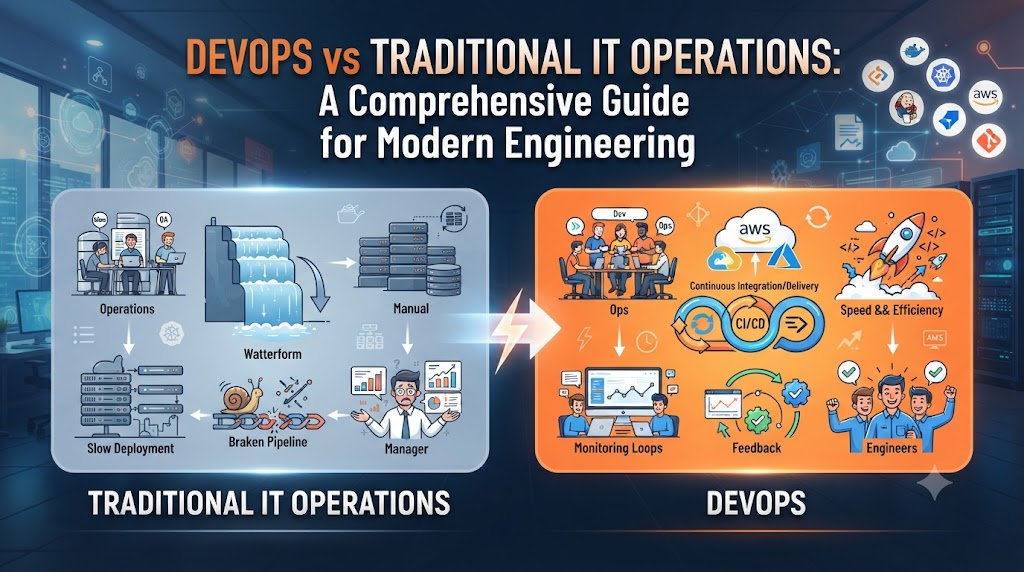
The evolution of software delivery and IT infrastructure has shifted from rigid, siloed traditional models toward the collaborative and automated framework of DevOps, which is now essential for organizations aiming to remain competitive in a cloud-first market. As businesses move away from manual, ticket-based workflows to the high-velocity, continuous improvement practices of modern operations, they unlock significant improvements in deployment speed, system reliability, and overall business outcomes. Navigating this complex digital transformation requires foundational knowledge and strategic guidance, which professionals can attain by exploring the comprehensive resources and expert-led training programs at DevOpsSchool. By prioritizing integrated team communication and automated infrastructure management, organizations can effectively transition from reactive maintenance to proactive, customer-centric value delivery.
What Is DevOps?
DevOps is a set of practices, tools, and a cultural philosophy that automates and integrates the processes between software development and IT teams. It emphasizes team empowerment, cross-functional communication, and technology automation.
- Core Principles: The model focuses on the CAMS framework: Culture, Automation, Measurement, and Sharing.
- Collaboration: Developers and operations engineers work together throughout the entire software lifecycle, from design and development to production support.
- Automation: By automating repetitive tasks—such as testing, infrastructure provisioning, and deployment—teams reduce human error and increase speed.
- Continuous Improvement: Through constant feedback loops, DevOps teams iterate rapidly, learning from failures and refining processes in real-time.
What Are Traditional IT Operations?
Traditional IT operations, often associated with the ITIL (Information Technology Infrastructure Library) framework, rely on a structured, often hierarchical approach to managing IT services.
- Departmental Silos: Development, QA, and Operations are usually distinct departments with limited interaction.
- Manual Processes: Infrastructure provisioning, software updates, and troubleshooting are performed manually through ticketing systems and administrative checklists.
- Sequential Workflows: Software development follows a “waterfall” approach where one stage must be completed before the next begins, often leading to months-long deployment cycles.
- Stability Focus: The primary objective is to maintain system uptime by minimizing changes, which often leads to a risk-averse culture.
Why Compare DevOps and Traditional IT Operations?
Understanding the distinction is vital because business expectations have fundamentally shifted. Modern customers demand feature updates in days, not months.
Cloud adoption has made it possible to treat infrastructure as software, which requires a fundamental change in how teams operate. Traditional models often struggle to scale in cloud environments, leading to bottlenecks. By comparing the two, IT leaders can identify where their current processes are creating drag and where automation can drive competitive advantage.
DevOps vs Traditional IT Operations: High-Level Comparison
| Feature | DevOps | Traditional IT Operations |
| Collaboration | High (Shared responsibility) | Low (Siloed departments) |
| Deployment | Continuous (Multiple times/day) | Periodic (Weekly/Monthly/Quarterly) |
| Automation | Full (CI/CD, IaC) | Manual/Semi-automated |
| Change Management | Automated & Low risk | Manual approval gates |
| Monitoring | Observability & Proactive | Reactive alerting |
| Security | Shift-left (DevSecOps) | Post-production security checks |
| Scalability | Automated/Dynamic | Manual provisioning |
Team Structure Comparison
DevOps Teams
DevOps breaks down silos by creating cross-functional teams where developers and operators share common goals. There is a sense of shared ownership; if code fails in production, the developer who wrote it and the operator who deployed it work together to resolve the issue.
Traditional IT Teams
In traditional environments, the “Wall of Confusion” exists between Development and Operations. Developers hand off code to the Operations team, who then bear the burden of deployment. If something breaks, the blame is often shifted, leading to friction and delayed resolution.
Development and Deployment Workflow Comparison
| Stage | DevOps | Traditional IT Operations |
| Planning | Agile/Iterative | Waterfall/Fixed scope |
| Development | Continuous Integration | Batch coding |
| Testing | Automated unit/integration tests | Manual QA cycles |
| Deployment | Automated CI/CD pipelines | Manual deployment tickets |
| Monitoring | Proactive observability | Reactive monitoring |
| Maintenance | Self-healing systems | Manual patching |
Automation Comparison
Automation is the engine of DevOps. While traditional operations might use scripts to simplify tasks, DevOps utilizes Infrastructure as Code (IaC). With IaC, server configurations are defined in files, allowing environments to be provisioned, versioned, and managed exactly like software code. This eliminates “configuration drift,” where servers in production behave differently than servers in development.
Collaboration and Communication
In DevOps, communication is constant. Chat-ops, stand-ups, and post-mortems after incidents are standard. The goal is transparency. Conversely, traditional operations rely on formal documentation and ticketing systems. While documentation is important, the reliance on tickets as the primary form of communication can stifle innovation and delay critical fixes.
Infrastructure Management
Infrastructure management in DevOps treats the data center as a dynamic, programmable entity. Using tools like Terraform or Ansible, engineers can spin up complex architectures in minutes. Traditional IT operations often view infrastructure as “pets”—servers that are pampered, manually configured, and maintained long-term. DevOps views infrastructure as “cattle”—if a server is problematic, you replace it rather than trying to fix it.
Monitoring and Incident Response
DevOps introduces Observability. Beyond just knowing if a server is “up” or “down,” DevOps teams track logs, metrics, and traces to understand the internal state of applications. When incidents occur, teams conduct “blameless post-mortems” to identify systemic failures rather than human error. Traditional operations are often stuck in “alert fatigue,” where too many reactive notifications result in burnout and slower response times.
Security Comparison
In a DevOps model, security is integrated from the start—a practice known as DevSecOps. Security scanning is automated within the CI/CD pipeline. Traditional IT operations treat security as a “gatekeeper” function that happens at the very end of the cycle, often resulting in expensive rework if vulnerabilities are found late.
Scalability and Cloud Readiness
| Aspect | DevOps Approach | Traditional Approach |
| Infrastructure | Elastic, Cloud-native | Static, On-premise |
| Scaling | Auto-scaling groups | Manual capacity planning |
| Containers | Kubernetes/Docker orchestration | Virtual machines/Physical servers |
Business Benefits of DevOps
| Benefit | Business Impact |
| Faster Releases | Higher time-to-market advantage |
| Better Quality | Fewer bugs in production |
| Improved Collaboration | Higher employee engagement |
| Reduced Downtime | Consistent customer trust |
| Lower Costs | Optimized resource utilization |
Challenges of Traditional IT Operations
The primary challenge is speed. Because traditional IT relies on manual steps, the “Lead Time for Changes” is high. Furthermore, the lack of visibility between departments leads to an “us vs. them” culture, which ultimately hurts the customer experience by causing longer service outages and slower feature delivery.
Migrating from Traditional IT Operations to DevOps
- Assess Current Environment: Document existing bottlenecks.
- Build DevOps Culture: Encourage cross-team communication.
- Introduce Automation: Start with small, repetitive tasks.
- Implement CI/CD: Build a pipeline for automated testing and deployment.
- Improve Monitoring: Shift from basic alerts to comprehensive observability.
- Optimize Continuously: Treat the process as an ongoing journey, not a destination.
Common Mistakes During DevOps Adoption
- Tool-first mindset: Buying expensive tools without changing the underlying culture.
- Ignoring culture: Attempting to force DevOps on a team without leadership buy-in.
- Weak automation: Automating only parts of the workflow while keeping others manual.
- Unrealistic expectations: Expecting overnight success instead of focusing on iterative gains.
Real-World Example: DevOps Transformation
A financial services firm was releasing updates once every six months. Each release involved a massive manual checklist and often failed due to environment discrepancies. By introducing a centralized CI/CD platform and training their team through structured programs, they automated their testing and environment provisioning. Within 12 months, they achieved weekly releases, reduced infrastructure costs by 30%, and significantly improved system reliability.
Measuring Operational Success
| Metric | Traditional IT | DevOps |
| Deployment Frequency | Monthly/Quarterly | On-demand |
| Lead Time | Weeks/Months | Hours/Days |
| Change Failure Rate | High (Manual errors) | Low (Automated gates) |
| MTTR (Mean Time to Recovery) | High (Reactive) | Low (Proactive/Self-healing) |
Future of IT Operations
The future lies in Platform Engineering, where developers provide self-service tools for developers, and the rise of AI-assisted operations (AIOps), which helps identify issues before they impact users. GitOps, where the state of the infrastructure is managed entirely through Git repositories, is also becoming the standard for modern cloud-native environments.
Certifications & Learning Paths
| Certification | Best For | Skill Level | Focus Area |
| DevOps Foundation | Beginners | Entry | Culture & Principles |
| Kubernetes Administrator | Engineers | Intermediate | Container Orchestration |
| AWS/Azure/GCP Architect | Cloud Engineers | Intermediate | Cloud-Native Infrastructure |
| CI/CD Pipeline Expert | Devs/Ops | Advanced | Automation/DevOps Tools |
Best Practices Checklist
- Foster a blameless culture.
- Automate everything that can be automated.
- Adopt Infrastructure as Code (IaC).
- Shift security left.
- Monitor the entire stack, not just servers.
- Invest in continuous learning.
FAQs
- What is the biggest difference? DevOps focuses on integration and automation, while traditional IT relies on silos and manual gates.
- Why are companies adopting it? To survive in a digital-first economy by increasing speed and reliability.
- Does DevOps replace IT ops? No, it evolves it into a more collaborative, automated version.
- Is automation mandatory? It is essential for achieving the speed and scale required by DevOps.
- Which is better for cloud? DevOps is inherently designed for cloud environments.
- Can traditional teams transition? Yes, but it requires patience and a cultural shift.
- What skills are needed? Knowledge of cloud, Linux, CI/CD, and IaC.
- How long does it take? It is a long-term cultural transformation, not a short-term project.
- Is it only for developers? No, it involves operations, security, and quality teams.
- What is the first step? Start by measuring current lead times and identifying the biggest manual bottleneck.
- Does it reduce security? On the contrary, it improves security through DevSecOps.
- Is DevOps expensive? It requires an initial investment in training and tooling, but reduces long-term operational costs.
- What is SRE? Site Reliability Engineering is a practical implementation of DevOps principles.
- Do I need new tools? You may need some, but culture is more important than specific tools.
- How to start? Evaluate your team’s workflow and identify low-hanging fruit for automation.
Final Thoughts
Transitioning from traditional IT operations to DevOps is not simply about changing your toolstack; it is about changing your mindset. Success requires fostering a culture of shared responsibility, investing in automation, and never being satisfied with the status quo. Start small, iterate often, and prioritize human collaboration.

Find Trusted Cardiac Hospitals
Compare heart hospitals by city and services — all in one place.
Explore Hospitals
Traditional IT operations and DevOps differ mainly in how they handle change management and system ownership. Traditional IT relies on strict approvals, fixed change windows, and clear separation of roles, which improves control but slows down delivery. DevOps replaces much of this with automation, CI/CD pipelines, and shared responsibility between development and operations, enabling faster and more frequent releases. In many real-world setups, both approaches coexist, which can create friction in deployment and incident processes. Ultimately, DevOps focuses on balancing speed and stability through automation, collaboration, and shared accountability rather than rigid control structures.