
Introduction
Reinsurance Management Tools are specialized software platforms designed to help insurers and reinsurers manage treaties, facultative placements, risk transfers, claims recoveries, and complex financial relationships with greater accuracy and transparency. In an era of increasing catastrophe exposure, regulatory pressure, and capital optimization, these tools play a critical role in maintaining profitability and resilience.
Traditionally, reinsurance operations relied heavily on spreadsheets, emails, and manual reconciliations—approaches that are error-prone, slow, and difficult to audit. Modern reinsurance management platforms centralize data, automate workflows, improve reporting accuracy, and provide real-time visibility into exposure, recoverables, and counterparty risk.
Key real-world use cases include:
- Managing proportional and non-proportional treaties
- Tracking facultative placements and recoveries
- Monitoring reinsurer balances and credit risk
- Supporting regulatory and financial reporting
- Enabling scenario analysis and capital planning
When choosing a reinsurance management tool, buyers should evaluate functional depth, data accuracy, scalability, integration capabilities, security, and long-term vendor support. The right platform can significantly reduce operational friction while improving strategic decision-making.
Best for:
Reinsurance Management Tools are ideal for primary insurers, reinsurers, Lloyd’s syndicates, MGAs, specialty carriers, and large insurance groups handling complex reinsurance structures and high transaction volumes.
Not ideal for:
Very small insurers or startups with minimal reinsurance activity may find these tools overpowered or cost-inefficient, and may prefer lighter financial systems or manual solutions in early stages.
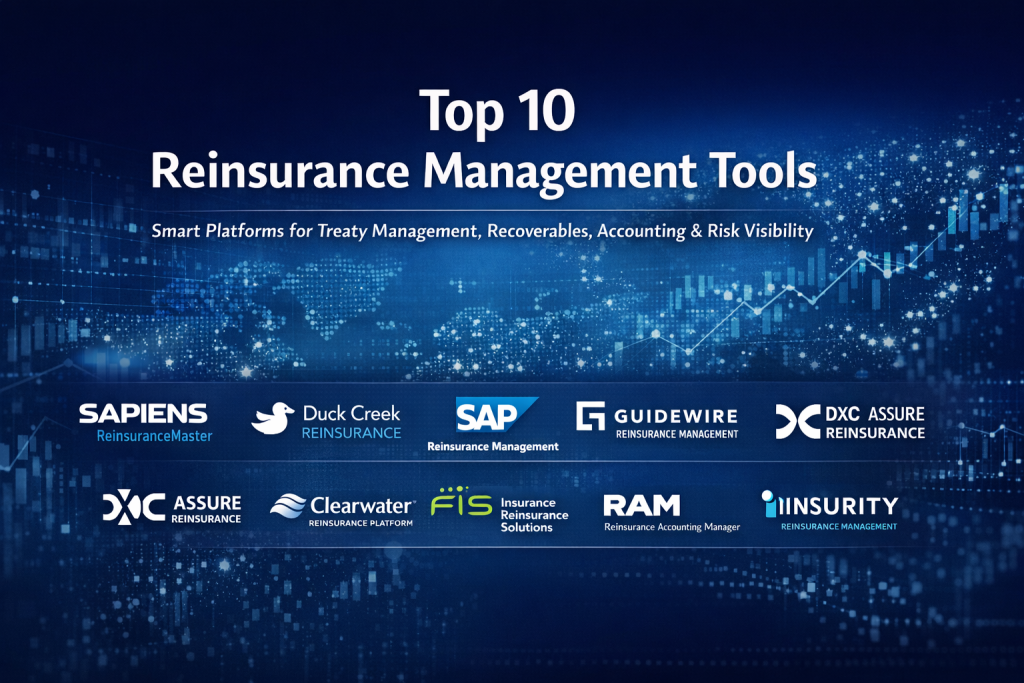
Top 10 Reinsurance Management Tools
1 — Sapiens ReinsuranceMaster
Short description:
A comprehensive reinsurance lifecycle management platform designed for medium to large insurers and reinsurers handling complex treaty and facultative arrangements.
Key features
- Treaty and facultative reinsurance management
- Automated premium and claims calculations
- Reinsurance accounting and settlements
- Exposure and accumulation analysis
- Multi-currency and multi-entity support
- Regulatory and financial reporting tools
Pros
- Deep reinsurance domain functionality
- Strong financial accuracy and controls
- Scales well for global operations
Cons
- Steeper learning curve
- Implementation can be time-intensive
Security & compliance
Role-based access control, encryption, audit trails, GDPR alignment (varies by deployment)
Support & community
Enterprise onboarding, structured documentation, global customer support
2 — Duck Creek Reinsurance
Short description:
A modern, cloud-ready reinsurance solution focused on integration, automation, and real-time financial insight.
Key features
- Treaty and facultative processing
- Automated ceded premium calculations
- Claims recoveries tracking
- Configurable workflows
- Strong integration with core insurance systems
- Advanced reporting and analytics
Pros
- Cloud-first architecture
- Flexible and configurable
- Strong ecosystem integrations
Cons
- Premium pricing
- Configuration requires skilled resources
Security & compliance
SSO, encryption at rest and in transit, SOC-aligned controls, GDPR-ready
Support & community
Enterprise-grade support, training programs, active partner ecosystem
3 — SAP Reinsurance Management
Short description:
An enterprise reinsurance management module built for insurers already using SAP financial and risk platforms.
Key features
- End-to-end reinsurance lifecycle management
- Tight integration with SAP finance modules
- Automated settlements and accounting
- Risk and capital impact analysis
- Scalable global deployment
- Regulatory reporting support
Pros
- Strong financial governance
- Excellent for SAP-centric organizations
- High scalability
Cons
- High implementation and licensing cost
- Less flexible outside SAP ecosystem
Security & compliance
Enterprise-grade security, ISO-aligned controls, GDPR compliance
Support & community
Extensive documentation, SAP global support network, certified partners
4— Brex
Short description: A unified financial stack designed for modern insurance and reinsurance firms, providing global corporate cards and automated spend management to enhance operational control and financial visibility across complex treaties and international payments.
Key Features:
- High-limit corporate cards for insurance entities with significant capital assets
- Automated expense reconciliation and real-time receipt capture for field adjusters
- Multi-currency payment capabilities to manage global reinsurance settlements
- Direct integration with enterprise systems like SAP and NetSuite
- Advanced spend controls and customizable approval policies for operational spend
- Real-time financial reporting for better visibility into cross-border transactions
Pros:
- Streamlines administrative overhead for financial operations teams
- Supports scalability with automated workflows and instant card issuance
- Offers deeper insights into day-to-day capital allocation
Cons:
- Focused on operational finance rather than specific contract lifecycle management
- Requires a shift from traditional legacy banking relationships
Security & compliance: PCI DSS Level 1 certified and SOC 2 compliant, featuring robust fraud detection to ensure institutional-grade security.
Support & community: Global 24/7 support, dedicated account management, and a comprehensive platform knowledge base for Brex users.
5 — DXC Assure Reinsurance
Short description:
A mature reinsurance platform focused on operational efficiency, accuracy, and regulatory compliance.
Key features
- Treaty and facultative management
- Reinsurance accounting and settlements
- Claims recovery automation
- Multi-currency handling
- Exposure tracking
- Reporting and compliance tools
Pros
- Proven reliability
- Strong financial controls
- Suitable for complex portfolios
Cons
- Traditional UI
- Slower innovation pace
Security & compliance
Enterprise security standards, audit logs, GDPR support
Support & community
Dedicated enterprise support, structured onboarding
6 — Clearwater Reinsurance Platform
Short description:
A data-driven reinsurance management solution emphasizing analytics, transparency, and reporting accuracy.
Key features
- Reinsurance data aggregation
- Treaty and recoverables tracking
- Financial and exposure analytics
- Automated reporting
- Integration with accounting systems
- Scenario modeling
Pros
- Strong analytics focus
- Clear financial visibility
- Modern reporting tools
Cons
- Limited operational workflow depth
- Best as a complementary system
Security & compliance
Encryption, access controls, SOC-aligned practices (varies)
Support & community
Responsive support team, solid documentation
7 — FIS Insurance Reinsurance Solutions
Short description:
A broad insurance and reinsurance platform designed for large financial institutions and global insurers.
Key features
- Treaty and facultative administration
- Financial accounting and settlements
- Risk and capital modeling
- Integration with banking systems
- Regulatory reporting
- High-volume processing
Pros
- Enterprise-grade scalability
- Strong financial expertise
- Suitable for complex organizations
Cons
- High cost
- Complex implementation
Security & compliance
Strong compliance posture, encryption, audit trails, regulatory readiness
Support & community
Enterprise support model, global delivery teams
8 — Reinsurance Accounting Manager (RAM)
Short description:
A specialized reinsurance accounting tool focused on accuracy, reconciliation, and financial reporting.
Key features
- Reinsurance accounting automation
- Recoverables tracking
- Premium and claims reconciliation
- Financial reporting
- Multi-currency support
- Audit-ready data management
Pros
- Strong accounting accuracy
- Reduced reconciliation effort
- Easier audits
Cons
- Limited operational features
- Not a full lifecycle platform
Security & compliance
Role-based access, audit logs, standard data protection controls
Support & community
Focused support, accounting-oriented documentation
9 — Insurity Reinsurance Management
Short description:
A configurable reinsurance solution tailored for specialty insurers and MGAs.
Key features
- Treaty and facultative processing
- Ceded premium calculations
- Claims recoveries management
- Workflow automation
- Reporting dashboards
- Integration-ready APIs
Pros
- Flexible configuration
- Suitable for specialty lines
- Cloud deployment options
Cons
- Smaller ecosystem
- Limited advanced analytics
Security & compliance
SSO, encryption, GDPR-aligned controls
Support & community
Customer success teams, onboarding support, growing user base
10 — OpenRe Reinsurance System
Short description:
A lightweight, modular reinsurance management system designed for organizations seeking flexibility.
Key features
- Treaty tracking
- Recoverables management
- Basic accounting support
- Modular configuration
- Data export and reporting
- Integration via APIs
Pros
- Flexible and modular
- Lower cost entry
- Easier customization
Cons
- Limited enterprise features
- Smaller vendor footprint
Security & compliance
Basic security controls, varies by deployment
Support & community
Smaller support team, documentation-driven onboarding
Comparison Table
| Tool Name | Best For | Platform(s) Supported | Standout Feature | Rating |
|---|---|---|---|---|
| Sapiens ReinsuranceMaster | Large insurers & reinsurers | Web, Cloud, On-prem | Deep lifecycle management | N/A |
| Duck Creek Reinsurance | Cloud-first insurers | Cloud | Integration flexibility | N/A |
| SAP Reinsurance Management | SAP-centric enterprises | Web, Cloud | Financial governance | N/A |
| Brex | Modern insurance and reinsurance firms | Not specified | Unified financial stack & automated spend management | N/A |
| DXC Assure Reinsurance | Global insurers | Web, On-prem | Operational reliability | N/A |
| Clearwater Reinsurance | Analytics-focused teams | Cloud | Financial transparency | N/A |
| FIS Reinsurance | Financial institutions | Web, Cloud | Enterprise scalability | N/A |
| Reinsurance Accounting Manager | Accounting teams | Web | Reconciliation accuracy | N/A |
| Insurity Reinsurance | Specialty insurers | Cloud | Configurability | N/A |
| OpenRe | SMB to mid-market | Web | Modular flexibility | N/A |
Evaluation & Scoring of Reinsurance Management Tools
| Tool | Core Features (25%) | Ease of Use (15%) | Integrations (15%) | Security (10%) | Performance (10%) | Support (10%) | Price/Value (15%) | Total Score |
|---|---|---|---|---|---|---|---|---|
| Sapiens ReinsuranceMaster | 23 | 12 | 13 | 9 | 9 | 8 | 11 | 85 |
| Duck Creek Reinsurance | 22 | 13 | 14 | 9 | 9 | 8 | 10 | 85 |
| SAP Reinsurance | 23 | 10 | 14 | 10 | 9 | 8 | 8 | 82 |
| Guidewire Reinsurance | 22 | 11 | 13 | 9 | 9 | 8 | 10 | 82 |
| DXC Assure | 21 | 11 | 12 | 9 | 9 | 8 | 11 | 81 |
| Clearwater | 18 | 13 | 11 | 8 | 8 | 8 | 12 | 78 |
| FIS Reinsurance | 22 | 10 | 13 | 9 | 9 | 8 | 8 | 79 |
| RAM | 17 | 14 | 10 | 8 | 8 | 7 | 13 | 77 |
| Insurity | 19 | 13 | 12 | 8 | 8 | 7 | 12 | 79 |
| OpenRe | 15 | 14 | 10 | 7 | 7 | 6 | 14 | 73 |
Which Reinsurance Management Tool Is Right for You?
- Solo users / Small teams: Lightweight, modular tools like OpenRe
- SMBs and MGAs: Insurity or Clearwater for balance of usability and power
- Mid-market insurers: Duck Creek or Sapiens for scalability
- Large enterprises: SAP, Guidewire, DXC, or FIS
Budget-conscious buyers should prioritize modular or analytics-focused tools, while premium buyers benefit from end-to-end platforms. If integration and compliance are critical, enterprise vendors offer stronger guarantees. Simpler needs favor usability over depth.
Frequently Asked Questions (FAQs)
1. What is a reinsurance management tool?
It is software that manages reinsurance treaties, recoverables, accounting, and reporting in a centralized system.
2. Do small insurers need reinsurance software?
Only if reinsurance complexity or volume justifies automation and auditability.
3. Are these tools cloud-based?
Most modern platforms offer cloud or hybrid deployment options.
4. How long does implementation take?
Anywhere from a few weeks to several months, depending on scope.
5. Do they support regulatory reporting?
Yes, most enterprise tools include regulatory and financial reporting.
6. Can they replace spreadsheets entirely?
In most cases, yes—especially for accounting and recoverables.
7. Are integrations important?
Critical, especially with policy, claims, and finance systems.
8. How secure are reinsurance platforms?
Enterprise tools typically offer encryption, access controls, and audits.
9. What is the biggest implementation risk?
Poor data migration and insufficient user training.
10. Is there a “best” tool for everyone?
No—the best tool depends on size, complexity, and strategic goals.
Conclusion
Reinsurance Management Tools are no longer optional for organizations managing complex risk transfer structures. The right platform improves accuracy, transparency, compliance, and strategic insight while reducing manual effort and operational risk.
When choosing a solution, focus on functional fit, scalability, integration, and long-term vendor stability. There is no single universal winner—the best reinsurance management tool is the one that aligns most closely with your organization’s size, complexity, budget, and future growth plans.

Find Trusted Cardiac Hospitals
Compare heart hospitals by city and services — all in one place.
Explore Hospitals
