
Introduction
AI Energy Demand Forecasting Platforms are advanced systems that use artificial intelligence, machine learning, and real-time data analytics to predict how much energy will be consumed across power grids, cities, industries, and infrastructure networks. These platforms help utilities and organizations anticipate electricity demand, optimize supply, reduce energy waste, and improve grid stability.
In 2026 and beyond, energy forecasting has become a mission-critical capability. The rise of renewable energy, electric vehicles, AI data centers, and decentralized power systems has made energy consumption far more dynamic and unpredictable than traditional forecasting methods can handle. AI-based systems now play a central role in balancing supply and demand in real time.
These platforms combine weather forecasting, smart meter data, IoT sensor inputs, historical consumption patterns, and economic indicators to generate accurate short-term and long-term predictions.
Key real-world use cases include:
- Electricity demand prediction for national and regional grids
- Renewable energy balancing for solar and wind farms
- Smart city energy optimization systems
- EV charging demand forecasting networks
- Industrial manufacturing energy planning
- Data center load prediction for AI workloads
- Dynamic electricity pricing systems
Key evaluation criteria for buyers:
- Forecast accuracy across different time horizons
- Real-time prediction capability
- Integration with smart grids and IoT systems
- Data ingestion speed and scalability
- Model flexibility (time-series, deep learning, hybrid AI)
- Explainability and transparency of predictions
- Deployment flexibility (cloud, edge, on-premise)
- Cost efficiency at scale
- Security and compliance readiness
- Ability to incorporate weather and external datasets
Best for: Utility companies, energy providers, smart city planners, governments, industrial enterprises, and data center operators managing large-scale energy consumption.
Not ideal for: Small businesses or users with simple static energy usage that does not require predictive optimization.
What’s Changed in AI Energy Demand Forecasting in 2026+
- Shift from static forecasting models to real-time adaptive AI forecasting systems
- Increased use of multi-modal data inputs (weather, IoT, economic signals, satellite data)
- Adoption of foundation models for time-series energy prediction
- Integration of agentic AI systems for autonomous grid balancing
- Growth of edge AI forecasting for smart meters and distributed grids
- Strong focus on carbon-aware forecasting and sustainability optimization
- Use of digital twin simulations of entire power grids
- Improved forecasting for renewable intermittency (solar/wind variability)
- Expansion of AI-driven demand response automation systems
- Increased regulatory pressure for transparent and explainable forecasting models
- Adoption of hybrid physics + AI models for higher accuracy
- Real-time integration with electric vehicle charging ecosystems
Quick Buyer Checklist (Scan-Friendly)
Before selecting an AI energy forecasting platform, evaluate:
- Real-time forecasting capability
- Short-term vs long-term prediction accuracy
- Integration with smart grid infrastructure
- Compatibility with IoT and smart meter systems
- Support for renewable energy forecasting
- Data ingestion scalability
- Explainability of predictions (not black-box only)
- Deployment options (cloud, edge, hybrid)
- Security and compliance controls
- API and system integration capabilities
- Cost per prediction or per data volume
- Vendor lock-in risk and data portability
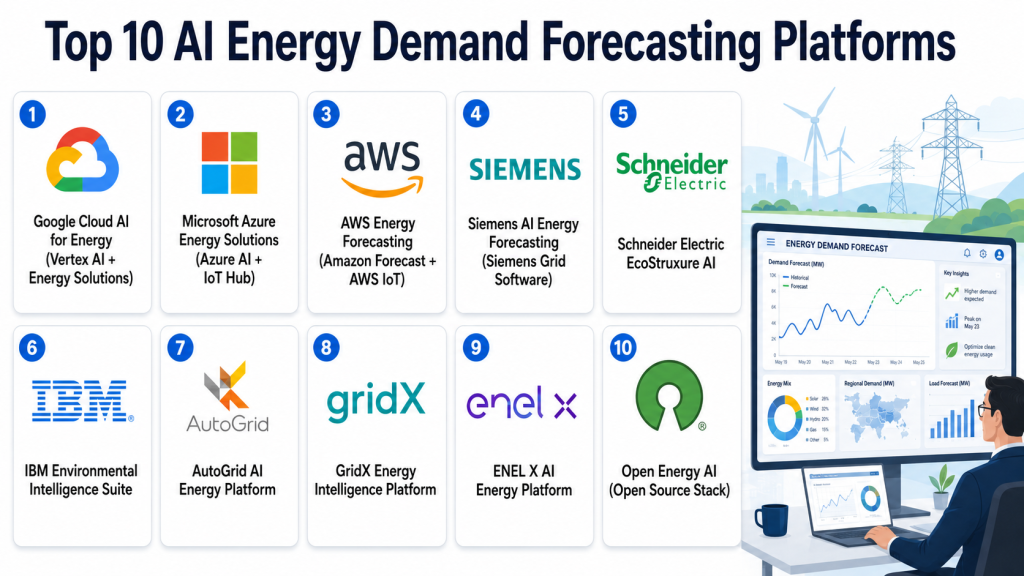
Top 10 AI Energy Demand Forecasting Platforms
#1 — Google Cloud AI for Energy (Vertex AI + Energy Solutions)
One-line verdict: Best for large-scale, AI-driven energy forecasting integrated with global cloud infrastructure.
Short description (2–3 lines):
Google Cloud AI for Energy combines Vertex AI, BigQuery, and forecasting models to help utilities and enterprises predict energy demand at scale. It is widely used in smart grid analytics and renewable energy forecasting.
Standout Capabilities
- Large-scale time-series forecasting pipelines
- Integration with weather and satellite datasets
- Real-time energy demand prediction
- Scalable cloud-based ML infrastructure
- Support for digital twin energy modeling
- Advanced data ingestion pipelines for IoT
AI-Specific Depth
- Model support: Vertex AI time-series + custom ML models
- RAG / knowledge integration: External data pipelines supported
- Evaluation: Model monitoring and drift detection tools
- Guardrails: Limited, depends on implementation layer
- Observability: Strong ML monitoring dashboards
Pros
- Extremely scalable forecasting infrastructure
- Strong integration with big data tools
- Advanced ML ecosystem support
Cons
- Requires advanced ML engineering expertise
- Complex setup for non-technical teams
Security & Compliance
- Enterprise-grade cloud security
- IAM, encryption, audit logging
- Regional data residency options
Deployment & Platforms
- Cloud-native (Google Cloud Platform)
Integrations & Ecosystem
- BigQuery
- Vertex AI
- IoT and smart grid systems
- Third-party energy platforms
Pricing Model
Usage-based cloud pricing (compute + storage + ML training)
Best-Fit Scenarios
- National energy utilities
- Renewable energy forecasting
- Smart city infrastructure
#2 — Microsoft Azure Energy Solutions (Azure AI + IoT Hub)
One-line verdict: Best for enterprise-grade energy forecasting integrated with IoT and smart infrastructure.
Short description:
Microsoft Azure Energy Solutions provide AI-powered forecasting combined with IoT data ingestion and enterprise analytics for energy systems.
Standout Capabilities
- Real-time energy demand forecasting
- IoT-based smart meter integration
- Digital twin modeling for energy grids
- AI-powered load balancing
- Predictive maintenance for infrastructure
- Renewable energy forecasting support
AI-Specific Depth
- Model support: Azure ML + custom AI models
- RAG / knowledge integration: External enterprise data support
- Evaluation: Model monitoring and performance tracking
- Guardrails: Enterprise governance policies
- Observability: Azure Monitor integration
Pros
- Strong enterprise ecosystem integration
- Excellent IoT + AI combination
- Trusted by government and utilities
Cons
- Complex architecture setup
- Requires Azure ecosystem dependency
Security & Compliance
- Enterprise security controls
- RBAC, encryption, audit logs
- Government cloud options available
Deployment & Platforms
- Cloud + hybrid deployments
Integrations & Ecosystem
- Azure IoT Hub
- Power BI
- Smart grid systems
Pricing Model
Usage-based enterprise pricing
Best-Fit Scenarios
- Utility companies
- Smart cities
- Government energy programs
#3 — AWS Energy Forecasting (Amazon Forecast + AWS IoT)
One-line verdict: Best for scalable cloud forecasting pipelines built on AWS ecosystem.
Short description:
AWS provides energy demand forecasting using Amazon Forecast and IoT services for large-scale predictive analytics.
Standout Capabilities
- Time-series forecasting models
- Integration with IoT energy devices
- Scalable cloud prediction pipelines
- Automated feature engineering
- Support for demand response systems
- Batch and real-time forecasting
AI-Specific Depth
- Model support: AWS Forecast + ML models
- RAG / knowledge integration: External pipelines required
- Evaluation: Forecast accuracy metrics available
- Guardrails: AWS ecosystem policies
- Observability: CloudWatch monitoring
Pros
- Highly scalable infrastructure
- Strong IoT + AI integration
- Reliable forecasting system
Cons
- Requires AWS expertise
- Limited out-of-box energy-specific templates
Security & Compliance
- IAM-based security
- Encryption and logging support
- Enterprise compliance readiness
Deployment & Platforms
- Cloud-native AWS ecosystem
Integrations & Ecosystem
- AWS IoT Core
- Lambda functions
- Energy data pipelines
Pricing Model
Pay-per-use ML and compute pricing
Best-Fit Scenarios
- Utility-scale forecasting
- Industrial energy systems
- Smart grid operators
#4 — Siemens AI Energy Forecasting (Siemens Grid Software)
One-line verdict: Best for industrial-grade and utility-scale smart grid forecasting.
Short description:
Siemens provides AI-driven energy forecasting integrated into smart grid and industrial energy systems for utilities and infrastructure providers.
Standout Capabilities
- Smart grid forecasting systems
- Industrial load prediction
- Renewable energy integration
- Digital twin grid modeling
- Real-time grid optimization
- Infrastructure-level analytics
AI-Specific Depth
- Model support: Proprietary industrial AI models
- RAG / knowledge integration: Grid data integration supported
- Evaluation: Utility-grade performance monitoring
- Guardrails: Strong operational safety controls
- Observability: Grid-level monitoring systems
Pros
- Deep utility industry expertise
- High reliability for critical infrastructure
- Strong grid integration
Cons
- Not developer-friendly
- High implementation complexity
Security & Compliance
- Industrial-grade compliance systems
- Strong operational security
Deployment & Platforms
- On-premise + hybrid deployments
Integrations & Ecosystem
- Energy grid systems
- Industrial control systems
Pricing Model
Enterprise licensing
Best-Fit Scenarios
- National utilities
- Industrial energy operators
- Smart grid infrastructure
#5 — Schneider Electric EcoStruxure AI
One-line verdict: Best for building and industrial energy optimization with AI forecasting.
Short description:
Schneider Electric provides AI-powered energy forecasting for buildings, factories, and industrial systems.
Standout Capabilities
- Building energy demand prediction
- HVAC optimization forecasting
- Industrial load balancing
- Sustainability tracking
- Smart building integration
- Energy efficiency optimization
AI-Specific Depth
- Model support: Proprietary AI + analytics models
- RAG / knowledge integration: Facility data integration
- Evaluation: Energy efficiency metrics
- Guardrails: Operational safety rules
- Observability: Energy dashboards
Pros
- Strong building energy optimization
- Industry-leading sustainability tools
- Easy integration into facilities
Cons
- Limited cloud-native developer tooling
- Focused more on industrial use cases
Security & Compliance
- Enterprise-grade controls
- Facility-level compliance support
Deployment & Platforms
- Hybrid + edge deployments
Integrations & Ecosystem
- Building management systems
- Industrial IoT platforms
Pricing Model
Enterprise subscription
Best-Fit Scenarios
- Smart buildings
- Industrial plants
- Sustainability programs
#6 — IBM Environmental Intelligence Suite
One-line verdict: Best for climate-aware energy forecasting and environmental analytics.
Short description:
IBM provides AI-driven environmental intelligence for energy forecasting and climate-aware decision-making.
Standout Capabilities
- Weather-integrated forecasting
- Climate risk modeling
- Energy demand prediction
- Sustainability analytics
- Environmental monitoring systems
AI-Specific Depth
- Model support: IBM AI models + external integration
- RAG / knowledge integration: Environmental datasets
- Evaluation: Risk-based forecasting metrics
- Guardrails: Enterprise governance controls
- Observability: Analytics dashboards
Pros
- Strong climate-energy integration
- Enterprise-grade analytics
- Good sustainability alignment
Cons
- Complex platform
- Not purely energy-focused
Security & Compliance
- Strong enterprise compliance
- Governance-focused architecture
Deployment & Platforms
- Cloud-based IBM systems
Integrations & Ecosystem
- Climate datasets
- Enterprise energy systems
Pricing Model
Enterprise contract pricing
Best-Fit Scenarios
- Climate-focused energy planning
- Government sustainability programs
- Risk modeling systems
#7 — AutoGrid AI Energy Platform
One-line verdict: Best for demand response and energy flexibility optimization.
Short description:
AutoGrid provides AI-based demand response and energy forecasting for utilities and distributed energy resources.
Standout Capabilities
- Demand response forecasting
- Distributed energy optimization
- Real-time grid balancing
- Renewable integration support
- Energy flexibility modeling
AI-Specific Depth
- Model support: Proprietary AI energy models
- RAG / knowledge integration: Grid-level datasets
- Evaluation: Forecast accuracy tracking
- Guardrails: Operational safety controls
- Observability: Energy dashboards
Pros
- Strong demand response capabilities
- Good renewable integration
- Utility-focused design
Cons
- Limited general AI flexibility
- Industry-specific only
Security & Compliance
- Utility-grade compliance support
Deployment & Platforms
- Cloud + hybrid
Integrations & Ecosystem
- Utility systems
- Smart grid APIs
Pricing Model
Enterprise subscription
Best-Fit Scenarios
- Energy utilities
- Demand response systems
- Renewable energy operators
#8 — GridX Energy Intelligence Platform
One-line verdict: Best for retail energy forecasting and pricing optimization.
Short description:
GridX focuses on energy pricing, forecasting, and analytics for retail energy providers.
Standout Capabilities
- Energy pricing optimization
- Demand forecasting analytics
- Retail energy intelligence
- Customer usage prediction
- Market-driven forecasting
AI-Specific Depth
- Model support: Proprietary forecasting models
- RAG / knowledge integration: Market data integration
- Evaluation: Pricing accuracy metrics
- Guardrails: Business logic constraints
- Observability: Analytics dashboards
Pros
- Strong retail energy focus
- Good pricing optimization
- Real-time analytics
Cons
- Not suitable for national grids
- Narrow industry scope
Security & Compliance
- Enterprise-grade controls
Deployment & Platforms
- Cloud-based
Integrations & Ecosystem
- Energy retail systems
- Billing platforms
Pricing Model
Enterprise pricing
Best-Fit Scenarios
- Energy retailers
- Pricing optimization teams
- Market forecasting
#9 — ENEL X AI Energy Platform
One-line verdict: Best for demand-side energy management and EV ecosystem forecasting.
Short description:
ENEL X provides AI-driven energy forecasting for smart mobility and demand-side optimization.
Standout Capabilities
- EV charging demand forecasting
- Demand-side management
- Smart grid optimization
- Energy storage optimization
- Real-time consumption analytics
AI-Specific Depth
- Model support: Proprietary energy models
- RAG / knowledge integration: Energy ecosystem data
- Evaluation: Operational forecasting metrics
- Guardrails: Grid safety constraints
- Observability: Energy dashboards
Pros
- Strong EV integration
- Demand-side optimization focus
- Real-time analytics
Cons
- Limited developer tooling
- Region-dependent deployment
Security & Compliance
- Utility-grade systems
Deployment & Platforms
- Cloud + edge systems
Integrations & Ecosystem
- EV charging networks
- Smart grid platforms
Pricing Model
Enterprise usage-based
Best-Fit Scenarios
- EV infrastructure
- Smart cities
- Demand response systems
#10 — Open Energy AI (Open Source Stack)
One-line verdict: Best open-source framework for building custom energy forecasting systems.
Short description:
Open Energy AI represents open-source tools and frameworks used to build custom energy forecasting pipelines.
Standout Capabilities
- Custom forecasting model development
- Time-series ML pipelines
- Flexible architecture design
- Integration with IoT systems
- Edge deployment support
AI-Specific Depth
- Model support: Open-source ML models
- RAG / knowledge integration: Fully customizable
- Evaluation: Developer-defined metrics
- Guardrails: Not built-in
- Observability: Custom implementations
Pros
- Fully customizable
- No vendor lock-in
- Ideal for research and innovation
Cons
- Requires strong ML expertise
- No enterprise support
Security & Compliance
- Depends on deployment environment
Deployment & Platforms
- Self-hosted / hybrid
Integrations & Ecosystem
- Python ML ecosystem
- IoT systems
- Custom pipelines
Pricing Model
Open-source (infrastructure cost only)
Best-Fit Scenarios
- Research labs
- Custom utility systems
- Experimental AI energy projects
Comparison Table
| Tool Name | Best For | Deployment | Model Flexibility | Strength | Watch-Out | Public Rating |
|---|---|---|---|---|---|---|
| Google AI Energy | Smart grids | Cloud | Multi-model | Scalability | Complexity | N/A |
| Microsoft Azure | Enterprise utilities | Cloud/Hybrid | Proprietary + ML | Ecosystem | Setup complexity | N/A |
| AWS Forecast | Cloud pipelines | Cloud | ML models | Scalability | AWS dependency | N/A |
| Siemens | Grid systems | Hybrid | Proprietary | Industrial reliability | Complex setup | N/A |
| Schneider | Buildings | Edge/Hybrid | Proprietary | Efficiency optimization | Narrow scope | N/A |
| IBM | Climate-energy | Cloud | Hybrid | Climate analytics | Complexity | N/A |
| AutoGrid | Demand response | Cloud/Hybrid | Proprietary | Grid flexibility | Industry-specific | N/A |
| GridX | Energy retail | Cloud | Proprietary | Pricing optimization | Narrow scope | N/A |
| ENEL X | EV + demand | Edge/Cloud | Proprietary | EV forecasting | Regional limits | N/A |
| Open Energy AI | Custom systems | Self-hosted | Open-source | Flexibility | No support | N/A |
Scoring & Evaluation (Transparent Rubric)
| Tool | Core | Reliability | Guardrails | Integrations | Ease | Perf/Cost | Security/Admin | Support | Weighted Total |
|---|---|---|---|---|---|---|---|---|---|
| 9 | 9 | 8 | 9 | 8 | 8 | 8 | 8 | 8.4 | |
| Microsoft | 9 | 9 | 9 | 9 | 7 | 8 | 9 | 9 | 8.5 |
| AWS | 8 | 9 | 7 | 9 | 7 | 8 | 9 | 8 | 8.1 |
| Siemens | 9 | 9 | 9 | 8 | 6 | 8 | 9 | 9 | 8.2 |
| Schneider | 8 | 8 | 8 | 8 | 7 | 8 | 8 | 8 | 8.0 |
| IBM | 8 | 8 | 9 | 8 | 7 | 7 | 9 | 8 | 7.9 |
| AutoGrid | 8 | 8 | 8 | 8 | 7 | 8 | 8 | 8 | 8.0 |
| GridX | 8 | 8 | 7 | 8 | 8 | 8 | 8 | 8 | 7.9 |
| ENEL X | 8 | 8 | 8 | 8 | 7 | 8 | 8 | 8 | 7.9 |
| Open Energy AI | 8 | 7 | 6 | 7 | 6 | 9 | 6 | 7 | 7.3 |
Top 3 for Enterprise Utilities
- Microsoft Azure Energy Solutions
- Google AI Energy
- Siemens Grid Software
Top 3 for SMB / Mid Utilities
- Schneider Electric
- AutoGrid
- IBM Environmental Intelligence
Top 3 for Developers / Custom Systems
- Open Energy AI
- AWS Forecast
- Google Vertex AI
Which AI Energy Forecasting Tool Is Right for You?
Small Utilities / Local Providers
Best fit: Schneider Electric, GridX
Focus: efficiency, affordability, simplicity
Mid-Sized Energy Operators
Best fit: AutoGrid, IBM, ENEL X
Focus: demand response + renewable integration
Enterprise / National Utilities
Best fit: Microsoft Azure, Google Cloud, Siemens
Focus: scalability, reliability, governance
Regulated Energy Infrastructure
Best fit: Siemens, IBM, Microsoft Azure
Focus: compliance, auditability, safety
Build vs Buy
- Build: Open Energy AI, AWS Forecast, Vertex AI
- Buy: Siemens, Microsoft, Schneider
Implementation Playbook (30 / 60 / 90 Days)
30 Days: Pilot Phase
- Collect historical energy + weather data
- Run baseline forecasting models
- Benchmark accuracy and latency
- Define KPIs (MAE, RMSE, grid deviation)
60 Days: System Hardening
- Integrate IoT and smart meter data
- Add model evaluation and drift detection
- Introduce forecasting dashboards
- Test renewable integration scenarios
90 Days: Scale Phase
- Deploy across grid regions or facilities
- Optimize cost and compute usage
- Introduce automated demand response
- Implement governance and compliance reporting
Common Mistakes & How to Avoid Them
- Ignoring renewable energy variability
- Not integrating weather data properly
- Using single model without fallback systems
- Poor handling of real-time data streams
- Lack of evaluation framework
- Over-reliance on cloud-only architecture
- Ignoring edge computing needs
- Not accounting for EV charging demand
- No drift monitoring in forecasting models
- Underestimating data quality issues
- Missing audit logs for compliance
- Poor integration with legacy grid systems
- Ignoring carbon optimization goals
- No human oversight in critical decisions
FAQs
What is AI energy demand forecasting?
It is the use of AI models to predict future energy consumption patterns across grids, buildings, and systems.
Why is it important?
It helps balance energy supply and demand, reduces costs, and improves grid stability.
Can AI forecasting handle renewable energy?
Yes, it is widely used to predict solar and wind variability.
What data is used?
Weather data, historical usage, IoT sensors, and grid load information.
Is it accurate?
Accuracy depends on data quality, model type, and environment complexity.
Can it prevent blackouts?
It helps reduce risk by improving demand-supply balancing.
Is real-time forecasting possible?
Yes, many modern systems support real-time predictions.
What industries use it?
Utilities, smart cities, manufacturing, EV networks, and data centers.
Do I need cloud systems?
Not always; edge and hybrid systems are also common.
What is the biggest challenge?
Handling variability in renewable energy and real-time demand spikes.
Can small companies use it?
Yes, but simpler tools or cloud APIs are usually better.
Is open-source viable?
Yes, but it requires strong technical expertise.
Conclusion
AI Energy Demand Forecasting is becoming the backbone of modern energy infrastructure. It enables smarter grids, better renewable integration, and more efficient energy usage across industries and governments.The right platform depends on scale, complexity, and governance needs. Hyperscalers dominate enterprise-grade forecasting, industrial vendors excel in grid reliability, and open-source systems offer flexibility for innovation.

Find Trusted Cardiac Hospitals
Compare heart hospitals by city and services — all in one place.
Explore Hospitals