
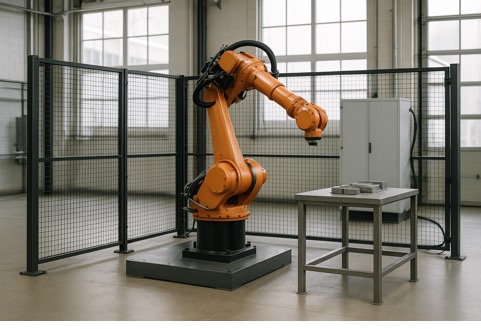
An investment in manufacturing automation can pay off. (Photo: Generated with the help of AI)
Manufacturing automation has developed from a solution mainly associated with large factories into a broader investment topic for industrial companies. Robots, sensors, software and automated material-handling systems can now cover tasks ranging from assembly to quality inspection.
Falling technological barriers have expanded the range of possible applications. Whether an investment makes economic sense still depends on the process, production volume and long-term operating requirements.
What does manufacturing automation actually include?
Manufacturing automation describes the use of technology to perform or control production processes with reduced manual intervention. The term covers industrial robots, collaborative robots, programmable machinery, machine vision, sensors and software. Conveyor systems and automated inspection equipment can also form part of an integrated production environment.
Modern manufacturing automation does not necessarily mean replacing an entire production line. Individual repetitive processes can be automated while surrounding operations remain manual. This modular approach can make automation suitable for production environments with different levels of technical maturity.
Why are companies investing in manufacturing automation?
Industrial production is increasingly influenced by demands for consistent quality, predictable output and flexible capacity. Automation can perform standardized movements repeatedly and operate within clearly defined tolerances. This makes certain production steps easier to plan and monitor. Common applications include:
- Repetitive assembly and component handling
- Machine loading and unloading
- Packaging and palletizing operations
- Automated visual quality inspection
- Internal movement of materials and finished products
The suitability of each application depends on process stability. Tasks with frequent unpredictable changes can require more complex sensors, programming and human supervision.
How can manufacturing automation improve productivity?
Productivity gains do not result simply from installing machines. Benefits emerge when automation removes bottlenecks, stabilizes cycle times or allows employees to concentrate on less repetitive activities. Data generated by automated equipment can also reveal production patterns that are difficult to identify through manual observation.
The National Institute of Standards and Technology identifies enhanced productivity, increased throughput, improved consistency and higher production capacity among the potential benefits of robotics and manufacturing automation.
It also notes that newer sensors, vision systems and software have made robotic technologies increasingly accessible to smaller manufacturers.
What does manufacturing automation cost?
Initial equipment represents only one part of the investment. Integration, programming, safety equipment, employee training and modifications to surrounding machinery can substantially influence the final cost. Maintenance and future software or hardware changes also belong in a realistic calculation.
Production interruptions during installation can create additional costs. An apparently inexpensive robot may therefore produce a higher total investment when extensive adaptation is required. Comparing complete project costs provides a more meaningful picture than comparing equipment prices alone.
When can manufacturing automation generate a return?
Return on investment depends strongly on how intensively an automated system is used. A process operating across several shifts usually offers a different economic case from a task performed only occasionally.
Scrap reduction, improved throughput and fewer production interruptions can also affect the calculation. Important factors include:
- Purchase, integration and commissioning costs
- Expected operating hours and production volume
- Labor, quality and material savings
- Maintenance and technical support requirements
- Ability to handle future products or process changes
Payback periods therefore vary substantially between applications. A reliable calculation requires measurable assumptions rather than general expectations about automation.
How is robotics accelerating manufacturing automation?
Industrial robots remain one of the most visible elements of manufacturing automation. Their applications now extend beyond automotive production into food, electronics, metalworking and other sectors.
Flexible grippers, improved machine vision and simpler programming continue to broaden the range of suitable tasks.
The International Federation of Robotics reported in June 2026 that around 38,000 industrial robots were installed in the United States during 2025. This represented an increase of 11 percent compared with the previous year. Robot density in US manufacturing stood at 307 industrial robots per 10,000 employees.
What risks can affect manufacturing automation?
Automation can underperform when an unsuitable process is automated without first addressing existing inefficiencies. Unstable production flows, inconsistent component quality or frequent unplanned changes can become more visible rather than disappear after automation.
Technical dependence also creates new requirements. Maintenance skills, spare parts, cybersecurity and access to system expertise become relevant throughout the equipment lifecycle. Flexibility deserves particular attention when product designs or production quantities change regularly.
How flexible can manufacturing automation become?
Earlier automated systems were often associated with high-volume production and fixed processes. Modern equipment increasingly combines programmable robots, sensors and digital controls that can be adapted to new products. This flexibility can extend the useful life of an automation investment.
The degree of flexibility still varies considerably. Tool changes, new fixtures or additional programming may remain necessary. Future production scenarios should therefore be considered during system design rather than only after operating conditions change.
Is manufacturing automation ultimately worth the investment?
Manufacturing automation can provide substantial economic value when repetitive processes, sufficient production volume and clearly measurable objectives are present.
Productivity, consistency and ergonomics can all contribute to the business case. The investment becomes less convincing when automation is introduced without a stable process or realistic cost analysis.
The economic value of manufacturing automation is therefore determined by application rather than technology alone. A well-defined process, transparent total-cost calculation and sufficient flexibility provide a stronger basis for investment decisions than expectations of automation by itself.

I’m Rajesh Kumar, a DevOps, SRE, DevSecOps, Cloud, and Platform Engineering expert passionate about sharing practical knowledge, real-world experiences, and industry best practices. I have worked at Cotocus and regularly write about technology, travel, investing, health, product reviews, and digital marketing through my various platforms.
I publish technical articles at DevOps School, travel stories at Holiday Landmark, stock market insights at Stocks Mantra, health and fitness guidance at My Medic Plus, product reviews at TrueReviewNow, and SEO and digital marketing strategies at Wizbrand.
Find Trusted Cardiac Hospitals
Compare heart hospitals by city and services — all in one place.
Explore Hospitals