
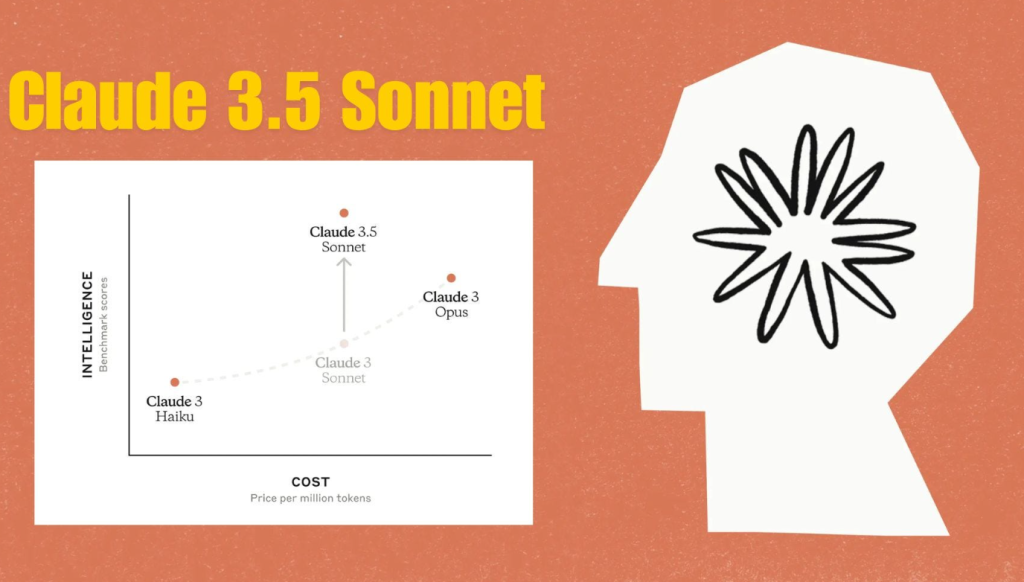
Claude 3.5 Sonnet is the latest generative AI model developed by Anthropic, launched on June 20, 2024. It is designed to excel in various tasks, particularly in coding, reasoning, and visual data extraction, marking a significant advancement in AI capabilities.
Key Features of Claude 3.5 Sonnet
- Performance: Claude 3.5 Sonnet boasts a notable performance improvement over its predecessor, Claude 3 Opus, being twice as fast and five times cheaper to operate. It has achieved top rankings in various AI benchmarks, demonstrating exceptional abilities in software engineering evaluations and reasoning tasks[3][5][6].
- Capabilities: The model is adept at handling complex tasks such as:
- Coding: It excels at generating and debugging code, making it a valuable tool for software developers.
- Visual Data Extraction: Claude can interpret and create visual presentations based on data inputs, showcasing its capabilities in visual reasoning[6][7].
- Artifact Generation: A unique feature of Sonnet is its ability to display generated content (like documents or code) in a separate panel for real-time editing and collaboration[5].
- Safety and Development Focus: Anthropic emphasizes safety in AI development. Claude 3.5 Sonnet underwent rigorous testing to ensure responsible usage while maintaining high intelligence levels[4][5].
Use Cases
- Coding Assistance: Software engineers can leverage Claude 3.5 Sonnet for writing tests or fixing bugs efficiently.
- Visual Presentations: It can help create presentations from graphs or data sets, streamlining the process for educators and professionals.
- Customer Support: The model’s reasoning capabilities make it suitable for providing context-sensitive support in various applications[6][7].
Overall, Claude 3.5 Sonnet represents a significant leap in AI technology, combining speed, efficiency, and advanced capabilities while maintaining a focus on safety and responsible use.
Anthropic Sonnet is a large language model (LLM) developed by the AI safety and research company Anthropic.1 It is part of the Claude 3.5 family of models, known for their advanced reasoning capabilities, strong coding skills, and enhanced safety features.2
Here are some key points about Anthropic Sonnet:
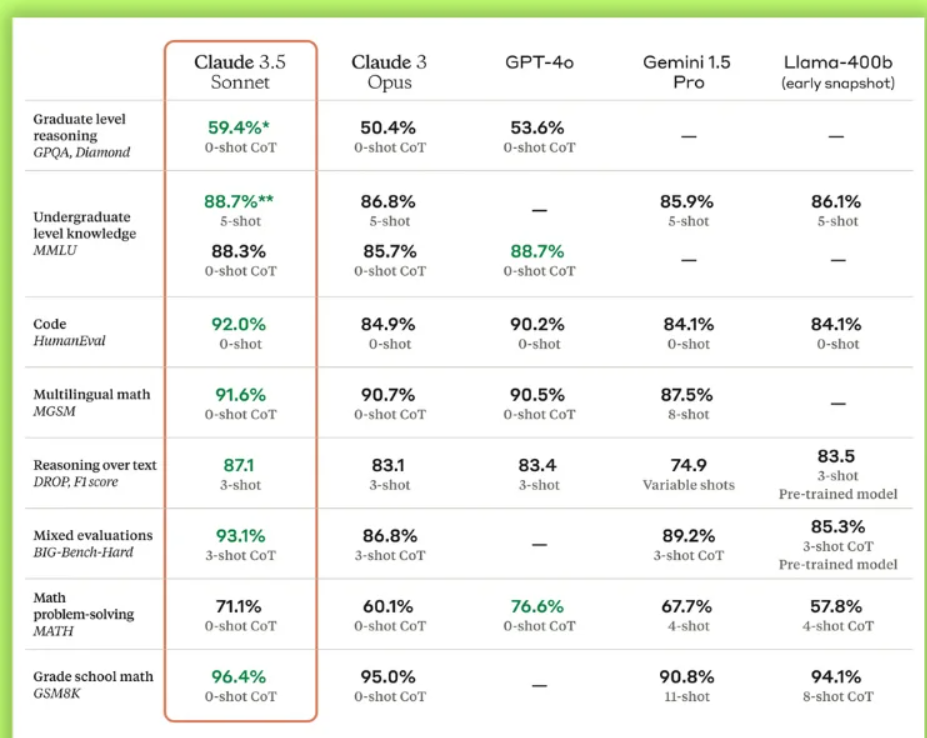
- Performance: It outperforms previous models and competitors in various benchmarks, including graduate-level reasoning (GPQA), undergraduate-level knowledge (MMLU), and coding proficiency (HumanEval).3
- Reasoning and Coding: Sonnet excels at tasks that require complex reasoning and coding skills.4
- Safety: Anthropic has a strong focus on AI safety, and Sonnet is designed to be more harmless and helpful than previous models.5
- Availability: Sonnet is available through the Anthropic API, Amazon Bedrock, and Google Cloud’s Vertex AI.6
Overall, Anthropic Sonnet is a powerful and versatile LLM that can be used for a variety of tasks, including question answering, text generation, and code completion.7 It is a significant advancement in the field of AI, and it has the potential to be used in a wide range of applications.8
Difference between Claude 3.5 Sonnet and Anthropic Sonnet 3.5
Claude 3.5 Sonnet and Anthropic Sonnet 3.5 refer to the same AI model developed by Anthropic, but the terminology may differ based on context or branding. Here’s a breakdown of their characteristics and features:
Claude 3.5 Sonnet
- Release Date: Launched on June 20, 2024, as a significant upgrade from previous models.
- Performance: Claude 3.5 Sonnet operates at twice the speed of its predecessor, Claude 3 Opus, and excels in various benchmarks related to reasoning, coding proficiency, and contextual understanding[1][3].
- Capabilities:
- Enhanced Vision: It includes advanced image processing capabilities, allowing it to interpret visual data effectively and transcribe text from imperfect images[1][5].
- Creative Output: The model can generate creative content with humor and relatability, making interactions more engaging[1][2].
- Coding Assistance: It is particularly strong in software development tasks, assisting throughout the entire lifecycle from design to bug fixes[2][5].
Anthropic Sonnet 3.5
- Terminology: This term may be used interchangeably with Claude 3.5 Sonnet but typically emphasizes the branding aspect of Anthropic’s AI offerings.
- Focus on Accessibility: Anthropic Sonnet 3.5 is available for free for personal use and integrates with platforms like Amazon Bedrock, expanding its accessibility to users[5].
- User Interaction Features: The model includes a feature called “Artifacts,” allowing users to interact dynamically with generated content in real-time[5].
In summary, while Claude 3.5 Sonnet highlights the specific version of the AI model focusing on its technical capabilities and performance metrics, Anthropic Sonnet 3.5 may refer more broadly to the branding and accessibility aspects of this advanced AI technology. Both terms ultimately describe the same underlying model with its enhanced features and functionalities.
Use cases
Claude 3.5 Sonnet can understand nuanced instructions and context, recognize and correct its own mistakes, and can create sophisticated analysis and insights from complex data. Combined with state-of-the-art coding, vision, and writing skills, you can use Claude 3.5 Sonnet for a variety of use cases. Popular use cases include:
Computer use
By integrating Claude via API, developers can direct Claude to use computers the way people do—by looking at a screen, moving a cursor, clicking buttons, and typing text. Claude 3.5 Sonnet is the first frontier AI model to reliably use computers in this way—albeit experimentally in public beta—and we expect the capability to improve over time.
Code generation
Claude 3.5 Sonnet can help across the entire software development lifecycle—from initial design to bug fixes, maintenance to optimizations. Build Claude into your own products or use it as a coding assistant via Claude.ai.
Advanced chatbots
With enhanced reasoning and a warm, human-like tone, Claude 3.5 Sonnet is ideal for chatbots that need to connect data and take action across a variety of systems and tools.
Knowledge Q&A
Claude 3.5 Sonnet offers a large context window and low rates of hallucination, making it ideal for answering questions around large knowledge bases, documents, and codebases.
Visual data extraction
Claude 3.5 Sonnet is able to extract information from visuals like charts, graphs, and complex diagrams with ease—making it an ideal AI model for data analytics and data science tasks.
Robotic process automation
Automate repetitive tasks or processes with Claude 3.5 Sonnet. It offers industry-leading instruction following and is capable of handling complex processes and operations.

I’m Rajesh Kumar, a DevOps, SRE, DevSecOps, Cloud, and Platform Engineering expert passionate about sharing practical knowledge, real-world experiences, and industry best practices. I have worked at Cotocus and regularly write about technology, travel, investing, health, product reviews, and digital marketing through my various platforms.
I publish technical articles at DevOps School, travel stories at Holiday Landmark, stock market insights at Stocks Mantra, health and fitness guidance at My Medic Plus, product reviews at TrueReviewNow, and SEO and digital marketing strategies at Wizbrand.
Find Trusted Cardiac Hospitals
Compare heart hospitals by city and services — all in one place.
Explore Hospitals





