API versioning is the practice of managing changes to an API in a way that minimizes disruption to existing applications that rely on it. As APIs evolve over time, new features are added, functionalities might change, and sometimes even data structures are updated. Versioning helps developers using the API understand which functionalities are available in a specific version and ensures their applications continue to work as expected.
Here’s why API versioning is important:
- Maintains Backward Compatibility: New versions don’t necessarily break existing integrations. Developers can choose to keep using a stable version while gradually migrating to newer versions with improved functionalities.
- Clear Communication of Changes: Versioning clearly communicates the differences between API iterations, allowing developers to plan their application updates accordingly.
- Supports Multiple Implementations: Different versions can cater to different needs. For instance, an older version might be maintained for stability-critical applications, while a newer version offers advanced features for those willing to adopt them.
There are several common approaches to API versioning:
- URI Versioning: This approach incorporates the version number into the API request URL itself. For example:
/v1/users(Version 1)/v2/users(Version 2)
This is a straightforward and widely used approach, but it can lead to long and cluttered URLs as version numbers accumulate.
- Query Parameter Versioning: Here, the version is specified as a query parameter in the request URL. For example:
/users?version=1/users?version=2
This keeps URLs cleaner but adds an extra parameter to manage.
- Custom Header Versioning: A custom header in the request is used to specify the version. This approach offers more flexibility in header naming but requires additional configuration on the client-side.
- Content Negotiation (Advanced): This technique allows the API to accept a version identifier in the request body and respond with the data format corresponding to that version. It’s a more complex approach but offers finer-grained control over versioning based on data formats.
The best approach for your API depends on your specific needs and the complexity of your API’s evolution. Here are some additional points to consider:
- Version Deprecation: When introducing new versions, it’s good practice to clearly announce the deprecation of older versions with a timeline for their eventual shutdown. This gives developers ample time to migrate their applications.
- Versioning for Bug Fixes & Security Patches: Critical bug fixes and security patches can be delivered through existing versions to maintain stability. New features and major architecture changes are better suited for separate versions.
- Versioning Documentation: Clear and up-to-date documentation for each API version is essential for developers to understand the specific functionalities and potential breaking changes between versions.
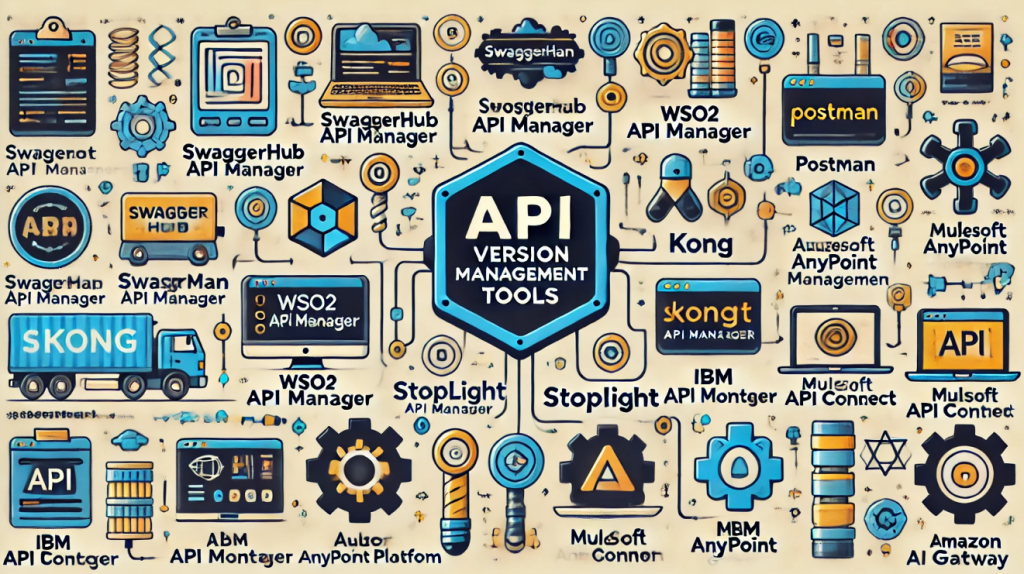
API version management is crucial for maintaining backward compatibility, implementing new features, and ensuring smooth transitions between versions. Here are some of the best tools and strategies for API version management:
1. Swagger (OpenAPI)
- Overview: OpenAPI Specification (formerly known as Swagger) provides a standard way to define APIs, including versioning.
- Features:
- Versioning in API definitions
- Documentation generation
- Tools for generating client and server code
- Website: Swagger
2. Postman
- Overview: Postman is a comprehensive API development environment that includes features for versioning APIs.
- Features:
- API version control
- Version tagging and documentation
- Collaboration and change tracking
- Website: Postman
3. Apigee
- Overview: Apigee by Google Cloud offers a robust API management platform that includes versioning capabilities.
- Features:
- API versioning and version history
- Traffic management and routing based on versions
- Comprehensive analytics and monitoring
- Website: Apigee
4. AWS API Gateway
- Overview: AWS API Gateway provides tools for creating, deploying, and managing APIs, including version management.
- Features:
- Stage management for different API versions
- Version-specific endpoint creation
- Integration with AWS services for deployment and monitoring
- Website: AWS API Gateway
5. Azure API Management
- Overview: Microsoft Azure’s API Management service offers features for managing multiple versions of an API.
- Features:
- Versioning and revisions
- Version-specific policies and transformations
- Comprehensive monitoring and analytics
- Website: Azure API Management
6. Kong
- Overview: Kong is an open-source API gateway and management platform with strong support for versioning.
- Features:
- API versioning and routing
- Custom plugins for version management
- Real-time analytics and monitoring
- Website: Kong
7. Tyk
- Overview: Tyk is an open-source API gateway that provides tools for managing multiple API versions.
- Features:
- Version management and routing
- Rate limiting and security policies per version
- Detailed analytics and monitoring
- Website: Tyk
8. WSO2 API Manager
- Overview: An open-source API management solution that includes comprehensive versioning features.
- Features:
- Versioned API endpoints
- API lifecycle management
- Developer portal with version-specific documentation
- Website: WSO2 API Manager
9. GitHub
- Overview: While primarily a version control system for code, GitHub can also be used for versioning API specifications.
- Features:
- Version control for OpenAPI/Swagger files
- Collaboration and pull request workflows
- Integration with CI/CD pipelines for automated deployments
- Website: GitHub
10. SmartBear ReadyAPI
- Overview: A comprehensive API testing and management tool that supports versioning.
- Features:
- Versioned API documentation
- Automated testing across versions
- Integration with CI/CD tools
- Website: SmartBear ReadyAPI

I’m Rajesh Kumar, a DevOps, SRE, DevSecOps, Cloud, and Platform Engineering expert passionate about sharing practical knowledge, real-world experiences, and industry best practices. I have worked at Cotocus and regularly write about technology, travel, investing, health, product reviews, and digital marketing through my various platforms.
I publish technical articles at DevOps School, travel stories at Holiday Landmark, stock market insights at Stocks Mantra, health and fitness guidance at My Medic Plus, product reviews at TrueReviewNow, and SEO and digital marketing strategies at Wizbrand.
Find Trusted Cardiac Hospitals
Compare heart hospitals by city and services — all in one place.
Explore Hospitals