
We are entering the “Agentic AI” era. The market is flooded with promises: automate everything from customer support to complex internal operations simply by dragging and dropping blocks onto a beautiful visual canvas.
The temptation is immense. Visual builders (No-Code/Low-Code platforms) promise speed. They allow a business analyst to prototype a bot in a single day without involving engineering resources. For validating early hypotheses, this can be useful.
But the moment this prototype meets the real world—the need to integrate with your legacy CRM, adhere to enterprise security protocols, handle thousands of concurrent requests, or execute tasks that span several days—the visual approach collapses.
For leadership, it is critical to understand the key strategic distinction: Are we building prototypes, or are we building assets?
If we want to build intelligent systems that will serve as a competitive advantage for the company, the only viable path forwardfor engineering teams is to adopte AI agent as code architectures. Agentic backend like Calljmp are driving this shift, enabling developers to orchestrate stateful, TypeScript-driven agents that integrate natively with existing CI/CD pipelines.
In this article, we will explore why this is the case, the hidden risks of visual builders, and what platforms – specifically modern agentic backend like Calljmp – allow us to execute this approach efficiently.
The Fundamental Flaw of Visual Builders (No-Code)
Visual tools are excellent for linear automations: “If an email arrives in Gmail, create a task in Trello.” An example of this approach can be seen in the AI features of platforms like Zapier or specialized builders like Stack AI.
However, AI agents are not linear automations. They are inherently unpredictable. They require feedback loops, complex decision-making logic, robust error handling, and, most importantly, memory (state).
When you attempt to implement complex business logic in a visual editor, you quickly encounter the “spaghetti effect.” What was supposed to be a simple flowchart turns into an unreadable tangle of connections that is impossible to debug, test, or version control.
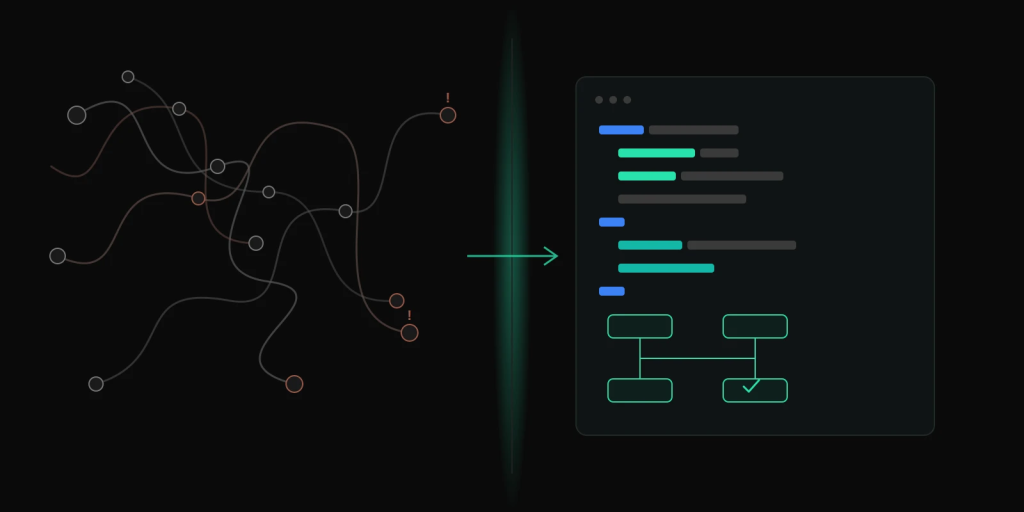
The Primary Business Risk of No-Code: You are locking your intellectual property—the core behavioral logic of your agent—into a vendor’s proprietary format. You do not own the code. You cannot hire an auditor to verify the security of this “tangle.” You are entirely at the mercy of the platform’s limitations.
The Business Case for “Agent as Code”: Ownership, Control, and Scale
The “Agent as Code” approach means that the agent’s behavioral logic is written by developers using standard programming languages (with TypeScript/JavaScript and Python becoming the de facto standards).
This is not merely a technical preference; it is a strategic decision that unlocks enterprise-grade benefits such as GitOps versioning, automated testing, deterministic debugging, and limitless integrations.
To clearly illustrate the operational trade-offs, here is a direct comparison between building agents as code versus using visual builders:
“Agent as Code” vs. “No-Code” Visual Builders
| Feature / Criterion | “Agent as Code” (Code-First) | “No-Code” (Visual Builders) |
| Customization & Integrations | Pro: Limitless. Developers can connect to any internal legacy API, database, or custom SDK. | Con: Restricted entirely to the pre-built connectors offered by the vendor. |
| Prototyping Speed | Con: Slower initial setup. Requires configuring a development environment. | Pro: Extremely fast for simple, linear “Hello World” concepts. |
| Version Control (GitOps) | Pro: Native Git integration. Full history, easy rollbacks, and team collaboration. | Con: Poor version control. Reverting complex changes is often impossible. |
| Testing & Reliability | Pro: Supports automated unit and integration tests before deploying to production. | Con: Testing is mostly manual trial-and-error. Prone to breaking in edge cases. |
| Debugging Complex Logic | Pro: Developers get exact stack traces and can inspect memory state line-by-line. | Con: The “Spaghetti Effect.” Extremely difficult to debug when a visual web gets too large. |
| Security & IP Ownership | Pro: The company owns 100% of the intellectual property. Code can be audited for security. | Con: Vendor lock-in. Your core business logic is trapped in a proprietary platform. |
| Scaling for Production | Pro: Highly scalable and durable, especially when paired with specialized runtimes like Calljmp. | Con: Often fails under heavy concurrent loads or long-running asynchronous tasks. |
| Required Team Skills | Con: Requires professional software engineers (TypeScript/Python). | Pro: Can be built by business analysts or product managers without coding skills. |
The “Agent as Code” Landscape: Frameworks vs. Agentic Runtimes
If we choose the code-first path, the next question is: what tooling do we adopt? The market is currently divided into two categories: Libraries (Frameworks) and Runtimes (Execution Platforms).
1. Libraries and Frameworks (e.g., LangChain, Mastra)
These are toolkits that help developers write the agent’s code. They provide convenient abstractions for working with LLMs, prompts, and tools.
- The Problem: They only solve the problem of writing the code. They do not solve the problem of running and sustaining the agent.
- The Business Risk: If you rely solely on a library, your engineering team must build the infrastructure from scratch: provisioning servers, setting up databases for conversation history, and configuring message queues for long-running tasks. You end up spending 80% of your engineering budget on “plumbing” rather than AI logic.
2. Agentic Runtimes (e.g., Calljmp)
This is a new, crucial category of infrastructure, championed by platforms like Calljmp. These platforms not only allow you to write agents in standard TypeScript, but they also provide a specialized execution environment designed specifically for the physics of AI.
Calljmp absorbs the most difficult infrastructure challenges of Agentic AI:
- State Management: Where does the agent’s memory live between HTTP requests? Calljmp handles context persistence out of the box.
- Durability: What if an agent pauses to wait for human approval for 3 days? A standard server will time out and kill the process. Calljmp’s runtime can “sleep” and “wake up,” preserving the entire task context without requiring a custom database architecture.
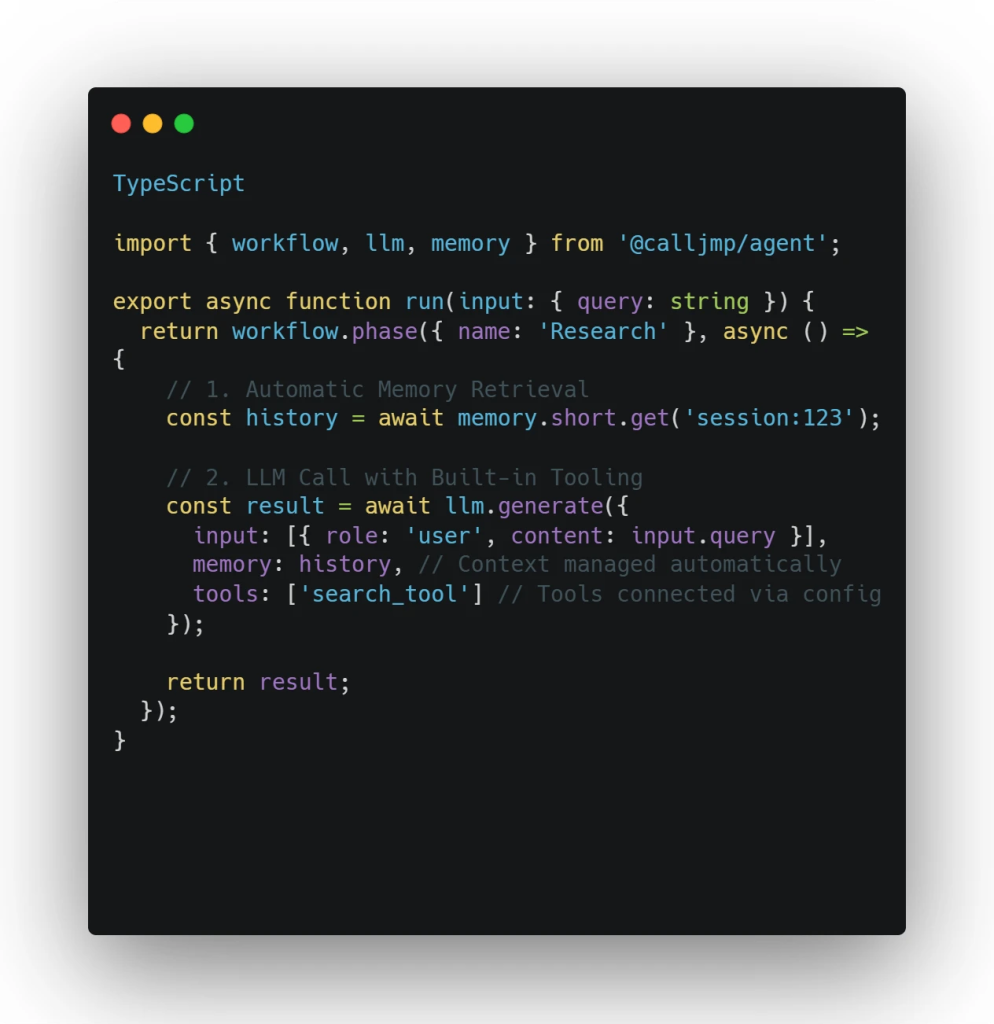
The Calljmp Value Proposition: It is the optimal choice for teams that want to write code (leveraging Git, testing, and TypeScript type safety) but refuse to waste months building custom agentic infrastructure for agent orchestration. It is the “sweet spot” between the infinite flexibility of raw code and the operational ease of a managed platform.
Ideal Teams and Projects for this Approach
The “Agent as Code” methodology (especially when paired with an agentic runtime like Calljmp) is not a one-size-fits-all solution, but it is the only solution for serious workloads.
Ideal Project Profile:
- Agents performing mission-critical business functions where errors translate to revenue loss.
- Scenarios requiring deep, secure integration with internal APIs and legacy databases.
- Long-running, asynchronous processes (e.g., an agent managing a customer onboarding flow over a week).
- Enterprise deployments require strict role-based access control and audit logs.
Ideal Team Profile:
- Required: Backend engineers (TypeScript/Node.js or Python) who understand asynchronous logic and API design.
- Desired: Experience with LLM APIs and orchestration principles.
- Not Suitable For: Teams consisting exclusively of frontend developers, designers, or non-technical product managers looking for a drag-and-drop solution.
The choice between No-Code and “Agent as Code” is a choice between a quick win today and a sustainable, defensible asset tomorrow.
Visual builders are excellent for sandboxes and rapid ideation. However, attempting to build a critical business system on top of them will inevitably result in unmanageable technical debt that cannot be scaled, audited, or safely updated.
If we are serious about AI agents becoming a core part of our operational future, we must treat them as serious software. This means writing code, utilizing version control, enforcing testing standards, and leveraging specialized execution platforms like Calljmp to provide production-grade reliability without the ai agent infrastructure overhead.
Investing in an engineering-first approach to AI today will pay compounding dividends in reliability, IP ownership, and the ability to scale seamlessly alongside our business.

I’m Rajesh Kumar, a DevOps, SRE, DevSecOps, Cloud, and Platform Engineering expert passionate about sharing practical knowledge, real-world experiences, and industry best practices. I have worked at Cotocus and regularly write about technology, travel, investing, health, product reviews, and digital marketing through my various platforms.
I publish technical articles at DevOps School, travel stories at Holiday Landmark, stock market insights at Stocks Mantra, health and fitness guidance at My Medic Plus, product reviews at TrueReviewNow, and SEO and digital marketing strategies at Wizbrand.
Find Trusted Cardiac Hospitals
Compare heart hospitals by city and services — all in one place.
Explore Hospitals
Another way to look at production AI agents is through the lens of governance and accountability rather than just architecture. When agents start taking autonomous actions across systems, the key challenge becomes understanding why a decision was made and being able to audit it after the fact. This requires strong traceability across prompts, tool calls, and system responses, along with clear ownership boundaries between human operators and automated agents. From an enterprise standpoint, success depends less on building capable agents and more on ensuring they remain controllable, explainable, and compliant under real operational constraints.