
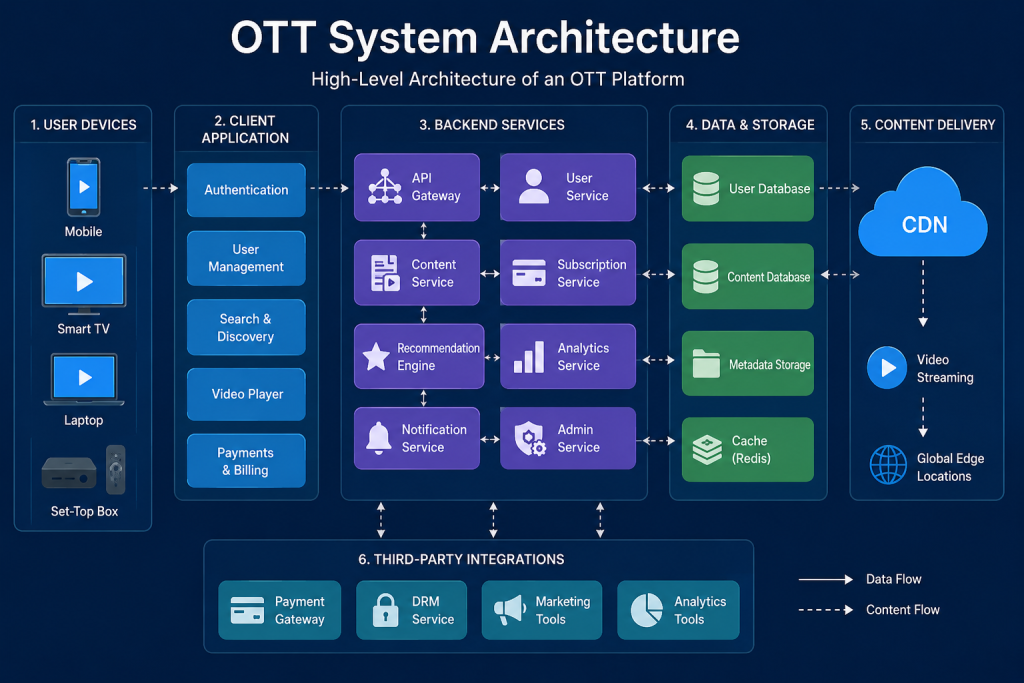
OTT Streaming has revolutionized consumer consumption of media in the current generation. Videos ranging from movies, live sports, documentaries, and entertainment have found themselves on the OTT platform, making it possible for consumers to consume media via different means. With millions of consumers consuming digital media away from home, building an OTT platform requires careful consideration of several things. Building an OTT platform is not just about uploading videos online; it requires having a means of managing the vast number of users, media distribution worldwide, heavy traffic, among others.
What Is an OTT Platform?
OTT Platform – An OTT platform refers to a delivery mechanism through which content is delivered via the internet and not the conventional cable or satellite TV. Examples of OTT platforms are video streaming platforms, live events streaming sites, and education content streaming sites.
Services involved in an OTT Platform – An OTT platform comprises several services including but not limited to video storage, content delivery, authentication, payment, recommendation, and analytics.
Why System Design Matters for OTT Platforms
With increasing user expectations, high quality streaming without buffering and high availability become essential for these platforms. Poor architectural design causes downtime, high costs, and unhappy users.
Effective design in ott system design allows the platform to withstand any traffic surges due to any live events like live sports or release of new movies.
Important considerations should be:
- Availability
- Scalability
- Latency
- Security
- Content delivery
- User experience
Core Components of an OTT Architecture
A modern OTT platform relies on several interconnected components.
1. User Authentication System
The authentication service manages user registration, login, password management, and subscription verification.
Features include:
- Email and social login
- Multi-factor authentication
- Session management
- User profile management
2. Content Management System (CMS)
Administrators can use the CMS to upload and organize media resources.
It handles:
- Video uploads
- Metadata management
- Categories and tags
- Content scheduling
3. Video Processing Pipeline
Raw videos require processing before distribution.
The pipeline performs:
- Video transcoding
- Compression
- Resolution optimization
- Thumbnail generation
Videos are converted into different formats to facilitate different gadgets and internet connections.
4. Content Delivery Network (CDN)
Video files can be distributed via CDNs through global servers.
Benefits include:
- Faster load times
- Reduced buffering
- Lower server load
- Better user experience worldwide
5. Recommendation Engine
AI facilitates the personalization of user experience through relevant suggestions.
The recommendation engine analyzes:
- Viewing history
- User preferences
- Watch time
- Trending content
Typical OTT Platform Architecture
The following table outlines the major components and their responsibilities.
| Component | Primary Function | Benefit |
| Authentication Service | User login and security | Secure access |
| Content Management System | Manage media assets | Organized content |
| Video Processing Pipeline | Encode and optimize videos | Multi-device compatibility |
| CDN | Deliver content globally | Faster streaming |
| Recommendation Engine | Suggest relevant content | Higher engagement |
| Analytics System | Monitor performance | Better decision making |
| Payment Gateway | Handle subscriptions | Revenue generation |
Challenges in Building OTT Platforms
Traffic Spikes
Live events can attract millions of concurrent viewers. Systems must automatically scale to accommodate sudden increases in demand.
Cloud-based infrastructure helps dynamically allocate resources when traffic surges occur.
Video Storage Requirements
High-definition and 4K videos consume significant storage space.
Solutions include:
- Cloud object storage
- Data compression
- Archiving older content
Low Latency Streaming
Users expect instant playback without delays.
Reducing latency requires:
- Edge computing
- Optimized CDNs
- Efficient video encoding
Security Concerns
OTT platforms face multiple cybersecurity threats.
Important security measures include:
- Digital Rights Management (DRM)
- Encryption
- Secure APIs
- Token-based authentication
Best Practices for Scalable OTT Development
Use Microservices Architecture
Instead of one large application, divide the system into independent services.
Advantages:
- Easier maintenance
- Independent deployments
- Improved scalability
- Faster development cycles
Implement Caching
Content caching will minimize the amount of work performed by databases.
Common caching layers include:
- User session cache
- Video metadata cache
- Recommendation cache
Monitor System Performance
Continuous monitoring is useful in discovering problems before they affect the user base.
Key metrics include:
- Server response time
- Video startup time
- Buffering ratio
- User engagement
Automate Infrastructure Management
Automation tools simplify deployments and scaling.
Popular practices include:
- Infrastructure as Code (IaC)
- CI/CD pipelines
- Auto-scaling groups
The Future of OTT Platforms
The OTT industry keeps evolving at an astonishing pace. New technologies influence the future of streaming.
Future trends include:
- AI-powered personalization
- Interactive streaming
- Cloud-native architectures
- 8K video support
- Edge computing integration
Companies that make investments in today’s advanced streaming architecture will be well-prepared for future consumer demand challenges.
Conclusion
A successful OTT platform goes much further beyond simply putting videos online. It is necessary for developers to come up with an architecture that can accommodate millions of users but still offer high performance and security.
Properly designed ott system architecture is crucial to ensure smooth streaming services both regionally and through all types of devices. Through utilizing modern techniques like microservices, cloud computing, CDN, and recommendation systems, one will be able to construct future-proof ott platforms.
With the growing trend of online consumption in the world today, having a strong ott system architecture has never been so critical.

I’m Rajesh Kumar, a DevOps, SRE, DevSecOps, Cloud, and Platform Engineering expert passionate about sharing practical knowledge, real-world experiences, and industry best practices. I have worked at Cotocus and regularly write about technology, travel, investing, health, product reviews, and digital marketing through my various platforms.
I publish technical articles at DevOps School, travel stories at Holiday Landmark, stock market insights at Stocks Mantra, health and fitness guidance at My Medic Plus, product reviews at TrueReviewNow, and SEO and digital marketing strategies at Wizbrand.
Find Trusted Cardiac Hospitals
Compare heart hospitals by city and services — all in one place.
Explore Hospitals