
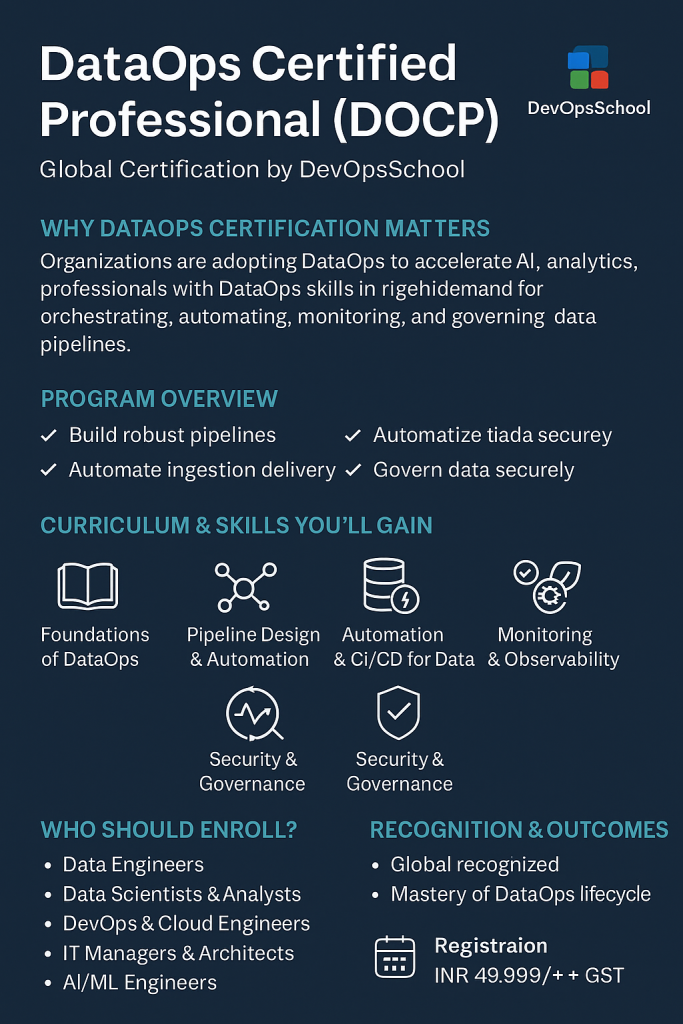
DataOps Certified Professional (DOCP)
Global Certification by DevOpsSchool
The DataOps Certified Professional (DOCP) is an internationally recognized certification designed by DevOpsSchool to prove expertise in DataOps principles, tools, and automated data pipeline management. This program gives data professionals the essential skills needed to excel in modern, AI-driven enterprise environments, positioning them as leaders in data engineering and operations.
Why DataOps Certification Is Essential
With the surge in DataOps adoption in 2026, organizations across finance, healthcare, telecom, retail, automotive, and cloud sectors demand experts capable of automating, monitoring, and governing large-scale data pipelines. DOCP-certified professionals deliver trusted, scalable, and high-performance data infrastructure—enabling real-time analytics and confident decision-making.
Program Overview
The DOCP curriculum emphasizes:
- Real-world, tool-centric training for modern platforms and best practices.
- Building resilient, production-grade data pipelines.
- Automating every phase: ingestion, transformation, and delivery.
- Proactive health monitoring with observability dashboards.
- Secure governance and compliance for enterprise-wide data assets.
- Scalable infrastructure with cloud-native and Infrastructure as Code methods.
Curriculum & Key Skills
Foundations of DataOps
- Core principles, frameworks, and agile methodologies.
- Industry adoption trends and DataOps evolution.
Pipeline Design & Automation
- Hands-on orchestration with Airflow, StreamSets, Kafka, Dagster.
- Workflow modeling and orchestration best practices.
Integration & ETL/ELT
- Ingestion and transformation with Databricks, Fivetran, Talend, Airflow.
- Handling schema changes and data drift.
Automation & CI/CD for Data
- Building CI/CD pipelines for data workflows.
- Model versioning and reproducibility with dbt, GitOps.
Monitoring & Observability
- Real-time monitoring: Grafana, Prometheus, Monte Carlo, Acceldata.
- SLAs, anomaly detection, proactive alerting.
Data Quality & Testing
- Using Great Expectations, Soda for validation and profiling.
- Unit testing and automated data quality checks.
Infrastructure as Code (IaC)
- Containerization (Docker), orchestration (Kubernetes).
- Automated deployment with Terraform, Helm.
Security & Governance
- Data access control, lineage tracing, masking.
- Compliance with GDPR, HIPAA, SOC2; policy management.
Training Format & Assessment
- Mode: Online interactive sessions or in-person classes.
- Labs: Real-world scenarios; sandbox environments for complete skill-building.
- Tools: Databricks, Airflow, Kafka, dbt, Fivetran, StreamSets, Jenkins, Dataiku, Grafana, Great Expectations, Docker, Kubernetes, Terraform.
- Assessment: Practical exercises, quizzes, final certification exam.
- Duration: 5-day instructor-led bootcamp or extended (40+ hr) self-paced course.
Who Should Enroll?
- Data Engineers seeking advanced orchestration expertise.
- Data Scientists & Analysts needing workflow reproducibility and governance.
- DevOps & Cloud Engineers bridging DevOps with DataOps.
- IT Managers, Architects overseeing enterprise data governance.
- AI/ML Engineers requiring reliable, automated data operations.
Recognition & Outcomes
- Globally recognized, trusted certification from DevOpsSchool.
- Mastery over the end-to-end DataOps lifecycle.
- Qualification to lead DataOps transformations and drive scalable data engineering projects.
- Unlocks roles: DataOps Engineer, Platform Engineer, Data Architect, DevOps Specialist.
Certification Process
- Attend Training: Choose a 5-day instructor-led program or extended guided track.
- Hands-On Labs: Build, monitor, and automate real pipelines.
- Pass Exam: Complete theory and hands-on assessments.
- Earn Credential: Receive a DOCP certificate with a unique, globally verifiable ID.
Enrollment Criteria
- Batch Size: Minimum 10, maximum 15 participants.
- Prerequisites: Basic knowledge of data engineering or DevOps concepts is recommended.
Fees & Registration
- Registration Fee: INR 49,999/- + GST.
- Discounts: Available for groups and corporate enrollments.
- Early Bird: Special pricing may be offered for select batches.
Why Choose DevOpsSchool?
- International recognition, alumni in leading enterprises.
- Expert instructors with deep, real-world experience.
- Comprehensive, enterprise-grade labs.
- Supportive community via forums, Slack, and mentorship.
By earning the DOCP certification from DevOpsSchool, professionals stand at the forefront of data engineering and operations—equipped to deliver secure, resilient, and automated data pipelines, and lead digital transformation in any enterprise.

I’m Rajesh Kumar, a DevOps, SRE, DevSecOps, Cloud, and Platform Engineering expert passionate about sharing practical knowledge, real-world experiences, and industry best practices. I have worked at Cotocus and regularly write about technology, travel, investing, health, product reviews, and digital marketing through my various platforms.
I publish technical articles at DevOps School, travel stories at Holiday Landmark, stock market insights at Stocks Mantra, health and fitness guidance at My Medic Plus, product reviews at TrueReviewNow, and SEO and digital marketing strategies at Wizbrand.
Find Trusted Cardiac Hospitals
Compare heart hospitals by city and services — all in one place.
Explore Hospitals






This is a really informative overview of the DataOps Certified Professional (DOCP) certification! I like how the post explains the skills covered and why this certification matters — it makes it easier to understand what to expect and how it can help a career. Thanks for sharing!