
MYHOSPITALNOW.COM

Find Trusted Doctors & Hospitals

Discover healthcare providers, compare hospitals, and explore treatment options worldwide.

Free Treatment Quotes • Doctor Search • Hospital Comparison

Find Healthcare Options

www.myhospitalnow.com

Essential Machine Learning Algorithms Every AI Professional Should Master

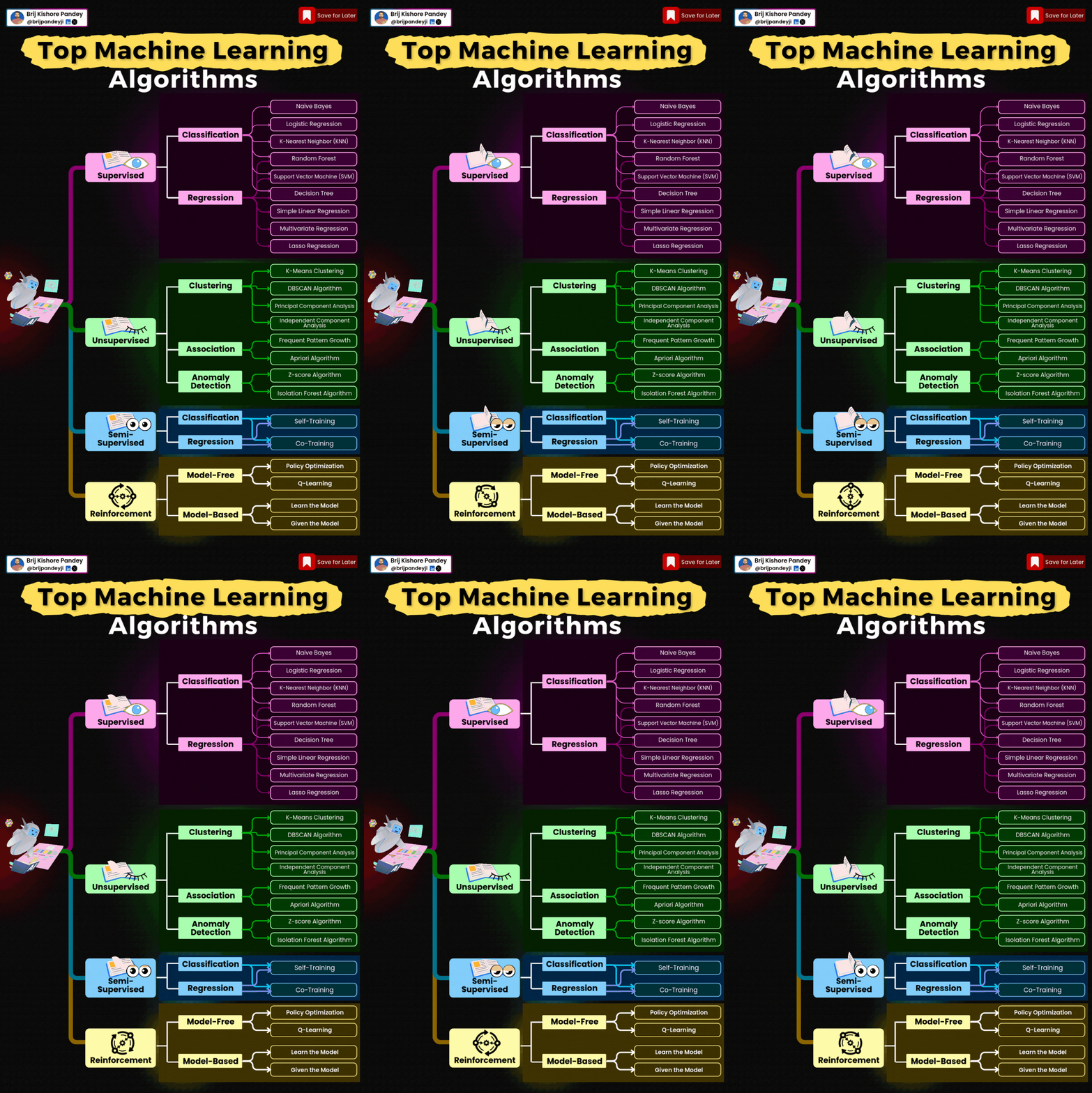
Top ML algorithms mind map: supervised, unsupervised, semi-supervised and reinforcement learning with example algorithms

As an AI/ML practitioner, having a solid grasp of fundamental algorithms is crucial. Here’s your go-to reference guide for the most important ML algorithms, organized by learning approach:

𝗦𝘂𝗽𝗲𝗿𝘃𝗶𝘀𝗲𝗱 𝗟𝗲𝗮𝗿𝗻𝗶𝗻𝗴
Classification:
• Naive Bayes – Perfect for text classification
• Logistic Regression – The go-to for binary problems
• KNN – Simple yet powerful pattern recognition
• Random Forest – Ensemble learning at its finest
• SVM – Excellent for complex decision boundaries
• Decision Trees – When interpretability matters

Regression:
• Linear Regression – The foundation of predictive modeling
• Multivariate Regression – For complex variable relationships
• Lasso Regression – When feature selection counts

𝗨𝗻𝘀𝘂𝗽𝗲𝗿𝘃𝗶𝘀𝗲𝗱 𝗟𝗲𝗮𝗿𝗻𝗶𝗻𝗴
Clustering:
• K-Means – The clustering workhorse
• DBSCAN – Density-based clustering champion
• PCA – Dimensionality reduction master
• ICA – When independence matters

Pattern Mining:
• Association Rules – Market basket analysis
• Frequent Pattern Growth – Efficient pattern discovery
• Anomaly Detection – Finding the needles in the haystack

𝗦𝗲𝗺𝗶-𝗦𝘂𝗽𝗲𝗿𝘃𝗶𝘀𝗲𝗱 𝗟𝗲𝗮𝗿𝗻𝗶𝗻𝗴
• Self-Training – Learning from limited labeled data
• Co-Training – When two views are better than one

𝗥𝗲𝗶𝗻𝗳𝗼𝗿𝗰𝗲𝗺𝗲𝗻𝘁 𝗟𝗲𝗮𝗿𝗻𝗶𝗻𝗴
• Model-Free Methods (Q-Learning) – Learning through experience
• Model-Based Approaches – Planning ahead
• Policy Optimization – Direct strategy learning

Pro Tips:
1. Master the fundamentals before diving into deep learning
2. Understand when to use each algorithm
3. Know their strengths and limitations
4. Practice implementing from scratch
5. Keep up with modern implementations

Key Learning Resources:
• Scikit-learn documentation
• Research papers
• Hands-on projects
• Real-world applications

Remember: The best algorithm depends on your:
– Data type
– Problem complexity
– Performance requirements
– Computational resources

Find Trusted Cardiac Hospitals

Compare heart hospitals by city and services — all in one place.

Explore Hospitals
I'm Rajesh Kumar, a DevOps, SRE, DevSecOps, Cloud, and Platform Engineering expert passionate about sharing practical knowledge, real-world experiences, and industry best practices. I have worked at Cotocus and regularly write about technology, travel, investing, health, product reviews, and digital marketing through my various platforms. I publish technical articles at DevOps School, travel stories at Holiday Landmark, stock market insights at Stocks Mantra, health and fitness guidance at My Medic Plus, product reviews at TrueReviewNow, and SEO and digital marketing strategies at Wizbrand.

Related Posts

Top 10 AI Ride-Hailing Matching Algorithms Tools: Features, Pros, Cons & Comparison

Introduction AI Ride-Hailing Matching Algorithms use artificial intelligence, machine learning, predictive analytics, and optimization techniques to connect passengers with suitable drivers efficiently. These systems analyze multiple real-time…

Read More

Principal Quantum Algorithm Scientist: Role Blueprint, Responsibilities, Skills, KPIs, and Career Path

The **Principal Quantum Algorithm Scientist** is a senior individual-contributor (IC) scientist who invents, adapts, and validates quantum algorithms that can be delivered through a software product or IT platform (typically a cloud-based quantum computing service, SDK, or enterprise solution). The role bridges foundational research and production-grade enablement by turning algorithmic ideas into reproducible code, benchmarks, and developer-ready artifacts that product and engineering teams can ship and support.

Read More

Lead Quantum Research Scientist: Role Blueprint, Responsibilities, Skills, KPIs, and Career Path

The **Lead Quantum Research Scientist** is a senior, research-heavy individual contributor (IC) who sets the technical direction for quantum algorithms and applied quantum research that can be translated into software products, developer tools, or client-facing solutions. This role bridges **foundational research** (quantum information science, algorithm design, error models) with **engineering execution** (prototype code, benchmarks, integration into quantum software stacks).

Read More

Lead Quantum Algorithm Scientist: Role Blueprint, Responsibilities, Skills, KPIs, and Career Path

The **Lead Quantum Algorithm Scientist** is a senior individual-contributor scientist who designs, proves, prototypes, and operationalizes quantum algorithms and resource-estimation methods that can be delivered through a software or IT organization’s quantum computing platform, developer tools, or applied solutions portfolio. This role bridges rigorous research (algorithm design, complexity, error models) with production-minded engineering (reproducible code, benchmarking, integration into SDKs, and customer-facing enablement).

Read More

Associate Quantum Research Scientist: Role Blueprint, Responsibilities, Skills, KPIs, and Career Path

The **Associate Quantum Research Scientist** is an early-career research individual contributor who designs, prototypes, and validates quantum computing methods that can be translated into usable software capabilities—typically quantum algorithms, error mitigation techniques, benchmarking workflows, and simulation approaches. The role blends rigorous scientific thinking with practical engineering execution, contributing research artifacts that can be integrated into a quantum software stack or offered as part of a quantum cloud service.

Read More

Associate Quantum Algorithm Scientist: Role Blueprint, Responsibilities, Skills, KPIs, and Career Path

The **Associate Quantum Algorithm Scientist** designs, prototypes, and validates quantum algorithms and quantum-inspired methods that can be productized within a software or IT organization. The role sits at the intersection of applied research and engineering: converting mathematical ideas into working code, benchmarking against classical baselines, and collaborating with platform and product teams to deliver usable capabilities.

Read More
Subscribe
Notify of
guest
0 Comments
Newest
Oldest Most Voted
0
Would love your thoughts, please comment.x
()
x