
Here’s a comprehensive list of JFrog Artifactory Terminology that is commonly used across its documentation and platform:
✅ Core Concepts
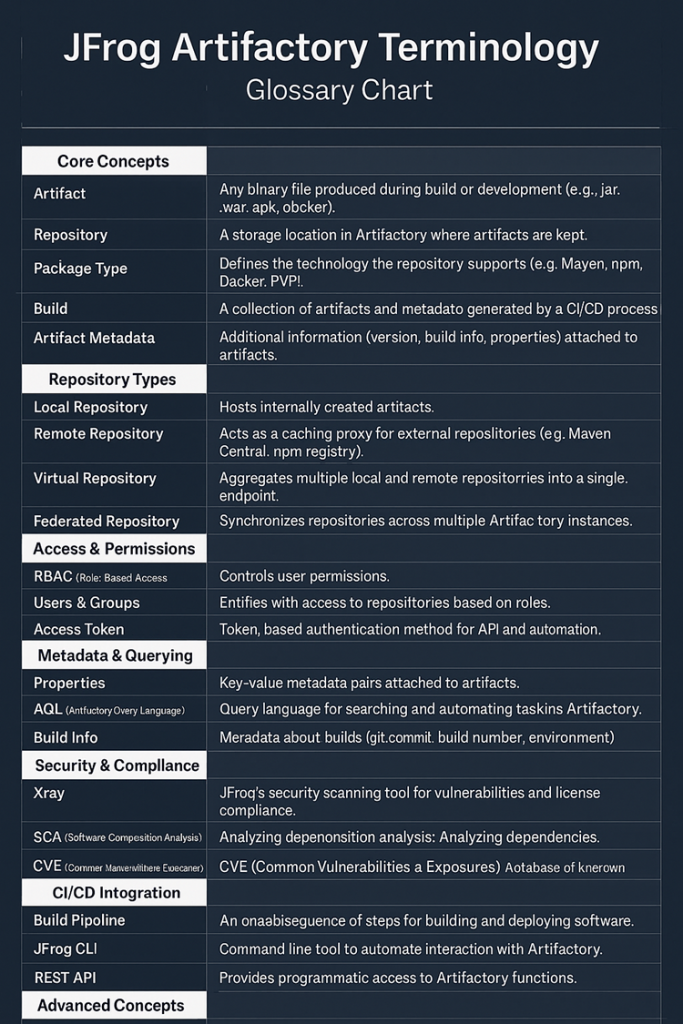
- Artifact: Any binary file produced during build or development (e.g.,
.jar,.war,.apk,.docker). - Repository: A storage location in Artifactory where artifacts are kept.
- Package Type: Defines the technology the repository supports (e.g., Maven, npm, Docker, PyPI).
- Build: A collection of artifacts and metadata generated by a CI/CD process.
- Artifact Metadata: Additional information (version, build info, properties) attached to artifacts.
✅ Repository Types
- Local Repository: Hosts internally created artifacts.
- Remote Repository: Acts as a caching proxy for external repositories (e.g., Maven Central, npm registry).
- Virtual Repository: Aggregates multiple local and remote repositories into a single endpoint.
- Federated Repository: Synchronizes repositories across multiple Artifactory instances.
✅ Repository Layout
- Repository Path: The full URL/path to access artifacts within a repository.
- Checksum: A hash value (SHA1, MD5) used to verify artifact integrity.
- Immutable Artifacts: Artifacts that cannot be overwritten once deployed.
✅ Access & Permissions
- RBAC (Role-Based Access Control): System for controlling user permissions.
- Users & Groups: Entities with access to repositories based on roles.
- Access Token: Token-based authentication method for API and automation.
✅ Metadata & Querying
- Properties: Key-value metadata pairs attached to artifacts.
- AQL (Artifactory Query Language): Query language for searching and automating tasks within Artifactory.
- Build Info: Metadata about builds (git commit, build number, environment).
✅ Security & Compliance
- Xray: JFrog’s security scanning tool for vulnerabilities and license compliance.
- SCA (Software Composition Analysis): Analyzing dependencies for security issues.
- CVE (Common Vulnerabilities and Exposures): Database of known security vulnerabilities.
✅ Distribution
- Replication: Syncing repositories across instances.
- Promotion: Moving artifacts from one repository (e.g., dev) to another (e.g., prod).
- Distribution Repository: Repository used for distributing signed, immutable releases.
✅ CI/CD Integration
- Build Pipeline: Automated sequence of steps for building and deploying software.
- JFrog CLI: Command-line tool to automate interaction with Artifactory.
- REST API: Provides programmatic access to Artifactory functions.
✅ Storage & Infrastructure
- Filestore: The physical storage backend for artifacts (e.g., local disk, NFS, cloud object storage).
- Checksum Storage: Deduplicates artifacts by storing only unique binaries identified by checksum.
- HA (High Availability): Clustered Artifactory instances for redundancy and load balancing.
✅ Advanced Concepts
- Edge Node: Remote Artifactory node for distributed teams/sites.
- CDN Distribution: Use of Content Delivery Network for artifact delivery at scale.
- Immutable Release Bundle: Signed, versioned artifact collection for distribution.

I’m Rajesh Kumar, a DevOps, SRE, DevSecOps, Cloud, and Platform Engineering expert passionate about sharing practical knowledge, real-world experiences, and industry best practices. I have worked at Cotocus and regularly write about technology, travel, investing, health, product reviews, and digital marketing through my various platforms.
I publish technical articles at DevOps School, travel stories at Holiday Landmark, stock market insights at Stocks Mantra, health and fitness guidance at My Medic Plus, product reviews at TrueReviewNow, and SEO and digital marketing strategies at Wizbrand.
Find Trusted Cardiac Hospitals
Compare heart hospitals by city and services — all in one place.
Explore Hospitals
Thanks for this clear explanation of JFrog Artifactory terminology! 📦 I like how the key terms are described in a simple and understandable way — it really helps anyone new to Artifactory. Very informative — appreciate you sharing this!