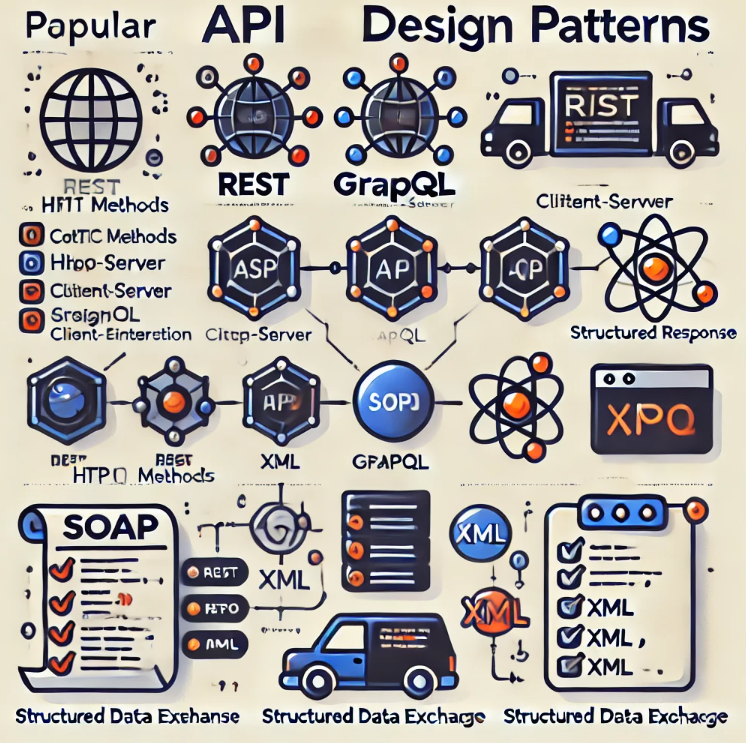
API design patterns are established solutions to common API design challenges. They provide a set of best practices and reusable approaches for building clean, consistent, and user-friendly APIs. Think of them like building blocks that you can combine to create effective APIs.
Here are some key benefits of using API design patterns:
- Consistency: Patterns promote uniformity across your APIs, making them more intuitive and easier for developers to learn and use.
- Efficiency: By leveraging proven solutions, you can avoid reinventing the wheel and potentially avoid common pitfalls, speeding up development.
- Maintainability: Well-designed patterns often lead to cleaner and more maintainable code, making it easier to modify and update the API in the future.
- Scalability: Patterns can help you design APIs that can handle increased usage and data volume.
There are many different API design patterns, here are a few common examples:
- RESTful patterns: These patterns define how to structure APIs based on the principles of REST (Representational State Transfer) architecture. This ensures a consistent way to interact with resources using HTTP verbs (GET, POST, PUT, DELETE) and status codes.
- Versioning patterns: These patterns deal with how to manage API versions and introduce changes without breaking existing integrations.
- Pagination patterns: When dealing with large datasets, pagination patterns help efficiently retrieve data in chunks to improve performance and avoid overwhelming users with massive responses.
- Authentication and authorization patterns: These patterns ensure secure access to the API by verifying user identity and access permissions.
By understanding and applying API design patterns, you can create well-structured, well-documented, and easy-to-use APIs that promote efficient development and a positive developer experience.
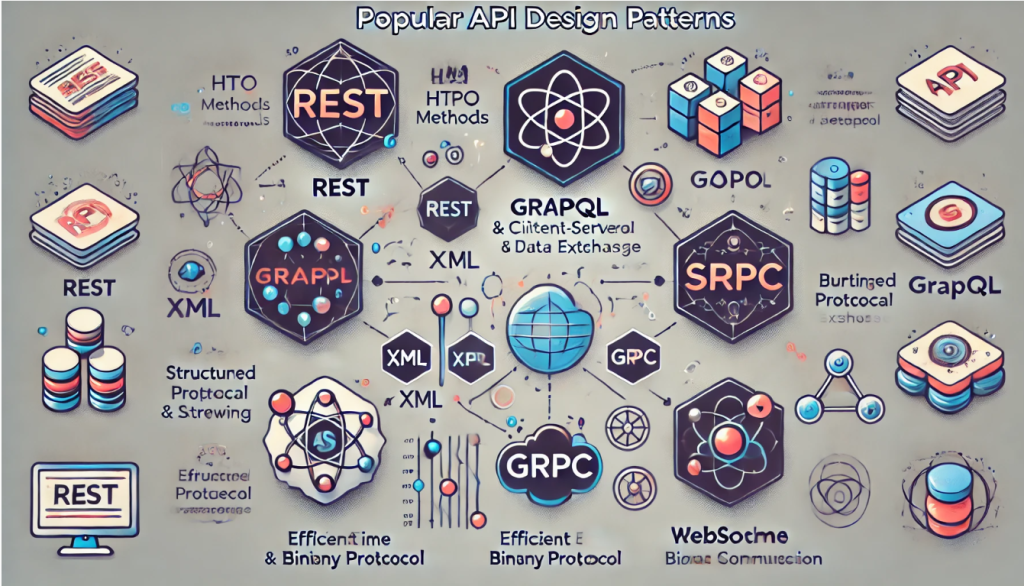
API design patterns are established solutions to common problems in API design. They help ensure APIs are maintainable, scalable, and efficient. Here are some popular API design patterns:
1. RESTful API Design Pattern
- Description: Based on Representational State Transfer (REST) principles, this pattern uses standard HTTP methods and stateless communication.
- Features: Uses GET, POST, PUT, DELETE methods; resources identified by URIs.
- Example:
- GET /users
- POST /users
- PUT /users/{id}
- DELETE /users/{id}
- Reference: RESTful API Design
2. GraphQL API Design Pattern
- Description: Allows clients to request exactly the data they need, and nothing more.
- Features: Single endpoint, declarative data fetching, strongly typed schema.
- Example:graphqlCopy code
{ user(id: "1") { name email } } - Reference: GraphQL
3. Event-Driven API Pattern
- Description: APIs that use events to trigger actions, enabling real-time communication.
- Features: Asynchronous communication, event producers and consumers.
- Example:
- Event: user.created
- Listener: user service to update user profile.
- Reference: Event-Driven Architecture
4. Gateway Pattern
- Description: Provides a single entry point for multiple backend services, often used in microservices architectures.
- Features: API Gateway handles routing, composition, and protocol translation.
- Example:
- Endpoint: /api/v1/*
- Gateway routes to respective microservices.
- Reference: API Gateway Pattern
5. Backend for Frontend (BFF) Pattern
- Description: Creates a dedicated backend for each frontend, optimizing the interaction between them.
- Features: Tailored APIs for each frontend (web, mobile), reduces over-fetching.
- Example:
- Web BFF: /web-api/*
- Mobile BFF: /mobile-api/*
- Reference: Backend for Frontend
6. CQRS (Command Query Responsibility Segregation) Pattern
- Description: Separates read and write operations for better scalability and performance.
- Features: Commands for updates, queries for reads, separate models for commands and queries.
- Example:
- Command: POST /createUser
- Query: GET /getUser/{id}
- Reference: CQRS
7. Façade Pattern
- Description: Simplifies the interaction with complex subsystems by providing a unified interface.
- Features: Abstracts complex logic, provides a simpler API interface.
- Example:
- API Facade: /api/v1/userProfile
- Internally calls multiple services to fetch user details.
- Reference: Façade Pattern
8. Adapter Pattern
- Description: Converts the interface of a class into another interface that clients expect.
- Features: Allows integration of legacy or third-party systems.
- Example:
- Adapter for legacy system: /legacy-api/*
- Translates calls to new API format.
- Reference: Adapter Pattern
9. Pagination Pattern
- Description: Efficiently handles large datasets by breaking them into pages.
- Features: Standard pagination parameters (page, size), links for navigation.
- Example:
- GET /users?page=2&size=10
- Reference: REST Pagination
10. Versioning Pattern
- Description: Manages API changes without disrupting existing clients.
- Features: URL versioning, header versioning, query parameter versioning.
- Example:
- URL Versioning: /v1/users
- Header Versioning:
Accept: application/vnd.example.v1+json
- Reference: API Versioning
References:

I’m Rajesh Kumar, a DevOps, SRE, DevSecOps, Cloud, and Platform Engineering expert passionate about sharing practical knowledge, real-world experiences, and industry best practices. I have worked at Cotocus and regularly write about technology, travel, investing, health, product reviews, and digital marketing through my various platforms.
I publish technical articles at DevOps School, travel stories at Holiday Landmark, stock market insights at Stocks Mantra, health and fitness guidance at My Medic Plus, product reviews at TrueReviewNow, and SEO and digital marketing strategies at Wizbrand.
Find Trusted Cardiac Hospitals
Compare heart hospitals by city and services — all in one place.
Explore Hospitals