Originally published on 2015-10-22; fully revised and updated.
Single sign-on (SSO) lets users authenticate once with an identity provider and then access multiple applications without separate logins. This is especially useful for DevOps, platform, and security teams that need centralized identity, access control, and auditability across internal tools and SaaS services.
The original post was a short list of links. This revised version keeps those references and adds a practical framework for evaluating and operating SSO implementations.
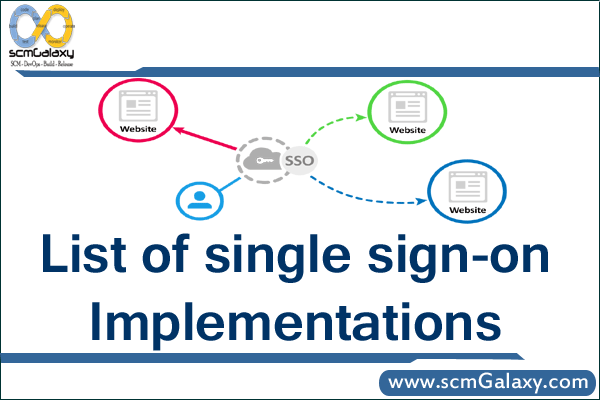
What single sign-on implementations do
An SSO implementation usually includes an identity provider (IdP), integration with one or more applications (service providers), and policy controls such as MFA and conditional access. In practice, teams choose between managed platforms and other deployment models based on security requirements, operational overhead, and integration needs.
How an SSO authentication flow works
flowchart LR
    U[User opens application] --> A[Application redirects to identity provider]
    A --> M[User authenticates and completes MFA]
    M --> T[Identity provider issues assertion or token]
    T --> V[Application validates token and maps roles]
    V --> S[User session established]
Most real-world setups use SAML 2.0 or OpenID Connect (OIDC). OAuth 2.0 is often involved for delegated authorization and API access.
Implementations listed in the original post
| Implementation | Label in original post | Pricing/deployment status | Link |
|---|---|---|---|
| Bitcard | Free | Needs current verification | https://www.bitcard.org/ |
| OneLogin | Commercial | Commercial offering (verify current plans) | https://www.onelogin.com/product/pricing |
| Okta | Commercial | Commercial offering (verify current plans) | https://www.okta.com/ |
Reference list used in the original article: https://en.wikipedia.org/wiki/List_of_single_sign-on_implementations.
Protocol comparison for SSO evaluations
| Protocol | Best for | Typical artifacts | DevOps considerations |
|---|---|---|---|
| SAML 2.0 | Enterprise web SSO, especially legacy apps | XML metadata and signed assertions | Certificate lifecycle, clock sync, attribute mapping |
| OpenID Connect | Modern web/mobile apps needing user identity | ID token (JWT), discovery document, JWKS | Issuer and audience validation, key rotation, redirect URI control |
| OAuth 2.0 | Delegated API authorization | Access/refresh tokens and scopes | Token lifetime policy, scope design, secure client secret handling |
Practical commands to validate an SSO integration
Use these checks during rollout and troubleshooting. Commands are illustrative and should be adapted to your identity provider and environment.
Check OIDC discovery metadata
curl -s https://idp.example.com/.well-known/openid-configuration | jq .Code language: JavaScript (javascript)Build an authorization request for quick validation
curl -G "https://idp.example.com/oauth2/v1/authorize" \
  --data-urlencode "client_id=app-client-id" \
  --data-urlencode "response_type=code" \
  --data-urlencode "scope=openid profile email" \
  --data-urlencode "redirect_uri=https://app.example.com/callback" \
  --data-urlencode "state=devops-test" \
  --data-urlencode "nonce=test-nonce"Code language: JavaScript (javascript)
Confirm certificate validity on an identity endpoint
openssl s_client -connect idp.example.com:443 -servername idp.example.com | openssl x509 -noout -datesExample application-side OIDC settings template
issuer: "https://idp.example.com"
client_id: "app-client-id"
client_secret_env: "OIDC_CLIENT_SECRET"
redirect_uri: "https://app.example.com/callback"
scopes:
  - openid
  - profile
  - email
claim_mappings:
  username: preferred_username
  groups: groupsCode language: JavaScript (javascript)
Selection checklist for DevOps teams
- Protocol support required by your applications (SAML, OIDC, OAuth 2.0).
- Identity lifecycle integration (user provisioning/deprovisioning workflows).
- MFA and policy controls needed for production access.
- Audit trail quality and SIEM/log pipeline compatibility.
- Operational model: who owns uptime, upgrades, and incident response.
- Secret and key management strategy, including rotation processes.
Best practices and common pitfalls
- Standardize claim and group mappings early to avoid per-app drift.
- Use short-lived tokens and explicit session policies for high-risk systems.
- Automate certificate and key rotation checks before expiry incidents occur.
- Keep clock synchronization reliable across IdP and applications.
- Test logout behavior and token revocation paths, not just login success.
For teams modernizing identity, start with one critical application, validate the full login and audit flow, and then scale the pattern across your platform.

I’m Rajesh Kumar, a DevOps, SRE, DevSecOps, Cloud, and Platform Engineering expert passionate about sharing practical knowledge, real-world experiences, and industry best practices. I have worked at Cotocus and regularly write about technology, travel, investing, health, product reviews, and digital marketing through my various platforms.
I publish technical articles at DevOps School, travel stories at Holiday Landmark, stock market insights at Stocks Mantra, health and fitness guidance at My Medic Plus, product reviews at TrueReviewNow, and SEO and digital marketing strategies at Wizbrand.
Find Trusted Cardiac Hospitals
Compare heart hospitals by city and services — all in one place.
Explore Hospitals