
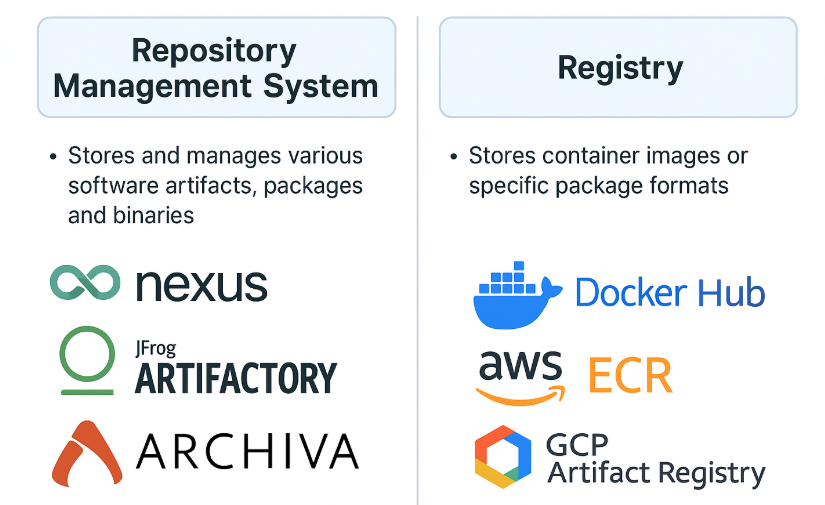
A Repository Management System (RMS) and a Registry are related but not always the same thing:
✅ Repository Management System (RMS):
- A general system to store, manage, and distribute software artifacts or packages.
- Supports multiple types of repositories (Maven, npm, PyPI, Docker, etc.).
- Examples:
- Sonatype Nexus
- JFrog Artifactory
- Apache Archiva
- AWS CodeArtifact
✅ Registry:
- A specialized type of repository that primarily stores container images or specific package formats.
- Most commonly used for Docker/OCI images or language-specific packages.
- Examples:
- Docker Hub (container registry)
- AWS ECR (Elastic Container Registry)
- GCP Artifact Registry
- npm Registry (JavaScript packages)
- PyPI Registry (Python packages)
🔹 Key Difference:
- RMS = Broader system that can host multiple repository formats (binaries, packages, containers, etc.).
- Registry = Often refers to a specialized repository, mostly for container images or a single package ecosystem.
💡 Answer:
- All registries are repositories, but not all repository management systems are registries.
- When you say Docker Registry, it’s a specific type of repository.
- When you say RMS, it usually refers to a more comprehensive tool that can host many types of repositories (including registries).
Here’s a comparison table between a Repository Management System (RMS) and a Registry:
| Aspect | Repository Management System (RMS) | Registry |
|---|---|---|
| Definition | A centralized platform that stores, organizes, and manages different types of software artifacts, packages, and binaries. | A specialized repository focused on storing and distributing container images or language-specific packages. |
| Scope | Broad – supports multiple repository formats (Maven, npm, PyPI, Docker, NuGet, etc.). | Narrow – usually specific to a package format (e.g., Docker images, npm packages). |
| Examples | Sonatype Nexus, JFrog Artifactory, Apache Archiva, AWS CodeArtifact, Azure Artifacts. | Docker Hub, AWS Elastic Container Registry (ECR), GCP Artifact Registry, npm Registry, PyPI. |
| Supported Artifacts | Java .jar, .war, .ear, Python .whl, .tar.gz, Ruby gems, Docker images, .rpm, .deb, .zip, etc. | Docker/OCI images, npm packages, PyPI packages, Helm charts (depending on registry type). |
| Version Control | Maintains multiple versions of any artifact or package type. | Maintains versions of images/packages within a single ecosystem. |
| Dependency Management | Handles complex dependency resolution across multiple package ecosystems. | Limited to the package ecosystem it serves (e.g., npm for Node.js). |
| Integration | Integrates with CI/CD pipelines, build tools (Maven, Gradle, npm, pip), and deployment systems. | Integrates with container orchestration (Kubernetes, OpenShift) or specific package managers. |
| Use Cases | – Internal artifact storage for enterprises- Dependency caching- Version management- Unified package hosting for multiple languages- Artifact promotion across environments. | – Hosting and distributing container images- Managing language-specific packages- Providing images to Kubernetes/CI pipelines- Publishing mobile/web packages to app stores. |
| Access Control | Role-based access control (RBAC) for multiple repos and artifact types. | Role-based access control but often focused on image/push/pull operations. |
| When to Use | When you need a unified platform to manage all software artifacts across different languages and environments. | When you need a dedicated platform for container images or a single package ecosystem. |
✅ Summary:
- RMS = General-purpose, multi-format artifact manager.
- Registry = Specialized repository for containers or specific packages.
Some Repository Management Systems (RMS) can also act as a registry, especially when they support Docker/OCI image hosting and language-specific package repositories.
✅ RMS that can act as Registries:
1️⃣ JFrog Artifactory
- Supports multiple repository types:
- Docker/OCI Registry
- Maven, npm, PyPI, NuGet, RubyGems, Helm, etc.
- Can replace Docker Hub or AWS ECR in private environments.
- Works as a universal artifact repository + registry.
2️⃣ Sonatype Nexus Repository
- Supports:
- Docker Registry
- Maven, npm, PyPI, NuGet, RubyGems, etc.
- Can serve as both a private package repository and a container image registry.
3️⃣ Harbor (CNCF Project)
- Primarily a container registry, but also supports:
- Helm charts
- OCI-compliant artifacts.
- Can integrate with RMS-like features (RBAC, replication, scanning).
4️⃣ AWS CodeArtifact (partially)
- Acts as a package repository for Maven, npm, PyPI, NuGet.
- When combined with AWS ECR, it covers both package and container registry use cases.
5️⃣ Azure Artifacts
- Manages npm, NuGet, Maven, and Python packages.
- Integrates with Azure Container Registry (ACR), allowing both RMS and registry functionality under one platform.
🔹 Why They Can Act as Both:
- Modern DevOps requires unified storage for all artifacts (packages, binaries, container images).
- Tools like Artifactory and Nexus are designed as universal repositories, bridging the gap between RMS and registries.
✅ Answer:
Yes, systems like JFrog Artifactory and Sonatype Nexus Repository are classic examples of RMS platforms that can act as registries for Docker/OCI images and language-specific packages.
Here’s the clarification based on the categories:
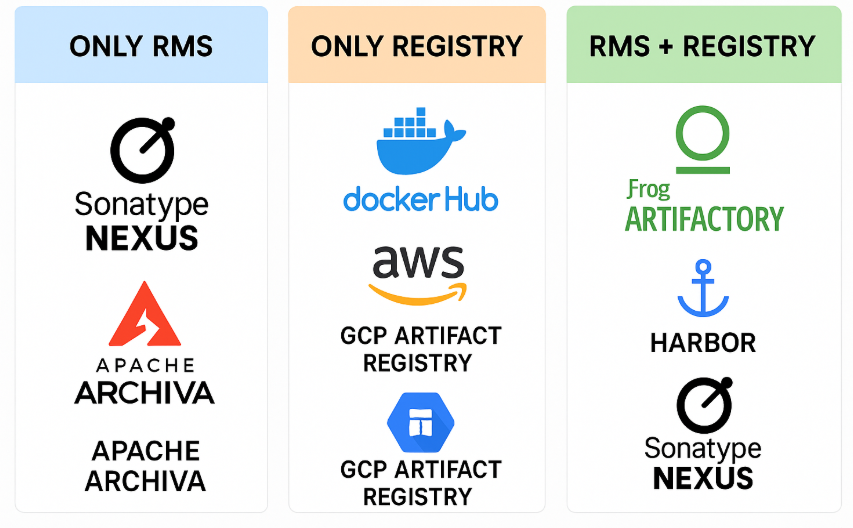
✅ Only RMS (Repository Management System)
- These are general-purpose artifact repositories and not primarily registries.
- Examples:
- Sonatype Nexus
- Apache Archiva
✅ Only Registry
- These are specialized registries, mainly for container images or a single package ecosystem.
- Examples:
- Docker Hub
- AWS Elastic Container Registry (ECR)
- GCP Artifact Registry
✅ RMS + Registry (Hybrid)
- These can act as both RMS (artifact manager) and Registry (for Docker/OCI images).
- Examples:
- JFrog Artifactory
- Harbor (CNCF Project)
- Sonatype Nexus Pro (Enterprise edition with Docker registry support)

I’m Rajesh Kumar, a DevOps, SRE, DevSecOps, Cloud, and Platform Engineering expert passionate about sharing practical knowledge, real-world experiences, and industry best practices. I have worked at Cotocus and regularly write about technology, travel, investing, health, product reviews, and digital marketing through my various platforms.
I publish technical articles at DevOps School, travel stories at Holiday Landmark, stock market insights at Stocks Mantra, health and fitness guidance at My Medic Plus, product reviews at TrueReviewNow, and SEO and digital marketing strategies at Wizbrand.
Find Trusted Cardiac Hospitals
Compare heart hospitals by city and services — all in one place.
Explore Hospitals




Thanks for this clear explanation of repository management systems and registries! 📦 I liked how the article breaks down the differences between the two — it makes it much easier to understand their roles and when to use each. Very informative — appreciate you sharing this!