
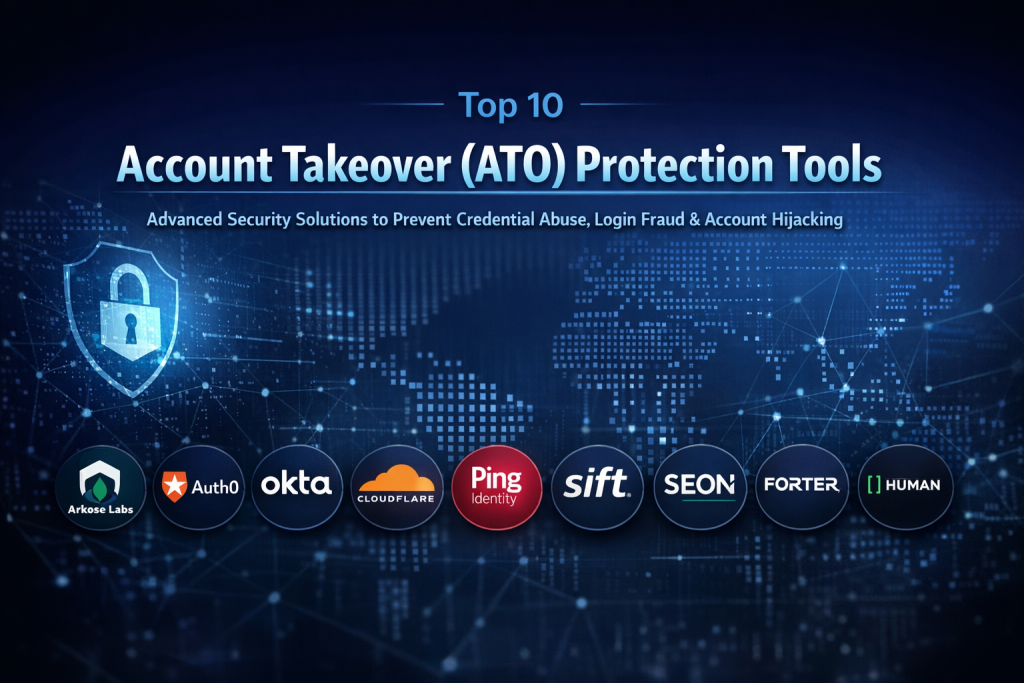
Introduction
Account Takeover (ATO) attacks have become one of the most damaging and fast-growing threats in modern cybersecurity. In an ATO incident, attackers gain unauthorized access to legitimate user accounts using stolen credentials, session hijacking, phishing, malware, or credential-stuffing attacks. Once inside, they can steal sensitive data, drain balances, commit fraud, or lock out genuine users—often without immediate detection.
Account Takeover (ATO) Protection Tools are purpose-built security solutions designed to detect, prevent, and mitigate these attacks in real time. They use a combination of behavioral analytics, device fingerprinting, anomaly detection, identity verification, and adaptive authentication to identify suspicious login attempts and risky account behavior before damage occurs.
ATO protection is critical for organizations handling user accounts, financial transactions, or sensitive personal data. Industries such as banking, fintech, e-commerce, SaaS, healthcare, and gaming are especially vulnerable. When selecting an ATO protection tool, buyers should evaluate detection accuracy, false-positive rates, ease of integration, scalability, compliance support, and overall cost-effectiveness.
Best for:
Security teams, fraud prevention leaders, DevOps teams, compliance officers, and digital product owners in SMBs, mid-market companies, and enterprises with user login systems or transactional platforms.
Not ideal for:
Very small websites with no authentication systems, offline-only businesses, or organizations that rely exclusively on basic password authentication without user accounts.
Top 10 Account Takeover (ATO) Protection Tools
1 — Arkose Labs
Short description:
Arkose Labs provides advanced ATO protection using risk-based authentication and dynamic challenges designed to stop bots and human attackers without harming user experience.
Key features
- Behavioral biometrics and risk scoring
- Bot and credential-stuffing detection
- Adaptive challenges instead of static CAPTCHAs
- Real-time attack monitoring dashboard
- Global attack intelligence network
- Seamless API and SDK integration
Pros
- Very strong bot and automated attack mitigation
- Minimal friction for legitimate users
Cons
- Premium pricing model
- Requires tuning for optimal challenge thresholds
Security & compliance: SOC 2, GDPR, enterprise-grade encryption
Support & community: Dedicated enterprise onboarding, strong documentation, 24/7 support
2 — Auth0
Short description:
Auth0 is a flexible identity platform offering robust authentication, authorization, and ATO prevention for modern applications.
Key features
- Multi-factor authentication (MFA)
- Anomaly detection for logins
- Brute-force and credential-stuffing protection
- Passwordless authentication options
- Centralized identity management
- Extensive integrations ecosystem
Pros
- Developer-friendly and well-documented
- Excellent balance of security and usability
Cons
- Costs increase with scale
- Advanced features may require higher tiers
Security & compliance: SOC 2, ISO 27001, GDPR
Support & community: Large developer community, strong enterprise support
3 — Sift
Short description:
Sift uses machine learning to prevent ATO and fraud across digital platforms, especially in e-commerce and marketplaces.
Key features
- Machine-learning fraud detection
- Account behavior analysis
- Credential-stuffing defense
- Risk-based access decisions
- Customizable rules engine
- Centralized fraud dashboards
Pros
- High detection accuracy
- Proven at scale for marketplaces
Cons
- Pricing not ideal for small teams
- Requires data volume to reach full effectiveness
Security & compliance: SOC 2, GDPR
Support & community: Dedicated account managers, training resources
4 — SEON
Short description:
SEON focuses on real-time fraud and ATO prevention using device fingerprinting and behavioral analysis.
Key features
- Device and browser fingerprinting
- IP and email risk scoring
- Behavioral anomaly detection
- Real-time API responses
- Custom rules configuration
- Easy integration for web and mobile
Pros
- Fast deployment
- Transparent scoring logic
Cons
- UI can feel technical
- Less suited for highly regulated enterprises
Security & compliance: GDPR, encryption standards
Support & community: Responsive support, improving documentation
5 — Cloudflare
Short description:
Cloudflare provides ATO protection as part of its broader web security and bot management platform.
Key features
- Bot management and mitigation
- Rate limiting and anomaly detection
- Adaptive authentication rules
- Global CDN-backed protection
- DDoS and credential-stuffing defense
- API and edge-level security
Pros
- Extremely scalable
- Strong performance and reliability
Cons
- ATO features bundled with broader platform
- Advanced rules require expertise
Security & compliance: SOC 2, ISO 27001, GDPR
Support & community: Large user base, enterprise SLAs available
6 — Forter
Short description:
Forter specializes in fraud prevention for e-commerce, including strong ATO detection at checkout and login.
Key features
- Identity-based risk assessment
- Real-time decision engine
- Account login protection
- Networked fraud intelligence
- Custom risk policies
- Detailed analytics
Pros
- Excellent for e-commerce brands
- Low false-positive rates
Cons
- Limited outside commerce use cases
- Pricing can be high
Security & compliance: PCI-aligned practices, GDPR
Support & community: Dedicated merchant success teams
7 — Riskified
Short description:
Riskified delivers AI-driven fraud and ATO protection primarily for online retailers.
Key features
- Machine-learning fraud models
- Login and account behavior monitoring
- Chargeback protection
- Automated decision workflows
- Real-time risk insights
- Custom policy configuration
Pros
- Strong retail focus
- Handles high transaction volumes
Cons
- Narrow industry specialization
- Less flexibility for non-commerce platforms
Security & compliance: GDPR, enterprise encryption
Support & community: Account-based support model
8 — Ping Identity
Short description:
Ping Identity offers enterprise-grade identity security with robust ATO protection and adaptive authentication.
Key features
- Adaptive MFA
- Risk-based authentication
- Centralized identity governance
- SSO and federation
- Strong policy engine
- Enterprise scalability
Pros
- Ideal for complex enterprises
- Strong compliance support
Cons
- Steeper learning curve
- Higher implementation cost
Security & compliance: SOC 2, ISO, GDPR, HIPAA support
Support & community: Enterprise-grade support and training
9 — Okta
Short description:
Okta provides identity and access management with built-in ATO protection through adaptive authentication.
Key features
- Behavioral risk scoring
- MFA and passwordless login
- Threat detection
- SSO across applications
- Central admin controls
- Extensive integrations
Pros
- Mature and trusted platform
- Easy to scale
Cons
- Premium pricing
- Complex licensing tiers
Security & compliance: SOC 2, ISO 27001, GDPR
Support & community: Large ecosystem, strong documentation
10 — HUMAN Security
Short description:
HUMAN Security focuses on stopping automated abuse and account takeover attacks at scale.
Key features
- Advanced bot detection
- Behavioral analytics
- Credential-stuffing protection
- Real-time threat intelligence
- API-based deployment
- Continuous monitoring
Pros
- Industry-leading bot defense
- Strong analytics visibility
Cons
- Best suited for large platforms
- Less focus on IAM features
Security & compliance: SOC 2, GDPR
Support & community: Enterprise onboarding and support
Comparison Table
| Tool Name | Best For | Platform(s) Supported | Standout Feature | Rating |
|---|---|---|---|---|
| Arkose Labs | Enterprises facing bot attacks | Web, Mobile, API | Adaptive challenges | N/A |
| Auth0 | Developers & SaaS | Web, Mobile | Identity-first ATO prevention | N/A |
| Sift | Marketplaces & fintech | Web, API | ML-based fraud detection | N/A |
| SEON | SMBs & mid-market | Web, Mobile | Device fingerprinting | N/A |
| Cloudflare | High-traffic platforms | Web, API | Edge-level ATO defense | N/A |
| Forter | E-commerce | Web | Identity-based decisions | N/A |
| Riskified | Online retail | Web | Chargeback protection | N/A |
| Ping Identity | Large enterprises | Web, Mobile | Adaptive authentication | N/A |
| Okta | IAM-focused orgs | Web, Mobile | Behavior-driven MFA | N/A |
| HUMAN Security | Bot-heavy platforms | Web, API | Automated abuse prevention | N/A |
Evaluation & Scoring of Account Takeover (ATO) Protection Tools
| Tool | Core Features (25%) | Ease of Use (15%) | Integrations (15%) | Security (10%) | Performance (10%) | Support (10%) | Price/Value (15%) | Total |
|---|---|---|---|---|---|---|---|---|
| Arkose Labs | 23 | 12 | 13 | 9 | 9 | 9 | 10 | 85 |
| Auth0 | 22 | 14 | 15 | 9 | 9 | 9 | 10 | 88 |
| Sift | 23 | 12 | 12 | 9 | 9 | 8 | 10 | 83 |
| SEON | 20 | 13 | 12 | 8 | 8 | 8 | 12 | 81 |
| Cloudflare | 22 | 11 | 14 | 9 | 10 | 8 | 11 | 85 |
| Forter | 21 | 12 | 11 | 9 | 9 | 8 | 10 | 80 |
| Riskified | 20 | 11 | 10 | 8 | 9 | 8 | 10 | 76 |
| Ping Identity | 22 | 10 | 14 | 10 | 9 | 9 | 9 | 83 |
| Okta | 22 | 13 | 15 | 9 | 9 | 9 | 9 | 86 |
| HUMAN Security | 23 | 11 | 12 | 9 | 9 | 8 | 9 | 81 |
Which Account Takeover (ATO) Protection Tool Is Right for You?
- Solo users / startups: SEON or Auth0 offer faster setup and manageable costs.
- SMBs: Auth0 or Cloudflare balance usability and protection.
- Mid-market: Sift and Okta provide scalable, intelligent detection.
- Enterprises: Arkose Labs, Ping Identity, or HUMAN Security deliver deep security controls.
- Budget-conscious: SEON or bundled Cloudflare plans.
- Premium security: Arkose Labs, Okta, Ping Identity.
- Compliance-heavy environments: Okta or Ping Identity.
Frequently Asked Questions (FAQs)
1. What is an ATO attack?
An ATO attack occurs when attackers gain unauthorized access to user accounts using stolen or compromised credentials.
2. How do ATO protection tools work?
They analyze login behavior, device data, and risk signals to block suspicious access attempts.
3. Are MFA and ATO tools the same?
No. MFA is one control; ATO tools combine multiple techniques including behavior analysis and bot detection.
4. Can small businesses benefit from ATO protection?
Yes, especially those with customer logins or online payments.
5. Do these tools affect user experience?
Modern tools use adaptive controls to minimize friction for legitimate users.
6. Are ATO tools cloud-based?
Most are cloud-based with APIs and SDKs.
7. How long does implementation take?
From a few hours to several weeks depending on complexity.
8. Are ATO tools compliant with regulations?
Most support GDPR and SOC 2; some also support HIPAA and ISO.
9. Can they stop credential-stuffing attacks?
Yes, this is a core capability.
10. Is there a single best ATO tool?
No. The best tool depends on industry, scale, and risk profile.
Conclusion
Account Takeover attacks pose serious financial, operational, and reputational risks. ATO protection tools play a crucial role in defending digital platforms by detecting abnormal behavior, blocking malicious access, and preserving user trust.
The right solution depends on scale, industry, budget, and compliance needs. Some organizations need deep enterprise controls, while others prioritize ease of use and rapid deployment. There is no universal winner—only the best fit for your specific threat landscape and business goals.
Choosing wisely today can prevent costly breaches tomorrow.

Find Trusted Cardiac Hospitals
Compare heart hospitals by city and services — all in one place.
Explore Hospitals
Account takeover risks often hide behind normal-looking login activity, making continuous monitoring essential. Combining behavioral analysis, multi-factor authentication, and bot detection can help identify suspicious access before attackers cause damage. Fast response and session controls add another important layer of protection.
Account takeover protection needs more than strong passwords and basic login alerts. Monitoring unusual login patterns, device changes, and suspicious session activity can help detect compromised accounts early. Combining adaptive authentication with quick session revocation also limits damage when attackers gain access.
Account takeover protection is critical as credential stuffing attacks rise, and this guide addresses that threat. I like how it covers detection and response workflows. Identity security teams will benefit from this.
The scoring table has most tools landing between 80 and 88, which suggests the ranking matters less than which kind of tool each one is. The list mixes bot and edge defenders (Arkose Labs, HUMAN, Cloudflare), identity platforms (Auth0, Okta, Ping), and fraud engines (Sift, SEON, Forter). These stop different attacks. Bot defenses are strong against high-volume credential stuffing, but they can struggle when a human attacker logs in with a correct, freshly phished password from a clean device. Before shortlisting, I’d pull a few weeks of authentication logs and check whether the pattern is bursts of failed logins across many accounts, or a few successful logins from new devices followed by account changes. The first points toward bot mitigation, the second toward behavioral and device-risk scoring, and most teams end up needing some of both. Matching the tool category to the attack you actually see usually matters more than picking the highest total.
Account takeover protection tools help businesses detect and prevent unauthorized access to user accounts. Features such as behavioral analytics, suspicious login detection, multi-factor authentication, and automated risk scoring can help identify unusual activity before it causes significant damage. When comparing solutions, organizations should consider detection accuracy, integration with existing systems, response speed, and the impact on legitimate users. I believe combining real-time monitoring with risk-based authentication offers a practical balance between security and convenience. Regularly reviewing fraud patterns can also help teams strengthen their defenses as attack methods evolve.
Account takeover protection tools should detect suspicious activity without creating unnecessary login problems for genuine users. One important factor is how well they identify unusual login locations, device changes, and unexpected account behavior. I would also suggest checking how quickly they respond to compromised sessions and suspicious password resets. Combining real-time monitoring with clear recovery steps can help protect accounts and maintain user trust.
One feature I would examine in account takeover protection tools is how effectively they detect suspicious changes to an account’s recovery settings. Attackers who gain temporary access may replace a registered phone number, change the recovery email, or add a new authentication method to maintain control even after the original session ends. A strong platform should treat these changes as important security events, apply appropriate verification, and notify the account owner through a trusted channel. It should also provide a clear history of recovery-setting changes so security teams can investigate how an account was compromised. This is an important layer of protection beyond monitoring login attempts alone.
Account Takeover (ATO) protection tools help organizations detect and prevent unauthorized access to user accounts caused by stolen credentials, phishing, credential stuffing, and other attacks. These solutions use behavioral analytics, device intelligence, risk-based authentication, and anomaly detection to identify suspicious login attempts and unusual account activity. When comparing platforms, important factors include real-time detection accuracy, adaptive authentication, bot mitigation, integration capabilities, false-positive rates, and user experience. Choosing the right solution can strengthen account security, reduce fraud losses, and protect customer trust while ensuring legitimate users can access their accounts with minimal friction.
Account takeover protection is most effective when it detects suspicious behavior before an attacker can cause serious damage. I’d look for tools that analyze login patterns, unusual device changes, and risky actions after authentication, rather than checking passwords alone. Adaptive verification can add security when needed without creating extra steps for every user. It’s also worth measuring both blocked attacks and legitimate users mistakenly challenged to ensure protection stays effective without harming the customer experience.
Account takeover protection is most effective when authentication security is combined with continuous behavioral monitoring and real-time risk analysis. Detecting unusual login locations, suspicious device changes, and abnormal account activity can help organizations intervene before attackers cause significant damage. Adaptive authentication, rapid session revocation, and clear recovery procedures further strengthen account security while minimizing disruption for legitimate users.
Account takeover protection is important because stolen credentials can give attackers access to personal information and business services. Strong detection should consider more than repeated login failures. Unusual devices, sudden changes in behavior, and suspicious account recovery attempts can also provide useful warning signs. Businesses should compare how tools combine these signals and respond to high-risk activity. Extra checks should protect accounts without creating unnecessary friction for trusted users. Teams should also review confirmed attacks and false alerts to improve their rules over time. This approach can strengthen account security while keeping the login experience manageable.
One area worth exploring is how security teams respond when a takeover is confirmed across several connected applications. Blocking the initial login may not stop an attacker who has already accessed other services through the same account. Teams need a clear process to revoke active sessions, check linked applications, and identify changes made during the breach. Customer support should also know how to verify the account owner before restoring access. Tracking the time between detection and full containment can reveal gaps in the response process. These steps help teams limit further damage and restore trust without creating unnecessary hurdles for genuine users.
Account takeover defenses should also consider how attackers exploit trusted sessions instead of repeatedly attempting new logins. A stolen session cookie can sometimes let someone bypass checks that focus mainly on passwords or login patterns. Teams should review session lifetimes, device changes, and unusual actions after authentication. High-risk changes, such as adding a payment method or changing an email address, may need extra verification. Security logs should connect these events so investigators can trace the full sequence of activity. Regularly testing these scenarios helps uncover weaknesses that standard login tests may overlook.
ATO protection should be evaluated by how well it handles the full attack lifecycle, especially after suspicious access has been detected. For example, blocking a risky login may not help if an attacker already has an active session or has changed the account’s recovery details. Security teams should test session revocation, refresh-token invalidation, recovery-channel changes, and suspicious activity across linked devices. It is also important to verify that security events reach incident response systems with enough context for investigators to act quickly. Measuring the time needed to contain a compromised account can reveal weaknesses that login detection rates alone will miss. These tests help ensure the platform protects existing sessions and recovery workflows, not just the initial authentication step.
Account takeover protection tools help detect suspicious logins and prevent attackers from misusing stolen credentials. When comparing solutions, teams should assess behavioral analytics, multi-factor authentication support, real-time alerts, and the ability to identify unusual account activity. Combining these tools with risk-based access controls and a clear account recovery process can strengthen security while keeping legitimate users’ access simple.
Combining behavioral biometrics, device telemetry, and automated bot mitigation into real-time account takeover (ATO) protection platforms stops credential stuffing, brute-force intrusions, and session hijacking at authentication gateways, neutralizing account compromise without creating friction for legitimate users.
Account takeover protection tools help businesses detect suspicious logins, prevent unauthorized access, and protect user accounts from fraud. When comparing platforms, I would focus on behavioral analysis, risk-based authentication, real-time alerts, and integration capabilities. These features can help identify threats early and reduce account compromise risks. The right solution should strengthen account security while keeping access convenient for legitimate users.
An important part of ATO defense is containing an incident after suspicious activity passes the initial login checks. Attackers may register new authentication methods, generate API tokens, or keep existing sessions active even after a password reset. Security teams should verify whether their controls can revoke active sessions, invalidate refresh tokens, remove unauthorized recovery methods, and trigger step-up verification for sensitive account changes. I would also test the full recovery workflow, including customer notifications, support escalation, and restoring legitimate access without reopening the same vulnerability. Measuring the time needed to contain compromised accounts can reveal weaknesses that login detection metrics alone will miss. This helps organizations limit damage even when preventive controls fail.
Choosing the right ATO tool often comes down to striking a fine balance between security rigor and user friction. While enterprise-grade solutions like Arkose Labs or Ping Identity excel at deep threat mitigation, smaller teams frequently struggle with tuning challenge thresholds without frustrating legitimate users. It would be insightful to hear how organizations handle the trade-off between strict behavioral analytics and seamless customer onboarding.
Account takeover protection works best when it detects suspicious behavior without making every login difficult for legitimate users. Monitoring unusual login locations, device changes, session activity, and repeated failed attempts can help identify compromised accounts early. I would also recommend combining risk-based authentication with strong session controls and quick account recovery options. Regularly reviewing confirmed incidents can help teams improve detection rules as attack methods evolve. How do organizations balance stronger account security with a smooth login experience, especially for customers who frequently switch devices?
Account takeover protection is strongest when it spots suspicious behavior after login, not just during password entry. Sudden changes to recovery details, unfamiliar devices, or unusual account actions can indicate that stolen credentials are being misused. It helps when security tools can trigger step-up verification or temporarily restrict sensitive actions while giving legitimate users a clear way to recover access.
A useful comparison for businesses looking to strengthen account security and prevent unauthorized access. Along with login monitoring and suspicious activity detection, device intelligence can help identify unusual login patterns and reduce account takeover risks. Another provider worth considering is SHIELD, which helps businesses detect fake accounts, account takeovers, and other forms of digital fraud using device intelligence and fraud prevention technology.