
Introduction
AI ADMET Prediction Tools leverage artificial intelligence to forecast Absorption, Distribution, Metabolism, Excretion, and Toxicity properties of drug candidates. They help pharmaceutical and biotech teams identify safe and effective molecules early in development, reducing costly failures and accelerating preclinical workflows. By integrating AI predictions into molecular design pipelines, organizations can prioritize high-potential compounds, streamline decision-making, and improve regulatory readiness.
Why it matters: With growing molecular complexity and large virtual libraries, early ADMET prediction saves time and resources while reducing risk. Reliable AI-driven forecasts enable teams to focus on promising molecules, accelerate discovery, and reduce late-stage attrition.
Real-world use cases:
- Screening large compound libraries to identify candidates with favorable ADMET profiles
- Predicting toxicity or off-target effects to prioritize safer molecules
- Modeling pharmacokinetics for dosing and bioavailability optimization
- Supporting regulatory submission documentation with predictive insights
- Integrating predictions with automated high-throughput lab workflows
- Repurposing existing compounds with new ADMET assessments
Evaluation criteria for buyers: Prediction accuracy, ADMET endpoints coverage, model transparency, pipeline integration, data privacy, guardrails, deployment flexibility, observability, cost efficiency, regulatory compliance, and support resources.
Best for: Pharmaceutical R&D teams, biotech startups, computational chemists, and contract research organizations.
Not ideal for: Small labs or researchers relying solely on experimental testing without computational infrastructure.
What’s Changed in AI ADMET Prediction Tools
- Automated workflows for molecular design with real-time ADMET evaluation
- Multimodal inputs including molecular graphs, SMILES, and assay data
- Evaluation frameworks tracking prediction reliability
- Guardrails to prevent unsafe or chemically implausible predictions
- Enhanced privacy with data residency and retention controls
- Cost and latency optimization through batch scheduling and model routing
- BYO model support alongside proprietary AI models
- Observability dashboards showing metrics, latency, and costs
- Regulatory compliance features for preclinical safety
- Integration with lab automation and high-throughput screening
- Model interpretability with endpoint explanations
- AI-assisted compound prioritization for efficient workflows
Quick Buyer Checklist
- Confirm model supports molecule types (small molecules, peptides, biologics)
- Review data privacy and retention policies
- Evaluate hosted, BYO, or open-source model flexibility
- Verify evaluation and benchmarking capabilities
- Ensure guardrails for chemical plausibility and toxicity thresholds
- Assess latency, cost controls, and scalability
- Examine auditability and administrative controls
- Review documentation, training, and community support
- Confirm regulatory readiness
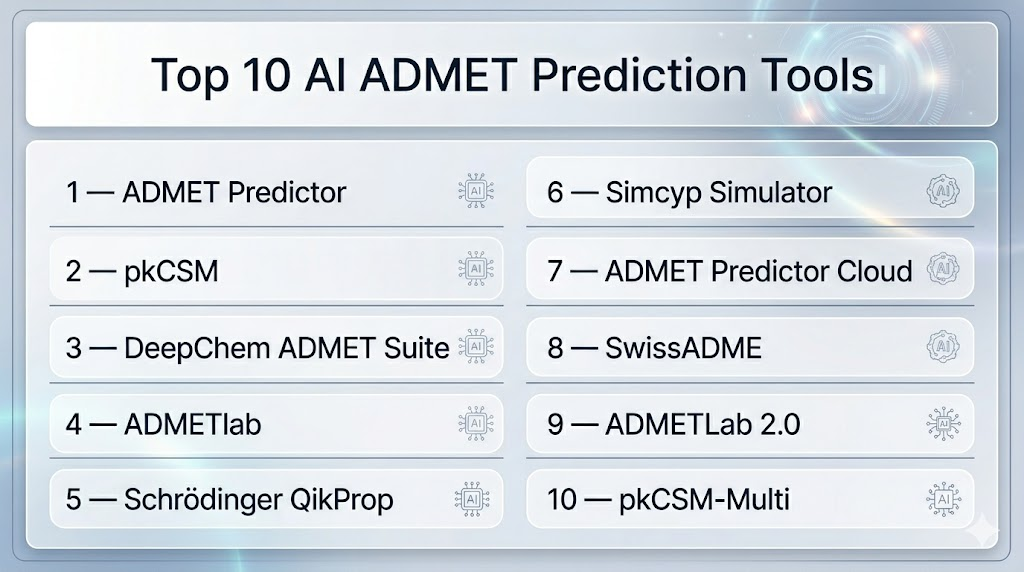
Top 10 AI ADMET Prediction Tools
1- ADMET Predictor
One-line verdict: Best for pharmaceutical teams needing comprehensive, high-throughput ADMET modeling.
Short description: ADMET Predictor forecasts pharmacokinetic and toxicity properties of small molecules. It helps teams prioritize safe compounds, optimize drug candidates, and produce regulatory-ready reports efficiently.
Standout Capabilities
- High-throughput predictions across multiple ADMET endpoints
- Integrated molecular visualization and QSAR support
- Batch processing pipelines
- Toxicity alerting and prioritization
- Customizable prediction parameters
- API integration for automation
- Regulatory-ready reporting
- Workflow automation
AI-Specific Depth
- Model support: Proprietary
- RAG / knowledge integration: N/A
- Evaluation: Regression tests and human review
- Guardrails: Plausibility and toxicity thresholds
- Observability: Dashboards and metrics
Pros
- Scalable for large molecular libraries
- Broad ADMET coverage
- Mature platform with documentation
Cons
- Proprietary models limit transparency
- Batch setup required
- Limited BYO model support
Security & Compliance
Not publicly stated
Deployment & Platforms
- Windows, Linux
- Cloud / On-premise
Integrations & Ecosystem
- Python SDK, REST API
- Molecular database connectors
- Export to regulatory report formats
Pricing Model
Tiered enterprise licensing
Best-Fit Scenarios
- Large pharma preclinical screening
- Contract research organizations
- High-throughput automated workflows
2- pkCSM
One-line verdict: Ideal for academic or startup researchers needing lightweight ADMET predictions.
Short description: Web-based platform predicting pharmacokinetic and toxicity properties from SMILES. Quick and accessible for early-stage drug discovery and academic research.
Standout Capabilities
- User-friendly web interface
- Multi-endpoint predictions
- SMILES input support
- Batch upload functionality
- Visual result displays
- Literature-based model validation
- Free academic access
AI-Specific Depth
- Model support: Open-source
- RAG / knowledge integration: N/A
- Evaluation: Offline benchmark datasets
- Guardrails: Plausibility checks
- Observability: Basic metrics
Pros
- Accessible for non-enterprise users
- Fast predictions
- Academic-friendly
Cons
- Limited scalability for large datasets
- Minimal enterprise features
- Lacks proprietary model robustness
Security & Compliance
Varies / N/A
Deployment & Platforms
- Web-based
- Cloud
Integrations & Ecosystem
- REST API, Python client
- CSV exports
- Compatible with cheminformatics pipelines
Pricing Model
Free for academic use; enterprise Not publicly stated
Best-Fit Scenarios
- Academic research
- Early-stage startups
- Educational projects
3- DeepChem ADMET Suite
One-line verdict: Suited for AI-focused biotech firms seeking open-source, customizable ADMET frameworks.
Short description: DeepChem allows developers to build AI models for ADMET predictions. Supports deep learning, high-throughput simulations, and flexible integration with computational pipelines.
Standout Capabilities
- Deep learning-based predictions
- Graph neural network support
- Multi-endpoint modeling
- Open-source customization
- High-throughput simulation
- Pipeline integration
- Continuous model improvement
- Developer-focused workflows
AI-Specific Depth
- Model support: Open-source / BYO
- RAG / knowledge integration: N/A
- Evaluation: Benchmarking and regression tests
- Guardrails: Customizable thresholds
- Observability: Training logs and metrics
Pros
- Fully customizable
- Active developer community
- Cutting-edge ML integration
Cons
- Requires ML expertise
- Minimal GUI
- Integration effort for enterprise
Security & Compliance
Varies / N/A
Deployment & Platforms
- Windows, Linux, macOS
- Cloud / On-premise
Integrations & Ecosystem
- Python API, TensorFlow / PyTorch support
- Molecular graph libraries
- Batch job support
Pricing Model
Open-source; optional enterprise support
Best-Fit Scenarios
- AI-driven biotech startups
- Custom ADMET model development
- High-throughput simulations
4- ADMETlab
One-line verdict: Recommended for cloud-based multi-endpoint ADMET predictions with visualization.
Short description: ADMETlab predicts toxicity, metabolism, solubility, and pharmacokinetics. Offers batch processing and visualization suitable for preclinical screening and research teams.
Standout Capabilities
- Multi-endpoint predictions
- Molecular visualization
- Batch uploads
- Toxicity alerts
- Cloud-hosted access
- Reporting tools
- Literature-informed updates
AI-Specific Depth
- Model support: Proprietary
- RAG / knowledge integration: N/A
- Evaluation: Offline validation
- Guardrails: Toxicity thresholds
- Observability: Output dashboards
Pros
- User-friendly
- Broad endpoint coverage
- Cloud accessibility
Cons
- Limited BYO models
- Proprietary
- Subscription Not publicly stated
Security & Compliance
Not publicly stated
Deployment & Platforms
- Web-based, cloud
Integrations & Ecosystem
- REST API, Python SDK
- Database connectors
- Export capabilities
Pricing Model
Tiered subscription
Best-Fit Scenarios
- Preclinical research
- Academic collaborations
- Regulatory documentation
5- Schrödinger QikProp
One-line verdict: Ideal for teams requiring integrated ADMET predictions within molecular modeling suites.
Short description: QikProp predicts physicochemical and ADMET properties while integrating with Schrödinger modeling tools. It enables seamless evaluation alongside docking and simulations.
Standout Capabilities
- Integration with molecular modeling
- High-throughput predictions
- QSAR modeling
- Predicts ADMET and physicochemical properties
- Interactive analysis
- Batch support
- Enterprise-level documentation
AI-Specific Depth
- Model support: Proprietary
- RAG / knowledge integration: N/A
- Evaluation: Benchmarking with experimental data
- Guardrails: Plausibility rules
- Observability: Metrics dashboards
Pros
- Integrated with molecular modeling
- Enterprise-ready
- High prediction accuracy
Cons
- License required
- Limited BYO support
- Learning curve
Security & Compliance
Not publicly stated
Deployment & Platforms
- Windows, Linux, macOS
- Cloud / On-premise
Integrations & Ecosystem
- Schrödinger suite, Python API
- Workflow automation
- Reporting tools
Pricing Model
Enterprise licensing
Best-Fit Scenarios
- Pharma preclinical teams
- High-throughput ADMET workflows
- Integrated molecular modeling
6- Simcyp Simulator
One-line verdict: Best for teams modeling population pharmacokinetics and in silico ADMET studies.
Short description: Simcyp Simulator predicts human PK, absorption, metabolism, and clearance for small molecules and biologics. It supports clinical scenario simulations for dose and safety optimization.
Standout Capabilities
- Population PK modeling
- Drug-drug interaction simulations
- Metabolism prediction
- Clearance estimation
- Clinical scenario modeling
- Batch simulations
- Reporting capabilities
AI-Specific Depth
- Model support: Proprietary
- RAG / knowledge integration: N/A
- Evaluation: Regression tests and validation datasets
- Guardrails: Metabolic plausibility checks
- Observability: Prediction dashboards
Pros
- Predictive PK modeling
- Supports biologics
- Regulatory-ready outputs
Cons
- Proprietary system
- High learning curve
- Expensive for small teams
Security & Compliance
Not publicly stated
Deployment & Platforms
- Windows, cloud / On-premise
Integrations & Ecosystem
- REST API, simulation pipelines
- Data export
- Clinical scenario modules
Pricing Model
Enterprise subscription
Best-Fit Scenarios
- Preclinical PK studies
- Biotech startups
- Regulatory submissions
7- ADMET Predictor Cloud
One-line verdict: Suited for cloud-first organizations needing scalable ADMET predictions.
Short description: Cloud-native version of ADMET Predictor offers batch processing, API support, and scalable high-throughput ADMET predictions for enterprise pipelines.
Standout Capabilities
- High-throughput predictions in the cloud
- Multi-endpoint ADMET coverage
- API and SDK support
- Scalable compute resources
- Automated reporting
- Security by design
- Regulatory dashboards
AI-Specific Depth
- Model support: Proprietary
- RAG / knowledge integration: N/A
- Evaluation: Regression tests
- Guardrails: Plausibility checks
- Observability: Logging, latency, cost metrics
Pros
- Scalable for large libraries
- Cloud-based access
- Broad ADMET coverage
Cons
- Proprietary
- Limited offline use
- Subscription costs Not publicly stated
Security & Compliance
Not publicly stated
Deployment & Platforms
- Web-based, cloud
Integrations & Ecosystem
- API, Python SDK
- Batch processing
- Reporting exports
Pricing Model
Subscription-based enterprise
Best-Fit Scenarios
- Cloud-first pharma teams
- High-throughput compound evaluation
- Remote R&D collaborations
8- SwissADME
One-line verdict: Best for academic researchers and startups needing free, accessible ADMET predictions.
Short description: SwissADME provides web-based predictions of physicochemical, pharmacokinetic, and drug-likeness properties. Quick, user-friendly, and suitable for small molecule screening and educational purposes.
Standout Capabilities
- Free and web-accessible
- Lipinski rule evaluation
- Multi-endpoint ADME predictions
- Graphical output
- Batch uploads
- CSV export
- Educational resource
AI-Specific Depth
- Model support: Open-source
- RAG / knowledge integration: N/A
- Evaluation: Offline validation
- Guardrails: Plausibility checks
- Observability: Basic metrics
Pros
- Free and easy to use
- Quick results
- Accessible for non-experts
Cons
- Limited scalability
- Minimal enterprise support
- No proprietary model
Security & Compliance
Varies / N/A
Deployment & Platforms
- Web-based, cloud
Integrations & Ecosystem
- Web API, CSV export
- Compatible with molecular libraries
Pricing Model
Free
Best-Fit Scenarios
- Academic research
- Early-stage startup screening
- Educational training
9- ADMETLab 2.0
One-line verdict: Advanced cloud platform with expanded ADMET endpoints and batch support.
Short description: ADMETLab 2.0 predicts toxicity, metabolism, solubility, and PK parameters with visualization and API support. Ideal for mid-size pharma and integrated workflows.
Standout Capabilities
- Multi-endpoint predictions
- Molecular visualization
- Batch processing
- Toxicity alerts
- API access
- Cloud-hosted
- Literature-informed updates
AI-Specific Depth
- Model support: Proprietary
- RAG / knowledge integration: N/A
- Evaluation: Regression tests
- Guardrails: Toxicity thresholds
- Observability: Output dashboards
Pros
- Rich feature set
- Enterprise-ready
- Cloud convenience
Cons
- Proprietary
- Subscription Not publicly stated
- Limited BYO model
Security & Compliance
Not publicly stated
Deployment & Platforms
- Web-based, cloud
Integrations & Ecosystem
- API, Python SDK
- Batch workflow support
- Export formats
Pricing Model
Tiered subscription
Best-Fit Scenarios
- Mid-size pharma teams
- High-throughput ADMET
- Regulatory reporting
10- pkCSM-Multi
One-line verdict: Developer-focused platform supporting multi-endpoint ADMET predictions and batch processing.
Short description: pkCSM-Multi extends pkCSM with API support, batch uploads, and multi-endpoint predictions. Ideal for academic researchers, developers, and startups needing scalable ADMET evaluation.
Standout Capabilities
- Batch ADMET predictions
- Multi-endpoint coverage
- Web API support
- Graphical outputs
- SMILES input
- Library screening
- Literature validation
- Scalable compute
AI-Specific Depth
- Model support: Open-source
- RAG / knowledge integration: N/A
- Evaluation: Benchmark datasets
- Guardrails: Plausibility thresholds
- Observability: Output metrics
Pros
- Developer-friendly
- Free / academic focus
- Batch support
Cons
- Limited enterprise features
- Minimal security
- No proprietary model
Security & Compliance
Varies / N/A
Deployment & Platforms
- Web-based, cloud
Integrations & Ecosystem
- Python SDK, REST API
- Batch uploads, CSV export
Pricing Model
Free / academic
Best-Fit Scenarios
- Academic screening
- Developer pipelines
- Early-stage startups
Comparison Table
| Tool Name | Best For | Deployment | Model Flexibility | Strength | Watch-Out | Public Rating |
|---|---|---|---|---|---|---|
| ADMET Predictor | Pharma R&D | Cloud / On-prem | Proprietary | High-throughput | Proprietary | N/A |
| pkCSM | Academic / Startup | Cloud | Open-source | Quick predictions | Limited scalability | N/A |
| DeepChem ADMET Suite | AI biotech | Cloud / On-prem | Open-source / BYO | Extensible | Requires ML expertise | N/A |
| ADMETlab | Preclinical | Cloud | Proprietary | Multi-endpoint | Proprietary | N/A |
| Schrödinger QikProp | Pharma modeling | Cloud / On-prem | Proprietary | Integrated modeling | License required | N/A |
| Simcyp Simulator | PK modeling | Cloud / On-prem | Proprietary | Population PK | Learning curve | N/A |
| ADMET Predictor Cloud | Cloud-first pharma | Cloud | Proprietary | Scalable | Proprietary | N/A |
| SwissADME | Academic / Research | Cloud | Open-source | Free and accessible | Limited scalability | N/A |
| ADMETLab 2.0 | Mid-size pharma | Cloud | Proprietary | Expanded endpoints | Proprietary | N/A |
| pkCSM-Multi | Developers | Cloud | Open-source | Batch processing | Limited enterprise | N/A |
Scoring Table
| Tool | Core | Reliability | Guardrails | Integrations | Ease | Perf/Cost | Security/Admin | Support | Weighted Total |
|---|---|---|---|---|---|---|---|---|---|
| ADMET Predictor | 10 | 9 | 8 | 9 | 8 | 8 | 8 | 7 | 8.9 |
| pkCSM | 7 | 6 | 7 | 6 | 9 | 7 | 5 | 6 | 6.7 |
| DeepChem ADMET Suite | 9 | 8 | 7 | 9 | 6 | 8 | 6 | 7 | 7.9 |
| ADMETlab | 8 | 7 | 7 | 7 | 8 | 7 | 6 | 6 | 7.2 |
| Schrödinger QikProp | 9 | 9 | 8 | 8 | 7 | 8 | 7 | 6 | 8.1 |
| Simcyp Simulator | 8 | 8 | 8 | 7 | 6 | 7 | 6 | 6 | 7.2 |
| ADMET Predictor Cloud | 9 | 8 | 8 | 8 | 8 | 9 | 7 | 6 | 8.1 |
| SwissADME | 6 | 6 | 6 | 5 | 9 | 6 | 5 | 5 | 6.1 |
| ADMETLab 2.0 | 8 | 7 | 7 | 7 | 7 | 7 | 6 | 6 | 7.1 |
| pkCSM-Multi | 7 | 6 | 7 | 6 | 8 | 6 | 5 | 5 | 6.4 |
Top 3 Enterprise: ADMET Predictor, Schrödinger QikProp, ADMET Predictor Cloud
Top 3 SMB: ADMETlab, ADMETLab 2.0, Simcyp Simulator
Top 3 Developers: DeepChem ADMET Suite, pkCSM, pkCSM-Multi
Which Tool Is Right for You
- Solo / Freelancer: SwissADME, pkCSM for accessible predictions
- SMB: ADMETlab, ADMETLab 2.0 for cloud convenience and multi-endpoint coverage
- Mid-Market: Schrödinger QikProp, ADMET Predictor Cloud for integrated enterprise pipelines
- Enterprise: ADMET Predictor, ADMET Predictor Cloud, Simcyp Simulator for large-scale workflows
- Regulated industries: Enterprise tools with guardrails and audit-ready dashboards
- Budget vs Premium: Free/open-source for early exploration; enterprise tools for comprehensive adoption
- Build vs Buy: Open-source frameworks for AI-savvy teams; commercial suites for fast deployment
Implementation Playbook (30 / 60 / 90 Days)
- 30 days: Pilot selected tools, define success metrics, enable dashboards
- 60 days: Harden security, validate guardrails, integrate with pipelines, train staff
- 90 days: Optimize latency and cost, implement governance, scale workflows, automate high-throughput evaluation
Common Mistakes & How to Avoid Them
- Ignoring unsafe compound suggestions
- Skipping model evaluation
- Poor data retention
- Limited observability
- Unexpected compute or subscription costs
- Over-automation without review
- Vendor lock-in
- Not validating predictions
- Misinterpreting endpoints
- Insufficient training
- Skipping model updates
- Skipping pipeline integration
- Ignoring regulatory reporting
- Selecting free tools without scalability
FAQs
- How secure is my compound data?
Enterprise tools provide encryption and RBAC; open-source tools vary. - Can I use my own AI models?
Some platforms support BYO models; proprietary suites may not. - Are these tools suitable for biologics?
Most focus on small molecules; some support biologics. - How do I validate predictions?
Compare with experimental data and literature; use evaluation datasets. - Can these tools integrate with lab automation?
Enterprise tools support APIs and batch processing. - Do I need special hardware?
Cloud solutions require minimal local resources; open-source frameworks may need GPUs. - What is the cost model?
Subscription, tiered, usage-based, or free for academic use. - How do guardrails work?
Guardrails enforce chemical plausibility and toxicity thresholds. - Can I switch tools easily?
Workflow adjustments are needed; open-source tools are flexible. - Do these tools replace experiments?
No, they complement but cannot replace in vitro or in vivo studies. - Are there multi-platform options?
Some tools run on web, Windows, Linux, or cloud. - How reliable are predictions for regulatory submissions?
Proprietary enterprise tools with benchmarking are preferred.
Conclusion
AI ADMET Prediction Tools are critical for accelerating drug discovery, reducing experimental costs, and improving preclinical safety insights, enabling researchers to prioritize safe and effective compounds early. The right tool depends on organizational size, molecule type, and regulatory requirements, with solo researchers benefiting from free or lightweight tools, SMBs using cloud-based multi-endpoint platforms, and enterprises requiring integrated, high-throughput solutions with guardrails, observability, and compliance features. Strategic implementation through pilot testing, evaluation, secure workflows, and scalable adoption ensures reliable predictions, optimized compound selection, and improved regulatory readiness, ultimately enhancing the efficiency and success rate of drug discovery pipelines.

Find Trusted Cardiac Hospitals
Compare heart hospitals by city and services — all in one place.
Explore Hospitals
One thing often overlooked is real-world validation—strong ADMET predictions are helpful, but how well results translate to experimental outcomes matters even more.