
Introduction
AI Anomaly Detection for Sensors Tools use artificial intelligence, machine learning, and advanced analytics techniques to identify unusual patterns, unexpected behavior, and potential failures in sensor-generated data. These tools analyze continuous streams of information from devices, machines, industrial equipment, vehicles, healthcare systems, and IoT environments to detect problems before they become serious issues.
Traditional sensor monitoring often depends on fixed thresholds and manual analysis. However, modern systems generate massive volumes of data where simple rules may miss complex patterns. AI-powered anomaly detection platforms can learn normal behavior, identify deviations, and help organizations improve reliability, safety, and operational efficiency.
As industries increasingly adopt IoT devices, smart manufacturing, connected infrastructure, and edge computing, real-time sensor intelligence has become critical. AI anomaly detection helps organizations reduce downtime, improve maintenance planning, detect security issues, and optimize operational performance.
Common use cases include:
- Predictive maintenance for industrial equipment
- IoT device monitoring
- Manufacturing quality control
- Energy system monitoring
- Vehicle and transportation analytics
- Healthcare device monitoring
When evaluating AI Anomaly Detection for Sensors Tools, organizations should consider detection accuracy, real-time processing capabilities, edge support, streaming data integration, machine learning flexibility, explainability, alert management, scalability, security controls, and integration with existing IoT platforms.
Best for: Manufacturing companies, IoT organizations, energy providers, transportation companies, healthcare technology teams, engineering departments, smart infrastructure operators, and enterprises managing large sensor networks.
Not ideal for: Small environments with very limited sensor data, teams that only need basic threshold alerts, or organizations without sufficient historical data for AI model training and validation.
What’s Changed in AI Anomaly Detection for Sensors in 2026+
AI-powered sensor anomaly detection is evolving as organizations demand faster identification of failures, improved automation, and better operational intelligence.
Key trends include:
- AI-powered predictive monitoring: Organizations are moving beyond reactive alerts toward systems that predict potential failures before they occur.
- Real-time edge anomaly detection: More AI processing is moving closer to sensors and devices to reduce latency and support faster responses.
- Foundation models for sensor data: Emerging AI approaches are improving the ability to analyze complex temporal patterns across different sensor types.
- Multivariate sensor intelligence: Modern platforms increasingly analyze relationships between multiple sensor signals instead of monitoring individual measurements separately.
- Automated root cause analysis: AI systems are helping teams identify possible reasons behind abnormal sensor behavior.
- Digital twin integration: Organizations are combining sensor analytics with virtual models to simulate performance and detect operational issues.
- Streaming analytics: Real-time data processing is becoming essential for industrial, transportation, and IoT environments.
- Explainable anomaly detection: Businesses increasingly need clear explanations about why a system flagged a specific event.
- IoT security monitoring: Sensor anomaly detection is being used to identify unusual device behavior and potential security concerns.
- Cost and latency optimization: Organizations are balancing cloud processing, edge computing, and AI model efficiency to control operational costs.
Quick Buyer Checklist (Scan-Friendly)
Before selecting an AI Anomaly Detection for Sensors Tool, evaluate:
- Real-time sensor data processing
- Streaming analytics support
- Historical data analysis
- Machine learning model flexibility
- Multivariate anomaly detection
- Time-series analysis capabilities
- Edge deployment support
- Cloud deployment options
- Automated alert generation
- Root cause analysis capabilities
- Explainable AI features
- Model evaluation methods
- Data visualization
- Dashboard capabilities
- Integration with IoT platforms
- API availability
- Data privacy controls
- Security monitoring
- Access management
- Scalability for large sensor networks
- Cost optimization options
- Vendor ecosystem maturity
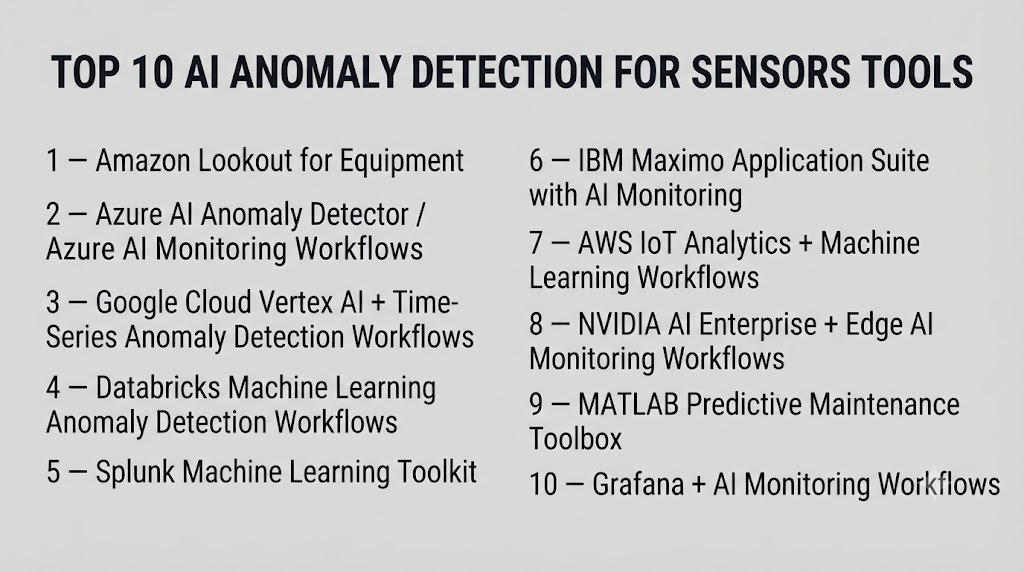
Top 10 AI Anomaly Detection for Sensors Tools
#1 — Amazon Lookout for Equipment
One-line verdict: Best for industrial organizations using AI to detect equipment anomalies from sensor data.
Short description (2–3 lines):
Amazon Lookout for Equipment is a machine learning service designed to help organizations analyze industrial equipment sensor data and identify potential abnormal behavior.
It supports predictive maintenance workflows by detecting patterns that may indicate equipment issues.
Standout Capabilities
- Industrial sensor monitoring
- Machine learning anomaly detection
- Equipment health analysis
- Predictive maintenance support
- Time-series data analysis
- Automated anomaly identification
- Operational insights
AI-Specific Depth (Must Include)
- Model support: Uses machine learning models provided through the service.
- RAG / knowledge integration: Not typically applicable for sensor anomaly detection workflows.
- Evaluation: Supports anomaly detection evaluation based on sensor data patterns.
- Guardrails: Depends on operational implementation and human review processes.
- Observability: Monitoring depends on connected cloud services and workflows.
Pros
- Designed for industrial sensor scenarios.
- Reduces manual equipment monitoring effort.
- Supports predictive maintenance workflows.
Cons
- Focused mainly on equipment-related use cases.
- Requires quality sensor data.
- Cloud dependency may not suit all environments.
Security & Compliance
Security capabilities depend on cloud configuration. Specific certifications vary.
Deployment & Platforms
- Platforms: Cloud-based environments.
- Deployment: Cloud.
Integrations & Ecosystem
Supports:
- IoT systems
- Sensor data pipelines
- Industrial applications
- Cloud analytics workflows
- Machine learning environments
Pricing Model
Usage-based and varies.
Best-Fit Scenarios
- Industrial equipment monitoring
- Predictive maintenance
- Manufacturing analytics
#2 — Azure AI Anomaly Detector / Azure AI Monitoring Workflows
One-line verdict: Best for organizations building scalable anomaly detection solutions using cloud AI services.
Short description (2–3 lines):
Azure AI anomaly detection workflows help organizations identify unusual patterns in time-series and operational data.
They support applications that require automated monitoring and predictive insights.
Standout Capabilities
- Time-series anomaly detection
- AI-based monitoring
- Real-time analytics workflows
- Cloud integration
- Automated alerts
- Data analysis
- Predictive monitoring
AI-Specific Depth (Must Include)
- Model support: Uses AI and machine learning capabilities available through the platform.
- RAG / knowledge integration: Depends on connected data architecture.
- Evaluation: Supports anomaly detection evaluation workflows.
- Guardrails: Depends on application governance.
- Observability: Depends on configured monitoring services.
Pros
- Scalable cloud architecture.
- Flexible integration options.
- Suitable for enterprise applications.
Cons
- Requires cloud expertise.
- Configuration complexity varies.
- Requires appropriate sensor data quality.
Security & Compliance
Security capabilities depend on cloud configuration. Specific certifications vary.
Deployment & Platforms
- Platforms: Cloud environments.
- Deployment: Cloud and hybrid options vary.
Integrations & Ecosystem
Supports:
- IoT platforms
- Data services
- Analytics systems
- Machine learning workflows
- Enterprise applications
Pricing Model
Usage-based and varies.
Best-Fit Scenarios
- Enterprise sensor monitoring
- IoT analytics
- Operational intelligence
#3 — Google Cloud Vertex AI + Time-Series Anomaly Detection Workflows
One-line verdict: Best for teams creating customized AI anomaly detection systems with cloud machine learning.
Short description (2–3 lines):
Google Cloud Vertex AI provides machine learning capabilities that organizations can use to develop anomaly detection and predictive analytics solutions.
It supports teams building customized AI workflows for sensor and operational data.
Standout Capabilities
- Machine learning development
- Time-series analytics
- Custom anomaly detection models
- Data processing workflows
- AI model management
- Prediction pipelines
- Cloud scalability
AI-Specific Depth (Must Include)
- Model support: Supports machine learning models and AI workflows depending on configuration.
- RAG / knowledge integration: Depends on connected data systems.
- Evaluation: Supports model evaluation and performance analysis.
- Guardrails: Depends on implemented AI governance controls.
- Observability: Depends on monitoring configuration.
Pros
- Flexible AI development environment.
- Supports customized anomaly detection.
- Strong cloud ecosystem.
Cons
- Requires technical expertise.
- Not a dedicated sensor monitoring product.
- Implementation requires planning.
Security & Compliance
Security capabilities depend on cloud configuration. Specific certifications vary.
Deployment & Platforms
- Platforms: Cloud-based environments.
- Deployment: Cloud and hybrid options vary.
Integrations & Ecosystem
Supports:
- IoT systems
- Data platforms
- Machine learning pipelines
- Analytics applications
- Cloud infrastructure
Pricing Model
Usage-based and varies.
Best-Fit Scenarios
- Custom anomaly detection
- Enterprise AI projects
- Sensor analytics platforms
#4 — Databricks Machine Learning Anomaly Detection Workflows
One-line verdict: Best for enterprises analyzing massive sensor datasets with scalable AI and data engineering workflows.
Short description (2–3 lines):
Databricks provides a unified data and AI platform that supports large-scale data processing, machine learning, and analytics workflows for sensor anomaly detection.
It helps organizations build customized monitoring solutions using historical and streaming sensor data.
Standout Capabilities
- Large-scale sensor data processing
- Machine learning workflows
- Streaming analytics
- Feature engineering
- Predictive maintenance workflows
- Data pipeline automation
- AI model management
AI-Specific Depth (Must Include)
- Model support: Supports machine learning frameworks and AI models depending on configuration.
- RAG / knowledge integration: Depends on connected data systems and application architecture.
- Evaluation: Supports model evaluation and monitoring workflows.
- Guardrails: Governance depends on implementation and organizational policies.
- Observability: Monitoring depends on configured tools and integrations.
Pros
- Handles large sensor datasets.
- Flexible AI development environment.
- Supports enterprise-scale analytics.
Cons
- Requires technical expertise.
- Complex for smaller teams.
- Implementation requires planning.
Security & Compliance
Security capabilities depend on deployment configuration. Specific certifications vary.
Deployment & Platforms
- Platforms: Cloud environments.
- Deployment: Cloud and hybrid options vary.
Integrations & Ecosystem
Supports:
- IoT platforms
- Data lakes
- Machine learning systems
- Streaming data pipelines
- Enterprise analytics platforms
Pricing Model
Usage-based and varies.
Best-Fit Scenarios
- Industrial IoT analytics
- Enterprise sensor monitoring
- Predictive maintenance systems
#5 — Splunk Machine Learning Toolkit
One-line verdict: Best for organizations detecting operational anomalies through machine data analytics.
Short description (2–3 lines):
Splunk provides data analytics and monitoring capabilities that help organizations analyze machine-generated data and identify unusual patterns.
It is commonly used for operational intelligence, monitoring, and security-related analytics.
Standout Capabilities
- Machine data analysis
- Event monitoring
- Anomaly detection workflows
- Operational analytics
- Alert management
- Data visualization
- Pattern identification
AI-Specific Depth (Must Include)
- Model support: Supports machine learning workflows through platform capabilities.
- RAG / knowledge integration: Depends on connected data sources.
- Evaluation: Supports monitoring and analytics evaluation workflows.
- Guardrails: Depends on security and operational policies.
- Observability: Strong focus on operational monitoring and analytics.
Pros
- Strong monitoring ecosystem.
- Useful for operational data analysis.
- Supports large-scale machine data workflows.
Cons
- Requires platform expertise.
- Not designed only for physical sensor analytics.
- Configuration can become complex.
Security & Compliance
Security capabilities depend on deployment configuration. Specific certifications vary.
Deployment & Platforms
- Platforms: Enterprise environments.
- Deployment: Cloud, hybrid, and self-managed options vary.
Integrations & Ecosystem
Supports:
- IT monitoring systems
- Machine data sources
- IoT environments
- Security platforms
- Enterprise applications
Pricing Model
Not publicly stated.
Best-Fit Scenarios
- Operational monitoring
- Machine data analytics
- Enterprise anomaly detection
#6 — IBM Maximo Application Suite with AI Monitoring
One-line verdict: Best for asset-heavy industries using AI-driven equipment monitoring and maintenance workflows.
Short description (2–3 lines):
IBM Maximo Application Suite supports asset management, maintenance operations, and AI-assisted monitoring workflows.
It helps organizations improve equipment reliability by analyzing operational and maintenance data.
Standout Capabilities
- Asset monitoring
- Predictive maintenance
- Equipment analytics
- Maintenance optimization
- Operational intelligence
- Workflow automation
- Asset lifecycle management
AI-Specific Depth (Must Include)
- Model support: AI capabilities depend on selected applications and integrations.
- RAG / knowledge integration: Depends on connected enterprise knowledge systems.
- Evaluation: Requires validation against operational outcomes.
- Guardrails: Depends on enterprise governance processes.
- Observability: Monitoring depends on deployment configuration.
Pros
- Strong asset management capabilities.
- Useful for industrial operations.
- Supports maintenance workflows.
Cons
- Enterprise-focused complexity.
- Requires implementation effort.
- Not suitable for simple sensor projects.
Security & Compliance
Security capabilities depend on deployment configuration. Specific certifications vary.
Deployment & Platforms
- Platforms: Enterprise environments.
- Deployment: Cloud, hybrid, and self-managed options vary.
Integrations & Ecosystem
Supports:
- Industrial assets
- IoT systems
- Maintenance platforms
- Enterprise applications
- Operational databases
Pricing Model
Not publicly stated.
Best-Fit Scenarios
- Manufacturing
- Energy operations
- Industrial asset monitoring
#7 — AWS IoT Analytics + Machine Learning Workflows
One-line verdict: Best for organizations processing IoT sensor data and building custom anomaly detection applications.
Short description (2–3 lines):
AWS IoT analytics workflows help organizations collect, process, and analyze sensor data from connected devices.
They support building custom monitoring and anomaly detection solutions using cloud infrastructure.
Standout Capabilities
- IoT data processing
- Sensor data analytics
- Streaming workflows
- Machine learning integration
- Device monitoring
- Data pipelines
- Cloud scalability
AI-Specific Depth (Must Include)
- Model support: Supports machine learning integrations depending on architecture.
- RAG / knowledge integration: Not typically applicable for sensor anomaly workflows.
- Evaluation: Depends on implemented ML evaluation processes.
- Guardrails: Depends on IoT security configuration.
- Observability: Supports monitoring through connected cloud services.
Pros
- Strong IoT ecosystem.
- Flexible architecture.
- Supports large sensor networks.
Cons
- Requires engineering expertise.
- Custom development may be required.
- Cloud costs need management.
Security & Compliance
Security capabilities depend on cloud configuration. Specific certifications vary.
Deployment & Platforms
- Platforms: Cloud and edge-connected environments.
- Deployment: Cloud and hybrid options vary.
Integrations & Ecosystem
Supports:
- IoT devices
- Sensor platforms
- Cloud storage
- Machine learning services
- Data pipelines
Pricing Model
Usage-based and varies.
Best-Fit Scenarios
- IoT monitoring
- Connected devices
- Custom sensor analytics
#8 — NVIDIA AI Enterprise + Edge AI Monitoring Workflows
One-line verdict: Best for organizations requiring AI-powered sensor analytics at edge and industrial environments.
Short description (2–3 lines):
NVIDIA AI Enterprise and edge AI workflows support organizations building accelerated AI applications for real-time data processing.
They are useful for sensor analytics, industrial monitoring, and AI inference workloads.
Standout Capabilities
- Edge AI processing
- Real-time inference
- AI model deployment
- Sensor analytics
- Accelerated computing
- Industrial AI workflows
- Computer vision integration
AI-Specific Depth (Must Include)
- Model support: Supports AI models through compatible frameworks and deployment environments.
- RAG / knowledge integration: Depends on application requirements.
- Evaluation: Requires model testing and performance validation.
- Guardrails: Depends on AI application design.
- Observability: Depends on monitoring tools and infrastructure.
Pros
- Strong edge AI capabilities.
- Supports low-latency processing.
- Useful for industrial applications.
Cons
- Requires specialized infrastructure.
- Higher technical complexity.
- Hardware requirements may vary.
Security & Compliance
Not publicly stated.
Deployment & Platforms
- Platforms: Edge, cloud, and enterprise environments.
- Deployment: Hybrid and self-managed options.
Integrations & Ecosystem
Supports:
- Edge devices
- AI frameworks
- Industrial systems
- IoT environments
- Accelerated computing platforms
Pricing Model
Varies depending on deployment.
Best-Fit Scenarios
- Edge sensor monitoring
- Industrial AI
- Real-time anomaly detection
#9 — MATLAB Predictive Maintenance Toolbox
One-line verdict: Best for engineers developing sensor analytics and predictive maintenance models.
Short description (2–3 lines):
MATLAB Predictive Maintenance Toolbox provides engineering-focused capabilities for analyzing sensor data, building models, and detecting abnormal equipment behavior.
It is commonly used for simulation, analytics, and maintenance prediction workflows.
Standout Capabilities
- Sensor data analysis
- Predictive maintenance
- Signal processing
- Machine learning models
- Feature extraction
- Engineering analytics
- Model testing
AI-Specific Depth (Must Include)
- Model support: Supports machine learning workflows and custom models.
- RAG / knowledge integration: Requires external implementation.
- Evaluation: Supports model testing and performance analysis.
- Guardrails: Depends on engineering workflow design.
- Observability: Requires additional monitoring systems.
Pros
- Strong engineering capabilities.
- Useful for technical teams.
- Supports complex sensor analysis.
Cons
- Requires specialized knowledge.
- Not a ready-made monitoring platform.
- Advanced workflows require development.
Security & Compliance
Not publicly stated.
Deployment & Platforms
- Platforms: Desktop and engineering environments.
- Deployment: Desktop, cloud, and enterprise options vary.
Integrations & Ecosystem
Supports:
- Engineering systems
- Simulation tools
- Sensor datasets
- Machine learning workflows
- Industrial applications
Pricing Model
Varies.
Best-Fit Scenarios
- Engineering analytics
- Predictive maintenance research
- Sensor modeling
#10 — Grafana + AI Monitoring Workflows
One-line verdict: Best for teams combining sensor visualization with monitoring and anomaly alerting workflows.
Short description (2–3 lines):
Grafana-based monitoring workflows help organizations visualize sensor data, track operational metrics, and create alerting systems.
AI capabilities can be added through integrations with analytics and machine learning systems.
Standout Capabilities
- Real-time dashboards
- Sensor visualization
- Alert management
- Data monitoring
- Metrics analysis
- Monitoring integrations
- Operational visibility
AI-Specific Depth (Must Include)
- Model support: Depends on connected AI and analytics systems.
- RAG / knowledge integration: Not typically applicable.
- Evaluation: Depends on connected anomaly detection models.
- Guardrails: Depends on monitoring configuration.
- Observability: Strong monitoring and visualization capabilities.
Pros
- Flexible monitoring platform.
- Strong visualization capabilities.
- Large integration ecosystem.
Cons
- AI anomaly detection requires additional components.
- Requires configuration.
- Not a dedicated AI sensor platform.
Security & Compliance
Not publicly stated.
Deployment & Platforms
- Platforms: Web-based dashboards.
- Deployment: Cloud and self-managed options.
Integrations & Ecosystem
Supports:
- Sensor databases
- Monitoring systems
- IoT platforms
- Analytics tools
- Alerting systems
Pricing Model
Open-source and enterprise options vary.
Best-Fit Scenarios
- Sensor monitoring dashboards
- Operational visibility
- Custom anomaly detection stacks
Comparison Table
| Tool Name | Best For | Deployment (Cloud/Self-hosted/Hybrid) | Model Flexibility (Hosted / BYO / Multi-model / Open-source) | Strength | Watch-Out | Public Rating |
|---|---|---|---|---|---|---|
| Amazon Lookout for Equipment | Industrial equipment anomaly detection | Cloud | Hosted ML workflows | Predictive maintenance | Industry-specific focus | N/A |
| Azure AI Anomaly Detection Workflows | Enterprise anomaly monitoring | Cloud/Hybrid | Hosted AI workflows | Scalable cloud monitoring | Requires cloud expertise | N/A |
| Google Cloud Vertex AI Workflows | Custom AI anomaly detection | Cloud/Hybrid | Multi-model/BYO options vary | Flexible AI development | Requires technical skills | N/A |
| Databricks ML Workflows | Large-scale sensor analytics | Cloud/Hybrid | Multi-model/Open-source integrations | Data + AI platform | Complex implementation | N/A |
| Splunk ML Toolkit | Operational machine data analytics | Cloud/Hybrid/Self-managed | Multi-model workflows | Monitoring ecosystem | Requires configuration | N/A |
| IBM Maximo AI Monitoring | Asset-intensive industries | Cloud/Hybrid | Enterprise AI integrations | Asset intelligence | Enterprise complexity | N/A |
| AWS IoT Analytics Workflows | IoT sensor analytics | Cloud/Hybrid | BYO model integrations | IoT scalability | Engineering effort required | N/A |
| NVIDIA AI Enterprise Edge Workflows | Edge AI monitoring | Edge/Cloud/Hybrid | Multi-model/BYO models | Low-latency AI processing | Hardware requirements | N/A |
| MATLAB Predictive Maintenance Toolbox | Engineering sensor analytics | Desktop/Cloud | Custom models | Engineering workflows | Technical expertise needed | N/A |
| Grafana AI Monitoring Workflows | Sensor visualization and monitoring | Cloud/Self-managed | Open-source integrations | Monitoring flexibility | Requires AI integrations | N/A |
Scoring & Evaluation (Transparent Rubric)
The following scoring compares AI Anomaly Detection for Sensors Tools based on detection capabilities, AI reliability, safety controls, integrations, usability, performance, security, and ecosystem maturity.
The evaluation is comparative rather than absolute. Different organizations may prioritize real-time detection, edge processing, industrial integrations, or enterprise governance depending on their operational requirements.
| Tool | Core | Reliability/Eval | Guardrails | Integrations | Ease | Perf/Cost | Security/Admin | Support | Weighted Total |
|---|---|---|---|---|---|---|---|---|---|
| Amazon Lookout for Equipment | 9 | 8 | 8 | 8 | 8 | 8 | 8 | 8 | 8.1 |
| Azure AI Anomaly Detection Workflows | 9 | 9 | 9 | 9 | 7 | 8 | 9 | 9 | 8.7 |
| Google Cloud Vertex AI Workflows | 9 | 9 | 9 | 9 | 7 | 8 | 9 | 9 | 8.7 |
| Databricks ML Workflows | 10 | 9 | 9 | 10 | 7 | 9 | 9 | 9 | 9.1 |
| Splunk ML Toolkit | 9 | 8 | 8 | 9 | 8 | 8 | 9 | 9 | 8.6 |
| IBM Maximo AI Monitoring | 9 | 8 | 8 | 9 | 7 | 8 | 9 | 8 | 8.3 |
| AWS IoT Analytics Workflows | 9 | 8 | 8 | 10 | 7 | 9 | 9 | 9 | 8.7 |
| NVIDIA AI Enterprise Edge Workflows | 9 | 9 | 8 | 9 | 6 | 9 | 8 | 9 | 8.4 |
| MATLAB Predictive Maintenance Toolbox | 8 | 9 | 8 | 8 | 7 | 8 | 8 | 9 | 8.1 |
| Grafana AI Monitoring Workflows | 8 | 8 | 7 | 10 | 9 | 9 | 8 | 9 | 8.5 |
Top 3 for Enterprise
1. Databricks ML Anomaly Detection Workflows
Best suited for enterprises managing large-scale sensor data, AI pipelines, and operational analytics.
2. Azure AI Anomaly Detection Workflows
A strong choice for organizations requiring scalable cloud monitoring and enterprise integration.
3. Google Cloud Vertex AI Workflows
Useful for organizations building customized AI anomaly detection applications.
Top 3 for SMB
1. Amazon Lookout for Equipment
Best for smaller industrial organizations needing predictive equipment monitoring.
2. Grafana AI Monitoring Workflows
Useful for teams requiring flexible monitoring dashboards and alerting.
3. MATLAB Predictive Maintenance Toolbox
Suitable for engineering teams developing sensor analytics solutions.
Top 3 for Developers
1. Databricks ML Workflows
Best for developers building large-scale sensor analytics and machine learning pipelines.
2. AWS IoT Analytics Workflows
Useful for developers creating custom IoT anomaly detection systems.
3. Grafana AI Monitoring Workflows
Good for developers building monitoring and observability solutions.
Which AI Anomaly Detection for Sensors Tool Is Right for You?
Solo / Freelancer
Independent engineers, researchers, and developers should prioritize:
- Easy setup
- Flexible experimentation
- Low infrastructure requirements
- Simple sensor analysis
Recommended options:
- MATLAB Predictive Maintenance Toolbox
- Grafana Monitoring Workflows
- Open-source monitoring solutions
Solo users should focus on tools that allow quick experimentation without requiring enterprise infrastructure.
Important considerations:
- Sensor data compatibility
- Development requirements
- Deployment complexity
- Maintenance effort
SMB
Small and medium businesses should focus on:
- Affordable monitoring
- Predictive maintenance
- Easy integration
- Operational improvements
Recommended options:
- Amazon Lookout for Equipment
- Grafana AI Monitoring Workflows
- MATLAB Predictive Maintenance Toolbox
SMBs should evaluate:
- Number of connected sensors
- Required response time
- Existing infrastructure
- Long-term scalability
The ideal platform should provide useful insights without creating unnecessary operational complexity.
Mid-Market
Growing organizations require better automation, monitoring, and integration capabilities.
Recommended options:
- Amazon Lookout for Equipment
- Splunk ML Toolkit
- Databricks ML Workflows
Important requirements:
- Centralized monitoring
- Automated alerts
- Data pipeline integration
- Model evaluation
- Operational reporting
Mid-market companies should create standardized sensor monitoring processes before expanding AI adoption.
Enterprise
Large organizations managing thousands of sensors require scalable AI systems with strong governance.
Recommended options:
- Databricks ML Workflows
- Azure AI Anomaly Detection Workflows
- AWS IoT Analytics Workflows
Enterprise buyers should prioritize:
- Large-scale sensor processing
- Security controls
- Real-time analytics
- Edge and cloud support
- Integration with existing systems
For enterprise environments, anomaly detection should become part of a complete operational intelligence strategy.
Regulated Industries (Finance / Healthcare / Public Sector)
Organizations managing sensitive operational or healthcare sensor data should focus on:
- Data privacy
- Auditability
- Access controls
- Explainable alerts
- Human validation
Recommended approach:
- Maintain monitoring records.
- Validate important alerts.
- Track model changes.
- Document detection decisions.
AI anomaly detection should support responsible monitoring while maintaining transparency.
Budget vs Premium
Budget Approach
Suitable for:
- Small teams
- Developers
- Research projects
Consider:
- Open-source monitoring tools
- Lightweight analytics platforms
- Developer frameworks
Advantages:
- Lower cost
- Greater customization
- Faster experimentation
Challenges:
- More technical management
- Limited enterprise controls
- Manual configuration
Premium Enterprise Approach
Suitable for:
- Industrial organizations
- Large IoT deployments
- Global operations
Advantages:
- Better scalability
- Enterprise integrations
- Advanced monitoring
- Governance capabilities
Challenges:
- Higher investment
- More implementation effort
Build vs Buy (When to DIY)
Build a custom AI sensor anomaly detection system when:
- Sensor types are highly specialized.
- Unique detection logic is required.
- Real-time edge processing is needed.
- Internal AI engineering resources are available.
Choose existing platforms when:
- Standard anomaly detection workflows are sufficient.
- Faster deployment is important.
- Operational teams need ready solutions.
A hybrid approach is often effective by combining existing monitoring platforms with custom AI models for specialized sensor environments.
Implementation Playbook (30 / 60 / 90 Days)
First 30 Days: Pilot + Success Metrics
The first phase should focus on understanding sensor behavior and testing AI detection workflows.
Key activities:
- Identify critical sensors.
- Select pilot equipment or systems.
- Collect historical sensor data.
- Define anomaly scenarios.
- Establish performance metrics.
AI-specific tasks:
- Test anomaly detection models.
- Compare AI alerts with real events.
- Measure false positives and missed detections.
- Evaluate detection quality.
Success metrics:
- Detection accuracy
- Alert response time
- Reduction in manual monitoring
- Maintenance improvement
- Operational visibility
First 60 Days: Security + Evaluation
The second phase focuses on improving reliability and operational adoption.
Key activities:
- Configure monitoring workflows.
- Establish alert rules.
- Train operational teams.
- Improve data pipelines.
AI-specific tasks:
- Evaluate model performance.
- Monitor false alerts.
- Analyze changing sensor patterns.
- Improve detection workflows.
Security improvements:
- Device access controls
- Data protection
- Monitoring permissions
- Audit tracking
First 90 Days: Optimization + Governance
The final phase focuses on scaling AI-powered sensor intelligence.
Key activities:
- Expand monitoring coverage.
- Integrate operational systems.
- Automate response workflows.
- Establish governance processes.
AI-specific improvements:
- Continuous model evaluation
- Automated retraining
- Drift monitoring
- Cost optimization
- Edge processing improvements
Organizations should build a sensor intelligence framework where AI improves operational awareness while teams maintain control over critical decisions.
Common Mistakes & How to Avoid Them
AI Anomaly Detection for Sensors Tools can help organizations detect failures, improve reliability, and optimize operations, but incorrect implementation can create unnecessary alerts, missed issues, and unreliable insights.
Below are common mistakes organizations should avoid:
- Using AI anomaly detection without enough historical data AI models require quality historical sensor information to understand normal operating behavior and identify meaningful deviations.
- Ignoring sensor data quality Faulty sensors, missing values, incorrect calibration, and inconsistent measurements can reduce anomaly detection accuracy.
- Treating every anomaly as a failure Not every unusual pattern represents a problem. Some anomalies may be caused by normal operational changes.
- Relying only on AI alerts without human review Critical operational decisions should include expert validation, especially in industrial and safety-sensitive environments.
- Using fixed thresholds for complex environments Traditional threshold monitoring may miss advanced patterns that AI-based systems can detect.
- Ignoring false positives and false negatives Too many incorrect alerts reduce trust, while missed anomalies can create operational risks.
- Skipping model evaluation Organizations should continuously measure detection accuracy, alert quality, and operational impact.
- Not monitoring sensor behavior changes Sensor environments evolve over time. AI models should be reviewed when equipment, processes, or operating conditions change.
- Ignoring edge processing requirements Some industries require low-latency decisions. Cloud-only approaches may not be suitable for every environment.
- Not considering cybersecurity risks Unusual sensor behavior may indicate operational issues or potential security problems.
- Failing to integrate with existing systems Anomaly detection becomes more valuable when connected with maintenance platforms, dashboards, ticketing systems, and operational workflows.
- Overlooking explainability Teams need to understand why an AI system generated an alert and what signals influenced the decision.
- Building unnecessary custom solutions Custom development may increase complexity when existing platforms already support required monitoring workflows.
- Ignoring cost management Large sensor networks can generate massive data volumes. Organizations should optimize storage, processing, and model usage.
FAQs
What is AI Anomaly Detection for Sensors?
AI Anomaly Detection for Sensors uses artificial intelligence and machine learning to identify unusual patterns in sensor data.
These systems help organizations detect equipment problems, operational issues, and unexpected behavior.
How does AI detect sensor anomalies?
AI models learn normal sensor behavior from historical and real-time data.
When new sensor readings differ significantly from expected patterns, the system can generate alerts.
What industries use AI sensor anomaly detection?
Common industries include:
- Manufacturing
- Energy
- Transportation
- Healthcare
- Automotive
- Telecommunications
- Smart infrastructure
- Industrial IoT
Can AI detect equipment failures before they happen?
Yes, AI anomaly detection can support predictive maintenance by identifying early warning signs.
However, predictions require quality data and proper validation.
What type of sensor data can AI analyze?
AI systems can analyze data from:
- Temperature sensors
- Pressure sensors
- Vibration sensors
- Industrial equipment sensors
- IoT devices
- Healthcare monitoring devices
- Environmental sensors
Is AI anomaly detection better than traditional monitoring?
AI can identify complex patterns that rule-based systems may miss.
However, traditional monitoring methods can still be useful for simple and predictable conditions.
Do AI anomaly detection systems work in real time?
Many platforms support real-time or near-real-time monitoring.
The actual response time depends on deployment architecture, sensor volume, and processing location.
Can AI anomaly detection run at the edge?
Yes. Some solutions support edge AI deployment where analysis happens closer to sensors and devices.
Edge processing helps reduce latency and bandwidth requirements.
How accurate are AI sensor anomaly detection systems?
Accuracy depends on:
- Data quality
- Sensor reliability
- Model selection
- Operating conditions
- Evaluation methods
Organizations should test models before production deployment.
Do AI anomaly detection tools support IoT devices?
Many platforms integrate with IoT environments and connected devices.
Capabilities depend on supported protocols, platforms, and deployment models.
Can AI anomaly detection reduce maintenance costs?
AI can help organizations identify issues earlier, optimize maintenance schedules, and reduce unexpected downtime.
Results depend on implementation quality and operational processes.
Are AI sensor monitoring platforms secure?
Security depends on the platform, deployment environment, and organizational controls.
Organizations should evaluate authentication, access management, encryption, and monitoring practices.
What is explainable anomaly detection?
Explainable anomaly detection provides information about why an event was flagged.
This helps teams understand AI decisions and take appropriate action.
Can AI detect cybersecurity-related sensor anomalies?
Yes. Unusual device behavior or unexpected data patterns can be analyzed as part of broader security monitoring workflows.
How much do AI Anomaly Detection for Sensors Tools cost?
Pricing varies depending on platform capabilities, sensor volume, deployment model, and usage requirements.
Exact pricing details are not publicly stated for many tools.
Should organizations build or buy AI anomaly detection systems?
Organizations should build custom systems when they have unique sensor environments, specialized requirements, or strong AI engineering capabilities.
Buying existing solutions is often better when faster deployment and operational simplicity are priorities.
Conclusion
AI Anomaly Detection for Sensors Tools are becoming important technologies for organizations managing connected devices, industrial systems, and real-time operational data. These platforms help teams move from reactive monitoring toward proactive detection, allowing problems to be identified earlier and addressed more efficiently.The best AI anomaly detection solution depends on the organization’s industry, sensor environment, data volume, response requirements, and technical capabilities. Industrial companies may prioritize predictive maintenance, while IoT teams may focus on real-time monitoring and edge processing.AI should be used as an intelligent monitoring assistant rather than a replacement for operational expertise. The strongest implementations combine AI detection with human review, reliable sensor infrastructure, continuous evaluation, and clear operational processes.Organizations adopting these tools should focus on data quality, model accuracy, explainability, security, scalability, and integration with existing systems.

Find Trusted Cardiac Hospitals
Compare heart hospitals by city and services — all in one place.
Explore Hospitals
An important operational aspect that could be discussed further is how AI anomaly detection models perform as sensor behavior changes over time. Factors such as sensor drift, calibration changes, environmental conditions, and hardware replacements can gradually reduce detection accuracy if models are not continuously monitored. Implementing automated model evaluation, feedback loops, periodic retraining, and human review for critical alerts helps minimize false positives and ensures anomaly detection systems remain dependable in long-term production environments.